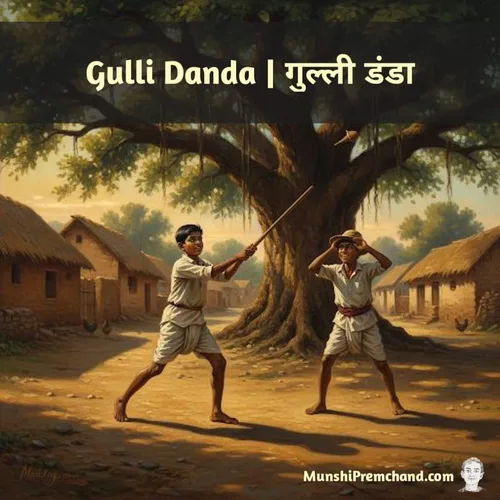
Complete English Translation: Gulli Danda (Tip-Cat)
Whether our English-educated friends agree or not, I will say without hesitation that gulli-danda is the king of all sports!
Even now, whenever I see young boys playing gulli-danda, my heart leaps with an irresistible urge to run out and join them. No lawn is required, no court, no net, no bat. You simply chop a branch from a tree, shape a wooden tip-cat (gulli), get hold of a stick (danda), and even if just two players show up, the game begins!
The biggest flaw in foreign English sports is that their equipment is outrageously expensive. Until you spend at least a hundred rupees, you aren't even counted among the players. Here, gulli-danda produces splendid results without costing a grain of myrobalan or alum! Yet we have become so infatuated with English imports that we have developed a distaste for all our own native things. In schools, every boy is charged three or four rupees annually as a mandatory sports fee. No one stops to think of encouraging Indian games, which can be played without costing a single broken cowrie! English sports are meant for those who possess wealth; why force this expensive addiction upon the heads of poor schoolboys?
True, they say that a flying gulli carries the risk of striking an eye; but does cricket carry no risk of fracturing a skull, rupturing a spleen, or breaking a leg? If the scar of a childhood gulli wound remains upon my forehead to this day, I also have several friends who traded their cricket bats for crutches! It is a matter of personal taste. To me, gulli-danda remains the finest of all games, and among the sweet memories of my childhood, gulli is the sweetest.
Ah, that morning routine of slipping out of the house, climbing trees to cut branches, carving gullis and dandas, that boundless enthusiasm, the gathering of players, the turns of batting and the drudgery of fielding, the petty squabbles, and above all, that simple, innocent spirit in which untouchability and the barrier between rich and poor ceased to exist! There was no room for aristocratic pretense, ostentation, or arrogance.
Those memories will leave me only when... when life itself departs!
At home, my parents would be furious. Father sat at his dining mat taking out his rage upon his rotis, while Mother's chase reached only as far as the front door—her mind tormented by visions of my ruined future floating like a shipwreck. But there I was, utterly lost in batting and fielding, caring neither for bath nor for food! The wooden gulli was small, yet it held within itself the sweetness of all the world's confections and the delight of all its spectacles!
Among my playmates was a boy named Gaya. He was two or three years older than me—lean, with long, thin, monkey-like fingers, a monkey's agility, and a quick temper. No matter how wildly the gulli flew, he would snatch it mid-air just as a gecko snaps up insects! I had no idea whether he had parents, where he lived, or what he ate; but he was the undisputed champion of our Gulli Club. Whichever side he joined was guaranteed victory. Whenever we caught sight of him approaching from afar, we would run out to welcome him and choose him as our partner.
One day, Gaya and I were playing alone. He was fielding and making me chase the gulli, while I had taken my turn batting. But it is a curious thing about gulli-danda—one can happily bat all day long, but fielding for even a single minute rankles like poison! I tried every trick in the book to wriggle out of my fielding turn—tricks that, though not strictly sanctioned by the rules of the game, are universally forgiven among boys on such occasions. But Gaya refused to let me off the hook without taking his full turn!
I turned and bolted toward home. My appeals and entreaties had produced no effect.
Gaya chased me down, caught hold of me, raised his stick, and shouted: "Give me my turn before you leave! You were very brave when you were batting—why are you running away now that it's your turn to field?"
"If you keep batting all day, am I supposed to keep fielding all day?"
"Yes! You will have to field all day!"
"Am I not allowed to go home to eat or drink?"
"No! You cannot go anywhere without giving me my turn!"
"Am I your slave?"
"Yes, you are my slave!"
"I am going home—let me see what you can do!"
"How can you go home? Is this a joke? You took your turn, now I'll take mine!"
"Fine! Yesterday I gave you a guava to eat. Return my guava first!"
"It went into my belly!"
"Pull it out of your belly! Why did you eat my guava?"
"You gave it to me, so I ate it! I didn't go begging you for it."
"Until you return my guava, I will not field for you!"
I genuinely believed that justice was entirely on my side. After all, I must have given him that guava out of some self-interest—who ever treats another without self-interest? Even alms are given out of self-interest! Since Gaya had eaten my guava, what right did he have to demand a fielding turn from me? People swallow murder after taking a bribe—was he going to digest my guava for free? Those guavas cost a pice for five—something Gaya's father could never have afforded in his life! It was blatant, monstrous injustice.
Gaya dragged me toward him, shouting: "Give me my turn! I know nothing about your guava-suava!"
I had the moral strength of justice; he was obstinately digging in his heels on injustice. I struggled to break free and flee, but he wouldn't let me go! I hurled an insult at him; he hurled a sharper insult back—and not just an insult, he delivered a hard slap across my face! I sank my teeth deep into his arm. He brought his wooden stick down upon my back with a sharp crack!
I burst into loud wailing! Gaya had no defense against this ultimate weapon of mine. I instantly wiped my tears, forgot the pain of the stick, and ran home smiling! That I—a police inspector's son—had been thrashed by a low-caste boy felt humiliating even then; but I complained to no one at home.
Shortly after that incident, my father was transferred from that town.
In my excitement to behold a new world, I was so elated that I felt not the slightest grief at parting from my playmates. My father was unhappy—it was a lucrative posting with large under-the-table earnings. My mother was grieved too—everything was cheap there, and she had grown deeply attached to the neighborhood women. But I could scarcely contain my joy! I bragged to the local boys: "City houses aren't like these mud huts! They have multi-story buildings that touch the sky! In the English school there, if a master dares strike a student, he gets sent to prison!"
My friends' wide eyes and astonished expressions revealed how much envy they felt toward me. They seemed to say: You are fortunate, brother—go! As for us, we must live and die in this desolate village.
Twenty years passed away.
I passed my engineering examinations and, while on an inspection tour of that very district, arrived at the township and stayed at the government inspection bungalow.
The moment I saw the place, such sweet childhood memories flooded my heart that I picked up my walking stick and set out to explore the town. My eyes longed like a thirsty traveler to behold those childhood playgrounds; but except for the familiar name, nothing else remained recognizable. Where mud ruins once stood, solid brick houses had risen. Where the ancient banyan tree had spread its shade, a manicured garden now stood. The place had undergone a complete transformation! Had I not known its name and location, I could never have recognized it.
The stored, immortal memories of childhood were opening their arms, impatient to embrace those old comrades; but that old world had vanished. My heart yearned to throw myself upon that earth, weep, and say: Have you forgotten me? I still yearn to behold your old, familiar face!
Suddenly, in an open clearing, I caught sight of two or three young boys playing gulli-danda. For a single moment, I completely forgot who I was. I forgot that I was a high government officer, wrapped in the grandeur of an English gentleman, clad in the armor of authority and prestige!
I walked over to one of the boys and asked: "Tell me, son, does a man named Gaya live around here?"
The boy gathered up his gulli and danda, and asked in a frightened, hesitant voice: "Which Gaya? Gaya the Chamar?"
I replied casually: "Yes, yes, that very one. Is there a man named Gaya? Perhaps it is he."
"Yes, he is here."
"Can you call him here for a moment?"
The boy ran off, and in a moment appeared escorting a towering, dark-skinned giant of five cubits. I recognized him from a distance! I wanted to leap forward and throw my arms around his neck, but something held me back.
I said: "Well, Gaya, do you recognize me?"
Gaya bowed low and offered a humble salaam: "Yes, Sarkar! How could I fail to recognize you? Are you keeping well?"
"Very well indeed. Tell me about yourself."
"I am a syce in the service of the Deputy Sahib."
"Where are Matai, Mohan, and Durga? Any news of them?"
"Matai has passed away; Durga and Mohan have both become postmen. And you, Sarkar?"
"I am the District Engineer."
"Sarkar was always exceptionally brilliant!"
"Do you ever play gulli-danda these days?"
Gaya looked at me with questioning, bewildered eyes: "How could I play gulli-danda now, Sarkar? I never get a moment's respite from my chores."
"Come, let us two play today! You bat, and I will field. You have one turn of fielding owed to you by me from our childhood. Take it back today!"
Gaya agreed with immense difficulty. He was a two-pice daily laborer; I was a high-ranking officer. What match was there between us? The poor fellow was overcome with embarrassment. But I was feeling no less embarrassed myself—not because I was going to play with Gaya, but because people would consider it a bizarre spectacle, and a massive crowd would gather. In such a crowd, where would the joy remain? Yet without playing, my heart could not be satisfied.
At last, it was decided that we would play far away from the settlement, where we could savor that sweet confection of childhood in seclusion. I brought Gaya to the inspection bungalow, and both of us climbed into my motorcar and drove out toward the open countryside. We took an axe along with us. I wore a grave, solemn expression, while Gaya still treated the whole affair as a practical joke. Even so, there was not a trace of eagerness or joy upon his countenance. Perhaps he was lost in contemplating the vast chasm that had opened between us.
I asked: "Did you ever remember me, Gaya? Tell me the truth."
Gaya answered bashfully: "Why would I remember you, Huzoor? What standing did I have? It was my good fortune that I was destined to play with you for a few days; otherwise, what was my worth?"
I said with a touch of sadness: "But I remembered you constantly. That stick you raised and struck across my back—do you remember it?"
Gaya said with deep regret: "That was childhood folly, Sarkar! Please do not remind me of it."
"Nonsense! That is the sweetest, most delicious memory of my boyhood! The juice that was in your stick—I find it neither in wealth nor in high honors today."
By that time, we had traveled about three miles outside the town. Complete silence reigned on all sides. To the west, the great lake of Bhimtal stretched for miles, where long ago we used to pluck lotus blossoms and wear them as earrings. A summer twilight dipped in saffron was rolling across the sky. I leaped out, climbed a roadside tree, and chopped off a sturdy branch. In a trice, a gulli and danda were carved.
The game began. I placed the gulli across the hole and flicked it into the air. The gulli flew past Gaya. He lunged with his hands, as if catching a fish. The gulli landed behind him.
This was that very same Gaya into whose palms the gulli used to fly and seat itself as if by magic! Whether he was to the right or left, the gulli invariably landed in his palm, as though he had cast an enchantment over it. New gullis, old gullis, tiny gullis, large gullis, pointed gullis, blunt gullis—all of them were friends with him. It was as if his hands held a magnet that drew every gulli to itself; but today, the gulli seemed to have lost its love for him.
Then I began batting. I resorted to every conceivable form of cheating! I made up for my lack of practice with outright dishonesty. Even when I swung and missed the gulli completely, I continued to play with the stick, although according to the sacred scriptures of the game, Gaya's turn should have commenced. If I struck a weak blow and the gulli fell a short distance away, I would rush forward, snatch it up myself, and strike it again. Gaya watched all these flagrant violations of the rules; yet he uttered not a word, as if he had forgotten every law and convention of the sport.
And his aim had once been so unerring! When the gulli left his hand, it would strike the stick with a resounding clack! Leaving his hand, its sole duty had been to crash into the stick; but today, his gulli failed to hit the stick even once! Sometimes it flew to the right, sometimes to the left, sometimes too far forward, sometimes too short.
After half an hour of fielding, one of his throws finally struck my stick.
I cheated shamelessly: "The gulli didn't hit the stick! It passed very close, but it didn't touch."
Gaya showed not the slightest discontent: "It must not have hit."
"If it had hit, would I cheat?"
"No, brother, why would you cheat?"
In childhood, had I dared to pull off such a brazen fraud, Gaya would have jumped upon my neck! But today, I was fooling him with utter ease. What a simpleton he is! He has forgotten everything!
Suddenly, the gulli struck my stick again—and struck it with such tremendous force that it rang out like a gunshot! Even I lacked the brazen courage to deny such overwhelming proof; yet I thought to myself: Why not attempt lying one more time? What do I have to lose? If he accepts, wonderful; if not, I will field for two or three throws, make an excuse about the dark, and end the game. Who comes back to pay a fielding debt anyway?
Gaya cried out in quiet triumph: "It hit! It hit! It rang out loud and clear!"
I pretended ignorance: "Did you see it hit? I didn't see it."
"It rang out with a loud ton, Sarkar!"
"What if it struck a brick on the ground?"
How those words escaped my mouth at that moment, I wonder at myself even today! To deny such an obvious truth was like calling broad daylight night. Both of us had seen and heard the gulli crash into the stick with full force; yet Gaya quietly accepted my lie:
"Yes, it must have hit a brick. Had it hit the stick, it wouldn't have made such a sound."
I resumed batting once more. But after pulling off such blatant, shameless dishonesty, Gaya's gentle simplicity began to arouse a feeling of pity within me. Therefore, when the gulli struck my stick for the third time, I displayed grand generosity and agreed to yield my turn.
Gaya said: "It has grown dark now, brother. Let us leave it for tomorrow."
I thought to myself: Tomorrow he will have plenty of time and might make me field for hours! It is far better to settle the score right now.
"No, no! There is plenty of light left. Take your turn now."
"I won't be able to see the gulli."
"It doesn't matter!"
Gaya took the stick and prepared to bat; but he seemed to have lost all practice. He swung twice, but missed the gulli both times. In less than a minute, he lost his turn!
I displayed the boundless magnanimity of my heart: "Take another turn! You missed on your very first attempt."
"No, brother, it has grown dark."
"You have lost your practice. Don't you ever play?"
"Where is the time to play, brother?"
We climbed into the motorcar and returned to the campsite just as the evening lamps were being lit.
As he was leaving, Gaya said: "Tomorrow there will be a gulli-danda match here. All the old players will participate. Will you come? Whenever you are free, I will summon the players."
I set the time for the following evening, and the next day I went to watch the match.
A circle of about ten men had gathered—several of them turned out to be my childhood playmates, while most were younger men whom I could not recognize. The game began. I sat in my motorcar, watching the spectacle.
Today, as I watched Gaya play, his extraordinary skill left me utterly spellbound! When he struck the gulli, it soared high into the clouds! There was none of yesterday's hesitation, none of that shyness, none of that listless indifference today. The raw talent of his boyhood had matured into absolute mastery! Had he made me field like this yesterday, I would have broken down in tears. Under the ferocious strike of his stick, the gulli flew two hundred yards away!
During the match, one of the younger fielding players attempted a slight deception. In his opinion, he had caught the gulli mid-air. Gaya insisted that the gulli had bounced off the ground first. A fierce argument broke out, and both men were on the verge of coming to blows. But the young man backed down—terrified by the fiery, blazing fury on Gaya's face. Had he not yielded, a violent brawl would have been inevitable.
I was not participating in the game; yet watching others play gave me that very same pure, uninhibited joy of boyhood, when we forgot the entire world and lost ourselves in the match.
And then, the bitter truth dawned upon me!
Yesterday, Gaya had not played with me—he had merely put on a show of playing! He had regarded me as an object of pity. I had cheated, I had lied, I had violated every rule of the game; yet he had shown not a flicker of anger. Why? Because he was not playing a game—he was merely entertaining me, humoring me, accommodating my fragile ego! He did not want to crush me by making me chase the gulli until I collapsed.
I am an officer now. This official status has become an unbridgeable wall between us!
I can command his formal deference now; I can receive his humble salaams; but I can never regain his equal companionship. In childhood, I was his equal. Having acquired this high rank, I have become merely an object of his mercy!
He no longer considers me his match.
He has grown big; I have become small.
Summary of Gulli Danda (Tip-Cat)
Gulli Danda ("Tip-Cat") is one of Munshi Premchand's most celebrated and poignant short stories, combining nostalgic boyhood reminiscence with an incisive social critique of class, caste, and the psychological alienation produced by colonial administrative prestige (afsaari).
The narrative unfolds in three distinct movements:
- The Defense of Native Sport: The narrator opens with a spirited philosophical defense of gulli-danda as the "king of all sports." Unlike expensive, elitist British games like cricket, tennis, or hockey—which require costly equipment, maintained grounds, and heavy school sports fees—gulli-danda is completely free, democratic, and accessible to every poor village child. Above all, it creates a space of pure social equality where caste, wealth, and status vanish.
- Childhood Rivalry and Departure: The narrator recalls his childhood playmate Gaya, an impoverished low-caste boy who was the undisputed champion of their village gulli club. During a match, the narrator—the pampered son of a police inspector—cheats to avoid fielding. When Gaya insists on his rightful turn, a fight ensues: the narrator bites Gaya's arm, and Gaya cracks his stick across the narrator's back. Before Gaya can claim his turn, the narrator's father is transferred, and the family leaves the village.
- The Adult Reunion: Twenty years later, the narrator returns to the town as the high-ranking District Engineer (Zila Engineer). Nostalgic for his youth, he tracks down Gaya, who has become an impoverished syce (horse-groom) working for a deputy magistrate. The narrator invites Gaya to drive into the secluded countryside in his motorcar to finally settle the twenty-year-old game.
- The False Match and the Revelation: During their game, Gaya plays listlessly, missing simple catches and failing to strike the stick. The narrator cheats repeatedly, lying about misses and hits, and Gaya meekly accepts every lie without protest. The narrator arrogantly assumes Gaya has grown dull and forgotten how to play. However, the next evening, the narrator watches from his car as Gaya plays in a village match against his peers. Gaya plays with breathtaking brilliance, soaring power, and fierce competitiveness, nearly coming to blows with an opponent who attempts to cheat. The narrator is struck by a crushing moral revelation: Gaya had deliberately lost the previous day to humor his former playmate's fragile ego. The narrator's high official rank has erected an insurmountable barrier between them. He can receive Gaya's polite subservience, but never his equal friendship. The story concludes with the famous, bittersweet inversion: "He has grown big; I have become small."
Publication History
Gulli Danda ("Tip-Cat") was written by Munshi Premchand in 1933 and first published in contemporary Hindi periodicals before being anthologized in Part 1 of his renowned collection Mansarovar (मानसरोवर, भाग 1).
The story is universally recognized as one of the crown jewels of modern Indian literature. It is widely taught across school and university curricula throughout South Asia for its effortless narrative charm, autobiographical warmth, and devastatingly subtle exposure of how adult social hierarchies corrupt human relationships.
This unabridged English translation was published in 2026 by MunshiPremchand.com as part of the MunshiPremchand.com English Translation Series.
Themes & Critical Significance
1. The Loss of Childhood Equality
The core theme of Gulli Danda is the irrecoverable loss of innocence and social equality. In boyhood, the playground operates as an egalitarian sanctuary where skill alone dictates hierarchy. Gaya, though poor and low-caste, commands natural authority as the champion, while the police inspector's son must field like anyone else. In adulthood, however, institutional hierarchies of caste, wealth, and colonial bureaucratic power destroy this innocence, replacing spontaneous fraternity with frozen deference.
2. The Critique of Colonial Elitism and Expensive Sports
Premchand uses the contrast between gulli-danda and English sports to critique colonial cultural hegemony. Western sports impose financial burdens on poor students and instill an inferiority complex toward indigenous culture. In contrast, gulli-danda represents self-reliance, physical vigor, and genuine communal joy, needing only a pocketknife and a fallen branch.
3. The Irony of "Greatness" (Afsaari vs. Moral Nobility)
The story's climax hinges on a profound philosophical reversal. The narrator believes that his engineering degree, motorcar, and government authority make him superior to the illiterate horse-groom. Yet Gaya's deliberate indulgence of the narrator's petty cheating reveals a moral magnanimity and psychological sensitivity far superior to the narrator's childish vanity. By treating the engineer like a child who must not be made to cry, the poor laborer demonstrates true greatness, leaving the colonial officer feeling diminished and morally small.
4. Caste, Deference, and the "Courteous Mask"
Premchand provides a masterclass in subaltern psychology. Gaya's meekness during the private match is not ignorance, but a protective mask worn by the marginalized when dealing with state power. Gaya understands that the state engineer cannot handle the rough-and-tumble equality of a low-caste laborer's stick. True self-expression is possible for Gaya only among his social equals, where he can unleash his athletic power and righteous anger without fear of administrative retribution.