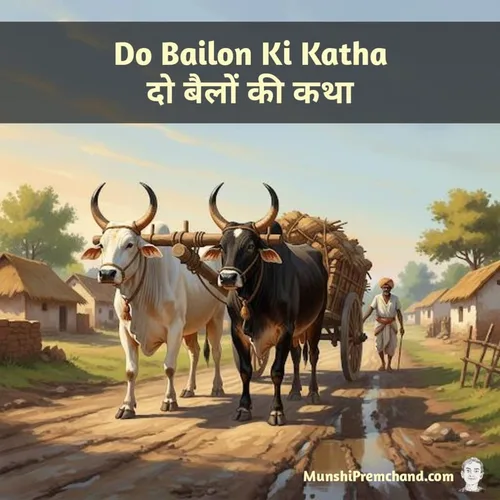
Complete English Translation: Do Bailon Ki Katha (A Tale of Two Bullocks)
Part I
Among all animals, the donkey is considered the most devoid of intellect. Whenever we wish to designate a human being as a fool of the first water, we call him a donkey.
Whether the donkey is truly a fool, or whether his guileless simplicity and harmless, uncomplaining tolerance have earned him that unflattering title, is difficult to decide with certainty. Cows will thrust with their horns; a newly calved cow transforms spontaneously into a ferocious lioness. Even the dog is a mild, humble creature, yet occasionally even he loses his temper. But no one has ever seen or heard a donkey grow angry. Beat the poor fellow as much as you like, throw moldy, putrid straw before him, and not a shadow of discontent will ever darken his face. In the month of Vaisakh, he might occasionally frolic in the dust; yet we have never seen him genuinely happy. A permanent melancholic gloom hangs perpetually over his countenance. In joy or sorrow, profit or loss, under no condition has he ever been seen to change his disposition.
All the austere virtues of ancient ascetics and sages have reached their supreme pinnacle in the donkey; yet man dismisses him as an utter fool! Nowhere else in this universe are moral virtues treated with such boundless disrespect.
Perhaps absolute simplicity and forbearance are unsuited for this worldly life. Look at what is happening to the natives of India in South Africa! Why are they barred from entering America? The poor fellows do not touch liquor, they scrupulously save four copper coins for a rainy day, they work themselves to the bone, they pick quarrels with no one, and when insulted with harsh words, they quietly swallow their grief—yet they are universally reviled! It is said that they lower the standard of living. If they had only learned to return a brick with a stone, they might have been hailed as 'civilized.' Look at Japan—a single military victory elevated that nation into the front ranks of the world’s civilized powers!
However, the donkey has a younger brother who is only slightly less of an ass than he, and that is the bullock. In the same sense that we use the word 'donkey' to insult someone, we also employ the idiom 'the uncle of the heifer' (bachhiya ke taau). Some people might rank the bullock at the very pinnacle of stupidity; but our opinion is otherwise. A bullock occasionally butts; at times, a stubborn bullock refuses to budge from the furrow; and in various other ways, he makes his displeasure known. Therefore, his rank in foolishness is slightly lower than that of the donkey.
The two bullocks belonging to Jhuri the farmer were named Heera and Moti. Both were of the sturdy Pachhain breed—magnificent to look at, diligent in labor, and tall of stature.
Having lived together for years, a deep fraternal bond had grown between them. Sitting side by side or facing each other, they carried on an exchange of thoughts in their silent, unspoken tongue. How one deciphered the secret thoughts of the other’s mind, we cannot explain; but undoubtedly they possessed some hidden spiritual faculty of which man, despite his proud boast of being the crown of creation, is utterly deprived.
They expressed their deep love by sniffing and licking each other’s coats. Occasionally they would even lock their horns together—not in hostility, but out of pure playfulness and affection, exactly as bosom friends engage in hearty bouts of wrestling and mutual shoving. Without such playful tussles, friendship remains somewhat bland, shallow, and fragile, incapable of sustaining deep trust.
Whenever these two bullocks were yoked together to the plow or the cart and strode forward swaying their necks, each made it his supreme endeavor that the heavier burden of the load should press upon his own neck. In the evening or at noon, when unyoked after a grueling day's labor, they would lick each other from ears to flanks to soothe away their exhaustion. When crushed mustard cake and dry chopped straw were poured into the common feeding trough, both would rise together, bury their muzzles into the trough side by side, and lie down to chew the cud at the same moment. If one pulled his snout out of the trough, the other instantly withdrew his as well.
By an unfortunate turn of fate, Jhuri once sent the pair of bullocks to his in-laws' village with his brother-in-law, Gaya. The animals had no conception of why they were being dispatched away from home; they assumed that their master had sold them. Whether this supposed sale pleased them or grieved them, who can tell? But it cost Gaya sweat and tears to drag the pair to his village!
If he tried to urge them from behind, both would bolt sideways into the ditches; if he gripped their halters and pulled them from the front, both would dig their hooves into the earth and haul backward with all their might. If he struck them with a stick, both would lower their horns, snort, and rumble fiercely.
If God had gifted them human speech, they would have questioned Jhuri: Why are you casting us poor wretches out of your house? We left no stone unturned in your service! If the hard labor we gave was not enough, you could have demanded double work from us! We would have gladly died in your service! We never raised a single complaint about our feed or fodder; whatever you placed before us, we ate with bowed heads. Then why have you sold us into the hands of this cruel tyrant?
By nightfall, the two bullocks arrived at their new home. They were famished after the long, grueling march, but when they were tethered to the manger, neither buried his snout into the straw. Their hearts were heavy as stone. The home they had considered their own since birth was torn from them today. This new house, this unfamiliar village, these strange men—everything appeared alien and hostile.
The two friends consulted each other in their silent tongue, glanced sideways at each other, and lay down in the dark. When the village had fallen into deep slumber, both strained against their tethers with tremendous power, snapped their thick halters, and galloped straight for home! The halters were exceptionally thick and strong; no one could have dreamed that a bullock could snap them. But at that moment, double strength surged through their limbs. With a single violent jerk, the ropes parted like thread.
When Jhuri awoke at dawn, he was astonished to see both bullocks standing at their familiar feeding trough! Halves of the broken ropes hung from their necks, their legs were caked with mud up to their knees, and their eyes glowed with a mixture of affectionate love and fierce rebellion.
Jhuri was overwhelmed with tender emotion. He ran forward and embraced both animals, kissing their foreheads. That scene of mutual love, joyful reunions, and affectionate caresses was wondrous to behold!
The village children gathered in a cheerful crowd, clapping their hands in celebration. Although such an escape was not unprecedented in rural history, it was an event of great significance. The children's council resolved that these two animal heroes must be presented with an address of honor! One boy brought chapatis from his house, another brought raw jaggery, another brought wheat bran, and another brought chopped husk.
One boy remarked: "No one in the district has bullocks like these!"
Another agreed: "They came all this long distance by themselves, without losing their way!"
A third declared: "They are not mere animals—they were noble men in their past lives!"
No one possessed the courage to dispute this verdict.
Just then, Jhuri’s wife stepped out into the courtyard. Seeing the runaway bullocks standing at the door, she flared up in fury: "What treacherous, ungrateful beasts! They could not even perform a single day's labor there, and ran away!"
Jhuri could not endure this unfair aspersion cast upon his darlings: "Why call them ungrateful? He must not have fed them proper grain and fodder—what else were they to do?"
His wife retorted haughtily: "Oh yes, indeed! As if you are the only man on earth who knows how to feed cattle, while everyone else keeps them alive on well water alone!"
Jhuri teased: "If they had received proper feed, why would they run away?"
She snapped with rising venom: "They ran because people over there do not pamper animals like you fools do! When they feed them, they make them grind at the plow too! These two are lazy slackers who bolted at the first taste of work! Now let me see where they get oil-cake and bran! I shall give them nothing but bone-dry straw—let them eat it or starve to death!"
And that was precisely what was done. The domestic farmhand was given strict, menacing orders: feed the bullocks nothing but dry straw!
When the two friends dipped their muzzles into the trough, the straw tasted dry and insipid—neither oil, nor grain, nor flavor! How could they stomach it? They gazed toward the door with piteous, pleading eyes.
Jhuri whispered to the farmhand: "Why don't you toss in a handful of oil-cake on the sly, boy?"
"The mistress will skin me alive, master!"
"Do it quietly, without her knowing."
"No, Dada! Later on, you too will take her side and leave me to suffer!"
Part II
The very next morning, Jhuri’s brother-in-law, Gaya, reappeared at the farm and led the bullocks away once more. This time, he yoked them both to a heavy bullock cart.
Along the road, Moti attempted two or three times to plunge the cart into the roadside ditch; but Heera steadied the yoke and pulled it out. Heera was inherently more patient and tolerant.
Reaching his village at dusk, Gaya tied the two bullocks with thick, heavy ropes, determined to teach them a lesson for their mischief. Then he threw the same dry, tasteless straw before them, while he generously served his own bullocks crushed mustard cake, gram, and bran.
The two friends had never endured such bitter insult in their lives. Jhuri had never touched their backs even with a twig; at his mere whistle, both would fly like the wind across the fields. Here, they were brutally thrashed with cudgels! Added to the acute anguish of wounded pride was the misery of dry straw. They did not even deign to look toward the manger.
The next morning, Gaya yoked them to the plow. But the two friends seemed to have taken a solemn vow never to lift a single hoof! Gaya beat them mercilessly until his arms ached; but neither bullock would take a step forward. When the cruel wretch lost his temper and struck Heera hard across the tender cartilage of his nose with a thick lathi, Moti’s fury erupted beyond all control!
Lowering his head, Moti charged forward, dragging the plow with him! The wooden plow, the heavy ropes, the yoke, the leather harness—everything was smashed to splinters! Had thick ropes not bound their necks, the two bullocks would have been lost beyond all hope of capture.
Heera whispered in their silent tongue: Running away is futile.
Moti growled in return: He was about to take your very life!
Now we shall receive a terrible thrashing.
Let it come! Once we have taken birth as bullocks, how far can we hope to escape beatings?
Look—Gaya is running toward us with two men carrying heavy wooden staves!
Moti snorted: Give me the word, and I will show them some sport! He comes armed with a stave—I shall toss him into the sky!
Heera reasoned with him: No, brother! Stand firm. Do not move.
If he strikes me, I will knock at least one or two of them flat on the earth!
No, Moti! That is contrary to the sacred ethics of our species.
Moti stood trembling with impotent rage. Gaya arrived and seized them both by their broken tethers. Fortunately, he refrained from beating them on the spot; had he struck a blow, Moti would have retaliated with his horns. Observing their menacing posture and fiery eyes, Gaya and his companions judged that prudence was the better part of valor.
That evening, dry straw was thrown into their trough once more. Both bullocks stood motionless, refusing to touch it.
Inside the house, the family sat down to their evening meal. Just then, a little girl slipped out into the courtyard carrying two thick chapatis. She approached the bullocks, placed a chapati into each of their mouths, and quietly vanished into the house.
That solitary piece of bread could hardly satisfy their ravenous hunger; yet to their aching hearts, it was as nourishing as a royal feast. Here, too, dwells a noble soul! The child was the daughter of Bhairo. Her own mother had passed away, and her cruel stepmother beat her incessantly. For this reason, the little girl felt a tender, instinctive kinship with the suffering bullocks.
Every day, the bullocks were yoked to the plow, beaten with sticks, and forced to endure exhausting labor. In the evening, they were tied to their stakes, and at night, that sweet little maiden would secretly come out and feed each of them a chapati.
Such was the miraculous power of that loving offering that, despite surviving on mere mouthfuls of dry straw, neither bullock wasted away to death. Yet rebellion burned in every fiber of their beings, and their eyes glowed with defiance.
One night, Moti whispered in their silent tongue: Heera, this torment is no longer bearable!
What do you propose to do?
I will hoist one of these rascals onto my horns and fling him over the wall!
Do you realize that the sweet little girl who feeds us chapatis is the daughter of the master of this house? She will become an orphan.
Then why shouldn't I toss the mistress instead? She is the cruel witch who beats that innocent child!
Have you forgotten our code, Moti? To raise one's horns against womanhood is strictly forbidden to our kind!
You will not allow me to do anything! Then let us snap these ropes and take to our heels!
To that I readily agree; but how can we snap these thick ropes?
There is a way. First, chew the rope with your teeth to weaken the fibers. Then, a single violent jerk will snap it!
That night, after the little girl had fed them and returned inside, both friends began gnawing furiously on their tethers. But the ropes were so thick that they could scarcely fit between their teeth. They pulled with all their strength, but in vain.
Suddenly, the wooden door creaked open, and the little girl appeared. Both bullocks lowered their heads and affectionately licked her hands, their tails wagging with delight. She gently stroked their foreheads and whispered:
"I am unfastening your ropes! Run away quietly into the night, or these wicked men will kill you! Tonight, they held a consultation inside the house to pierce your nostrils and put iron rings through your noses!"
She slipped the heavy halters from their necks. Yet both bullocks stood rooted to the spot.
Moti asked: Why aren't we moving, Heera?
Heera replied: If we run now, tomorrow morning a storm of wrath will break upon this motherless child. Everyone will suspect her!
Suddenly, the little girl cried out at the top of her lungs: "Uncle's bullocks are running away! O Dada! Dada! Both bullocks are running away! Come quickly! Run!"
Gaya came rushing out of the house in panic and darted after the bullocks. The two friends broke into a gallop. Gaya pursued them, shouting for help. The bullocks sprinted even faster. Gaya paused and ran back to summon the men of the village.
This delay gave the two friends the precious moment they required. They sprinted forward across the dark countryside until they lost all sense of direction. The familiar roads were gone; strange villages and unknown paths stretched before them.
Halting by the edge of an unfamiliar field, Heera said: It seems we have completely lost our way.
Moti grumbled: You ran blindly like a madman! We should have knocked him flat right back there!
Heera replied: If we had struck him down, what would the world have said? He may abandon his dharma, but why should we forsake ours?
Both were famished. A lush green field of peas stood right before them. They stepped in and began grazing, lifting their heads every few moments to listen for approaching footsteps.
When their bellies were filled, the intoxicating joy of newfound liberty rushed through their blood! They began frolicking like young calves. First, both let out deep, resonant bellows of satisfaction. Then, locking their horns, they began playfully pushing each other. Moti shoved Heera back several paces until Heera slipped and fell into a ditch. A flash of genuine anger flared within Heera; scrambling to his feet, he charged back at Moti. Sensing that play was crossing the line into a serious quarrel, Moti gracefully stepped aside.
Part III
Suddenly—what was that?
A gigantic, terrifying wild bull came lumbering toward them, bellowing with thunderous fury! It was an absolute monster of an animal, built like an elephant.
To cross swords with this beast meant certain death; yet standing idle offered no prospect of life either. The bull was advancing directly upon them with murderous intent.
Moti whispered in their silent language: We are trapped in a deadly net! Will we survive? Think of a plan!
Heera replied with grave concern: He is swollen with arrogant pride; he will listen to neither prayers nor pleas.
Why shouldn't we take to our heels?
To flee is the mark of a coward.
Then stay here and die! I am bolting!
And what if he chases us down? No—think of an honorable strategy!
What strategy can there be?
The only way is for both of us to launch a simultaneous, coordinated assault! I will engage him from the front; you strike him from behind. When he receives blows from both sides, he will break and flee. If he charges at me, drive your sharp horns deep into his belly from the flank! It is a desperate gamble, but there is no other path.
Putting their lives upon their horns, the two friends charged!
The giant bull had never fought an organized, disciplined enemy; he was accustomed only to single combat. The moment he lunged forward to crush Heera, Moti charged and gored him from behind. When the enraged bull swung around to finish Moti, Heera drove his horns into his flank. The monster attempted to annihilate them one by one, but the two friends were masters of tactical teamwork; they never afforded him that opening.
Finally, blinded by fury, the bull made a desperate charge to impale Heera; at that precise second, Moti struck from the side, plunging his horns deep into the beast's soft underbelly! In agony and rage, the wounded bull wheeled around, only for Heera to drive his horns into the opposite side.
Bleeding profusely, exhausted, and bewildered by this double onslaught, the giant beast collapsed onto the earth, completely incapacitated!
The two friends left him lying there in the dust and walked away.
Drunk on the wine of glorious victory, they swaggered down the road.
Moti boasted in his silent tongue: My heart urged me to finish the rascal off for good!
Heera reprimanded him sternly: One must never strike a fallen, helpless enemy.
Moti scoffed: That is mere hypocrisy! An enemy must be crushed so thoroughly that he can never rise again.
Heera reminded him: Now think how we are to find our way home.
Let us eat our fill first; then we shall think.
Before them lay another luxuriant field of green peas. Moti plunged straight into the crop. Heera called out, forbidding him, but Moti paid no heed. He had swallowed barely two or three mouthfuls when two watchmen armed with heavy wooden staves came racing across the field, surrounding the intruders!
Heera was standing upon the dry embankment and easily leaped to safety. But Moti was in the freshly irrigated field; his hooves sank deep into the thick, sticky mud. He could not run. The watchmen seized him.
Heera looked back and saw his brother in mortal distress. Without a second thought, Heera turned back and walked into the field—If we are trapped, we shall be trapped together!
The watchmen seized Heera as well.
At dawn, both friends were led away and locked inside the municipal cattle pound (kanjihaus).
Part IV
For the first time in their lives, the two friends experienced a misery where an entire day passed without a single blade of grass being placed before them. They could not fathom what kind of master this was! Even Gaya, in comparison, had been far better.
Inside the pound were impounded several buffaloes, goats, horses, and donkeys; but not a straw of feed lay before any of them. All lay sprawled upon the bare dirt like corpses. Many had grown so emaciated that they could not even lift their heads.
All day long, the two friends stared wistfully through the iron gate, hoping someone would arrive carrying a bundle of grass. When no one appeared, they began licking the salty mud off the unbaked walls; but how could dry mud appease a burning belly?
When night fell and still not a crumb of food arrived, the flame of righteous rebellion flared up in Heera’s breast. He said to Moti: Moti, I can endure this no longer!
Moti hung his head feebly: I feel as if life is slipping from my body.
Do not lose heart so easily, brother! We must discover a way to break out of this prison.
Come—let us smash down the wall!
I have no strength left in my bones.
Was that all your boasts were worth?
All my pride has crumbled.
The outer perimeter wall of the cattle pound was made of unbaked mud. Heera gathered his remaining strength, drove his sharp, pointed horns into the mud wall, and pulled violently. A large chunk of earth fell out. His courage surged! He backed up and charged the wall repeatedly, dislodging fresh heaps of earth with every thunderous blow.
At that moment, the pound keeper arrived carrying a kerosene lantern to take the evening roll call of the impounded beasts. Witnessing Heera's rebellion, he rained brutal blows with his stick upon Heera's ribs and bound him with an exceptionally thick, heavy rope to a post!
Moti whispered from where he lay on the floor: You took a thrashing after all—what did you accomplish?
I exerted all the strength God gave me!
What use is strength if it only results in heavier chains?
I will continue to strike, no matter how many chains they bind me with!
You will lose your life!
I do not care! We must die here in any case. Think, Moti—if this wall falls, how many precious lives will be saved? Look at all our brethren imprisoned here—not one has any strength left. Two or three more days of this, and every single animal will perish!
Yes, that is true. Stand aside—let me try!
Moti rose, leveled his horns, and struck the very spot where Heera had weakened the wall. A chunk of earth tumbled down. His confidence mounted! He began battering the mud wall with furious determination, as though locked in mortal combat with a living adversary.
After two hours of relentless battering, the upper half of the wall gave way. Moti gathered all his remaining power, delivered a final, earth-shaking ram, and half the entire wall collapsed into the courtyard!
The moment the wall crumbled, the half-dead animals snapped into frantic life! The three mares galloped out first into the night, followed swiftly by the goats, and then the buffaloes scrambled through the breach.
Only the two donkeys remained standing right where they were, motionless and passive.
Heera called out: Why aren't you two running away?
One donkey replied timidly: What if they capture us again?
What harm is there in trying? The gate to freedom is open!
We are terrified—we would rather stay right here.
Midnight had passed. The two donkeys were still debating whether to flee, while Moti was frantically gnawing at the thick rope that bound Heera's neck. When all his efforts failed to sever the cord, Heera urged him:
Go, Moti! Leave me here to my fate. Escape while you can. Perhaps we may meet again somewhere in this world.
Tears welled in Moti’s eyes. He replied with deep reproach:
Do you take me for such a selfish coward, Heera? We have lived together through so many years of joy and sorrow. Today, when you are bound in chains, should I abandon you and save my own skin?
Heera warned: You will be beaten mercilessly tomorrow! They will know at once that you broke the wall.
Moti answered with proud defiance: If I am beaten for the very deed that liberated nine or ten living beings, what sorrow is there? At least their lives have been preserved—they will all shower blessings upon us!
Saying this, Moti lowered his horns, drove the two hesitant donkeys out through the breached wall into the open fields, and then quietly came and lay down beside his bound brother.
At daybreak, what pandemonium broke out among the pound clerk, the watchmen, and the municipal staff need hardly be described. Suffice it to say that Moti was subjected to a merciless thrashing and was bound with a rope so thick that he could scarcely turn his head.
Part V
For an entire week, the two friends lay tethered side by side. Not a single blade of fodder was offered to them; once a day, a bucket of well water was placed before them, and that was their sole sustenance. Both grew so emaciated that their ribs protruded like bird cages; they could scarcely lift their legs from the dirt.
One afternoon, a brass drum began beating outside the cattle pound. By midday, a crowd of fifty or sixty buyers had assembled. The two bullocks were brought out for public auction. People stepped forward, examined their hollow flanks, felt their dry skin, shook their heads in distaste, and walked away. Who would waste money on such living skeletons?
Suddenly, a short, stocky man with bloodshot eyes, a bristling grey beard, and a cruel, merciless countenance stepped forward. Poking his sharp fingers violently into the bullocks’ rumps, he began haggling with the clerk.
The moment they looked upon his face, a chilling, instinctive terror gripped the hearts of both bullocks. They needed no one to tell them who he was or why he was examining their flesh. Exchanging terrified glances, they bowed their heads toward the earth.
Heera whispered: We fled from Gaya’s house in vain. Now our lives are truly forfeit.
Moti replied in bitter disillusionment: They say God is merciful to all living beings—why does He show no mercy to us?
Heera said gently: To the Almighty, our living or dying is the same. Perhaps it is best this way; we shall soon find eternal rest. Once before, He saved us through that little girl. Will He not save us now?
This monster will slit our throats with his butcher's knife—mark my words!
What does it matter, brother? Our flesh, our hide, our horns, our bones—everything will be put to some use by someone.
The auction concluded, and the two friends were handed over to the bearded butcher. Every limb in their bodies trembled with fear. The poor creatures could scarcely drag one hoof before the other; yet terror drove them forward, stumbling and staggering, because the moment their pace slackened, the butcher struck them across their spines with a heavy club.
Along the road, they passed a lush green meadow where a large herd of cows and bullocks were grazing peacefully. All the animals were glossy, sleek, and spirited—some were leaping with joy, while others sat chewing the cud in blissful contentment. What a joyous, carefree life they enjoyed! Yet how utterly selfish they all were—not a single one cared that two of their own brothers were being dragged to the slaughterhouse!
Suddenly, a strange feeling stirred within both bullocks: this road seemed familiar!
Yes! This was the very path along which Gaya had driven them! The same cultivated fields, the same orchards, the same thatched huts began to appear!
With every passing second, their pace quickened. All their exhaustion, all their mortal weakness dissolved as if by magic!
Ah! Look! Our own pasture has arrived! Here is the very well where we used to turn the irrigation water-wheel! It is our well!
Moti cried out: Our home is near!
Heera declared with tears of joy: It is God's infinite mercy!
I am sprinting straight for our courtyard!
Will this butcher let us go?
I will knock him into the dust!
No, no! Run straight to our feeding trough! Once we reach our post, we shall not budge an inch!
Like two wild calves suddenly released from their pens, the two friends broke into a thunderous sprint toward home!
There is our courtyard!
Galloping through the gate, both bullocks ran up to their feeding trough and stood there, panting. The butcher came racing behind them, gasping for breath, clutching their trailing ropes.
Jhuri was sitting outside on the veranda, basking in the pleasant morning sunshine. The moment his eyes fell upon his beloved bullocks, he leaped up with a cry of joy and threw his arms around their necks, embracing each in turn. Streams of tears flowed from the eyes of the two friends; one began licking Jhuri’s hands, while the other rubbed his muzzle against his chest.
The butcher strode forward and seized their ropes.
Jhuri said sharply: "These are my bullocks!"
"How are they your bullocks?" the butcher barked. "I bought them fair and square at the cattle pound auction!"
Jhuri retorted: "I took you for a cattle thief! Begone from my doorway quietly! These are my bullocks. Only when I sell them are they sold! Who gave anyone the right to auction my property?"
"I will go to the police station and file a report!"
"Go and file ten reports! They are my bullocks, and the proof stands right before you—they are standing at my trough!"
Furious, the butcher lunged forward to drag the bullocks away by brute force.
At that very instant, Moti lowered his horns and charged!
The butcher leaped backward in panic. Moti pursued him. The butcher broke into a frantic run! Moti galloped behind him, chasing him out of the courtyard and down the village lane. At the edge of the village, Moti halted; but he stood planting his hooves firmly in the road, blocking any return. The butcher stood at a safe distance in the fields, shouting curses, hurling stones, and screaming threats. But Moti stood like a victorious champion, daring him to advance. The villagers gathered along the lanes, watching the spectacle and laughing heartily.
When the defeated butcher finally realized that all his threats were useless, he turned and slouched away into the distance. Only then did Moti return, swaggering proudly with his tail held high.
Heera whispered: I was terrified that in your fury you would kill him!
Moti snorted: If he had touched me again, I would never have let him leave alive!
He will not return now.
If he returns, I will deal with him from a distance! Let me see how he dares lay a hand upon us!
What if he returns with guns and shoots us?
I will gladly die, but I will never be of any service to him!
No one values our lives.
Only because we are so gentle and long-suffering!
Within minutes, the feeding troughs were filled to the brim with rich mustard cake, chopped straw, wheat bran, and boiled grain. The two friends buried their muzzles into the feast with boundless delight. Jhuri stood beside them, gently stroking their backs and whispering endearments, while twenty village boys stood by, cheering with joy. A festival of celebration seemed to have descended upon the entire village.
Just then, Jhuri’s wife stepped out into the courtyard. Walking up to the manger, she lovingly kissed the foreheads of both bullocks.
Summary of Do Bailon Ki Katha (A Tale of Two Bullocks)
"Do Bailon Ki Katha" tells the stirring story of Heera and Moti, two noble and hardworking bullocks belonging to a gentle peasant named Jhuri. Blessed with mutual empathy and an unspoken language of understanding, the two bullocks are virtually inseparable. When Jhuri sends them to his brother-in-law Gaya's village to help with plowing, the bullocks interpret this as a betrayal and refuse to cooperate. Facing beatings and starvation, they break their ropes at night and flee back to Jhuri's house, where the village children celebrate their return as heroes. However, Jhuri's wife is incensed by their return and feeds them only dry straw.
Gaya returns and takes the bullocks back, subjecting them to severe cruelty and starvation. Moti breaks the plow in rebellion, but Heera restrains him from harming their handlers. In Gaya's household, a little motherless girl who is abused by her stepmother feels deep compassion for the bullocks and secretly feeds them chapatis every night. When she overhears plans to pierce their nostrils with iron rings, she unties their ropes, helping them escape.
During their flight, the two friends lose their way and encounter a massive wild bull. Utilizing coordinated tactical teamwork—one attacking from the front while the other gores from behind—they defeat the monster. Soon after, while grazing in a pea field, Moti becomes trapped in the mud; rather than escaping alone, Heera stays by his side, leading to their capture.
Impounded in a municipal cattle pound (kanjihaus) alongside starved horses, goats, buffaloes, and donkeys, Heera and Moti witness the slow death of their fellow captives. Heera uses his horns to break the mud wall, and after Heera is bound tightly by the keeper, Moti brings down half the wall, liberating the other animals. Refusing to abandon his bound companion, Moti stays behind and is thrashed and tied with heavy ropes.
Starved for a week, the emaciated bullocks are auctioned off to a cruel, knife-wielding butcher. As they are being driven toward the slaughterhouse, they suddenly recognize their old grazing fields and irrigation well. Reinvigorated by the scent of home, they break into a frantic gallop straight to Jhuri's feeding trough. When the butcher attempts to drag them away, Moti drives him out of the village with his horns. Welcomed home with tears of joy, rich fodder, and affectionate kisses from Jhuri and his repentant wife, the two heroes find their hard-won freedom and dignity restored.
Publication History
"Do Bailon Ki Katha" (A Tale of Two Bullocks) was first published in 1931 during the height of the Indian nationalist movement and was subsequently included in Munshi Premchand's celebrated anthology Mansarovar, Volume 2. The story is widely regarded as one of the greatest masterpieces of Hindi literature, taught across school curricula and revered for its poignant blend of animal fable, social realism, and anti-colonial allegory.
This unabridged English translation was published in 2026 by MunshiPremchand.com as part of the MunshiPremchand.com English Translation Series.
Themes & Critical Significance
- Allegory of the Indian Independence Struggle: Written during the Civil Disobedience Movement, the story serves as an allegorical commentary on India's struggle against British colonial rule. Heera symbolizes Gandhian passive resistance (Satyagraha), patient forbearance, and adherence to moral codes, while Moti embodies the militant, revolutionary impulse that refuses to submit to tyranny without striking back.
- The Paradox of Forbearance vs. Resistance: In the opening philosophical discourse, Premchand reflects on how humility and non-violence are often mistaken for weakness, drawing explicit parallels to the ill-treatment of Indians in South Africa and the United States. Through Heera and Moti's journey, the author argues that while moral restraint is noble, freedom ultimately requires active, collective resistance against oppression.
- Fraternity, Mutual Sacrifice, and Solidarity: The bond between Heera and Moti represents the highest ideal of brotherhood. Whether facing a ferocious wild bull, refusing to flee a muddy field alone, or choosing imprisonment over deserting a bound comrade in the cattle pound, their mutual loyalty demonstrates that the oppressed can overcome tyranny only through unwavering unity.
- Empathy Across Species and Human-Animal Bonds: Premchand rejects anthropocentric arrogance, showing that animals possess rich emotional lives, a sense of dignity, and moral codes. The poignant relationship between the bullocks and the motherless girl highlights how shared suffering creates bonds of empathy that transcend species barriers.
- The True Cost of Liberty: The narrative emphasizes that freedom is never given freely; it must be won through continuous struggle, suffering, and the willingness to sacrifice everything for self-respect.