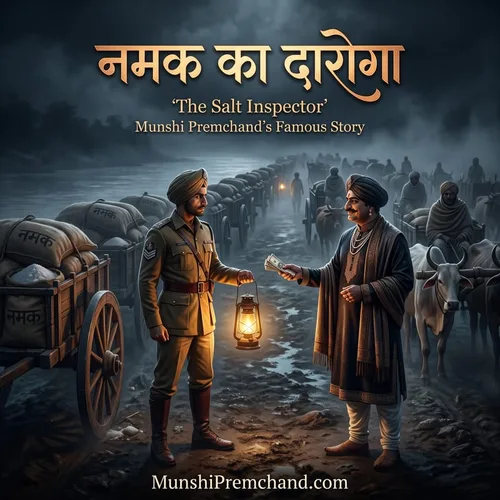
Complete English Translation: Namak Ka Daroga (The Salt Inspector)
When the new Government Department of Salt was established and commerce in a God-given commodity was legally prohibited, people took to trading it through clandestine and illicit channels.
Innumerable varieties of deceit and cunning schemes sprang into existence: some accomplished their ends through open bribery, others through crafty stratagems. For government officials, it was an era of unprecedented windfall—the dice rolled all sixes! Men gladly abandoned the time-honored, highly prestigious office of village revenue registrar (patwari) to serve as ordinary musketeers in this lucrative department. As for the coveted post of Salt Inspector (Daroga), even practicing lawyers looked upon it with envious and watering mouths!
This was an era when English education and Christian doctrine were regarded by the public as one and the same novelty. The Persian language held absolute sway. By merely reading romantic tales of passionate love and composing courtly verses in the erotic mood, Persian scholars easily stepped into the highest offices of the realm.
Young Munshi Vanshidhar, having completed the poignant tale of Zuleikha's longing and regarding the romantic legends of Majnun and Farhad as far more weighty and consequential matters than the mythical clash of Nal and Neel or the discovery of America, stepped forth into the wider world in search of gainful employment.
His father was a seasoned, worldly-wise old man. He began imparting counsel to his son:
"Son! You see with your own eyes the wretched plight of our household. We are crushed under a mountainous burden of debt. There are your sisters; they are shooting up rapidly, spreading like wild grass and weeds! I have become like a fragile tree perched on the crumbling edge of a riverbank—God alone knows at what moment I may crash down! Now you alone are the master and sole manager of this house.
"In seeking a job, pay no heed to rank or designation! A government post is merely a Sufi saint's tomb—your eyes should remain fixed on the offerings (chadhaawa) and the velvet burial veil (chaadar)! Seek out a position that promises a steady flow of extra income (ooppari aay). A regular monthly salary is merely the full moon: it appears but once a month, only to wane and vanish into thin air. But extra income is a perpetual, flowing mountain spring that continuously quenches a man's thirst! Salary is given by mortal man, which is why it never multiplies; extra income is bestowed directly by Almighty God, which is why divine abundance (barkat) resides within it!
"You are a learned scholar yourself; what counsel can I presume to give you? In this matter, the keenest practical judgment is required. Examine the man, evaluate his desperate need, weigh the golden opportunity—and only then, do whatever you deem appropriate! In dealing with a needy man, strict severity yields nothing but pure profit; but to corner a man who has no immediate need is an exceedingly difficult task. Bind these precepts firmly in your mind—this is the hard-earned treasure of my entire life's experience!"
Having delivered this sermon, the old father bestowed his blessings. Vanshidhar was a dutiful, obedient son. He listened to these words with respectful attention, and then set out from home. In this vast and treacherous world, patient fortitude was his sole companion, his own intellect his guide, and self-reliance his only supporter.
Setting out under auspicious stars, no sooner had he arrived than he was appointed to the coveted post of Inspector in the Department of Salt! The salary was handsome, and as for illicit extra income—its horizons were limitless. When the glad tidings reached the old father, his heart swelled with immense pride and joy. Moneylenders grew suddenly polite and accommodating, the hopes of the local liquor-merchant blossomed, while sharp pangs of jealousy pierced the hearts of all their neighbors.
Winter had set in, and it was the dead of night. The salt constables and village watchmen were steeped in drunken revelry, insensible to the world.
Munshi Vanshidhar had been posted at this station for barely six months; yet in that brief span, through his remarkable administrative efficiency and exemplary moral character, he had completely captivated the hearts of his superior officers. His superiors had come to place implicit trust in him.
About a mile to the east of the salt office, the Yamuna River flowed in its dark channel, spanned by a bridge of boats. The Inspector was fast asleep behind barred doors in deep, restful slumber. Suddenly, his eyes flew open. In place of the gentle, tranquil murmuring of the river currents, his ears caught the rumbling clamor of heavy cartwheels and the noisy shouts of boatmen!
He sat bolt upright on his cot. Why should carts be crossing the river at such an unearthly hour of the night? Surely, there must be some dark mischief afoot!
Cold logic came to reinforce his suspicion. He donned his uniform, slipped his pistol into his pocket, and in the twinkling of an eye, spurred his horse toward the riverbank.
Reaching the bridge, he found a long convoy of bullock carts crossing over to the opposite shore.
He shouted in a stern, commanding tone: "Whose carts are these?"
A tense silence fell over the convoy. The drivers exchanged nervous, hurried whispers among themselves. At last, the driver of the lead cart called out:
"Pandit Alopidin's!"
"Which Pandit Alopidin?"
"Of Dataganj."
Munshi Vanshidhar was taken aback. Pandit Alopidin was the most eminent, wealthy, and prestigious zamindar in the entire territory! He carried on financial transactions amounting to hundreds of thousands of rupees. Throughout the district, from the humblest peasant to the wealthiest merchant, there was scarcely anyone who was not indebted to him. His commercial enterprises were vast and far-reaching. He was an extraordinarily clever, well-connected man of affairs. British officers frequently arrived in his estates for hunting expeditions and were lavishly entertained as his honored guests. Throughout the twelve months of the year, a magnificent free almshouse (sadavrat) fed the needy at his gates.
Vanshidhar demanded: "Where are these carts bound?"
The reply came: "To Kanpur."
"What is loaded inside them?"
At this question, a deathly silence descended upon the bridge. The Inspector's suspicion deepened into certainty. Having waited a moment in vain for a reply, he raised his voice and bellowed: "Have all of you turned struck dumb? I am asking you—what is loaded in these sacks?"
When no answer was forthcoming, he urged his horse alongside one of the carts and dug his fingers deep into the rough burlap sack. All doubt vanished in an instant. They were solid lumps of contraband salt!
Pandit Alopidin was traveling at a leisurely pace behind the convoy in his ornate, gilded carriage, half-dozing, half-awake. Suddenly, several frantic cart-drivers came running up in breathless terror, woke him, and cried:
"Maharaj! The Salt Inspector has seized all our carts at the ghat, and stands there demanding your personal presence!"
Pandit Alopidin held an absolute, unshakeable faith in the supreme power of Goddess Lakshmi. He was fond of declaring that let alone this earthly world, even the heavenly realms were governed entirely by the sovereign power of Wealth! And in truth, his assertion was grounded in solid reality. Justice, virtue, law, and morality were nothing more than malleable playthings in the hands of Lakshmi; she made them dance to whatever tune she pleased!
Reclining comfortably upon his cushions, he said with supreme complacency: "Go on; I am coming."
Saying this, the Pandit leisurely prepared two betel leaves (paan), popped them into his mouth, wrapped a soft, luxurious shawl around his shoulders, and strolled over to the Inspector.
He greeted him with silky deference: "Greetings, Babuji! Blessings upon you! Pray tell, what grave offense have we committed that our humble carts have been halted? Upon us poor Brahmins, your eyes of gracious favor should always rest."
Vanshidhar replied with icy curtness: "Government orders."
Pandit Alopidin smiled indulgently: "We know nothing of government orders, nor of any government! For us, our sole government is your noble self. Our relationship with you is an intimate household affair; could we ever dream of holding ourselves separate from you? You have put yourself to unnecessary trouble and hardship. It is utterly unthinkable that we should pass through this ferry without offering a devout tribute to the presiding deity of the ghat! I was already on my way to present myself in your worshipful service."
Upon Vanshidhar, the enchanting flute of wealth produced not the slightest charm. The pristine, uncorrupted fervor of honesty burned bright in his youthful heart.
He retorted with fiery indignation: "I am not one of those vile traitors who wander about peddling their honor and conscience for a few copper coins! You are under arrest at this very moment. You shall be formally prosecuted according to the letter of the law. I have neither the time nor the inclination for idle chatter! Jamadar Badlu Singh! Take this man into custody immediately—that is my order!"
Pandit Alopidin was struck dumb with shock! A frantic commotion broke out among the carters. In his entire life, it was perhaps the very first time that the great Pandit had been subjected to such harsh, unsparing words.
Badlu Singh stepped forward, but paralyzed by the sheer awe of Alopidin's towering stature, he could not summon the courage to lay a hand upon the landlord's person.
The Pandit had never in his existence witnessed Morality treating Wealth with such brazen contempt! He reasoned in his mind: The fellow is merely an arrogant, reckless boy. He has not yet fallen into the tangled webs of worldly greed and attachment. He is raw, inexperienced, and timid.
Adopting a tone of piteous humility, Alopidin pleaded: "Babu Sahib, pray do not do this! We will be utterly ruined! Our ancestral honor will be rolled in the dust! What will you gain by heaping disgrace upon my head? In no way do we consider ourselves outside your gracious fold!"
Vanshidhar said sternly: "I do not wish to hear another word of this kind!"
The solid rock upon which Alopidin had rested his entire life seemed suddenly to crumble beneath his feet. His immense self-esteem and pride of fortune suffered a staggering blow. Yet, he still placed profound confidence in the numerical power of money.
He turned to his chief clerk and commanded: "Lala Ji, present a currency note of one thousand rupees to Babu Sahib—he is behaving like a famished lion at this moment!"
Vanshidhar flared up in blistering rage: "Not one thousand—not even one hundred thousand rupees can sway me by an inch from the path of righteousness!"
At this mindless obstinacy of Duty and this god-like, incomprehensible renunciation, Alopidin's mind burned with intense vexation.
Now, a titanic duel erupted between the two supreme powers of the earth! Wealth launched attack after attack with leaping fury. The bribe surged from one thousand to five thousand; from five thousand to ten; from ten to fifteen; and from fifteen to twenty thousand rupees!
Yet Duty, endowed with supernatural heroism, stood alone like an immovable, unshakeable mountain before this colossal host, serene and resolute.
At last, utterly exhausted and defeated, Alopidin said in despair: "Beyond this, I have no courage to advance. You possess the legal authority; do as you see fit."
Vanshidhar called out to his constable: "Badlu Singh!"
Cursing the Inspector bitterly in his heart, Badlu Singh advanced toward Pandit Alopidin.
Terrified and trembling, the Pandit retreated two or three paces and cried out in the most abject, pleading tones: "Babu Sahib! For God's sake, have mercy upon me! I am ready to settle the matter for twenty-five thousand rupees!"
"Utterly impossible!"
"Thirty thousand?"
"Not possible under any circumstances!"
"Will you not relent even for forty thousand?"
"Not for forty thousand—not even for forty lakhs! Badlu Singh, seize this man instantly! I will not listen to a single word more!"
Righteous Duty trampled Wealth beneath its heel!
Alopidin saw a brawny constable advancing toward him, holding a pair of gleaming iron handcuffs. He looked around him with eyes filled with utter helplessness and desolation—and then, collapsing under the crushing weight of shame, fell unconscious upon the cold ground.
The world slept, but the world's wagging tongue remained wide awake.
By daybreak, the sensational news was on the lips of every living soul, young and old alike. Whomever one looked upon was dissecting the incident, and a torrent of righteous condemnation poured from every mouth—as though, with this single arrest, the entire catalog of human sin had been expunged from the earth!
The milkman who diluted his milk with filthy water, the dishonest clerks who fabricated fictitious account ledgers, the respectable gentlemen who traveled on railway trains without tickets, the wealthy merchants who manufactured forged deeds and promissory notes—every single one of them wagged their heads in moral outrage, strutting about like spotless deities!
When, on the following day, Pandit Alopidin, formally arraigned as a criminal accused, was escorted through the streets toward the courthouse by constables—iron handcuffs locked around his wrists, his heart overflowing with shame and torment, his noble head bowed low in disgrace—a tremendous uproar seized the entire town. Even at the greatest religious fairs, eager crowds could not have thronged with such frantic curiosity. Under the immense pressure of the multitudes, the distinction between rooftops and courtyard walls dissolved completely.
Yet no sooner had they stepped inside the portals of the courthouse than the entire scene underwent a magical transformation!
Pandit Alopidin was the undisputed monarch of this administrative jungle. The executive officers were his devoted disciples, the court clerks were his humble dependents, the advocates and pleaders were his obedient instruments, while the peons, orderlies, and watchmen were his unpaid slaves!
The moment he appeared, people rushed from every quarter to surround him. Everyone was seized with amazement—not that Alopidin had engaged in illegal salt smuggling, but how on earth had he fallen into the clutches of the law? How could a man possessing limitless wealth capable of accomplishing the impossible, coupled with irresistible eloquence of tongue, ever be trapped by legal technicalities?
Every heart overflowed with boundless sympathy for him. With extraordinary speed and zeal, an invincible army of lawyers was marshaled to repel this sudden assault. In the arena of justice, a fierce battle was joined between Righteousness and Wealth!
Vanshidhar stood alone and unsupported. He possessed no power save the shield of truth, and no weapon except the sword of straightforward, fearless speech. Witnesses were present, but their integrity was thoroughly corrupted by the lure of gold.
Indeed, the Inspector could distinctly perceive that the scales of justice were tipping heavily against him. It was styled a court of impartial justice, yet over every one of its officials hung the heavy, blinding intoxication of prejudice and partiality! But what communion can ever exist between partiality and justice? Where prejudice reigns, the very concept of justice becomes an absurd delusion.
The judicial proceedings were brought to a swift conclusion.
The Deputy Magistrate recorded in his formal judgment: "The allegations and evidence adduced against Pandit Alopidin are utterly groundless, frivolous, and misleading. He is a gentleman of the highest eminence and social standing. It is completely beyond the bounds of human imagination that a man of his stature would stoop to such reckless misconduct for the sake of a petty pecuniary gain. Although Munshi Vanshidhar, Inspector of Salt, cannot be held grievously at fault, it is nonetheless a matter of profound regret that on account of his unbridled arrogance and rash indiscretion, a noble and respectable gentleman has been subjected to severe harassment and distress. While we are pleased with the Inspector's vigilance and dedication to duty, his excessive zeal in the matter of salt prosecutions has evidently perverted his judgment and clouded his discretion. He is strictly cautioned to exercise greater prudence and circumspection in the future."
Hearing this verdict, the defense advocates leapt into the air with jubilation! Pandit Alopidin stepped out of the courtroom, smiling triumphantly. His relatives and admirers scattered silver coins among the crowd with lavish hands; a veritable ocean of generosity surged forth, its waves threatening to shake the very foundations of the courthouse!
When Vanshidhar stepped out into the open courtyard, venomous arrows of mockery and sarcastic taunts showered upon him from every direction. The peons and court orderlies bowed in exaggerated, mocking salutations. Yet at that moment, every stinging insult, every covert gesture, served only to ignite the fire of his moral pride. Had he triumphed in this lawsuit, he might never have walked with such unbending dignity.
Today, he had gained a bitter, illuminating insight into the ways of the world: that judicial justice and scholarly erudition, grand academic titles, venerable flowing beards, and flowing legal gowns were not worthy of a single shred of genuine human reverence!
Vanshidhar had dared to declare war against Wealth, and the price of that audacity had to be paid in full. Barely a week had elapsed when the official warrant of suspension arrived! His steadfast devotion to duty had received its just reward.
Heartbroken, tormented by grief and despair, the ruined young man set out for his ancestral village home.
Old Munshi Ji had already been muttering and grumbling for days: "I cautioned that wretched boy a thousand times when he set out, but he refused to listen to a single word! He must always follow his own obstinate whims! Here we sit, enduring the humiliating duns of the liquor-seller and the butcher, dragging out our old age like pious ascetics, while he brings home nothing but a dry, meager salary! I held a government job too in my day; I was no exalted dignitary, but I worked with an open heart and gathered wealth! And here he goes, determined to play the incorruptible saint! There may be pitch darkness at home, but he must light a lamp in the mosque! A curse upon such foolish intellect! All his schooling and education have gone completely down the drain!"
When Munshi Vanshidhar reached home in this wretched, destitute condition and his aged father learned the catastrophic news, the old man beat his forehead in fury!
He cried bitterly: "I feel like smashing your skull and my own against the stone wall!"
For hours, the father wrung his hands in impotent rage, muttering bitter curses and insults. Had Vanshidhar not prudently slipped away from his presence, the old man's wrath would have assumed a violent form.
His aged mother was crushed with sorrow; her cherished lifelong dream of embarking on a holy pilgrimage to Jagannath Puri and Rameshwaram dissolved into dust. As for Vanshidhar's young wife, she was so consumed with anger that she refused to look him in the face or speak a word to him for days.
In this gloomy and suffocating atmosphere, a full week dragged by.
It was evening. Old Munshi Ji was sitting on the front verandah, chanting prayers upon his rosary beads. At that very moment, a magnificent, decorated carriage came to a halt before his humble doorway!
It was adorned with emerald-green and rose-pink silk curtains, drawn by a pair of splendid western bullocks with indigo cords wound around their necks and their horns tipped with polished brass. Several liveried attendants carrying heavy silver-tipped staffs marched beside it.
Old Munshi Ji leaped to his feet and rushed forward to receive the illustrious visitor. Looking up, he saw to his utter amazement that it was none other than Pandit Alopidin!
The old man bowed to the earth in abject prostration, showering the landlord with fawning flattery:
"Our supreme fortune has dawned today that your holy feet have sanctified our wretched doorway! You are our revered family deity. How can I dare show my face to your honor? Our faces are blackened with shame! But what can we do? My son is an ill-fated, worthless scoundrel! Had he not turned out to be such an unfilial wretch, why would we have to hide our faces in disgrace before you? May Almighty God leave a man childless rather than curse him with such an offspring!"
Alopidin interrupted him gently: "No, my dear brother, pray do not say such things!"
Old Munshi Ji asked in utter bewilderment: "What else should I call such an ungrateful wretch?"
Alopidin spoke in a voice vibrating with profound tenderness:
"He is the crowning ornament of his entire lineage, the radiant illuminator of his ancestors' glory! In this selfish world, how many righteous souls exist who would cheerfully sacrifice their all for the sake of unbending Duty?"
Turning to Vanshidhar, Pandit Alopidin said:
"Daroga Ji, do not regard this as mere courtly flattery. To flatter you, I had no need to undertake the hardship of journeying all the way to your door. That night, by the sheer authority of your office, you placed me in your custody; today, of my own free will, I have come to surrender myself into your custody!
"I have encountered thousands of wealthy aristocrats and noblemen; I have dealt with thousands of exalted government dignitaries; but the only man who ever conquered and humbled me was your noble self! I had succeeded in turning everyone into a slave to myself and my wealth. Grant me permission to lay a single humble petition before you."
When Vanshidhar had first seen Alopidin approaching, he had risen politely to greet him, but with cold, unbending self-respect. He had assumed that the great zamindar had come to gloat over his ruin and heap humiliation upon his head. He had made no effort to apologize, nor could he endure his father's degrading, servile sycophancy.
Yet as he listened to the Pandit's words, every trace of bitterness melted away from his heart like mist before the sun. He looked up into Alopidin's face—the landlord's eyes shone with unmistakable goodwill and profound reverence.
Vanshidhar's youthful pride bowed in awe before such magnanimity.
Blushing with modesty, he said: "It is your boundless generosity, sir, that prompts you to speak thus. Whatever discourtesy or insolence I showed that night, pray forgive me for it. I was bound hand and foot by the sacred chains of duty; otherwise, in my personal capacity, I am your humble servant. Whatever command you lay upon me shall be borne upon my head and eyes."
Alopidin said with deep earnestness: "On the riverbank, you refused to grant my petition; today, you must accept it!"
Vanshidhar replied: "What worth or merit do I possess? Yet whatever humble service I am capable of rendering, there shall be no shortcoming on my part."
Alopidin drew forth a stamped, registered legal document, placed it before Vanshidhar, and said:
"Accept this appointment, and affix your signature to it. I am a Brahmin; until you grant this prayer, I will not budge an inch from your doorstep!"
Munshi Vanshidhar read through the document, and tears of overwhelming gratitude rushed to his eyes.
Pandit Alopidin had appointed him the Permanent General Manager of his entire estate—at an annual salary of six thousand rupees, with separate daily traveling allowances, a fine horse for riding, a spacious bungalow for residence, and a full retinue of domestic servants and attendants provided free of cost!
In a voice choked with emotion, Vanshidhar said: "Pandit Ji, I possess neither the eloquence nor the capacity to praise your boundless magnanimity. But I am utterly unworthy of so exalted an office."
Alopidin laughed softly and replied: "At this moment, I stand in need of precisely such an 'unworthy' man!"
Vanshidhar said with grave solemnity: "In truth, I am your humble servant. To serve an illustrious, noble-hearted gentleman of your renown is a supreme privilege for me. But I possess neither scholarship, nor intellectual brilliance, nor that polished worldly tact which compensates for such deficiencies. For a task of such monumental magnitude, an experienced, seasoned man of affairs is required."
Alopidin drew a gold pen from his pen-case, placed it firmly in Vanshidhar's hand, and said:
"I seek neither scholarship, nor experience, nor deep worldly insight, nor administrative cunning! I have become thoroughly acquainted with the true worth of all those fine qualities. Today, through supreme good fortune and auspicious opportunity, I have discovered a priceless jewel before whose radiant luster all the cleverness and learning of the world pale into insignificance!
"Take this pen, indulge in no further hesitation, and affix your signature. My sole prayer to Almighty God is that He may forever preserve you as that very same uncompromising, strict, unbending, and fiercely righteous Inspector of the Yamuna riverbank!"
Tears spilled over from Vanshidhar's eyes. The narrow vessel of his youthful heart could scarcely contain such an ocean of honor and grace.
Once more, he gazed upon Pandit Alopidin with eyes brimming with devotion, reverence, and gratitude—and with a trembling hand, affixed his signature to the deed of appointment.
Beaming with immense joy, Pandit Alopidin stepped forward and embraced him warmly in his arms.
Summary of Namak Ka Daroga (The Salt Inspector)
Namak Ka Daroga (The Salt Inspector) is Munshi Premchand's timeless classic exploring the clash between moral duty (Dharma) and the corrupting power of wealth (Lakshmi). Set during the British colonial era when a government monopoly on salt turns a basic necessity of life into a heavily taxed contraband commodity, the story follows Munshi Vanshidhar, an upright young man from an impoverished, debt-ridden family. Disregarding his cynical father's worldly advice to seek lucrative illicit 'extra income' rather than depend on an honest salary, Vanshidhar secures an appointment as Inspector in the newly created Salt Department, quickly earning the admiration of his superiors through his integrity and diligence.
On a freezing winter night on the banks of the Yamuna River, Vanshidhar intercepts a suspicious convoy crossing the bridge of boats, discovering that it is smuggling contraband salt belonging to Pandit Alopidin, the region's wealthiest, most aristocratic, and influential landlord. Arriving on the scene in his carriage, Alopidin assumes that the young official can be easily bought and offers escalating bribes ranging from one thousand to forty thousand rupees. Undaunted, Vanshidhar arrests the landlord, proclaiming that not even forty lakhs could sway him from his duty. However, when the case reaches court, Alopidin's wealth, legal army, and compliant colonial officers orchestrate his acquittal, while Vanshidhar is formally reprimanded for 'excessive zeal' and subsequently suspended from service.
Returning home in disgrace, Vanshidhar faces the bitter scorn and lamentations of his father, the tears of his mother, and the icy silence of his wife. Yet a week later, Pandit Alopidin arrives at Vanshidhar's modest home in a lavish carriage. Rather than seeking vengeance, Alopidin prostrates himself before the incorruptible young man, confessing that while his wealth had enslaved everyone else, Vanshidhar alone had conquered him. Alopidin appoints Vanshidhar as the permanent General Manager of his vast estates with a princely salary, bungalow, carriage, and servants, praying that God keep him forever the same unyielding, righteous officer of the Yamuna ghat. The story concludes on a triumph of moral character over material corruption.
Publication History
Namak Ka Daroga (नमक का दारोगा) was written by Munshi Premchand and first published in Hindi in 1914. It was subsequently anthologized in Volume 8 of Premchand's eight-volume collection Mansarovar. Widely regarded as one of the finest gems of modern Indian literature, the story has been included in educational curricula across India for generations, embodying Premchand's philosophy of idealistic realism (Aadarshonmukh Yatharthavad).
This unabridged English translation was published in 2026 by MunshiPremchand.com as part of the MunshiPremchand.com English Translation Series.
Themes & Critical Significance
- The Clash Between Conscience (Dharma) and Wealth (Lakshmi): The central dynamic of the story is the direct conflict between unshakeable moral duty and the overwhelming power of money. Premchand dramatizes this struggle both on the dark riverbank and in the colonial courtroom, demonstrating that while wealth can subvert legal systems, genuine moral integrity retains an incorruptible majesty that commands reverence.
- Critique of Colonial Bureaucracy and Bribery: Premchand exposes the structural corruption of the British colonial administration, where state monopolies create illicit black markets and bureaucratic venality. The cynicism of Vanshidhar's father—who equates bribery with divine blessing and salary with a waning moon—reflects a deeply ingrained societal tolerance for corruption born of economic insecurity.
- Idealistic Realism (Aadarshonmukh Yatharthavad): While Premchand realistically depicts how the court system and public opinion bend to wealth and influence, he elevates the narrative through an idealistic resolution: Alopidin's spiritual transformation. True character is not rewarded by the colonial state, but by the moral awakening of his adversary.
- Family Pressure and Moral Solitude: Vanshidhar's struggle highlights the immense loneliness of the honest individual. His family does not celebrate his integrity; instead, they condemn his refusal of bribes as foolishness that deprives them of comfort and pilgrimages, underscoring the severe social and domestic toll borne by principled individuals.