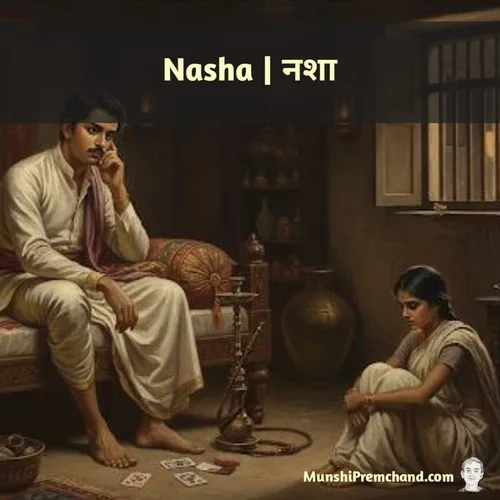
Complete English Translation: Nasha (Intoxication)
Ishwari was the son of an opulent landlord (zamindar), while I was the son of an impoverished clerk who possessed no property in this world other than his daily, grueling physical toil.
Heated debates constantly flared up between the two of us. I would vehemently denounce the entire zamindari system, calling landlords bloodthirsty beasts, leeches that suck the lifeblood of the poor, and barren, parasitic creepers blooming on the highest treetops of society. Ishwari would defend the zamindars; but naturally, his side of the argument was fundamentally weak, because he possessed not a single rational justification in favor of his class. He would argue that all human beings are not born equal, that hierarchies of high and low have always existed throughout history and will always continue to exist—a thoroughly flimsy and hollow argument! It was impossible to justify such an oppressive social order by any moral or humanitarian law.
In the mounting heat of these debates, I often grew furious and uttered sharp, stinging words; yet Ishwari, even when utterly routed in debate, merely smiled with undisturbed composure. I never once saw him lose his temper—perhaps because in his heart, he clearly recognized the fatal weakness of his cause.
Toward domestic servants, however, he never spoke with a pleasant or respectful face. In the callous cruelty and unfeeling insolence characteristic of the wealthy, he had received an abundant share. If a servant was a minute late in laying his bedding, if his milk was slightly hotter or colder than required, or if his bicycle had not been polished with meticulous care, he would fly completely into a rage. Sloth or insolence was something he could not tolerate for an instant.
Yet toward his friends—and especially toward me—his behavior was brimming with warmth, affection, and modesty. Perhaps had I been placed in his circumstances, the very same harsh, tyrannical tendencies would have sprouted in me as well, for my theoretical love for the common masses was anchored not in immutable moral principles, but in my own impoverished personal condition. Whereas had Ishwari been in my place, he would probably still have remained an aristocrat at core, for by his very inborn nature, he was a lover of luxury, pomp, and grandeur.
During this year's Dussehra vacation, I firmly resolved not to go home. I did not possess enough money for the railway ticket, nor did I wish to heap hardship upon my family. I knew perfectly well that whatever meager allowance they sent me every month was already far beyond their financial means. In addition, the looming final examinations weighed heavily upon my mind; there was a mountain of reading still to be done, and I had no desire to mope alone like a solitary ghost in the deserted college boarding house.
Therefore, when Ishwari invited me to spend the holidays at his ancestral home, I agreed without needing the slightest persuasion. Studying together with Ishwari would ensure excellent exam preparation, for despite his vast wealth, he was hardworking, sharp, and exceptionally intelligent.
Along with the invitation, however, Ishwari gave me a quiet warning: "Listen, brother, keep one thing firmly in mind. If you start preaching your anti-zamindari sermons there, the entire atmosphere will be ruined and my family will be deeply offended. My elders rule over their tenant peasants solely on the unshakeable premise that Almighty God created peasants for the express purpose of serving landlords! The peasant tenants believe it with religious conviction too. If it is ever suggested to them that there is no fundamental difference between a landlord and a tenant, the entire zamindari system will vanish from the earth in the blink of an eye!"
I asked: "Do you imagine that the moment I arrive there, I will magically transform into someone else?"
"Yes, that is precisely what I believe."
"You are completely mistaken!"
Ishwari offered no rejoinder. Perhaps he chose to leave the matter to my good sense—and he acted very wisely. Had he stubbornly pressed the argument, my pride would have dug in its heels.
Let alone traveling in Second Class, I had never in my life traveled even in an Intermediate Class carriage! On this occasion, through Ishwari's generosity, I was blessed with the supreme good fortune of traveling Second Class.
The train was scheduled to arrive at nine o'clock at night, but in the intoxicating excitement of the journey, we arrived at the railway station early in the evening. After strolling about the platforms, we stepped into the first-class railway refreshment room to take our dinner.
From my coarse attire, awkward gait, and rustic demeanor, the sharp-eyed waiters took no time to discern who was the wealthy master and who was the dependent hanger-on! Yet, for some inexplicable reason, their subtle impudence stung me to the quick. The money was paid entirely from Ishwari's pocket; indeed, the handsome tips that Ishwari routinely tossed around probably exceeded my father's entire monthly salary! When departing, Ishwari handed them an eight-anna silver coin as a tip.
Even so, I expected those waiters to serve me with the very same bowing deference, alertness, and humble promptness with which they waited upon Ishwari! At Ishwari's slightest nod, they sprinted eagerly; but when I asked for anything, they displayed scarcely a flicker of enthusiasm. The delicious food tasted completely bland and flavorless to me; this glaring social discrimination monopolized my mind entirely.
When the train pulled in, we boarded. The waiters offered deep, formal salaams to Ishwari, but did not deign to cast so much as a glance in my direction.
Ishwari remarked: "How exquisitely well-mannered these people are! Look at our domestic servants at home—they don't know the first thing about proper etiquette."
I retorted in sour resentment: "If you started giving your domestic servants an eight-anna tip every single day, they too would become far more polite and polished than these fellows!"
Ishwari asked: "Do you honestly believe that they show all this deference purely out of greed for tips?"
"Certainly not! Decorum and deference have been pumped into their very bloodstream by wealth!"
The mail train sped into the night. It set out from Prayag (Allahabad) and halted at Pratapgarh. A passenger opened our compartment door to enter.
I immediately bellowed in an imperious, haughty tone: "This is Second Class! Second Class!"
The passenger stepped inside the carriage, cast a look of cool, devastating disdain upon me, and said quietly: "Yes, your humble servant understands that much!"—and proceeded to sit comfortably upon the middle berth.
I cannot begin to describe the searing shame that flooded over me!
By daybreak, we reached Moradabad. On the platform, a reception party stood waiting to receive us: two respectable estate gentlemen and five uncompensated bonded laborers (begars). The laborers hoisted our luggage upon their heads; the two gentlemen walked respectfully behind us. One was a Muslim gentleman named Munshi Riyasat Ali; the other was an orthodox Brahmin named Ramharakh.
Both cast curious, uncomprehending glances at me, as though silently asking: How is this common crow strutting in the company of a majestic swan?
Munshi Riyasat Ali asked Ishwari deferentially: "Does this young Babu Sahib study with your honor?"
Ishwari replied grandly: "Yes, he studies with me, and lives with me as well! In truth, it is entirely on his account that I am still stranded in Allahabad; otherwise, I would have transferred to Lucknow college long ago. This vacation, I literally dragged him along with me! Several frantic telegrams arrived from his family demanding his return home, but I made him send refusal replies. The final telegram was marked 'Urgent'—costing four annas per word—yet from our end, a refusal was dispatched nonetheless!"
Both gentlemen stared at me with wide, awe-struck eyes, visibly straining to appear properly terrified and reverent.
Riyasat Ali remarked in a tone of hesitant inquiry: "Yet the Babu Sahib dresses in extraordinarily simple attire!"
Ishwari instantly swept their doubts away: "Ah, he is an ardent devotee of Mahatma Gandhi, sir! He wears nothing on his person except pure hand-spun khaddar. He made a bonfire of all his expensive, foreign clothes! In reality, he is a great raja—his private estate yields an income of two and a half lakhs annually! But looking at his face, one would think he has just escaped from an orphanage!"
Ramharakh gasped in admiration: "Such saintly humility among great lords is rarely seen in this world! No ordinary man could ever fathom his true grandeur!"
Riyasat Ali concurred enthusiastically: "Had you seen the late Maharaja of Changli, you would have bitten your fingers in wonder! He used to wander through the bazaars wearing a coarse cotton vest and rough country shoes! It is said that he was once seized by mistake by police for forced manual labor—and yet, it was he who donated ten lakh rupees to establish a great college!"
Inside, I was dying of utter embarrassment; yet, through some bizarre psychological twist, this monstrous, brazen lie did not strike me as ridiculous in the least! With every extravagant sentence Ishwari uttered, I felt myself drawn irresistibly closer to that imaginary aura of princely grandeur!
I was no horseman. True, in my barefoot childhood, I had occasionally clambered upon the backs of pack-mules; but here, two magnificent, pedigree horses stood saddled and waiting for us!
My heart sank into my boots! I mounted the steed, my limbs trembling like leaves in a gale, but I took care not to let the faintest ripple of fear show upon my countenance. I kept my horse trotting obediently behind Ishwari's mount. Fortunately, Ishwari did not urge his horse into a gallop; had he done so, I would certainly have returned with broken limbs! It is quite possible that Ishwari secretly grasped the exact depth of my equestrian prowess.
Ishwari's ancestral mansion was not a mere house—it was a colossal fortress! It had an arched entrance resembling a grand Imambara, armed sentries pacing at the gateway, an endless retinue of servants, and a royal tusker elephant swaying in chains in the courtyard.
Ishwari introduced me to his father, uncles, and elder relatives with the exact same theatrical hyperbole. He spun such an intoxicating yarn that words fail to describe it! Not only the servants, but even the venerable family elders began treating me with profound reverence. These rural landlords, who reaped lakhs in agricultural rents, regarded even a petty police constable as a high government dignitary; when confronted with an alleged multi-millionaire prince, several elderly gentlemen began addressing me as "Huzoor! Huzoor!" (Your Highness!).
When we finally found a moment of privacy, I whispered to Ishwari: "You are a devil incarnate, my friend! Why are you dragging my humble honor through the dirt with these outrageous lies?"
Ishwari laughed with cool self-assurance: "Before these ignorant donkeys, this exact stratagem was essential! Otherwise, they wouldn't have deigned to speak to you with a straight face!"
A short while later, the household barber arrived to massage our feet, assuming that the young princes had returned exhausted from their long railway journey.
Ishwari gestured toward me: "Massage Kuwar Sahib's feet first!"
I lay stretched out upon the plush charpoy. In my entire life, it had never happened that someone had massaged my feet! I had always mocked such feudal luxuries, branding them as upper-class decadence, aristocratic stupidity, and bourgeois tyranny—yet today, I was playing the role of a blue-blooded prince with absolute, shameless relish!
By ten o'clock, dinner was announced. These were people of the old feudal orthodoxy; the light of the new Western education had barely touched the mountaintops. We went to wash.
In the hostel, I had always washed my own dhoti with my own hands; but here, imitating Ishwari's haughty manners, I cast my soiled dhoti aside for the servants to wash. I felt deeply ashamed to touch my own clothes!
When we entered the dining hall, the old custom required washing one's feet before stepping onto the spotless floor. A domestic servant (kahar) stood waiting with a brass pitcher of water and a basin. Ishwari extended his feet, and the servant washed them. I extended my feet, and the servant washed mine too!
Where had my fierce egalitarian principles vanished? They had dissolved without leaving a trace!
I had imagined that in the quiet countryside, we would bury ourselves in our books and study diligently for the examinations; but here, our entire days slipped away in lavish amusement and recreation.
Sometimes we went sailing in an ornamental barge on the river; sometimes we hunted waterfowl and fish; sometimes we watched bouts of professional wrestling; at other times, we were engrossed in marathon games of chess. Ishwari ordered crates of eggs, and rich omelets were prepared over a kerosene stove inside our chamber.
A small army of servants hovered around us at all hours. There was not the slightest need to move hand or foot—merely moving one's tongue was more than sufficient! Sit down to bathe, and an attendant was on hand to pour water over your shoulders; recline upon the bed, and a servant stood by fanning you with a hand-fan.
I had become celebrated far and wide as the 'Princely Disciple of Mahatma Gandhi.' My supreme authority reigned unchallenged from the inner zenana to the outer gates!
Make sure breakfast is not delayed by a minute, lest Kuwar Sahib take offense! Ensure the bedding is laid out precisely on time, for Kuwar Sahib's bedtime has arrived!
Indeed, I had become far more delicate, temperamental, and exacting than Ishwari himself—or rather, I was forced into that role! Ishwari might occasionally stoop to spreading his own bed, but how could a royal guest lay his own bedding with his own hands? His princely majesty would suffer an irreparable stain!
One night, this artificial pretense erupted into genuine fury.
Ishwari was detained inside the main residence in long conversation with his mother. It was past ten o'clock, and my eyelids were heavy with sleep; yet how could I make my own bed? I was a prince after all!
Around eleven-thirty, a trusted household servant arrived in breathless haste. Busy with domestic chores in the inner quarters, he had forgotten to make my bed. The moment he appeared, I delivered such a blistering, ferocious reprimand that the poor wretch trembled to the roots of his hair!
Hearing my thunderous shouts, Ishwari came out and remarked approvingly: "You did quite right! All these lazy rascals deserve precisely that treatment."
On another evening, Ishwari had gone out to attend a feast in a neighboring village. Dusk fell, and a kerosene table-lamp lay upon my study desk, alongside a box of matches. But Ishwari never lit a lamp with his own hands—so how could Kuwar Sahib possibly strike a match?
I sat fuming in the darkness, longing to read the newspaper, but there was no light. By chance, Munshi Riyasat Ali stepped into the room. I exploded upon him, unleashing a torrent of furious abuse that left the poor clerk utterly stunned:
"Don't you people possess even the basic sense to have a lamp lit in my room? I cannot fathom how such lazy, incompetent drones manage to survive here! In my estate, you wouldn't last an hour!"
With trembling hands and a terrified heart, Munshi Riyasat Ali lit the lamp and backed out of the room.
A local village tenant—a sturdy, spirited Rajput named Thakur—frequently visited the estate. He was an ardent, simple-hearted devotee of Mahatma Gandhi. Regarding me as the revered disciple of Gandhi Baba, he treated me with immense awe and respect, though he always felt hesitant to address me directly.
One afternoon, finding me sitting alone on the verandah, he approached, folded his hands, and whispered timidly: "Sarkar is a disciple of Gandhi Baba, isn't it? People say that when Swaraj comes, there will be no more zamindars in the land."
I struck an imposing, grandiloquent posture: "What is the earthly need for landlords anyway? What do these people do except suck the blood of the starving poor?"
The Thakur asked eagerly: "So, Sarkar, will the lands of all zamindars be confiscated?"
I declared with pompous certainty: "Many will surrender their lands voluntarily. Those who refuse will have their estates seized by force! We ourselves are fully prepared. The moment Swaraj is achieved, we will register our entire estate as a free gift in the names of our peasant tenants!"
I was sitting in an armchair with my legs crossed. The simple-hearted Thakur knelt down and began reverently massaging my feet! He murmured: "Landlords commit dreadful tyranny these days, Sarkar! If Your Highness would graciously grant me a small plot of land in your estate, I will leave this village and spend my life serving at your feet."
I replied in an air of majestic patronage: "At this moment, brother, I hold no official authority; but the moment the power comes into my hands, I will summon you first of all! I will have you taught motor-driving and appoint you as my personal chauffeur!"
I learned later that evening that the delighted Thakur had drunk a heavy dose of hemp (bhang), beaten his wife in sheer ecstasy, and marched off to pick a fight with the village moneylender!
The holidays came to an end, and the hour arrived for our return journey to Prayag.
A massive crowd of villagers assembled to bid us farewell. The devoted Thakur accompanied us all the way to the railway station on foot. I played my theatrical part to perfection, stamping the seal of princely generosity and divine nobility upon every heart! I inwardly yearned to shower lavish tips upon all the servants, but where was the financial capacity?
We already held return tickets, so we only needed to board the train. But when the express pulled into the platform, it was packed to suffocating capacity! Crowds of passengers were returning after the Durga Puja and Dussehra holidays. In Second Class, there was not an inch of standing room; Intermediate Class was in an even more wretched condition.
Since this was the final train of the night and we could not afford to delay our return, we were forced, with immense difficulty, to squeeze into a Third Class compartment!
Our newly acquired aristocratic dignity suffered a humiliating blow; yet what choice was there? We had arrived lounging at our ease on cushioned berths in Second Class; we were returning crammed like cattle in Third Class, unable even to shift our posture!
Several passengers in the carriage were educated men, and they were passing the journey singing the praises of British rule. One gentleman observed: "Such impartial justice is to be found in no other regime! Great and small are equal before the law. Even if a king commits injustice, the law court grabs him by the throat!"
Another passenger agreed warmly: "Indeed, sir! You can file a lawsuit against the King-Emperor himself, and the law court will issue a decree against the Crown!"
Near the carriage doorway stood a poor rural laborer bound for Calcutta, carrying a colossal bundle strapped to his back. Finding nowhere inside the crowded carriage to set his burden down, he was forced to stand by the open doorway with the heavy load strapped to his back. Seated right beside the doorway, every time the train lurched, his massive, rough bundle rubbed against my face and shoulder!
It irritated me beyond all endurance. The carriage was suffocatingly hot and breathless; to have this uncouth peasant standing right over my face felt as though he were strangling me!
For some time, I choked back my rising fury.
Suddenly, a wave of savage rage overpowered my senses! I grabbed the wretched laborer, shoved him violently backward, and struck him across the face with two hard, stinging slaps!
The poor man opened his eyes wide with piteous shock and cried: "Why are you striking me, Babuji? I have paid for my railway ticket too!"
Enraged by his answer, I sprang to my feet and landed two or three more ferocious slaps upon his cheek!
A furious storm erupted inside the carriage! A barrage of blistering condemnation showered upon me from every direction:
"If you are so extraordinarily delicate and refined, why didn't you travel in First Class?"
"He might be a great lord in his own house! Had he dared to strike me like that, I would have taught him a lesson!"
"What crime did the poor man commit? There is scarcely room to breathe in this compartment—if he stood near the doorway for a gasp of fresh air, why such ferocious wrath? Does becoming wealthy mean a man must strip himself of all human decency?"
"And this is the very British justice you gentlemen were praising so loudly!"
A rustic villager laughed mockingly: "The fellow can't even get entry into a clerk's office, yet look at his aristocratic haughtiness!"
Ishwari looked at me, shook his head in disgust, and whispered in English:
"What an idiot you are, Bir!"
And in that single, piercing moment, the dark, intoxicating spell of my artificial wealth dissolved into thin air.
Summary of Nasha (Intoxication)
Nasha (Intoxication) is Munshi Premchand's razor-sharp psychological satire on the hypocrisy of theoretical radicalism, the fragility of moral pretensions, and the seductive corruption of feudal power. The story is narrated by Bir, an impoverished clerk's son and college student who vehemently attacks the feudal zamindari system in debates with his wealthy classmate Ishwari, calling landlords parasites and bloodsucking leeches. Ishwari, the son of an affluent landlord, listens to Bir's fierce ideological lectures with amused tolerance.
During the Dussehra vacation, unable to afford the train fare to his own village, Bir accepts Ishwari's invitation to visit his family's grand estate in Moradabad. To ensure that Bir is treated with respect by the caste-conscious rural gentry and domestic servants, Ishwari invents an audacious lie: he introduces Bir as an extraordinarily wealthy prince whose estate yields two and a half lakhs annually, who lives in austere khadi as a devout disciple of Mahatma Gandhi. Rather than rejecting this pretense, Bir quickly surrenders to the fantasy. Surrounded by bonded laborers, fawning relatives, and fanning attendants, his anti-feudal principles evaporate. He becomes far more exacting, irritable, and tyrannical than Ishwari himself, viciously abusing a servant who forgets to make his bed and terrorizing a clerk who fails to light his desk lamp. He even indulges a gullible Gandhian peasant named Thakur, promising him personal favors while allowing the man to massage his feet.
The vacation concludes, and the two friends return to college. However, finding the Second and Intermediate Class compartments completely full on the post-festival train, they are forced to travel in an overcrowded Third Class carriage. Crammed among common laborers, Bir's artificial aristocratic dignity is deeply offended. When a poor, overburdened laborer standing near the door accidentally brushes his heavy bundle against Bir's face, Bir loses his temper and brutally slaps the man repeatedly. The entire compartment turns on Bir, showering him with ridicule and exposing the hollowness of his aristocratic airs. When Ishwari rebukes him in English—"What an idiot you are, Bir!"—the intoxicating spell of borrowed wealth and privilege shatters, leaving Bir confronted with his own moral degradation.
Publication History
Nasha (नशा) was written by Munshi Premchand and first published in Hindi in 1934 in the literary journal Madhuri. It was subsequently anthologized in Volume 1 of Premchand's eight-volume master collection Mansarovar. Written during the peak of the Indian Nationalist movement and the rising socialist critique of the zamindari system, Nasha remains one of Premchand's most widely anthologized and psychologically incisive short stories.
This unabridged English translation was published in 2026 by MunshiPremchand.com as part of the MunshiPremchand.com English Translation Series.
Themes & Critical Significance
- The Hypocrisy of Armchair Radicalism: Premchand exposes how easily progressive ideology and socialist slogans can serve as superficial intellectual postures. Bir's passionate hatred for the zamindari system is rooted not in unshakeable moral conviction, but in the resentment of poverty. The moment he is given power, luxury, and social deference, his radical principles dissolve into feudal tyranny.
- The Seductive Intoxication of Power (Nasha): The title metaphorically equates class privilege with a potent intoxicant. Just as alcohol clouds judgment and inflames ego, the unearned privilege of being treated as a prince intoxicates Bir's psyche, warping his empathy and turning him into an arrogant brute who demands total subservience.
- Feudal Servitude and the Complicity of the Oppressed: The story illustrates how the feudal order perpetuates itself through internalized submission. Servants, clerks, and tenants readily accept their degraded status, viewing landlords as divinely ordained masters. The tragicomic episode of the village Thakur—who fanatically worships Gandhi yet dreams only of becoming Bir's personal chauffeur—highlights how deep feudal consciousness runs among the rural masses.
- Class Reality and Public Exposure: The climax in the third-class railway compartment provides a dramatic confrontation between feudal illusion and proletarian reality. When stripped of his estate setting, Bir's violence is met with swift, collective condemnation by ordinary working passengers, revealing that feudal arrogance cannot survive outside its protected institutional ecosystem.