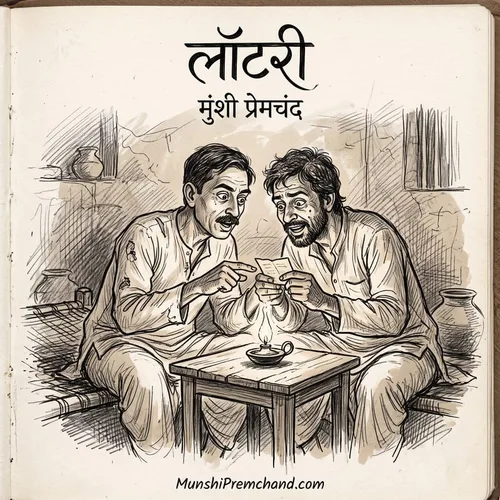
Complete English Translation: Lottery
Who among us is immune to the burning lust to become rich overnight?
In those days, when lottery tickets arrived in town, everyone in the household of my friend Vikram—his father, his uncle, his mother, and his elder brother—bought a ticket each. Who could say whose destiny might exert its power? No matter whose name the prize favored, the fortune would remain within the four walls of the family.
Yet Vikram could find no peace. If the money was drawn in someone else's name, who would care about him? At most, they might toss him five or ten thousand rupees. What would become of him with such a petty sum? In his mind, he harbored grand ambitions for his life. First of all, he wanted to undertake a complete tour of the entire globe—exploring every single corner. Peru, Brazil, Timbuktu, and Honolulu were all on his itinerary! He was not one of those travelers who flitted about like a whirlwind for a month or two only to scurry back home. He wished to reside in each place for days at a time, studying the local lifestyles, customs, and manners, and then pen a monumental, encyclopedic treatise on world travel.
Next, he wanted to erect an immense public library, wherein the finest literary masterpieces of the entire world would be assembled. For that library, he was prepared to expend as much as two lakh rupees; a luxurious bungalow, a motorcar, and opulent furnishings were trivial matters by comparison! If the fortune was won in his father's or uncle's name, there was little hope of receiving more than five thousand; if Mother won it, he might obtain twenty thousand; but if his elder brother won, he wouldn't get so much as a dusty copper coin!
Vikram was a fiercely self-respecting young man. The thought of taking anything from his relatives in the form of charity or a handout felt deeply humiliating to him. He used to say, "Brother, it is far better to drown in a ditch than to stretch out one's begging palm before anyone! When a man cannot carve out an independent place for himself in this world, he ought to depart from it altogether!"
He was thoroughly agitated. Who in his family would grant him money to buy a lottery ticket, and how could he even demean himself to ask? After prolonged thought and deliberation, he suggested to me, "Why shouldn't you and I purchase a ticket jointly as equal partners?"
I liked the proposal. In those days, I was employed as a primary schoolteacher, earning a meager twenty rupees a month. Squeezing through life on that sum was an excruciating struggle. Buying a ten-rupee ticket was, for me, like purchasing a white elephant! True, by sacrificing milk, ghee, snacks, and cutting every incidental expense for an entire month, a margin of five rupees might somehow be carved out; yet my heart trembled at the prospect. If only some windfall or discarded sum came into our hands from somewhere, my courage might be fortified.
Vikram said, "If you agree, shall I sell my gold ring? I will tell everyone it slipped from my finger."
The ring was worth no less than ten rupees; an entire ticket could be bought with it. If one could secure a half-share in a ticket without spending a copper, what was wrong with that?
Suddenly, Vikram added, "But brother, you will have to pay your share in hard cash. Without receiving five rupees in cash from you, I will not enter into a partnership."
Now my conscience was abruptly awakened. I said, "No, my friend, this is wrong. If the theft is discovered, we will be deeply disgraced, and along with you, I will face severe reprimand."
In the end, it was resolved that we would sell our old school textbooks to a second-hand bookseller and purchase the ticket with that money. We possessed nothing more useless than those old books. We had passed matriculation together; and seeing that those who pursued degrees, blinded their eyes over study, and squandered their family wealth were still wandering the streets wearing down the soles of their shoes without employment, we called a halt right there! I took up the post of a humble schoolteacher, and Vikram took to idle wandering.
Our old textbooks were now of no earthly use to anyone except termites. As much as we could lick and digest, we had sucked their essence dry; whether rats gnawed on them now or termites devoured them, we didn't care in the least.
That very day, we hauled them out of the junk pile, dusted them off, and bound them into a massive bundle. Being a schoolmaster, I felt embarrassed to stand at a bookseller's stall haggling over used books—everyone in town recognized me. Therefore, this assignment was entrusted to Vikram, and within half an hour, he returned leaping and bounding with joy, brandishing a ten-rupee note! I had never seen him so radiant with delight. The books were originally worth no less than forty rupees, but those ten rupees felt to us at that moment like found treasure lying on the road.
Now we would have a half-and-half partnership in the ticket! A prize of ten lakh rupees would be won: five lakhs would fall to my share, and five lakhs to Vikram's. We were completely lost in our own private ecstasy.
Assuming an air of modest contentment, I remarked, "Five lakh rupees is hardly a small fortune, after all!"
Vikram was not so easily contented. He retorted, "What do you mean, five lakhs? For us, even five hundred is a massive fortune right now, brother! But it has forced me to alter the entire program of my life. My world travel scheme cannot possibly be postponed; which means my grand library has vanished into thin air!"
I objected, "Surely you won't spend more than two lakhs on travel?"
"Certainly not! The travel budget alone is three and a half lakhs. It is a seven-year program. That comes to fifty thousand rupees a year, does it not?"
"Say four thousand rupees a month! I believe you could live in grand luxury on two thousand."
Vikram flared up: "I intend to live with supreme style, not like a wandering beggar!"
"Even on two thousand, you can live with supreme style."
"Unless you surrender two lakhs from your share to me, the library cannot be built."
"It is hardly necessary that your library be completely unrivaled in the city!"
"I will build it unrivaled or not at all!"
"You have the right to do as you please, but you will not get a single copper from my share. Look at my obligations! Your household possesses ample property and ancestral wealth. You have no heavy burdens upon your head, whereas I carry the weight of an entire family. Two sisters are to be married, two younger brothers are to be educated, and a new house must be constructed! I have resolved that I will deposit my entire money directly into the bank and live off the interest alone. I will attach such legal conditions to it that even after my death, no one can lay a reckless hand on the capital."
Vikram said with an air of sympathy, "Yes, under such circumstances, asking anything from you would be unjust. Well, I will bear the hardship myself. But the interest rates in banks have fallen drastically."
We consulted the interest rates of several banks—both fixed deposits and savings accounts. Indeed, the yield was pitifully low. Depositing money at two or two-and-a-half percent interest seemed pointless.
Why shouldn't we launch a money-lending business? Vikram would postpone his global travels for a while. We would run a grand financial firm (kothi) in equal partnership; once a substantial fortune had accumulated, he could set out on his world tour. In money-lending, the interest returns would be handsome, and we would command tremendous prestige and authority in society. Of course, without iron-clad collateral, not a rupee should ever be loaned, no matter how trustworthy the client might appear! In fact, why loan on mere personal security at all? We would advance funds only against formal mortgages on immovable real estate! Then there would be no risk whatsoever.
That hurdle was also settled.
Now the question arose: whose name should be inscribed upon the ticket? Vikram insisted adamantly that it must bear his name alone. If his name was not written on it, he refused to take the ticket at all! Seeing no other alternative, I consented—and consented without any written agreement or receipt, an omission that was to cause me agonizing distress later on!
Day by day, the period of waiting began to tick away. The moment dawn broke, our eyes turned instinctively toward the calendar. My house adjoined Vikram's. Before heading to school and immediately upon returning, both of us would sit together in a private room plotting our schemes, whispering in hushed tones so that no one might overhear. We were determined to keep our ticket a closely guarded secret. When that secret transformed into radiant reality, how astonished the world would be! We had no intention of forfeiting the sheer theatrical ecstasy of that dramatic revelation!
One day, during our discussions, the subject of marriage came up. Vikram remarked with philosophical gravity, "Brother, I have no desire to burden myself with the entanglement of marriage. Pointless anxiety, endless nagging, and weeping! A vast portion of one's wealth is squandered simply in pampering a wife's whims."
I opposed his view: "Yes, that may be true; but unless one has a companion to share the joys and sorrows of life, what joy is there in existence? I am not so averse to married life. Of course, I desire a companion who will stand by me until the very end—and such a companion can be none other than a wife."
Vikram retorted with excessive irritability, "Well, everyone has his own perspective! You are welcome to your wife, welcome to trotting behind her like a faithful lapdog, and welcome to regarding screaming brats as the supreme treasure of the universe and God's greatest blessing! As for this humble servant, I shall remain absolutely free! Flying wherever I wish, whenever I please, and returning home only when the mood takes me. Not having a stern sentry permanently perched upon one's head! If you are five minutes late returning home, an immediate explanation is demanded: 'Where were you all this time?' The moment you step outside the door, you are interrogated: 'Where are you going?' And if, by misfortune, the mistress decides to accompany you, there remains no course left for you but to jump into a river and drown! No, my brother, I have not an ounce of sympathy for your sentiment. The baby catches a slight sniffle, and you go running frantically to a homeopathic physician! The moment your hair turns grey, the young rascals begin praying for your early departure from the world so they can squander your wealth on lavish revelry! Given half a chance, they would slip poison into your cup and proclaim to the world that you died of cholera! I will never step into that trap."
Just then, Kunti burst into the room. She was Vikram's younger sister, about eleven years old, studying in the sixth grade and perpetually failing her exams. Extremely mischievous, sharp-tongued, and playful. She slammed the door open with such a tremendous bang that both of us leaped to our feet in fright.
Vikram scolded her, "You are a little devil, Kunti! Who invited you in here?"
Scanning the room like a secret detective, Kunti asked, "What secret talks do you two keep having in here behind locked doors all day long? Whenever I look, you are huddled right here! You never go out for a walk, never go to watch a show; you must be performing some secret witchcraft or chanting magical mantras!"
Seizing her by the neck and shaking her playfully, Vikram said, "Yes, we are chanting a mantra to ensure you get a husband who will lash you with five thousand whip-strokes every single day, counted one by one!"
Clambering onto his back, Kunti said, "I will marry a husband who will stand wagging his tail before me! I will toss him leaf-bowls of leftover sweets, and he will lick them clean. If he dares utter a single squeak, I will box his ears till they burn red! When Amma gets the lottery money, she will give me fifty thousand rupees. Then I will live in sheer luxury! I pray to Thakur-ji twice every day for Amma. Amma says the prayers of maiden girls are never ignored by God. My heart tells me Amma is certain to win the money!"
I was suddenly reminded of an incident from my childhood. Once, when I visited my maternal grandparents' village, a severe drought had gripped the land. The month of Bhadon had arrived, yet not a single drop of rain fell. The villagers pooled donations and hosted a grand feast for all the unmarried maiden girls of the village; and on the very third day, torrential rain poured from the heavens! Surely, there was divine potency in the prayers of innocent maidens!
I looked at Vikram with meaningful eyes; Vikram returned my glance. In that silent exchange of glances, we consulted each other and made up our minds.
Vikram said to Kunti, "Listen, if we tell you a secret, you won't tell anyone, will you? No, you are such a good girl, you won't tell a soul. I will tutor you thoroughly this year and make sure you pass your exams. The truth is, both of us have also bought a lottery ticket! Pray to God for our ticket too. If we win the money, we will have splendid jewelry made for you—gold and diamonds! Truly!"
Kunti was skeptical. We swore solemn oaths. She began playing coy and acting haughty. Only when we solemnly pledged to coat her from head to toe in pure gold and dazzling diamonds did she finally agree to offer prayers on our behalf.
Yet while her stomach could easily digest mounds of rich sweets, it could not digest that tiny scrap of a secret for a single minute! She darted straight into the inner quarters, and within an instant, the news spread like wildfire throughout the entire household.
Now, whoever you looked at was reprimanding Vikram—his mother, his uncle, and his father! Whether out of genuine concern for Vikram's welfare or from some other hidden resentment, who could tell?
"Sitting idly with nothing to do, all you can devise is foolishness! Taking good money and throwing it into the gutter! When so many people in the house had already purchased tickets, what on earth was the need for you to buy one? Would you not have received a share from ours? And you, Master Sahib, are a complete blockhead! Is this what you teach the boy—ruining him further instead of guiding him toward good habits?"
Vikram was the pampered darling of the house; what else could they say to him? If he took offense and refused to eat for a couple of meals, the whole house would be thrown into turmoil. Consequently, the brunt of their wrath fell upon me alone: "The boy is being completely corrupted in this tutor's company!"
The proverb "Many are skilled at preaching to others" flashed before my eyes. I was reminded of an episode from my own childhood. It was the day of Holi. A bottle of liquor had been procured for the celebration. My maternal uncle was visiting us in those days.
I quietly slipped into the back room, poured a gulp of liquor into a glass, and tossed it down. My throat was still scorching and my eyes were still bloodshot when my uncle walked into the room, catching me red-handed like a burglar in a breach! He flew into such a towering rage that my heart dried up like a desiccated date! Mother scolded me, Father berated me, and I had to extinguish the fires of their wrath with a flood of repentant tears.
Yet that very afternoon, my uncle became raving mad with drunkenness—singing wildly, weeping bitterly, hurling vile abuses at Mother, lunging to strike Father despite his warnings, and finally vomiting all over the floor and collapsing senseless onto the dirt!
Vikram's father, the elder Thakur Sahib, and his uncle, the younger Thakur Sahib, had both been hardened materialists throughout their lives—men who openly mocked religious rituals and were thorough atheists. Yet now, both had transformed into fervent devotees and pious servants of God! The elder Thakur Sahib would head to the Ganges before dawn for holy ablutions, spending his mornings circumambulating temples, and returning home at noon with his entire body smeared in sandalwood paste. The younger Thakur Sahib bathed at home in warm water and, despite suffering from agonizing gout, sat down diligently to inscribe the name of Rama on slips of paper thousands of times. When the sun climbed higher, he would hobble off toward the municipal park to feed wheat flour to the ants. At dusk, both brothers would seat themselves in their private temple sanctuary and listen entranced to recitations of the Bhagavata Purana until midnight!
Vikram's elder brother, Prakash, placed his faith in wandering holy men and ascetics. He scoured monastic hermitages, akhadas, and yogis' huts; while Mother had no other occupation from dawn to midnight except ritual baths, prayers, and rigorous fasts. Even at her age, she had always possessed a fondness for cosmetics and fine adornment; but nowadays she had transformed into a complete, austere ascetic!
People condemn human greed without cause. I, for one, believe that whatever religious devotion, faith, and piety exist within us are born solely out of our latent greed and desire! Our religion rests squarely upon the bedrock of our self-interest. That worldly lust could bring about such an extraordinary reformation of the human mind and intellect was an entirely novel revelation to me. Both Vikram and I, too, occasionally visited astrologers and pundits, posing anxious queries only to torment our own minds.
As the day of the lottery draw drew nearer, the peace of our souls evaporated into thin air. Our thoughts remained perpetually suspended upon that single outcome.
An involuntary, unbidden suspicion began creeping into my mind: What if Vikram refuses to give me my rightful share? What if he flatly denies that I ever entered into a partnership for the ticket? There is no written agreement, no receipt, no witness, no evidence whatsoever. Everything rests entirely upon Vikram's integrity! If his conscience wavers in the slightest, my ruin is complete. I will not even be able to lodge an appeal anywhere, nor can I even open my mouth in public. If I say anything now, it will do no good. If his intentions are already corrupt, he will deny it right away; and if they are pure, my suspicion will inflict a deep, mortal wound upon his heart. He is not a wicked man; yet brother, keeping one's integrity intact upon receiving a mountain of wealth is extraordinarily difficult! Right now, the money hasn't arrived; being honest costs nothing at this stage. The true test will come when ten lakh rupees are held firmly in one's hands!
I interrogated my own conscience: If the ticket had been registered in my name and I received ten lakh rupees, would I have handed over half the fortune to Vikram without twitching an ear or a tail? Who can say? Most likely, I would have made hollow excuses, saying: 'You gave me five rupees as a loan; take ten in return, take a hundred, what more do you want?' Yet no, surely I could not be guilty of such base villainy!
The next day, both of us were glancing through the newspapers when Vikram suddenly remarked, "If our ticket happens to be drawn, I will deeply regret having partnered with you for no good reason!"
He smiled with apparent innocence, yet it was an unmistakable glimpse of his inner soul which he was trying to veil behind the screen of jest.
Startled, I exclaimed, "Really? But by the same token, I too could harbor the very same regret!"
"Except that the ticket is registered in my name!"
"What difference does that make?"
"Well, just imagine: what if I flatly deny your partnership?"
My blood ran cold. Darkness descended before my eyes.
"I never imagined you could possess such base intentions!"
"Yet it is entirely probable! Five lakh rupees—just think of it! The mind reels!"
"Then brother, safety lies in settling it right now: write out a formal agreement! Why should this suspicion linger between us at all?"
Vikram laughed dismissively: "You are an excessively suspicious fellow, my friend! I was merely testing you. Could such a thing ever happen? Forget five lakhs—even if it were five crores, God willing, I will never permit my integrity to waver!"
Yet I could not place the slightest faith in his reassurance. A deep, persistent dread had nestled in my heart.
I insisted, "I know very well that your intentions could never waver, but what harm is there in putting it down on paper?"
"It is utterly futile."
"Even if it is futile, write it anyway!"
"Then it must be drawn up on stamped legal paper. The court fee on a ten-lakh transaction will amount to seven and a half thousand rupees! What delusion are you living in?"
I thought to myself: To the devil with legal enforceability! Even if I cannot take legal action on the strength of a plain piece of paper, it will at least place in my hands the power to shame him, to disgrace him, to expose him before the world as a dishonest swindler! And in this world, if not for the dread of public infamy, who knows what villainies man would commit? The fear of humiliation is in no way less powerful than the fear of the penal code.
I said aloud, "A statement written on plain paper will be quite enough to satisfy me."
Vikram replied with cool indifference, "Why squander time writing a piece of paper that carries no legal validity whatsoever?"
I became thoroughly convinced that corruption had already taken root in Vikram's soul! Otherwise, what hindrance could there be in scribbling a few lines on a plain sheet?
Losing my temper, I snapped, "Your intentions have turned foul already!"
He retorted with brazen shamelessness, "So, do you wish to prove that under similar circumstances your intentions would have remained immaculate?"
"My integrity is not so frail!"
"Oh, spare me! Such a paragon of virtue! I have seen the greatest men crumble!"
"You will have to put it down in writing this very instant! I no longer trust you!"
"If you have no trust in me, then I refuse to write anything at all!"
"Then do you imagine you will swallow my money whole?"
"Whose money, and what money?"
"I am warning you, Vikram: this will not merely mark the end of our friendship, it will lead to far more catastrophic consequences!"
A blazing furnace of violent fury erupted within my chest.
Suddenly, hearing the loud noise of an altercation from the outer drawing room, my attention was diverted. The two elder Thakurs were accustomed to sitting there. Between the two brothers existed a mutual affection that represented the ideal of fraternal devotion—Rama and Lakshmana could hardly have shared greater harmony! Leave aside fighting, I had never even heard them exchange a contentious word. Whatever the elder Thakur decreed was absolute law for the younger; and the elder Thakur spoke only after gauging his younger brother's wishes.
Both Vikram and I were astonished. We hurried to the doorway of the drawing room and stood watching.
Both brothers had risen from their chairs and stepped forward toward each other—their eyes blazing crimson, their faces contorted, brows knitted in fury, and fists clenched tight! It appeared as though a physical brawl was about to erupt at any moment.
Catching sight of us, the younger Thakur stepped back slightly and declared, "In a joint Hindu family, whatever comes, from wherever it comes, and in whosever name it arrives, belongs equally to all—in equal shares!"
The elder Thakur took a step forward, glaring at Vikram: "Under no circumstances! If I commit a crime, I will be arrested, not the joint family! I will be sentenced, not the joint family! This is an entirely personal matter."
"This will be decided in a court of law!"
"Go to court by all means! If the lottery is won in my name, my wife's name, or my son's name, you will have no claim upon it whatsoever—just as if the lottery is won in your name, neither I, nor my wife, nor my son will have any claim upon it!"
"Had I known your intentions were so vile, I too could have purchased tickets in the names of my wife and children!"
"That was your own blunder!"
"Only because I trusted that you were my brother!"
"This is gambling—you should have understood that much! The wins and losses of gambling have no bearing upon the joint estate. If you were to gamble and lose ten or twenty thousand at the horse races tomorrow, the family would not be held responsible for your debts!"
"Yet you can never enjoy happiness by usurping a brother's rightful share!"
"You are neither Brahma, nor God, nor any holy prophet!"
Hearing that a fierce clash had erupted between the two brothers and that physical combat was imminent, Vikram's mother came running from the inner quarters and began pleading with them to calm down.
The younger Thakur barked indignantly, "Why do you preach to me? Preach to those who sit holding four tickets among themselves! What do I hold? A single ticket! What certainty is there in that? For those who hold four times the chance of wealth to harbor such corrupt intentions is a matter of profound shame and sorrow!"
Attempting to console her brother-in-law, the Thakurain said soothingly, "Very well, whatever comes to my ticket, half of it shall be yours! Are you satisfied now?"
The elder Thakur seized upon his wife's words immediately: "Why on earth should he take half? I will not part with a single copper! Even if we act with extreme generosity and tender-heartedness, he cannot possibly receive more than a fifth share! On what principle can a claim to half be sustained? Neither logical, nor religious, nor moral!"
The younger Thakur snapped bitterly, "You alone understand all the laws of the universe, don't you?"
"Of course I do! Have I not practiced law for thirty years?"
"All your legal practice will vanish into dust the moment I pit a Calcutta barrister against you in court!"
"To hell with your barrister, whether he hails from Calcutta or London!"
"I will claim half, exactly as I own half of the ancestral estate!"
Just then, Vikram's elder brother, Prakash, entered the room—his head and arm wrapped in thick bandages, limping heavily, his clothes stained with fresh patches of blood; yet with a radiant, smiling face, he collapsed into an easy chair!
The elder Thakur asked in panic, "What condition is this you are in? Good heavens, how did you get these wounds? Did you get into a violent brawl with someone?"
Leaning back in the chair, Prakash let out a groan, and then smiled serenely: "No, Sarkar, it is nothing; I haven't suffered any great injury."
"How can you say you haven't suffered any injury? Your entire arm and head are terribly swollen! Your clothes are drenched in blood! What is this affair? Were you involved in a motor accident?"
"It is a very trivial wound, Sir. It will heal in two or three days. There is nothing to worry about."
Prakash's face bore a calm, triumphant smile brimming with boundless hope. There was not a trace of anger, shame, or vengeance upon his countenance.
The elder Thakur demanded with growing agitation, "Tell us what happened! If someone assaulted you, let me lodge a report at the police station immediately!"
Prakash replied with a light heart, "Nobody assaulted me, Sir. The fact is, I went to visit the revered Jhakkar Baba. As you well know, he flees from the very sight of human beings and charges at them with stones! Whoever turns tail and flees is doomed. But whoever endures his stone-blows and remains standing before him is turned to gold! That is his method of testing devotees. Today, when I arrived there, some fifty people had gathered—some bringing sweets, some offering costly tributes, some carrying bales of fine cloth. Jhakkar Baba was seated in deep trance. Suddenly, he opened his eyes; and seeing this crowd of mortals, he gathered several large stones and charged after them! Pandemonium broke loose! People fled tumbling over one another; they vanished into thin air! Not a single soul stood his ground. I alone stood rooted to the spot like a clock tower! Then Baba hurled a stone straight at me. The first strike hit me squarely on the skull. His aim is unerring! My skull spun dizzyingly, and a torrent of blood gushed forth; yet I did not budge an inch! Then Babaji hurled a second stone. It struck my arm. I collapsed to the ground and lost consciousness.
"When I regained my senses, desolate silence reigned over the spot. Babaji had vanished—he possesses the power of vanishing into thin air! Whom could I call? Whom could I ask to fetch a carriage? My arm felt split with agony and blood was still flowing from my head. Somehow I dragged myself to the doctor. He examined me, announced that the bone was fractured, and applied these bandages, ordering hot-water compresses. He will visit again this evening. But whatever injury I suffered was worth it; now the lottery is guaranteed to be drawn in my name! It is an absolute certainty! It has never happened in history that anyone who endured Jhakkar Baba's beatings remained unfulfilled! The very first thing I will do with my prize is to construct a magnificent hermitage for Baba!"
A glimmer of profound satisfaction appeared upon the elder Thakur's face. Immediately, a cot was prepared. Prakash was helped onto it. The Thakurain began fanning him tenderly, her own face glowing with delight. Securing ten lakh rupees at the price of a broken bone and a cracked skull was hardly a bad bargain!
Meanwhile, rats of envy were racing through the younger Thakur's belly. The moment the elder Thakur stepped out to dine and the Thakurain went to arrange Prakash's meal, the younger Thakur leaned over and asked Prakash, "Does he strike very hard with his stones?"
"Hard? What do you mean by hard!"
Reading his uncle's thoughts, Prakash said, "Arre, Sir, he doesn't throw stones—he hurls cannonballs! He has the physique of a giant, and he is so powerful that he can slaughter lions with a single fist! An ordinary man would expire on the spot with a single blow. Many have died; yet to this day, no police case has ever been registered against Jhakkar Baba. And he doesn't stop after tossing two or three stones—he will keep pounding you until you collapse senseless to the ground! But the secret is this: the more injuries you absorb, the closer you draw to your objective!"
Prakash painted such a terrifying, spine-chilling portrait that the younger Thakur shuddered from head to foot. His courage to suffer stone-blows evaporated entirely!
At last, the fateful day of reckoning arrived—the twentieth of July, the night of slaughter!
When we woke at dawn, an intoxicating fever gripped our senses—a ferocious duel between desperate hope and paralyzing dread. Both Thakurs had bathed in the holy Ganges while the stars were still out, and were now seated inside the temple engrossed in worship.
Today, a sudden wave of devout faith awakened in my own heart. Entering the temple, I began praying silently to Thakur-ji from the bottom of my soul: O Lord of the destitute! Will Your merciful gaze not fall upon us? Do You not know who deserves Your divine compassion more than we do?
Dressed in a Western suit and polished boots, Vikram arrived at the temple gates. Catching my eye, he signaled to me and whispered, "I am going to the post office!"—and vanished like the wind.
A moment later, Prakash emerged from the house bearing large platters of sweets and stood at the temple gates distributing them to the swarm of destitute beggars who had gathered outside.
Inside, both Thakurs had surrendered their souls at the feet of the deity—heads bowed, eyes tightly closed, submerged in devotional ecstasy. The elder Thakur lifted his head, looked at the priest, and asked, "The Lord is exceptionally affectionate toward His devotees, is He not, Pujari-ji?"
The priest affirmed, "Yes, Sarkar! To protect His devotees, the Lord raced all the way from the Ocean of Milk to rescue the elephant Gajendra from the jaws of the crocodile!"
A moment later, the younger Thakur raised his head and asked, "Tell me, Pujari-ji, the Lord is omnipotent, omniscient—He knows the secret longings of every heart, does He not?"
The priest affirmed again, "Yes, Sarkar! Had He not been omniscient, how could He read the thoughts of all souls? Beholding the devotion of Shabari, He fulfilled her innermost desire in person!"
The worship concluded. The aarti was performed. Both brothers sang the hymn at the top of their lungs today. The elder Thakur placed two rupees into the ceremonial platter. The younger Thakur dropped four rupees! The elder Thakur cast a furious glare at his brother and turned his face away.
Suddenly, the elder Thakur asked the priest, "What does your heart say, Pujari-ji?"
The priest declared, "Sarkar's victory is assured!"
The younger Thakur asked, "And mine?"
The priest responded with equal promptness, "Your victory is assured as well!"
Submerged in devotion, the elder Thakur walked out of the temple singing: "O Lord, I have surrendered myself at Your holy feet, yes O Lord!"
A minute later, the younger Thakur emerged singing lustily: "Now preserve my honor, O merciful Lord, Your ways are unfathomable!"
I too followed them outside and attempted to assist Babu Prakash in distributing the sweets; but he pulled the platter away and said, "Leave it, please! I will finish distributing them myself. How many are left now anyway?"
Feeling rebuffed, I was walking toward the post office when Vikram arrived pedaling his bicycle, wearing a broad smile!
The moment everyone caught sight of him, madness seized the entire crowd! Both Thakurs were standing right before the gates; both lunged like falcons upon prey! A few sweets were left on Prakash's platter—he hurled the platter onto the dirt and sprinted forward! And in that ecstatic madness, I scooped Vikram up into my arms!
Yet nobody asked him anything; everyone was shouting frantic cries of divine triumph!
The elder Thakur gazed toward the heavens: "Hail to King Ramachandra!"
The younger Thakur leaped in the air: "Hail to Lord Hanuman!"
Prakash clapped his hands, shrieking: "Victory to Jhakkar Baba!"
Vikram broke into an even louder, uproarious laugh. Stepping back, he declared, "Whosever name has been drawn, I will demand one lakh rupees from him! Tell me, is it agreed?"
The elder Thakur seized his arm: "First tell us the name!"
"No! I will not tell you just like that."
The younger Thakur flared up: "One lakh just for announcing the name? Bravo!"
Prakash knitted his brows: "Do you think we have never seen a post office before?"
Vikram declared, "Very well, then prepare yourselves to hear your names!"
Everyone snapped into rigid military attention, standing frozen like statues.
"Hold onto your senses!"
Everyone braced themselves in total alertness.
"All right, then listen with open ears: this city has been completely wiped out! Not only this city—the whole of India has been wiped clean! The prize has been drawn in the name of a Black man in America!"
The elder Thakur exploded in rage: "Lies! Lies! Utter lies!"
The younger Thakur reeled: "Never! Has three months of severe penance gone entirely for nothing? Incredible!"
Prakash thumped his chest: "Here I sit with my head smashed and my arm broken—is this a cruel joke?"
Just then, dozens of men emerged from that direction with long, weeping faces. These unfortunate souls were also trudging back from the post office, lamenting their ruined hopes: "He swept it away—that Black fellow in America! The wretch! The demon! The scoundrel!"
How could anyone doubt the truth now?
The elder Thakur stormed into the temple in a blind rage and dismissed the priest on the spot: "Is this why I have maintained you all these years? Feeding upon free rations and living in luxury!"
The younger Thakur felt as though his backbone had snapped. Beating his head two or three times, he collapsed right where he stood.
Yet Prakash's fury knew no bounds! Grabbing a thick, heavy lathi, he set out to settle scores with Jhakkar Baba!
Mother merely uttered, "Everyone engaged in dishonesty. I will never believe in this. What can our deities do? They cannot snatch wealth from someone else's hands and bring it here, can they?"
That night, not a single soul in the household touched food.
I too was sitting in desolate gloom when Vikram walked over and said, "Come, let us go eat something at a restaurant. The stove hasn't been lit at home."
I asked, "When you returned from the post office, why were you looking so radiant and cheerful?"
He answered, "When I saw the ocean of thousands of people swarming before the post office, I burst out laughing at the utter foolishness of our people! When so many thousands are crammed into a single city, there must be a thousand times that number across the whole of India; and across the world, more than a hundred thousand times as many! The colossal mountain of hope that I had erected in my imagination suddenly shrank until it became smaller than a mustard seed—and I could not help laughing! It was as though some philanthropist took a mere fistful of grain and issued an invitation to a feast for a hundred thousand people; and here every single member of our household was convinced that the feast was destined for him alone..."
I too laughed: "Yes, in reality, that is the exact truth. And we two fools were ready to slaughter each other over a written agreement! But tell me the honest truth: had your intentions turned corrupt or not?"
Vikram smiled and said, "What will you gain by asking now? Let the veil remain drawn."
Summary of Lottery
In Lottery, Munshi Premchand presents a razor-sharp psychological satire on the intoxicating power of unearned wealth. When a global lottery offering a colossal grand prize of ten lakh rupees opens for sale, every member of Vikram's household—his father, uncle, mother, and elder brother Prakash—purchases a ticket, convinced that luck will favor them. Vikram, unemployed and fiercely proud, refuses to beg for handouts from family. Harboring grand dreams of undertaking a seven-year world tour to write an encyclopedic travelogue and building a world-class public library, he approaches his neighbor—an impoverished primary schoolteacher earning a paltry twenty rupees a month—to buy a joint half-share ticket. Lacking ten rupees, the two friends sell their old, useless matriculation textbooks to a second-hand bookseller to raise the capital.
The moment the ticket is bought, the two friends are consumed by the illusion of wealth. Dividing the hypothetical five lakh rupees in their minds, they engage in bitter debates over how the money should be spent. The narrator plans to marry off his sisters, educate his younger brothers, build a house, and live off bank interest, whereas Vikram insists on spending lavishly on world travel and luxury. They eventually scheme to start an aggressive money-lending business against mortgaged real estate. However, because the ticket is registered in Vikram's name alone, suspicion rapidly corrodes their friendship. The narrator demands a written contract, while Vikram evades it, bringing their relationship to the brink of open hostility.
Meanwhile, the prospect of ten lakhs drives Vikram's entire family into religious fanaticism. His formerly atheist father and uncle become pious temple devotees, performing austerities and bribing the temple priest for blessings. His elder brother Prakash approaches an eccentric mystic named Jhakkar Baba, who routinely pelts devotees with stones; Prakash endures a fractured arm and a cracked skull, convinced the blows guarantee his victory.
On the day of the draw, the family gathers at the temple in frantic prayer. Vikram arrives from the post office to announce the results: the entire city and India have been wiped out—the grand jackpot has been won by a man in America! The family's fantasies collapse instantly: the father sacks the temple priest, the uncle collapses in despair, and Prakash grabs a club to attack the mystic. Later, as the narrator and Vikram share a meal at a restaurant, the narrator asks whether Vikram's intentions would have truly turned dishonest had they won. Vikram enigmatically replies: "What will you gain by asking now? Let the veil remain drawn."
Publication History
Lottery (लॉटरी) was written by Munshi Premchand and first published in Hindi in the prestigious literary journal Hans in 1933. It was later anthologized in Volume 2 of Premchand's authoritative eight-volume short story collection, Mansarovar. Written during the Great Depression, when state and commercial lotteries were spreading across British India and capturing the imaginations of an economically beleaguered middle class, the story stands as one of Premchand's most brilliant first-person psychological satires.
This unabridged English translation was published in 2026 by MunshiPremchand.com as part of the MunshiPremchand.com English Translation Series.
Themes & Critical Significance
- The Corrosive Psychology of Imagined Wealth: Premchand demonstrates that unearned, prospective money corrupts the human psyche long before a single coin changes hands. Without possessing a single rupee, the two friends turn suspicious, greedy, and hostile, exposing how fragile human morality is when tempted by fortune.
- Satire on Middle-Class Greed and Get-Rich-Quick Schemes: The story captures the economic desperation of the urban lower-middle class during the 1930s. Earning twenty rupees a month, the characters seek salvation not through organized collective struggle or honest labor, but through the lottery—a capitalist mirage that promises instant transformation through sheer chance.
- Religious Hypocrisy and Transactional Faith: Premchand delivers a biting critique of commercialized religion. The father, uncle, and brother treat God not as a source of moral guidance, but as a transactional agent to be bribed with coconuts, sweetmeats, and ritual fasts. Prakash's willingness to suffer bone fractures from a violent mystic satirizes the extreme irrationality spawned by greed.
- Trust, Law, and the Fragility of Friendship: The conflict between Vikram and the narrator centers on the absence of a written legal contract. Premchand shows that while poverty unites people in shared misery, the mere possibility of wealth immediately demands legal boundaries, exposing the vulnerability of verbal trust in a monetized world.