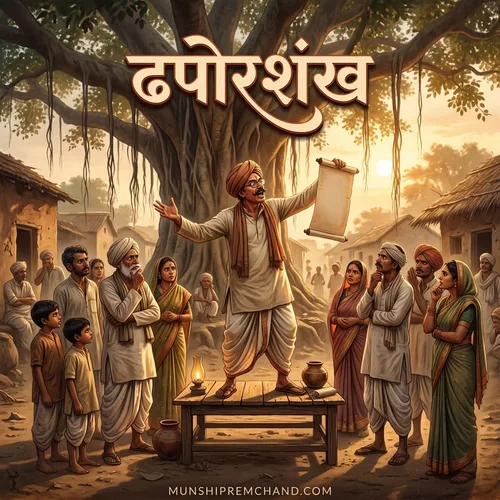
Complete English Translation: Dhaporsankh (The Idle Boaster)
I have a friend who lives in Moradabad. He is a truly singular character. He possesses so much simplicity and innocence that even in this iron age of deceit, he can easily be led by the nose by anyone who cares to try. God has not gifted him with wealth, yet his heart is so extraordinarily large that if he had an empire, he would give it away in charity within a week. He runs a small monthly journal. He barely scrapes together enough to keep the kitchen fire burning, but his self-respect is so towering that he would rather starve than stretch his hand before anyone. If anyone ever attempts to praise his writing or his generous nature, he swells up like a bladder and completely loses his wits. In our circle of friends, we have christened him Dhaporsankh—The Great Braggart, the gullible windbag who talks endlessly and falls for every fairy tale.
His wife, whom we respectfully call Devi Ji, is the absolute opposite of him in every conceivable way. She is sharp, practical, quick-witted, and possesses eyes that can see through stone walls. Nature has bestowed upon her both beauty and a tongue sharper than a razor. Dhaporsankh is terrified of her temper, but because his generous, credulous nature constantly gets him into trouble, domestic storms in their home are as frequent as summer squalls.
Last month, when I had occasion to go to Moradabad on some personal business, I stayed at his house. The moment I set foot inside his sitting room, I found the atmosphere thick with impending disaster.
Dhaporsankh was sitting on the floor with his head lowered, clutching an enormous bundle of letters. Standing before him, with hands planted on her hips and her eyes flashing lightning, was Devi Ji.
Seeing me enter, Dhaporsankh looked up as though a condemned man had suddenly caught sight of a royal pardon. "Ah, brother! Come in, come in! Thank God you have arrived! You could not have chosen a better moment."
Devi Ji did not allow him to finish. Turning her blazing eyes toward me, she snapped, "You have come just in time! Please, take a seat and act as our arbitrator. Look at these letters! Look at this mountain of rubbish! For six whole months, I have been screaming myself hoarse, but this great philosopher here refuses to listen. A vagabond, a scoundrel, a cheat named Karunakar Joshi came along, spun him a few sob stories, and stripped him of more than five hundred rupees! We don't have enough money to buy decent clothes for the children, our milkman comes every morning to threaten us, the grocer has stopped our credit, and this saintly gentleman has been sending postal money orders to a charlatan in Bombay and Agra! And even today, when the scoundrel's fraud has been dragged into broad daylight, he is still singing praises of that cheat's literary genius!"
Dhaporsankh grimaced, trying to muster an air of injured dignity. "Devi, there is a limit to everything! You are speaking in front of a guest. Whatever Karunakar Joshi may or may not be, you have no right to insult literature and art. He is an exceptionally gifted poet and dramatist. If an artist falls into dire misfortune and a brother writer extends a helping hand, only a heart made of stone would call it foolishness! Has anyone ever seen an artist who is also a shrewd businessman? Poverty and tragedy are the eternal companions of true genius!"
"Genius indeed!" Devi Ji retorted mockingly. "A genius at emptying fools' pockets! Brother, you listen to the facts from beginning to end. If after hearing everything, you say that my husband is not a certified idiot, I shall touch his feet and never utter a word of complaint again. But if you find that he has been played for a fool, he must surrender all financial authority to me and admit his stupidity!"
Dhaporsankh accepted the challenge with bravado. "Agreed! Let our friend be the Panch, the sole judge! He is an educated, impartial man. He will distinguish milk from water."
Devi Ji sniffed contemptuously and marched into the kitchen to prepare our lunch, leaving the two of us alone.
Dhaporsankh heaved a deep sigh of relief, bolted the inner door softly, and sat down beside me, spreading the sheaf of letters upon the carpet.
"You see, brother," Dhaporsankh began in a low, conspiratorial whisper, "women have absolutely no appreciation for literary sentiment. Their entire universe revolves around flour, lentils, ghee, and gold bangles. They cannot fathom the sublime heights of an artistic soul. Listen to this saga from the beginning, and judge for yourself whether any sensitive human being could have acted otherwise."
"I am all ears," I said, suppressing a smile. "Begin."
"About a year ago," Dhaporsankh narrated, smoothing out the first letter, "I received this letter from a young man named Karunakar Joshi. He wrote from Allahabad. He said he had written a historical drama titled Chandrahas and requested that I write a critical preface for it. The language of his letter was breathtaking—pure, poetic, dripping with modesty and reverence. He wrote: 'Respected Editor Ji, your critical essays shine like the polestar in the dark firmament of modern Hindi literature. A single blessing from your golden pen will bestow immortality upon my humble offering.' Tell me, brother, could any true lover of literature turn away an earnest young writer who writes with such devotion?"
"Certainly not," I answered diplomatically. "Praise from an aspiring writer is hard to resist."
"Precisely!" Dhaporsankh beamed. "I wrote back immediately, encouraging him warmly and promising to write an exhaustive preface. A week later, came his second letter. Ah, what a heart-rending document! He poured his entire soul into it. He revealed that he was the only son of an extremely wealthy zamindar in Rajasthan. His father and uncle wanted him to marry an illiterate girl from a rich family merely to acquire a dowry of fifty thousand rupees. Karunakar was an idealist, a worshipper of beauty and culture. He flatly refused, declaring that he would rather die than sell his soul for filthy lucre! At this, his tyrannical father cursed him, beat him, and cast him out of the ancestral estate without a single copper!
He walked barefoot to Prayag. There, starving and friendless, he secured a meager job proofreading at a printing press for twenty rupees a month. But even there, his towering self-respect proved to be his undoing. The press manager, a coarse and vulgar brute, insulted him one day over a delayed galley proof. Karunakar flung the papers into the manager's face, resigned on the spot, and declared: 'A true poet may starve, but he will never lick dust for bread!'"
Dhaporsankh paused, wiping a tear from the corner of his eye. "Brother, when I read that, my hair stood on end! What nobility! What sublime defiance! Here was a youth of royal blood enduring starvation for the sake of his ideals!
Two weeks passed. Then came a frantic telegram from Bombay. Karunakar had traveled there in search of work, but fate had dealt him blow after blow. He was penniless, sleeping under the awnings of closed shops, living on parched gram, and shivering with fever. He wrote: 'Beloved Gurudev! This is my final letter to you. My shoes have worn through, my clothes are in rags, and my body has no strength left. Tonight I shall plunge into the Arabian Sea and end this miserable existence. But before I die, I kiss your feet in gratitude for your kindness.'
Tell me, brother, could I let an immortal genius drown himself in the ocean? Would the guilt not have haunted my conscience until my dying day?"
"So what did you do?" I asked.
"What could I do?" Dhaporsankh said, his chest puffing out. "It was the middle of the month. I didn't have a pie in my pocket. I went to the local moneylender, pledged Devi Ji's silver anklets—which she luckily wasn't wearing that day—and took fifty rupees. But just as I was heading to the post office, a supplementary telegram arrived: 'A miraculous door of fortune has opened! A major German commercial agency has offered me their sole representation for military supplies. Salary two hundred rupees a month plus hefty commission! But they require an immediate cash security deposit of one hundred rupees. If the money does not arrive by wire before five o'clock tomorrow evening, the post will be given to a Parsi candidate. Save me, Gurudev!'
Think of it! Two hundred rupees a month! A guaranteed path to prosperity! I rushed back to the moneylender, pledged my gold ring as well, borrowed another fifty rupees, and sent an urgent telegraphic money order of one hundred rupees to Bombay!"
"A hundred rupees by wire," I muttered. "A princely sum for an editor whose journal runs on a deficit."
"Princely indeed! But see what happened next," Dhaporsankh continued. "A week later, a grand gentleman stepped down at the Moradabad railway station and took a horse carriage straight to the Imperial Hotel! It was none other than Karunakar Joshi himself!
He sent a messenger to fetch me. When I arrived at the hotel, I was dazzled. He was wearing an exquisite English tweed suit, shining leather boots, a felt hat, and had three massive leather trunks resting in his room! He ran forward, fell at my feet, and wept tears of profound gratitude. 'Gurudev! You are my savior, my living deity!'
He told me that the German agency had accepted him with open arms, given him an advance, and sent him on an inspection tour of Northern India. He stayed at the Imperial Hotel for three days. But when the time came to settle the hotel bill, a slight embarrassment occurred. Karunakar discovered that his pocketbook, containing his bank drafts and five hundred rupees in currency notes, had been pickpocketed during his train journey from Delhi! The hotel manager was threatening to call the police. Could I allow my disciple, a distinguished representative of a foreign firm, to be arrested in my own city? Never! I ran around, borrowed thirty rupees from our friend Mathur, and cleared his hotel bill. Then I brought him to my own house with all honor!"
I chuckled inwardly. "And how did Devi Ji receive this distinguished guest?"
Dhaporsankh coughed awkwardly. "Well... at first, she was suspicious, as women always are. But Karunakar was a master of etiquette. He addressed her as Bhabhi Ji, fell at her feet, and within two days completely won her over. He would help in the kitchen, prepare special Bengali delicacies, tell delightful jokes, and play divine melodies on our harmonium every evening. Even Devi admitted that she had rarely met a young man with such refined manners.
He stayed with us for two weeks. But living in our cramped quarters proved inconvenient for his high-level correspondence. Our friend Mathur—you remember Mathur, don't you? The poor clerk who earns thirty rupees a month and has an old mother, two widowed sisters, and half a dozen orphaned nephews to feed—Mathur had a spare room in his rented house. Karunakar decided to move there to give us some peace.
Shortly after moving to Mathur's house, Karunakar came to me looking pale and distressed. He said: 'Gurudev, a catastrophe has occurred! That rogue publisher in Prayag who stole my drama Chandrahas has threatened to publish it under someone else's name unless I pay him fifty rupees to release the copyright! That drama is my life's masterpiece. If I lose it, I will lose my mind!'
I didn't have fifty rupees, but I couldn't let his masterpiece be stolen. I took an advance on the next issue of my journal from our press owner and handed him fifty rupees.
A few days later, Karunakar came running again, breathless with anxiety. 'Gurudev, poor Mathur is in terrible trouble! His landlord has brought bailiffs to seize their household pots and throw his widowed sisters into the street because of thirty rupees in arrears of rent! Mathur is weeping like a child. I cannot bear to see such misery under the roof that shelters me. Please, lend me thirty rupees so I can save that poor family!'
I was deeply moved by his compassion for Mathur. I borrowed thirty rupees from another acquaintance and gave it to him."
"Did Mathur pay his rent with that money?" I inquired, already guessing the punchline.
Dhaporsankh waved his hand dismissively. "Wait, wait, listen to the sequence of events first! A week later, Karunakar received a telegram from an influential Member of the Legislative Council in Agra, a wealthy nobleman named Rai Bahadur Shyam Sunder Lal. The Rai Bahadur was an old college friend of Karunakar's father. He wrote offering Karunakar the post of Private Secretary at a salary of one hundred and fifty rupees a month, with free bungalow and car!
Karunakar was overjoyed. But there was a hitch. His clothes had grown slightly worn, and he had no money for the first-class railway fare to Agra. 'Gurudev,' he said, 'this is the turning point of my destiny! Once I take charge of the Rai Bahadur's secretariat, all our financial troubles will be over forever. I will repay every single pie you have spent on me, with interest! Just arrange forty rupees for my train fare and a new woolen overcoat.'
I went to the cloth merchant, bought the woolen cloth on credit, got the overcoat stitched, gave him forty rupees in cash, and saw him off at the station with our blessings."
"And then?" I asked, thoroughly amused.
"Then, brother, came the most extraordinary chapter of this epic!" Dhaporsankh said, leaning forward with shining eyes. "Two weeks later, Karunakar returned to Moradabad, looking like a lord! He told me that the Rai Bahadur was utterly enchanted with his work. The Rai Bahadur's family was visiting Moradabad's famous brassware market through him. Karunakar said the Rai Bahadur wanted fifty rupees worth of exquisite Moradabad brass utensils—engraved jugs, trays, and vases—to present as gifts to the Governor!
Naturally, I took him to the leading brass merchant in the bazaar. Since the merchant knew me, he gave us fifty rupees worth of the finest brassware on my personal guarantee. Karunakar packed them into two crates and took them to Agra.
And then, barely ten days later, I received this letter—the masterpiece of his correspondence!"
Dhaporsankh unfolded a thick, scented letter written in purple ink and began reading aloud with tremendous dramatic flourish:
"Most Revered Gurudev!
Fate has showered the treasures of heaven upon your humble servant! Yesterday evening, as I was taking my customary stroll along the scenic banks of the Yamuna in Agra, a horrifying scream pierced the air. A wealthy elderly gentleman and his ethereal, angelic daughter were bathing at the ghat. The young lady took a false step, slipped into the deep, raging whirlpool of the river, and was swept away by the current! The old father was beating his chest on the bank, screaming for help, but none of the terrified bystanders dared plunge into the swirling vortex.Without hesitating for a fraction of a second, I invoked your holy name and dived into the roaring flood! Battling the ferocious waves with superhuman strength, I caught the drowning maiden by her silken tresses just as she was sinking for the third time. Dragging her unconscious form through the churning waters, I brought her safely to the bank and restored her to her weeping father!
The old gentleman, whose name is Seth Jamunadas—a multi-millionaire banker of Mathura—embraced me with tears of boundless gratitude. When he learned of my noble lineage and my literary achievements, he declared: 'Young man, you have saved my only child, Pramila! God Himself has sent you to be her husband!'
Gurudev, Pramila is an apsara descended from heaven! The wedding has been fixed for next Thursday. Seth Ji is bestowing a dowry of fifty thousand rupees in cash, a palatial mansion, and motorcars! But alas, my aristocratic pride forbids me from appearing before my bride's family as a pauper. I must arrange a decent bridal trousseau, gifts for the priests, and customary offerings. Seth Ji will shower me with lakhs after the wedding, but today I need at least three hundred rupees for immediate preparations. If you cannot arrange three hundred, send at least one hundred rupees by wire at once, and come to Agra by the night train to bless your disciple as the chief guest of honor! Your grateful son, Karunakar."
Dhaporsankh lowered the letter, looking at me with triumph. "Well? Tell me honestly! When a young man whom you have nurtured from dust is about to marry a millionaire's daughter and receive fifty thousand rupees, could you hold back? Was it not my sacred duty as his Gurudev to ensure that his wedding took place with full splendor?"
"And so," I said, "you sent another hundred rupees."
"I did!" Dhaporsankh proclaimed proudly. "I had no money left, so I borrowed a hundred rupees from Lala Ramswarup at two percent monthly interest. I wired the money to Agra, packed my best sherwani, and caught the evening passenger train to Agra to attend the wedding!"
"Marvelous!" I laughed. "And what happened when you reached Agra?"
At this point, Dhaporsankh's face fell. The triumphant sparkle in his eyes vanished, replaced by a sheepish, melancholic twitch of his lips.
"Well... brother... that is where the tragedy began," Dhaporsankh mumbled.
Just then, the inner door flew open, and Devi Ji stepped into the room carrying a large brass tray laden with hot rotis, lentils, and vegetables.
"Why have you stopped?" she asked with biting sarcasm. "Go on, tell him the glorious climax! Tell your wise friend what happened when you got down at the Agra station! Tell him how you searched every corner of Agra for Seth Jamunadas's palace and found that no such millionaire had ever existed in the history of Mathura or Agra! Tell him how you discovered that Karunakar Joshi had checked out of his boarding house two days before, leaving behind an unpaid laundry bill and three empty cigarette tins!"
Dhaporsankh stared at his toes, muttering, "It is quite possible that Seth Jamunadas lives under an assumed name to escape tax collectors... or that the wedding party had to relocate to Mathura due to astrological considerations..."
"Astrological nonsense!" Devi Ji cried, setting the tray down with a loud clang. "Brother, listen to the rest of the scandal! While my saintly husband was wandering around Agra like a lost ghost, our poor neighbor Mathur was served with a court summons!
It turned out that Karunakar had not only pocketed the thirty rupees my husband gave him for Mathur's rent, but he had actually gone to a local money-lender in Moradabad, forged Mathur's signature as guarantor, and taken a personal loan of one hundred rupees before absconding! Poor Mathur, who cannot even afford milk for his starving babies, was being dragged to civil court!
And that is not all! Three days after my husband returned empty-handed from Agra, who should arrive at our door but Rai Bahadur Shyam Sunder Lal himself, visiting Moradabad on government business. When my husband timidly went to his camp to inquire about Karunakar's secretariat and the fifty rupees worth of brass utensils, the Rai Bahadur was utterly flabbergasted!
The Rai Bahadur said: 'What private secretary? What brass utensils? Karunakar came to me in Agra weeping bitter tears, telling me that his dearest friend Mathur in Moradabad had suddenly dropped dead of cholera, leaving behind a destitute mother and starving widows! Out of pity for the grieving family, I handed Karunakar one hundred rupees as emergency funeral aid!'"
Devi Ji turned on her husband, her eyes blazing with indignation. "He stole from us, he stole from Mathur, he cheated the Rai Bahadur, he cheated the brass merchant, and this great editor of ours is still defending him as a misunderstood literary martyr! Now, brother, you are our Panch. Give your verdict! Is my husband a noble benefactor, or is he the biggest simpleton walking upon the earth?"
I looked at Dhaporsankh. The poor man was cowering like a schoolboy caught stealing mangoes, his eyes pleading with me for mercy. If I declared him a fool, his domestic peace would be shattered for the next ten years; Devi Ji would never let him live it down. On the other hand, the evidence of his supreme gullibility was as clear as the noonday sun.
I cleared my throat, assumed the solemn expression of a High Court judge, and delivered my verdict:
"Respected Devi Ji, and my dear friend Dhaporsankh! I have listened to the entire testimony with the utmost impartiality.
There can be no doubt that Karunakar Joshi is an unprincipled scoundrel and an accomplished swindler of the first order. But when we examine the actions of my friend Dhaporsankh, we must judge the motive rather than the outcome.
Did he give this money to buy luxury for himself? No. Did he give it out of greed or malice? No. Every single rupee he parted with was offered at the altar of compassion, friendship, literary devotion, and self-sacrifice! When he heard of a writer starving, his heart bled. When he heard of Mathur's distress, he reached out to save him. When he believed an innocent girl was saved from drowning, he rejoiced in another man's good fortune.
Such boundless innocence and generosity may be considered foolishness by cold, calculating accountants who weigh life on a grocer's scale. But in the eyes of God and high morality, it is not foolishness—it is the supreme nobility of an uncorrupted soul! A man who can maintain such pure, childlike faith in human goodness in this cynical world is not an idiot; he is a living saint!"
The moment the words left my mouth, Dhaporsankh leaped up from the carpet with a roar of triumph, threw his arms around my neck, and embraced me so hard that my ribs creaked!
"Did you hear that, Devi?" he shouted exultantly. "Did you hear the verdict of the Panch? He called me a living saint! He recognized the sublime purity of my artistic soul! Literature has triumphed over ledger books!"
Devi Ji picked up the empty brass tray, gave the two of us a look of blistering, withering scorn, and shook her head in disgust.
"A saint indeed!" she scoffed, marching toward the kitchen. "Crows will always defend crows! Thieves will always call each other brothers! God save any household where two such philosophers sit together in judgment!"
And with that parting shot, she slammed the kitchen door, leaving Dhaporsankh beaming like an emperor who had just conquered the three worlds.
Summary of Dhaporsankh (The Idle Boaster)
The narrator visits his childhood friend in Moradabad, nicknamed "Dhaporsankh"—an affectionate moniker for a naive, impractical, yet deeply warm-hearted editor of an impoverished literary journal. Upon arrival, the narrator finds Dhaporsankh locked in a fierce domestic quarrel with his sharp-witted and pragmatic wife, Devi Ji. Devi Ji accuses her husband of being an irredeemable simpleton who has been swindled out of more than five hundred rupees by a con-artist named Karunakar Joshi. Dhaporsankh, on the other hand, stubbornly defends Joshi as a tragic, noble writer whose genius was persecuted by an unfeeling world.
Appointed as the sole arbitrator (Panch) to settle the dispute, the narrator listens as Dhaporsankh reads dramatic excerpts from Joshi's correspondence. Joshi had initially hooked the editor by flattering his critical acumen and asking for a preface to his drama Chandrahas. Gradually, Joshi spun an escalating series of tragic falsehoods: being disowned by a wealthy father for refusing a dowry marriage, enduring starvation in Bombay, requiring a hundred-rupee deposit for a lucrative German agency, needing funds to rescue his drama manuscript, and pleading for cash to pay his friend Mathur’s rent.
The swindle peaked with a fabricated romance: Joshi claimed he had rescued a millionaire banker's daughter from drowning in the Yamuna River in Agra and was set to marry her with a fifty-thousand-rupee dowry, needing immediate funds for bridal preparations. When Dhaporsankh traveled to Agra to attend the wedding, he found neither banker nor bride. Devi Ji then delivers the final devastating revelations: Joshi had forged Mathur's signature for a loan, pocketed Mathur's rent money, swindled fifty rupees worth of brass utensils, and extorted emergency bereavement money from an Agra Councillor by claiming that Mathur had died of cholera.
Cornered between harsh reality and saving his friend from eternal domestic ridicule, the narrator diplomatically delivers a Solomonic verdict. He condemns Joshi as a scoundrel but exalts Dhaporsankh's motives as expressions of pure, saintly altruism and childlike innocence rather than foolishness. Overjoyed, Dhaporsankh embraces the narrator in triumph, while Devi Ji exits in exasperation, declaring that men will always band together to protect their collective folly.
Publication History
Dhaporsankh (ढपोरशंख) was written by Munshi Premchand in 1931 during his prolific later literary phase. It was published in leading Hindi literary periodicals and subsequently collected in his definitive eight-volume short story anthology Mansarovar (मानsarovar). The story belongs to Premchand's celebrated corpus of domestic and literary satires, where humor, marital banter, and sharp character studies illuminate the foibles of the contemporary middle-class intelligentsia.
This unabridged English translation was published in 2026 by MunshiPremchand.com as part of the MunshiPremchand.com English Translation Series.
Themes & Critical Significance
1. Literary Vanity and Exploitative Flattery
Premchand brilliantly satirizes the vanity that plagues aspiring writers and editors. Karunakar Joshi succeeds in defrauding Dhaporsankh not through brute force, but by appealing directly to his literary ego. By praising the editor as the "polestar of Hindi literature" and framing his own life as a romantic struggle between noble art and crass commercialism, Joshi easily disarms Dhaporsankh's critical faculties.
2. The Conflict Between Romantic Idealism and Practical Realism
The central dynamic between Dhaporsankh and Devi Ji captures the perennial domestic tension between idealistic dreamers and practical homemakers. Dhaporsankh lives in a world of high-minded abstractions, self-sacrifice, and poetic grandeur, while Devi Ji must contend with the realities of overdue grocery bills, rent, and empty larders. Premchand portrays Devi Ji not as a shrew, but as the clear-headed anchor protecting the family from financial ruin.
3. Empathy as a Vulnerability in a Cynical World
While the story is richly comedic, it carries an underlying pathos regarding human empathy. Dhaporsankh's willingness to pawn his wife's jewelry and borrow money at high interest stems from genuine horror at another human being's reported suffering. Premchand highlights how an unscrupulous con-artist weaponizes the finest impulses of the human heart—compassion, solidarity, and altruism—turning noble virtues into perilous liabilities.