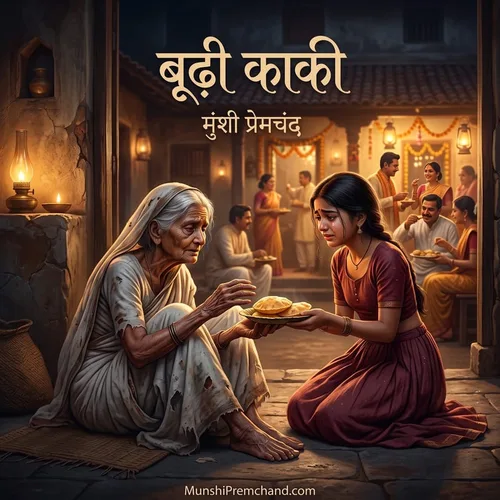
Complete English Translation: Budhi Kaki (The Old Aunt)
1
Except for the craving of the palate, no other active sense remained within her, nor had she any means left to draw attention to her miseries except tears. All her faculties—her eyes, her hands, and her legs—had given up their function. She lay flat upon the earth, and whenever the members of the household did anything contrary to her wishes, or if the hour for her meal was delayed, or if the portion of food served was insufficient, or if something special was brought from the market and not given to her, she would burst into weeping. Hers was no ordinary sobbing or weeping; she wept at the very top of her voice, screaming out her sorrow.
A long age had passed since her husband had departed for heaven. Her sons had grown to manhood only to pass away one after the other in their youth. Now, none remained in the world save for a single nephew. In the name of that nephew, she had legally deeded her entire property. While having the property registered in his name, the nephew had showered her with lavish, sweeping promises; but all those pledges were merely like the lush green gardens painted by labor recruiters—all hollow illusions.
Although the annual income from that property was not less than one hundred and fifty to two hundred rupees, Budhi Kaki could barely secure even enough food to fill her stomach. Whether the blame for this lay with her nephew, Pandit Buddhi Ram, or with his better half, Shrimati Rupa, was by no means easy to determine. Buddhi Ram was a gentle, polite gentleman by nature—but only so long as no demand was made upon his purse. Rupa was sharp-tongued and ill-tempered, true; yet she feared God. Consequently, Budhi Kaki did not mind Rupa's harsh tongue nearly as much as she resented Buddhi Ram's polite, hypocritical gentility.
Now and then, Buddhi Ram did feel a pang of regret for his heartless conduct. He would reflect: "It is solely on account of this property that I sit here today as a respectable, prosperous gentleman." Had it been possible to remedy the situation through polite assurances and dry verbal sympathy, he would probably have raised no objection; but the dread of incurring additional expenditure invariably smothered his good intentions. Things reached such a pass that if some respectable visitor happened to be seated at the door and Budhi Kaki began whining her mournful song inside, he would flare up into a fury, rush into the house, and berate her violently.
Children harbor a natural malice toward the elderly; and when they observed this attitude in their parents, they tormented Budhi Kaki all the more. One would pinch her and run away; another would spit water at her. Kaki would scream aloud in pain; but it was universally accepted that she wept only for food, and therefore no one paid the slightest heed to her agony and despair. Of course, if Kaki lost her temper and began heaping curses upon the children, Rupa would instantly swoop down upon the scene. Out of terror of Rupa, Kaki rarely wielded the dagger of her tongue, although as a means of quelling the children's mischief, it was far more effective than mere tears.
In the entire family, if anyone felt genuine affection for Kaki, it was Buddhi Ram's little daughter, Ladli. Out of dread of her two elder brothers, Ladli used to sit beside Budhi Kaki to eat her own share of sweets and roasted parched grain. This was her secure fortress; and although seeking Kaki's protection proved quite expensive on account of the old woman's insatiable greed—for Kaki invariably demanded a share—nevertheless, safety against the tyranny of her brothers was nowhere else so readily available. This mutual convenience had planted the seeds of deep, tender sympathy between the little girl and the old woman.
2
It was night. Outside Buddhi Ram's door, the melodious notes of the shehnai were resounding, and a flock of village children stood watching the performance with wide, marveling eyes. Guests were lounging on string-cots, enjoying foot-massages from the barbers. Standing nearby, a bard was singing verses of praise and genealogy, rejoicing at the appreciative "Wah! Wah!" of the discerning guests as though he alone were the legitimate claimant to that applause. A couple of English-educated young men stood aloof, indifferent to these rustic festivities; they deemed it beneath their dignity to converse with or mingle in this uncultured gathering.
Today was the celebration of the ceremonial betrothal (tilak) of Buddhi Ram's eldest son, Mukhram. It was in his honor that this festive banquet was taking place. Inside the house, the women were singing wedding songs, and Rupa was busy supervising the cooking for the guests. Cauldrons were mounted upon blazing earthen furnaces. In one, puris and spiced kachauris were being scooped out; in another, sweet delicacies were being prepared. In a large cauldron, rich, spiced vegetables were simmering. The appetizing aroma of pure ghee and fragrant spices hung heavy in the air, wafting all around.
Budhi Kaki sat in her small, dingy chamber like an embodied thought of gloom. This tantalizing aroma, laden with rich flavor, was making her utterly restless. She thought to herself: "Most likely, I shall receive no puris. It is so late already, and no one has brought food for me. It seems everyone has finished eating; nothing has been left for me." At this thought, tears welled up in her eyes; yet out of fear of bringing ill omen upon the house, she choked back her sobs.
"Ah... what a marvelous aroma! Who cares for me now? When even dry rotis are hard to come by, where is the fortune that would grant me my fill of puris?" Thinking this, a deep sob rose in her throat; a sharp ache pierced her chest. But dread of Rupa compelled her to remain silent once more.
For a long time, Budhi Kaki remained submerged in these agonizing thoughts. The fragrant scent of ghee and spices repeatedly drove her mind beyond endurance. Her mouth watered incessantly. Remembering the crisp, savory taste of puris, her heart fluttered with excitement. "Whom should I call? Even little Ladli has not come today. Those two boys are always teasing me; today they are nowhere to be seen either. If only someone would tell me what is being cooked!"
In Budhi Kaki's vivid imagination, pictures of puris began dancing before her eyes: "They will be golden-red, puffed up round and fat, soft and tender! Rupa must have eaten her fill. In the kachauris, there must be the aroma of carom seeds (ajwain) and cardamom! If only I could get just one puri, just to hold it in my hands and look at it! Why shouldn't I go myself and sit near the frying cauldron? Puris will be sizzling as they are scooped from the oil. Hot from the cauldron, they must be piled high upon the brass platters. One can smell a flower even from inside the house, but walking into the garden is quite another matter!"
Having reached this resolution, Budhi Kaki squatted down and, dragging herself forward on her hands and knees with immense difficulty, crawled over the wooden threshold and slowly, painfully crept toward the cauldron. Arriving there, she felt that same desperate patience which a starving dog feels when it sits right before a man eating his dinner.
At that moment, Rupa was frantic under an overwhelming burden of work. Now she ran to this storeroom, now to that chamber, now toward the cauldrons, now to the pantry. Someone shouted from outside: "The Maharaj is asking for thandai!" She began preparing the cooling drink. Just then, someone else entered: "The bard has arrived; give him his grain and flour!" She was measuring out the flour for the bard when a third person arrived and asked: "How much longer before the food is ready? Hand down the drum and cymbals, please!"
The poor woman, running about all alone, was completely exhausted, irritable, and seething with frustration; yet she found no opportunity to vent her rage. She feared that the neighboring women might say she had boiled over so easily. Her own throat was parched with thirst, and she was burning with the sweltering heat; yet she had not a moment's leisure to sip water or fan herself. She was also terrified that the moment her back was turned, provisions would be looted.
In this agitated state, when she suddenly saw Budhi Kaki sitting right beside the frying cauldron, she flared up in fury! Her rage knew no bounds. She forgot that neighbors were sitting all around; she forgot what the men outside would say if they heard. Just as a frog pounces upon an earthworm, she pounced upon Budhi Kaki, shook her violently with both hands, and shrieked:
"May fire consume such a belly! Is it a belly or a blazing furnace? Did you choke to death sitting in your room? The guests have not yet eaten; the food has not yet been offered to the Lord; could you not possess patience until then? You have come to ride upon my chest! May such a tongue burn to ashes! Had you not been stuffing your face all day long, God knows whose cooking pot you would have dipped your snout into! If the village sees this, they will say the old hag gets nothing to eat, and that is why she wanders about with her mouth wide open! The witch neither dies nor vacates the cot! She is hell-bent on dragging our family honor through the dust! She will rest only after cutting our noses off! She stuffs so much food down her throat, God knows into what pit it all burns away! If you want your own good, go this instant and sit in your dark room! When the family eats, you will get your share too! You are no goddess that even before water touches anyone's lips, your worship must be performed first!"
Budhi Kaki lifted her head; she neither wept nor uttered a word. Quietly, dragging herself along, she crept back to her room.
The voice had been so terrifyingly harsh that all the faculties of her heart and brain, all her thoughts, and all the weight of her spirit were drawn entirely in that direction. When a massive chunk of a riverbank collapses and plunges into the river, the surrounding waters from every side rush headlong to fill the void.
3
The feast was ready. Leaf-plates were laid out in the courtyard, and the guests sat down to dine. The women began singing celebratory banquet songs (jevanar). The barbers and servants of the guests also sat down to eat with the company, though seated slightly apart. By polite social custom, however, until every single guest had finished eating, no one could rise from his plate. One or two English-educated guests were growing thoroughly annoyed at the slow, leisurely pace of the servants; they regarded this social etiquette as a thoroughly useless encumbrance.
Sitting in her dark chamber, Budhi Kaki was drowning in deep remorse: "Why on earth did I go out there?" She harbored no anger toward Rupa; she felt grief only at her own impatient haste. "It is only right: until the invited guests have finished eating, how can the family eat? I could not wait even that long! I lost all my respect before everyone. Now, until someone comes to summon me, I shall not stir an inch!"
Comforting herself with these thoughts, she began waiting for the summons. But the delicious fragrance of ghee was proving a grueling test of her endurance. Every single moment seemed to stretch out like an entire epoch.
"The leaf-plates must have been laid out by now... now the guests must have arrived... people are washing their hands and feet; the barber is pouring water... it seems they have sat down to eat... the banquet songs are being sung."
Reflecting upon this, she lay down to divert her mind. Softly, she began humming a tune to herself. After a while, she thought: "I have been singing for a very long time. Could people still be eating after all this time? No voice can be heard. Surely everyone has dined and departed! No one has come to summon me. Rupa is annoyed; who knows, she may not call me at all! She must be thinking that I will come out on my own; after all, I am no honored guest that she should come to invite me."
Budhi Kaki prepared to move. The firm conviction that within a minute puris and spiced vegetables would appear before her made her taste buds tingle with delight. In her mind, she wove all sorts of grand plans: "First, I will eat puris with spiced vegetables; then with sweet curd and sugar; the kachauris will taste heavenly with raita! Whether anyone thinks ill of me or well, I shall ask for more and eat my fill! At most, people will say: 'She has no shame!' Let them say so! After so many days I am getting puris; I will not get up merely after tasting a crumb!"
Squatting upon her hams and dragging herself on her hands, she crept into the courtyard.
Alas, cruel misfortune! Following its ancient habit, her eager yearning had miscalculated the hour!
The assembly of guests was still seated! One was licking his fingers after eating; another was glancing sideways to see if the rest were still eating; another was fretting that puris were left on his leaf-plate and wondering how to tuck them inside; another was smacking his lips after eating curd, yet felt too shy to ask for a second leaf-cup.
Just at that moment, Budhi Kaki came crawling right into their midst!
Several guests started up in astonishment and cried aloud: "Arre! Who is this old woman? Where has she come from? Look out, don't let her touch anyone!"
The moment Pandit Buddhi Ram laid eyes on Kaki, he was beside himself with boiling rage! He was standing with a brass platter piled high with puris. He slammed the platter onto the earth, and just as a heartless moneylender seizes a dishonest, absconding debtor by the throat the moment he catches sight of him, so Buddhi Ram sprang forward, seized Kaki by both arms, dragged her mercilessly across the rough courtyard, and slammed her down violently inside her dark chamber!
The garden of hope was obliterated in a single scorching gust of wind!
The guests finished their feast. The household members ate. The musicians, the washermen, the Chamars—all had their meals; yet no one asked after Budhi Kaki. Both Buddhi Ram and Rupa had resolved to punish the old woman for her shameless brazenness. Upon her extreme old age, her helplessness, her shattered wits, not a soul felt the slightest pity. Only little Ladli sat grieving for her in secret.
Ladli loved Kaki with all her innocent heart. She was a simple, tender girl; not a trace of childish spite or mischief existed in her nature. Both times when her parents had dragged Kaki with such savage cruelty, Ladli's heart had writhed in anguish. She fretted: "Why don't we give Kaki plenty of puris? Will the guests eat every single one? And if Kaki ate before the guests, what great harm would have happened?"
She yearned to run to Kaki and comfort her, but out of fear of her mother, she dared not go. She had not eaten a single crumb of her own share of puris. She had locked them securely inside her doll's basket (pitari). She was desperate to carry those puris to Kaki. Her little heart grew intensely restless: "The moment she hears my voice, Budhi Kaki will sit up; how happy she will be to see the puris! She will shower me with loving kisses!"
4
It was eleven o'clock at night. Rupa was lying asleep in the courtyard. Ladli could not sleep. The joy of feeding puris to Kaki kept her wide awake. She kept the doll's basket right before her. When she was fully convinced that her mother was fast asleep, she rose stealthily and wondered how to make her way.
Darkness hung all around. Only the dying embers of the hearths glowed dimly, and beside the hearths lay a sleeping dog. Ladli glanced toward the neem tree in front of her. It seemed to her that Lord Hanuman was perched upon its branches; his tail, his mace—she could see them distinctly! Out of sheer terror, she shut her eyes tight.
Just then, the dog sat up and stretched. Ladli took courage: a moving dog gave her far more comfort than several sleeping humans! She picked up her basket and crept toward Budhi Kaki's dark chamber.
5
Budhi Kaki remembered only this much: someone had seized her hands and dragged her, and then it felt as though someone were flying away with her over a high mountain; her feet had struck repeatedly against jagged stones, and then someone had hurled her down from the cliff, and she had plunged into unconsciousness.
When her senses returned, not a sound could be heard. She realized that everyone had eaten and gone to sleep, and along with them, her cruel destiny had fallen asleep too.
"How will this night pass? O Lord Rama! What shall I eat? A fire is raging in my belly! Alas! Not a soul took thought of me! Will amassing wealth come from starving my stomach? Do these people have no mercy at all—knowing that the old woman may die at any moment? Why do they torment her soul? Do I ask for anything more than dry bread to fill my belly? And even for that, this treatment! I am blind, crippled; I can neither hear nor understand. If I wandered into the courtyard, could Buddhi Ram not have simply said: 'Kaki, the people are eating right now; come later'? Instead, he dragged me, slammed me down! For those very puris, Rupa heaped curses on me before everyone! Even after dragging me through such degradation, their stone hearts did not melt! They fed everyone, but never asked after me! When they gave me nothing then, what will they give me now?"
Reflecting on this, Kaki lay down with hopeless resignation. Her throat choked with bitter sorrow, but out of fear of the remaining guests, she did not weep aloud.
Suddenly, a sweet whisper reached her ears: "Kaki, wake up! I have brought puris!"
Kaki recognized Ladli's tender voice. She sat up instantly. Feeling with both hands, she pulled Ladli into her lap. Ladli took out the puris and handed them to her.
Kaki asked: "Did your mother give them?"
Ladli said: "No, these are my own share."
Kaki fell upon the puris like a starving creature! Within five minutes, the basket was licked clean.
Ladli asked: "Kaki, is your stomach full?"
Just as a light drizzle produces even more sweltering heat instead of coolness, so those few puris only inflamed Kaki's hunger and craving all the more! She said: "No, my child; go to your mother and ask for some more."
Ladli said: "Amma is fast asleep; if I wake her, she will beat me."
Kaki felt the inside of the basket again. A few crumbs had fallen at the bottom. Again and again, she licked her lips, smacking her tongue.
Her heart was aching with desperation: how could she obtain more puris? When the dam of contentment breaks, the torrent of desire becomes boundless! The mere thought of wine makes the drunkard crazed with thirst. Kaki's restless spirit was swept away in the powerful current of craving. All sense of proper and improper conduct vanished.
For a brief while she struggled against the urge. Suddenly, she said to Ladli: "Take my hand and lead me to the place where the guests sat and ate their dinner."
Ladli could not fathom her intention. She took Kaki's hand and led her out, seating her beside the pile of soiled, discarded leaf-plates.
The wretched, starving, half-crazed old woman began picking up scraps of puris from the dirty leaf-plates and devouring them!
Oh... how delicious the curd was! How savory the kachauris, how wonderfully crisp and tender! Senseless as she was, Kaki knew well enough in her heart that she was committing a deed that she ought never to commit—that she was licking the soiled scraps left by others! But extreme old age is the final stage of the disease of desire, when all human longings converge upon a single solitary center. In Budhi Kaki, that center was the sense of taste.
At that very moment, Rupa awoke! She noticed that Ladli was not beside her. Startled, she peered all around the cot to see if the child had fallen to the ground. Not finding her there, she stood up, and what did she behold?
Ladli was standing silently beside the pile of discarded, dirty leaf-plates, and Budhi Kaki was picking up half-eaten scraps of puris from those soiled leaves and stuffing them into her mouth!
Rupa's heart was struck numb with horror! The sensation that would have seized her upon seeing a sharp knife drawn across the neck of a sacred cow—that exact same terror gripped her at this moment!
A Brahmin woman scavenging the dirty leaf-plates of other men—a more tragic, more horrifying spectacle was impossible to conceive! For a few mouthfuls of puris, her elderly aunt was stooping to such unspeakable degradation!
This was a scene that made the hearts of onlookers tremble. It seemed as though the earth had stopped spinning, as though the sky were whirling in dizziness, as though some cosmic catastrophe were about to crash down upon the world!
No anger touched Rupa. Before such monumental grief, where was the room for anger? Her eyes brimmed with tears of profound compassion and terror. "Who is the perpetrator of this monstrous unrighteousness?"
Lifting her hands toward the heavens with a sincere, trembling heart, she cried: "O Supreme Lord! Have mercy upon my children! Do not visit the retribution of this heinous sin upon me, or my family will be utterly destroyed!"
Never before had Rupa's own selfishness and cruelty appeared before her in such naked, glaring reality. She began to weep: "Alas! How heartless, how monstrous I am! She from whose property I receive an income of two hundred rupees—to reduce her to this abject misery! And all because of me! O Merciful God! A grievous sin has been committed by my hands; forgive me! Today was the betrothal feast of my son. Hundreds of men dined here; I remained a humble slave to their slightest whims; for the sake of worldly vanity, I squandered hundreds of rupees; yet she through whose generosity we have enjoyed thousands of rupees—I could not provide even a bellyful of food for her on this festive day! And only because she is an old, helpless widow!"
Rupa lit the oil lamp, opened the doors of her pantry, arranged a large brass platter with every delicacy—hot puris, savory kachauris, spiced vegetables, curd, and sweetmeats—and walked toward Budhi Kaki's dark room.
Midnight had long passed. The platter of the night sky was adorned with stars, and upon them the deities were arranging celestial feasts; but not one among them could experience that supreme, heavenly ecstasy which filled Budhi Kaki when she beheld the laden platter placed before her!
In a voice choked with tears, Rupa said: "Kaki, arise and eat your food. A terrible wrong was committed by me today; do not take it to heart. Pray to the Supreme Lord to forgive my transgression!"
Like an innocent little child who forgets all blows, scoldings, and humiliations the moment a handful of sweets is placed in its hands, Budhi Kaki forgot every insult, every agony, and sat eating the feast.
From every single pore of her being, pure, heartfelt blessings were pouring forth; and Rupa sat beside her, completely immersed in the divine bliss of that heavenly sight.
Summary of Budhi Kaki (The Old Aunt)
Budhi Kaki is one of Munshi Premchand's most moving and psychologically incisive masterpieces, depicting the tragic vulnerability and neglect of the elderly in joint families.
Budhi Kaki is an aged, infirm widow whose husband and sons have all died. Having transferred her entire landed property (yielding an annual income of nearly two hundred rupees) to her nephew, Pandit Buddhi Ram, she is treated as an unwelcome burden. While Buddhi Ram maintains an outward facade of respectability, his wife Rupa openly mistreats Kaki, denying her sufficient food. Kaki's physical faculties have failed, leaving only her acute craving for food intact; whenever she is starved or mistreated, she screams and weeps at the top of her voice, drawing only annoyance from the family. The sole source of affection in the home is Buddhi Ram's gentle little daughter, Ladli, who shares her sweets with the old woman.
On the occasion of Buddhi Ram's eldest son Mukhram's ceremonial engagement (tilak), a grand banquet is prepared with cauldrons of fried puris, spiced kachauris, and rich curries. Overwhelmed by the mouth-watering aromas, the starving Kaki crawls out of her dingy room on her hands and knees toward the frying cauldron. Rupa, harried by work, attacks Kaki in a fury, heaping vicious verbal abuse upon her and banishing her to her room. Later that evening, when the guests sit down to dine, Kaki's ravenous hunger drives her to crawl into the courtyard once more. Enraged at the potential embarrassment before his guests, Buddhi Ram brutally drags Kaki across the yard and slams her into her dark chamber.
Late that night, after everyone has eaten and gone to sleep without feeding Kaki, little Ladli secretly brings her own uneaten share of puris to the old woman. The few puris only whet Kaki's voracious hunger. Desperate for food, Kaki asks Ladli to guide her to the courtyard where the guests had eaten. In the dark, the blind, starving Brahmin widow sits upon the ground, picking up discarded scraps of puris from the dirty, leftover leaf-plates.
Awakening in the night, Rupa discovers Ladli missing and finds her standing by the garbage heap, watching Budhi Kaki scavenge food scraps from the soiled plates. The sight strikes Rupa with immense horror and remorse. Terrified of divine retribution for starving the helpless benefactor whose property funds their prosperity, Rupa breaks down in tears. She prepares a lavish platter of fresh puris, curries, and sweets, carries it to Kaki's room, and tearfully begs for forgiveness. Forgetting all her past torment like an innocent child, Budhi Kaki feasts with boundless joy, showering blessings upon Rupa.
Publication History
Budhi Kaki (बूढ़ी काकी) was written by Munshi Premchand in 1921 and was first published in the leading Hindi literary monthly Saraswati (सरस्वती). It was subsequently collected in Volume 8 of Mansarovar (मानसरोवर भाग 8). Widely acclaimed as one of Premchand's greatest emotional masterpieces, the story has been adapted numerous times for theater, television, and radio across India.
This unabridged English translation was published in 2026 by MunshiPremchand.com as part of the MunshiPremchand.com English Translation Series.
Themes & Critical Significance
- Elder Abuse and the Plight of the Elderly: The story is a devastating indictment of how traditional families treat elderly dependents once property rights have been transferred. Premchand illustrates how economic vulnerability strips the aged of their human dignity, reducing them to desperate hunger.
- The Psychology of Senile Desire: Premchand insightfully explores the regression of old age into a second childhood. With her intellect and physical senses failing, Kaki's entire existence centers upon the sense of taste (jihva-swad), highlighting the primal tragedy of hunger stripped of societal vanity.
- Innocence vs. Adult Hypocrisy: Little Ladli serves as a moral foil to her selfish parents. Uncorrupted by social calculation or material greed, the child embodies instinctive empathy, sacrificing her own food to comfort the suffering elder.
- The Moral Shock of Retribution and Guilt: The turning point of the narrative is Rupa's spiritual awakening. The sight of a revered Brahmin widow licking discarded food scraps from garbage shatters Rupa's complacency, awakening her conscience and illustrating the power of genuine moral repentance (prayaschitta).
- The Sanctity of Forgiveness: Kaki's instant forgiveness upon being fed reflects the purity of an innocent soul. In Premchand's vision, compassion transcends bitterness, offering a path to domestic harmony and human redemption.