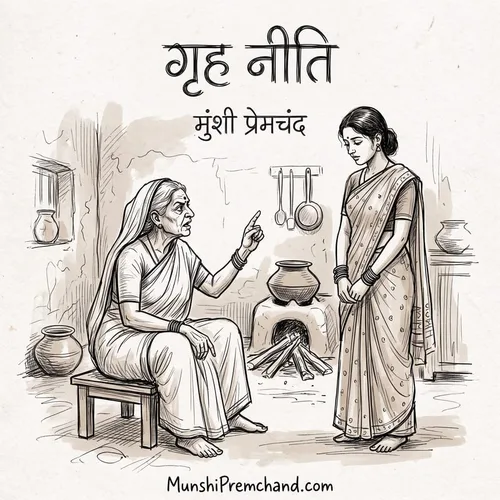
Complete English Translation: Grih Neeti (Domestic Policy)
When a mother opens an endless ledger of grievances against her daughter-in-law before her son, and this unending recital shows not the slightest sign of concluding, the son eventually grows exhausted. Weary from the grueling labors of the entire day, he turns to his mother in exasperation and says:
"So, after all, Amma, what exactly are you asking me to do? My occupation is not that of a schoolmaster to instruct a woman! That is your department. Scold her, beat her, impose whatever punishment you deem fit! What could bring me greater happiness than to see her transformed into a refined human being through your endeavors? Do not come to me complaining that she lacks manners, that she has no etiquette, that she is impudent. Scold her yourself and teach her!"
Mother: "Splendid! She doesn't allow a single syllable to escape my lips! If I dare scold her, she looks ready to tear out my flesh! I spend all my days running about trying to protect my own honor, terrified that she might fling some scandalous insult straight into my face before strangers. Tell me, son, what is my fault in this?"
Son: "And do I instruct her to be disrespectful toward you?"
Mother: "Then who else teaches her?"
Son: "You are acting completely unreasonably, Amma!"
Mother: "I am not acting unreasonably; I speak the gospel truth! It is only because she receives encouragement and support from you that her conceit has climbed into the skies! When she comes running to you shedding crocodile tears, have you ever once rebuked her? Have you ever once explained to her: 'You must show reverence and deference to Amma'? You have turned into her willing slave! She too thinks to herself: 'My husband earns the bread, so why shouldn't I reign like a queen? Why should I bow before anyone?' As long as a husband does not encourage her, no woman on earth can muster such insolence!"
Son: "Then what should I do? Should I tell her that I earn nothing, that I am an absolute good-for-nothing parasite? Do you imagine she wouldn't look down upon me with contempt then? Every single man alive desires that his wife should regard him as capable, prosperous, worthy, and dignified; in fact, a man generally portrays himself as far more accomplished than he actually is! I have never acted foolishly; I have never bragged before my wife. But no man willingly forfeits his respect in the eyes of his own wife!"
Mother: "Then continue to worship her! Go on burning your own mother's heart! I suffered all my life as a helpless widow, broke my back and sold my very jewelry to educate you and make a man out of you; and today you stand there acting like her advocate! God above is watching everything."
Son: "I simply cannot fathom what more you expect of me! Whatever humble salary I earn, I place the entire amount directly into your hands on the first of every month. I wear whatever clothes you have stitched for me; I eat whatever food you place before me. I have never uttered a harsh word to you; I have never shown you disrespect. I cannot recall a single instance where I deliberately displeased you."
Mother: "You soothe my feelings! You comfort me! The way I am forced to live in your house—an enemy's dog would not live like this! When I came as a bride, I never dared speak a loud word before my elders! Before going to bed at night, I would massage my mother-in-law's body from head to foot, rub fragrant oil into her scalp, warm her milk, and serve her like a maidservant. Only after she was fast asleep did I dare retire to my mat. And this precious wife of yours—she locks herself inside her room, flings open the windows to enjoy the fresh breeze, lounges upon her soft cot, and reads novels! Was it for this wretched day that I brought you up?"
Son: "If anyone owes you such service, Amma, it is I, your son! Why should you expect my wife to become your maidservant? I would feel utterly mortified if my wife were forced to massage my feet at night, because I would never accept a service from her that I am not prepared to reciprocate equally! Husband and wife are equal partners in life. Treating a daughter-in-law as a personal servant to wash feet and scrub floors is a relic of an ancient, barbaric era when women were bought and sold like cattle!"
Mother: "Splendid! So now your old mother is barbaric! And what about common social decency? When respectable elderly ladies of the neighborhood come to visit, your wife does not even bother to step out of her room! She does not touch their feet with her sari-pallu; she does not offer them a pranam; she does not serve them paan; she does not fan them! A daughter-in-law earns honor in society through these very graces. Because of her arrogance, all the women of the neighborhood spit upon our house and sneer: 'The new bride has become proud and haughty; she refuses to speak to anyone with a civil tongue!'"
Son: "Those women come to visit you, Amma, not her! Heaven alone knows what gossip and slander pass between you and them. If your daughter-in-law were to intrude into your circle, I would consider her thoroughly ill-mannered! I would certainly never tolerate it if you or my wife barged into the room while I was chatting with my friends. If my wife is sitting with her own companions, I would never dream of entering without being invited. That is modern etiquette."
Mother: "You take her side in every single matter! God knows what love-potion she has fed you! Who is asking her to barge into our conversation? But surely she owes basic respect and hospitality to her elders!"
Son: "In what manner?"
Mother: "By coming forward, touching their feet with her veil, bowing low, serving paan, and waving the fan! These are the marks of a well-bred daughter-in-law. It is through these virtues that people praise a bride! Otherwise, every woman in town will declare that she has grown swollen with conceit!"
Son: (Reflecting) "Yes, in that regard, she is certainly at fault. I will explain it to her."
Mother: (Pleased) "I tell you the absolute truth, son—she doesn't even bother to rise from her cot! All the women click their tongues in disgust, yet shame hasn't touched her even by mistake! And as for me, I am dying of embarrassment!"
Son: "What I cannot understand, Amma, is why you insist on taking responsibility for all her actions upon your own head! In my office, my superiors shower me with reproaches every day; explanations are demanded from me constantly. Yet you always shower me with sympathy! Do you imagine my officers harbor some ancient grudge against me, or that they have gone mad and lunge forward to bite me without cause?
No! The simple truth is that I am careless in my duties. I make mistakes, I am lazy, I neglect my files. The moment the officer turns his back, I start reading the newspaper or playing cards! Don't we know at that moment that work is lying unfinished? We think to ourselves: At worst, the sahib will give me a scolding; I will bow my head, listen quietly, and the storm will blow over! Yet even knowing that I am guilty, you take my side! If it were in your power, you would exile our head clerk to the penal colony of the Andaman Islands merely for daring to demand an explanation from your darling boy!"
Mother: (Beaming with motherly pride) "If anyone dares punish my boy, am I supposed to worship him with flowers and paan?"
Son: "Every son expects exactly this tender indulgence from his mother, and all mothers cast a protective veil over their sons' flaws! Why then, Amma, does your heart turn into solid granite when it comes to your daughter-in-law? That is what I cannot comprehend!
When other neighborhood women fling barbed taunts at your daughter-in-law, maternal affection dictates that you should apologize on her behalf, invent an excuse, and strive to elevate her in their eyes! Why do you join hands with those strangers in humiliating her? Why do you take perverse delight in her disgrace?
Look at me—I do not show blind reverence to every Brahmin or elderly person who crosses my path. I cannot bow my head before any individual for whom I feel no genuine, heartfelt reverence! Merely having white hair, wrinkled skin, a toothless mouth, and a bent spine does not make a person worthy of veneration; nor are a sacred thread, a sandalwood mark, or high-sounding titles like 'Pandit' and 'Sharma' objects of blind devotion!
I consider mechanical, unthinking reverence to be a moral crime! I will honor only that person who is genuinely worthy of honor in thought, word, and deed! If I know that an individual does nothing all day except practice deceit, pursue selfish ends, and slander others; if I know that he fattens himself on bribes, usury, and flattery—even if such a person possesses the lifespan of Lord Brahma Himself, I will never bow my head before him!"
Mother: "You have learned these fancy English ideas from your college books, son! If a young bride does not show humility before the world, the family's honor is dragged through the gutter! And what about household chores? She does not cook, she does not sweep, she does not wash a single utensil! My old bones are aching, yet I am forced to sweat over the hearth while she lies reclining like a maharani!"
Son: "I admit that it pains me deeply to see you cooking meals while she reads novels. But let us be entirely honest with ourselves, Amma: what was the foundation of this marriage?
When her father arranged this alliance, our relatives deliberately gave them the impression that we were a family of grand wealth and aristocratic standing! We concealed our real poverty and allowed them to believe that they were marrying their daughter into a prosperous household with cooks, maidservants, and carriages!
Having practiced that deception upon them, is it fair now to dump the burden of domestic drudgery upon that innocent girl's shoulders? We must compensate for our family's deception through gentleness, humility, and extraordinary kindness! If she is denied even the consolation of finding a loving, understanding family under this roof, she will end up despising every single one of us!"
Mother: "Her father should have investigated our circumstances before giving his daughter! If she has entered this house, she must adapt to its customs, like all daughters-in-law do! Look at her—she sleeps until broad daylight! Are these the marks of a modest, well-born bride? A woman who does not wake before dawn brings ruin upon the household!"
Son: "I too sleep until late in the morning, Amma! You have never cursed me for waking late!"
Mother: "Do you compare yourself to a woman in every single matter?"
Son: "It is gross injustice to judge her by a separate, cruel standard! Until she has come to consider this house as her very own, her status under our roof is that of an honored guest—and we shower hospitality upon a guest; we do not sit around scrutinizing their every fault!"
Mother: "May God never grant anyone such a haughty daughter-in-law!"
Son: "Well, she is already living in your house."
Mother: "Is there any shortage of women in this world?"
Son: "There is no shortage of ordinary women, Amma; but there is certainly a great shortage of goddesses!"
Mother: "Heaven protect us from such goddesses! When she goes to sleep, she wouldn't stir even if the baby were to cry his lungs out! She took a blooming flower of a baby to her father's house, and when she returned after three months, the poor child was reduced to half his size!"
Son: "So am I to believe that you love her child more than she loves her own flesh and blood? That is contrary to the laws of nature! And even if she is careless, that is her responsibility. Why do you take that burden upon your head? She possesses complete independence to raise her child as she sees fit. If she asks for your advice, offer it with a smiling face; if she doesn't ask, understand that she does not require your assistance. Every mother loves her offspring, and she cannot be an exception."
Mother: "So I am to keep my eyes open and seal my lips? Am I to watch the house catch fire and stand there like a statue with ashes smeared over my face?"
Son: "You are an elder who has lived your life; she is the one who has to live in this house for decades to come. She is far more concerned with the welfare of this home than you can be. And after all, what can I do? At most, I can give her a scolding; but if she disregards my scolding and returns a sharp, cutting reply, what weapon do I possess to discipline her?"
Mother: "If you stop speaking to her for two days, your proud goddess will straighten up instantly and rub her nose at your feet!"
Son: "I have no faith in such foolish tactics! If I stop speaking to her, she will stop speaking to me. And if I push her too far, she will simply pack her bags and return to her parents' home!"
Mother: "May God bring that blessed day! I will bring a new, obedient bride for you!"
Son: "And it is quite likely that the new one will prove to be her senior in stubbornness!"
(Suddenly, the curtain parts and the young Wife enters the room, standing erect before them! Both mother and son are struck dumb, as though a bomb has detonated between them. She is an exceptionally beautiful, delicate, and spirited young woman, possessing the imperious aura of one born to command. Her cheeks are flushed with crimson rage; a bitter, sarcastic smile plays upon her lips, and her eyes flash with mocking defiance.)
Mother: (Stammering to hide her embarrassment) "Who... who invited you here?"
Wife: "Why? A magnificent theatrical performance is being staged here—why shouldn't I enjoy the spectacle?"
Son: "You have no right to interfere in a private conversation between a mother and her son!"
(The Wife's posture instantly turns rigid and severe.)
Wife: "Hold your tongue! A husband who sits silently listening to the humiliation and slander of his own wife is not worthy of the title of husband! He does not know the basic alphabet of a husband's sacred duty!
If someone dared speak an ill word against you in my presence—even if that person were my dearest mother or father—I would sever all ties with them on the spot! But you sit here comfortably, participating in an endless court of inquiry against me!
Look at the difference between our families! Whenever you visit my father's house, everyone—from my father to the humblest servant—treats you with the reverence due to a prince! My mother waits upon you; my brothers rush to fulfill your slightest wish; no one would dare breathe a word that might ruffle your pride!
And how am I treated in your house? From morning to night, I am pelted with taunts, curses, contempt, and accusations!
Let me declare this once and for all: I did not come into this house as a maidservant! I came here as your equal life partner! Being a life partner does not mean that you or your mother possess the divine right to trample upon my human dignity!
Whatever duties I perform in this home must spring from my own conscience and my own love—not from fear, coercion, or insults! If your mother wishes to teach me, let her approach me with the gentle affection of a mother, and I will gladly learn at her feet. But if anyone attempts to stand upon my chest and issue royal decrees, I will defy them until my dying breath!
I would have embraced this household as my very own on the very first day, had I been welcomed with love. Instead, every single hour I am made to feel that I am an outsider, an interloper, a purchased drudge brought here to sweat over the hearth! If this daily psychological torture continues, it will destroy my spirit completely!"
Mother: (Bursting into tears of wounded pride) "Alas, my son! You allow your wife to insult me to my face! Was it for this wretched day that I raised you from an infant? Why doesn't the earth split open and swallow me whole?"
(Wiping her tears with her veil, overwhelmed with emotion, the Mother rushes out of the room. Husband and wife exchange bewildered, amused glances, which quickly soften into genuine sympathy.)
Husband: "A mother's heart is wounded..."
Wife: "Not a mother's heart—a woman's heart!"
Husband: "What do you mean by that?"
Wife: "A woman's heart desires a man's exclusive affection and emotional support until the end of her days; and when she sees another woman occupying that central place in his life, she burns with uncontrollable jealousy!"
Husband: "Why do you talk like a madwoman? That is a bizarre, convoluted idea."
Wife: "I speak the psychological truth of human nature!"
Husband: "Your perspective is completely warped. You will realize the truth only when you become a mother-in-law yourself!"
Wife: "I have no intention of ever becoming a mother-in-law! When my son grows up, let him stand on his own two feet, marry the girl of his choice, and manage his own household! What business do I have ruling over his wife?"
Husband: "Don't you have the slightest desire that your son should be accomplished, your daughter-in-law should be an embodiment of Lakshmi, and that both of them should live happily under your roof?"
Wife: "Am I not a mother?"
Husband: "Is there any difference between a mother and a mother-in-law?"
Wife: "As much difference as there is between heaven and earth! A mother loves; a mother-in-law commands! No matter how kind-hearted, patient, and virtuous a woman may be, the moment she becomes a mother-in-law, she turns into a ferocious cow protecting its calf!
The more intensely she loves her son, the more ruthlessly she strives to dominate her daughter-in-law! I do not trust even myself with such power. Who does not become intoxicated when handed autocratic authority?
I have resolved firmly that I will never become a mother-in-law! The subjugation of women in our society is sustained primarily through the tyranny of mothers-in-law. The day mothers-in-law cease to demand feudal subservience, the historical slavery of womankind will come to an end!"
Husband: (Smiling thoughtfully) "I believe that if you exercise a tiny bit of common sense, you could easily win Amma's heart and rule over her through love. Did you overhear our conversation?"
Wife: "Even without listening at the keyhole, I knew perfectly well what was transpiring! The same old lamentation about the wicked bride..."
Husband: "No, no! You have misunderstood completely! Today I witnessed an astonishing, miraculous transformation in Amma's temperament—something utterly unprecedented! Today, she seemed deeply ashamed of her past harshness. Not directly, of course, but through subtle hints.
Until now, she used to be furious with you for waking late; but today, she was worried that if you wake too early in this bitter morning frost, you might catch a severe chill! She was actually asking me to boil hot water for your morning bath!"
Wife: (Her eyes lighting up with genuine delight) "Is that true?"
Husband: "I swear to you! I was completely flabbergasted when I heard her say it."
Wife: "Then from tomorrow morning, I will wake before the crack of dawn! A little cold never hurt anyone. But tell me honestly—are you playing a clever trick on me?"
Husband: "What remedy is there for chronic suspicion? After all, a human being occasionally feels genuine remorse for their past injustices!"
Wife: "May sugar and ghee sweeten your mouth! From tomorrow, I will rise at the first stroke of the gong. Why on earth should that poor old woman boil hot water for me? I will boil it myself! What cannot a person accomplish if she sets her mind to it?"
Husband: "Listening to her today, it felt as though some divine commandment had awakened her slumbering soul! You know how furious she used to get over your vivacity and light-hearted spirit? She used to insist that whenever an elderly matron entered the house, you must fall at her feet; but today, she seemed to realize that at your young age, every girl is naturally lively and carefree!
She was probably reminiscing about her own youth. She said to me: 'Youth is the season for pretty clothes, fine adornments, good food, and innocent pleasures! These old neighborhood gossips troop in all day long; how far can a young bride keep touching their feet, and why on earth should she? Are they such exalted goddesses that people must worship them?'"
Wife: (Beaming with boundless joy) "I feel as though I could dance with sheer happiness!"
Husband: "I could scarcely believe my own ears. I pinched myself, wondering if I was dreaming!"
Wife: "At last, she has come around to the path of reason!"
Husband: "And that is not all! Now she has begun to dislike the very idea of a daughter-in-law massaging her mother-in-law's feet, washing her clothes, or kneading her limbs! She said to me: 'A daughter-in-law is not a bought maidservant that she should sit rubbing an old woman's feet!'"
Wife: "Do you swear on my life?"
Husband: "I speak the absolute truth! What is more, she declared that she will not even allow you to cook! She said: 'When the poor girl suffers from headaches, why should she be tortured over the smoky stove? We must hire a Brahmin cook immediately!'"
Wife: (Her heart overflowing with emotion) "I feel as though I am flying in the clouds! One should wash the feet of such a noble mother-in-law and drink the water! But tell me, did you ask her why she was so bent on breaking my spirit all these months?"
Husband: "Of course I asked her! Would I let such an opportunity slip? She replied: 'I was an illiterate girl from a poor peasant family; I had to slave over the hearth all my life, so I foolishly expected her to do the same. But now I realize that she is an educated daughter of a cultured, prosperous family!'"
Wife: "Ammaji has a pure, golden heart beneath her rough exterior! I consider her thoroughly deserving of forgiveness. After all, the cultural atmosphere in which a person is raised cannot be discarded in a single day. The ancient traditions and customs in which she spent her entire existence—how can she abandon them overnight? Neither she nor anyone else could do so.
Yet she has shown such extraordinary nobility of soul! Listen to me: do not hire a cook just yet. Why should you incur unnecessary expenses and plunge into debt? When you secure a promotion at work, then we shall hire a cook. For now, I will happily prepare the meals myself! Cooking for three or four family members is no great burden. At least my presence should bring some rest and comfort to Amma's aging limbs!
I know how to manage everything; it was only when someone tried to tyrannize me that my temper flared up!"
Husband: "But I will certainly object if you sit down to massage Amma's feet at night!"
Wife: "Why on earth should you object? When she shows such tender consideration for my feelings, surely it is my sacred duty to honor her! The day I sit down to press her tired feet, she will shower her very life upon me!
After all, shouldn't she experience the joy and comfort of having a loving daughter-in-law? There is no loss of self-respect in serving one's elders out of love! Degradation occurs only when service is demanded as a matter of despotic right—and Amma would never force me to massage her feet now! I will earn unearned blessings and praise!"
Husband: "And hear this: Amma no longer finds your little expenditures objectionable either. She suggested that all the household money should be handed directly into your custody!"
Wife: "Did she say that out of spite?"
Husband: "No, no! She spoke with overflowing affection. She is worried that keeping the purse in her hands causes you embarrassment. She thinks you feel shy and hesitant having to ask her for every single rupee, and that you are forced to suppress your personal desires."
Wife: "No, heaven forbid! I will not take that massive headache upon my head just yet! Your salary is modest; if it is spent too quickly, managing the end of the month becomes an ordeal. The fine art of managing a home on a frugal budget is known only to experienced elders like Amma.
What personal needs do I have, after all? I used to demand money from Amma repeatedly simply to tease her and provoke her temper! I always have fifty or a hundred rupees of my own lying in my trunk. Whenever a letter arrives from my father, it invariably contains ten- or twenty-rupee notes. But now I will restrain my hand. After all, how long can my poor father continue to send money, and why should I burden him with an endless tax?"
Husband: (Smiling warmly) "Just wait and see how deeply Amma will love you from this day forth!"
Wife: "And you will see with your own eyes how devotedly I will serve her!"
Husband: "So the initiative began with her?"
Wife: "Only in thought! In actual practice, the initiative will begin entirely from my side! It is time to prepare the evening dinner; I must go to the kitchen. Tell me, is there anything special you wish to eat tonight?"
Husband: "Even dry, plain chapatis baked by your loving hands will taste like the feast of the gods!"
Wife: (Blushing with a radiant smile) "Now you are turning mischievous!"
Summary of Grih Neeti (Domestic Policy)
Grih Neeti ("Domestic Policy") is one of Munshi Premchand's most witty, psychologically brilliant, and progressive domestic comedies. Moving beyond the conventional tropes of the bitter mother-in-law versus daughter-in-law war, Premchand constructs a sophisticated drama centered around dialogue, gender equality, and clever psychological diplomacy.
The story unfolds across three masterfully crafted phases:
- The Generational Debate: An elderly, widowed mother sits down with her exhausted clerk son after work, reciting an endless list of complaints about her new, educated daughter-in-law. The mother demands traditional feudal submission: early rising, cooking every meal, massaging her feet at night, and touching the feet of all neighborhood elderly women. The son, however, fearlessly challenges patriarchal orthodoxy. He insists that his wife is an equal life partner (sahachari), not a purchased servant, that mutual respect must be earned from the heart rather than demanded through mechanical rituals, and that his family's own concealment of their modest financial status obligates them to treat the bride with extra tenderness.
- The Wife's Declaration of Independence: The spirited young bride overhears the conversation and confronts them. She rebukes her husband for passively listening to his wife's slander, contrasts her family's royal treatment of him with the humiliation she receives here, and boldly declares that while she will gladly learn and serve out of genuine maternal affection, she will never submit to domestic tyranny. Overwhelmed, the mother retreats in tears.
- The Husband's "Domestic Policy": When the wife analyzes the psychology of mothers-in-law—noting that the cycle of female subjugation is perpetuated by older women who cling to authority—the husband invents an inspired diplomatic ruse. He falsely tells his wife that his mother secretly experienced an extraordinary change of heart, feels guilty for her harshness, wants hot water boiled so the bride doesn't catch cold, desires to hire a cook, and wants the household finances handed to the young bride. Believing that the elder woman took the first step in affection, the wife's defensive pride dissolves instantly into voluntary devotion. She resolves to wake early, boil her own water, cook dinner, decline hiring an expensive cook to save her husband money, and lovingly massage her mother-in-law's feet. The story concludes with the husband praising her, having proved that domestic harmony cannot be coerced by command, but is easily won through empathy and psychological diplomacy.
Publication History
Grih Neeti ("Domestic Policy") was written by Munshi Premchand in 1935, during the culminating phase of his literary career. It was first published in contemporary literary magazines before being included in Part 2 of his canonical short-story collection Mansarovar (मानसरोवर, भाग 2).
The story is widely celebrated by literary scholars for its sparkling, dramatic dialogue—structured almost like a one-act chamber play—and its remarkably modern, egalitarian perspective on marriage, women's dignity, and intergenerational family dynamics.
This unabridged English translation was published in 2026 by MunshiPremchand.com as part of the MunshiPremchand.com English Translation Series.
Themes & Critical Significance
1. Marital Equality vs. Feudal Domestication
Premchand delivers an uncompromising critique of the traditional view of marriage as female servitude. Through the son's arguments, Premchand rejects the notion that a daughter-in-law owes unconditional physical labor to her husband's family. He articulates the modern ideal of companionship (sahadharmini), where husband and wife stand as moral and social equals, and where domestic authority must be replaced by mutual accommodation.
2. Women as Agents of Female Subjugation
The story offers a profound feminist insight into domestic hierarchy. The young wife articulates how the oppression of women is historically reproduced by women themselves: the abused daughter-in-law of yesterday becomes the tyrannical mother-in-law of tomorrow. By declaring that she will never become a conventional mother-in-law, she consciously breaks the generational cycle of domestic oppression.
3. The Psychology of "Domestic Policy" (Grih Neeti)
The title Grih Neeti refers to the subtle art of governing human relationships within the household. Premchand illustrates that rigid authority breeds rebellion, while perceived respect disarms defensiveness. The husband's "lie" is not malicious deceit, but a benevolent psychological catalyst. By giving each woman an honorable pretext to surrender her pride without feeling defeated, he transforms toxic conflict into collaborative harmony.
4. Voluntary Devotion vs. Coerced Obedience
The ultimate moral of the story is that service rendered out of love elevates the soul, whereas service demanded as an autocratic right degrades it. Once the young bride believes she is respected and cherished as a daughter, she willingly embraces the very chores she previously resisted. Respect and love cannot be legislated; they must be cultivated through empathy and mutual recognition of human dignity.