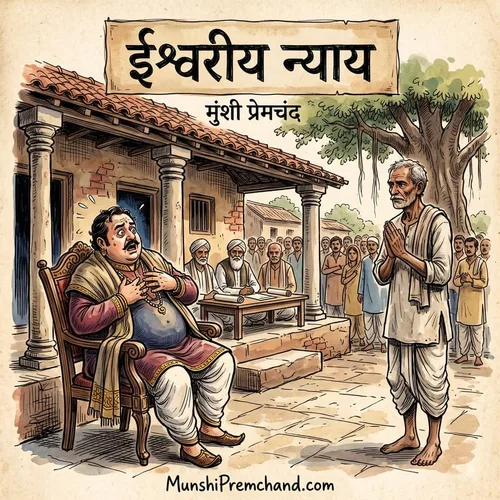
Complete English Translation: Ishwariya Nyay (Divine Justice)
1
In Kanpur district, there lived a wealthy and prominent zamindar named Pandit Bhrigudatt. Munshi Satyanarayan was his chief manager and estate steward.
Munshi Satyanarayan was a man of exceptional character and unswerving loyalty to his master. The collection of lakhs of rupees of rent and the transactions of thousands of maunds of grain were entirely entrusted to his hands; yet never once did his integrity waver. Under his excellent administration, the zamindari estate flourished and expanded day by day.
A devoted servant of such high fidelity received all the honor and esteem he deserved, and indeed far more. On every occasion of joy or sorrow, Pandit Bhrigudatt treated him with the utmost generosity. Gradually, the Pandit’s trust in the Munshi grew to such a degree that he ceased even examining the estate's accounts.
It is quite possible that matters might have continued peacefully in this manner throughout their lifetimes, but destiny is inexorable.
When the great Kumbh festival was held at Prayag, Pandit Bhrigudatt went to take the sacred bath in the holy confluence. He never returned home. Whether he slipped into some deep underwater abyss or was dragged down by an aquatic creature, no trace of him was ever found.
Now Munshi Satyanarayan’s authority grew greater still. In the Pandit’s household, there remained no one except a wretched, grief-stricken widow and two young boys.
Having concluded the funeral rites, the mourning mistress, Bhanukunwari, summoned him one day and wept bitterly:
"Lala, the Pandit Ji has departed for the heavenly abode, leaving us stranded in midstream. Now, if this boat is to cross safely to the shore, you alone can steer it across. All this harvest was sown by your own hands; I leave everything entirely in your care. These children are your own; take them under your wings. As long as the master lived, he regarded you as his own brother. I have full faith that you will shoulder this heavy burden with the same faithfulness."
Satyanarayan replied with tears in his eyes:
"Bhabhi, when Bhaiya passed away, my own good fortune was shattered. Had he lived, he would have made a man of me. I have lived by eating his salt, and I shall die in his service! Take heart. Do not harbor any anxiety whatsoever. So long as life remains in me, I shall never turn my face from your service. You need only do one thing: whenever I bring a complaint against anyone, scold them firmly; otherwise, these subordinate agents will ride roughshod over our heads."
2
Hardly six months had elapsed after Pandit Bhrigudatt’s demise when a zamindar from a neighboring estate found himself facing ruin. His entire ancestral village came up for public auction.
The village was exceedingly fertile, prosperous, and highly profitable. Its revenue yielded three thousand rupees annually. Pandit Bhrigudatt had long cast an eager eye upon it during his lifetime; on several occasions, negotiations had been opened, but the zamindar had refused to part with it. Now, owing to an impending court decree, the village was to be auctioned away.
Munshi Satyanarayan seized the opportunity. He withdrew thirty thousand rupees from the estate treasury and bought the village at the auction.
To safeguard the purchase against potential legal disputes and rival claims, he thought it prudent for the moment to have the sale deed registered in his own name. He intended to transfer the proprietary deed formally to his master's heirs as soon as the purchase was finalized.
Such a practice was an everyday occurrence among the wealthy landlords of the district: to evade litigation, taxes, or encumbrances, estates were frequently purchased in the names of trusted servants and retainers.
Satyanarayan considered it his paramount duty to secure the master's advantage, confident that once the property was securely in hand, the transfer could be executed at any convenient time.
3
Although at the time of registering the village in his own name Munshi Satyanarayan harbored not the faintest spark of dishonesty, within only two or three days an evil desire began to sprout within his heart.
He thought to himself: Why shouldn't this village remain mine? The estate already possesses dozens of fertile villages. If one village remains in my possession, what difference will it make to the mistress?
Yet his conscience was not so deadened that he could boldly assert ownership right away. For the time being, he kept the thought buried in the secret recesses of his mind.
In this manner, several years slipped by. Now the sprout of deceit developed into a full-grown, poisonous tree.
Bhanukunwari had completely forgotten the matter of that village. One afternoon, while reviewing general affairs, she casually inquired:
"Lala, that village which you purchased at the auction eight years ago—whose name does it stand under in the government records? Has it been transferred to our family's name yet?"
By raising the subject in this gentle, natural manner, Bhanukunwari displayed admirable tact. Munshi Satyanarayan inwardly recognized her sharpness. Feigning unconcern, he said:
"It stands in my name."
Bhanukunwari said: "I learned of this only today. Eight years have passed, yet you never mentioned the subject even by mistake. What was the difficulty in having it transferred to our name?"
Satyanarayan: "There was no particular difficulty. But I thought to myself: what does it matter whose name it bears? It is our village, and that is enough."
Bhanukunwari: "If it is our village, then have the transfer executed tomorrow."
Munshi Satyanarayan steadied himself. He realized that it would be difficult to outwit this intelligent woman. Since he was determined to keep the village, why retreat now? With cold insolence, he said:
"Why should I have it transferred? It is my village. I purchased it with my own money."
A sharp dagger seemed to pierce Bhanukunwari’s heart. Stepping out from behind her curtain, she stared at him with blazing eyes:
"You purchased it with your own money? Did you bring thirty thousand rupees from your ancestral home?"
Satyanarayan replied cautiously: "You know very well that the village was settled in my name. True, the money was borrowed from your treasury; but that was a loan, and I have paid off the debt long ago with its accrued interest."
Trembling with rage, Bhanukunwari cried:
"You shall surely reap the fruit of this treachery! You cannot butcher my orphan children's throats with such cold-blooded cruelty! I never dreamed that you harbored a murderous dagger in your heart; otherwise, matters would never have reached this pass! Very well: from this instant, do not dare touch my cash-box, my account ledgers, or a single paper belonging to this estate! Whatever is rightfully mine, I shall recover! Go, sit in solitude and ponder your deed: no man ever prospered through sin! You imagine that because these children are fatherless, you can swallow their inheritance? Do not live under that delusion—I will have the very bricks of your house sold off to the last penny!"
Having uttered these fiery words, Bhanukunwari sat down behind the curtain once more and burst into tears. It is the nature of women that after an outburst of rage, they seek relief in tears.
Lala Satyanarayan could find no words in reply. He rose from his seat, walked into the estate office, and began rummaging through papers.
But Bhanukunwari followed him directly into the office and commanded sternly:
"Do not touch a single paper of mine! Otherwise, it will go ill with you! You are a venomous serpent—I do not wish to see your face!"
Munshi Satyanarayan had intended to make alterations and deletions in the ledgers, but he was completely thwarted. He pulled out the keys to the treasury and hurled them to the floor; he slammed down the account books, banged the heavy door shut, and swept out like a gust of wind.
He had dipped his hands into deceit, but he had not learned the art of deceit.
When the other clerks and estate agents heard of this breach, their joy knew no bounds. In the presence of Munshi Satyanarayan’s strict integrity, they had never been able to line their own pockets. Rushing to Bhanukunwari, they began pouring oil upon the fire. All were unanimous in declaring that Munshi Satyanarayan had committed vile treason: The master's salt will burst forth from his very bones!
Preparations for litigation began from both sides. On one side stood the outward body of law; on the other stood the living soul of justice. Material circumstance summoned the courage to battle against moral truth.
Bhanukunwari asked Lala Chhakkan Lal: "Who is our legal counsel?"
Chhakkan Lal glanced about conspiratorially and whispered:
"The regular attorney is Seth Ji, but Satyanarayan will have bribed him already. For this lawsuit, we require a lawyer of exceptional brilliance. Babu Mehra is enjoying tremendous fame nowadays. He catches the judge's pen mid-air! When he speaks, words race like a motor car, Sarkar! What more can I say—he has snatched several men down from the very gallows! No lawyer dares open his mouth before him. If Sarkar commands, let him be engaged."
Chhakkan Lal’s excessive flattery aroused Bhanukunwari’s suspicion. She said:
"No. Let us consult Seth Ji first. Afterward, we shall see. Go and bring him here."
Cursing his luck, Chhakkan Lal went to Seth Ji.
Seth Ji had handled all legal affairs for the estate since the lifetime of Pandit Bhrigudatt. When he heard the details of the dispute, he was stunned into silence. He had always regarded Satyanarayan as a man of upright integrity, and he was deeply grieved by his moral fall. He came immediately.
Bhanukunwari recounted her tale of woe with flowing tears. Presenting her two little boys before him, she pleaded:
"Protect these fatherless orphans. I place them in your hands."
Seth Ji suggested a compromise: "Domestic litigation is never good."
Bhanukunwari replied: "Fighting against an oppressor is always noble!"
Seth Ji: "But our legal position is extremely weak."
Stepping out from behind the curtain once again, Bhanukunwari asked in astonishment:
"Our position is weak? The whole world knows that the village belongs to us! Who can wrest it from us? No! I will never agree to a compromise! Examine the papers. Undertake this trouble for the sake of my children; your labor will not go unrewarded. Satyanarayan’s intentions were not wicked in the beginning. Look at the date when the village was purchased: see what expenditure of thirty thousand rupees is entered under that date. If he entered it as a loan in his own name, check whether the annual interest was ever paid or accounted for. With such a fiend, I will never make peace!"
Seth Ji realized that offering counsel was useless at this juncture. He inspected the records, and preparations for filing the lawsuit commenced.
4
Munshi Satyanarayan reached his house in a sullen, bitter rage. When his little son ran up begging for sweets, he struck the child. He showered fury upon his wife simply because dinner was not ready at that very instant. He neither ate nor drank, but threw himself upon his charpoy and lay brooding.
In this turmoil, he suddenly sat up: an idea struck him. Why not bribe the office clerks?
Yet when a man bows his head before wicked desires once, it becomes almost impossible to regain his balance. In the bottomless quagmire of sin, once a foot slips, the wretched soul sinks deeper and deeper with every step.
Satyanarayan pondered: Will the clerks dare commit perjury? What if one of them reveals the truth? No, that is too dangerous.
Then a darker thought entered his mind: What if I break into the office at night and steal the account ledgers?
He considered: Is committing burglary so easy? How much cunning, how much daring, how much resourcefulness does it demand! If the night watchmen catch me, what will happen? My reputation of forty years will be trampled into the dust!
Yet despite all his hesitation, one obsession remained fixed like an iron spike in his mind: By whatever means necessary, those account books must be destroyed! Without the ledgers, she has no proof whatsoever!
5
It was ten o'clock at night. Munshi Satyanarayan slipped out of his house with a bunch of skeleton keys hidden in his waistband.
He stood at his doorstep for a few moments. His conscience whispered: Turn back! But greed shouted: Forward!
What fear is there at my own doorway? What fear on the public street? I am walking along my own way; who dares look at me askance?
Suddenly, he saw one of Bhanukunwari’s peons approaching in the distance. His heart thumped violently. He ducked swiftly into a pitch-dark alley.
Once the peon had passed, Satyanarayan chided himself: Have I consumed hemp tonight? Why was I terrified of that peon, as though he could read the thoughts in my mind?
He reached the town bazaar. Most of the shops had shuttered down. Bulls and stray cows sat chewing the cud in front of the stalls. A few stray dogs barked in the shadows.
Near the estate office, a group of leather-workers were singing folk songs to the rhythm of a dholak:
"I lay asleep, and beheld a vision, Rama!
My slumber broke, the collyrium ran down my cheeks!
My beloved Shyam is not at home, and the dark storm clouds have gathered!"
The estate night watchmen were leaning against the wall, engrossed in watching the singers.
Munshi Satyanarayan crept silently toward the hanging lantern. Like a cat pouncing upon a mouse, he darted forward and extinguished the lantern with a swift flick!
The first hurdle was cleared. The task was not as impossible as he had imagined. His resolve hardened.
He reached the veranda of the estate office, holding his breath and listening intently. Complete silence reigned, broken only by the distant singing of the laborers.
His heart pounded against his ribs, his temple veins throbbed, his hands and feet trembled, and his breath came in heavy, rapid gasps. Every pore of his body became an eye and an ear. All the physical strength, agility, daring, cunning, and intelligence he possessed were summoned to the aid of his desperate will.
The office door was locked with the familiar old padlock. Satyanarayan had spent hours scouring the bazaar that afternoon to procure a matching key.
He inserted the key. The lock turned; the heavy wooden doors yielded with a faint creak. No one noticed.
He slipped inside. An earthen oil lamp was burning faintly on a wooden stand. As Satyanarayan entered, the flickering flame wavered, as if shaking its head to warn him against entering.
His knees knocked together. His heels felt as though they were bouncing off the floor. The crushing weight of sin was almost unbearable.
Within a few frantic moments, he turned over the ledger volumes. The handwriting danced before his eyes. Where was the time to sort out the relevant papers?
Gathering all the heavy account registers into a bundle, he wrapped them inside his cotton shawl, hoisted the load upon his head, and darted out of the room like an arrow!
Loaded with that burden of sin, he vanished into the dark alley.
Through narrow, foul-smelling, mud-choked lanes, he hurried barefoot, bearing the dead weight of selfishness, greed, and treachery—looking like a damned soul dragging its sins through the sewers of hell.
After wandering far through the gloom, he reached the banks of the sacred Ganges.
Just as in a deeply corrupted heart a faint twilight glimmer of religion sometimes lingers, so across the black expanse of the river the distant stars were shimmering. Along the sandy shore, a few ascetics lay asleep near their smoldering sacred fires.
Satyanarayan took down the heavy bundle from his head, tied the shawl tightly, and with all his physical strength, hurled it far into the river!
The sleeping waves parted with a heavy splash, surged for a moment, and then fell silent forever.
In Munshi Satyanarayan’s household, there lived two women: his aged mother and his wife.
Both were completely unlettered. Yet Munshi Satyanarayan had never felt the need to drown himself in the Ganges or flee the house on their account! Neither woman wore modern Western blouses, nor stockings and shoes; neither could play the harmonium. They did not even know how to use fragrant toilet soap. As for hairpins, brooches, jackets, and other "essential" items of modern vanity, they had never heard their names!
The daughter-in-law had not the slightest arrogance of modern self-importance; nor did the mother-in-law harbor aristocratic pride. The young wife endured her mother-in-law’s rebukes like a meek kitten—alas, what ignorance! The mother-in-law felt no disgust in bathing the grandchildren or even sweeping the courtyard with her own hands—alas, what lack of modern enlightenment!
The wife was a lump of innocent clay: if she needed a single paisa, she asked her mother-in-law for it. In short, both women lived in utter oblivion of modern "rights," leading a simple, traditional life. They were so unsophisticated that they kneaded and baked bread with their own hands, never ordering spicy snacks and samosas from the bazaar. The old mother also knew traditional herbal medicines, pounding roots and leaves to treat the sick.
Returning home, Satyanarayan approached his mother and said:
"Amma, what will become of us now? Bhanukunwari has dismissed me from service!"
The mother asked in alarm: "Dismissed you?"
Satyanarayan: "Yes! Entirely without fault!"
Mother: "What happened? Bhanukunwari was never of such an ill disposition."
Satyanarayan: "It was nothing at all. That village which I bought in my own name—I took possession of it. Tomorrow she might pick a quarrel with me and cast me out into the street; should I have given up my village as well?"
The mother looked at her daughter-in-law with an expression of deep anguish and said:
"Why, son? Did you not purchase that village with their money?"
Satyanarayan: "I purchased it then. But now I cannot let go of such a fertile and wealthy estate. She can do nothing against me!"
The mother said: "Son, if someone possesses great wealth, does he throw it into the street? You have corrupted your own integrity; that is not good. To usurp the property of orphans will bring no blessing. A single sigh from an orphan will reduce your prosperity to ashes!"
Satyanarayan sneered: "Humph! I have heard plenty of such moralizing tales! If the world ran on such pious homilies, all practical business would shut down! I served that estate for forty years; was I supposed to walk away empty-handed?"
Tears filled the old mother’s eyes:
"Son, I never heard such wicked words from your lips before! What has happened to your mind? Have you no fear of God? If you commit such a terrible sin, this house will be destroyed!"
The young wife looked at her mother-in-law and added quietly:
"We do not desire such ill-gotten wealth. We are content with our simple bread and lentils."
Satyanarayan snapped: "Very well! You two may eat dry bread and wear coarse cloth; I now have a desire for fine puris and halwa!"
The mother cried: "I cannot bear to witness such unrighteousness! I shall go and drown myself in the Ganges!"
The wife said: "If you intend to sow such thorns, send me back to my parents' home. I will not remain under this roof with my children to eat the bread of sin!"
Satyanarayan flared up in irritation: "You women have lost your wits! Millions of government officers and businessmen cut people's throats day and night; do their families die of curses? Go to sleep and stop preaching to me!"
When the estate office opened the next morning, all the account books and ledgers were missing!
Lala Chhakkan Lal rushed into the inner apartments in frantic panic: "Mistress! The ledgers are gone!"
Bhanukunwari replied coldly: "How should I know? They must be where you left them."
A tremendous uproar shook the entire household. The night watchmen were beaten and interrogated. Bhanukunwari suspected Munshi Satyanarayan immediately, but there was not an iota of tangible proof against him.
The lawsuit became the talk of the entire city. Several wealthy gentlemen supported Bhanukunwari.
On the day the trial opened, a celebrated barrister represented Bhanukunwari. He delivered an eloquent, stirring speech depicting the forty years of Satyanarayan’s service and the sacred trust Pandit Bhrigudatt had reposed in him. Several prominent citizens testified, but because their knowledge was based on hearsay, their testimony crumbled under cross-examination.
On the second day, the defense counsel rose to speak. His address relied on biting humor and legal technicalities:
"Gentlemen! It is a bizarre legal doctrine that whatever a servant of a wealthy man purchases must be deemed the property of his master! By this logic, the government ought to confiscate every house and plot purchased by its employees! We have no hesitation in admitting that our client borrowed money from his master to purchase the village; but instead of demanding the repayment of the loan, the plaintiff seeks to confiscate the entire property! Had the account books been produced, they would have shown clearly that the loan was repaid in full. My learned friend argues that the disappearance of the ledgers should be treated as evidence against us. If I borrow money from you to celebrate my wedding, will you confiscate my newly wedded bride?
"Our friend accuses us of betraying orphans. Had Munshi Satyanarayan harbored dishonest intentions, the most opportune moment was when Pandit Bhrigudatt died. Why should he wait eight long years? If you trap a tiger and do not seize its cub at once, but wait until the cub grows into a powerful beast, no one would call you wise! The truth is that Munshi Satyanarayan fulfilled every obligation of his master's salt. For eight years he served the master's children with all his heart. Today, the reward he receives for his lifelong fidelity is heartbreaking. This lawsuit has been fabricated solely by envious subordinates who could never indulge their dishonesty while Satyanarayan was manager. Bhanukunwari is present here: can she swear that during these eight years, the income and expenditure of this village were ever laid before her? Why should the affairs of a village belonging to Satyanarayan be brought before her?"
Several neighboring zamindars stepped into the witness box, testifying that they had seen Satyanarayan issuing receipts in his own name and paying the land revenue directly into the government treasury.
By evening, the arguments concluded. The court announced that judgment would be delivered in one week.
6
Munshi Satyanarayan now had no doubt of his total victory. The plaintiff’s witnesses had broken down, their arguments had lacked documentary proof, and the law was entirely on his side.
Yet alongside the intoxicating expectation of victory, an invisible, agonizing torment gnawed at his soul.
He was victorious, yet he could not lift his eyes before the world. People greeted him on the street, but in their eyes he saw unspoken disgust. When he returned home, neither his mother nor his wife spoke a single word to him. The food placed before him felt like dry ashes.
Bhanukunwari, on her part, had abandoned all hope. Human law had failed her. She comforted herself with the thought that divine retribution would inevitably strike the traitor: You have stolen our village, but God will never grant you happiness with it. You shall burn in the fires of hell, and no one will be left to light a lamp in your home.
The day of judgment arrived. The courtroom was packed to overflowing. Prominent gentlemen, high officials, and a veritable army of lawyers and pleaders were present.
At the appointed hour, the Judge took his seat upon the bench. A profound, breathless silence enveloped the vast chamber.
The clerk brought forth the written decree.
The Judge delivered the verdict:
"Suit dismissed. Both parties shall bear their own costs."
Although the judgment was precisely what everyone had anticipated, hearing it pronounced by the Judge created a sudden, quiet stir in the room. Murmuring among themselves, people slowly began turning toward the doors.
Suddenly, Bhanukunwari—draped in a modest white shawl, her face concealed behind her veil—stepped forward and stood directly before the Judge’s bench!
Those who were leaving stopped in their tracks. Those who had reached the veranda hurried back inside. A hum of intense curiosity rippled through the courtroom.
In a voice trembling with emotion, Bhanukunwari addressed the Judge:
"Sarkar! If you permit, may I ask the Munshi Ji a single question?"
Although this was completely contrary to procedural rules, the Judge, moved by her dignified sorrow, granted permission:
"You may ask."
Turning slowly toward Satyanarayan, Bhanukunwari looked directly at him and said in a clear, ringing voice:
"Lala Ji! The government court has awarded you the decree. May the village bring you blessing! But honor and faith are everything to a man. Before God and your conscience, speak the sacred truth: whose village is it?"
Thousands of eyes instantly shifted from the widow to Munshi Satyanarayan.
The question struck the Munshi like a bolt of lightning! A titanic, ferocious war erupted within the depths of his soul.
Thousands of human eyes were fixed upon his countenance. The reality was hidden from no one. Before this vast assembly of his fellow men, a lie refused to pass his lips. Shame clamped his tongue.
To say "It is mine" would secure the worldly prize—the law had already declared it his. Yet the crushing weight of public infamy, the curse of orphans, and the eternal condemnation of society pressed down upon him with terrifying certainty.
To say "It is yours" meant throwing away a won battle. It meant surrendering a fortune worth thirty thousand rupees. Yet alongside that surrender lay the supreme reward society and God can bestow upon a repentant soul: the reclamation of honor, the salvation of the spirit, and the washing away of sin!
Hope triumphed over fear!
It felt to him as though the Almighty Himself had reached down and granted him this final, miraculous chance to illuminate his blackened face; that he could still walk among men with his head held high; that he could still rescue his immortal soul from the pits of hell!
Stepping forward with tears streaming down his cheeks, Munshi Satyanarayan bowed low before Bhanukunwari, touched her feet in deep reverence, and cried in a shaking voice:
"Yours!"
From the throats of thousands of spectators, a mighty, sky-shattering roar erupted:
"Victory to Truth! Satya ki Jai!"
The Judge rose to his feet from the bench and declared with profound emotion:
"This is not the justice of human law—this is Divine Justice!"
Do not imagine this to be a mere work of fiction; this is a true event. Bhanukunwari and Munshi Satyanarayan lived to see its enduring blessing.
People were utterly captivated by the Munshi’s extraordinary moral courage. The wondrous triumph of Divine Justice over human jurisprudence was celebrated throughout the city for months.
Bhanukunwari herself visited Munshi Satyanarayan’s home, comforted him with sisterly affection, and brought him back with full honor. She restored the entire management of her estate into his hands.
A few years later, she formally executed a deed of gift, bestowing that very village upon Satyanarayan as a personal reward for his lifelong service.
Munshi Satyanarayan, however, deemed it improper to keep the property for personal enrichment. He dedicated the entire village to Lord Krishna (Krishnarpan). To this day, its entire income is devoted to the feeding of the poor, the care of the destitute, and the education of needy students.
Summary of Ishwariya Nyay (Divine Justice)
Ishwariya Nyay ("Divine Justice") is Munshi Premchand’s powerful narrative demonstrating the supremacy of conscience and divine truth over technical human jurisprudence.
The story centers on Munshi Satyanarayan, the exceptionally capable and devoted manager of Pandit Bhrigudatt, a wealthy landlord of Kanpur. When the Pandit drowns during the Kumbh Mela, his widow, Bhanukunwari, places her young children and the entire estate into Satyanarayan's hands. Soon after, Satyanarayan uses thirty thousand rupees from the estate treasury to purchase a lucrative neighboring village at an auction, registering it in his own name as a temporary convenience. Over the next eight years, however, the seed of greed sprouts into an obsession, and Satyanarayan begins regarding the village as his personal property.
When Bhanukunwari discovers that the village has never been transferred to her family's name and asks for the deed, Satyanarayan insolently claims that he bought it with his own funds. An enraged Bhanukunwari dismisses him and initiates legal proceedings. Terrified that the estate ledgers will expose his perjury, Satyanarayan breaks into the estate office at midnight, steals the account books, and throws them into the depths of the Ganges. His pious mother and virtuous wife condemn his wickedness and threaten to abandon him, but he stubbornly persists.
In court, despite Bhanukunwari's moral righteousness, the absence of written records causes her case to collapse under legal technicalities. The judge dismisses the suit, awarding the legal decree to Satyanarayan.
Just as the court is dispersing, Bhanukunwari steps forward and asks the judge's permission to ask Satyanarayan a single question. Addressing him directly before thousands of spectators, she asks: "The government court has awarded you the decree... but on your sacred honor, tell us—whose village is it?"
Pierced to the core of his being, Satyanarayan experiences a profound spiritual crisis. Recognizing that this is God's final grace to redeem his soul, he breaks down in tears, bows at Bhanukunwari's feet, and confesses: "Yours!" The courtroom erupts in cheers, and the judge exclaims that human law has been superseded by Divine Justice. Reconciled, Bhanukunwari restores Satyanarayan to his post, and when she later gifts the village to him, he dedicates its entire revenue to charitable trusts for the poor and students.
Publication History
Ishwariya Nyay (ईश्वरीय न्याय) was written by Munshi Premchand in 1917 and published in contemporary literary journals before being included in Mansarovar, Part 5 (मानसरोवर भाग 5).
This unabridged English translation was published in 2026 by MunshiPremchand.com as part of the MunshiPremchand.com English Translation Series.
Themes & Critical Significance
- Human Law vs. Divine Justice: Premchand draws a sharp contrast between technical human law—which relies on material evidence, manipulation, and legalistic sophistry—and Divine Justice (Ishwariya Nyay), which speaks directly to the human conscience and requires no external courtroom.
- The Psychological Anatomy of Greed: The story traces the gradual moral degeneration of an upright man. Satyanarayan does not start as a criminal; the seed of dishonesty enters subtly, grows over eight years, and ultimately drives him to commit burglary, evidence destruction, and perjury.
- The Voice of Moral Conscience: Bhanukunwari’s brilliant appeal bypasses lawyers, evidence, and statutes, speaking directly to Satyanarayan’s inner soul in front of his community. Her question forces him to choose between material theft and spiritual salvation.
- Redemption and Restitution: Unlike conventional crime narratives that end in punitive retribution, Premchand champions moral transformation (hriday-parivartan). Satyanarayan's public confession redeems him, leading not to ruin, but to true reconciliation, mutual respect, and lifelong philanthropy.