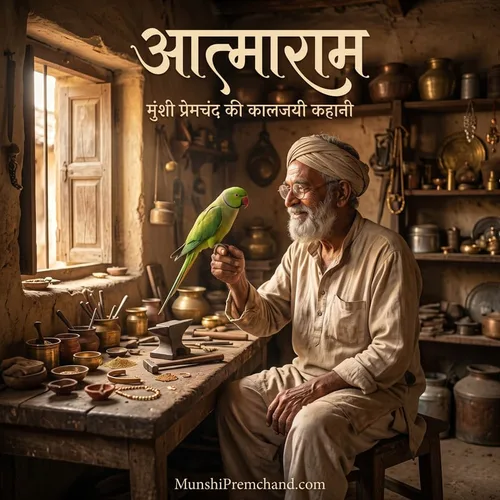
Complete English Translation: Atmaram
In the village of Vedon, Mahadev the goldsmith was a well-known figure. From morning until dusk, he would sit beneath his thatch-roofed veranda before his furnace, tapping away steadily with his hammer—clink, clink, clink. The villagers had grown so accustomed to hearing this constant rhythmic tapping that if, for any reason, it ever ceased, it felt as though some essential fixture of the universe had suddenly vanished. Every single morning, without fail, carrying his parrot's cage in hand and humming devotional hymns, he would walk down toward the village pond. In the dim, misty light of dawn, his decrepit frame, sunken toothless mouth, and bowed back might easily have led a stranger to mistake him for an apparition or a ghoul. But the moment his raspy voice reached people's ears chanting—"Satt Gurudatta Shivdatta Daata"—everyone knew that morning had broken.
Mahadev's domestic life was far from happy. He had three sons, three daughters-in-law, and dozens of grandchildren, yet there was not a single soul among them willing to lighten his heavy load. The sons would say among themselves, "So long as the old man is alive, let us enjoy life; once he is gone, this burdensome drum will be hung around our necks anyway." The wretched Mahadev was often compelled to go without food altogether. At mealtime, such a clamorous, thunderous uproar over equitable sharing would erupt in the household that he would simply rise hungry, retreat to his corner, puff on his coconut hookah, and drift off to sleep. His professional life was even more vexing. Although he was thoroughly skilled at his craft, and his acid washes were far more refining and his metallurgical processes far more painstaking than those of other craftsmen, he was nonetheless constantly subjected to the vile abuses of suspicious, impatient customers. Yet Mahadev would listen to everything with head bowed in unperturbed gravity. As soon as the commotion subsided, he would gaze toward his parrot and call out: "Satt Gurudatta Shivdatta Daata." The moment he chanted this sacred formula, his agitated heart would find complete tranquility.
One day, by sheer accident, one of the village boys unlatched the door of the cage. The parrot flew out! When Mahadev lifted his eyes and glanced at the cage, his heart skipped a beat. Where had the parrot gone? He looked at the cage again—the bird had vanished! In a frantic panic, Mahadev scrambled to his feet and began casting his eyes wildly across the tiled rooftops. If there was anything in this world he held dear, it was this very parrot. He had long grown sick of children, sons, and grandchildren. The children's restless mischief merely disrupted his delicate work. As for his grown sons, he felt no affection for them—not because they were worthless idlers, but because their perpetual demands deprived him of his customary, comforting count of clay liquor cups. He harbored resentment against his neighbors because they would constantly come and carry away live embers from his furnace. From all these vexations and torments, his sole refuge in the world had been this parrot. The bird demanded nothing and caused him no grief. Mahadev had reached that stage of advanced age when a man desires nothing more than undisturbed peace.
The parrot had settled upon a tiled roof. Mahadev took down the empty cage, held it aloft toward the bird, and began coaxing, "Come, come! Satt Gurudatta Shivdatta Daata." But the neighborhood children quickly gathered around, shouting and clapping their hands in delight. From the branches above, a flock of crows began cawing raucously. Startled, the parrot took flight, soared beyond the edge of the village, and perched high in a tree. With the empty cage swinging in his hand, Mahadev ran after it as fast as his frail legs could carry him. Onlookers watched in utter astonishment at the briskness of the old man's pace. A more vivid, poignant, and living portrait of earthly attachment (moh) could hardly be conceived.
Noon arrived. Farmers were returning from the fields. They found in this spectacle a splendid opportunity for amusement. Taunting Mahadev was an entertainment everyone relished. Some threw pebbles; others clapped mockingly. The parrot took wing once more and flew far away, coming to rest upon the topmost crest of a tree in an expansive mango orchard. Mahadev hobbled forward after it, empty cage in hand, bounding awkwardly like a frog. By the time he reached the orchard, the soles of his feet burned like hot coals, and his head spun with dizzying exhaustion. As soon as he caught his breath, he held up the cage again and called out, "Satt Gurudatta Shivdatta Daata." The parrot fluttered down from the treetop to a lower branch, yet continued to eye Mahadev with cautious, suspicious glances. Mahadev thought, "He is frightened." Setting the cage upon the ground, he stepped back and concealed himself behind the trunk of another tree. The parrot examined the surroundings carefully from every side, became reassured, descended, and perched atop the cage. Mahadev's heart leapt with joy. Chanting the mantra of "Satt Gurudatta Shivdatta Daata," he crept forward softly and lunged forward to seize the bird; but the parrot slipped through his grasp and flew back up into the branches.
This cat-and-mouse game continued until evening. The parrot would flit from this bough to that bough. At times it would drop down and sit upon the cage, or alight at the cage door peering at its little bowls of grain and water, only to take flight again. If the old man was the living embodiment of attachment (Moh), the parrot was the veritable incarnation of illusion (Maya). At last, twilight fell. The prolonged battle between attachment and illusion dissolved into the gathering gloom.
Night descended! A dense, impenetrable darkness enveloped the orchard. Where the parrot sat concealed among the leaves, no one could tell. Mahadev knew full well that in the pitch black of night, the bird could not fly away anywhere, nor would it venture down into the cage; nevertheless, he refused to budge from the spot. All day long he had not eaten a single morsel. The hour for the evening meal had long since passed; not even a drop of water had moistened his throat; yet he felt neither hunger nor thirst! Without his parrot, his existence seemed entirely hollow, arid, and desolate. He worked day and night only because it was an ingrained reflex; he performed other daily acts merely out of routine habit. In none of those mundane pursuits did he ever feel the faintest spark of living vitality. The parrot was the single object that reminded him of his conscious soul. To lose the bird was tantamount to the soul departing from the body.
Starving, parched, and exhausted from the day's pursuits, Mahadev would intermittently doze off into brief slumber; but in a moment he would startle awake, open his eyes, and across the vast darkness his quavering voice would ring out: "Satt Gurudatta Shivdatta Daata."
Midnight had passed. Suddenly, hearing a faint rustle, he started. Looking across, he saw a dim lamp flickering beneath another tree, where several men were seated close together, speaking in hushed undertones. They were smoking a clay chillum. The rich aroma of burning tobacco stirred Mahadev's craving uncontrollably. In a loud voice he cried out, "Satt Gurudatta Shivdatta Daata!" and began walking toward the men to ask for a puff from their pipe. But just as a herd of deer scatters at the sudden crack of a gunshot, the men sprang to their feet the instant they saw him approaching and fled in panic! Some dashed in one direction, some in another. Mahadev shouted after them, "Wait! Wait!" Then suddenly it dawned upon him—these men were thieves! He yelled at the top of his lungs, "Thieves! Thieves! Catch them! Catch them!" The fleeing figures never once looked back.
Mahadev walked up to the lamp and found an earthen jar sitting upon the ground, blackened with age and grime. His heart thumped wildly against his ribs. He plunged his hand into the mouth of the vessel—it was filled with gold coins! He drew out a single coin and examined it in the glow of the lamp. Yes, it was indeed an authentic gold mohur! Instantly, he picked up the heavy jar, blew out the lamp, and crouched down in the deep shadows beneath the tree. In the span of a breath, the honest citizen had turned into a thief.
Presently, fear crept over him: what if the thieves realized their folly, returned, and, seeing him all alone, snatched the coins away? He tied a handful of the gold coins securely around his waist, and then, using a dry stick, scraped away the earth to dig several small pits. Filling these with the remaining coins, he covered them carefully with loose soil.
Before Mahadev's inner vision, a new world now unfolded, brimming with anxieties and grand fantasies. Though the fear of losing the treasure still hung over him, his long-dormant desires had already begun their work. A sturdy brick mansion rose before his mind's eye; an opulent jewelry shop was established; estranged kinfolk rallied around him once more; luxuries of every kind accumulated. Then he envisioned embarking upon a grand pilgrimage to holy shrines, followed upon his return by magnificent religious ceremonies, sacrificial fires, and lavish feasts for Brahmins. Thereafter, a temple to Lord Shiva and a public masonry well would be constructed, a lush orchard planted, and he would spend his days listening to sacred recitations of the Puranas. Holy ascetics and saints would be treated with boundless hospitality and reverence.
Suddenly, a panic struck him: "What if the thieves return right now? How will I ever run away?" To test his strength, he hoisted the vessel and sprinted recklessly for two hundred paces. It seemed as though wings had sprouted upon his feet! His anxiety was dispelled. Amidst these spinning reveries, the night drifted away. Dawn arrived; the morning breeze awoke; the birds broke into song. All at once, a familiar sound struck Mahadev's ears:
"Satt Gurudatta Shivdatta Daata,
Ram ke charan mein chitta laaga."
(True is the bounty of Guru, Shiva is the giver; my heart is devoted at the feet of Rama.)
These words had forever lingered upon Mahadev's tongue. Thousands of times a day, these syllables would tumble from his lips, yet their sacred religious meaning had never once touched his inner soul. Just as an inanimate musical instrument emits a melody, in precisely that mechanical manner had this chant issued from his mouth—hollow and devoid of power. Back then, the tree of his heart had been barren, stripped of leaves and shoots. The pure, fragrant breeze could not stir it to rustle. But now, fresh green buds and tender branches had sprouted upon that tree. At the caress of this morning breeze, it swayed with delight, vibrant and resounding.
It was the hour of crimson sunrise. Nature was bathed in an affectionate, golden glow. At that very instant, tucking its wings close, the parrot swooped down from the high branch—like a shooting star descending from the heavens—and settled straight inside the cage! Overjoyed, Mahadev rushed forward, lifted the cage, and exclaimed, "Come, Atmaram! You caused me immense torment, but you have also fulfilled and sanctified my life! Now I will keep you in a cage of silver, adorned with pure gold!" From every pore of his being, hymns of gratitude to the Supreme Lord welled up. O Lord, how merciful You are! This is Your boundless parental love, for when was a wretched, sinful creature like me ever worthy of such grace! His soul was overwhelmed by these sacred, devout emotions. Filled with profound devotion, he cried out:
"Satt Gurudatta Shivdatta Daata,
Ram ke charan mein chitta laaga!"
Holding the cage in one hand and pressing the heavy vessel under his arm, he turned his face toward home.
When Mahadev reached his house, it was still faintly dark. On the road he encountered no one except a stray dog, and dogs have little love for gold mohurs. He concealed the vessel inside a large clay trough, covered it thoroughly with charcoal, and stowed it away inside his private chamber. When daylight broke, he went directly to the village priest's house. The priest was seated at his morning prayers, brooding bitterly: Tomorrow is the hearing of my lawsuit in court, and as yet there is not a cowrie in my palm—not a single patron breathes a word of charity. Just then, Mahadev bowed low and offered his salutations. The priest turned his face away in disgust. From where has this harbinger of ill omen arrived? Who knows whether even a morsel of food will be attained today or not? Angrily, he snapped, "What is it, man? What do you want? Don't you see that I am in the midst of my morning prayers?"
Mahadev replied humbly, "Maharaj, today there is to be a recitation of the Satyanarayan Katha at my house."
The priest was struck dumb with astonishment. He could scarcely believe his ears. A religious recitation at Mahadev's house was an event as extraordinary as alms being willingly offered to a beggar from his own doorstep. He asked, "What is the special occasion today?"
Mahadev said, "Nothing in particular, Maharaj. A sudden desire arose in my heart to listen to the Lord's sacred story."
Preparations commenced from early morning. Betel nuts were distributed as invitations throughout the neighboring hamlets of Vedon. A grand community feast was announced to follow the recitation. Whoever heard of it was gripped by wonder: How has green grass managed to sprout upon barren sand today?
In the evening, when the gathering assembled and the priest took his seat upon the ceremonial cushion, Mahadev stood up before the crowd and spoke in a clear, resonant voice: "Brothers, my entire life has been spent in deception and deceit. I know not how many people I have wronged, how much pure gold I have tainted with base metal. But now God has shown mercy upon me; He wishes to wipe away the black stain from my face. I declare openly before you all: whoever holds a claim against me, whose savings I have misappropriated, or whose pure metal I have adulterated, let them step forward and claim every single cowrie due to them. If anyone could not be present here today, please convey this message to them: from tomorrow for a whole month, whenever they please, let them come and settle their accounts. There is no need for witnesses or sworn testimonies."
A stunned silence fell over the assembly. Some nodded solemnly, remarking, "Did we not always say so?" Others muttered with skepticism, "Where will he find the means to pay? It will total thousands of rupees!"
A village Thakur joked, "And what of those who have already departed for the heavenly realms?"
Mahadev answered calmly, "Their families must surely still be here."
Yet at this moment, the people were far less interested in collecting debts than in discovering where on earth he had obtained such immense wealth. No one dared step forward toward Mahadev. They were simple village folk; what did they care to exhume old bones? Moreover, hardly anyone remembered precisely what Mahadev owed them, and on such a sacred occasion, the fear of making a wrongful or exaggerated claim sealed their lips. Above all, Mahadev's sudden saintliness and humility held them completely in awe.
Suddenly the priest spoke up: "Do you remember, I gave you gold to fashion a necklace, and you shaved off several mashas in the weighing?"
Mahadev: "Yes, I remember. How much loss did you suffer?"
Priest: "It could not have been less than fifty rupees."
Mahadev drew two gold mohurs from his waistband and laid them respectfully before the priest.
Murmurs of disapproval immediately broke out among the crowd against the priest's greed. This is sheer dishonesty! At most, the loss could not have exceeded two or four rupees. He has extorted fifty rupees from the poor man! Has he no fear of God? A priest by station, yet his intentions are so wretched! Ram, Ram!
The villagers' respect for Mahadev deepened into genuine reverence. An hour elapsed, yet out of those thousands of people, not another soul stood up to make a claim. Then Mahadev spoke once more: "It appears that you have all forgotten your accounts. Therefore, let the recitation proceed tonight. I will await you for a full month. After that, I shall depart on a pilgrimage to holy shrines. My humble plea to you, my brothers, is that you grant me liberation from my sins."
For an entire month, Mahadev waited for creditors to arrive. At night, anxiety about thieves kept sleep from his eyes. He no longer practiced his craft. His craving for liquor had vanished entirely. Whenever holy men and mendicants arrived at his doorstep, he served them with the utmost hospitality. The fame of his righteousness spread far and wide. The month came to an end, yet not a single soul came forward to claim a debt. It was then that Mahadev realized how much virtue, honor, and goodwill truly existed in the world. He understood at last that the world is harsh only to the wicked, and noble and generous to the good.
Fifty years have elapsed since this event took place. If you visit the village of Vedon today, a gleaming golden spire is visible from afar. It is the pinnacle of the Thakurdwara temple. Adjoining it is a large, masonry-paved pond, filled with blossoming lotuses. No one catches the fish that swim in its waters. On the bank of the pond stands a grand shrine (samadhi). This is the memorial monument to Atmaram. Various legends circulate concerning it. Some say that the gem-encrusted cage ascended straight to heaven; others say that the bird vanished into thin air while chanting "Satt Gurudatta." But the plain truth is that this moon-like bird was swallowed by some cat-like demon of eclipse. People say that even now, at the stroke of midnight, a voice echoes along the banks of the pond:
"Satt Gurudatta Shivdatta Daata,
Ram ke charan mein chitta laaga."
Concerning Mahadev, too, many oral legends endure. The most widely accepted among them is that after Atmaram was laid to rest in his shrine, Mahadev departed for the Himalayas in the company of wandering renunciants and never returned. In time, he himself came to be remembered throughout the land by the sacred name of Atmaram.
Summary of Atmaram
Atmaram by Munshi Premchand is a celebrated classic exploring the journey of an old village goldsmith, Mahadev, from habitual dishonesty and emotional numbness to moral redemption and spiritual realization. Living in the village of Vedon, Mahadev works tirelessly before his furnace adulterating gold, unloved by his sons and family who merely wait for his death to inherit his burden. His sole earthly companion is his caged parrot, Atmaram, with whom he shares a daily routine of chanting "Satt Gurudatta Shivdatta Daata."
When a neighborhood child accidentally leaves the cage unlatched, the parrot escapes. In a frantic chase driven by profound attachment, Mahadev follows the bird miles into a distant mango orchard. Night falls, and Mahadev refuses to leave his parrot alone in the darkness. In the middle of the night, while approaching a flickering light hoping for a smoke, his sudden appearance terrifies a band of thieves into fleeing, leaving behind a buried jar filled with ancient gold coins.
At daybreak, as the parrot voluntarily descends into the open cage, Mahadev experiences an overwhelming religious epiphany. The mechanical chant turns into a living reality: "Ram ke charan mein chitta laaga" (My heart is devoted at the feet of Rama). Convinced that God has granted him an opportunity to cleanse his sins, Mahadev organizes a sacred Satyanarayan recitation and public feast. Standing before the entire village, he openly confesses his lifelong deceit and invites anyone he ever defrauded to collect their rightful dues without needing proof. Touched by his genuine humility, no villager except the greedy priest steps forward to take money, awakening Mahadev to the innate nobility and compassion of human beings. Mahadev utilizes the wealth to construct a grand temple, a lotus-filled public pond, and a memorial shrine for Atmaram before renouncing worldly life to spend his final days as a sannyasi in the Himalayas.
Publication History
Atmaram was written by Munshi Premchand and originally published in Hindi in 1921. It was later collected in Mansarovar, Volume 7 (मानसरोवर भाग 7), solidifying its place among Premchand's finest allegorical stories exploring moral conscience, human attachment, and spiritual awakening.
This unabridged English translation was published in 2026 by MunshiPremchand.com as part of the MunshiPremchand.com English Translation Series.
Themes & Critical Significance
- Spiritual Awakening and Moral Transformation: Mahadev's trajectory exemplifies Premchand's enduring belief in ethical redemption. Wealth acquired through divine coincidence does not plunge him deeper into greed; instead, it triggers a profound introspection that dismantles decades of dishonesty.
- Attachment (Moh) versus Spiritual Realization (Atma-Bodha): The parrot Atmaram functions on two levels—as a literal pet in a loveless household and as an allegory for the individual soul (Atma). Mahadev's relentless pursuit of his lost bird mirrors the restless human search for spiritual peace.
- Public Confession and Restitution: Rather than hoarding the treasure, Mahadev's immediate instinct is restorative justice. His public confession subverts conventional village hierarchies, proving that true dignity lies in repentance and transparency.
- Human Nobility and Community Ethics: When presented with the opportunity to claim money without proof, the villagers choose reverence and forgiveness over exploitation. Premchand highlights that humanity responds in kind to genuine virtue—the world is harsh to the deceptive, but compassionate to the sincere.
- Allegorical Depth and Legacy: The enduring monuments—the temple, the lotus pond, and the shrine of Atmaram—serve as physical emblems of spiritual elevation, demonstrating how worldly labor and ill-gotten wealth can be transmuted into communal well-being and eternal peace.