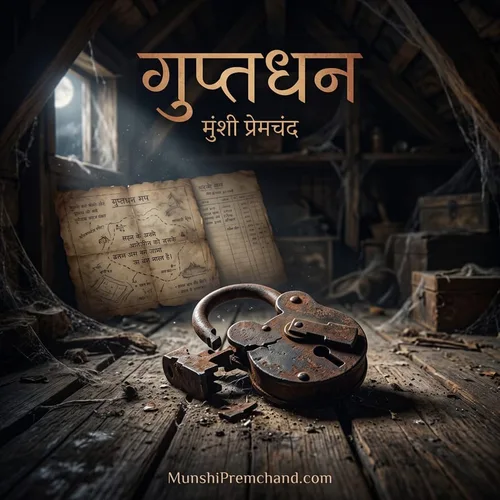
Complete English Translation: Gupt Dhan (Hidden Treasure)
Babu Haridas's brick kiln was situated just outside the borders of the town. Every morning, hundreds of men, women, and boys from neighboring villages arrived there to lift baked bricks upon their heads and stack them in neat rows on the upper terraces.
Near the kiln sat a man with a basket full of cowrie shells. He distributed the cowries to the laborers according to the count of bricks they transported. The greater the number of bricks carried, the larger the handful of cowries received. Lured by this temptation, many laborers exerted themselves far beyond their physical capacity. To behold old men and frail children bent double and stiffened beneath the crushing weight of bricks was a deeply heart-wrenching sight.
Occasionally, Babu Haridas himself would come and sit beside the cowrie-counter, encouraging the laborers to haul even heavier loads. This spectacle grew all the more agonizing whenever some extraordinary emergency demand for bricks arose. On such days, wages were doubled, and the laborers attempted to carry twice their normal capacity. Every single step became an agonizing ordeal. To watch them, drenched in sweat from head to foot, smeared with gray kiln ash, balancing a veritable mountain of bricks upon their crowns, crushed beneath the burden, looked as though the demon of greed had hurled them to the dust and planted itself firmly upon their heads!
The most pathetic plight of all was that of a slender young boy who invariably carried twice the number of bricks hauled by children of his age, laboring all day long with untiring diligence and quiet endurance. Such meek sorrow hovered over his countenance, and his frame was so emaciated and frail, that the mere sight of him filled the heart with pity. Other boys would buy jaggery from the grocer's stall to munch, or gaze at the passing carriages and automobiles on the highway, or display the prowess of their tongues and fists in childish squabbles; but this poor lad remained strictly absorbed in his labor. He possessed neither childish mischief, nor playful restlessness, nor frivolous exuberance; indeed, a smile had never once been seen upon his lips. Babu Haridas felt deep compassion for his condition. Occasionally, he would signal the cowrie-clerk to award the boy more cowries than his strict count warranted; sometimes he would give him something nourishing to eat.
One day, Haridas summoned the lad, made him sit beside him, and inquired about his welfare. It was revealed that the boy lived in a neighboring village. There was no one in his house except an elderly mother, and she too was afflicted with a chronic, debilitating illness. The entire burden of the household rested upon this boy's shoulders. There was not a soul to bake bread for him; when he returned home at dusk, he had to knead the flour, bake the rotis with his own hands, and feed his mother. He belonged to the Thakur caste. At one time, his family had been prosperous and respected; they engaged in moneylending, owned a flourishing sugarcane-refining factory, and possessed fertile agricultural lands. But the bitter rivalry, jealousy, and malice of relatives had reduced them to such acute destitution that securing even dry crusts of bread had become an ordeal. The boy's name was Magan Singh.
Haridas asked, "Do the village people offer you no assistance?"
Magan replied, "Ah, sir! If it were in their power, they would murder me! Everyone in the village imagines that gold is buried beneath our ruins."
Haridas asked with keen curiosity, "Yours is an ancient family; surely something must remain. Has your mother never spoken to you about this?"
Magan said, "No, Babu Sahib, not a single copper! If there were money, why would poor Amma endure such unbearable agony?"
Babu Haridas was so pleased with Magan Singh that he elevated him from the ranks of manual laborers and employed him among his personal household staff. He assigned him the duty of distributing cowries, and instructed the head clerk at the kiln to teach the boy how to read and write. The orphan's fortune had awakened!
Magan Singh proved to be an exceptionally dutiful, sharp, and intelligent youth. He was never late, never absent. Within a short time, he won Babu Sahib's complete trust, and became proficient in reading, writing, and maintaining accounts.
It was the monsoon season. The kiln pits were flooded with rain; business had come to a standstill. Magan Singh had been absent for three consecutive days. Haridas grew worried: What could have happened? Has he fallen ill? Has some misfortune occurred? He inquired from several laborers, but learned nothing. On the fourth day, asking his way from village to village, Haridas arrived at Magan Singh's home.
What a house it was! It was nothing more than the ruined skeleton of past prosperity. Hearing his voice, Magan Singh came rushing outside.
Haridas asked, "Why haven't you come to work for several days, Magan? How is your mother?"
Magan Singh answered in a choked voice, "Amma is critically ill, sir; she says she will not survive. Several times she begged me to call you, but out of bashfulness and shame I did not dare approach your presence. Now, by great fortune, you have arrived; please step inside and see her just once, so that her dying wish may be fulfilled."
Haridas stepped inside. The entire dwelling was an image of earthly desolation. Piles of brick-dust, rubble, and crumbling mortar lay strewn on every side—the vivid picture of ruin. Barely two dingy chambers remained fit for human habitation. Magan Singh gestured toward one of the rooms. Haridas entered and saw the old woman lying upon a rotting wooden plank, groaning in pain.
Hearing his footsteps, she opened her dim eyes and recognized him by intuition. She whispered: "You have come, Babu Sahib! How infinitely merciful you are! I yearned with all my soul to behold you once before I die. You alone are the protector of my orphan boy now! The protective gaze you have cast upon him until today—please maintain it over him forever.
My days of misery have reached their end. Please help lay this mortal frame to rest. Once upon a time, Goddess Lakshmi resided in this house. When evil days dawned, even she turned her eyes away! For just such a dark day, our ancestors entrusted a secret treasure to Mother Earth. The inventory and map—the beejak—had been preserved with extraordinary care; but for many long years, no one knew where it was. Magan's father searched for it everywhere but could never find it; otherwise, our condition would never have become so wretched.
Just three days ago, by pure divine accident, I found that very beejak lying hidden among a bundle of discarded scrap papers! Ever since, I have kept it secretly concealed, while Magan was outside. In the small wooden box beside my pillow lies that beejak. Everything is recorded therein; it gives the exact location of the cache. When you find an opportunity, please have the ground excavated, and hand over the treasure to Magan!
It was solely to tell you this that I sent for you again and again. Except for you, I have faith in no living soul upon this earth. True righteousness has departed from the world; whose conscience can one trust today?"
Haridas uttered not a word about the beejak to anyone. His moral conscience was corrupted; a fly had fallen into the milk!
Examining the beejak, he discovered that the treasure lay buried five hundred paces to the west of the ruined homestead, beneath the stone platform of an ancient, deserted temple.
Haridas yearned to enjoy the wealth, but in such a manner that not a soul should catch wind of it. The task was arduous and fraught with physical toil; moreover, there was the terrifying danger of staining his spotless reputation—which, in the eyes of the world, is the most agonizing torment. What monstrous baseness it was! To practice treachery against an innocent orphan whom he had protected, whom he had nurtured like his own son!
For several days, he suffered the sharp pangs of inner torment. In the end, twisted rationalizations defeated his moral conscience: I have never abandoned the path of righteousness in my life, nor shall I ever do so again. Is there a single living being who has not stumbled even once in his existence? If there is such a man, he is not human; he is a god. I am a mere mortal; I make no claim to sit in the ranks of the gods!
To pacify the soul with false arguments is like pacifying a crying child with a toy. In the evenings, Haridas would leave home under the pretext of taking a stroll. When complete silence fell over the countryside, he would steal toward the temple platform and excavate the earth with a pickaxe. During the day, he would cast furtive glances around the spot to see if anyone was watching. Working alone in the dead stillness of the night, removing brick after brick, he felt the same suffocating dread that a devout Vaishnava feels when eating meat!
The stone platform was vast and thick. A full month was consumed in digging, and even half the distance had not yet been conquered. His limbs ached; his mind remained trapped in a tempest of terror. Sometimes he imagined someone was peeping from behind the ruins; sometimes he thought a figure was advancing toward him. His heart pounded wildly like a blacksmith's bellows.
It was the night of the new moon—Amavasya. Haridas sat upon the platform like a dark silhouette mirroring the blackness settled in his corrupt heart. Tonight the excavation would be completed; it would merely require a little extra labor. What matter if people at home grew anxious? Tonight it would be determined once and for all what lay beneath the platform. If the stone vault appeared, he would know that the gold was truly there; if no vault was found, it would prove that the whole affair was an illusion. What a joke it would be if no vault were found! I would have made an absolute fool of myself for nothing!
Suddenly, his pickaxe struck stone with a sharp, ringing clack-clack. Yes! It was a massive slab of stone! He probed the surface with trembling fingers; his doubt vanished. It was a granite slab—the vault was found! Yet Haridas did not leap with joy.
When he returned home that night, a dull throbbing headache plagued him. He assumed it was mere physical exhaustion; but sleep failed to dispel the fatigue. Before the night was out, a violent, raging fever seized him. For three days he lay consumed by burning delirium; no medicine produced the slightest relief.
In this helpless sickness, Haridas was repeatedly haunted by the terrifying suspicion: Is this fever the divine punishment for my insatiable greed? A desperate impulse arose in his heart to hand the beejak over to Magan Singh and beg for his forgiveness; but the dread of public exposure and humiliation sealed his lips. Heaven alone knows how the followers of Christ confess the dark sins of their entire lives before their priests! Within four days, Haridas breathed his last.
Following Haridas's death, the beejak fell into the hands of his worthy son, Prabhudas.
There was not the slightest doubt that the document had been written by Magan Singh's ancestors. Yet Prabhudas thought to himself: Father must have stepped upon this path only after deep reflection. What a righteous, truthful, upright man he was! No one ever doubted his integrity in his entire life. When he did not consider this act beneath him, who am I to question it? If this treasure comes into my hands, how splendidly life could be spent! I will show the wealthy aristocrats of the city how wealth should be used! I will make the proudest heads bow before me! No one will dare look down upon me. His resolve was sealed.
As dusk fell, Prabhudas slipped out of the house. It was the same hour, the same furtive, watchful eyes, and the same sharp pickaxe. It seemed as though the restless soul of Haridas was continuing its dark enterprise in a new guise!
The earth atop the platform had already been cleared away by his father. Now lay the solid masonry vault; prying apart the stone joints proved formidable. It was laid with the indestructible lime-mortar of ancient days; the pickaxe bounced off the surface, sparking futilely. It took several nights merely to open the upper seams, yet the granite slabs refused to budge. Prabhudas then began using a heavy iron crowbar, but even after days of straining with all his might, the stones remained unmoved. Everything had to be accomplished with his own hands; he could solicit assistance from no one.
At last, the dark night of Amavasya returned once more! Midnight struck as Prabhudas strained against the crowbar, yet the slabs remained as immovable as the lines of destiny.
Yet tonight the puzzle had to be unlocked! If anyone catches sight of this exposed vault, the cherished desire of my heart will remain buried forever!
He sat upon the rock, his intellect paralyzed. Suddenly an idea struck him: Why not use gunpowder? He was so frantic with impatience that he could not postpone the deed until tomorrow.
He headed straight for the town's bazaar, covering the two miles as swiftly as the wind. When he reached the market, the shops were already shuttered. He pounded upon a pyrotechnician's door.
The fireworks-maker made endless excuses: "I cannot sell gunpowder at this midnight hour! There are strict government prohibitions. Who are you? What do you need gunpowder for at two in the morning? No, brother! If some crime occurs, the police will drag me off in irons for nothing; who will protect me then?"
Prabhudas's patient nature had never faced such a grueling test. He pleaded, begged, and cajoled, until finally the melodious, enchanting clinking of silver coins cast its hypnotic spell upon the merchant. When Prabhudas walked away, his feet scarcely touched the ground!
It was two o'clock in the morning when Prabhudas returned to the ruined temple. He packed the dark powder into the stone crevices, attached a long fuse, lit it, and ran for safety.
A moment later, a deafening explosion shattered the night! The granite slabs were blown to fragments. A pitch-black cavern lay yawning before him, looking like the gaping maw of an ancient demon ready to swallow him whole!
Morning arrived. Prabhudas lay upon his bed inside his room. Before him, resting upon the floor, was a heavy iron chest containing ten thousand ancient gold mohurs!
His mother sat beside his pillow, waving a hand-fan over his brow. Prabhudas was burning in the violent, raging furnace of high fever! He tossed and turned in agony, groaning, thrashing his limbs; yet his eyes remained fixed with hypnotic intensity upon that iron chest. In that metal box, all the hopes and dreams of his earthly existence lay locked!
Magan Singh was now the head clerk at the brick kiln, living in this very house as a trusted family member. He stepped into the room and asked respectfully: "Shall we go to the kiln, Babu Sahib? Shall I have the carriage harnessed?"
Prabhudas looked at the boy's face with eyes brimming with silent, agonizing appeals for forgiveness, and whispered: "No... I will not go today. I am not well. You too must not go."
Seeing his grave condition, Magan Singh hurried away to summon the physician.
By ten o'clock, Prabhudas's face had turned waxy pale; his eyes were bloodshot. His mother looked upon him and was overwhelmed with horror—the terrifying final hours of Babu Haridas flashed before her eyes! It seemed as though that very same tragic calamity was replaying itself! She began making fervent vows to the family deities, but Prabhudas's dying gaze remained glued to that iron chest upon which he had offered up his immortal soul.
His young wife came and sat weeping bitterly at the foot of his bed. Tears flowed from Prabhudas's eyes as well, yet those dying eyes continued to stare at the iron chest with a gaze of unutterable despair.
The physician arrived, examined the patient, administered medicine, and departed; but the medicine produced the opposite effect! Prabhudas's hands and feet turned icy cold; his face grew lifeless; the pulse of his heart slowed to a faint flutter. Yet his eyes never wavered from the chest!
Neighbors gathered in the courtyard. People began whispering praises of the father and son—both had been paragons of modesty, gentleness, and virtue, never uttering a harsh word to anyone. Prabhudas's entire body had grown stone cold; life lingered only in those burning eyes, which still stared with insatiable hunger at the iron chest.
Wailing and lamentation erupted through the house. The two women threw themselves upon the floor, thrashing in grief. The women of the neighborhood tried to console them, while friends pressed handkerchiefs to their weeping eyes. The death of a vibrant young man in the prime of his youth is the most tragic, unnatural, and terrifying spectacle on earth—it is a thunderbolt hurled by an unpitying Providence! Prabhudas's entire body was lifeless, yet his eyes remained miraculously alive. Life had assumed the very form of insatiable craving. Breath departs, but worldly desire refuses to depart!
Just then, Magan Singh returned and stepped into the room, standing beside the bed.
Prabhudas's dying gaze fell upon the orphan boy. In an instant, it seemed as though fresh blood surged through his frozen veins! Signs of sudden animation stirred in his limbs.
With a supreme, superhuman effort, Prabhudas signaled Magan Singh to bend low beside his lips. He whispered a final, agonizing confession into the boy's ear, pointed a trembling, dying finger toward the iron chest of gold—and his eyes rolled upward. His soul took flight.
Summary of Gupt Dhan (Hidden Treasure)
Gupt Dhan ("Hidden Treasure") is a chilling, moralistic masterpiece by Munshi Premchand exploring the corrosive power of greed, the sanctity of trust, and the terrifying certainty of karmic retribution.
The narrative unfolds through the following key events:
- The Orphan's Plight: At Babu Haridas's suburban brick kiln, laborers are paid in cowries based on the number of bricks they carry. A frail, fatherless Thakur boy named Magan Singh works with silent, heroic endurance, carrying double the load of other children to support his chronically ill mother. Moved by the boy's quiet dignity and honesty, Haridas takes him under his personal care, employs him as an office clerk, and teaches him how to read and write.
- The Sacred Trust: During the monsoon season, Magan's mother falls critically ill. On her deathbed, she summons Haridas and entrusts him with an ancient family secret: an inventory and map (beejak) showing where ten thousand gold mohurs were buried by her ancestors beneath the stone platform of a ruined temple. Trusting Haridas completely as her son's protector, she begs him to excavate the treasure and hand it to Magan after her death.
- The Father's Fall: The sight of ten thousand gold coins poisons Haridas's conscience. Rationalizing his betrayal with the excuse that no human being is entirely free from sin, he conceals the beejak from Magan and begins excavating the temple platform alone in the dead of night. After a month of grueling, terrified toil, he strikes the granite vault on a moonless night (Amavasya). But that very night, a violent fever strikes him down, and he dies within days, tormented by guilt but terrified of confessing.
- The Son's Inheritance: Following Haridas's death, his son Prabhudas discovers the map. Instead of repenting, Prabhudas rationalizes the theft by assuming his saintly father must have had good reason, and resolves to claim the gold to elevate his social status.
- The Blast at Midnight: Resuming the secret excavation, Prabhudas finds the ancient lime mortar impenetrable. On the next Amavasya, he bribes a fireworks-maker for gunpowder at midnight, blasts the vault open, and drags the heavy iron chest containing ten thousand gold mohurs back to his bedroom.
- Retribution and Repentance: By morning, Prabhudas is burning with the exact same fatal fever that killed his father. As physicians fail and his mother and wife weep, Prabhudas's body turns cold, but his dying eyes remain transfixed with desperate longing upon the iron chest. Only when Magan Singh enters the room does Prabhudas experience a profound moral awakening. Summoning his last ounce of life, he whispers the truth into Magan's ear, points toward the chest, and breathes his last, restoring the stolen inheritance to its rightful owner.
Publication History
Gupt Dhan ("Hidden Treasure") was written by Munshi Premchand in 1923 and was published in contemporary Hindi literary journals before being included in Part 8 of his canonical eight-volume anthology Mansarovar (मानसरोवर, भाग 8).
The story is celebrated for its gripping Gothic atmosphere—featuring ruined ancestral estates, moonless nights, midnight explosions, and haunting supernatural retribution—wedded seamlessly to Premchand's signature psychological realism and moral seriousness.
This unabridged English translation was published in 2026 by MunshiPremchand.com as part of the MunshiPremchand.com English Translation Series.
Themes & Critical Significance
1. Greed as a Fatal Spiritual Malady
Premchand presents greed (trishna) not merely as an ethical flaw, but as a fatal pathology that consumes the soul. Both Haridas and Prabhudas are initially portrayed as upright, respectable men who consider themselves virtuous. Yet the mere sight of ten thousand gold coins dissolves their lifelong moral principles. The fatal fever that consumes both father and son symbolizes the internal heat of greed destroying the physical vessel that harbors it.
2. The Perversion of Rationalization
One of the most perceptive psychological insights in Gupt Dhan is the ease with which intelligent men rationalize grave moral crimes. Haridas justifies his theft by arguing that all mortals sin; Prabhudas justifies it by arguing that his father was too good to be wrong. Premchand warns that intellectual sophistry and self-delusion are the primary weapons through which human beings silence the voice of conscience.
3. The Sanctity of Trust (Amanat mein Khayanat)
In traditional Indian culture, betraying a sacred trust—especially the dying wish of an impoverished widow regarding an orphan's inheritance—is considered among the gravest of spiritual sins (Brahma-hatya or Kritaghnata). The story demonstrates that ill-gotten wealth carries an inescapable curse; it cannot be enjoyed, and destroys the very families that seek to hoard it.
4. Sublime Redemption at the Threshold of Death
The tragic conclusion elevates the story beyond a simple cautionary tale. Even as his physical body turns stone cold, Prabhudas's desire clings desperately to the gold chest. However, the sight of the innocent, devoted Magan Singh breaks the demonic spell of greed. In his final breath, Prabhudas chooses truth over pride, whispering the secret into Magan's ear and making restitution, proving that the human soul remains capable of redemption even at the brink of eternity.