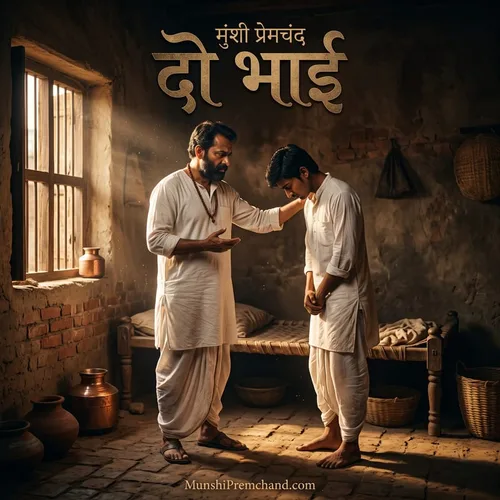
Complete English Translation: Do Bhai (Two Brothers)
Part I
In the pleasant golden morning sunlight, Kalavati would seat both her little sons upon her thighs, feeding them morsels of milk and roti. Kedar was the elder, Madhav the younger. Holding the bite of food in their little mouths, both would scramble down, frolic and hop around for a few paces, and then scramble back onto her lap, chanting in their child-lisp the old verse in which a sympathetic ancient poet had captured the shivering cry of a winter-tormented child:
Daiv-daiv ghaam karo, tumhare baalak ko lagta jaad!
(O God, O God, bring forth the warm sunshine, your little child is shivering with cold!)
The mother would coo lovingly, calling them near, and feed them generous morsels. In her heart surged a wave of boundless tenderness, and in her eyes shone a proud gleam of joy.
The two brothers grew up side by side. They played with their arms lovingly draped around each other's necks. Kedar possessed a sharp, agile mind; Madhav was strong and sturdy of body. So profound was their mutual affection that they went to the village school together, ate their meals together, and remained inseparable at every moment of the day!
In due course, both brothers were married. Kedar’s bride, Champa, was sharp-tongued, restless, and talkative. Madhav’s bride, Shyama, was a dusky-skinned beauty—a veritable mine of loveliness, sweet-spoken, gentle, and peaceful by disposition.
Kedar was completely enchanted by Champa, while Madhav was utterly captivated by Shyama. But Kalavati’s heart could never harmonize with either daughter-in-law. She was pleased with both and displeased with both. Much of her moral instruction was spent in the futile endeavor to persuade Champa to exchange a fraction of her practical cleverness for a share of Shyama’s gentle patience.
Both brothers were blessed with children. The lush green tree grew wide, spreading its branches and bending under the heavy weight of fruit (Madhav had many offspring). The scrawny, stunted tree produced only a solitary fruit, and that too yellowish, sickly, and withered (Kedar had only one frail child). Yet neither brother was content: Madhav longed for wealth and property, while Kedar yearned for a house full of healthy children.
This subtle irony of fate gradually transformed into bitter malice, as was only natural. Shyama remained engrossed day and night in bathing, feeding, and dressing her little brood; she scarcely found a single moment to lift her head from child-rearing. Poor Champa had to slave alone—burning before the cooking fire and grinding grain at the stone handmill.
This sense of unfairness occasionally erupted in stinging, sharp-edged words. Shyama would listen, brood in silence, and swallow the insults without a retort. Yet her quiet tolerance, instead of placating Champa’s anger, inflamed it even further. At last, the cup brimmed over. A cornered deer, finding no avenue of escape, lunges directly at the hunter.
Champa and Shyama separated like two lines diverging at right angles. On that fateful day, two separate cooking hearths were lit beneath the same ancestral roof. But neither brother could bear to look at a single grain of food, and Kalavati wept bitterly through the long day.
Several years went by. The two brothers who had once sat cross-legged upon the very same mat, eaten from the very same plate, and nursed at the very same mother’s breast, now found it intolerable even to live under one roof, in one village. Yet, so that the prestigious reputation of the ancestral family might not be dragged in the mud, a futile, pathetic attempt was made to conceal the roaring flames of jealousy and resentment beneath a thin layer of cold ash.
Between them, genuine brotherly affection no longer existed; only shame for the sacred name of brotherhood remained. The aged mother was still alive, weeping silent tears whenever she witnessed the mutual hostility of her sons. Love still dwelt in her maternal heart, but the proud light in her eyes was extinguished forever. The flower was the same, but its radiant blossom had faded into gray dust.
When they were young boys, if one began to cry, the other instantly burst into tears as well; in those days, they were innocent, foolish, and simple. Today, when one brother wept, the other laughed aloud and clapped his hands in mockery; for now they had grown wise and intelligent!
In those days when they could not distinguish between 'mine' and 'thine', if an outsider playfully teased by threatening to carry one brother away, the other would throw himself upon the earth and clutch the stranger’s tunic, screaming in terror. Today, even if Death itself stood threatening one brother, not a single tear would moisten the other’s eye. Now they had learned to distinguish between 'mine' and 'thine'!
Poor Madhav’s condition was truly pitiful. His expenses were overwhelming and his income minuscule. On top of that, he had to maintain the aristocratic pride and dignity of his lineage! Though the heart wept in agony, the lips were forced to smile; though the soul was soiled by poverty, the white clothes had to be kept spotless. Four growing sons, four daughters, and ordinary necessities sold at the price of pearls! How far could a tiny fractional share of ancestral land revenue sustain such a burden?
The marriage of sons was an affair within one's own control; but how could the marriage of daughters ever be postponed? Two pies of ancestral land were sold off to pay the dowry for the eldest daughter's wedding. Even then, the groom's party rose from the feast in anger without eating the ceremonial rice. The remaining sliver of land was liquidated for the second daughter's wedding. A year later, when the third daughter was married, not even trees or leaves remained upon his holdings! To be sure, this time the bridal feast had been abundant; but poverty and mortgage share the exact same relationship as raw meat and a ravenous dog!
Part II
The third daughter’s gauna (ceremonial departure to her husband’s home) had not yet taken place when an urgent court warrant arrived for Madhav, demanding two years of unpaid government land revenue. To escape imprisonment, the daughter's bridal gold ornaments had to be pledged with a pawn-broker. The noose was loosened for a fleeting moment.
Champa had been lying in wait for just such an opportunity! She immediately sent secret word to the daughter’s new in-laws: "You sit resting in blissful ignorance, while here every piece of your daughter-in-law's gold jewelry is being liquidated!"
The very next morning, a barber and two stern Brahmins representing the in-laws arrived at Madhav’s doorway and planted themselves upon his veranda.
A fatal noose tightened around the poor man's throat! Where on earth was he to find the money? He possessed neither land, nor cattle, nor orchard, nor estate. As for personal credit, that had expired years ago. If any property remained in his name, it was solely those two modest rooms in which he had spent his entire life—and for mud rooms in a remote village, there were no buyers.
Every hour of delay threatened to cut off his nose in everlasting disgrace. In sheer helplessness, Madhav crossed the threshold into Kedar’s courtyard. With tears streaming down his cheeks, he pleaded:
"Bhaiya, at this moment I am trapped in a dreadful calamity! For God's sake, save my honor!"
Kedar replied coldly: "Maddhu, I swear to you, my own hands are terribly tight these days."
Champa interjected with an authoritative, mocking ring: "Oh, are your hands tight for him as well? Does eating at separate hearths mean that our family honor has become separate too?"
Kedar glanced sideways at his wife with cautious eyes and muttered: "No, no, that was not what I meant. Even if money is tight, some arrangement or other will surely have to be made."
Champa turned to Madhav and asked: "The jewelry was mortgaged for a little over five twenties (one hundred rupees), was it not?"
Madhav replied: "Yes, including accumulated interest, it comes to around a hundred and twenty-five rupees."
Kedar, who had been holding a copy of the Ramayana, pretended to immerse himself once more in the holy text.
Champa initiated the practical negotiation: "The sum is substantial. If the money were in our own hands, it would be no matter; but we will have to procure it from an outside moneylender (mahajan). And moneylenders never part with money without formal written deeds on paper."
Madhav reflected bitterly: If I possessed property to pledge on paper, would all other moneylenders in the district have perished that I should come begging at your doorway?
Aloud, he said: "What do I have left to put down on paper? Whatever little property I possess consists only of those two rooms."
Kedar and Champa exchanged a swift, piercing glance. In their secret hearts, both thought: Is our cherished life's ambition finally going to be fulfilled today?
Yet that surging greed assumed an air of grave detachment by the time it reached Champa's lips. Speaking with solemn disdain, she remarked:
"A moneylender will scarcely advance a single copper on a village mud house! If it were in a city, it might yield a monthly rent; but in a village, no one would live in it even for free! Furthermore, it is a shared property."
Kedar grew uneasy lest Champa’s uncompromising severity should spoil the entire game. He interjected: "I happen to have an acquaintance with a certain moneylender. Perhaps, if I plead with him earnestly, he might agree."
Champa nodded, admiring her husband's tactical stroke, and said: "Still, it will be difficult to secure more than two or three twenties (forty to sixty rupees)."
Kedar made a show of stretching the limit: "Well, if we press him very hard, perhaps he might extend it to four twenties (eighty rupees)—not a dam more!"
Champa glared sharply at Kedar, feigning reluctance: "Moneylenders are not so blind, after all!"
Madhav began to see through the hidden machinations of his brother and sister-in-law. He was astounded at how remarkably cunning they had become.
He asked: "And where will the remaining money come from?"
Champa snapped irritably: "Make other arrangements for the remainder! No one in this lifetime will ever advance a hundred and twenty-five rupees on those two crumbling rooms! If you want eighty rupees, I can arrange it from a moneylender—let us draw up the legal deed."
Madhav grew deeply suspicious of these mysterious, evasive terms. He was terrified that they were playing a deep, treacherous trap against him.
Digging his heels in with stubborn dignity, he declared firmly: "What other arrangements can I make? If I possessed ornaments, I would offer them to be pledged. Here, there is not even a scrap of raw cotton thread left! Once disgrace arrives, whether it is for ten rupees or fifty, it is the exact same humiliation!
"If selling my house preserves my name, I am ready to accept it up to that limit. But to surrender my house and still have my honor dragged in the dust—that I shall never do! It is only the family name I care about. If I turn my back and refuse to pay, who can do anything to me? And truth be told, I have no fear for my own name—nobody in the world knows me! The world will laugh only at Bhaiya!"
Kedar’s throat went dry. Champa was thoroughly rattled. She was a shrewd, eloquent woman, but she had never anticipated such unyielding resolve from a simple rustic like Madhav.
Looking at him with newfound respect, she softened her tone:
"Lalu, why do you talk like an unreasonable child? Who on earth would advance a hundred rupees on this little hut? Bring me someone who will give a hundred rupees instead of a hundred and twenty-five, and I will sell my own half of the house this very day! My portion is equal to yours, is it not?
"On the house itself, you will receive only those eighty rupees. As for the remainder, we shall arrange it ourselves. Your honor and our honor are one and the same; it shall not be allowed to perish! That extra sum will simply be entered into a separate personal ledger."
Madhav had achieved his objective. He had won the tactical contest. Thinking to himself, I care only about securing the money—let them enter it in one account or ten! As for the house, I will never surrender it while breath remains in my body, he took his leave in high spirits.
The moment he departed, Kedar and Champa cast aside their hypocritical masks. For a long time, they argued with each other, each trying to prove the other guilty of driving too soft a bargain. In the end, they consoled their hearts with the thought that even if the meal was not sweet, at least the bowl was filled to the brim. Yes, we shall see how Queen Shyama continues to reign in that house!
Outside at Kedar’s doorway stood two bullocks tethered to a post. What mutual solidarity, what deep friendship and affection existed between them! They walked beneath a single yoke; that was their only relationship. Yet only recently, when one was lent to Champa's parents' village for a few days, the other had refused to touch feed for three whole days.
Yet, alas! Human brothers who had played in the very same lap, nursed at the very same breast, had become such bitter strangers today that they could not bear to live within the same four walls!
Part III
It was morning.
At Kedar’s front doorway sat the village Mukhiya and the official Numberdar. Munshi Datadayal, the village petition-writer, sat proudly upon a string cot, engrossed in drafting the mortgage deed (rehannama). He sharpened his reed pen repeatedly and smoothed the legal paper, yet the elegance of his calligraphy refused to improve.
Kedar’s countenance bloomed with radiant triumph, and Champa could scarcely contain her joy. Madhav sat nearby, withered, pale, and crushed in spirit.
The Mukhiya observed with admiration: "There is no friend like a brother, and no enemy like a brother! Kedar has stepped forward to preserve his younger brother’s honor!"
The Numberdar chimed in: "A brother should be like this!"
The estate agent added: "Indeed, brothers! That is the true mark of worthy, noble sons!"
Munshi Datadayal dipped his pen in the inkpot and asked: "The name of the mortgagor?"
The elder brother replied: "Madhav, son of Shivdatt."
"And the name of the mortgagee—the lender who advances the sum?"
"Kedar, son of Shivdatt!"
Madhav looked up at his elder brother in stunned disbelief!
His eyes brimmed with hot, bitter tears. Kedar could not bear to meet his brother's gaze and lowered his head.
The Numberdar, the Mukhiya, and the estate agent sat frozen in sheer astonishment!
Was Kedar himself providing the money? The entire negotiation had been framed around an outside moneylender! If the money was already present inside the ancestral home, what was the need for this cold, formal mortgage deed?
Such bottomless mistrust between own brothers! Good heavens! Ram! Ram! Was Madhav so worthless that he could not be trusted for eighty rupees? And even if he had defaulted on the loan, would the money have drowned in the river? Was it not staying within the family?
Every pair of eyes in the gathering began to exchange silent, meaningful glances, as if small boats were tossing upon an unfathomable ocean of bewilderment.
Shyama stood silently behind the doorway screen. She had always treated Kedar with the deepest reverence as her elder brother-in-law; but today, only social decorum restrained her from stepping out and giving him a piece of her mind!
When the aged mother, Kalavati, heard the words read aloud, a dried-up river of tears burst forth from her sunken eyes.
She looked up at the boundless sky and beat her forehead in agony.
Before her eyes rose the vivid memory of a golden morning long ago—a morning as pleasant and radiant as this, when two sweet, innocent children had sat upon her thighs, hopping and frolicking as they ate milk and bread. In those days, what majestic pride had shone in the mother's eyes! What boundless joy and enthusiasm had filled her breast!
And today—ah, today!
Today there was only burning shame in her eyes and inconsolable grief in her broken heart.
Staring down at the bare earth, she cried in a weeping, trembling voice:
"O Lord Narayana! Were such sons destined to be born from my womb?"
Summary of Do Bhai (Two Brothers)
"Do Bhai" is Munshi Premchand's poignant psychological tragedy depicting the breakdown of brotherly affection under the corrosive influence of domestic rivalry, economic disparity, and property greed. In childhood, Kedar and Madhav are inseparable brothers, lovingly raised by their mother Kalavati. They share every meal, game, and chore, inspiring immense pride in their mother.
As adults, both marry: Kedar weds the sharp-tongued, calculating Champa, while Madhav weds the gentle, self-effacing Shyama. Soon, domestic friction over household labor and sibling jealousy leads to bitter quarrels. Champa resents doing all the cooking while Shyama tends to her growing family. The brothers divide their hearths, and their childhood love cools into mutual hostility and suspicion.
As years pass, their fortunes diverge dramatically. Kedar prospers with only one child, while Madhav sinks into desperate poverty under the burden of raising eight children (four sons and four daughters). To marry off his elder daughters, Madhav liquidates his ancestral land parcel by parcel. When an official warrant arrives for unpaid land revenue, Madhav is forced to pawn his third daughter's bridal jewelry. When the daughter's in-laws discover the mortgage, they send representatives to demand its immediate retrieval, threatening the family with public disgrace.
Facing complete ruin, Madhav swallows his pride and begs Kedar for a loan of one hundred and twenty-five rupees. Kedar and Champa seize upon his vulnerability, pretending they have no money of their own but offering to arrange eighty rupees from an outside moneylender, demanding Madhav's two ancestral rooms as mortgage security. When the mortgage deed is formally drawn up in the presence of the village elders, the scribe asks for the lender's name, and Kedar gives his own: "Kedar, son of Shivdatt."
The village elders and Madhav are stunned by Kedar's cold deceit and mistrust toward his own flesh and blood. Their elderly mother, Kalavati, remembers the innocent mornings of their childhood and weeps bitterly over the moral decay of her sons, crying out in anguish to God.
Publication History
"Do Bhai" (Two Brothers) was first published in 1916 in the Hindi literary journal Saraswati and was later collected in Munshi Premchand's famous short story anthology Mansarovar, Volume 7. Set against the backdrop of early twentieth-century rural North India, the story reflects Premchand's keen observation of the disintegration of the traditional Indian joint family system under the pressures of colonial agrarian taxation, property disputes, and individualistic self-interest.
This unabridged English translation was published in 2026 by MunshiPremchand.com as part of the MunshiPremchand.com English Translation Series.
Themes & Critical Significance
- The Disintegration of the Joint Family: The story provides an incisive anatomical study of how the traditional Indian joint family fractures. The transition from collective harmony to individualized self-interest is catalyzed not only by financial strain, but by petty household rivalries and the lack of mutual empathy.
- Innocence vs. Worldly 'Wisdom': Premchand draws a sharp, ironic contrast between the innocent affection of childhood and the calculated selfishness of adulthood. In youth, the brothers shared everything and wept at each other's pain; as 'wise' adults, they rejoice in each other's misfortunes and exploit each other's desperation.
- Economic Distress and Social Pride in Rural India: Through Madhav's plight, Premchand illustrates the crushing economic realities of rural peasant life—unpayable land revenue, dowry debts, and the exorbitant cost of maintaining social status (kul-maryada)—which force impoverished families to mortgage their very shelter.
- Greed and the Sanctity of Blood Ties: Kedar's covert mortgaging of his own brother's rooms demonstrates how the lust for property can overpower the sacred bonds of brotherhood. The contrast between human cruelty and the natural loyalty of the two tethered bullocks highlights the moral degradation of human beings driven by greed.
- The Tragedy of Maternal Grief: The narrative culminates in the anguish of Kalavati, whose heartbreak symbolizes the destruction of the ancestral family ideal. Her memory of her sons' innocent childhood highlights the irreversible loss of moral purity in a materialistic world.