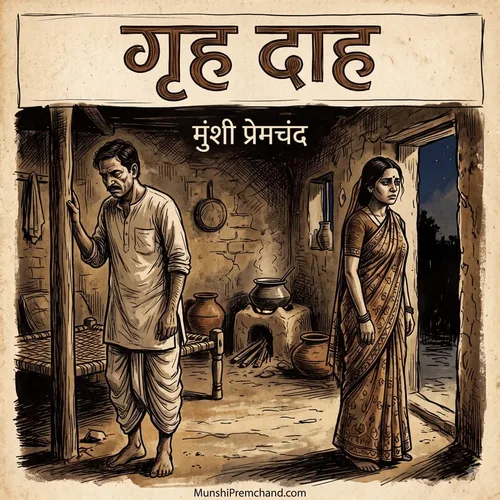
Complete English Translation: Grih Daah (The Burning of the Home)
1
Lala Devprakash had spent a great deal of money celebrating the birth of Satyaprakash. His initiation into learning—the Vidyarambha ceremony—was likewise performed with magnificent pomp and ceremony. There was a charming little carriage for him to take the fresh air; in the evening, a servant took him out for a stroll. Another servant escorted him to school, sat waiting there throughout the entire day, and brought him back home.
What an amiable, promising child he was! A fair countenance, large expressive eyes, a high noble forehead, slender ruby lips, and sturdy little feet. Gazing upon him, words would spontaneously escape one's lips: "May God grant him long life; he will surely grow into an illustrious man!" People were astonished by the sharpness of his intellect and strength. A sweet smile constantly danced upon the moon of his face. No one had ever seen him display obstinacy or burst into tears.
It was the rainy season. Devprakash went with his wife to bathe in the holy Ganges. The river was swollen and surging, brimming like the weeping eyes of an orphan. His wife, Nirmala, entered the water and began playing in the waves. Now she would wade forward, now retreat, now plunge beneath the surface for a dip, now splash glittering sprays with cupped hands.
Devprakash called out, "Come now, step out of the water! You will catch a chill."
Nirmala laughed, "Shall I wade in until the water reaches my chest?"
Devprakash replied, "And what if your foot slips?"
Nirmala said, "Why should my foot slip!"
Saying this, she waded into the current until the water reached her chest.
Her husband pleaded, "Very well, do not take another step forward!"
But death was hovering over Nirmala's head. This was no longer water-play; it was a dance with death. She took one step further forward—and her foot slipped. A piercing shriek broke from her lips; both hands reached upward grasping for support, and then plunged beneath the surface. In a single instant, the thirsty river swallowed her whole.
Devprakash, who had been standing on the bank wiping his body with a towel, leaped instantly into the swirling water. The family servant jumped in behind him. Two boatmen plunged in as well. All of them dived repeatedly and searched the depths, but not a trace of Nirmala could be found. Then a dinghy was summoned. The boatmen dived again and again, but the corpse could not be recovered.
Devprakash returned home drowned in bottomless sorrow. Satyaprakash ran toward him, expecting some sweet gift or toy from the excursion. The father lifted him into his lap, and despite his greatest efforts, could not stifle his wracking sobs.
Satyaprakash asked, "Papa, where is Amma?"
Devprakash choked back his tears, "Son... Mother Ganga invited her to a feast, and has kept her back."
Satyaprakash gazed into his father's face with deep, questioning eyes, and instantly understood the dark reality. He buried his face and began wailing, "Amma! Amma!"
2
A motherless child is the most pitiful creature in the entire world. Even the most destitute of living beings have the solace of God, which gently caresses their wounded hearts. A motherless child is deprived even of this divine refuge. A mother is the sole foundation of a child's universe; without a mother, he is a bird shorn of its wings.
Satyaprakash developed a deep love for solitude. He would sit alone for hours. In the whispering trees he felt a strange, unknown sympathy that was denied to him by the living souls of the household. While the mother's love had been present, everyone showered him with affection; the moment that motherly love was extinguished, everyone turned cold and cruel. Even in his father's eyes, that divine light of tender love faded away. Who gives alms to the utterly destitute?
Six months passed away. Suddenly one day, he learned that a new mother was about to arrive. He ran to his father and asked eagerly, "Papa, is my new mother really coming?"
The father replied, "Yes, my child, she will come and love you dearly."
Satyaprakash asked, "Will my very own mother return from heaven?"
Devprakash said, "Yes, that very mother will return."
"And will she love me just like she used to?"
What answer could Devprakash give? Yet from that very day, Satyaprakash's little heart was filled with joy. Amma is coming! She will take me into her lap and fondle me! Now I will never trouble her, I will never be obstinate, and I will narrate wonderful stories to her!
The wedding day arrived. Grand preparations commenced throughout the house. Satyaprakash could scarcely contain his delight. My new Amma is coming! He too traveled with the wedding procession. He received splendid new clothes; he sat proudly upon the palanquin. Inside the bride's home, his maternal grandmother called him inside, took him onto her lap, and presented him with a gold ashrafi. It was there that he caught his first glimpse of his new mother.
The grandmother said to the young bride, "Look, my daughter, what an exquisite boy! Love him with all your heart."
Satyaprakash looked upon his new mother and was utterly enchanted. Children too are ardent worshippers of beauty. A lovely, radiant young woman, draped in dazzling ornaments, stood before him. He caught hold of her veil with both hands and whispered with all his soul: "Amma!"
How distasteful the word sounded to her! How mortifying! How unpalatable! That young maiden, whose name was Devpriya, could not bear this title of solemn responsibility, sacrifice, and maternal forgiveness. She was still dreaming the intoxicating dreams of romantic passion and youthful pleasure; she was swaying in the fragrant, heady breezes of early youth. This single word shattered her romantic reverie.
Frowning with sharp irritation, she snapped, "Do not call me Amma!"
Satyaprakash stared at her with wide, bewildered eyes. His childhood dream lay shattered on the floor. His eyes welled with tears.
The grandmother scolded gently, "Look, daughter, you have crushed the poor child's heart! What does a little boy know of propriety? If he called you Amma, what injury did it inflict upon you?"
Devpriya answered coldly, "He must not call me Amma."
Why a co-wife's son should be such a thorn in the eyes of a stepmother is a mystery that no scholar of human emotion has ever resolved. Where do we stand in unraveling it? As long as Devpriya remained childless, she would occasionally speak to Satyaprakash and narrate tales; but the moment she became pregnant, her demeanor hardened. And as the hour of delivery drew near, her cruelty intensified day by day.
The day a moon-like baby boy arrived in her lap, Satyaprakash leaped and danced with sheer ecstasy. He rushed eagerly toward the nursery to behold the baby. The infant was sleeping peacefully in Devpriya's arms. With eager, outstretched hands, Satyaprakash leaned forward to lift the little child from his stepmother's lap.
Suddenly, Devpriya shrieked in fury, "Beware! Don't you dare touch him, or I will wrench your ears off!"
The little boy stepped backward as if struck, retreated to the roof, and wept his heart out. What a beautiful baby! If only I could hold him in my lap and play with him, how wonderful it would be! Would I ever drop him? Why then did she scream at me? The innocent child could not comprehend that this harsh rebuke was born not of maternal caution, but of something far darker and more sinister.
One day, the baby was sleeping. He had been named Gyanprakash. Devpriya was in the bathing chamber. Satyaprakash crept quietly into the room, gently lifted the child's blanket, and gazed upon his little brother with eyes brimming with tender devotion. His heart yearned desperately to lift him up and shower him with kisses, but terrified of his stepmother, he did not dare pick him up. He merely bent low and began showering soft, tender kisses upon the baby's chubby cheeks.
Just then, Devpriya emerged from the bath. Seeing Satyaprakash kissing the child, fire erupted in her veins. She roared from the doorway, "Get away from there this instant!"
Satyaprakash looked at his stepmother with meek, pleading eyes, and quietly backed out of the room.
That evening, his father asked sternly, "Why do you constantly make the baby cry?"
Satyaprakash replied, "I never make him cry, Papa. Amma doesn't let me play with him."
Devprakash frowned, "You are lying! Today you pinched the child."
"No, Papa! I was only kissing his cheeks."
"Liar!"
"I am not lying, Papa."
Devprakash flew into a rage. He struck the boy with two or three sharp slaps across the face. For the first time in his life, Satyaprakash received physical punishment—and that too while completely innocent! That single unjust beating transformed the boy's destiny forever.
3
From that fateful day, a strange and tragic transformation came over Satyaprakash's nature. That cheerful, radiant child became sullen, stubborn, and withdrawn. That high, noble forehead was now permanently clouded with gloom; those tender red lips were perpetually dry. The boy who was once the living embodiment of sweetness and grace now developed the cunning obstinacy of a thief.
He was given no books, his tuition fees were withheld, and no clothes were made for him. If clothes were ever provided, they were made of coarse, rough fabric, while Gyanprakash was swathed in fine muslin, silks, and wool. Satyaprakash wandered about in tattered rags, bearing a countenance as withered as that of a seasoned criminal.
He began failing in his studies. In the classroom, he was routinely made to stand on the bench in disgrace, yet he felt not the slightest shame. His sensitivity and self-respect had been systematically ground into dust.
Whenever he was hungry, he would sneak into the kitchen like a thief and pilfer stale chapatis. Devpriya made this a pretext for daily complaints, and Devprakash would beat the boy mercilessly. Sometimes he was locked inside a dark, suffocating room; sometimes he was starved of his evening meal.
A bird can be tamed and trained with a few grains of kindness, but a human heart cannot be subdued through sheer terror. If terror could educate and reform, prisons would be the finest universities in the world! Satyaprakash became completely fearless; he laughed in the face of beatings. He realized with bitter clarity that no matter what he did, his stepmother would concoct some false accusation, and his father would blindly beat him. Why, then, should he make any effort to be good?
Once, Satyaprakash stayed away from school for several consecutive days. His father summoned him: "Why haven't you been attending your classes? Do you imagine I have taken a lifelong contract to feed you for free?"
Satyaprakash replied coolly, "I have accumulated several rupees in fines and unpaid school fees. Whenever I show my face, I am thrown out of the classroom."
Devprakash demanded, "Why are your fees in arrears? Don't you take the money from me month after month?"
"Collections and subscriptions are demanded every few days. I gave my tuition fee money toward the school fund."
"And why were you fined?"
"For non-payment of tuition fees."
"Why on earth did you donate toward the fund?"
Satyaprakash answered quietly, "Gyanu gave a donation, so I gave one as well."
Devprakash sneered, "Are you burning with jealousy toward Gyanu?"
Satyaprakash looked up: "Why should I burn with jealousy toward Gyanu? Inside this house, you consider us two separate beings; but outside in the world, people regard us as one. I did not want people to say that I have nothing to give."
"Are you ashamed to admit the truth?"
"Yes, Papa. It would bring dishonor upon your name."
"Splendid! So now you are protecting my honor! Why don't you simply confess that you have no desire to study? I do not possess so much wealth that I can afford to keep you in the same class for three consecutive years while handing you spending money every month! Gyanbabu is so much younger than you, yet he is only a single grade behind you. This year you are certain to fail, while he is certain to pass and sit right beside you in the same class next year. Then your face will truly be blackened with disgrace!"
Satyaprakash muttered, "Education is simply not written in my destiny."
"And what is written in your destiny, pray tell?"
"Begging for alms."
Devprakash roared, "Then go and beg for alms! Get out of my house!"
Devpriya entered the room at that moment and added venomously, "Look at the shameless wretch! Not an ounce of shame, answering back to his father!"
Satyaprakash retorted calmly, "Those whose destiny it is to beg are orphaned in their childhood."
Devpriya flared up: "I will not tolerate these poisoned taunts any longer! Every day I am forced to swallow gulps of my own blood!"
Devprakash shouted, "He is utterly shameless! Tomorrow I will have his name struck off the school register. If he wants to beg, let him beg in the streets!"
4
The very next day, Satyaprakash made quiet preparations to leave the house forever. He had turned sixteen years of age. After enduring such insults, remaining under that roof had become impossible.
As long as he lacked physical strength, as long as the helplessness of early adolescence held him captive, he had endured neglect, insult, cruelty, and vicious scolding. But now his limbs were strong and capable; why should he remain bound in such degrading slavery? Self-respect, like hope, is an enduring flame that refuses to die easily.
It was the peak of summer, high noon. Every soul in the house was fast asleep. Satyaprakash tucked a spare dhoti under his arm, picked up a tiny cloth bag, and was quietly stepping out through the parlor when young Gyanu suddenly appeared.
Seeing his elder brother dressed for a journey, Gyanu asked innocently, "Where are you going, Bhaiya?"
Satyaprakash paused, "I am going away to find employment somewhere."
Gyanu said, "I will go and tell Amma right now!"
"Then I will slip away secretly so you cannot see me."
Gyanu's eyes widened: "Why are you leaving? Don't you love me at all?"
Satyaprakash took his little brother into his arms and embraced him tightly: "My heart does not wish to leave you behind, Gyanu; but to remain lying in a place where no one cares whether you live or die is sheer shamelessness. I will find some petty job earning five or ten rupees, and fill my stomach. What else am I fit for?"
Gyanu asked, "Why is Amma so furious with you? She always forbids me from talking to you."
Satyaprakash stroked his hair, "My fortune is wretched, that is all."
"Why don't you apply your heart to your studies?"
Satyaprakash smiled sadly, "My heart simply refuses to apply itself, Gyanu. How can it? When no one cares for me, I think to myself: Bah! What is the worst that can happen? I will stumble and suffer. Let it be!"
Gyanu pleaded, "Will you forget me? I will write letters to you. You must invite me to visit you once!"
"I will write to you care of your school address."
Tears streamed down Gyanu's face: "I don't know why, Bhaiya, but I feel such deep, overwhelming love for you!"
Satyaprakash hugged him again, "I will always remember you, my brother."
Saying this, he embraced his brother once more and stepped out into the blinding glare of the summer sun. He did not have a single copper coin in his pocket—and he was heading for the distant metropolis of Calcutta.
5
How Satyaprakash managed to reach Calcutta is a painful tale that would be useless to narrate. For two days he traveled huddled beneath a train seat; for two more days he walked on foot under the scorching sun.
Whenever hunger gnawed at his intestines, he begged for a mouthful of parched grain from kind-hearted strangers; when parched with thirst, he drank water from roadside troughs. At last, weary, haggard, and coated in dust, he reached the colossal, roaring labyrinth of Calcutta.
He stood beside the majestic Howrah Bridge, staring dumbfounded at the rushing river and the colossal ocean-going steamships. The immense wealth of this imperial city seemed to mock his destitution. Here, rivers of gold flowed on every side, yet he possessed not a single cowrie to purchase a loaf of bread!
He wandered through the crowded lanes of Burrabazar. Seeing a Bengali merchant's shop where large bales of cloth were being loaded onto bullock carts, he stepped forward and pleaded for work as a coolie. The manager took one look at his delicate, handsome features and fair complexion, and said, "You do not look like a coolie. Can you read and write Hindi?"
Satyaprakash replied eagerly, "Yes, sir! I know Hindi well, and I can keep basic accounts."
The merchant hired him at twelve rupees a month to tally bales and write dispatch slips. Satyaprakash rented a tiny corner in a dingy, damp tenement in Mechhua Bazar, sharing the floor with half a dozen poor laborers.
He was frugal beyond imagination. He ate once a day—coarse chapatis with raw onions and salt—and saved every single pie. In the evenings, while other laborers smoked cannabis or gambled, Satyaprakash sat beneath a streetlamp with a wooden board, inkpot, and reed pen, writing letters for illiterate upcountry migrants who wished to send remittances to their distant villages. For writing a postcard he charged one pice; for a money-order form, two pice. Within six months, he had established a reputation for absolute honesty and discretion.
A year later, he left the cloth merchant and rented a small wooden kiosk on Harrison Road, selling postage stamps, envelopes, stationery, and books, while continuing his lucrative trade as a letter-writer and petitioner.
His income rose to thirty, forty, and eventually fifty rupees a month. Yet his personal expenditures never exceeded ten rupees!
Where did the rest of the money go? Every month, without fail, an insured parcel or money order reached Gyanprakash at his school address! Sometimes it contained thirty rupees for tuition and boarding fees; sometimes a fine woollen coat, expensive English textbooks, or a sturdy watch. Gyanprakash was now studying in college, supported almost entirely by the sweat, blood, and quiet sacrifice of his exiled elder brother.
6
What tender, sacred, and enchanting memories are awakened by the mere thought of home! When a weary traveler sits beneath a shaded bower, the vision of his home floats before his eyes like a tranquil oasis.
Yet whenever Satyaprakash remembered his home, his heart shivered with dread. That house was not a temple of familial warmth; to him, it was an altar of torment, an executioner's chamber where his childhood innocence and youthful dreams had been butchered without mercy.
He recalled his father's terrifying scowl, his stepmother's poisonous glares, the false accusations, the blows of the cane, the solitary confinement in dark rooms. The memory filled him with nausea and revulsion. He swore never to step foot inside that accursed threshold again.
His only living bond with the world of his ancestors was Gyanu. For Gyanu he would have gladly sliced off his flesh to make shoes for his feet; but for the rest of that house, he felt only a profound, freezing indifference.
Seven long years slipped away. Satyaprakash had now blossomed into a handsome, dignified young man of twenty-three. His business had prospered; he had earned a name among the merchants of Burrabazar as a young man of immaculate integrity.
One evening, as he sat finishing his accounts, a letter arrived bearing a familiar postmark. It was in his father's handwriting!
It was the first letter Lala Devprakash had ever written to his eldest son in seven years.
7
It was twilight. Lala Devprakash was sitting in the inner courtyard, engaged in an anxious conversation with Devpriya.
A wealthy and influential family from a neighboring district had sent a marriage proposal for Gyanprakash. The bride's family was offering a handsome dowry—thousands of rupees in cash, gold ornaments, and fine household goods. Devpriya was impatient to accept the alliance.
Devprakash sighed, "Gyanu flatly refuses to give his consent."
Devpriya said sharply, "Go ahead and finalize the negotiations! He will come around. All boys make a show of refusal at first."
Devprakash replied, "Gyanu's refusal is not born of bashfulness; it is a matter of unyielding principle. He declares openly: 'Until my elder brother is married, I will never consent to marry!'"
Devpriya's lips curled with bitter malice: "Who knows what that rogue is doing in Calcutta! He has probably kept some low-caste concubine there. Why should he marry? Does anyone go there to spy on his disgraceful life?"
Devprakash flared up with irritation: "If he had kept a concubine, he would not be sending forty rupees every single month to your son! Nor would he have sent all those fine articles, clothes, and expensive books that he has provided from his very first month away until today! Heaven knows why your heart has become so utterly blackened against him! Even if the boy were to tear out his living heart and lay it at your feet, your stone heart would never soften!"
Devpriya rose in a fury and stormed out of the courtyard.
Devprakash had desperately wanted her to utter the words that Satyaprakash should be married first; but she never permitted that subject to arise. Devprakash himself had harbored a deep, guilty desire to arrange his elder son's wedding, yet until today he had never found the courage to write a single line to him.
After Devpriya departed, Devprakash sat down and, for the first time in seven years, penned a letter to Satyaprakash.
He began by begging forgiveness for his long years of cruel silence. Then he made a tender, heartfelt appeal for the boy to return home just once. He wrote:
"My son, I am now an old, broken man, a guest in this world for only a few more days. The supreme desire of my heart is to witness the weddings of both my sons before I close my eyes forever. It will break my heart if you reject your father's humble plea. Gyanprakash refuses to step into the wedding pavilion until you are wed. If for no other reason, then at least for the sake of your pure love for Gyanu, you must accept this sacred bond."
When Satyaprakash read this letter in Calcutta, a deep sadness settled upon his soul. I never imagined that my fraternal love would bear such an awkward fruit!
At the same time, a dark, vengeful satisfaction stirred within him: At last, Amma and Papa will taste a drop of mental agony! What did they ever care for me? If I had dropped dead in the gutter, not a tear would have escaped their eyes. For seven long years, they never bothered to write whether I was alive or dead. Now let them suffer! Gyanprakash will eventually agree to marry, but it will not be easy. At least I have been granted the opportunity to state my reasons for refusal. Gyanu loves me, but I will not become an accomplice in this monstrous domestic fraud. Our traditional family life is thoroughly steeped in injustice! It sows the seeds of malice, cruelty, and barbarity. It is inside this trap that parents become the mortal enemies of their own offspring! No, I will not swallow this poisoned fly with open eyes! I will certainly persuade Gyanu. Whatever modest savings I have accumulated, I will offer entirely for his wedding expenses. Beyond that, I can do nothing. If Gyanu too chooses to remain unmarried, the world will not turn desolate! Why must the son of such a father perpetuate this miserable dynasty? Must the same tragic drama that butchered my youth be enacted in his life as well?
The next morning, Satyaprakash dispatched five hundred rupees by bank draft to his father, accompanied by a polite reply:
"Revered Father,
It is my immense good fortune that you remembered this humble servant. Heartiest congratulations on the settlement of Gyanu's wedding! Please use these five hundred rupees to have suitable ornaments made for the new bride.As for my own marriage: after everything I have witnessed with my own eyes and suffered upon my own body, if I were to ensnare myself in the fetters of family life, there would be no greater fool upon this earth than I. I trust you will forgive me. The mere mention of marriage sends a shudder of horror through my soul."
He penned a second letter to Gyanprakash:
"My beloved Gyanu,
Obey the command of our parents with all your heart. I am an uneducated, foolish, ruined creature; I possess neither the standing nor the right to marry. I will not be able to participate in the festivities of your wedding, but nothing in this world could bring me greater joy and profound contentment than your happiness."
8
Lala Devprakash stood stunned and speechless after reading this reply. He lacked the courage to press the matter further. But Devpriya's mind was seized by a wild, uncontrollable frenzy.
She screamed, "He has sent this insult deliberately to mock us! He wants to keep my Gyanu unmarried so that our line will die out! He has cast an evil eye upon my child! He wants to ruin Gyanu's future!"
Gyanprakash stood firm: "Bhaiya has sacrificed his entire youth for me. I will not marry until he is brought home with honor and married first!"
A violent tempest raged inside the household for days. Devpriya starved herself, rolled on the floor in hysterics, and showered curses upon Satyaprakash. Finally, seeing that Gyanprakash was adamant, Devpriya picked up a pen and wrote a letter to Satyaprakash herself.
It was not a letter; it was a bowl of concentrated viper's venom! She wrote:
"You ungrateful, wicked sorcerer! You have bewitched my boy with your evil spells! You want to ruin his happiness and see this house turned into a graveyard! You sit there in Calcutta like an executioner, tightening the noose around our necks. If you have any shame left, stay away forever, but release my child from your black magic! If any harm befalls my Gyanu, I will drink your blood!"
When Satyaprakash opened this letter in Calcutta and read its venomous lines, his head reeled. The earth seemed to slip beneath his feet. All the buried horrors of his childhood—the cold glares, the false accusations, the beatings, the curses—surged back like a flood of molten lead. His hands trembled violently. A cold sweat drenched his limbs. He tore the letter to shreds, but the poison had already seeped into his soul.
The following day, another letter from Devpriya arrived. Satyaprakash snatched it and tore it into bits without opening it; he did not possess the courage to read it.
The next day, a third letter arrived. It met the exact same fate.
Soon it became a daily ritual. Every morning, the postman would deliver a venomous missive from Devpriya, and Satyaprakash would rip it to pieces unread.
Yet Devpriya's cruel design was accomplished even without the letters being read—every single envelope struck another devastating hammer-blow upon Satyaprakash's shattered spirit! The mere sight of that familiar handwriting on the post was enough to reopen every ancient wound, plunging an invisible dagger deep into his chest.
9
After a month of this unbearable psychological torture, a profound weariness and disgust with life overtook Satyaprakash.
He closed down his shop. He stopped going outside. He stopped meeting his friends and clients. All day and all night, he lay motionless upon his string cot in that dingy, airless tenement.
Haunting visions of the past swarmed before his feverish eyes. He remembered those blissful childhood days when his birth mother Nirmala would gather him tenderly into her lap, stroke his hair, and whisper: "My precious son!" He remembered his father returning from the office at dusk, lifting him high into the air with a joyful cry: "My little prince!"
The vivid, radiant image of his mother would appear before him, looking exactly as she did on that tragic morning when she waded into the sacred Ganges. Her affectionate words echoed in his ears.
Then that beautiful vision would vanish, replaced by the horrifying memory of the day he had run to the newly wedded bride and innocently cried: "Amma!"
He heard again those chilling, harsh words: "Do not dare call me Amma!"
He saw those fierce, venomous eyes glaring at him. He remembered his broken sobs on the rooftop.
Then the nursery scene unfolded before him—how he had crept in, yearning only to kiss the sleeping infant's cheeks, and how that terrible voice had thundered from behind! Alas! That single thunderbolt destroyed my entire universe!
Countless memories of cruelty marched before him like grotesque demons. He remembered being beaten for faults he had never committed; his father's callous, compliant cruelty; the suspicion and rage in every glance; the malicious slanders manufactured out of nothing. Alas! My entire existence has been ruined!
He would turn violently upon his cot, yet the same nightmare played endlessly before his burning eyes. He would toss and turn, clutching his temples, screaming in the empty room: "Why doesn't this wretched life come to an end? O God, why don't You let me die?"
10
For weeks, Satyaprakash lay in this state of living death, neither eating nor drinking, wasting away to a mere skeleton.
One evening, as twilight shadows lengthened across the dingy room, he suddenly heard a voice calling from the lane outside. He listened intently, his heart skipping a beat. It was a voice he knew!
He dragged his frail, trembling body to the door and pulled it open. Standing before him was Gyanprakash!
What a tall, handsome, dignified young man his little brother had become! Satyaprakash threw his arms around him and wept upon his chest. Gyanprakash bent low and touched his elder brother's feet with reverence.
Both brothers stepped inside the dark room. A heavy, graveyard gloom hung over the tenement. Seeing the utter squalor and desolation, Gyanprakash, who had been struggling to control the choking grief in his throat, burst into wracking sobs.
Satyaprakash lit an old kerosene lantern with trembling fingers. The place looked like an abandoned haunted ruin. Satyaprakash quickly pulled a tattered kurta over his emaciated chest.
Gyanprakash stared at his brother's skeletal frame, his sunken, waxen cheeks, and the extinguished fire in his hollow eyes, and wept uncontrollably.
Satyaprakash whispered with a faint, trembling smile, "I have been unwell these past few weeks, Gyanu."
Gyanprakash choked out, "I can see that, Bhaiya... I can see that with my own eyes!"
Satyaprakash asked gently, "You did not send any word of your arrival. How did you manage to find this wretched room?"
"I did write to you, Bhaiya! Perhaps the letter was delivered to your shop."
"Ah, yes... you must have sent it to the shop. I have not opened the stall for many days. Tell me, is everything well at home? Is everyone in good health?"
Gyanprakash's head bowed low. In a voice as cold as ice, he said: "Amma has passed away."
Satyaprakash started in shock: "What? Was she ill?"
"No, Bhaiya. She swallowed poison. Over the past month, she had descended into a state of absolute madness. Father uttered a few harsh words to her, rebuking her wickedness, and in a fit of wild frenzy she consumed poison."
Satyaprakash gasped, "And Father? Is Father well?"
Gyanprakash looked away, his jaw tightening: "He is not dead yet."
Satyaprakash cried out, "What are you saying, Gyanu? Is he gravely ill?"
Gyanprakash said in a hollow, trembling voice, "When Amma took the poison, Father desperately tried to pry open her jaws to administer an antidote. In her dying delirium, she sank her teeth deep into two of his fingers and bit through the flesh. The lethal poison from her mouth seeped directly into his bloodstream. Since that day, his entire body has swollen into a monstrous shape. He is lying in the hospital, completely delirious. Whenever anyone approaches his bed, he lunges forward trying to bite them like a rabid creature. The doctors say there is no hope of his survival."
Satyaprakash covered his face with both hands and groaned in agony: "Then... then our home is completely ruined! It has been burned to ashes!"
Gyanprakash looked at his shattered brother, his eyes flashing with a terrible, righteous fire:
"Such a home should have been burned to ashes long, long ago!"
On the third morning, both brothers quietly boarded the train, bidding a final, silent farewell to Calcutta.
Summary of Grih Daah (The Burning of the Home)
Grih Daah ("The Burning of the Home") is one of Munshi Premchand's most devastating and psychologically intense domestic tragedies. It explores the corrosive destruction of a family through stepmotherly hatred, paternal complicity, and the unassailable nobility of fraternal love.
The tragedy unfolds in distinct stages:
- The Fall of the Household: Lala Devprakash and his wife Nirmala enjoy an idyllic life with their bright, extraordinarily gifted son, Satyaprakash. During a monsoon excursion to the Ganges, Nirmala wades too deep into the swollen current and drowns before her husband's eyes.
- The New Stepmother: Six months later, Devprakash marries the young, vain Devpriya. When little Satyaprakash rushes forward and calls her "Amma", Devpriya recoils in disgust, refusing to assume maternal responsibility.
- The Birth of Gyanprakash and Persecution: When Devpriya gives birth to her own son, Gyanprakash, her aversion toward Satyaprakash deepens into active cruelty. She forbids him from touching the baby, manufactures false complaints of pinching, and provokes Devprakash into beating the innocent boy. Over time, Satyaprakash is starved of affection, stripped of decent clothes and books, and systematically branded a thief and failure, until he becomes hardened and fearless in the face of punishment.
- Flight to Calcutta: At age sixteen, unable to endure daily degradation, Satyaprakash leaves home with empty pockets. Yet despite his suffering, he harbors no jealousy toward his half-brother; they share a tearful, loving farewell.
- Sacrifice in Exile: Reaching Calcutta, Satyaprakash endures grueling poverty, working first as a tally-clerk and letter-writer for illiterate laborers, before establishing a modest stationery stall. Living on the barest sustenance, he secretly remits thirty to forty rupees every month to support Gyanprakash's college education and buy him clothes and books.
- The Marriage Crisis: Seven years later, Devprakash writes his first letter to Satyaprakash, begging him to return and marry so that Gyanprakash (now an educated teacher) can accept an advantageous proposal. Gyanprakash steadfastly refuses to marry until his self-sacrificing elder brother is honored first.
- The Poisonous Campaign: Satyaprakash gently declines marriage, sending five hundred rupees as a gift for the new bride. Devpriya, convinced that Satyaprakash is deliberately obstructing her son's fortune through black magic, launches a vicious campaign of daily venomous letters. Although Satyaprakash tears them up unread, the psychological trauma shatters his spirit and health, confining him to bed in a state of living death.
- The Catastrophe: Gyanprakash arrives in Calcutta to find his beloved brother emaciated and near death. He reveals the horrifying climax: driven mad by her own hatred, Devpriya consumed poison; when Devprakash tried to pry open her jaws to save her, she bit his fingers, transmitting the poison into his bloodstream. With Devpriya dead and their father dying in delirium, Gyanprakash declares with righteous fury that a household founded on such cruelty deserved to be burned to ashes long ago.
Publication History
Grih Daah ("The Burning of the Home") was written by Munshi Premchand in 1919 during a period of prolific creative output focused on domestic realism and social critique. It was first published in contemporary literary magazines before being permanently preserved in Part 6 of his masterwork short-story anthology Mansarovar (मानसरोवर, भाग 6).
The story represents one of Premchand's earliest and most uncompromising explorations of the psychological pathology of domestic abuse, the destructive dynamics of the polygamous or remarried Hindu household, and the tragic consequences of emotional neglect upon children.
This unabridged English translation was published in 2026 by MunshiPremchand.com as part of the MunshiPremchand.com English Translation Series.
Themes & Critical Significance
1. Stepmotherly Malice and the Pathology of Insecurity
Premchand provides a chilling psychological portrait of Devpriya. Her initial rejection of the title "Amma" stems from youthful vanity and reluctance to shoulder domestic sacrifice. However, once she gives birth to her biological child, her aversion metastasizes into an irrational, all-consuming paranoia. She perceives Satyaprakash not as an innocent child, but as an existential competitor who threatens her son's primacy and wealth. Her descent into insanity and poison illustrates how unchecked jealousy ultimately annihilates the person who harbors it.
2. The Failure of Paternal Duty
While Devpriya is the active instigator of cruelty, Premchand places severe moral culpability upon Lala Devprakash. Enamored of his youthful second wife, Devprakash abdicates his moral duty as a father, credulously accepting every slander and physically beating his motherless eldest son. Premchand exposes the moral cowardice of patriarchal authority that sacrifices vulnerable children to preserve domestic peace or indulge sensual infatuation.
3. Pure Fraternal Love vs. Toxic Domesticity
The bright moral beacon of the tragedy is the bond between Satyaprakash and Gyanprakash. Despite the toxic environment engineered to breed hatred between half-brothers, their fraternal love remains immaculate. Satyaprakash sacrifices his own youth, education, and health in Calcutta to fund his brother's advancement, while Gyanprakash refuses marital happiness without his brother's presence. Their solidarity triumphs morally over the corruption of the parental generation, even as the physical home burns to ruin.
4. The True Meaning of Grih Daah (The Burning of the Home)
The title carries profound metaphorical resonance. A home is not destroyed merely by physical conflagration; it is incinerated when maternal tenderness dies, when justice is supplanted by favoritism, and when parents wage psychological war against their own flesh and blood. The literal poison that kills Devpriya and infects Devprakash is simply the biological manifestation of the hatred they nurtured for years beneath their roof.