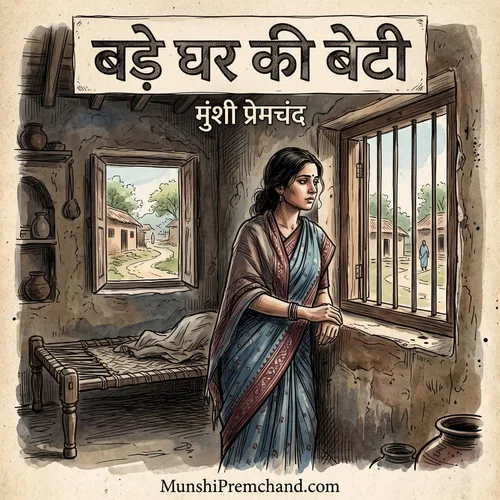
Complete English Translation: Bade Ghar Ki Beti (The Daughter of a Noble Household)
Part 1 — A Glorious Past, A Present of Modest Means
Beni Madhav Singh was the zamindar and village headman (nambardar) of Gauripur. His grandfather had once been a man of immense wealth and opulence. The paved stone pond and the village temple—whose repair had now become nearly impossible—stood as monuments to his former glory. It was said that an elephant used to sway majestically at their gateway; now, in its place, stood an aged buffalo whose frame was little more than a skeleton of bones. Yet she yielded milk in abundance, for someone or another was perpetually hovering over her head with a clay pot!
Beni Madhav Singh had sacrificed more than half of his ancestral estate to lawyers and court litigation. His present income did not exceed a thousand rupees annually. The Thakur Sahib had two sons. The elder was named Shrikant Singh. After long years of hard labor and industry, he had secured a Bachelor of Arts degree, and was now employed in an office in town.
The younger son, Lalbihari Singh, was a broad-chested, strapping young fellow with a handsome, full face. Every morning upon rising from bed, he would drink down two seers of fresh buffalo milk. Shrikant Singh was the exact opposite. He had sacrificed those pleasing physical attributes at the altar of two letters—B.A. Those two letters had rendered his frame frail and his face pale.
Consequently, he harbored a special affection for ancient medical treatises. He placed great faith in Ayurvedic medicines. Morning and evening, the melodious, rhythmic clatter of the mortar and pestle could frequently be heard echoing from his room. He maintained voluminous correspondence with Ayurvedic physicians in Lahore and Calcutta.
Yet, despite possessing an English university degree, Shrikant was by no means an admirer of Western social customs; on the contrary, he would often criticize and denounce them with intense fervor. For this reason, he commanded great respect in the village. During the Dussehra festival, he organized the Ramlila theatricals with immense enthusiasm and personally performed in one role or another. In Gauripur, he was the sole founder and patron of Ramlila.
Singing the praises of ancient Hindu civilization was the primary article of his social faith. He was a devout worshiper of the traditional joint family system. The growing reluctance among modern women to live harmoniously within a joint family was something he regarded as destructive to both community and country.
For this very reason, the women of the village were his fiercest critics! Some did not hesitate to regard him as their outright enemy! Even his own wife was in disagreement with him on this matter. This was not because she harbored any malice toward her parents-in-law or brother-in-law; rather, her conviction was that if, even after immense endurance and patience, living together in peace proved impossible, then rather than destroying life through daily domestic strife, it was far better to cook one's meal separately.
Anandi was a girl of noble birth. Her father, Thakur Bhup Singh, was the taluqdar of a small estate. A spacious manor house, an elephant, three hunting hounds, falcons, hunting hawks, crystal chandeliers, an honorary magistracy, and heavy debts—all the conventional luxuries and burdens of a prestigious taluqdar—were present there.
He was a generous-hearted and accomplished gentleman, but by misfortune, he had not a single son. Seven daughters were born to him, and by destiny's design, every single one survived! In his initial enthusiasm, he celebrated the marriages of the first three daughters with boundless magnificence; but when a debt of fifteen to twenty thousand rupees accumulated on his head, his eyes opened, and he drew in his lavish hand.
Anandi was the fourth daughter. She was far more beautiful and accomplished than all her sisters, and for this reason, Thakur Bhup Singh loved her dearly. A handsome, virtuous child is perhaps favored just a little more by parents.
The Thakur Sahib was trapped in a deep moral dilemma regarding where to marry her. He neither wished to increase the crushing burden of debt, nor could he bear the thought that his beloved daughter should consider herself ill-fated.
One day, Shrikant came to his estate seeking subscriptions for a public cause—perhaps for the Nagari Pracharini Sabha. Bhup Singh was enchanted by his refined conduct and noble disposition, and Shrikant Singh's marriage to Anandi was celebrated with great festivity.
When Anandi arrived at her new home, she witnessed an entirely different state of affairs. The pomp and elegance to which she had been accustomed from childhood were nowhere to be found. To speak of elephants and horses was out of the question—there was not even a handsomely decorated carriage!
She had brought silk slippers with her, but where were the paved garden walks? The dwelling lacked even proper windows; there were no carpets on the floor, no paintings on the walls. It was a simple, rustic village household. Yet, within a matter of days, Anandi adapted herself to these new conditions so completely that it seemed as though she had never seen luxurious amenities in all her life!
Part 2 — Hunger, Wrath, and Insult
One afternoon, Lalbihari Singh returned home carrying two hunted birds and said to his sister-in-law: "Cook these quickly, I am ravenously hungry!" Anandi had already finished cooking the regular meal and was waiting for him; she now sat down to prepare the new dish.
Looking into the clay pot, she saw barely a quarter-seer of clarified butter (ghee) remaining. Being a daughter of a wealthy house, she knew little of petty domestic rationing—she poured all the ghee into cooking the bird meat.
When Lalbihari sat down to eat, there was no ghee in the lentils. He barked: "Why didn't you put ghee in the lentils?"
Anandi replied: "All the ghee was used up in cooking the meat."
Lalbihari shouted: "A fresh supply of ghee arrived only the day before yesterday! How could it disappear so soon?"
Anandi answered: "There was barely a quarter-seer left today; I poured it all into the meat."
Just as dry wood catches fire in an instant, so too a man maddened by hunger flares up over the smallest trifle. Lalbihari found his sister-in-law's frankness utterly intolerable. Snapping in annoyance, he retorted:
"As if rivers of ghee flow in your father's house!"
A woman can endure harsh curses, and even physical blows; but insults directed against her parental home are beyond all endurance. Anandi turned her face and replied sharply:
"Even a dead elephant is worth nine lakhs! In my father's house, the barbers and servants consume more ghee than that every single day without anyone even noticing!"
Lalbihari was consumed with fury. He picked up his brass plate, overturned it upon the floor, and snarled:
"I feel like grabbing your tongue and ripping it out!"
Anandi's temper flared as well. Her countenance turned crimson, and she retorted:
"If he were present here today, he would make you pay for this!"
Now the crude, unlettered rustic could restrain himself no longer. His own wife was the daughter of an ordinary peasant; whenever he felt inclined, he would raise his hand against her. He picked up a heavy wooden sandal (khadaun), hurled it violently at Anandi, and yelled:
"The husband you boast so proudly of—I shall deal with him, and with you as well!"
Anandi blocked the flying wooden sandal with her raised hand. Her head was spared, but her finger was severely bruised. Trembling with rage like a leaf caught in a gale, she retreated into her room and stood in silence.
A married woman's strength, courage, honor, and dignity reside entirely in her husband. Her pride rests upon his protective power and manhood. Anandi swallowed this bitter draught of humiliation and kept her peace.
Part 3 — Honor, Rebellion, and Remorse
Shrikant Singh was accustomed to returning home from town on Saturday evenings. The incident had occurred on Thursday. For two full days, Anandi remained confined to her chamber of sorrow. She took neither food nor water, merely waiting for his return.
At last, on Saturday evening, he arrived home as usual. Sitting in the outer reception room, he engaged in casual conversation with the village elders, discussing local affairs, national news, and newly filed lawsuits. This conversation continued until ten at night. The gentlemen of the village derived such immense pleasure from these discussions that they forgot even their dinner! Shrikant found it nearly impossible to tear himself away.
These two or three hours were endured by Anandi in excruciating anguish.
At last, the hour for dinner arrived; the gathering dispersed. When the room was clear, Lalbihari said to his elder brother:
"Bhaiya, please instruct Bhabhi to mind her tongue when speaking, or one of these days a terrible disaster will occur."
Beni Madhav Singh testified on his younger son's behalf:
"Yes, it is not good conduct for daughters-in-law to bandy words with the men of the house."
Lalbihari added insolently:
"She may be the daughter of a noble house, but we are not low-caste laborers either!"
Shrikant inquired in an anxious tone:
"What, after all, took place?"
Lalbihari said dismissively:
"Nothing of consequence; she simply picked a quarrel all on her own. In the face of her father's grandeur, she considers us nothing at all."
Having finished his meal, Shrikant went to Anandi's room. She sat there overflowing with resentment; he too was somewhat sharp-tempered tonight. Anandi asked:
"Is your heart pleased?"
Shrikant replied:
"Very pleased! But what sort of tempest have you stirred up in the house these days?"
Anandi's eyebrows furrowed, and a fire of indignation flared throughout her frame. She said:
"If I could catch the person who ignited this fire in your ears, I would scorch his mouth!"
Shrikant:
"Why get so heated? Tell me what happened."
Anandi:
"What can I say? It is the misfortune of my cruel fate! Otherwise, a crude rustic boy who does not possess the sense even to serve as an office peon would never have struck me with a wooden sandal and strutted about so haughtily!"
Shrikant:
"Tell me everything clearly so I may know! I understand nothing of this."
Anandi:
"The day before yesterday, your darling brother asked me to cook meat. There was no more than a quarter-seer of ghee in the jar; I poured it all into the meat. When he sat down to eat, he demanded: 'Why is there no ghee in the lentils?' On that simple matter, he began heaping vile insults upon my father's house. I could bear it no longer. I remarked that in my father's house, even the barbers and servants consume that much ghee without anyone taking notice. Over this trivial matter, that unjust tyrant hurled a wooden sandal at me! Had I not shielded myself with my hand, my skull would have split open! Ask him yourself whether what I speak is truth or falsehood!"
Shrikant's eyes flared blood-red. He whispered in disbelief:
"It has come to this? That boy had the audacity to do this!"
Anandi, following the natural manner of women, began to weep; for tears linger ever upon their lashes. Shrikant was ordinarily a man of immense patience and tranquility, rarely prone to anger; but a woman's tears act as oil poured upon the fire of a husband's wrath.
All through the night he tossed and turned upon his bed. In his deep agitation, he did not close his eyes for a single moment. At dawn, he walked out to his father and declared firmly:
"Father, my life can no longer continue in this house."
On countless occasions, Shrikant had fiercely rebuked his friends for uttering such rebellious declarations against the joint family; yet today, by cruel fate, he was compelled to voice those very words from his own lips! How effortless it is to preach sermons to others!
Beni Madhav Singh was startled and asked:
"Why?"
Shrikant:
"Because I, too, possess some regard for my personal honor and self-respect. In your household, tyranny and obstinacy now hold absolute sway. Those who ought to venerate and respect their elders are riding roughshod over them. I am an employee in another's service and cannot remain at home; behind my back, showers of sandals and shoes are rained upon women!"
"I care nothing for harsh words; if someone trades insults, I can endure it. But it can never be permitted that blows and kicks should fall upon my wife while I remain silent!"
Beni Madhav Singh could offer no immediate answer. He could only say:
"Son, you are a man of intellect, yet you speak like this? Women destroy households in this fashion; it is unwise to indulge them so greatly."
Shrikant:
"The woman for whose honor and dignity I stand accountable before the court of God—such atrocious injustice and beastly violence toward her is completely intolerable to me! Either he stays in this house, or I do!"
Lalbihari Singh was standing silently beside the doorframe, listening to his elder brother's words.
Hearing such heart-wrenching declarations from the lips of the brother he revered, Lalbihari was overcome with unbearable grief and self-reproach. He broke down and wept bitterly.
Presently, he came and stood before Anandi's door, and spoke in a trembling voice:
"Bhabhi! Bhaiya has resolved that he will not reside in this house with me. He no longer wishes to look upon my face; therefore, I am leaving. I shall never show him my face again! Forgive whatever transgression I committed against you!"
Saying this, Lalbihari's throat choked with sobs.
Part 4 — The Triumph of Compassion
At the very moment when Lalbihari Singh stood with bowed head at Anandi's door, Shrikant Singh entered from the courtyard, his eyes flashing red. Seeing his brother standing there, he turned his gaze away in disgust and skirted past him, as though fleeing from his very shadow.
Anandi had indeed lodged her complaint against Lalbihari, but now in her heart she was repenting bitterly. She was compassionate by nature. She had never imagined that the matter would escalate to such catastrophic proportions. In her heart, she felt annoyed at her husband for becoming so furiously agitated. Moreover, the dread haunted her that he might insist on taking her away to live in Allahabad, and how would she manage?
Meanwhile, when she heard Lalbihari standing at the door declaring: "I am leaving now; forgive whatever transgression I committed," the last remaining ember of her anger dissolved completely into water. She began to weep. To cleanse the impurities of the human heart, there exists no substance more potent than the water of tears.
Seeing Shrikant, Anandi whispered:
"Lala is standing outside, weeping bitterly."
Shrikant:
"What am I to do?"
Anandi:
"Call him inside! May fire consume my tongue—from where did I ever raise this quarrel?"
Shrikant:
"I will not call him."
Anandi:
"You will repent! He is filled with immense sorrow and shame; God forbid, what if he wanders away forever?"
Shrikant did not move.
Just then, Lalbihari spoke once more from outside:
"Bhabhi, convey my humble salutations to Bhaiya. He does not wish to see my face; therefore, I too shall never show my face to him again."
Having spoken these words, Lalbihari turned upon his heel and walked swiftly toward the outer gate.
At last, Anandi stepped out of her chamber and caught him firmly by the hand. Lalbihari turned around, looked at her with eyes brimming with tears, and pleaded:
"Let me go!"
Anandi:
"Where are you going?"
Lalbihari:
"Where no one will ever look upon my face."
Anandi:
"I will not let you go!"
Lalbihari:
"I am not worthy to live among you all."
Anandi:
"I swear upon my life—you shall not take another step forward!"
Lalbihari:
"Until I know that Bhaiya's heart is completely clear toward me, I will never remain in this house."
Anandi:
"Taking God as my witness, I declare that in my heart there remains not the slightest speck of ill will toward you!"
Now Shrikant's heart, too, melted entirely. Stepping outside, he took Lalbihari into his arms and embraced him. Both brothers wept uncontrollably on each other's shoulders.
Lalbihari sobbed brokenly:
"Bhaiya, never say again that you will not look upon my face! Aside from that, whatever punishment you decree, I shall accept with a joyous heart!"
Shrikant spoke in a quavering voice:
"Lallu! Forget these things entirely. God willing, such an occasion will never arise again!"
Beni Madhav Singh was entering from the outer courtyard. Seeing both brothers locked in a warm embrace, his heart swelled with immense joy. He exclaimed with deep pride:
"Daughters of noble households are truly like this! They rebuild a home that is falling to pieces!"
And whoever in the village heard this tale echoed those very words in praise of Anandi's boundless generosity:
"Daughters of noble households are truly like this!"
Summary of Bade Ghar Ki Beti
Bade Ghar Ki Beti (The Daughter of a Noble Household) by Munshi Premchand is an enduring classic exploring family dynamics, human ego, forgiveness, and the moral responsibilities that preserve the traditional Indian joint family. Anandi, the fourth daughter of a wealthy taluqdar, Thakur Bhup Singh, is married to Shrikant Singh, the educated elder son of Beni Madhav Singh, the zamindar of Gauripur. Though raised amidst crystal chandeliers, hunting hounds, and elephants, Anandi adapts gracefully to the rustic, unadorned life of her marital village home.
The family equilibrium is shattered one afternoon when her hot-headed younger brother-in-law, Lalbihari, returns starving from a hunt. Discovering that Anandi has used the last quarter-seer of ghee to prepare meat, leaving none for the lentils, he insults her parental home. Anandi proudly retorts that in her father's house, even servants consume far more ghee daily. Enraged, Lalbihari hurls a heavy wooden sandal (khadaun) at her, injuring her finger.
When Shrikant returns on Saturday, Anandi recounts the assault. Shrikant, ordinarily calm and a vocal proponent of joint families, is furious at this breach of dignity and declares to his father that he can no longer live in the household, issuing an ultimatum that either Lalbihari or he must leave. Overhearing this and devastated by his brother's renunciation, Lalbihari is seized by profound remorse and prepares to leave the village forever, begging Anandi's pardon.
Moved by his tears and recognizing that her grievance is about to destroy the family, Anandi's anger completely vanishes. Rushing out, she stops Lalbihari, swears on her life that her heart is free of bitterness, and urges Shrikant to reconcile. Shrikant embraces his weeping brother, restoring unity to the home. The story concludes with Beni Madhav Singh and the entire village celebrating Anandi's magnanimity, declaring that the true mark of a daughter from a noble family is her ability to mend what is broken.
Publication History
Bade Ghar Ki Beti was written by Munshi Premchand and originally published in Urdu in December 1910 in the esteemed literary journal Zamana. It was later included in Premchand's foundational Urdu collection Prem Pachisi (1914). Its Hindi version was first published in Sapt Saroj (1917) and subsequently collected in Mansarovar, Volume 1 (मानसरोवर भाग 1), where it remains one of Premchand's most widely read and anthologized masterpieces.
This unabridged English translation was published in 2026 by MunshiPremchand.com as part of the MunshiPremchand.com English Translation Series.
Themes & Critical Significance
- The Real Meaning of Nobility: The story radically redefines the concept of Bade Ghar Ki Beti (daughter of a great family). True aristocracy is demonstrated not through wealth, lineage, or ostentation, but through magnanimity, emotional restraint, and the capacity to forgive.
- Preservation of the Joint Family: Premchand examines the fragile architecture of the Indian joint family. While interpersonal friction, differing temperaments, and financial stress inevitably create domestic conflict, the survival of the family depends on timely compromise, humility, and the rejection of destructive ego.
- The Centrality of Women in Domestic Harmony: Anandi is portrayed not merely as a passive victim of patriarchal anger, but as the active moral arbiter of the household. Her refusal to nurture resentment prevents a permanent fraternal rupture.
- Theoretical Ideals versus Practical Realities: Shrikant represents the educated reformer who preaches joint-family harmony to the world, yet readily demands separation the moment his personal pride is wounded. Premchand gently satirizes the gap between intellectual dogma and domestic practice.
- Repentance and Fraternal Love: Lalbihari's immediate transformation upon hearing his elder brother's declaration highlights Premchand's belief in the innate goodness of human nature. Sincere remorse possesses the power to dissolve even the fiercest hostility.