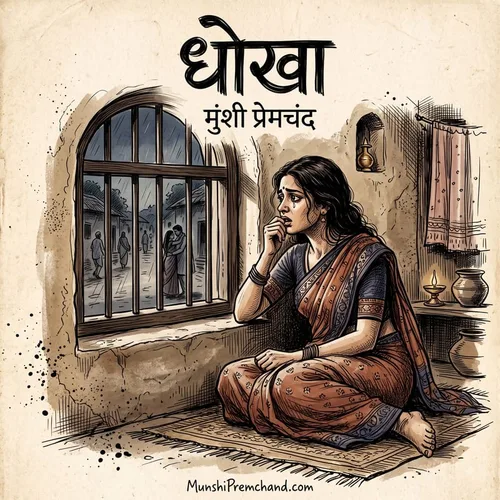
Complete English Translation: Dhokha (The Deception)
I
The lotuses blossoming upon the waters of Sati Kund swayed gently in the soft breezes of spring, and the mild, golden rays of the early morning sun smiled down upon them in tender communion. Standing upon the lush green grass along the water's edge, Princess Prabha was listening to the sweet warbling of birds. Her golden complexion sparkled like the petals of those blooming lotuses, as though she were the living, serene incarnation of the morning dawn, sculpted by the radiant sunbeams of Lord Surya himself.
Gazing up at an Indian robin perched upon a bough of a Spanish cherry tree, Prabha sighed: "How I wish that I, too, were a little bird!"
Her companion, Uma, smiled and asked: "Why so, sister?"
Prabha, keeping her eyes fixed upon the ripples of the reservoir, replied: "Perched upon the verdant leafy boughs of trees, I would chirrup and sing, until my warbling filled the entire garden with melody!"
Uma teased playfully: "The Queen of Naugarh can listen to the singing of hundreds of such birds whenever she pleases!"
Prabha blushed with a touch of modesty and sadness. "I have no desire to become the Queen of Naugarh. For me, a quiet, solitary riverbank is all I crave. A single veena, and the sweet melody of enchanting birds singing in harmony—in that alone lies all the wealth and grandeur of the universe for me!"
Prabha possessed an infinite, passionate love for music. She would frequently lose herself in such tender daydreams.
Uma was just about to reply when, suddenly, from beyond the garden wall, the resonant voice of someone singing floated into the air:
"Kar gaye thode din ki preeti..."
(You gave love for just a few short days, and departed...)
Prabha listened with rapt, undivided attention. Her heart began to race with uncontrollable agitation, and she cried: "Sister, there is magic in that voice! I cannot bear to let it pass unheard. Please, call the singer inside at once!"
Uma, too, was under the spell of that enchanting melody. She answered: "Undoubtedly, I have never in all my life heard such a magnificent melody. I shall unlatch the wicket gate and invite him in."
Within a few moments, the singer entered the garden. He was a young man of striking, elegant beauty—barefoot, bareheaded, with a deerskin slung across his shoulder, wrapped in simple ochre-colored robes, and holding a polished sitar in his hands. A radiant, divine glow seemed to emanate from his countenance. He cast a discreet, modest glance at the two delicate maidens, and bowing his head, sat down upon the lawn.
Prabha looked at him with bashful, hesitant eyes, then quickly lowered her gaze to the grass.
Uma said: "Revered Yogi Ji, it is our great good fortune that we have been blessed with your presence. Please, sanctify our ears by singing a holy verse."
The yogi lowered his eyes and replied humbly: "We ascetics sing only hymns in praise of Lord Narayana. What can we poor mendicants sing in royal palaces such as this? Yet, since it is your gracious pleasure, listen:"
"Kar gaye thode din ki preeti..."
(You gave love for just a few short days, and departed...)
"Kahan woh preeti, kahan yeh bichhran, kahan Madhuban ki reeti..."
(Where is that sweet love now, where is this bitter separation, and where the ancient promise of the flowering groves of Madhuban?)
"Kar gaye thode din ki preeti..."
(You gave love for just a few short days, and departed...)
The yogi's poignant, honeyed voice, the sweet, resonant chords of the sitar, and the sublime pathos of the melody cast a spell of complete intoxication over Prabha. Her own refined, artistic temperament and his intoxicating song formed an extraordinary communion. Just as the vibrations of the sitar echoed throughout the vault of the morning sky, so too did waves of tender emotion surge within the depths of Prabha's breast. Emotions that had slumbered in quiet innocence until that day awoke in full blossom. Her heart began to weave sweet, romantic dreams.
The swaying lotuses of Sati Kund seemed to transform into ethereal fairies, joining their palms with tearful eyes before the hovering bumblebees, whispering:
"Kar gaye thode din ki preeti..."
The drooping boughs laden with crimson and emerald leaves seemed to bow their heads, weeping before the chirruping birds:
"Kar gaye thode din ki preeti..."
And the fluttering heart of Princess Prabha, beating in perfect unison with the intoxicated strains of the sitar, echoed ceaselessly:
"Kar gaye thode din ki preeti..."
II
Prabha was the only child of Rao Devichand of Baghauli. Rao Devichand was a nobleman of traditional, orthodox ideals. He was deeply devoted to the worship of Lord Krishna, and consequently, master musicians, vocalists, and instrumentalists from distant provinces were constantly invited to his court, where they received lavish rewards and honors. Rao Sahib himself was passionately fond of music and was thoroughly accomplished in the classical arts. Although advanced age had diminished his vocal strength, he remained a consummate connoisseur of the profoundest intricacies of the ragas.
From her earliest childhood, Prabha had sat in these musical assemblies by her father's side. Partly due to the impressions of a past life, and partly through day-and-night immersion in musical discourses, she had developed an intense, consuming passion for the art.
By this time, her beauty was celebrated far and wide. Rao Sahib had arranged her marriage with the young, cultured King of Naugarh, Raja Harishchandra. Elaborate preparations were underway in both royal households. Raja Harishchandra was an educated alumnus of Mayo College, Ajmer, and an ardent devotee of modern enlightened thought. He cherished a secret desire to meet Princess Prabha at least once before the wedding and converse with her in sweet intimacy; but Rao Sahib regarded all such pre-marital encounters as improper and scandalous.
Prabha, hearing of Raja Harishchandra's modern notions, had never felt particularly enthusiastic about the match. But from the moment she heard that melodious young yogi's song, she remained utterly lost in his contemplation. Uma was her dearest confidante; between the two friends, there were no secrets; yet Prabha kept this deep romantic awakening hidden even from her. Uma, knowing Prabha's sensitive nature, quickly perceived the truth. But she deemed it unwise to fan the flames by preaching unsolicited sermons. She reasoned that within a few days, this youthful infatuation would naturally burn itself out—for such romantic longings usually fade of their own accord.
Her expectation, however, proved entirely mistaken.
The enchanting vision of that young yogi refused to fade from Prabha's mind for even an instant; his sweet melody echoed incessantly in her ears. She would sit for hours by the edge of Sati Kund with her head bowed in reverie. In her imagination, she would listen to that same soul-stirring melody, gazing upon the captivating image of the ascetic. Sometimes, she would fancy that his voice was calling from beyond the garden wall. She would start up with eager longing, rush all the way to the boundary wall, and return in bitter disappointment.
Then she would reproach herself in anguish: What is this terrible state I have fallen into? What madness has seized me? I am a Hindu maiden! Whomever my parents bestow me upon, it is my sacred duty to become his devoted handmaiden. I must serve him with all my body and soul! Even to harbor the thought of another man in my heart is a mortal sin! Ah, carrying such a tainted heart, with what face shall I ever go before my husband? How will these ears listen to his words of affection, which will sound harsher than mocking insults to my guilty conscience? How will these sinful eyes meet his tender, loving gaze, which will pierce my soul deeper than a thunderbolt? How will these arms accept his gentle embrace, which will feel heavier and colder than an iron chain? O beloved phantom, depart from the temple of my heart! This sanctuary is not worthy of you! Had I the power, I would lay you to rest upon the silken couch of my heart; but I am bound hand and foot by the sacred ropes of Dharma!
A whole month slipped away in this agonizing conflict. The wedding day drew closer and closer, and the lotus-like countenance of Prabha withered with every passing day. At times, overwhelmed by the pangs of longing and this inner tempest of guilt, she felt an impulse to cast herself into the cool depths of Sati Kund and find everlasting peace; but the thought that Rao Sahib would perish of grief held her back. She would reflect: I am his entire universe! With what tender love and indulgence has he raised this unfortunate daughter! I am the sole foundation of his life and the only hope of his twilight years. No, I will not extinguish his hopes by throwing away my life. Whatever agony my heart must endure, I shall never bring sorrow to him!
It was true that for a royal princess to lose her heart over an itinerant yogi seemed unbefitting her rank. However enchanting the yogi's melody might be—even surpassing the songs of Tansen himself—for a princess to surrender her soul to a wandering mendicant revealed a profound vulnerability of the heart. Yet in Rao Devichand's court, there had never been discussions of martial valor, statecraft, or battlefield heroics; day and night, the palace had echoed only with the raptures of musical symphonies. Here, the maestros of melody occupied the highest thrones of honor, and upon them the costliest gems of praise were showered. Prabha had breathed this very atmosphere from her infancy, and its colors had dyed her soul deeply. Under such circumstances, if her passion for melody assumed such an all-consuming form, what wonder was there?
III
The wedding was celebrated with magnificent pomp and splendor. Rao Sahib embraced Prabha with tears streaming down his face as he bid her farewell. Prabha wept inconsolably, clinging to Uma's neck and refusing to let her go.
Naugarh was a prosperous, extensive principality, flourishing under the enlightened administration of Raja Harishchandra. An entire retinue of maidservants was stationed in Prabha's service. For her residence, a palatial pleasure-pavilion had been furnished, in the construction of which master architects had displayed extraordinary artistic refinement. Skilled attendants adorned the royal bride in sparkling finery.
The ardent young King, yearning for the sweet nectar of her lips, stepped into the inner bedchamber. Prabha bowed her head with folded hands and offered her salutations. A river of silent tears was flowing from her eyes. Intoxicated with romantic devotion, the King lifted the bridal veil—there was a lamp, but its flame was extinguished; there was a blossom, but its petals were withered.
From the very next morning, the King's condition was such that, like a honeybee, he hovered ceaselessly around this delicate flower. He cared nothing for the affairs of governance; state tours and hunting expeditions were completely forgotten. Prabha's voice was a celestial melody to him, her glance an ocean of delight, and her moon-like face a secluded grove of supreme bliss. Raja Harishchandra was thoroughly intoxicated with love; how could he ever suspect that a fly had fallen into the cup of sweet milk?
It was impossible that the King's charming, tender, and deeply affectionate conduct should fail to leave an impression upon Prabha's heart. The light of genuine love illuminates even the darkest cavern of the soul. Prabha felt profoundly ashamed within herself. She deemed herself entirely unworthy of such pure, immaculate affection; to offer artificial, painted emotions in return for his sacred devotion caused her excruciating mental anguish.
Yet as long as Raja Harishchandra was by her side, she would twine her arms around him like a flowering vine and converse of love for hours. She would frolic with him in the royal flower gardens, weave garlands of fresh blossoms for his neck, and resting her hand upon his shoulder, whisper: "Dearest, promise me that these flowers shall never wither—keep them forever fresh!" On moonlit nights, she would glide with him across the tranquil lake in a decorated barge, singing sweet songs of love for his pleasure. If he was delayed even for a few minutes in returning from his council chambers, she would offer sweet, playful reproaches, calling him unfeeling and cruel. In his presence, she laughed merrily, her eyes smiled, and even the kohl lining her eyelids seemed to sparkle with joy.
Yet alas! The moment she was left alone, her restless spirit would take flight and alight upon the banks of Sati Kund. The blue, rippling waters of the pool, the floating lotuses, and the lovely rows of Spanish cherry trees would rise vividly before her eyes. Uma would appear, smiling with delicate grace; and then, the enchanting, radiant image of that handsome yogi would seat itself within her vision, and the sweet notes of the sitar would ring once more:
"Kar gaye thode din ki preeti..."
Then, drawing a deep, agonizing sigh, she would start up from her couch, step out onto the balcony, and seek solace in the cheerful chirruping of the caged birds. And so, the haunting vision would slowly melt away.
IV
Several months passed in this manner.
One afternoon, Raja Harishchandra escorted Prabha to his grand picture gallery.
In the first gallery hung portraits of legendary warriors and historical heroes. Directly before them hung a magnificent painting of Maharana Pratap Singh, the fire of unyielding valor radiating from his noble countenance. A little further along, to the right, stood the loyal Jagmal, the heroic Rana Sanga, and the indomitable Durgadas Rathore. To the left sat the noble-hearted Bhim Singh. Facing Maharana Pratap was the majestic portrait of Chhatrapati Shivaji, the Lion of Maharashtra. In another section stood Lord Krishna, the master of selfless action, and Lord Rama, the embodiment of righteousness. The artists had displayed wondrous skill in bringing these figures to life.
Prabha reverently touched the feet of Rana Pratap with her fingers and pressed them to her lips. Before Lord Krishna, she stood for a long time with bowed head, her eyes brimming with tears of devotion and love. Yet at that moment, the secret guilt of her unchaste affections gnawed sharply at her conscience. She felt that these were not mere paintings, but the living, sacred spirits of those great souls whose immaculate conduct glorified the annals of Bharatvarsha. Before such sublime souls, she felt unworthy to stand.
Passing into the second gallery, she beheld the enlightened Gautama Buddha seated in deep yogic contemplation. To his right stood the great philosopher Shankaracharya and Swami Dayananda Saraswati. On one side stood the saintly Kabir and the devoted Ramdas. Upon one wall, Guru Gobind Singh was depicted alongside his two brave sons who had sacrificed their lives for faith and country. Upon the opposite wall shone the portraits of Swami Rama Tirtha and Swami Vivekananda, radiant with the illumination of Advaita Vedanta. The skill of the masters breathed through every line and color. Prabha prostrated herself at their feet, unable to raise her eyes, feeling as though their divine gazes were piercing directly into the dark corners of her guilty heart.
Next, she entered the third gallery. This was the assembly of celebrated poets and bards. In the supreme place of honor sat the Adi Kavi Valmiki and Maharshi Vedavyasa. To the right stood Kalidasa, the peerless master of romance; to the left was Bhavabhuti, brimming with profound pathos. Nearby sat Bhartrihari, reposing in his hermitage of contentment.
Along the southern wall was an assembly of the great poets of the national language, Hindi. The tender-hearted Surdas, the majestic Tulsidas, the brilliant Keshavdas, and the romantic Bihari were seated in majestic order. Prabha held an immense, boundless devotion for Surdas. She stepped forward, intending to bow her head at his sacred feet—when suddenly, right before those very feet, her eyes fell upon a small, miniature portrait.
Prabha started as if struck by a lightning bolt!
It was the very portrait that had been etched upon the canvas of her soul!
She dared not gaze upon it openly. With furtive, trembling glances, she stared at the painted face.
Raja Harishchandra smiled gently and asked: "Have you ever seen this person anywhere?"
At that unexpected question, Prabha's heart began to throb violently. Just as a frightened fawn, cornered by a hunter, looks frantically from side to side in terror, so did Prabha look at the wall with wide, panic-stricken eyes. Her thoughts raced in turmoil: What answer can I give? Have I seen him? Why does he ask me this question? Has he discovered my shameful secret? O Lord Narayana, my honor rests in Your hands! How can I deny it?
The color drained from her cheeks. Bowing her head, she murmured in a faint, trembling voice: "Yes... I seem to recall having seen him somewhere."
Harishchandra asked: "Where did you see him?"
Prabha felt a dizzying darkness swimming before her eyes. She answered: "Perhaps... once, as he was singing, he passed before my garden wall. Uma called him inside to hear his song."
Harishchandra asked: "What was his singing like?"
Prabha's wits were thoroughly scattered. She thought: There is surely some deeper motive behind the King's inquiries. Let me see whether my honor survives today or turns to dust!
She answered carefully: "His singing was not bad."
Harishchandra smiled: "What song did he sing?"
Prabha thought: If I answer this question, what secret remains concealed? She was convinced that doom was at hand.
Gazing up at the high ceiling, she whispered: "It was some verse by Surdas."
Harishchandra said: "It wasn't this, by any chance, was it—
'Kar gaye thode din ki preeti...'?"
Darkness descended over Prabha's vision. Her head spun so violently that she could no longer remain standing; she sank down upon the carpet in utter despair.
"Yes," she whispered faintly. "It was that very verse." Then, summoning every ounce of her strength, she asked in a trembling voice: "How did you know of it?"
Harishchandra replied casually: "That yogi frequently visits my court. I, too, am fond of his singing. It was he who told me of the incident. In fact, he claimed that the Princess was so utterly enchanted by his melody that she commanded him to come again!"
Prabha seized the opportunity to express genuine indignation. She retorted sharply: "That is an absolute falsehood! I never said any such thing to him!"
Harishchandra laughed softly: "I understood that from the beginning. It is the customary trickery of musicians; boasting is second nature to them. But you cannot deny that his singing was truly magnificent?"
Prabha murmured: "No... who would call a beautiful thing ugly?"
Harishchandra asked eagerly: "If you wish to hear him again, shall I summon him? He will come running upon his head at my command!"
At the prospect of beholding him again, a sudden blossom of joy bloomed across Prabha's countenance. But then, the terrifying dread that the sweet memory she had struggled for months to bury might flare into fresh life held her back.
She said quickly: "I have no desire to listen to music at this moment."
The King laughed: "I will not accept that you have no wish to hear music! I shall go and summon him this very instant!"
Saying this, Raja Harishchandra rushed out of the gallery like an arrow shot from a bow.
Prabha could not hold him back. She stood rooted to the spot, engulfed in profound anxiety, waves of mingled joy and dread crashing through her breast.
Barely ten minutes had elapsed when, floating through the corridors, the intoxicating melody of the sitar was heard, accompanied by that same sweet, resonant voice:
"Kar gaye thode din ki preeti..."
(You gave love for just a few short days, and departed...)
It was the very same heart-ravishing melody! The very same soul-piercing power! The very same enchanting sweetness that captivated every sense!
In an instant, the captivating form of the yogi appeared before her eyes! The same careless bohemian grace, the same intoxicated eyes, the same divine, angelic beauty! Upon his lips played a tender, subtle smile.
Prabha looked at him with startled, trembling eyes.
Suddenly, her heart leaped into her throat! The dark veil fell from her eyes in a flash of blinding realization!
Overcome with boundless love, tears streaming down her face, she fell at her husband's lotus feet, crying out in a voice choked with emotion:
"My beloved! My lord! My heart's eternal treasure!"
On that day, Raja Harishchandra achieved his truest, most glorious victory. He raised Prabha from the floor and clasped her tightly to his breast. In that sacred embrace, two souls merged into one eternal life.
Raja Harishchandra smiled tenderly and whispered: "Do you know why I played that deception? Music has been my consuming passion since boyhood, and I had heard that you, too, were devoted to its art. Before offering you my heart and soul in marriage, it seemed essential to catch a glimpse of your true spirit—and this disguise appeared to be the easiest, swiftest path to reach the inner sanctum of your heart!"
Prabha looked into his eyes with boundless devotion and said softly: "What you attained as an ascetic yogi, you could never have won merely as a king! Now you are my lord, my husband, and my beloved! But still... you practiced a terrible deception upon me, and you burdened my innocent soul with a heavy shadow of guilt. Who shall answer for that sweet torment?"
Summary of Dhokha (The Deception)
Princess Prabha, the only daughter of the Krishna-devotee and music patron Rao Devichand of Baghauli, is raised in a court steeped in classical music and develops a profound sensitivity to melody. Her marriage is arranged with Raja Harishchandra of Naugarh, an educated, modern prince. Harishchandra wishes to meet his bride before the wedding, but traditional norms upheld by Rao Devichand prevent any pre-marital interaction.
One spring morning, while walking by the lotus pond of Sati Kund with her companion Uma, Prabha hears an enchanting voice singing outside the garden: "Kar gaye thode din ki preeti..." (You gave love for a few short days and departed). Captivated, she invites the singer inside. A handsome young ascetic with a sitar and ochre robes performs the verse with heartbreaking beauty. Prabha is smitten by the singer, but as an orthodox Hindu maiden, she considers this attraction a grave sin against the husband chosen for her. She endures intense internal torment, feeling unworthy of marriage, yet resolves to suppress her desire out of filial duty.
Following a lavish wedding, Raja Harishchandra showers Prabha with devoted love, abandoning court duties and hunting to be near her. Touched by his sincerity, Prabha responds with genuine affection, yet in solitary moments, the haunting image of the yogi and his song continue to surface, causing her deep guilt.
Months later, Harishchandra guides Prabha through his palace portrait gallery, which displays warriors, saints, and poets. Beneath a portrait of the poet Surdas, Prabha is stunned to discover a small painting of the singing yogi. When the King asks if she recognizes him, she reluctantly admits having heard him once. The King teases her, claims the yogi frequents his court, and dashes out to fetch him. Within minutes, the same yogi enters playing the sitar and singing the familiar melody. Looking closely at his radiant smile, the veil of illusion lifts: the mysterious yogi was her own husband, Raja Harishchandra! Overwhelmed, Prabha falls at his feet in joyful surrender. Harishchandra explains that he had adopted the disguise to win her heart through her love for music before their wedding. Prabha embraces him as both husband and beloved, playfully rebuking him for the sweet deception that had so deeply troubled her soul.
Publication History
Dhokha (धोखा) was written by Munshi Premchand in 1916 and was subsequently published in his short story collection Mansarovar, Volume 6 (मानसरोवर, भाग 6).
The story reflects Premchand's early romantic and artistic phase, showcasing his deep appreciation for Indian classical music, traditional aesthetics, and the emotional complexities of arranged marriages in princely North India.
This unabridged English translation was published in 2026 by MunshiPremchand.com as part of the MunshiPremchand.com English Translation Series.
Themes & Critical Significance
1. The Transcendent Power of Music and Art
Music serves as the emotional conduit of the entire narrative. It is not merely an aristocratic pastime but an irresistible spiritual force that stirs latent desires and creates an unbreakable emotional bond between Prabha and Harishchandra. Premchand illustrates how artistic resonance can bypass formal social barriers to unite two souls.
2. Duty (Dharma) vs. Romantic Passion
Prabha's internal conflict exemplifies the traditional ideal of pativrata (marital fidelity). Even before meeting her husband, she regards her attraction to the yogi as a moral transgression against her future spouse. Premchand captures the profound psychological weight carried by Indian women navigating the divide between personal romantic inclinations and societal expectations of purity.
3. Deception as a Path to Authenticity
The title Dhokha (The Deception) operates on a delightful paradox. Harishchandra's initial disguise is technically a deceit, yet it allows both partners to experience genuine, unforced emotional attraction free from royal court formalities. By conquering Prabha's heart as a penniless artist rather than an entitled monarch, Harishchandra ensures that their eventual marital union is grounded in genuine romantic devotion.