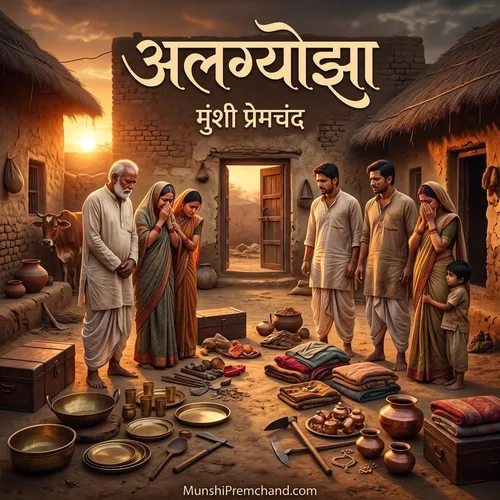
Complete English Translation: Algyojha (The Partition)
1
When Bhola Mahto remarried after the death of his first wife, dark days descended upon his son, Raghu.
Raghu was only ten years old at the time. Until then, he had spent his days carefree in the village, playing tip-cat (gulli-danda) with the boys. But the moment the new stepmother arrived, he was yoked to the grindstone like an ox.
Panna was an exceptionally beautiful young woman, and beauty and vanity are inseparable companions. She refused to touch any dirty work with her own hands. It was Raghu who scooped up cattle dung from the shed; it was Raghu who mixed dry straw and water to feed the bullocks; and it was Raghu who scrubbed the soiled earthen pots and metal vessels.
Bhola's eyes had turned so completely toward his young bride that he now saw nothing but faults in his own motherless boy. In accordance with ancient domestic custom, he accepted whatever Panna said with his eyes shut tight. He paid not the slightest heed to Raghu's cries or complaints. The result was that Raghu soon stopped complaining altogether.
Before whom could the poor child weep? Not only his father, but the entire village had turned against him. They would say: "What an obstinate, ill-mannered boy! He shows no respect for Panna at all. The poor woman pampers him and feeds him, and this is how he repays her! Any other woman would have thrown him out onto the streets long ago. It is only because Panna is so gentle and patient that this home endures."
Everyone lends a sympathetic ear to the complaints of the strong, but no one listens to the sorrowful plea of the weak! Day by day, Raghu's tender heart grew estranged from his mother.
Thus, eight long years rolled by. And then, one day, the messenger of death arrived at Bhola Mahto's door.
2
Bhola left behind Panna with four young children—three little boys (Kedar, Khunnu, Lakshman) and an infant daughter named Jhuniya.
It was a huge household to feed, and there was not a single earning member left. Why should Raghu look after them now? It was taken for granted by everyone. He was eighteen; he would soon bring his own bride home and set up a separate household. Once a new daughter-in-law stepped into the house, she would add fuel to the fire.
Panna saw nothing but pitch darkness stretching before her.
Yet, whatever came to pass, she swore she would never live in this house as Raghu's dependent, surviving on his mercy. In the very home where she had once reigned as absolute queen, she would never become a maidservant. She would never bow before the boy she had treated like a menial servant. She was still young and possessed remarkable beauty; her youth was in its fullest bloom. Could she not remarry and find another home?
At most, people would wag their tongues and laugh. Let them! Did second marriages not happen in her caste? She was neither a Brahmin nor a Thakur that her family's aristocratic pride would be tarnished! Such hypocritical rules belonged only to the upper castes, where one might do whatever one pleased behind closed doors so long as the veil remained drawn before the world. She could openly remarry before the entire village. Why, then, should she endure the humiliation of living under Raghu's thumb?
A month had passed since Bhola's death. Evening was falling. Panna sat brooding over these bitter thoughts when suddenly she realized that the children were nowhere inside the house. It was the hour when cattle returned from pasture; she feared one of the little ones might be trampled beneath the bullocks' hooves. Who was there now to watch over them? Raghu could not stand the sight of her children; he never even exchanged a warm word with them.
Hurrying out into the courtyard, she looked around.
To her utter astonishment, she saw Raghu sitting inside the thatched shed across the way, peeling sugarcane and slicing it into sweet candy sticks. The children were crowding around him with shining eyes. The youngest girl, little Jhuniya, had her tiny arms wrapped around his neck, trying playfully to ride upon his back!
Panna could hardly believe her own eyes. This was entirely new! Perhaps he is putting on a show for the village, she thought with deep suspicion, pretending how deeply he loves his little brothers while concealing a dagger in his heart! Given half a chance, he would slit their throats. A black cobra, that's what he is—a venomous black cobra!
In a sharp, stern voice, she called out: "What are all of you doing out there? Come inside the house this instant! Night is falling and the cattle will be returning."
Raghu looked up at her with humble, gentle eyes and said: "I am right here with them, Kaaki (Aunt/Stepmother). What is there to fear?"
Kedar, the eldest boy, spoke up proudly: "Kaaki, look! Raghu-dada has made two little wooden carts for us! Look here—Khunnu and I will sit in this one, and Lakshman and Jhuniya will ride in the other! Dada will pull both carts together!"
Saying this, he dragged two tiny wooden carts out from a corner. Each cart had four little wheels, wooden planks to sit upon, and side-rails to keep the children from tumbling out.
Panna asked in surprise: "Who made these carts?"
Kedar answered with a boastful grin: "Raghu-dada made them, who else! He borrowed an adze and a chisel from the carpenter Bhagat's house and crafted them in no time! They run so fast, Kaaki! Sit inside, Khunnu, I'll pull you!"
Khunnu climbed into the cart. Kedar began to pull it. The wheels creaked cheerfully, as though the little cart itself were joining in the children's laughter.
Lakshman sat in the second cart and clapped his hands: "Dada, pull me!"
Raghu gently placed little Jhuniya beside Lakshman and broke into a trot, pulling the cart across the courtyard. The children shrieked with delight, clapping their hands. Panna stood rooted to the spot, watching the scene in bewildered silence. Was this truly the same Raghu, or had another soul entered his body?
After a while, the two carts returned. The children rushed inside to recount the wondrous adventures of their vehicle ride, chattering with such excitement as though they had just descended from an aeroplane.
Khunnu exclaimed: "Kaaki, all the trees were running backwards!"
Lakshman chimed in: "And the little calves were running along with us—every single one of them was chasing our cart!"
Kedar added: "Kaaki, Raghu-dada pulls both carts at once with all his might!"
Jhuniya, the baby, possessed a vocabulary limited to laughter, jumps, and shining eyes. She danced about, clapping her little hands in sheer ecstasy.
Khunnu announced: "And Kaaki! A cow is coming to our house too! Raghu-dada asked Girdhari to bring us a milch cow. Girdhari said he will bring her tomorrow morning!"
Kedar beamed: "She gives three seers of milk every day, Kaaki! We shall drink plenty of fresh milk!"
Just then, Raghu walked inside.
Panna looked at him with a mixture of cold skepticism and doubt: "Raghu, is it true that you asked Girdhari for a cow?"
Raghu replied in a meek, apologetic tone: "Yes, Kaaki, I did. He will bring her tomorrow."
Panna asked: "And from whose house will the money come? Have you thought of that?"
Raghu said softly: "I have arranged everything, Kaaki. You know the gold mohur coin Father gave me? It will fetch twenty-five rupees. I shall adjust five rupees for the calf, and the cow will be entirely ours."
Panna was struck dumb. Even her distrustful, suspicious heart could no longer deny Raghu's genuine love and nobility.
She said gently: "Why must you sell your gold mohur? What is the hurry for a cow? When we have spare money in hand, we shall buy one. Your bare neck will look empty without the gold coin. If we have lived without a cow for all these years, did the children die of starvation?"
Raghu answered with philosophical tenderness: "These are the childhood years for them to eat well and grow strong, Kaaki. If they do not drink milk at this age, when will they ever have it? Besides, wearing a gold mohur does not suit me. People would whisper behind my back: His father died only yesterday, and the shameless boy struts about showing off his gold ornament!"
Bhola Mahto had died worrying about buying a cow; neither the money had ever materialized nor the cow arrived. Yet, how effortlessly this young boy had solved the entire problem!
For the first time in her life, Panna felt deep trust and reverence for Raghu. She said: "If an ornament must be sold, why should you sacrifice your gold coin? Take my silver hansuli necklace instead."
Raghu smiled and shook his head: "No, Kaaki. The necklace looks beautiful around your neck. What does a man care about wearing jewelry?"
Panna replied: "Nonsense! I have grown old. What use do I have for silver necklaces now? You are a young lad; your bare neck will look desolate."
Raghu chuckled softly: "How can you call yourself old already, Kaaki? Who is there in the entire village to match your grace?"
Raghu's innocent compliment made Panna blush with shame. A warm flush of joy spread over her pale, weathered cheeks.
3
Five years rolled by.
There was not another farmer in the entire village as hardworking, honest, and steadfast to his word as Raghu. He undertook no task without Panna's consent and blessing.
He was now twenty-three years of age. Time and again, Panna would urge him: "Son, bring your bride home. How long will she remain at her father's house? People in the village blame me, gossiping that I am preventing your wife from entering the household!"
Raghu would always put it off: "What is the hurry, Kaaki? There is plenty of time."
From casual remarks dropped by relatives, Raghu had already gathered an impression of his bride's haughty temperament. He did not wish to disturb the sweet peace and harmony of his home by introducing such a woman.
Finally, one day, Panna insisted firmly: "So, you will not go to fetch her?"
"I told you, there is no hurry yet."
"There may be no hurry for you, but there is an urgent need for me! I am sending a messenger today."
"You will regret it, Kaaki. Her temper is not good."
"Let that be! If I do not exchange words with her, will she pick a quarrel with the empty air? At least she will bake the bread. I can no longer manage all the heavy labor inside and outside the house alone. I am having her fetched today."
"If you are so determined, bring her home," Raghu sighed. "Only do not blame me later, saying that I cannot keep my wife in check or that I have become her slave."
"I shall never say such a thing. Go to the market and bring two fine sarees and sweets for the welcome."
On the third day, the bride, Muliya, arrived from her parents' village. Kettle-drums sounded at the doorway, and the sweet melodies of the shehnai echoed into the skies. The ritual of unveiling the bride's face (muh-dikhayi) was performed.
In that dry, dusty village, Muliya was like a stream of crystal-clear water. She had a glowing wheatish complexion, long arched eyelashes, a gentle flush upon her cheeks, and a captivating charm in her large eyes. The moment Raghu looked upon her, he was utterly enchanted.
When she walked toward the well in the morning carrying an earthen water pitcher, the golden rays of the early sun turned her fair skin into molten gold, as though the dawn itself were walking across the earth, laden with fragrance, youth, and blooming beauty.
4
Yet, Muliya had arrived from her father's house already burning with resentment and prejudice.
My husband must break his back toiling in the mud, while Panna sits inside like an idle queen and her children roam about like pampered princes! Muliya was determined never to tolerate such injustice. She was nobody's slave.
One's own sons often turn out ungrateful; how can stepbrothers ever remain loyal? So long as their wings haven't sprouted, they flock around Raghu. The moment they grow up, they will fly away without even asking how he fares!
One afternoon, she confronted Raghu: "If you wish to remain a lifelong slave to this household, do so; but I will not be a part of it."
Raghu replied patiently: "What else should I do, you tell me? The boys are still too young to manage the heavy work of the fields."
Muliya sneered: "Those boys belong to Bhola Mahto, not to you! This very Panna once starved you and treated you like dirt; I have heard all about it from the village. I refuse to live as a menial maidservant. I receive no account of the household earnings. Who knows what you bring home and what she hides away? You fool yourself into thinking the money stays in the family; but mark my words, when the time comes, you will not receive a single broken copper!"
Raghu said: "If I hand all the money to you, have you thought of what the world will say?"
Muliya retorted: "Let the world say whatever it pleases! I am not sold into the world's hands. Mark my words, after smearing yourself with oven-soot, your hands will remain black. You can break your neck dying for your brothers; I have no desire to die for them!"
Raghu gave no answer. The very calamity he had feared had arrived at his doorstep far too soon. He realized that even with endless diplomacy and patience, this fragile arrangement could last six months at best. Beyond that, the boat was bound to capsize.
One afternoon, Panna spread mahua flowers in the courtyard to dry. The rainy season had begun, and the grain in the storage bins was catching dampness.
Panna said gently: "Daughter-in-law, please keep an eye on the drying flowers while I go to take a dip in the pond."
Muliya answered with insolent indifference: "I am feeling sleepy. Sit here and watch them yourself. What will happen if you skip your bath for one day?"
Panna silently put away her clean saree and abandoned her bath. Muliya's barb had struck home.
A few days later, Panna returned late in the evening from transplanting paddy seedlings. It was pitch-dark. She had starved the entire day. She expected that her daughter-in-law would have prepared dinner; but when she stepped inside, the hearth lay cold and unlit, and the little children were tossing about on the floor, whimpering with hunger.
Panna asked in a low whisper: "Has the fire not been lit today?"
Kedar answered: "The fire wasn't lit at noon either, Kaaki! Bhabhi (Sister-in-law) didn't cook anything."
"Then what did you children eat?"
"Nothing. There were some stale leftover rotis from last night; Khunnu and Lakshman ate those. I ate a fistful of roasted barley flour (sattu)."
"And where is the bride?"
"She is lying inside, fast asleep. She hasn't eaten anything either."
Panna immediately blew into the embers, rekindled the hearth, and sat down to knead dough. Tears streamed down her face into the flour. What a wretched fate was hers! After burning under the scorching sun in the muddy fields all day, she had to return home only to burn before the kitchen hearth.
Kedar was now fourteen years old. Observing his sister-in-law's bitter behavior, he understood the whole crisis.
He said: "Kaaki, Bhabhi no longer wants to live with us."
Panna started, asking: "Did she say something to you?"
Kedar replied: "She didn't say anything, but that is what is inside her heart. Why don't you let them live separately? Let them live as they please; God will look after us."
Panna bit her tongue in reprimand: "Hush! Never utter such words before me again! Raghu is not merely your brother—he is your father! If you ever speak insolently to Muliya, understand this: I will swallow poison and end my life!"
5
The festival of Dussehra arrived.
A lively village fair was being held in a hamlet two miles away. All the children of the village were heading out to enjoy the festivities. Panna prepared to accompany her children, but where was the money to be found? The keys were now kept in Muliya's possession.
Raghu came inside and said to Muliya: "The children are going to the fair. Give each of them two copper pice."
Muliya knit her brows angrily: "There is no money in the house."
Raghu asked: "We just sold the oilseeds yesterday; did all the rupees vanish so quickly?"
"Yes, they vanished!"
"Where did they vanish? Let me hear. On a festive day, shall our children not go to the fair?"
Muliya snapped: "Ask your Kaaki to dig into her buried treasure! What will she do with all the money she has buried underground?"
The key was hanging from a wooden peg on the wall. Raghu reached up, took down the key, and moved toward the wooden chest.
Muliya lunged forward, grabbed his wrist, and hissed: "Give that key back to me, or there will be trouble! Clothes to wear, books and paper for school, and now pocket money for fairs! Our hard earnings are not meant for others to gorge upon while twirling their mustaches!"
Panna called out from the verandah: "Son, let it be! What will the children do with money? They need not go to the fair."
Raghu retorted sharply: "Why shouldn't they go to the fair? The entire village is going! Shall only our children stay behind?"
Shaking off Muliya's grip, Raghu opened the chest, took out the coins, and handed them to the boys. But when he tried to return the key to Muliya, she snatched it, flung it furiously across the courtyard, and lay down on her cot, pulling a sheet over her face!
The children, frightened by the commotion, did not go to the fair after all.
Two days passed. Muliya refused to touch a morsel of food, and Panna, too, went without eating.
Raghu tried to plead with one, then with the other; but neither would budge. Driven to his wit's end, Raghu finally said to Muliya: "Speak plainly! Tell me, what do you want?"
Muliya addressed the floor in a venomous whisper: "I want nothing. Just send me back to my father's house."
Raghu said: "Get up, cook food, and eat. I will take you there."
Muliya glared at him with bloodshot eyes. Raghu was terrified by the sight of her face. All the sweetness, charm, and beauty had vanished. Her teeth were bared, her eyes widened with fury, and her nostrils flared like a serpent's.
"Ah! So Kaaki has given you this clever advice, has she? She has tutored you well! But I am not so easily dismissed. I shall grind lentils right on both your chests! What did you think?"
Raghu said weary: "Fine, grind lentils on our chests if you must! But eat something first; only then will you have the strength to do it."
Muliya declared coldly: "I shall not put a drop of water into my mouth until this household is divided. I have endured enough; I can endure no more!"
Raghu froze in horror. For a whole minute, his tongue refused to move.
In his wildest nightmares, he had never conceived of a partition (algyojha). He had seen two or three families in the village break apart. He knew full well that along with separate hearths, human hearts also split in two. Brothers turned into strangers forever, retaining no more affection for one another than for distant villagers.
Raghu had resolved with all his soul never to let this curse enter his home. But before cruel destiny, his will was helpless.
Alas! My name will be blackened forever! The world will mock me, saying that once the father died, the brothers could not live together even for ten years! And from whom should I separate? From those very siblings whom I cradled in my lap, whom I raised like my own sons, for whose sake I endured every misery? Shall I throw my beloved ones out of the door?
His throat choked with tears. In a trembling voice, he pleaded: "Do you truly want me to abandon my own brothers? Think about it—shall I ever be able to show my face before anyone in this world?"
Muliya said: "Then I cannot live with these people."
"Then you live separately! Why do you drag me into your madness?"
"Do I feast on sweetmeats in your house? Is there no room for me anywhere else in this vast world?"
Raghu fell to his knees: "Live wherever you please, as you please. But I cannot cut myself off from my family. The day two separate hearths burn in this house, my heart will split into two pieces. I cannot bear such an agony! Whatever grievances you have, I will resolve them. You are the sole mistress of all possessions; the grain and money are in your hands; what more do you desire? If you do not wish to do any chores, do nothing! Had God blessed me with wealth, I would not have allowed you to lift a single straw. Your delicate hands were never meant for backbreaking drudgery. But what can I do? I am helpless. Even so, if you do not feel like working, do nothing! Only, I beg of you at your feet, do not demand a partition!"
Muliya pulled her veil forward, leaned closer, and said with honeyed venom: "I am not afraid of work, nor do I wish to sit and eat free bread. But I will not tolerate anyone's overbearing authority. If your Kaaki works, she works for herself and her own children. She does no favor to me; why then does she throw her weight around? Her children may be dear to her, but my only refuge in this world is you. I cannot bear to watch with my own eyes the whole house making merry, little brats gorging on milk, while the man whose sweat sustains the entire family yearns even for a bowl of buttermilk! No one cares whether you live or die. Look in the mirror—see what a haggard wreck you have become! In four years, other men's sons will be grown men ready to work; but you will be laid flat on a sickbed within ten years! Sit down; why are you standing? Will you hit me and run away? Am I going to tie you down? Truly, your heart is made of stone. Had I known I was marrying such a heartless man, I would never have set foot in this house. Even after coming, I would have kept my heart detached. But now my heart is tied to you. Even if I go to my father's home, my mind stays here; and yet you refuse to listen to a single word I say!"
Muliya's sweet, manipulative words failed to move Raghu.
He replied with stony coldness: "Muliya, this is beyond me. The very thought of partition turns my blood to water. I cannot survive this blow."
Muliya mocked him with a sneer: "Then put on glass bangles and sit inside the closet! Hand me your mustache, I will wear it! I thought you had some manhood in your chest. Now I see you are nothing more than a lump of wet clay!"
Panna had been standing in the corridor, listening to every single word. She could bear it no longer.
Stepping forward, she said to Raghu: "When she is hell-bent on separating, why do you force her to stay? Take her and live in peace; our Lord God will look after us. When the Mahto died and there was not even a leaf to give us shade, God preserved us then; what fear is there now? By God's grace, my three boys are growing up; we have no worries."
Raghu looked at Panna with tear-filled eyes: "Kaaki, have you lost your senses too? Do you not know that the moment two rotis are baked on separate fires, two minds drift miles apart?"
Panna said with tears streaming down her face: "When she refuses to listen, what can you do? If it is God's will, who can alter it? As long as our destiny ordained that we live together, we lived. Now if this is what destiny decrees, let it be so. What you have done for my children, I can never forget till my dying breath. If you had not placed your sheltering hand over their heads, who knows what wretched fate would have befallen them—at whose doors they would have been kicked, or in which gutters they would have begged for scraps! I shall sing your praises till the day I die. If my own skin could be used to fashion shoes for your feet, I would gladly offer it! Even if we are separated, call me at any hour of the day or night and I will come running like a faithful dog. Never think for a moment that after separating, I could ever harbor ill will toward you. The day an evil thought about you crosses my mind, I will swallow poison! May you bathe in milk and flourish with sons! This blessing will pour forth from every pore of my body until my last breath. And if these boys are truly their father's sons, they will honor your debt till the end of time."
Saying this, Panna walked away weeping.
Raghu sat motionless like a statue, staring blankly at the empty sky, tears flowing unchecked down his cheeks.
6
Hearing Panna's surrender, Muliya knew that victory was hers.
She sprang up with boundless energy, swept the courtyard, lit the hearth, and set out with her brass pot to fetch water from the well. Her stubborn resolve had triumphed.
In the village, the women were divided into two opposing camps—the camp of the daughters-in-law (bahus) and the camp of the mothers-in-law (saases). The young brides gathered together for advice and sympathy, while the older matriarchs held their own assemblies.
At the well, Muliya met two or three young brides. One asked: "I hear your old woman was weeping and wailing loudly today?"
Muliya replied with haughty pride: "She has ruled the roost for years; who likes to give up a kingdom? Sister, I wish her no harm; but how far can one man's earnings stretch? These are my youthful years to eat, dress, and enjoy life. Must I break my back slaving for her now, and then slave for my own children later? Should my whole life be spent in endless weeping?"
One young bride concurred: "The old hag wants you to remain a lifelong servant! Eat coarse food and lie in the dust."
Another bride remarked: "On whose reliance should anyone slave? One's own sons rarely look after you in old age; what hope is there from stepbrothers? Tomorrow they will grow sturdy limbs, and who will look at you? They will only gaze at their own wives' faces! It is best to cast them off early; then at least there will be no lifelong disgrace."
Muliya returned with the water, cooked the meal, and called out to Raghu: "Go, wash up. The food is ready."
Raghu acted as though he had heard nothing. Supporting his chin in his hand, he sat staring out through the doorway.
Muliya called again: "Are you deaf? I said the food is ready; go and take a bath."
Raghu snapped: "I can hear you! Am I deaf? If the food is ready, go and eat it yourself. I have no appetite."
Muliya did not ask a second time. She extinguished the embers, placed the rotis on the hanging wire basket (chheeka), and lay down with her face covered.
Shortly after, Panna came to the door and said: "Food is ready, son. Take a wash and eat something. The bride must be hungry too."
Raghu said in exasperation: "Kaaki, will you let me stay in this house, or must I blacken my face and flee to the jungle? Eating is a daily chore; if I do not eat today, I will eat tomorrow. But right now, I cannot swallow a morsel. Has Kedar not returned from school yet?"
Panna replied: "Not yet, he should be here any moment."
Panna understood completely. Unless she cooked food for her children and ate before his eyes, Raghu would not touch a grain of food. More than that, she realized she would have to pick a quarrel with him, speak harshly, and pretend that she herself wanted the separation; otherwise, Raghu would pine away and die of sheer grief.
With a heavy heart, Panna lit a separate hearth in her own corner and began cooking.
Just then, Kedar and Khunnu returned from school.
Panna called out: "Come, sons, eat your meal; the rotis are ready."
Kedar asked: "Shall I call Big Brother (Bhaiya) too?"
Panna said sharply: "You come and eat! His wife has cooked separately for him."
Khunnu asked: "Can't I go and ask Bhaiya?"
Panna retorted: "He will eat when he pleases! Sit down and eat your bread; what business is this of yours? Those who want to eat will eat, and those who don't, won't. When he and his wife are hell-bent on living separately, who is going to coax them?"
Kedar asked with wide, bewildered eyes: "Why, Mother? Are we going to live in a separate house?"
Panna said coldly: "If they wish, let them live in one house; if they wish, let them build a brick wall right through the courtyard!"
Khunnu peeked through the door. Across the yard, under the thatched shed, Raghu lay upon a cot, puffing slowly on his hookah (nariyal).
"Bhaiya is still sitting with his hookah," Khunnu whispered.
"He will eat when he feels like it," Panna replied.
Kedar asked: "Did Bhaiya not scold Bhabhi?"
Muliya, lying in her dark room, heard every word. She stormed out and snapped: "Bhaiya did not scold me; why don't you come and scold me yourself!"
Kedar turned pale. He did not utter another syllable.
The three boys ate their meal and stepped outside. The blazing summer loo wind had begun to howl. In the mango orchard near the village, local children were gathering wind-fallen green mangoes.
Kedar said: "Come, let us go gather mangoes too; so many are falling today!"
Khunnu hesitated: "What if Dada catches us?"
Lakshman said: "I won't go. Dada will scold us."
Kedar remarked: "He is separated from us now."
Lakshman asked innocently: "So even if someone beats us now, will Dada not speak up?"
Kedar replied: "Of course he will speak up! Why wouldn't he?"
Raghu watched the three boys standing by the doorway, but said not a single word. Previously, the moment they stepped near the gate during the hot afternoon, he would shout and order them back inside. But today he sat rigid, like a lifeless stone statue.
Seeing him silent, the children gathered courage and ventured a few steps farther. Raghu still did not call out. How could he? He was thinking: Kaaki fed the children, but she never even glanced at me. Has a veil fallen over her eyes too? If I call the boys and they refuse to obey, what will I do? I can no longer discipline them. They will wander about in the scorching loo; what if they fall ill?
His heart ached with agony, but his lips remained sealed. Seeing him silent, the boys ran toward the orchard without fear.
Suddenly, Muliya walked up to him and sneered: "Well, will you get up now, or will you stay pinned here forever? Those for whose sake you are starving have comfortably fed their sons, eaten their fill, and are now fast asleep! 'My lover asks not of me, yet they call me the favored wife!' Not once did she have the decency to ask: 'Come, brother, eat your food.'"
Raghu was writhing in excruciating pain. Muliya's cruel taunts rubbed salt into an open wound.
Looking at her with sorrowful eyes, he said: "What you desired has come to pass. Now go and beat the drums of celebration!"
Muliya said: "Oh yes, she is sitting with a golden platter waiting for you!"
Raghu snapped: "Do not provoke me! Because of you, I am disgraced before the whole world. When you refuse to belong to anyone, why should anyone coax you? Go and ask Kaaki—the children have gone to the mango grove in this blazing loo; shall I go and bring them back?"
Muliya flicked her thumb in contempt: "Look at him! If you are so desperate, go ask her yourself a hundred times!"
Just then, Panna stepped out from the inner corridor.
Raghu asked: "Kaaki, the boys have gone to the orchard. The loo is blowing fiercely."
Panna answered with feigned coldness: "Who is there to look after them now? Let them go to the orchard, climb trees, or drown in the pond. What all can I manage alone?"
"Shall I go and fetch them?"
"When you don't care to go of your own accord, why should I ask you? If you wanted to stop them, couldn't you have stopped them right here? They walked out right before your eyes, didn't they?"
Before Panna could finish her sentence, Raghu set his hookah in the corner and hurried off toward the orchard.
7
When Raghu returned from the grove escorting the boys, he found Muliya still standing under the shed.
He said: "Why don't you go and eat? I have no hunger this afternoon."
Muliya sneered: "Of course! Why should you feel hungry? Your brothers ate, so your belly was filled automatically!"
Raghu gritted his teeth: "Do not set me on fire, Muliya, or it will not be good for you. Food is not running away. If I miss one meal, I will not drop dead! Do you think what happened today is a minor trifle? You did not merely refuse to light the hearth; you set fire to my very heart! I had the pride that whatever else happened, the disease of family partition would never enter my home. But you have shattered my pride to dust. It was written in my destiny."
Muliya retorted: "Is all the love and affection reserved only for you? I don't see anyone else weeping like you do!"
Raghu took a deep breath: "Muliya, do not rub salt on my wounds. It is because of you that my honor is dragged in the dust. If I do not feel affection for this household, who will? I built it grain by grain, breaking my back. Those whom I cradled in my lap will now be my legal rivals. The children I once scolded, I can no longer even look at with stern eyes. Even if I do something for their own good, the world will say: 'He is robbing his younger brothers!' Leave me alone. I cannot eat anything right now."
Muliya said: "I will swear an oath on my life if you do not get up quietly and eat."
Raghu said: "Listen, nothing is lost yet. Abandon your obstinacy."
Muliya declared: "May you drink my own blood if you do not get up to eat this instant!"
Raghu covered his ears in distress: "What have you done, Muliya? I was getting up anyway. Come, I will eat. Who will bother to bathe now? But I tell you this: even if I eat six rotis instead of four, even if you drown me in a jar of clarified butter, this black stain will never be erased from my heart."
Muliya said casually: "All stains fade away with time. In the beginning, everyone feels this way. Don't you see how happily they are celebrating over there? She was praying day and night for us to separate. The old days are gone when whatever came into the house was secretly hoarded away! Why would she want to stay with us now?"
Raghu murmured in a broken voice: "That is the very grief that breaks my heart. I never expected this from Kaaki."
When Raghu sat down to eat, every morsel felt like a swallow of deadly poison. The rotis tasted like dry chaff; the lentil soup seemed like tasteless water. He could hardly swallow a drop; he did not even look at the milk. After forcing down two or three mouthfuls, he rose, feeling as though he had partaken of the funeral feast of his dearest kin.
He ate his dinner that night in the same wretched fashion. It was not eating; it was merely fulfilling a terrible oath.
All night long, his mind was tormented by dark forebodings. It felt as though his deceased father, Bhola Mahto, were sitting at the doorway, weeping bitterly. Several times Raghu started from his sleep in terror, imagining his father glaring at him with eyes full of reproach and scorn.
Henceforth, he ate his two daily meals, but like a prisoner eating in the home of an enemy. The sorrowful image of his dead father never left his mind. At night, sleep deserted him. Whenever he walked through the village lanes, he kept his face hidden and his head bowed low, as though he had committed the cardinal sin of slaughtering a sacred cow.
8
Five years rolled by.
Raghu was now the father of two little boys.
A mud wall had been erected right through the middle of the courtyard; boundaries had been marked across the agricultural fields; and the bullocks and calves had been divided.
Kedar was now nineteen years old. He had left school and taken over the farming of their share. Khunnu grazed the cattle. Only Lakshman still attended school.
Panna and Muliya despised the very sight of one another. Yet strangely, Muliya's two little boys spent most of their time in Panna's lap. It was Panna who massaged their bodies with mustard paste, Panna who lined their eyes with kohl, and Panna who carried them affectionately on her hips. Yet not a single word of gratitude ever crossed Muliya's lips. Nor did Panna seek any praise; whatever she did, she did out of pure, unconditional affection.
Panna had two earning sons now. Her daughter cooked the meals, and Panna herself managed the household easily.
In contrast, Raghu was entirely alone in his household. And he was frail, broken in health, and old before his time. He was barely thirty years of age, but his hair had turned grey, his back had bent into a stoop, and a chronic cough racked his wasted chest. To look upon him was to feel pity.
Agriculture requires the sweat of many brows. Raghu could no longer lavish upon the land the labor it demanded. How could the harvest be plentiful? Debts began to accumulate, and the constant dread of moneylenders wore him down further.
By rights, after so many years of ceaseless toil, he should have enjoyed rest. His heavy burden should have been lightened. But Muliya's selfishness and shortsightedness had laid waste to a thriving paradise. Had they remained together, Raghu would have retired like an elder patriarch, smoking his hookah at the door, offering wise counsel while his young brothers toiled. He would have settled village disputes and served holy men.
That golden opportunity had slipped away forever. Now, the crushing burden of anxiety mounted with every passing day.
Eventually, a low, chronic fever (jeern jwar) seized his body. Chronic fever, unrelenting worry, exhausting labor, and lack of nourishment—this was his reward.
At first, he ignored the illness, hoping it would pass on its own. But as his weakness grew alarming, he took whatever village quacks recommended. Where was the money to consult reputable doctors or Vaidyas? And even if there had been money, what good would it have done? The only true cure for chronic fever is absolute rest and nourishing food. He could neither afford costly Ayurvedic tonics nor rest quietly to regain his strength.
His weakness deepened relentlessly.
Whenever Panna found an opportunity, she would visit his bedside to offer comforting words. But her sons refused even to speak to Raghu. Far from helping with medicines, they mocked his condition: "Bhaiya thought that by separating from us, he would amass heaps of gold and bricks! Bhabhi thought she would be laden with gold jewelry! Now let us see who looks after them. If they don't die sobbing and weeping, mark my words! Too much greed and vanity are never good. A man should only work as much as he can, not kill himself for money."
Panna would protest: "What fault is it of poor Raghu?"
Kedar would argue bitterly: "Mother, I understand everything! If I had been in Bhaiya's shoes, I would have answered that woman with a stout stick! Was it a joke that a wife could demand a partition? It was all Bhaiya's own scheme. They had planned it all along."
Finally, one night, the flickering lamp of Raghu's life was extinguished forever. Death put an end to all his worldly anxieties.
In his final moments, Raghu had sent for Kedar. But Kedar was busy irrigating the sugarcane crop. Fearing that he might be dispatched to the town to buy expensive medicine, Kedar made an excuse and did not come.
9
Muliya's world plunged into utter darkness.
The ground upon which she had built her grand castles of independence had crumbled beneath her feet. The sturdy pillar upon which she had leaned had been uprooted forever.
The villagers began to whisper: "See how swiftly God has punished her pride!" The poor widow could only weep in silence, clutching her two fatherless boys. She lacked the courage to show her face to anyone in the village. Every creature seemed to point a finger at her: "She walked with such haughty pride that her feet refused to touch the earth—now she has received her just deserts!"
How was she to survive in this house now? Upon whose support could she lean? Who would plough and harvest the land?
Poor Raghu had been sick and frail, but so long as he lived, he had toiled. Sometimes, overcome by dizziness, he would sit clutching his head; then, catching his breath, he would resume swinging the hoe.
Now the entire harvest lay in ruins. Who would salvage it? The harvested stalks of grain lay rotting on the threshing floor; the sugarcane was drying up in the fields. What could a lone woman do? Irrigation was not the work of a single soul; where could she hire three laborers? There were hardly any laborers in the village, and every farmer was fighting for hands. What should she do? Where should she turn?
Thirteen days passed in funeral rites.
On the fourteenth morning, Muliya lifted her two little boys and walked to the threshing floor (khalihan). Reaching the field, she laid the younger child upon a soft bed of grass under the shade of a tree, set the elder boy beside him, and began driving the pair of bullocks around the threshing post to separate the grain.
Driving the oxen round and round, she wept bitter tears. Was it for this wretched fate that God brought me into this world? How swiftly everything turned to dust!
At this exact time last year, the grain was being threshed just like this. She had brought a jug of sweet sherbet and roasted peas for Raghu. Today, there was no one before her, no one behind her. Yet, at least I am nobody's maidservant! Even in this misery, she did not regret the partition.
Suddenly, hearing the infant crying, she looked toward the tree.
The older boy was gently patting the baby, cooing in his baby talk: "Quiet, little brother, quiet..." He stroked the baby's face, desperate to comfort him. When the baby refused to stop crying, the little boy lay down beside him, hugging him to his tiny chest. But when that effort failed as well, the older boy burst into tears himself!
At that very moment, Panna came running across the fields.
Lifting the crying infant into her arms and showering him with kisses, she cried: "Why didn't you leave the children with me, daughter-in-law? Alas! The poor innocent was rolling in the dust! When I die, do as you please; but while I am alive, did the children become separated just because the household was divided?"
Muliya murmured meekly: "You had no spare time either, Mother; what could I do?"
Panna said: "And what was the desperate rush for you to come running here? Would the grain stalks run away? Aren't there three grown boys in our house—for what other day are they meant? Kedar was saying yesterday that he would thresh your crop; but I told him: 'First water the sugarcane fields, then thresh the grain. Threshing can wait ten days, but if the sugarcane isn't irrigated, the crop will dry up.' The water has been running since yesterday; the fields will be soaked by tomorrow. Then the threshing will be done in a single day.
"You will not believe me, daughter-in-law, but ever since Bhaiya passed away, Kedar is consumed by worry. A hundred times a day he asks: 'Is Bhabhi weeping too much? Go and see if the children have eaten.' If a child cries, he comes running: 'Look, Mother, what happened? Why is the child crying?'
"Yesterday he wept aloud, saying: 'Mother, had I known Bhaiya would leave us so soon, I would have served him day and night! How I used to sleep while he woke me up; and now, see, I rise before dawn to toil in the fields!'
"When Khunnu grumbled yesterday that we should water our own sugarcane before watering Bhaiya's, Kedar scolded him so fiercely that Khunnu dared not speak another word! Kedar roared at him: 'What do you mean by your sugarcane and his sugarcane? If Bhaiya had not kept us alive, we would have either died long ago or been begging for scraps in the alleys! Today you act like a grand landlord! It is solely because of his selfless sacrifice that we are respectable men today!'
"The day before yesterday, when I went to call Kedar for lunch, he was sitting inside his hut, sobbing his heart out. When I asked why he was weeping, he said: 'Mother, Bhaiya died solely from the sorrow of this partition (algyojha)! Otherwise, what was his age? We didn't understand it then; why did we ever quarrel with him?'"
Panna looked meaningfully into Muliya's eyes and added: "He will never allow you to live as a separate, helpless woman, daughter-in-law. He says: 'Bhaiya sacrificed his life for us; now we will sacrifice our lives for his wife and children.'"
Tears gushed from Muliya's eyes like an overflowing river.
In Panna's voice today, there was genuine sorrow, genuine comfort, and profound love. Never before had Muliya's heart felt so deeply drawn toward her. Those very people from whom she had feared mockery, spite, and vengeance had proven to be so compassionate, so forgiving, and so noble!
For the very first time in her life, Muliya felt utterly ashamed of her petty selfishness. For the very first time, her soul cursed the day she had demanded the algyojha.
10
Five years passed after this incident.
Panna had grown old and frail. Kedar was now the master of the house, and Muliya was its undisputed mistress.
Khunnu and Lakshman had both been married. But Kedar remained unmarried.
He would say: "I will never marry."
Many marriage proposals arrived from respectable families; several matches were negotiated, but Kedar refused to give his consent. Panna set traps, laid snares of persuasion, but he refused to be caught.
He would say: "What joy is there in marriage? A wife enters the house, and the man's entire character changes! Then everything revolves around the wife. Father, mother, brothers, kin—all turn into strangers. When a saintly man like Bhaiya could be forced into partition, what hope is there for ordinary men? God has already blessed this house with two boys; what more do I need? To receive two sons without the burden of marriage—what greater blessing could there be? Those whom you hold close to your heart are your own; those whom you consider strangers remain strangers."
One day, Panna asked him: "How will your lineage continue?"
Kedar smiled: "My lineage is already flourishing. I consider both of Bhaiya's boys as my own sons."
Panna tested him: "If it is all a matter of what you hold in your heart, then do you consider Muliya as your wife too?"
Kedar blushed deeply, looking down in embarrassment: "Mother! You are abusing me!"
Panna said: "What abuse is there? She is your sister-in-law (bhabhi), eligible for marriage by our customs!"
Kedar said: "Why would a rustic, unlettered fool like me appeal to her?"
Panna asked: "If you give your word, shall I ask her?"
Kedar pleaded: "No, Mother, please! What if she begins to weep and takes offense?"
Panna replied: "If you have no objection, let me subtly test her feelings in conversation."
Kedar murmured: "I know nothing. Do whatever you think best."
Panna understood the secret of Kedar's heart. The young man's heart was already devoted to Muliya, but out of reverence, modesty, and fear, he had kept his lips sealed.
That very afternoon, Panna said to Muliya: "What can I do, daughter-in-law? The cherished desire of my heart remains unfulfilled. If Kedar were to settle down and establish a home, I could close my eyes in peace."
Muliya replied: "He refuses to marry at all."
Panna said: "He says that if he finds a woman who will live in peace and harmony without breaking the family, only then will he marry."
Muliya said: "Where will you find such a woman? Search for one."
Panna smiled: "I have already found her."
Muliya asked eagerly: "Truly? From which village does she come?"
Panna said: "I will not reveal that just yet. But this much I know: if Kedar marries her, our home will be blessed and Kedar's life will bear fruit. Only, I wonder whether the girl will consent."
Muliya said earnestly: "Why wouldn't she consent, Mother? Where could she ever find such a handsome, hardworking, and gentle husband? He is a saint from a past life! Who stays unmarried out of fear of family discord? Tell me where she lives—I will go myself, fall at her feet, and bring her home!"
Panna looked straight into her eyes and said: "If you wish, you can win her over. It all rests upon you."
Muliya insisted: "I will go this very day, Mother! I will clasp her feet and convince her!"
Panna whispered: "Shall I tell you who she is? It is you!"
Muliya blushed deeply and turned her face away: "Mother, you are teasing me!"
Panna said: "Why teasing? He is your younger brother-in-law (devar), isn't he?"
Muliya murmured: "Why would a handsome young man like him care for an old widow like me?"
Panna laughed: "His eyes have been fixed on you and you alone! He finds no other woman in the world worthy of his gaze. He kept silent out of fear and respect; but I know the deepest secrets of his heart."
Muliya's pale, sorrow-withered face, faded by years of widowhood, suddenly bloomed crimson like a fresh lotus.
Everything that she had lost during the ten years of sorrow seemed to return to her in that single, sacred moment—with interest! The same radiance, the same blossoming youth, the same irresistible grace, and the same joyful elasticity returned to her life!
Summary of Algyojha
'Algyojha' (The Partition) is one of Munshi Premchand's most moving and profound masterpieces on the Indian joint family system, dissecting how misunderstanding, insecurity, and petty domestic discord shatter a household, and how love, sacrifice, and remorse ultimately heal it.
The story opens with Bhola Mahto remarrying a young, beautiful woman named Panna. His ten-year-old son Raghu is treated harshly by his stepmother and neglected by his infatuated father. However, when Bhola dies leaving Panna with four young children (Kedar, Khunnu, Lakshman, and baby Jhuniya), Raghu displays extraordinary nobility. He sacrifices his cherished gold mohur to buy a milch cow for the children, builds toy carts for his little brothers, and toils day and night to become the finest farmer in the village. Panna is overcome with gratitude and entrusts the household entirely to him.
Years later, Raghu marries Muliya, a proud and insecure young woman. Muliya resents Raghu's devotion to his stepmother and siblings, suspecting that they are exploiting his earnings. She demands a household partition (algyojha). Raghu pleads desperately, knowing that a division of the hearth inevitably divides human hearts, but Muliya forces the issue by refusing to cook and threatening suicide. Heartbroken, Raghu relents, and the home and lands are divided.
The partition brings immediate ruin. Deprived of the collective labor of a joint household, Raghu breaks his back trying to manage the fields alone. Crushed by debt, emotional alienation, and guilt toward his deceased father, Raghu falls ill with a chronic fever and dies at the early age of thirty.
Widowed with two small children, Muliya faces destitution. When she tries to thresh her crop alone in the scorching heat, Panna arrives with boundless maternal tenderness, embraces her children, and reveals how deeply Kedar and the younger brothers mourn Raghu's sacrifice. Overwhelmed by this unconditional love, Muliya feels profound remorse for her past selfishness.
Years later, Kedar, having grown into an industrious young man, refuses to marry for fear that a new wife might break the household again. Recognizing the unspoken affection between Kedar and Muliya, Panna arranges their customary union, restoring Muliya's lost youth and joy, and reuniting the fragmented family into an enduring bond of love.
Publication History
'Algyojha' was written by Munshi Premchand in 1929 and first published in prestigious Hindi literary journals before being included as the opening masterpiece in Mansarovar (Vol. 1). The story stands as one of the definitive classic works in modern Indian literature addressing the sociological and emotional dimensions of rural household partition.
This unabridged English translation was published in 2026 by MunshiPremchand.com as part of the MunshiPremchand.com English Translation Series.
Themes & Critical Significance
- The Tragedy of Household Partition (Algyojha): Premchand portrays partition not merely as the legal division of land, cattle, and grain, but as a fatal spiritual rupture. The story demonstrates that an individualistic split deprives rural peasants of their collective resilience, leading to economic ruin and emotional despair.
- The Nobility of Fraternal Sacrifice: Raghu's character is the moral pinnacle of the narrative. Despite suffering childhood neglect from his stepmother, he steps into the role of a father to his step-siblings, embodying selfless duty (kartavya) without the slightest bitterness.
- Psychological Realism of Female Insecurity: Rather than demonizing Muliya, Premchand grounds her desire for separation in the real vulnerabilities of a young bride who fears financial insecurity and longs for an exclusive place in her husband's life. Her subsequent remorse marks a profound psychological transformation.
- Traditional Custom and Social Rehabilitation: The customary acceptance of levirate marriage (devar-bhabhi remarriage) in rural society is depicted with delicate sensitivity. Through Kedar and Muliya's union, Premchand celebrates the restoration of life, dignity, and familial continuity over rigid orthodoxy.
- The Enduring Power of Forgiveness and Familial Love: Ultimately, 'Algyojha' proves that while selfishness and suspicion can tear even the closest families apart, true affection, forgiveness, and moral responsibility possess the power to resurrect and heal broken lives.