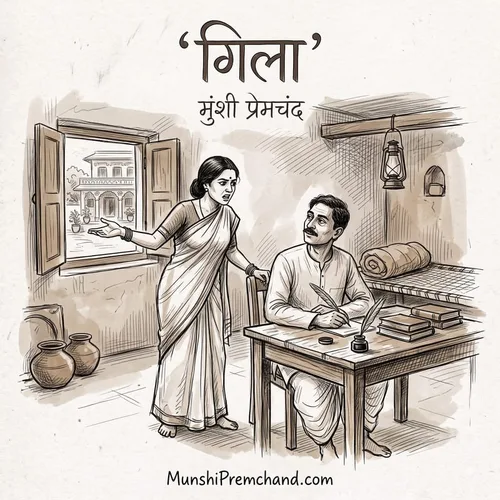
Complete English Translation: Gila (The Complaint)
A major portion of my life has passed away within this house, yet peace and comfort have never fallen to my lot. In the eyes of the world, my husband may be a great gentleman, an epitome of courtesy, a paragon of generosity, and a soul of profound gentleness; but only the one who actually endures it knows the truth. The world takes immense delight in praising those who cast their own hearth into the furnace while ruining themselves for the sake of strangers. If a creature slaves and dies for the sake of his own family, people of this world never sing his praises; in their eyes, such a man is merely selfish, a miser, narrow-minded, and morally deficient. In the very same way, why on earth should family members shower praises upon those who live and die only for outsiders?
Just look at this gentleman of mine—he keeps my heart burning with irritation all day long! I do not observe strict purdah; nevertheless, going to the marketplace for household provisions feels thoroughly repugnant to me. And his condition is such that if you ask him to fetch an article, he will invariably bring it from a shop where no customer would ever step foot even by mistake! At such a wretched shop, the goods are never wholesome, the weights and measures are never true, nor are the prices ever fair. If these flaws were absent, why would the shop be notorious in the first place? Yet he suffers from a chronic disease of patronizing precisely such run-down, ruined establishments. Time and again I have told him, "Sir, please buy our provisions from a brisk, bustling shop! A thriving shop has rapid turnover, so fresh goods arrive constantly." But his allegiance lies only with petty, bankrupt shopkeepers, and they fleece him with a blunt razor!
If he brings wheat, it is the foulest in the entire market; if rice, it is so coarse that an ox would refuse to sniff it; and the pulses are choked with husks, weevils, and pebbles. You may burn maunds of firewood beneath the pot, but perish the thought that they should ever soften! If he brings ghee, it is either half kerosene oil or pure adulterated vegetable fat, and in actual measure always a full chhatank short! If he brings hair oil, it is so adulterated that the moment you rub it into your scalp, your hair turns sticky and matted; yet he pays the full price of pure amla oil for it! Going to a well-known, thriving shop seems to terrify him. Perhaps he is a devout believer in the old adage: High shop, insipid sweets. But my personal experience is quite the opposite—it is at the low, obscure shops that you find rotten delicacies!
If it were a matter of a single day, one might swallow one's pride and bear it. But this everyday nuisance is beyond endurance. I ask him, "After all, why must you frequent the stalls of these bankrupt petty traders? Have you taken a lifelong contract for their upkeep and livelihood?"
He replies airily, "The moment they catch sight of me, every single one of them begins calling out to me with such warmth!"
Splendid! What an excuse! What extraordinary reasoning! A shopkeeper has merely to beckon him, whisper two words of flattery, offer a tiny bit of praise, and his self-esteem instantly climbs into the seventh heaven! Then he loses all awareness of whether the fellow is packing garbage or groceries for him. I ask him, "Why do you walk down that particular lane in the first place? Why can't you take another route? Why give encouragement to such street swindlers at all?"
To this, he offers no answer whatsoever. A single silence defeats a hundred obstacles!
Once, I wanted to have an ornament made. Knowing this gentleman well, I considered it utterly pointless to consult him. I was about to call a goldsmith known to me. As luck would have it, he happened to be present. He chimed in, "That entire caste of goldsmiths is utterly untrustworthy; you will surely be cheated. I know a goldsmith who studied with me in school; we played together for years in our childhood. He could never dream of playing tricks on me."
I too thought that since the man was his friend, and a childhood comrade at that, he would surely honor the bonds of friendship. I handed over a gold ornament and one hundred rupees to my husband. Heaven alone knows which scoundrel of an acquaintance this honest gentleman entrusted the gold and money to, for after years of endless wrangling, when the finished piece finally arrived, it contained eight annas worth of copper and was so hideous to behold that it made one nauseous! The cherished desire of years was reduced to dust. I could do nothing but beat my breast and weep.
Such are his loyal friends—men who wouldn't hesitate for a second to run a knife across a comrade's throat! His friendships, too, are reserved exclusively for the vagabonds, pickpockets, penniless loafers, and starving layabouts of the town, whose sole profession is to strike up friendships with blind fools like him. Every single day, one gentleman or another perches upon his head begging for a loan, and refuses to let go of his collar until he has extracted the cash. Yet never once has it happened that any of them returned a single copper! A normal man learns after losing once; he learns after losing twice; but this noble soul refuses to learn even after losing a thousand times!
When I say to him, "You handed over the money to them. Why don't you go and demand it back? Have your precious friends dropped dead?" he merely looks sideways and stares at the floor. He cannot bring himself to offer a blunt refusal to his friends. Well, don't give them a blunt refusal! I am not asking you to behave insolently with your companions. But surely you can utter sweet, polite excuses; surely you can invent pretexts! Yet the moment a friend asks for money, an unbearable burden falls upon his head.
How can the poor fellow ever refuse? After all, wouldn't people find out that this great gentleman's pockets are entirely empty! His insatiable vanity is that the world should continue to think him a prosperous man of means, even if my jewelry has to be pawned at the moneylender's to maintain the illusion. I speak the absolute truth—sometimes we are pinched for every single copper, yet money burns a hole in this good man's pocket whenever it enters the house. Until he has squandered every pie of it, he knows no peace.
How far can I recount his exploits? My life has been driven to the verge of despair! Every single day, some guest or another perches upon our heads like Yamraj, the God of Death himself. Heaven knows from where these carefree loafers descend upon him! One turns up from here, another drops in from there. Our home is not a household; it is an asylum for the disabled! It is a tiny, cramped house with barely two beds, and not a single spare quilt or sheet. Yet he is always prepared to welcome guests! Since he will sleep beside the visitor, he must have a cot, and he must have bedding, lest the secret poverty of the household be exposed to the world.
And who pays the price? My children! In summer, of course, it does not matter so much; but in the biting cold of winter, God Himself is invoked! Even in summer, the guests promptly stake their claim to the open terrace, while I am left suffocating and thrashing about in a stifling coop with my children. He does not even possess the basic sense to realize that when our house is in such a wretched state, why should we entertain guests who do not even possess their own clothes and bedding? By God's grace, every one of his friends belongs to this exact category. There is not a single mother's son among them who could help him with a farthing in his own hour of need! Once or twice, this gentleman had to...
Once, our household water-carrier and servant abandoned his work, and for several days no replacement could be found. To search for a clever and capable servant is a tiresome chore, so he brought along an utter simpleton named Ghure, whom he praised to the skies: "He is extremely simple, exceptionally hardworking, thoroughly honest, and remarkably obedient."
The very next day, his simplicity became glaringly evident. I sent him to fetch a quarter-ser of curd, and handed him four annas. He returned after an hour with a kulhad of curd. When I asked for the change, he stood there gaping at my face! I scolded him, "Are you deaf? Where is the change?"
He replied, "The shopkeeper didn't give me any."
"Why didn't he give it to you? Didn't you ask for it?"
"I gave him the four-anna coin, he handed me the curd, and I walked away."
"Go back at once and fetch the money!"
He went back, but returned empty-handed, saying, "The shopkeeper claims he gave me the change, and says, 'You must have lost it somewhere on the road.'"
I was furious, but my husband began consoling him: "Never mind, don't scold the poor fellow. He is a simple village bumpkin; he has never handled money before. He will learn by and by."
"Splendid!" I retorted. "So he will learn at my expense! If you wish to teach him, do so with your own pocket-money, not from the household provisions!"
From that day on, I stopped sending Ghure to the market. But in household chores, too, his clumsiness was unmatched. If he swept the floor, half the dust remained behind; if he washed the utensils, half the grime clung to the metal; if he drew water from the well, half the bucket splashed over his clothes. Yet my husband remained utterly blind to his faults. Whatever Ghure did was deemed wonderful.
One morning, my husband had to leave early for an urgent errand. He told Ghure, "Sweep my study and tidy up the papers."
I thought to myself, "At least the wretch will manage one task decently." Thereafter, every morning the study appeared immaculate and neat. Ghure began rising in my estimation as a dependable worker. Then, as chance would have it, one morning I woke up earlier than usual. Walking toward the study, what did I behold? Ghure was standing leisurely at the doorway, while my husband was sweeping the room with all his heart and soul!
Blood rushed to my eyes! I snatched the broom from his hand and brought it down hard upon Ghure's head. I drove the rascal out of the house that very second!
My husband cried out, "At least pay him his month's wages!"
Oh, what magnificent wisdom! The fellow doesn't do an ounce of work, shows insolence, and on top of that I am supposed to pay him full wages! I did not give him a single copper. I had given him an old kurta; I stripped that off him as well. Over this, my noble, obstinate philosopher remained furious with me for days. He was even packing his bags to run away from home! It was only with immense difficulty that he was restrained. Such blockheads exist in this world! If I were not around to watch over him, someone would have sold him off in the market long ago.
One winter day, a sweeper came begging for discarded warm clothes. In these days of severe hardship and unemployment, spare clothes might perhaps be found in the mansions of rich aristocrats or the quarters of police inspectors; in my house, even essential garments are barely sufficient. His entire wardrobe could fit inside a small bundle that could be dispatched anywhere by parcel post. Furthermore, this year we had not been able to afford any winter clothes. When there is no money to be seen, how on earth can clothes be made?
I gave the sweeper a blunt refusal. A bitter, bone-chilling frost was raging outside; I was by no means unaware of it. I knew full well what misery the poor endure. But what remedy is there in my hands or yours, except useless regret? As long as this social order persists, such grievances are bound to arise. When every single wealthy landlord possesses an entire railway goods train filled with clothes, why shouldn't the poor suffer the agony of nakedness?
At any rate, I turned the sweeper away. And what did this gentleman do? He picked up his own overcoat and presented it to him on the spot!
Fire raged through my entire body! I am not so saintly and charitable that I should feed others while going to sleep on an empty stomach. That single coat was all the deity possessed! He did not care in the slightest what he would wear himself! The greed for public acclaim seemed to have robbed him of his very intellect. The sweeper saluted him, showered blessings upon his head, and went on his merry way.
For days afterward, my husband shivered with cold. His morning walks had to be abandoned. God has endowed him with a truly bizarre temperament. He feels not the slightest embarrassment wearing tattered, threadbare rags; I am buried under shame on his behalf, but he doesn't care a straw. If someone laughs at him, let them laugh—what does he care? In the end, when I could no longer bear the sight, I got a new coat made for him. My heart burned to let him freeze in the cold, but I feared that if he fell ill, matters would become far worse. After all, he is the one who has to earn the daily bread!
This gentleman probably thinks in his heart, How humble I am, how benevolent! Perhaps he takes pride in these matters. But I do not consider him benevolent, nor do I consider him humble; this is pure obstinacy, sheer practical helplessness. That very sweeper to whom he gave his coat—I have seen him swaying drunkenly on the street at night multiple times, and I pointed it out to my husband as well. Why then should we make good the folly and dissipation of others?
If he were truly humble and charitable, wouldn't there be some generosity in his heart for his own family as well? Or is all generosity reserved strictly for outsiders? Shouldn't his own kin receive even the tiniest fraction of it? Such a large part of my life has passed by, yet this good man has never once presented me with a gift with his own hands! To be sure, whatever item I order from the market, he has not the slightest objection to bringing it, not the least reluctance—provided I supply the money! That is the sole condition. He never feels that spontaneous desire himself.
I admit that the poor fellow buys nothing for himself either. Whatever I procure for him, he is completely content with it. But after all, a human being occasionally desires little luxuries and pleasures! I look at other men; they constantly bring their wives various ornaments, fine clothes, and pretty trinkets to adorn themselves. Here, such conduct is strictly forbidden. For the children, too, he has probably never in his entire life brought sweets, toys, or little instruments on his own initiative. It seems he has sworn an oath against it! Therefore, I call him a miser, an insensitive soul, a man devoid of heart; I can never call him generous.
His spirit of service toward others stems entirely from a craving for fame and total worldly ignorance. As for his humility, such is its state that in the very office where he is employed, he maintains no social relations with any superior! To offer a salaam to an officer is against his sacred principles, to say nothing of presenting traditional gifts or fruit-baskets. What is more, he never sets foot in an officer's bungalow. If he does not pay the penalty for this, who else will? Others receive privileged leave; his salary is docked. Others secure promotions; no one even looks at him. If he is five minutes late in signing the register, an explanation is demanded. The poor fellow works himself to the bone, and whenever some exceedingly difficult assignment arrives, it is dumped onto his shoulders—and he raises not the slightest objection! In the office, they have bestowed upon him titles like Ghissu (the drudge) and Pissu (the flea); yet no matter how massive an encampment he builds through his labor, only dry grass is written in his destiny!
This is neither humility nor an independent spirit; I call it an utter lack of worldly tact, a complete ruin of practical sense. After all, why should any officer be pleased with you? Merely because you work very hard? The machinery of the world runs on courtesy, mutual accommodation, and social tact! If we remain aloof and cold toward someone, there is no reason why they should not remain cold toward us. Moreover, when resentment brews in the heart, it inevitably reveals itself in official dealings. A subordinate who strives to keep his officer pleased, who performs some personal service, whom the officer can trust—the officer naturally shows him regard. Why should anyone feel sympathy for such an eccentric recluse? An officer is a human being too. Where else can his desire for respect and status be satisfied? When his own subordinate treats him with defiance, will the officer come to offer him a salaam? Wherever he worked, he was eventually thrown out. He never survived in any office for more than two or three years. Either he quarreled with his superior, or he resigned in protest over an excessive workload!
He claims a great devotion to family service. He has several brothers and nephews; they never pay the slightest heed to his words.
One of his brothers is currently a Tehsildar. The ancestral family estate remains entirely under his supervision. He lives in grand style, owns carriages and horses, and squanders money recklessly; but he never inquires whether this poor brother is alive or dead. Yet this gentleman worships the ground his brother walks on! The Tehsildar visited our city on three occasions; each time he stayed at an inn or a hotel, and departed after merely sending a brief message. Not once did he visit our house, lest this poor brother ask him for some money! But when this gentleman learned of his arrival, he rushed to wait upon him at the inn, and sat there pressing his feet!
I scolded him soundly: "Why do you run after a brother who refuses even to step foot inside your house? He considers it beneath his dignity to come here, yet you run to serve him!"
He replied, "How could he come here? It is a tiny, dingy house, and he is used to grand quarters. He would be terribly uncomfortable here."
"Splendid! So a brother cannot bear discomfort for a single day? If you had an ounce of self-respect, you would never look at his face again!"
Yet when we faced an acute financial crisis and needed money desperately, I urged him, "Write to your brother and ask for our share of the estate's income. It is our lawful right!"
He hesitated for weeks: "How can I write? He might feel hurt. He will think I am demanding an account."
When I pushed him to the wall, he finally wrote a timid letter. A month passed, then two; no reply ever came. I asked him, "Did your brother reply?"
He lied shamelessly: "Yes, he wrote saying the harvest was ruined this year and the tenants haven't paid their rents. He will send money as soon as collections improve."
I caught him red-handed: "Show me the letter!"
He fumbled and stammered, "I... I lost it somewhere."
Such is his devotion to his family! He will starve his own wife and children rather than inconvenience a prosperous brother who robs him of his rightful inheritance!
By God's grace, he has two sons and two daughters. Should I call it God's grace or His wrath? He has never disciplined them for a single day. If Manu stays out till eight o'clock at night wandering the streets, this father sits calmly reading his newspaper!
I say to him, trying to stir his temper, "Look at your darling son! He has just walked in at this ungodly hour. Aren't you going to ask him where he has been?"
He thunders in a voice that shakes the walls: "Manu! Come here at once!"
The boy comes trembling with fear and stands in the courtyard. Both the girls scurry away to hide inside the room, terrified that their brother is about to be thrashed within an inch of his life. The father stands up, assumes a terrifying expression, and raises his stick!
I watch closely, thinking, This is only the prologue; the real play is about to begin. The prologue is not bad, but let us see what follows!
The father glares at the trembling boy, raises his hand high in the air—and then gently rests his palm upon the boy's shoulder! In a remarkably tender voice, he says, "Son, you shouldn't stay out so late. Go, wash your hands and eat your dinner."
I am defeated and exasperated: "You looked as if you were terrified of him! You might at least have given him a slap or two! Is this how you scold him?"
He replies with supreme confidence: "Didn't you hear how loudly I roared at him? The poor boy's life nearly leaped out of his throat!"
"You didn't scold him—you merely wiped away his tears!"
"Did you not hear my shout?"
"What an extraordinary shout! The entire neighborhood has gone deaf from it! Come, let me massage your throat after such tremendous exertion!"
He has formulated a brand-new philosophy that punishing children ruins their character! In his view, a child should never be reprimanded, never rebuked. The result is that Manu spends all day flying kites, playing hockey on the streets, and roaming with hooligans, while his studies are completely abandoned! And if I scold the boy, this noble soul becomes his counsel and protector!
Last year, our eldest daughter was to be married. He was adamant that he would not give a single broken cowrie in dowry, even if the girl remained unmarried for her entire life! Now, who doesn't know that the custom of dowry is a curse? But can a lone individual change an ancient, entrenched social custom? There may be two or three noble souls who don't demand dowry, but that doesn't alter the reality of society. Wherever I sent marriage proposals, the question of dowry arose immediately, and on every occasion he stood like a rock obstructing the match!
An entire year slipped away in this manner, and the girl entered her seventeenth year. Finally, I settled the alliance myself. He agreed, because the groom's family did not openly raise the demand for cash, though in their hearts they were certain of receiving a handsome sum, and I too had resolved to do everything within my power. There was no doubt that the wedding would proceed smoothly; but before this gentleman, my wits were at an end!
"This custom is contemptible! This ritual is meaningless! What is the need for money here? What is the purpose of singing songs?" He drove me to distraction! "Why this? Why that? This is blatant dowry! You have smeared ashes on my face! You have destroyed my honor!"
Just imagine the situation—the wedding procession was standing at our door, and inside, a philosophical debate was raging over every single detail! The auspicious moment for the wedding was past midnight. Following traditional custom, I had observed a fast; but his obstinate stand was that fasting was entirely unnecessary! "When the boy's parents do not fast, when the groom himself does not fast, why should the bride's family observe a fast?" I and the entire clan pleaded with him, but he sat down, ate his breakfast, and took his full meal!
Then arrived the auspicious moment for kanyadan—the sacred giving away of the bride. He has always opposed this ritual. He considers it improper and forbidden: "Is a daughter an object of charity to be given away? One can donate money, land, or cattle; but to donate a daughter! What absurd nonsense!"
How much I pleaded with him: "It is an ancient custom! It has been sanctified since the Vedic times; our scriptures prescribe it! All our relatives are pleading, the priests are explaining!" But not an insect stirred in his ear! I folded my hands, fell at his feet, wept and begged, but he flatly refused to sit beneath the wedding canopy!
And the supreme irony was that he committed this outrageous scandal, and yet it was he who sulked with me! For months after the wedding, he stopped speaking to me. In the end, it was I who had to swallow my pride and appease him!
Yet the greatest irony, the most astonishing paradox of all, is that despite all these incorrigible faults and vexations, I cannot remain separated from him for a single day—I cannot bear even a moment's absence! Despite all these flaws, I love him with an unfathomable, passionate love.
What virtue he possesses that has captivated my soul so completely, I do not know myself; but there is something in him that has made me his devoted slave forever. If he is even slightly late in returning home, my life seems to flutter in my throat with anxiety!
Today, if the Creator Himself were to offer me in his place an embodiment of boundless intellect and wisdom, a deity of radiant beauty and untold riches, I would not even raise my eyes to glance at him!
This is not the iron shackle of religious duty; no, certainly not! Nor is it merely the conventional piety of traditional wifely devotion. Rather, within the natures of both of us, certain mutual adaptations, certain delicate adjustments have evolved—as though the worn cogs and wheels of an old machine have ground against each other over years and fitted themselves perfectly together, so that no other part could ever take its place, no matter how shapely, brand-new, or sturdy that replacement might be!
Along a familiar path, we walk fearless and unhesitating with our eyes closed; every rise, every fall, every bend, and every curve of it is etched into our very eyes. How agonizing it would be to walk upon an unfamiliar road!
Today, perhaps, I would not be willing to exchange his faults even for the finest virtues in the world.
Summary of Gila (The Complaint)
Told through the brilliant, sharp-witted first-person monologue of a middle-class housewife, Gila ("The Complaint") is one of Munshi Premchand's most perceptive and humorous explorations of marriage, household economics, and the clash between public virtue and private duty.
The narrator opens by venting her exasperation over the world's habit of eulogizing men who ruin their households for the sake of public applause while branding family-oriented men as selfish. To the outside world, her husband is revered as a gentle, saintly, and extraordinarily charitable gentleman; but inside the home, his impractical idealism inflicts constant deprivation, financial chaos, and emotional exhaustion upon his wife and children.
She methodically catalogues his maddening habits:
- Patronizing Bankrupt Traders: He avoids established, reputable markets and buys rotten grain, adulterated ghee, and foul oil from failing petty shopkeepers simply because they flatter him and address him with honorifics.
- Cheated by Old Friends: He entrusts gold and cash to a childhood friend goldsmith, receiving an adulterated, hideous copper ornament, and repeatedly lends household money to parasitic loafers who never repay a single paisa.
- The Household as an "Asylum": Despite living in a cramped home without spare bedding, he constantly invites penniless guests who take over the family's cots in winter and monopolize the rooftop terrace in summer, leaving his wife and children to suffer in stifling rooms.
- The Servant Ghure: When their servant leaves, he hires an incompetent bumpkin named Ghure, defending the man's blunders until the wife discovers her husband sweeping the study floor himself while Ghure stands idle.
- Giving Away His Winter Coat: In freezing weather, he gives away his only warm overcoat to a sweeper, leaving himself shivering for weeks until his exasperated wife arranges a new coat to prevent him from falling gravely ill.
- Professional Ineptitude: In his clerical job, he refuses to greet or cultivate relations with superiors, viewing common courtesy as flattery; as a result, he is overburdened with the hardest clerical tasks ("Ghissu" and "Pissu"), denied promotions, docked pay, and repeatedly dismissed.
- Neglect of Inheritance: He refuses to demand their rightful share of ancestral income from his wealthy brother, a corrupt Tehsildar, preferring to let his own children face scarcity rather than offend his prosperous sibling.
- Inability to Discipline: When their son Manu stays out late wandering the streets, the father roars with fury, raises his stick—and then tenderly rests his hand on the boy's shoulder, advising him to eat dinner.
- The Wedding Rebellion: During their eldest daughter's wedding, he vehemently opposes dowry and boycotts the sacred ritual of kanyadan ("giving away the daughter"), arguing that a human being is not an object of charity, and subsequently sulks for months because his wife arranged the customary rites.
Yet the story concludes with a sublime, poignant reversal. Despite his infuriating shortcomings, the wife passionately confesses that she cannot live without him for a single day. Her grievances are born not of bitterness or hatred, but of deep, protective love. Over decades of shared life, their opposite temperaments have interlocked like the worn gears of an enduring machine. She realizes that she would not trade his flaws even for the most handsome, wealthy, or brilliant man on earth.
Publication History
Gila ("The Complaint") was written by Munshi Premchand during his mature creative phase in 1932. It was originally published in Hindi literary periodicals before being collected in Part 1 of his celebrated eight-volume anthology Mansarovar (मानसरोवर, भाग 1).
The story stands out in Premchand's corpus for its lively first-person narrative voice, its rich domestic realism, its sparkling comedic timing, and its profound psychological insight into the intricate dynamics of North Indian middle-class marriage.
This unabridged English translation was published in 2026 by MunshiPremchand.com as part of the MunshiPremchand.com English Translation Series.
Themes & Critical Significance
1. Public Virtue vs. Private Responsibility (Lok-Dharma vs. Griha-Dharma)
The central thematic tension in Gila lies in the moral contradiction between external philanthropy and domestic duty. Society readily crowns the man who lavishes gifts and hospitality on strangers, while ignoring the fact that his wife and children pay the price in poverty, anxiety, and discomfort. Premchand exposes the hidden vanity and self-indulgence masquerading as saintliness: the husband's inability to say "no" to flatterers and acquaintances is rooted not in divine wisdom, but in an insecure craving for external praise (yash-lobh) and an absence of worldly judgment.
2. The Pragmatism of Women in Household Management
Premchand portrays the wife not as a shrew, but as the pragmatic anchor of the household. In an era when women were expected to be silently submissive, the narrator possesses sharp economic acuity, worldly discernment, and moral clarity. She sees through the deceptive flattery of merchants, recognizes the parasitic nature of her husband's friends, understands workplace politics, and protects the family's survival when her husband's naive idealism threatens to ruin them.
3. Radical Reformism vs. Social Reality
The husband's principled opposition to the dowry system and the ritual of kanyadan reveals Premchand's engagement with contemporary social reform. While the husband's moral stance against treating daughters as tradable commodities or charitable gifts is progressive, his dogmatic refusal to engage with reality almost ruins his daughter's marriage. Premchand illustrates that philosophical idealism detached from empathy for the practical burdens borne by women becomes its own form of tyranny.
4. The Complexity of Marital Love
The brilliance of Gila culminates in its psychological resolution. The wife's monologue is not a petition for divorce or a declaration of contempt; it is the affectionate, exasperated grievance (gila) of a life partner whose existence has become inextricably entwined with her spouse. Premchand uses the metaphor of the worn gears of an old machine to illustrate that enduring love is not founded upon idealized perfection, but on mutual accommodation, shared struggle, emotional familiarity, and the tender acceptance of human vulnerability.