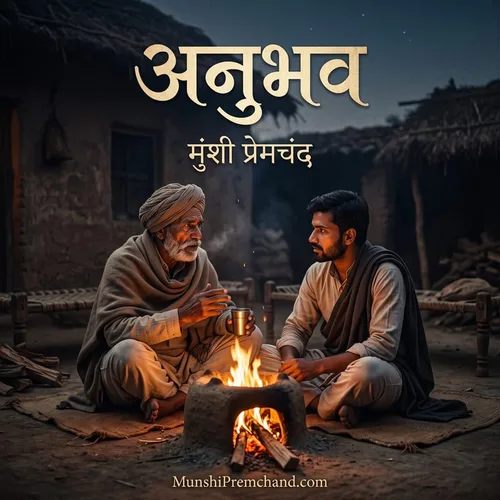
Complete English Translation: Anubhav (Experience)
1
My beloved was sentenced to one year of rigorous imprisonment.
And his offense was merely this: three days earlier, under the blazing midday sun of Jeth, he had offered hospitality to several servants of the nation with glasses of cooling sherbet!
I was standing inside the courtroom at that very moment. Outside the hall, the political conscience of the entire city seemed to be roaring like a caged beast. My heart's treasure was brought in, bound in heavy iron handcuffs. A dead silence fell all around.
Inside my breast, a tumult raged, as though my very soul were melting away. Surging waves of emotion sent shivers through every fiber of my being.
Oh, never in my life had I felt such boundless pride! That British courtroom, the English magistrate perched upon his elevated chair, the police constables wearing scarlet turbans embroidered with gold lace—all appeared utterly trivial and contemptible in my eyes.
Time and again, a wild urge surged within me to rush forward, throw my arms around the feet of the master of my life, and breathe my last in that very embrace!
What a serene, unshaken image he presented, radiant with majestic pride! There was not the faintest shadow of humiliation, melancholy, or grief upon his face. No, upon those firm lips played a charming, vigorous, inspiring smile.
For such an innocent deed, one year of rigorous imprisonment!
Bravo, O British Justice! All hail to your righteousness! I was ready to commit a thousand such offenses!
As he was led away, the lord of my life looked toward me just once. He smiled faintly, and then his expression turned solemn and resolute.
Returning home from the court, I bought five rupees worth of sweetmeats, summoned the young volunteers, and fed them with my own hands. And that very evening, for the first time in my life, I attended a public gathering of the Congress—not merely attended, but ascended the rostrum, spoke before the gathering, and took the sacred pledge of Satyagraha!
From where such unyielding strength entered my soul, I cannot tell. Once one's all is plundered, what fear or hesitation remains? What further harm could the harshest blow of Providence inflict upon me now?
2
The following morning, I dispatched two urgent telegrams—one to my father, and the other to my father-in-law.
My father-in-law was a retired government servant drawing a monthly pension from the Crown. My father held a lucrative, respectable post in the Imperial Forestry Department.
Yet the entire day passed, and there was not a trace of an answer! A second day rolled by, still no response.
On the third day, letters arrived from both gentlemen. Both were beside themselves with fury!
My father-in-law wrote:
"I had hoped that you two would support me in my frail old age. You have dashed all those hopes to the ground! Do you now desire that I beg for alms in the street? I draw a pension from the British government. By offering you shelter, I cannot afford to lose my pension and invite disaster upon my head."
My father's words were not quite so brutal, but their underlying sentiment was identical. This very year, he was due for a major promotion into a higher grade. If he invited me into his house, it was quite possible he would be stripped of his coveted promotion. To be sure, he expressed abundant willingness to assist me with verbal sympathy!
I tore both letters into shreds and threw them away. I did not write a single word in reply.
Alas, O human selfishness! How all-powerful is your illusory web! That one's own biological father, merely out of terror that his petty promotion might be jeopardized, should turn so heartlessly cruel toward his own daughter! That one's own father-in-law should display such callous indifference toward his daughter-in-law!
Yet, what was my age after all? The vast, untamed world still lay stretched out before my eyes.
Until now, I had remained utterly carefree concerning my own person; but now a novel, gnawing anxiety settled upon my mind. In this desolate, solitary house, without support and without refuge, how was I to live?
Where could I go? Had I been a man, I would have walked straight into the Congress ashram or earned my bread through manual labor.
Around my feet were clapped the heavy shackles of womanhood. I was not so anxious about preserving my life as I was about preserving my womanly dignity. I cared nothing for my physical survival; but no eye must be allowed to cast an insolent gaze upon my honor!
3
Hearing faint footsteps below, I looked down from the balcony. Two men were standing in the alley.
An impulse seized me to demand: "Who are you? Why are you standing here?" But then the thought occurred: What right do I have to question them? It is a public thoroughfare; whoever wishes may stand there.
Yet suspicion took root in my heart. Try as I might, I could not banish that dread from my soul. It had lodged within my breast like a smoldering spark.
The room was suffocating under the sweltering summer heat; yet I bolted the heavy door firmly from the inside. There was a large kitchen knife in the house; I took it out and placed it beneath my pillow. That shadowy dread seemed to sit right before me, glaring into my face.
Suddenly, a voice called out my name. My hair stood on end!
I pressed my ear against the wooden door. Someone was rattling the outer latch below. My heart began to thud violently against my ribs.
It must be those two scoundrels! Why are they rattling the door? What business do they have with me?
A surge of indignant irritation overcame my fear. Opening the terrace door and leaning over the railing, I called out sharply: "Who is rattling the latch down there?"
The moment the voice answered, all my apprehensions dissolved. What boundless comfort swept over me!
It was Babu Gyan Chand. Among all my husband's friends, there was none more noble, gentle, and upright than him.
I rushed downstairs and unbolted the door. To my surprise, a woman was accompanying him.
It was Mrs. Gyan Chand. She was older than I, and this was the very first time she had set foot in my home. I bent down and touched her feet in reverence. In our society, deep friendship usually remains confined to the men; it rarely extends to the women of the household.
Both of them ascended to the upper room.
Gyan Babu was a master in a local high school—a man of profound learning, generosity, and guileless sincerity. But today I realized that his true guide and commanding mentor was his wife.
She was a stately, robust, exceptionally commanding lady. Upon her countenance sat such natural majesty as though she were a reigning queen. Draped from head to foot in traditional gold ornaments, her face, though not conventionally pretty, possessed an irresistible attraction. Had I seen her elsewhere, I might have turned away in intimidation; she was the living portrait of proud dignity.
Yet, however formidable she appeared on the outside, within her breast beat a heart of pure tenderness.
"Did you write any letters home?" she asked with slight hesitation.
I answered: "Yes, I did."
"Is anyone coming to fetch you?"
"No. Neither my father wishes to keep me, nor my father-in-law."
"Then?"
"What then? For the present, I am staying right here."
"Then why do you not come to our home? I will never permit you to live alone in this empty house."
"Two men of the Secret Intelligence are stationed right outside at this very moment."
"I understood that the instant I saw them," she said calmly. "They are colonial spies."
Gyan Babu glanced toward his wife, as though awaiting her command, and asked: "Shall I go and fetch a tonga?"
The lady cast a glance upon him that seemed to say: Are you still standing here?
The schoolmaster moved meekly toward the door.
"Wait!" the lady called out. "How many tongas will you bring?"
"How many?" the master asked in confusion.
"Yes, how many! Only three passengers can sit in one carriage. Are the trunks, the bedding, and the brass utensils to travel upon my head?"
"Then I shall bring two," the master replied timidly.
"How much luggage will you cram into a single tonga?"
"Shall I bring three then?"
"Will you go now? You have wasted an hour over a trivial matter!"
Before I could interject, Gyan Babu had hurried down the stairs.
I said with embarrassed hesitation: "Sister, my staying with you will cause you immense trouble and..."
The lady interrupted with a sharp, affectionate retort: "Trouble? Of course it will! You will consume half a pound of flour in two meals, occupy a quiet corner of a room, and use an anna's worth of mustard oil for your hair. Is that a minor catastrophe?"
I blushed and murmured: "You are teasing me..."
The lady placed her hand affectionately upon my shoulder and said with deep warmth: "When your Babu returns from prison, invite me to your house as a guest. My loss will be made good! Now are you satisfied? Come, pack your belongings. We shall send for the cots tomorrow."
4
Never in my life had I encountered a woman so generous, warmhearted, and sweet-spoken. Had I been her own younger sister, she could not have treated me with greater devotion.
Anxiety and anger seemed to have been completely vanquished from her nature. A gentle, witty humor perpetually played upon her lips. She had no children of her own, yet I never saw her look despondent. She had hired a young servant boy for the heavy outdoor chores, while managing all the indoor cooking and domestic work with her own hands.
How she maintained such robust health while eating so little and laboring so unceasingly was a marvel to me. Rest seemed absent from her destiny; even in the blazing heat of a summer noon, she refused to lie down!
Yet, she would not permit me to lift a finger; and on top of that, she was perpetually insisting on feeding me delicacies. That was the only 'suffering' I had to endure under her roof!
However, barely eight days had elapsed when, looking down into the street one morning, I spotted those very same two secret police spies sitting upon a stone ledge outside the house.
My heart missed a beat. These wretched creatures have pursued me even here!
I rushed to the lady at once: "Sister, those two scoundrels are hovering outside your house too!"
She curled her lips in supreme contempt: "They are dogs! Let them roam."
I said in deep worry: "What if they concoct some malicious plot against you?"
With unruffled composure, she replied: "Apart from barking, what harm can they do?"
"They might bite as well," I whispered.
She laughed heartily: "Does anyone run away from home for fear of a barking dog?"
Yet my peace of mind was utterly poisoned. Time and again I would step out onto the balcony to watch them pacing the lane.
All these imperial hounds are hounding me! After all, what harm can a helpless woman do to their mighty bureaucracy? What is my power? Are they determined to drive me out of this shelter as well? What will they gain? Merely that I wander homeless from pillar to post! How vile, how utterly degraded is their mentality!
Another week passed by. The intelligence spies refused to abandon their post.
My soul withered with guilt. To remain under this roof in such circumstances seemed utterly unjust to my generous hosts; yet I lacked the courage to say anything to Mrs. Gyan Chand.
One evening, Gyan Babu returned home looking visibly shaken and agitated.
I was sitting in the verandah, peeling pointed gourds (parwal).
Gyan Babu hurried into the inner room and, with a grave gesture, summoned his wife inside...
Summary of Anubhav
'Anubhav' (Experience) by Munshi Premchand is a powerful psychological and social narrative set against the turbulent backdrop of the Indian independence movement (Civil Disobedience/Satyagraha), exploring the trials of a young wife whose husband is imprisoned by the colonial government.
The story opens with the narrator witnessing her patriotic husband being sentenced to one year of rigorous imprisonment for the minor offense of offering glasses of cold sherbet to passing national volunteers on a scorching summer day. Inspired by his fearless, radiant smile and unyielding pride, she refuses to weep, distributes sweets to the volunteers, and takes the Satyagraha pledge at a public Congress meeting.
Seeking temporary refuge, she writes to her father (a senior Forestry Department officer) and her father-in-law (a retired government pensioner). To her deep shock, both men refuse to take her in, terrified that harboring an agitator's wife will cost them their government pension and promotions. Disillusioned by the cowardice and self-interest of her own kin, the young woman locks herself inside her vacant house, keeping a kitchen knife under her pillow as colonial secret police begin stalking her door.
In her darkest hour, she is rescued by her husband's loyal friend, schoolmaster Babu Gyan Chand, and his formidable, majestic wife. Mrs. Gyan Chand refuses to let her live alone, takes her into their home, treats her with immense sisterly affection, and dismisses the colonial intelligence spies as mere barking dogs. However, when the spies continue their persistent surveillance and Gyan Babu returns home visibly alarmed, the narrator gains a profound, transformative life experience (anubhav): blood relations often retreat in fear when personal interest is threatened, while true nobility and courage reside in principled human solidarity.
Publication History
'Anubhav' was written by Munshi Premchand in 1930 during the height of Mahatma Gandhi's Salt Satyagraha and Civil Disobedience Movement, when thousands of ordinary citizens, teachers, and women were drawn into the national struggle. The story was published in leading literary periodicals before being included in the premier collection Mansarovar (Vol. 1).
This unabridged English translation was published in 2026 by MunshiPremchand.com as part of the MunshiPremchand.com English Translation Series.
Themes & Critical Significance
- The Awakening of Women in the Nationalist Struggle: The female narrator’s instant transformation from a sheltered domestic wife into an outspoken Satyagrahi illustrates how the colonial independence movement politicized and empowered ordinary Indian women.
- The Hollow Cowardice of Colonial Servants: Through the narrator’s father and father-in-law, Premchand exposes the moral bankruptcy of middle-class government employees whose obsession with pensions, increments, and promotions strips them of family loyalty and national self-respect.
- The Heroism of Everyday Solidarity: Mrs. Gyan Chand represents the unyielding moral strength of Indian womanhood. Fearless in the face of colonial surveillance, her practical generosity and fierce protective instinct offer a stark contrast to the spinelessness of the men in authority.
- The Nature of True Experience (Anubhav): The central philosophical insight of the story is that genuine knowledge does not come from formal schooling or smooth days, but from the searing experience of facing adversity, identifying real friends from opportunistic kin, and upholding human dignity.