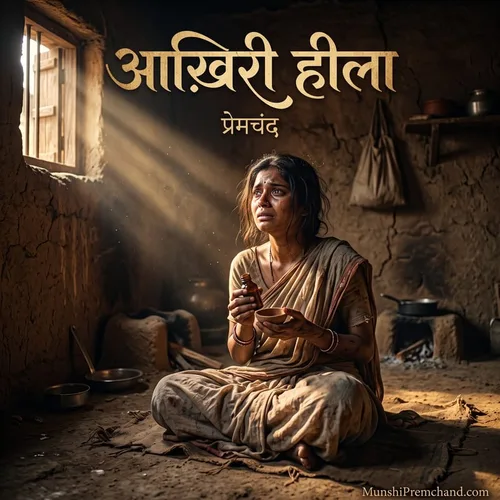
Complete English Translation: Aakhiri Heela
When Bhola Mahto took a second wife after the death of his first, dark days fell upon his son, Ragghu. Ragghu was only ten years old at the time. Until then, he had roamed carefree through the village alleys, playing gulli-danda to his heart’s content. But the moment his stepmother arrived, he was hitched to the domestic grindstone like an ox.
Panna was a beautiful woman, and beauty and pride have ever been as inseparable as the blouse and its hem. She refused to soil her own hands with manual labor. It was Ragghu who hauled out the cattle dung; it was Ragghu who prepared the fodder for the bullocks; it was Ragghu who scrubbed the greasy, used utensils until his knuckles turned raw.
Bhola’s eyes underwent such a strange alteration that he now saw nothing in Ragghu but flaws and wickedness. Following ancient custom, he accepted every word that fell from Panna’s lips with blind acquiescence. He did not care in the least for Ragghu’s grievances. The inevitable result was that Ragghu stopped complaining altogether.
Before whom could the poor boy weep? Not only his father, but the entire village seemed to have turned into his enemy. The villagers gossiped: "He is a terribly headstrong boy; he does not respect Panna in the slightest. The poor woman showers him with affection, feeds him, and takes care of him, and this is how he repays her! Had it been any other woman, they could never have lived under the same roof. Praise be to Panna, who is so gentle and simple-hearted that the household continues to function!"
Everyone lends an ear to the complaints of the strong, but no one pauses to hear the plea of the weak. With every passing day, Ragghu’s heart grew increasingly alienated from his stepmother. In this manner, eight years slipped by, until one fateful day, the summons of death arrived for Bhola Mahto.
Panna was left with four young children—three sons and one daughter. The household expenses were vast, and there was no breadwinner left. Why should Ragghu bother with them now? It was taken for granted that he would bring home his own wife and set up a separate establishment. And once a wife arrived, she would add fresh fuel to the fire.
To Panna, the world appeared shrouded in unyielding darkness. Yet, come what may, she vowed she would never live in that house as a dependent begging for Ragghu's charity. In the very home where she had once reigned as mistress, she would never stoop to becoming a servant. Before the boy she had treated as a menial, she would never look with pleading eyes.
She was still strikingly beautiful, and her youth had not yet deserted her; indeed, her womanhood was in full blossom. Could she not settle into another household? What of it if tongues wagged and people laughed? Let them! Did such remarriages not happen regularly within her caste? She was neither a Brahmin nor a Thakur that her family’s nose would be cut off in disgrace. It was only among those so-called high castes that one could do whatever one pleased behind closed doors while maintaining a respectable veil in public. She was free to hold her head high and take another husband before the whole world. Why, then, should she live under Ragghu’s thumb?
A month had passed since Bhola’s death. Dusk had settled over the village. Panna was lost in these bitter musings when she suddenly realized that the children were nowhere inside the house. It was the hour when the cattle returned from the pastures; what if one of the little ones was trampled beneath the hooves of the returning oxen? Who was there at the front door now to keep watch over them? Ragghu could not stand the sight of her children. He never even offered them a cheerful word.
Stepping out into the yard, she looked toward the thatch hut across the way. There sat Ragghu, cutting peeled sugarcane into juicy segments. The children were clustered closely around him, and the little girl had wrapped her arms around his neck, trying her best to climb onto his back.
Panna could scarcely believe her own eyes. This was something entirely new. Perhaps he is putting on a show for the world, she thought suspiciously, pretending to love his brothers while concealing a dagger in his heart. If he finds a chance, he will slit their throats! He is a black cobra—nothing but a venomous black cobra!
In a sharp, harsh tone, she called out: "What are all of you doing there? Come inside the house at once! It is evening, and the cattle will be returning."
Ragghu looked up at her with humble, gentle eyes and said: "I am right here with them, Kaki. What is there to fear?"
Kedar, the eldest boy, spoke up eagerly: "Kaki, Ragghu Dada has made two carts for us! Look, Khunnu and I will sit in this one, and Lachman and Jhuniya will ride in the other. Dada is going to pull both carts for us!"
Saying this, he dragged two miniature wooden carts out from a corner. Each had four carefully fitted wheels, wooden boards for sitting, and side rails to keep the riders from tumbling out.
Panna asked in astonishment: "Who made these carts?"
Kedar replied with childish indignation: "Ragghu Dada made them, who else! He borrowed an adze and a chisel from Bhagat’s house and put them together in a flash. They run wonderfully fast, Kaki! Get in, Khunnu, let me pull you!"
Khunnu clambered into the cart. Kedar began to pull it. The wheels creaked and rattled, as though the little cart itself was joining in the children’s laughter.
Lachman sat down in the second cart and pleaded: "Dada, pull me!"
Ragghu settled little Jhuniya beside him and broke into a run, pulling the cart behind him. The three boys clapped their hands in sheer delight. Panna watched the spectacle with bewildered eyes, wondering whether this was truly the same Ragghu she had known, or some entirely different soul.
After a short while, both carts returned. The children tumbled into the house, chattering excitedly about the adventures of their grand voyage. They were as ecstatic as if they had just returned from a flight in an airplane.
Khunnu exclaimed: "Kaki, all the trees were running backward!"
Lachman added: "And you should have seen the calves run, Kaki! Every single one of them raced alongside us!"
Kedar chimed in: "Kaki, Ragghu Dada can pull both carts at the very same time!"
Jhuniya was the youngest. Her power of expression was limited to bouncing, laughing, and wide-eyed wonder; she danced across the floor, clapping her tiny hands over and over.
Khunnu said: "And now a cow is coming to our house too, Kaki! Ragghu Dada told Girdhari to bring us a cow. Girdhari said he will bring her tomorrow."
Kedar beamed: "She gives three seers of milk, Kaki! We are going to drink plenty of milk every single day!"
Just then, Ragghu stepped inside. Panna looked at him with lingering skepticism and asked: "Ragghu, did you ask Girdhari for a cow?"
Ragghu answered in an apologetic, deferential tone: "Yes, Kaki, I did ask him. He will bring her tomorrow."
Panna said: "And from whose treasury will the money come? Have you thought about that?"
Ragghu replied softly: "I have arranged everything, Kaki. You see this gold coin pendant around my neck? A goldsmith is offering twenty-five rupees for it. I will offer our young heifer in part exchange for five rupees, and that will settle the price. The cow will be ours."
Panna was struck dumb. Even her hardened, mistrustful heart could no longer deny the purity of Ragghu’s affection and nobility.
"Why must you sell your gold coin pendant?" she asked, her voice softening. "What is the hurry for a cow? Buy one when you have spare cash in your hands. A bare neck will not look good on a young lad like you. If we have lived without a cow all these years, did the children starve to death?"
Ragghu spoke with the calm wisdom of a philosopher: "These are the years for children to eat and grow strong, Kaki. If they do not drink milk at this age, when will they ever drink it? Besides, wearing gold around my neck does not sit well with me. People would mock me behind my back and say: 'His father has barely died, and look at the fellow flaunting gold ornaments!' "
Bhola Mahto had departed this world consumed by the worry of acquiring a milk cow. He had lacked the money, and the cow had remained a distant dream. He had been helpless. Yet Ragghu had solved the intractable problem with such effortless grace.
For the first time in her life, Panna felt genuine trust and reverence for Ragghu. She said: "If an ornament must be sold, why should you sacrifice your pendant? Take my silver collar instead."
Ragghu smiled gently: "No, Kaki! That silver collar looks beautiful around your neck. What does an ordinary working man care for ornaments, whether he wears gold or goes bare-necked?"
Panna protested: "Hush, boy, I am an old woman now. What vanity do I have left for wearing silver collars? You are still in the prime of your youth; how will your bare neck look to the world?"
Ragghu chuckled: "How have you become an old woman so soon? Who in this entire village can compare with you in beauty and grace?"
Ragghu’s innocent compliment made Panna blush. A flush of warm, long-forgotten happiness swept across her pale, withered cheeks.
Five years slipped quietly by. In the entire village, there was no farmer as industrious, honest, and steadfast in his word as Ragghu. He never undertook a single task without first seeking Panna’s counsel and blessing.
He was now twenty-three years of age. Time and again, Panna would urge him: "Son, go and bring your bride home. How long will the poor girl remain at her father’s house? People in the village point fingers at me and accuse me of keeping your wife away."
Ragghu, however, consistently brushed the matter aside, saying: "What is the rush, Kaki? Let some more time pass."
Through travelers and acquaintances, Ragghu had already caught wind of his wife’s sharp tongue and haughty temperament. He had no wish to bring such a woman into the home and shatter the tranquil peace they had so painstakingly built.
Finally, one day, Panna pressed him stubbornly: "So, you refuse to bring her?"
"I have already told you, Kaki, there is no hurry."
"It may not be urgent for you, but it is urgent for me! I am sending a messenger today."
"You will regret it, Kaki. Her temper is far from pleasant."
"Let it be on my head! If I never exchange a harsh word with her, will she pick a quarrel with thin air? At least she will bake the daily bread. I can no longer manage all the heavy labor inside the house and out in the fields. I am having her fetched this very day."
"If you are set on calling her, go ahead and call her," Ragghu replied resignedly. "Only do not blame me later and say that I failed to control my wife or became her blind slave."
"I will say no such thing. Go to the market, buy two fine sarees and a basket of sweets."
On the third day, Muliya arrived from her maternal home. Drums resounded at the entrance, and the sweet, celebratory notes of the shehnai echoed across the sky. The village women gathered for the ceremony of unveiling the bride's face.
Muliya was like a shimmering stream of fresh water in a barren desert. She possessed a radiant, golden-wheatish complexion, long, sweeping eyelashes, a faint crimson glow upon her cheeks, and a captivating intensity in her eyes. The moment Ragghu laid eyes upon her, he was utterly spellbound. When she walked to the well at daybreak with a water pitcher balanced on her head, the golden rays of the morning sun turned her skin into burnished gold, as though Dawn herself were walking the earth, smiling with all her fragrance, youth, and intoxication.
Yet Muliya had arrived from her mother’s home filled with simmering bitterness. She resented the household arrangement deeply: Why should my husband tear his chest apart with backbreaking labor while Panna lounges about like a queen, and her spoiled sons strut around like young lords?
Muliya had no intention of tolerating this. She would serve no one. Even one's own sons cannot always be relied upon; what loyalty can one expect from stepbrothers? As long as their wings have not sprouted, they flock around Ragghu. The moment they grow a little older, they will shake their feathers, fly away, and not even glance back to ask how he fares!
One day, she confronted Ragghu directly: "If you wish to remain their lifelong bonded slave, go ahead and do so! But do not expect me to join you in your servitude."
Ragghu asked patiently: "What else would you have me do, Muliya? Tell me. The boys are not yet old enough to shoulder the field work."
Muliya retorted sharply: "Those boys belong to Bhola Mahto; they are no blood of yours! This is the very Panna who starved you and made you cry for every grain of food. I have heard the whole story from others. I will not live as an unpaid maidservant in this house. I am never given an account of the household money. Who knows what you bring home and what she tucks away? You fool yourself into believing that the money stays in the family; but mark my words, you will not receive a single broken copper when the reckoning comes!"
Ragghu tried to reason: "If I were to hand all the household finances to you, think of what the world would say."
Muliya snapped: "Let the world say whatever it pleases! I have not sold myself into bondage to the world. You will see—after slaving over this kiln, your hands will be left with nothing but soot. If you want to die working for your brothers, die! Why should I work myself to death for them?"
Ragghu offered no reply. The very calamity he had feared had landed squarely upon his shoulders far sooner than he anticipated. No matter how much he cajoled and mediated, the arrangement might limp along for another six months or a year at best. Beyond that, he could see no way forward. How long could the sacrificial goat escape the butcher's knife?
One afternoon, Panna spread a batch of dried mahua flowers in the sun. The monsoon had begun, and the grain in the storage bins was threatening to turn damp. She said to Muliya: "Bahu, please keep an eye on these flowers for a short while while I go to the pond to take my bath."
Muliya replied with cold indifference: "I am feeling sleepy. Sit here and watch them yourself. What calamity will befall you if you miss your bath for one day?"
Panna silently set down her towel and stayed behind. Muliya's barb had struck its mark.
Several days later, Panna returned from the fields after transplanting paddy until after dark. She had starved the entire day. She had harbored the hope that her daughter-in-law would have prepared the evening meal; but upon entering the courtyard, she found the hearth completely cold, and her little children writhing in hunger.
Panna asked softly: "Has the fire not been lit yet today?"
Kedar replied: "The hearth was not lit at noon either, Kaki! Bhabhi did not cook anything."
Panna asked: "Then what did you children eat?"
"Nothing. There were leftover rotis from last night; Khunnu and Lachman ate those. I ate a handful of roasted gram flour (sattu)."
"And where is your Bhabhi?"
"She is lying inside, fast asleep. She hasn’t eaten anything either."
Panna immediately lit the hearth and sat down to prepare food. Tears streamed down her face as she kneaded the dough. What a cursed fate was hers! She had burned under the scorching sun in the fields all day, only to return home and burn before the flames of the cooking hearth.
Kedar was now fourteen years old. Observing his sister-in-law's hostile conduct, he understood the whole situation clearly. He said: "Kaki, Bhabhi no longer wishes to live with you."
Panna looked up, startled: "Did she say something to you?"
Kedar answered: "She didn't say anything, but that is what is festering in her heart. Why don't you let them live separately? Let them live as they please; we too have God to look after us."
Panna bit her tongue in reprimand: "Silence! Never let such words pass your lips in front of me again. Ragghu is not merely your elder brother; he is your father! If you ever dare speak a disrespectful word to Muliya, remember this: I will swallow poison and end my life!"
The festival of Dussehra arrived. In a neighboring hamlet about two miles away, an annual fair was being held. All the village boys were setting out to see the festivities. Panna prepared to send her children along; but where was the money to come from? The key to the money chest was in Muliya’s possession.
Ragghu came to Muliya and said gently: "The boys are going to the fair. Give each of them two copper paise."
Muliya knitted her brows in fury: "There is no money in the house."
Ragghu said: "We just sold the oilseeds; could the money have vanished so quickly?"
Muliya snapped: "Yes, it is gone!"
Ragghu pressed: "Where did it go? Let me hear. Today is a festival day; should the children not go to see the fair?"
Muliya sneered: "Ask your Kaki to dig up her buried hoard. What will she do with all her hidden coins—take them to the grave?"
The key was hanging from a wooden peg on the wall. Ragghu reached out, took the key, and moved to unlock the wooden chest.
Muliya lunged forward, grabbed his wrist in a tight grip, and hissed: "Hand that key back to me, or there will be trouble! We must feed them, we must clothe them, we must buy their paper and schoolbooks, and on top of all that, we must finance their fairs! Our hard-earned labor is not meant for others to gorge upon while twirling their moustaches in leisure!"
Overhearing the commotion, Panna called out to Ragghu: "Bhaiya, what need is there for money? The boys will not go to the fair."
Ragghu scolded her gently: "Why shouldn't they go to the fair? The entire village is going. Are our children the only ones who must stay behind?"
With a firm pull, Ragghu wrenched his hand free, opened the chest, and handed the coins to the eager boys. But when he held out the key to return it to Muliya, she snatched it, hurled it violently across the courtyard, wrapped herself in her sheet, and threw herself onto her cot.
Seeing the bitter discord, the boys quietly gave up their plans and did not go to the fair.
For the next two days, complete gloom descended upon the household. Muliya refused to touch a morsel of food, and Panna fasted in turn. Ragghu ran back and forth, pleading first with his wife and then with his stepmother; but neither woman would budge from her bed.
Finally, worn down with exhaustion, Ragghu pleaded with Muliya: "At least open your mouth and tell me what it is you want!"
Addressing the dirt floor, Muliya muttered: "I want nothing. Pack my belongings and send me back to my father’s house."
Ragghu said: "Very well, get up, cook something, and eat. I will take you there."
Muliya raised her eyes to look at him, and Ragghu stepped back in fright. Her sweetness, her charm, her alluring beauty had vanished entirely. Her teeth were bared, her eyes flared wide, and her nostrils quivered with rage.
Staring at him with embers in her gaze, she hissed: "So, this is the counsel your Kaki has whispered into your ears? This is the mantra she has taught you? Do not think I am so easily discarded! I will stay right here and grind lentils on your chests! What did you take me for?"
Ragghu replied wearily: "Very well, grind lentils on our chests if you must! But eat and drink something first; only then will you have the strength to do it."
Muliya declared fiercely: "I will not let a single drop of water pass my lips until this household is partitioned! I have endured more than enough; I cannot bear another single day!"
Ragghu stood paralyzed. For a full minute, not a single sound could escape his throat. Even in his darkest nightmares, he had never conceived of a partition. He had seen two or three families in the village divide their homes. He knew only too well that when the hearth is divided, human hearts are torn asunder forever. Kin turn into permanent strangers; between them remains nothing more than the cold, distant relationship shared with ordinary villagers.
Ragghu had vowed in his heart that he would never permit this catastrophe to cross his threshold. Yet against the cruel hand of destiny, his will was powerless.
Alas! he thought, my face will be blackened with disgrace! The world will say that after his father died, he could not even keep the family together for ten years. And from whom am I being asked to separate? From those very children I cradled in my lap, whom I raised like my own sons, for whose sake I endured every hardship! Must I now cast out my beloved ones from my hearth?
His throat choked with tears. In a trembling voice, he asked: "Do you truly want me to separate from my own brothers? Think for a moment, Muliya—will I ever be able to show my face to the world again?"
Muliya retorted: "I cannot live with these people any longer."
Ragghu said: "Then set up your own separate living. Why must you drag me into it?"
"Am I fed royal delicacies in your house? Is there no corner left for me in this wide world?"
Ragghu pleaded desperately: "Do as you please, live wherever you wish, but I cannot tear myself away from my family! The day two hearths are lit in this house, my heart will split into two pieces. I will not survive the blow. If there is any grievance or discomfort you suffer, tell me, and I will remove it. You are already the mistress of all the household goods; the grain and water are entirely in your hands—what more is left? If you do not wish to work, do not do any work! Had God blessed me with sufficient wealth, I would never have let you lift a straw. These delicate hands and feet of yours were never made for hard labor and toil. But what can I do? I am helpless. Even so, if your heart refuses to do any chores, sit quietly and rest; but I fall at your feet, Muliya—do not ask me to separate from my family!"
Muliya slid the veil from her head, stepped closer, and spoke with piercing venom: "I am not afraid of work, nor do I desire to sit idle and eat. But I will not endure anyone’s arrogant dominion over me! If your Kaki does the household chores, she does them for herself and for her own children. She does no favor for me! Why, then, does she try to lord it over me? Her children may be dear to her, but my only support in this world is you. I cannot bear to see the whole house resting in comfort, the little children drinking rich milk, while the man on whose strength and labor this entire household stands pines for a bowl of watery buttermilk! There is no one to ask after your welfare. Look at your own face in the mirror—see how emaciated you have become! In four years, her sons will be grown young men, while in ten years, you will be permanently bedridden on a cot. Sit down, why are you standing? Are you afraid I will strike you? I am not going to tie you down, nor is the mistress issuing you an order! Truth be told, your heart is made of stone. Had I known I would be saddled with such a callous, unfeeling man, I would never have set foot in this house, even by mistake. And even if I had come, I would never have given my heart to you. But now my heart is bound to you. Even if I go back to my mother's home, my thoughts will remain trapped here; and you do not care for a single word I say!"
Muliya’s seductive pleading could make no impression upon Ragghu’s resolved mind. He replied with the same grim aloofness: "Muliya, I cannot do this. The very thought of partition turns my stomach. I will not be able to bear this wound."
Muliya sneered mockingly: "Then put on glass bangles and sit inside like a woman! Hand me your dhoti, and I will paste a moustache on my lip! I used to believe you had some masculine grit in you. Now I see that you are nothing more than a lump of wet clay!"
Panna had been standing quietly in the verandah, listening to every word of their exchange. She could bear it no longer. Stepping forward, she confronted Ragghu:
"When she is bent upon a partition, why do you seek to keep us tied together by force? Take her and live your own life; our master is God above! When Mahto died and there was not even the shade of a single leaf over our heads, God sustained us through that trial; what is there to fear now? By God's grace, my three boys have grown older; there is no need for worry."
Ragghu looked at Panna with eyes overflowing with tears and said: "Kaki, have you lost your senses too? Do you not know that the moment two rotis are baked on separate fires, two hearts turn into strangers?"
Panna replied: "When she refuses to listen, what can you do? If it is God’s will, who can alter it? We lived together for as many days as was written in our destiny. If this is what she desires, so be it. I can never forget what you have done for my children. Had you not placed your protective hand over their heads, who knows what their fate would have been? God alone knows at whose doorstep they would have been kicked, or in what alleys they would have wandered begging for scraps! To my dying breath, I will sing your praises. If my own skin could be used to stitch shoes for your feet, I would surrender it with a joyous heart. Even if we live apart, the moment you call for me, I will come running to your side like a faithful dog. Never let it enter your mind that once separated, I will harbor ill will against you. The day an unkind thought toward you enters my heart, I will swallow poison and die! May God grant that you bathe in milk and flourish with sons! Until my last breath, this blessing will rise from every pore of my body. And if my sons are truly born of their father’s seed, they too will honor your debt of gratitude until the day they die."
With these words, Panna broke down weeping and walked away. Ragghu remained seated there, motionless as a stone statue, his eyes fixed on the empty sky as tears streamed silently down his cheeks.
Hearing Panna’s surrender, Muliya knew that victory was hers. She sprang to her feet, swept the floor, kindled the fire in the hearth, and set off with her pitcher to fetch water from the well. Her stubborn demand had been fulfilled.
In every village, women are divided into two distinct camps: the faction of the young daughters-in-law, and the faction of the mothers-in-law. The young wives seek counsel and sympathy from their own cohort, while the older women gather in theirs. Each holds its own separate court. At the well, Muliya encountered two or three fellow brides.
One of them asked: "Your old woman was weeping and wailing quite loudly today, wasn't she?"
Muliya answered with triumphant pride: "She has reigned as the supreme mistress of the house for so many years; who likes to surrender their throne? Sister, I wish her no harm; but how far can one man’s earnings stretch? These are my youthful years to eat well and dress well. Am I to slave for her children now, and then slave for my own children later, spending my entire existence in tears?"
One bride agreed: "The old woman simply wants you to remain an unpaid servant all your life, eating coarse scraps and lying in a corner."
Another chimed in: "On whose loyalty should one sacrifice oneself? One's own sons do not care for you when they grow up; what reliance can one place on the sons of another woman? Tomorrow they will grow hands and feet and look only to the faces of their own wives. It is far better to cast them off now; at least no one can blame you later."
Muliya carried her water home, prepared the meal, and said to Ragghu: "Go, take your bath. The food is ready."
Ragghu acted as though he had not heard a word. Resting his head upon his hand, he kept staring mournfully out toward the door.
Muliya repeated: "Can you hear what I am saying? The food is ready. Go and bathe."
Ragghu said coldly: "I hear you. Am I deaf? If the food is ready, go and eat it yourself. I have no hunger."
Muliya did not ask him a second time. She extinguished the hearth fire, placed the rotis in the hanging basket (chheeka), covered her face, and lay down on her cot.
A short while later, Panna came to him and said: "Bhaiya, the food is ready. Take your bath and eat. The Bahu must be hungry as well."
Ragghu replied in exasperation: "Kaki, will you let me remain in this house, or must I blacken my face and wander off into the wilderness? Food is food; if I do not eat it today, I will eat it tomorrow. But right now, I cannot swallow a single bite. Has Kedar not returned from the school yet?"
"Not yet; he should be arriving any moment."
Panna understood completely. As long as she did not cook for her own children and eat before his eyes, Ragghu would never touch food. More than that, she would have to pick a quarrel with him, speak sharp, cutting words, and make it appear as though she herself wished for the separation; otherwise, the boy would waste away in anxiety and sacrifice his very life.
With this resolve, she lit a separate fire in her own corner and began preparing a meal. Just then, Kedar and Khunnu returned from the village school.
Panna called out: "Come, my sons, eat. The food is ready."
Kedar asked: "Shall I call Bhaiya too?"
Panna said firmly: "You come and eat. His wife has cooked separately for him."
Khunnu asked: "Should I go and ask Bhaiya?"
Panna snapped: "He will eat when he feels like it! Sit down and eat your food; what concern is it of yours? Those who are hungry will eat; those who are not will refrain. When he and his wife are determined to live separately, who is going to plead with them?"
Kedar asked in bewilderment: "Why, Amma, are we going to live in a separate house now?"
Panna answered: "If they wish, they may live under one roof; if they wish, they may raise a partition wall across the courtyard."
Khunnu peeked through the door. Across the way, beneath the thatch hut, Ragghu lay sprawled upon a wooden cot, smoking his coconut hookah in grim silence.
Khunnu reported: "Bhaiya is just sitting there with his hookah."
Panna said: "He will eat when it pleases him."
Kedar asked: "Did Bhaiya not scold Bhabhi?"
Muliya, lying in her room, overheard the boy’s question. Stepping outside, she snapped: "Your Bhaiya did not scold me; why don't you come and scold me yourself?"
The color drained from Kedar’s face. He did not utter another syllable.
The three boys quickly finished their food and stepped outside. The scorching summer wind (loo) had begun to blow violently. In the mango grove, village boys and girls were gathering the windblown mangoes that had dropped from the branches.
Kedar said: "Let us go and gather mangoes today; so many are falling from the trees!"
Khunnu hesitated: "Dada is sitting right there."
Lachman said: "I won't go; Dada will scold us."
Kedar muttered: "He has separated from us now."
Lachman asked innocently: "So even if someone beats us now, Dada won't speak up for us?"
Kedar replied: "Nonsense! Why wouldn't he speak up?"
Ragghu saw the three boys standing by the doorway, but he said nothing. In days past, the moment they stepped outside into the blazing heat, he would have thundered at them; but today he remained seated like an unmoving stone statue.
Emboldened by his silence, the boys took a few steps forward. Still, Ragghu did not speak. How could he? He was thinking: Kaki fed the boys, but she did not even bother to ask after me. Has a blind veil fallen over her eyes too? What if I call out to the boys and they refuse to obey me? I cannot raise a hand against them now. They will wander aimlessly in this blistering heat. What if they fall ill? His heart wrenched with agony, yet his lips remained sealed. Seeing that he stayed completely silent, the boys ran off toward the grove without fear.
Suddenly, Muliya stepped out and taunted him: "Will you get up now, or will you keep brooding? The very people for whose sake you are starving yourself have fed their children, eaten their fill, and are now resting comfortably inside! 'My beloved does not ask after me, yet I am called the favored bride!' Not once did it cross her lips to say: 'Come, Bhaiya, have your meal.' "
Ragghu was suffering unspeakable torment. Muliya’s callous words rubbed raw salt into his bleeding wound. Looking at her with sorrowful eyes, he said: "What you desired has come to pass. Now go and beat your victory drums!"
Muliya sneered: "Indeed, as if they are sitting waiting with a platter served for you!"
Ragghu warned: "Do not provoke me, Muliya! It is on your account that my reputation is ruined. When you refuse to belong to anyone, why should anyone fawn over you? Go and ask Kaki—the boys have gone to the mango grove in this blistering wind; should I go and fetch them back?"
Muliya thumbed her nose at him: "As if I care! If you have a hundred obligations, go and ask her yourself."
Just then, Panna emerged from inside. Ragghu asked: "The boys have gone off to the orchard, Kaki. The heatwave is blowing fiercely."
Panna said coldly: "Who is there to care for them now? Let them go to the orchard, let them climb trees, let them drown in the river! What all can I manage alone?"
Ragghu asked: "Shall I go and bring them back?"
Panna replied: "If your own heart did not move you to stop them, why should I ask you to go? Had you wished to restrain them, could you not have done so? They must have walked past right before your eyes."
Before Panna could finish her sentence, Ragghu set his hookah down in the corner and hurried toward the orchard.
When Ragghu returned from the mango grove with the boys, he found Muliya still waiting near the thatch hut. He said: "Why don't you go and eat your food? I have no appetite at this hour."
Muliya tossed her head haughtily: "Oh yes, why should you have an appetite? Your brothers have eaten, so your stomach must be completely full!"
Ragghu ground his teeth and said: "Do not torment me, Muliya, or it will not end well! Food is not going to run away. If I miss one meal, I will not drop dead! Do you think what happened in this house today is a trifling matter? You have not merely kindled a fire in the hearth; you have set a raging fire inside my heart! I used to pride myself on the thought that whatever else might happen, the poison of family division would never enter my home. But you have shattered my pride to dust. It is all the work of cruel destiny."
Muliya retorted sharply: "Are you the only one blessed with love and affection, or does anyone else possess it? I do not see anyone else mourning and weeping like you!"
Ragghu drew a deep, ragged breath: "Muliya, do not rub salt on my wounds. It is because of you that my honor has been dragged through the dust. If I do not feel affection for this household, who will? I am the one who slaved and pieced it together bit by bit! Those very boys I cradled in my arms will now be my legal rivals for land and grain. The children I once freely scolded—today I cannot even look at them with stern eyes. Even if I act for their own good, the world will point a finger at me and say: 'Look at him, robbing his helpless brothers!' Go, leave me be. I cannot swallow a single bite right now."
Muliya insisted: "I will make you swear a solemn oath if you do not come quietly and eat."
Ragghu said: "Listen to me, even now nothing is ruined beyond repair. Give up this stubborn folly."
Muliya swore: "May he drink my own blood who refuses to get up and eat!"
Ragghu clamped his hands over his ears in horror: "What have you done, Muliya? I was already rising. Come, I will eat. Who has the patience to go and bathe now? But I tell you this: even if I eat six rotis instead of four, even if you drown me in a jar of pure ghee, this black stain will never be washed from my soul."
Muliya remarked dismissively: "All stains fade away with time. Everyone feels like this at first. Don't you see how happily they are playing their flutes over there? She was merely praying for a way to cast us off. It is not like the old days when silver flowed freely and whatever came into the house vanished without a trace! Why should she want to live with us now?"
Ragghu replied in a wounded whisper: "That is the very sorrow that breaks my heart. I never expected such coldness from Kaki."
When Ragghu sat down to eat, every morsel felt like a swallow of deadly poison. The flatbread tasted like dry chaff; the lentils seemed like tasteless water. The water refused to slide down his parched throat, and he did not even cast a glance toward the bowl of milk. He forced down two or three mouthfuls and rose from the floor, as though he had partaken of the somber feast of a funeral rite (shraddha).
His evening meal was no different. It was not eating; it was merely fulfilling an oath under duress. Throughout the long night, his mind remained in feverish agitation. An unnameable dread hung over his soul, as though the ghost of Bhola Mahto were sitting at the front doorway, weeping bitterly. Several times he woke with a violent start, feeling as though his deceased father were gazing down upon him with eyes full of reproach and disgust.
He continued to eat his two daily meals, but it felt as if he were dining in the house of a mortal enemy. The grief-stricken image of Bhola Mahto refused to leave his vision. Sleep abandoned his eyes. Whenever he walked through the village streets, he hid his face and bowed his head in shame, as though he had committed the unforgivable sin of slaughtering a sacred cow.
Five years passed away. Ragghu was now the father of two young sons.
A brick partition wall had been erected down the center of the courtyard; earthen boundaries had been carved across the agricultural fields, and the bullocks and heifers had been divided between the two households.
Kedar was now nineteen years old. He had abandoned his schooling to take up the plough and manage his family's share of the land. Khunnu grazed the cattle in the pastures, and only young Lachman still attended the village school.
Panna and Muliya could not bear the sight of each other's faces. Yet Muliya’s two little boys spent most of their waking hours in Panna’s lap. It was Panna who rubbed them with cleansing paste, Panna who applied kohl to their eyes, and Panna who carried them about with unconditional warmth. Never once did a word of gratitude pass Muliya’s lips, nor did Panna seek any praise. Whatever she did, she did with pure, unselfish maternal devotion.
Panna now had two able-bodied sons earning for the household. Her young daughter had learned to cook the daily meals, and Panna herself looked after the lighter domestic tasks.
In contrast, Ragghu was completely alone in managing his household. Worse still, he had become frail, sickly, and aged before his time. He was barely thirty years old, yet his hair had turned into a pepper-and-salt gray, his back had begun to stoop, and a chronic, hacking cough had hollowed out his frame. To look at him was to feel a pang of deep pity.
Farming requires the relentless sweat of multiple hands. The painstaking labor that the soil demanded was far beyond his failing strength. How, then, could his fields yield a bountiful harvest? A mounting burden of debt began to weigh heavily upon his shoulders, and the worry of it consumed him from within. By right, these were the years when he ought to have enjoyed some measure of rest. After so many years of unbroken toil, the heavy burden upon his head should have grown lighter. But Muliya’s narrow selfishness and short-sighted pride had laid waste to a thriving household.
Had they all remained together under one roof, Ragghu would have effectively retired by now, sitting comfortably at the front door puffing his hookah. His younger brothers would have tilled the soil while he offered wise guidance, revered as the respected elder of the family (Mahto). He would have settled village disputes and served wandering holy men. But that golden opportunity was lost forever. Now, the crushing burden of anxiety grew heavier with every passing dawn.
Eventually, a low-grade, persistent fever settled into his bones. A wounded heart, gnawing anxiety, brutal labor, and chronic deprivation—this was the inevitable harvest he reaped. At first, he paid it no heed, assuming the fever would subside on its own. But as his weakness intensified, he was forced to seek remedies. He swallowed whatever herbs or potions well-meaning neighbors recommended; where was the means to afford licensed doctors or Ayurvedic physicians? And even had the money been available, what purpose would it have served beyond squandering coins? The only true remedy for a chronic consumptive fever is complete rest and rich, nourishing food. Ragghu could neither afford costly Ayurvedic tonics nor could he sit idle and enjoy strengthening broths. His vitality continued to ebb away.
Whenever Panna found a quiet moment, she would come to his bedside and offer words of comfort. Her sons, however, refused even to speak to Ragghu. Far from fetching medicines, they openly mocked his plight: "Bhaiya thought that by separating from us, he would amass heaps of gold and silver bricks! Bhabhi thought she would be draped from head to toe in heavy gold! Now let us see who comes to their aid. If he doesn't die weeping and wheezing, my name is not Kedar! Too much greed and vanity never end well. A man should undertake only as much labor as his body can bear, not work himself to death for the sake of hoarding coppers!"
Panna would reprimand him: "What fault is it of poor Ragghu's?"
Kedar would argue back: "Hush, Amma, I understand everything clearly. Had I been in Bhaiya's shoes, I would have answered that woman with a stout stick! It is a joke that a mere wife should carry on with such arrogance. It was all Bhaiya’s own connivance—a well-rehearsed charade between husband and wife!"
Finally, one evening, Ragghu’s flickering lamp of life was snuffed out. Death put an end to all his worldly tribulations.
In his final moments, Ragghu had called out for Kedar. But Kedar was busy irrigating the sugarcane crop in the field; fearing that he might be dispatched on an errand to fetch medicine, he made an excuse and stayed away.
Muliya’s world collapsed into complete darkness. The very ground upon which she had erected her grand castles of independence had crumbled beneath her feet. The peg upon which she had tethered her pride had been ripped out by the roots.
The villagers began to whisper among themselves: "See how swiftly God has delivered His punishment!"
Overcome with shame and grief, the poor widow spent her days weeping with her two infant boys clasped to her bosom. She lacked the courage to show her face to anyone in the village. Every passing soul seemed to say: "Her feet refused to touch the ground in her boundless arrogance—has she not received her just punishment at last?"
How was she to survive in this desolate home now? On whose strength was she to lean? Who would plough and tend her fields? Poor Ragghu had been ill and emaciated, yet as long as breath remained in his body, he had kept the farm running. Overcome with dizzy spells of weakness, he would clutch his head and sit down on the bund; but after resting a few moments, he would set his hands to the plough once more.
Now, the entire farm lay in utter ruin. Who would salvage it? Bundles of harvested grain lay rotting in the threshing floor, while the standing sugarcane was withering for want of water. What could a lone woman accomplish by herself? Irrigating fields was never a one-person task, and where could she find the means to hire three laborers? Even if she had the money, laborers were exceedingly scarce in the village, with households fiercely competing for hired hands. She was at her wit's end, trapped in helpless despair.
In this manner, thirteen days of mourning elapsed, and the final funerary rites were completed.
Early the very next morning, Muliya gathered her two infants into her arms and set out for the threshing floor to winnow and tread the grain. Arriving at the clearing, she laid the younger baby to sleep on a soft bed of grass beneath a shady tree, sat the older toddler beside him, and began driving the oxen around the post to tread the sheaves.
She cracked the whip over the bullocks, weeping bitterly with every step. Was it for this wretched fate that God brought me into this world? she thought. How swiftly everything has been reduced to ashes!
At this exact time last year, the grain had also been treaded upon this ground. She had brought Ragghu a brass pot filled with sweet sharbat and a bowl of spiced peas. Today, there was not a soul to stand before her or behind her. Yet her stubborn pride whispered: At least I am no one’s slave! Even now, she refused to admit regret over the partition.
Suddenly, hearing the infant's distressed wailing, she glanced over toward the tree. Her older boy was gently patting the baby's cheeks, murmuring in his babyish lisp: "Brother, hush now, hush..." He stroked the crying infant's face with his tiny hands, desperate to soothe him. When the baby refused to stop crying, the little boy lay down beside him, wrapped his small arms tightly around his baby brother, and tried to comfort him with kisses. When even that failed, the older child burst into tears himself.
At that very moment, Panna came running across the fields. Sweeping the crying infant into her embrace and showering him with kisses, she cried out: "Why didn't you leave the children with me, Bahu? Alas, alas! The poor innocent was rolling in the dust! When I am dead and gone, do whatever you please; but I am still alive! Did the children become strangers merely because our kitchens were divided?"
Muliya replied meekly: "You had no leisure either, Amma; what else could I do?"
Panna said: "What was the desperate hurry to rush out here? Would the dry grain stalks have run away? There are three strong boys in the house—for what day are they meant to be of use? Kedar was insisting on treading your grain yesterday itself; but I told him: 'First finish irrigating the sugarcane, and then tread the grain today. Winnowing can wait ten days, but if the sugarcane goes without water, the entire crop will dry up.' The water has been running since yesterday; by tomorrow evening, the field will be thoroughly flooded, and then the grain will be treaded. You will scarcely believe me, Bahu, but ever since Bhaiya passed away, Kedar is consumed with constant worry for you. A hundred times a day he asks me: 'Bhabhi isn't crying too much, is she? Make sure the little boys are not going hungry.' The moment a child cries, he comes running: 'Look, Amma, what happened? Why is the child weeping?' Yesterday he wept openly and said: 'Amma, had I known Bhaiya would leave us so soon, I would have washed his feet and served him night and day. In the old days, I would barely wake even after being shaken; now look at me—I rise at the third watch of the night and plunge into the fields.' Yesterday Khunnu muttered carelessly: 'First let us irrigate our own sugarcane, and then we will water Bhaiya's crop.' Kedar lashed out at him so fiercely that Khunnu dared not utter another word! Kedar roared: 'What do you mean by your sugarcane and our sugarcane? Had Bhaiya not kept us alive with his life's blood, we would either be dead today or wandering the world begging for alms! Today you have become a grand owner of sugarcane! It is solely by his virtue and sacrifice that you sit here today as respectable men!' The day before yesterday, when I went to the field hut to call him for dinner, he was sitting there alone, sobbing like a child. When I asked why he wept, he said: 'Amma, Bhaiya died from the sheer sorrow of this cursed partition; otherwise, what age did he have to die? Why didn't we realize this back then? Why did we ever pick a quarrel with him?' "
Panna paused, looked deeply into Muliya’s eyes, and added with quiet gravity: "He will never allow you to live as a separate, struggling household, Bahu. He says: 'Bhaiya gave his life for us; we will give our lives for his children!' "
Tears flowed unchecked down Muliya’s cheeks. In Panna’s words today, there was genuine grief, true solace, and deep, protective care. Never before had Muliya’s heart felt so drawn to her stepmother-in-law. Those very relatives from whom she had anticipated nothing but venomous taunts and cold vengeance had turned out to be so compassionate, so full of boundless goodwill.
For the first time in her life, Muliya felt utterly ashamed of her past selfishness. For the first time, her soul cursed the day she had demanded the partition.
Five more years rolled by.
Panna had grown into a frail, elderly woman. Kedar was now the master of the house, and Muliya presided as its undisputed mistress. Khunnu and Lachman had both been married and settled into their marital lives; yet Kedar remained unmarried.
He declared steadfastly: "I will never marry."
Proposals had arrived from several respectable families, and matrimonial emissaries had visited repeatedly; but Kedar refused to give his consent. Panna set traps, pleaded, and spread matrimonial nets, but he would not be snared.
He would say: "What happiness does a wife bring into a home? A bride enters the threshold, and a man’s entire character changes overnight! Thereafter, the wife becomes everything, while parents, brothers, and kinsmen turn into total strangers. When a saintly man like Bhaiya was driven to partition, what standing do ordinary mortals have? God has already blessed this home with two fine boys; what more could I desire? To receive two sons without the shackles of marriage—what greater fortune could a man ask for? Whomever you embrace as your own belongs to you; whomever you view as an outsider remains a stranger."
One day, Panna asked him: "How will your lineage continue, my son?"
Kedar replied: "My lineage is continuing already. I consider both of Bhaiya's boys as my very own."
Panna looked at him shrewdly: "If it is merely a matter of considering someone your own, do you consider Muliya to be your wife as well?"
Kedar blushed crimson with embarrassment: "Amma, you are heaping abuse upon me!"
Panna said: "What abuse is there? After all, she is your elder brother's widow!"
Kedar stammered: "Why should a refined woman like her care for an uncouth, rustic peasant like me?"
Panna asked: "If you give me leave, shall I broach the matter with her?"
Kedar pleaded anxiously: "No, Amma, please! What if she breaks down in tears or takes offense?"
Panna smiled: "If your heart desires it, shall I sound out her feelings through casual conversation?"
Kedar looked down and whispered: "I know nothing of these things. Do as you see fit."
Panna understood the secret yearning of Kedar’s heart. The young man was deeply in love with Muliya, but out of bashfulness, reverence, and fear of overstepping, his lips had remained sealed.
That very evening, Panna sat beside Muliya and sighed: "What can I do, Bahu? The cherished desire of my heart remains unfulfilled. If only Kedar’s household could be settled, I could close my eyes in peace."
Muliya replied: "He is the one who refuses to marry."
Panna said: "He says that if he can find a woman who will live in harmony and keep this household unified, he will agree to marry."
Muliya asked innocently: "Where will one find such a woman? Search far and wide."
Panna replied: "I have already found her."
Muliya asked eagerly: "Truly? Which village does she belong to?"
Panna said: "I will not reveal her name just yet. But this much I know: if Kedar is betrothed to her, our household will be blessed forever, and Kedar’s life will bear fruit. My only fear is whether the woman will agree or not."
Muliya reasoned: "Why wouldn't she agree, Amma? Where could she ever find such a handsome, hardworking, and noble-hearted groom? He must have been a saintly ascetic in his previous birth; otherwise, who stays unmarried simply out of fear of family discord? Tell me where she lives, Amma—I will go myself, fall at her feet, and persuade her to accept him!"
Panna looked straight into her eyes and said softly: "If you desire it, you can persuade her yourself. The decision rests entirely upon your shoulders."
Muliya insisted: "I will set out this very day, Amma! I will grasp her feet and bring her home with honor."
Panna whispered: "Shall I tell you who she is? She is none other than you yourself!"
Muliya lowered her eyes in profound modesty, blushing deeply: "Ammaji, you are shaming me!"
Panna said gently: "What shame is there, daughter? After all, he is your devar!"
Muliya whispered: "Why would an eligible young man like him desire an old widow like me?"
Panna replied with deep tenderness: "His heart has been set upon you, and you alone, all these years. No other woman in this world pleases his eyes. Out of bashfulness and respect, he dared not speak; but I know the innermost secret of his heart."
Muliya’s pale, grief-worn face, withered by long years of mourning and widowhood, suddenly flushed with a radiant crimson glow, blossoming like a fresh lotus in the morning sun. Everything that she had lost during those ten bitter years of sorrow seemed, in that single miraculous moment, to have been restored to her—with compound interest!
The same youthful radiance, the same blossoming vitality, the same irresistible allure, and the same supple grace returned to her being. The family hearth was rekindled, and the broken household was made whole once more.
Summary of Aakhiri Heela
Aakhiri Heela (The Last Stratagem) is Munshi Premchand’s moving exploration of rural stepfamily dynamics, the emotional devastation of household partition (algyojha), the tragedy of misdirected pride, and the ultimate restoration of domestic harmony through sacrificial love.
Following the death of his first wife, Bhola Mahto marries Panna, a beautiful and proud woman. Ten-year-old Ragghu is immediately pushed from carefree childhood into relentless drudgery, hauling dung, feeding cattle, and washing dishes. Bhola blindly accepts Panna's complaints, and the village labels the silent boy as stubborn. Eight years later, Bhola dies, leaving Panna with four young children (Kedar, Khunnu, Lachman, and Jhuniya). Anticipating that Ragghu will abandon them or treat them as burdens, Panna considers remarrying outside to preserve her dignity.
However, Ragghu astounds her. Instead of abandoning his step-siblings, he showers them with paternal affection, builds toy carts for them, and sells his prized gold coin pendant to buy a milk cow so the children will grow strong. Moved by his genuine nobility, Panna's long-standing hostility melts into maternal veneration and deep trust.
Five years later, at age twenty-three, Ragghu brings home his bride, Muliya. Muliya is extraordinarily beautiful but fiercely individualistic and resentful of the joint family. Believing her husband is being exploited as an unpaid laborer for his step-relatives, she demands a partition. Despite Ragghu's desperate pleas that dividing the household will break his heart, Muliya launches a domestic strike and fast. Overhearing the confrontation and wishing to spare Ragghu further torment, Panna steps forward and agrees to set up a separate kitchen.
Although the separation is formalized, Ragghu is morally and emotionally shattered. Eating separately feels like partaking of a funeral feast. Tormented by guilt, worked to exhaustion on his diminished fields without help, and plagued by a chronic consumptive fever, Ragghu rapidly declines. At just thirty years of age, he passes away, leaving Muliya with two infant boys and unharvested fields.
Muliya's pride collapses into utter despair as the village gossips over her misfortune. In her darkest hour, Panna and her eldest son Kedar (now nineteen) step forward. Panna gathers Muliya's infants into her lap, while Kedar irrigates and treads her crops before his own, weeping in remorse for having allowed his brother to die broken-hearted. Humbled by their unmerited kindness, Muliya repents her past selfishness.
Five years later, Kedar—now the prosperous master of the house—steadfastly refuses to marry, fearing that a new bride will divide the family again and vowing to raise Ragghu's sons as his own. Recognizing the mutual affection and unspoken reverence between Kedar and Muliya, Panna arranges their remarriage through the traditional custom of sagāī (karewa / niyoga). The story concludes with the reunification of the family hearth, fulfilling Ragghu’s lifelong dream of unity and love.
Publication History
Aakhiri Heela was composed by Munshi Premchand during his mature creative phase around 1930 and was subsequently anthologized in his acclaimed Hindi story collection Mansarovar, Volume 1 (मानसरोवर भाग 1). Written during a transformative period of Indian social reform, the story reflects Premchand's lifelong engagement with the agrarian crisis, the disintegration of traditional joint families under economic strain, and the progressive legitimacy of widow remarriage within peasant communities.
This unabridged English translation was published in 2026 by MunshiPremchand.com as part of the MunshiPremchand.com English Translation Series.
Themes & Critical Significance
- The Ideal of Selfless Fraternal Devotion: Ragghu’s character demolishes the conventional trope of stepfamily bitterness. His willingness to sacrifice his prized possessions, his health, and his personal comfort for his step-siblings elevates fraternal duty into an act of spiritual selflessness.
- The Social and Psychological Tragedy of Household Partition (Algyojha): Premchand demonstrates that family partitions in rural India are never merely administrative or economic divisions of land and cattle. They inflict deep psychological trauma, divide human hearts, and leave fragmented households economically vulnerable to debt, illness, and ruin.
- The Duality of Female Nature (Pride, Ruin, and Redemption): Muliya’s trajectory illustrates the destructive potential of short-sighted individualism and pride. Yet, Premchand does not reduce her to a one-dimensional villain; through her confrontation with bereavement, helplessness, and Panna's unexpected magnanimity, she experiences genuine moral awakening and remorse.
- Progressive Endorsement of Widow Remarriage: Through the union of Kedar and Muliya, Premchand highlights the practical wisdom and humane flexibility of rural remarriage customs (karewa / sagāī). Rather than condemning a young widow to lifelong deprivation, rural tradition offers an honorable path to restore domestic wholeness and nurture orphaned children.
- Premchand's Realism and Moral Vision: The story masterfully balances gritty socio-economic realism—such as the scarcity of agricultural labor, the burden of debt, and village gossip—with an optimistic faith in the transformative power of human goodness and remorse.