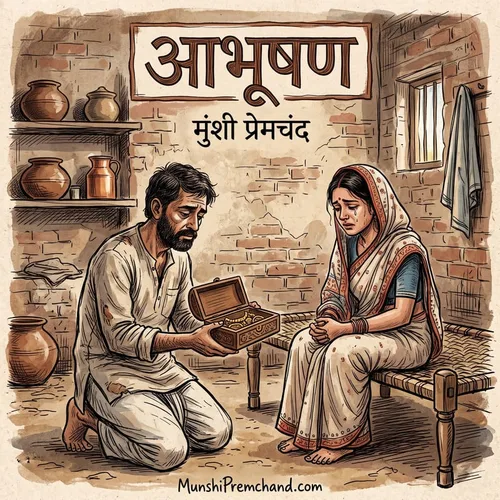
Complete English Translation: Aabhushan
It is not our intention to condemn ornaments. We can endure the persecutions of political non-cooperation, but we cannot face the cruel and fatal verbal arrows of women. Even so, this much we must say: if the immense sacrifices made to satisfy this craving were directed toward worthy ends, a person could attain the highest stature in life.
Although we have never seen an unattractive woman become beautiful merely through the embellishment of jewels, we concede that ornaments are as necessary to beauty as a lamp is to a house. Yet we hardly realize how sullied we make the body, how agitated the mind, and how tainted the soul merely for the sake of outward physical adornment. In the glaring light of this lamp, one's eyes grow dim. The mere thought of how much jealousy, malice, rivalry, anxiety, and false hope this glitter breeds is enough to make one's hair stand on end. It would be far more fitting to call them dooshan—blemishes—rather than bhooshan—adornments. Otherwise, how could it ever happen that a newly wedded bride, on the third day of entering her husband's home, would turn to him and say: "By tying me to your hem, my father has merely cast me into a well!"
Sheetala had gone that day to see the newly wedded bride of Kunwar Suresh Singh, the wealthy landlord (taluqdar) of her village. Standing before the bride, she became spellbound—not by the young woman's natural charm or beauty, but by the dazzling brilliance of her jewels, upon which her eyes remained fixed. From the moment she returned home, a venomous serpent of envy gnawed at her breast. At last, the moment her husband walked in, she burst into a fury, and the pent-up anguish of her heart spilled forth in the bitter words recorded above.
Sheetala's husband was named Vimal Singh. His ancestors had once been powerful landlords of the region; in fact, the entire village had once belonged entirely to them. But now the fortunes of the household had fallen into ruin. Suresh Singh's father had been an expert in estate affairs, and by hook or by crook, all of Vimal Singh's ancestral land had passed into his hands. Vimal did not even possess a pony to ride upon, and managed to secure two meals a day only with the greatest difficulty. On the other hand, Suresh owned elephants, motorcars, and several fine horses, and ten or twelve attendants were always lounging at his doorway.
Yet despite such disparity in wealth, the two families had maintained their traditional brotherhood. On occasions of weddings, births, and family ceremonies, visits and invitations were regularly exchanged. Suresh was a lover of learning. After completing his higher education in India, he had traveled to Europe, and contrary to everyone's apprehensions, he had returned as a devout disciple of traditional Aryan culture. The materialism, artificial hedonism, and inhumane, arrogant blindness of Western society had opened his eyes. Previously, despite the strong urging of his elders, he had refused to marry without becoming acquainted with the girl first, maintaining that love was impossible without prior courtship. But after returning from Europe, a profound transformation took place in his views on matrimony. He married the very girl who had earlier been proposed for him, without knowing anything of her character or habits. He now regarded marriage not as a contract of romantic passion, but as a sacred bond of duty (dharma).
It was to see this fortunate new bride that Sheetala had accompanied her mother-in-law to Suresh's mansion that morning. And it was the splendor of her jewelry that had pierced Sheetala to the quick.
Deeply hurt, Vimal said, "Then you should have asked your parents to marry you to Suresh. He could have loaded you with gold from head to foot."
"Why do you insult me?" Sheetala snapped.
"I am not insulting you; I am stating the truth," Vimal answered. "They threw away a beauty like you on a beggar like me for nothing."
"You feel no shame at your poverty, and on top of that, you dare fling taunts at me!"
"My destiny is not in my hands," said Vimal quietly. "Nor am I educated enough to earn big money in a high-ranking post."
"Why don't you simply admit that you feel no love for me?" Sheetala retorted. "If there were true love, gold would rain down from the skies!"
"Do you love jewelry so much?"
"Everyone does," she replied. "And so do I."
"Do you consider yourself unfortunate?"
"I certainly am! What else should I call it? Otherwise, would I have to burn with envy looking at another woman's fortune?"
"If I have ornaments made for you, will you consider yourself fortunate?"
"You ask as if the goldsmith is already sitting at our doorstep!" she scoffed bitterly.
"No, I speak in earnest," Vimal said. "I will have them made for you. But you will have to be patient for some time."
When men of power and resources are wounded by sharp words, they take the lives of others; but a powerless man wagers his own life. Vimal Singh resolved to leave his home. He swore to himself: Either I shall load her with ornaments, or I shall load her with the sorrow of widowhood. She shall either wear jewels, or she shall yearn even for vermilion.
He lay awake the entire day, drowned in brooding sorrow. He had sought to satisfy Sheetala with genuine love; today he had realized that a woman's heart is not bound by the cords of affection, but only by the chains of gold.
When a quarter of the night had passed, he rose and walked out of the house, without looking back even once. A detachment born of knowledge may still retain traces of worldly attachment, but a detachment born of despair is unshakeable. In the light, one's mind may waver upon seeing the objects around him; but in total darkness, who has the courage to deviate even a barley-corn from the straight path?
Vimal possessed neither higher learning nor technical skill. His only capital was his capacity for relentless toil and severe self-denial. He traveled first to Calcutta, where for some time he worked as an orderly running errands for a wealthy merchant (seth). There, learning that dock wages were high in Rangoon, he sailed for Burma and began working as a laborer loading and unloading cargo ships at the port.
Between the crushing physical labor, irregularities in food and drink, and the unwholesome climate, he soon fell ill. His body grew emaciated and the glow faded from his face, yet there was not a single laborer on the docks who worked harder than he did. Others were mere laborers; this man was an ascetic. To fulfill the vow he had taken had become the sole purpose of his life.
He sent no news to his home. He reasoned within his heart: Who is there in that house that cares for me? Who cares for me in the face of gold? His simple mind was incapable of comprehending the mystery that marital love can exist alongside a vain longing for ornaments.
The other laborers would feast on seers of sweets every morning for breakfast. Throughout the day, every few minutes, they took deep drags of cannabis, charas, and tobacco. Whenever they found leisure, they strolled through the bazaars, and many were addicted to liquor. Because they earned rupees instead of mere paisas, they squandered rupees just as freely. There was hardly a whole piece of cloth on their bodies. But Vimal was among those few laborers who lived with austere discipline, whose aim in life was something higher than merely eating, drinking, and dying.
Before long, he managed to accumulate a small fortune. Along with his money, his authority and respect among the other laborers grew. Almost everyone knew that Vimal was an upper-caste Thakur by birth, and they all addressed him respectfully as Thakur-ji. Self-restraint and upright conduct are the true mantras for commanding respect; in time, Vimal became both the leader and the creditor of the dockworkers.
Three years had passed since Vimal began working in Rangoon. One evening, as dusk was falling, he sat talking with several laborers by the seashore.
One laborer observed: "All the women here are utterly heartless. Look at poor Jhingur—he lived with that Burmese woman for ten years. No man could have loved even his lawfully wedded wife as deeply as he loved her! He trusted her so blindly that whatever he earned, he placed straight into her hands. They had three children together. Just yesterday, the two of them ate and lay down together in complete harmony—not a harsh word, not a quarrel. In the dead of night, the woman slipped away, God knows where, abandoning all the children! Poor Jhingur is sitting there weeping his eyes out. The hardest part is the youngest baby; he is barely six months old. God alone knows how the poor infant will survive!"
Vimal Singh asked in a solemn tone, "Did he have ornaments made for her or not?"
"The money was always in her own hands!" the laborer replied. "Who was there to stop her from having jewelry made?"
Another worker added, "Why, she was laden with jewels! Whenever she walked past, the chiming of her ornaments would ring in your ears!"
Vimal said, "When she proved so heartless despite being loaded with jewels, one must conclude that the whole race of women is unfaithful."
Just then, a man approached and said to Vimal Singh, "Chaudhary, I ran into a policeman just now. He was asking for your name, your village, and your father's name. It seems some Babu Suresh Singh has put him up to it."
Vimal grew suspicious and asked, "Yes, that is true. He is the landlord of my village and my clan-brother."
The man said, "He has had a notice printed at the police station announcing that whoever discovers the whereabouts of Vimal Singh will receive a reward of one thousand rupees!"
"And did you tell the policeman the exact truth?" Vimal inquired.
"Chaudhary, do you take me for an illiterate fool? I knew immediately that something was fishy; otherwise, why would anyone spend so much money? I told him, 'His name is not Vimal Singh, but Jasoda Pande; his father's name is Sukkhu, and his native district is Jhansi.' When the policeman asked how long he had lived here, I replied, 'About ten years.' Hearing that, he thought for a moment and went away. Tell me, Chaudhary, do you have some old enmity with this Suresh Babu?"
"There was no enmity," Vimal answered thoughtfully, "but who knows if his intentions have turned foul? Perhaps he wants to frame me for some crime and seize my remaining ancestral land. You did very well to give the policeman a false scent."
The man continued, "He was urging me, 'Tell me his exact whereabouts and I will get you fifty rupees too!' I thought to myself: You will pocket a bundle of a thousand rupees, and you offer me fifty? I told him off flatly!"
Another laborer chimed in with a laugh: "If he had offered you two hundred rupees, you would have sung out his full name and address immediately, wouldn't you? What a greedy fellow!"
The man said, blushing with embarrassment, "Not for two hundred, nor even for two thousand would I have spoken! Don't take me for a traitor. Put me to the test whenever you please!"
While the laborers continued their banter, Vimal retired to his small room and lay down. He began to worry: What should I do now? When the intentions of an honorable gentleman like Suresh have turned wicked, whom can I trust? No, I cannot afford to stay away from home any longer. If I delay any more, I shall lose everything. Had I stayed two more years, I would have saved a full five thousand rupees, and Sheetala's wish would have been satisfied. As it is, I have barely three thousand rupees in all; her longing will not be completely fulfilled. Never mind, let me go now; I can return after six months. At least my property will be saved. But why should I stay for six months? Travel each way will take a month; I shall not stay at home for more than fifteen days. Who cares for me there, whether I come or go, whether I live or die? All she loves is gold!
Having made up his mind, he boarded a ship and departed from Rangoon the following morning.
The world proclaims that outward beauty is nothing compared to inner virtue. The teachers of our moral scriptures say the same. But how utterly illusory this doctrine proves in real life!
Kunwar Suresh Singh's new bride, Mangala Kumari, was skilled in domestic affairs, ready to sacrifice her life at a single sign from her husband, deeply reflective, sweet-spoken, and God-fearing. Yet because she lacked physical beauty, she pricked her husband's eyes like a thorn. Suresh would lose his temper with her over the most trivial things, only to be overcome by remorse an hour later and beg for her forgiveness; yet the very next day, the same ugly scene would repeat itself.
The misfortune was that Suresh's character was not corrupt like that of other aristocrats. It was within married life that he sought joy, happiness, peace, trust, and the fulfillment of all earthly and spiritual goals. Being deprived of domestic happiness, his entire life appeared dry, tasteless, and blighted.
The result was that Mangala lost all confidence in herself. She grew fearful of taking any initiative, dreading that her husband would be displeased. To keep him pleased, she began concealing her mistakes, making excuses, and telling little lies. She tried to shield herself by casting blame on the servants. To win her husband's favor, she compromised her own virtues and degraded her own soul; but instead of rising in his esteem, she sank lower with every passing day. She dressed herself in new finery and ornaments every morning, yet slipped further away from her goal. For a single tender smile from her husband, for a single sweet word from his lips, her parched heart yearned and cried out in vain.
An uncomely woman is not a beggar who can be satisfied with a handful of flour. She too desires the complete, undivided love of her husband—perhaps even more ardently than a beauty does, because she performs extraordinary penances and efforts to obtain it. When Mangala failed in these efforts, her agony grew all the more unbearable.
Gradually, her reverence for her husband began to dissolve. She reasoned: Toward a man so cruel, heartless, and devoid of imagination, I too shall behave in kind. A man who is merely a worshipper of physical appearance is unworthy of love and devotion. This retaliation made the estrangement even more intractable.
Yet Mangala did not weep merely for her own plainness. Sheetala's peerless loveliness was also a fatal obstacle to her desires; indeed, it was the frost that blighted all the creepers of her hope. Mangala may not have been beautiful, but she adored her husband with all her being. One cannot easily turn away from someone who truly loves them; the power of love is boundless. But the radiant image of Sheetala stood guard at the gateway of Suresh's heart, barring Mangala from entering, no matter what guise she assumed. Suresh tried desperately to banish that image, wishing to cast it out by force; but the dominion of beauty is no less irresistible than the dominion of wealth.
On the very day Sheetala had visited his mansion to view the new bride, Suresh's eyes had caught a fleeting glimpse of her breathtaking form. That single glimpse had been like an instantaneous conquest, subduing the entire realm of his heart in a single assault and establishing absolute sovereignty over it.
Sitting in solitude, Suresh would mentally compare Sheetala's portrait with Mangala, trying to understand what the difference between them was—why one drew his soul irresistibly while the other repelled it. Yet this attraction in his mind was purely the aesthetic appreciation of a poet or a painter. It was pure and free from base lust; her image was merely an object of artistic delight. He would reason with himself and resolve firmly: Henceforth I shall keep Mangala happy. If she is not beautiful, what fault is it of hers? Yet the moment he came face to face with Mangala, all his noble resolutions vanished into thin air.
He watched the changing emotions of Mangala's heart with sharp perception, yet like a paralyzed man watching a jar of clarified butter (ghee) roll off a ledge, he was powerless to stop the disaster. He did not possess the courage even to contemplate what the outcome would be. But when at last Mangala began criticizing him sharply over every little matter and treating him with defiance, whatever little goodwill he had felt toward her dissolved, and he stopped entering the inner quarters of the house altogether.
One evening, the heat was suffocating. The waving of hand-fans seemed only to fan the furnace of the air. No one dared step out into the gardens for a stroll. All vitality had drained from the body like sweat; wherever a person lay, he remained stretched out like a corpse. Voices had turned harsh and rasping, like the skin of a drum scorched over embers. Even in casual conversation, tempers flared instantly, like dry woodland trees catching fire from slight friction.
Suresh Singh would take four paces, then sit down panting. He snapped at the servants for not sprinkling cold water on the courtyards quickly enough. Suddenly, from inside the women's quarters, the sound of singing reached his ears. He started, and then a wave of fury swept over him. The sweet singing grated on his ears like noise. What ill-timed music is this! he thought. Here a man is suffocating from the heat, and they have taken it into their heads to sing! Mangala must have invited them, who else? People falsely claim that women live on love. Their lives are sustained by the same trivial pleasures—food, sleep, idle gossip, and merrymaking—that govern all creatures. I have been listening to this for an hour! Will this infernal singing ever stop? They are just screaming at the top of their lungs for nothing!
Unable to bear it any longer, he strode into the inner courtyard and roared: "What is this screeching and caterwauling you have started? Is this an hour for singing and music? It has become impossible even to sit outside!"
A dead silence fell over the room, like a classroom of noisy children when the master suddenly enters. Every woman lowered her head and drew her veil tight.
Mangala immediately rose, walked into the adjoining room, called her husband inside, and said softly, "Why are you making such a scene?"
"I don't wish to hear singing at this hour," Suresh snapped.
"Who asked you to listen? Do you hold proprietary rights over my ears as well?"
"All this senseless clamor..."
"What business is it of yours?"
"I will not permit this uproar in my house!"
"Then is my house somewhere else?"
Suresh did not answer this directly. "Tell all these women to come some other time," he ordered.
"Simply because their presence displeases you?" Mangala challenged.
"Yes, exactly because of that!"
"Do you always act according to what pleases me? Your friends visit you and their laughter and jests echo inside the house. Do I ever tell you to turn them out? Why do you interfere in my affairs?"
Suresh replied heatedly, "Because I am the master of this house!"
"You are the master outside," Mangala retorted with stinging dignity. "Here, inside, the authority belongs to me."
"Why do you persist in this useless chatter? What do you gain by exasperating me?"
Mangala stood silent for a few moments, weighing her husband's innermost feelings. Then she said quietly: "Very well. If I have no authority in this house, I shall not stay here. Until today I was living under an illusion; today you have shattered it. I never had any real claim upon this house. A woman who holds no place in her husband's heart can have no right to his worldly property."
Ashamed of his harshness, Suresh muttered, "Why do you blow things out of proportion? That was not what I meant at all. You have completely misunderstood me."
Mangala replied, "What lies in a man's heart slips from his lips unawares. It is only when we are on our guard that we hide our true feelings!"
Suresh felt remorse for his ungentlemanly outburst, but fearing that the more he attempted to placate her, the more stinging reproaches she would utter, he turned on his heel and walked out into the outer courtyard.
In the early morning, a cool breeze was stirring. Suresh lay half-asleep, dreaming that Mangala was walking away in the distance. He started awake. Looking toward the gateway, he saw Mangala actually standing there, dressed for a journey. The maidservants were wiping their eyes with the corners of their saris. Several male attendants stood nearby with downcast faces and tearful eyes, as though the mistress of the house was departing forever.
Suresh understood that yesterday's words had cut Mangala to the quick. Yet he did not rise to question her, to coax her, or to reason with her. She is deliberately humiliating me, he thought with wounded pride. She is lowering my head before my servants. Let her go wherever she pleases! It is no concern of mine. To walk away like this without a word of explanation means that I am nothing to her. Who am I, then, to stop her?
He lay there like a stone, and Mangala walked away without looking back at him even once.
Mangala walked on foot along the village road. For the wife of a great landlord to travel on foot was no ordinary spectacle. No one dared say a word to her. Men stepped aside and stood at the edges of the path out of respect. Women gathered at their doorways, watching with pity and curiosity, their eyes saying silently: Alas, what a heartless man! Could he not even arrange a covered litter (doli) for her to sit in?
Leaving her village behind, she reached the neighboring village where Sheetala lived. Hearing of her arrival, Sheetala hurried to the doorway and called out: "Sister, come in and rest for a while!"
Mangala stepped inside and saw that the house was dilapidated and collapsing in several places. On a string cot in the veranda lay an old, ailing woman. Everywhere were the unmistakable signs of acute poverty.
Sheetala asked gently, "What has happened?"
"Only what was written in my destiny," Mangala replied.
"Did the Kunwar Sahib say something harsh to you?"
"Even when the lips utter nothing, the heart's intent cannot remain hidden."
"Good heavens! Has it really come to this?"
The ultimate stage of sorrow knows no hesitation. Mangala said: "Had I wished, I could have continued lying there; my life would have passed somehow in that mansion. But where there is no love, no respect, no honor, I can live no longer."
"Where is your father's home?"
"With what face could I return to my father's house?"
"Then where will you go?"
"To the court of God!" Mangala answered with tears welling in her eyes. "I shall ask Him: Why did you deny me beauty? Why did you make me plain? Sister, there is no greater misfortune for a woman than to be born uncomely. Perhaps it is only the witches and demons of a previous birth who are reborn as ugly women! Beauty commands love, and in this world, nothing is rarer or more precious than love."
With these words, Mangala rose to leave. Sheetala did not try to detain her. She thought: What could I offer her to eat? Today there is little hope even of lighting our own hearth.
After Mangala departed, Sheetala sat in silence for a long time, brooding bitterly: What a wretched woman I am! The very love for which this poor soul is renouncing her life is the love that I kicked away with my own feet! What did she lack in ornaments? Did all those gem-studded jewels bring her happiness? She has trampled them underfoot and walked away! And for the sake of those very ornaments, I threw away my all! Alas, who knows where Vimal is today, or in what state he lives!
She had cursed her own vain cravings a thousand times before; but witnessing Mangala's tragic plight today, she felt a profound revulsion toward ornaments.
Two years had passed since Vimal had abandoned his home. Sheetala was now plagued by all kinds of dark forebodings regarding his fate. Day and night, the fire of remorse and grief smoldered in her breast.
In rural villages, the small estates of minor landlords can be managed only through constant vigilance, strict authority, and forceful handling. Vimal's cultivation had depended largely on customary labor. After his departure, all his fields lay fallow. No tenant could be found to till them. No one would take them even on sharecropping, fearing that if Vimal Singh should suddenly return, he would disown the agreement. The tenants refused to pay their rents.
Sheetala managed to run the household for some time by borrowing money from the village moneylender. By the second year, the situation worsened; the moneylender refused to advance any more cash, and Sheetala's few modest personal ornaments were pawned or sold to survive. By the close of the second year, every scrap of savings had vanished. Famine entered the home. There were four mouths to feed: the old mother-in-law, a young brother-in-law, an unmarried sister-in-law, and Sheetala herself. Distant relatives were also constantly arriving as guests.
To crown this misfortune, a violent criminal lawsuit erupted in Sheetala's father's village. Her father and elder brother were imprisoned in the dispute, and her mother, two younger brothers, and an unmarried sister arrived to seek refuge in her home! The cart of the household, which had already been creaking heavily, now sank completely into the mud.
From early morning, bitter domestic strife would break out. The two mothers-in-law would clash, and brothers-in-law would squabble. On some days, there was no grain to cook; on other days, even when food was cooked, the storm of curses and recriminations was so violent that no one could eat. The children wandered into other people's fields to chew sugarcane and steal raw peas. The old mother-in-law visited neighboring houses, weeping her tale of woe and flattering strangers for sympathy.
In the absence of the male master, the wife's natal relatives tend to dominate the household, and in this war of words, the victory almost always lay with Sheetala's mother. Whenever grain was somehow procured, the question arose: who would grind it on the stone mill? Sheetala's mother would say haughtily, "Have I come here for a few days merely to grind flour on your mill?" The mother-in-law would retort, "When it is time to eat, you pounce like a cat, but when it is time to grind, your life leaves your body!" Compelled by necessity, Sheetala had to grind the heavy millstone alone.
At mealtime, such a tempest would erupt that the entire neighborhood was scandalized. Sheetala would fall at her mother's feet, then clasp her mother-in-law's knees, but both would push her away with sharp rebukes. Her mother would cry, "You brought us here only to humiliate us!" Her mother-in-law would sneer, "You brought a rival wife to sit upon my chest, and now you dare preach to me!"
In this raging warfare, Sheetala forgot the sorrow of her separation from her husband. All her ominous forebodings were consumed in the domestic fire. Her only consuming thought now was how to deliver herself from this living hell. Neither her mother nor her mother-in-law had any refuge left on earth except the God of Death, yet Yama seemed in no hurry to welcome either of them. Sheetala would devise a hundred schemes, but like a traveler who has walked all day only to find himself standing at his own doorway, her mind was paralyzed with exhaustion. She looked in all directions for a ray of hope, but found no anchor anywhere.
One day, standing at her doorway in this state of helpless despair—for in times of affliction, anxiety, and longing, one develops an attachment to the doorway—she suddenly saw Babu Suresh Singh riding past on horseback. His eyes turned toward her, and their gazes met. Sheetala shrank back in confusion and quickly closed the wooden doors.
The Kunwar rode on, but Sheetala felt a pang of embarrassment that he had seen her in such a state. Her sari was torn and covered in rough patches. What must he have thought of me in his heart? she wondered.
The Kunwar had already heard rumors from the villagers regarding the desperate hardships facing Vimal Singh's family, and he had wished to help them secretly. But at the sight of Sheetala, an overwhelming sense of bashfulness seized him, so that he could not pause at her doorway even for a moment. Today was the first time he had ventured out of his house in the three months since Mangala's departure. For sheer shame, he had ceased sitting in his public drawing-room.
There is no doubt that within his heart, Suresh secretly savored the memory of Sheetala's beauty. After Mangala's departure, a strange, sinful temptation had awakened within his soul: Could this beautiful woman ever become mine by some means? Vimal has been missing for a long time; it is quite possible he is no longer alive in this world.
Yet he had continually suppressed this evil fantasy through conscience and reason. Even upon hearing of Sheetala's misery, he had hesitated to offer assistance, fearing: Who knows if lust has assumed this disguise merely to strike a fatal blow against my wisdom and virtue?
In the end, however, the deceitful lure of desire outwitted him. He went to Sheetala's house under the pretext of inquiring after their welfare. He reasoned with himself: How unjust it would be if a helpless woman in our clan were starving and I did not even ask after her! But when he returned from that visit, the ropes of his reason and intellect were snapped, and his small boat was tossing helplessly upon the vast ocean of infatuation. Ah, what a breathtaking form! What peerless beauty!
In an instant, he began raving to himself like a madman: I surrender this soul and this body at your feet! Let the world laugh if it will! If it is a mortal sin, let it be! I cannot deprive myself of this heavenly bliss. She cannot escape me! I shall tear this heart from my chest and lay it before her feet! Vimal is dead. If he is not dead, he will die now! What is sin? I know nothing of it. How tender is the lotus, how blooming, how enchanting! Are her lips not meant...
Suddenly he stopped in his tracks, as though recalling something he had completely forgotten. Within human nature, beneath the conscious intellect, resides a deeper, intuitive wisdom. Just as an unexpected reinforcement arriving from a hidden reserve rallies soldiers who have lost heart on the battlefield, so this hidden wisdom alerted Suresh. He recovered himself. His eyes filled with tears of shame. For several minutes he stood motionless, brooding in anguish like a convicted criminal. Then, in a burst of triumphant moral resolve, he declared aloud:
"How simple it is! I shall slay this elephant of lust not with a lion, but with an ant! The moment I address Sheetala as my sister, all this vile passion will be pacified forever! Sheetala! Sister! I am your brother!"
At that very moment, he penned a letter to Sheetala:
"Sister, you have suffered such terrible hardships, yet you did not even inform me! I am not a stranger to you. I feel deep sorrow over this. Whatever has happened has happened; now, by God's grace, you shall not suffer any longer."
Along with this letter, he sent cartloads of grain and a generous sum of money.
Sheetala sent back a reply:
"Brother, forgive me. As long as I live, I shall sing your praises. You have brought my sinking boat safely to the shore."
Several months rolled by. One evening, Sheetala was feeding grain to her pet maina, a bird that Suresh had brought for her all the way from Nepal. Suresh arrived and sat down on a stool in the courtyard.
Sheetala asked, "Where have you been, brother?"
"I had gone to the police station," Suresh replied. "Still no trace of Vimal. Some time ago there was a clue from Rangoon, but later it turned out to be someone else. What should I do? Shall I increase the reward?"
Sheetala smiled faintly and said, "You seem to have money to burn! If it is his wish to return, he will come on his own."
Suresh looked at her and asked, "May I ask you one thing, if you will tell me honestly? Over what matter did he become angry with you?"
"It was nothing at all," Sheetala replied, looking down in embarrassment. "I merely asked him to have some ornaments made for me. He answered, 'What do I have?' I said—out of foolishness—'Then why did you marry me?' One word led to another, and an argument flared up."
Just then, Sheetala's mother-in-law entered the courtyard. Suresh had already arranged to send Sheetala's mother and brothers safely back to their own village, so peace had returned to the house. The mother-in-law had overheard her daughter-in-law's words. In a sharp, grating tone, she said:
"Son, why should anything be hidden from you? This queen of ours looks like a rose only from the outside; within, she is all thorns! In her craze for self-adornment, she never cared for Vimal at all. The poor boy would have given his life for her, but she never even gave him a civil word. Love never touched her heart. In the end, she drove him out of his own homeland before she would rest!"
Sheetala retorted in anger, "Is he the only man who has ever left home to earn a living? Traveling far and wide to earn wealth is a man's duty!"
Suresh remarked with a wry smile, "In Europe, of course, there is no relationship between man and woman other than the enjoyment of material wealth. If our sister had been born in Europe, she would have been sparkling with diamonds and rubies today! Sheetala, the next time you pray, ask God: If You grant me beauty, grant me birth in Europe!"
Hurt by his jest, Sheetala said, "Those whose destiny is blessed are loaded with gold right here in this land. It is not everyone whose fate is ruined like mine!"
Suresh noticed that the glow on Sheetala's face had dimmed with sorrow. Even in the midst of separation from her husband, she remains so desperately hungry for ornaments! he thought with quiet disdain. He said aloud: "Very well, I shall have ornaments made for you."
The sentence was spoken in a tone laced with slight mockery and pity, yet Sheetala's eyes filled with tears of pure joy, and her voice choked with gratitude. Before her mind's eye arose the dazzling vision of Mangala's gem-encrusted jewels. She looked at Suresh with a gaze overflowing with thankfulness. Her lips uttered not a single word, but every limb of her body seemed to proclaim: I am yours!
The cuckoo perched upon mango boughs, the fish sporting in cool, crystalline waters, and the young fawn leaping across emerald meadows never knew such ecstatic delight as Sheetala felt upon wearing Mangala's jewelry!
Her feet hardly touched the earth. All day long she stood before the mirror, combing her hair, parting her locks, and applying kohl to her eyes. The dark mist of her misery had parted, giving way to bright, unclouded moonlight. She would not lift a straw of household work. A strange, arrogant vanity infused her nature.
Yet what is self-adornment? It is the trumpet-call that awakens sleeping desire; it is the spell of sensual incitement. When Sheetala sat adorned from head to toe, an overwhelming urge seized her to be seen and admired. She would walk to the outer doorway and stand there. The compliments of village women brought her no satisfaction, and she regarded the village men as boorish rustics devoid of aesthetic refinement. Therefore, she constantly sent for Suresh Singh. Previously, he would visit once a day; now, despite Sheetala's repeated entreaties and messages, he avoided coming.
A quarter of the night had passed. The lamps in the village cottages had all been extinguished, but in Sheetala's room, a lamp was burning brightly. She had obtained jasmine flowers from the Kunwar's private garden and sat weaving a fragrant garland—not for herself, but for Suresh. Except for her affection, what else did she possess to repay his overwhelming debt?
Suddenly, the barking of dogs broke the nocturnal silence, and within moments, a man stepped inside the house.
In one hand he carried a heavy tin trunk, in the other a cloth bundle. His body was emaciated, his clothes soiled and ragged, his beard overgrown, and his countenance pale and hollow, like a convict who had just been released from prison. Seeing the light of the lamp, he walked toward Sheetala's room.
Inside its cage, the pet maina fluttered its wings in alarm. Sheetala started and looked up. "Who is it?" she cried out in fear. Then she recognized him. Instantly, she threw a cloth over the woven garland of flowers. She rose to her feet and, lowering her head, asked in a cool tone: "So you have remembered us so soon?"
Vimal gave no answer. In utter bewilderment, his gaze shifted from Sheetala to the room, as though he had stepped into an entirely different world. This was not the half-opened blossom whose petals had shriveled for want of favorable nourishment; this was a flower in full, glorious bloom—glistening with morning dew and swaying gracefully in the breeze. Vimal had been enchanted by her beauty before, but this radiance was a blazing fire that seared his heart and scorched his eyes.
Those gold ornaments! Those rich silk clothes! That luxurious adornment!
His head began to spin. He sank down onto the bare floor. Sitting before this radiant sunflower, he felt ashamed of his own ragged misery.
Sheetala still stood frozen like a statue. She did not rush to fetch him a vessel of water; she did not wash her husband's feet; she did not even wave a hand-fan to cool him. Her mind was utterly paralyzed. What a lovely garden of romantic dreams she had cultivated in her imagination! Now a killing frost had fallen upon it. In truth, looking upon this soiled, half-naked man, she felt an instinctive revulsion. This was not the proud, handsome zamindar Vimal of old; he had become a common laborer. Hard, menial toil never fails to leave its coarse stamp upon a man's face and form, and a laborer remains a laborer even if dressed in fine clothes.
Suddenly, Vimal's mother was awakened by the voices. Entering Sheetala's room, the sight of Vimal overwhelmed her with maternal affection, and she clasped him to her breast. Vimal laid his head upon her feet. Hot tears streamed from his eyes. The mother was trembling with emotion, unable to utter a single word.
After a moment, Vimal murmured in a choked voice, "Amma!"
The tone of his voice revealed the agonizing question of his soul.
Understanding his unspoken anguish, the mother said quickly: "No, my son, it is not what you think."
"Then what is this I see before my eyes?" Vimal gasped.
"When her nature is like this, what can anyone do?"
"Why did Suresh advertise a reward for my description?"
"Only to search for you, my son," she replied. "Had he not shown us mercy, you would not have found a single soul alive in this house today."
"It would have been far better if I hadn't!" Vimal cried out in despair.
Sheetala interjected with a stinging taunt: "For your part, you had already left us all to die! You didn't leave a bed of flowers behind you when you ran away!"
"And now I see a bed of flowers spread out before me!" Vimal retorted bitterly.
"Are you the master of everyone's destiny?" she snapped.
Vimal Singh rose to his feet, trembling with rage. "Amma, take me away from here!" he cried. "I cannot bear to look upon the face of this demoness! Blood rushes to my eyes! To satisfy this unchaste woman, I performed three years of penance so severe that it would have earned me the vision of God Himself, yet I could not win her heart!"
Saying this, he strode out of the room and collapsed upon a cot in his mother's quarters. His mother immediately brought water, washed his face, hands, and feet, and lit the hearth to fry puris for him, recounting all the misfortunes the family had endured in his absence.
The fire of enmity that had flared in Vimal's heart toward Suresh subsided, but the burning anguish of his soul took the form of a raging fever. His body was gripped by a burning temperature. The physical exhaustion and hardship of the long journey from Burma had weakened him; followed immediately by this devastating mental shock, the affliction proved fatal.
All through the night he lay delirious. His mother sat beside him, fanning him and weeping. Throughout the following day, he remained unconscious. Sheetala did not come near him even for a single moment. What golden morsels has he fed me that I should endure his temper? she rationalized to herself. To me, whether the husband is at home or abroad is all the same. I don't care a broken cowrie for anyone! He left in such an arrogant fury—and what great treasure has he brought back?
Toward evening, news of Vimal's condition reached Suresh Singh. He came running to the house at once—stepping across that threshold today for the first time in two months.
Vimal opened his heavy eyes and recognized him. Tears rolled down his sunken cheeks. On Suresh's countenance shone the light of genuine compassion. Vimal cursed himself in his heart for the unjust suspicions he had harbored against his noble brother.
The moment Sheetala heard that Kunwar Suresh Singh had arrived, she hurried to the mirror. Loosening her hair to look like an image of grief and distress, she entered Vimal's room.
Vimal, who had been lying with closed eyes in a state of stupor, suddenly opened them the instant Sheetala walked in. Looking at her with fiery, burning eyes, he said in a raspy whisper:
"You have come now? Come back on the third day from today! You will meet the Kunwar Sahib again on that day!"
Sheetala turned on her heel and fled from the room.
Suresh felt as though a bucket of icy water had been emptied over him. He thought with a shudder: What breathtaking beauty, yet how deadly is its poison! In place of a human heart, there is only an unquenchable lust for adornment!
The terror of death deepened. Suresh summoned skilled doctors, but the God of Death listened to no one. His heart is stone; it never softens. Though a man might tear out his heart and offer it, though a river of tears be shed, Death shows no mercy. To desolate thriving homes, to wither lush, green fields is his eternal task. And how playfully cruel is his sport! He assumes ever-changing disguises: now a flash of lightning, now a garland of flowers; now a lion, now a jackal; now fire, now water!
In the last watch of the third night, Vimal's mental agony and the fever of his heart reached their end. A thief never commits burglary by daylight; the messengers of Yama come stealthily in the dark, evading all watchful eyes, and steal away the priceless jewel of life. The stars in the sky appeared withered; the trees stood motionless, bowing their heads in mourning. Night is the outward embodiment of sorrow; night is the playground of death.
At that very hour, a piercing wail arose from Vimal's cottage—that agonizing cry which the God of Death waits eagerly to hear.
Sheetala started awake in terror and rushed toward the deathbed. She looked upon the corpse and stepped back a pace in horror. It seemed to her that Vimal Singh was staring at her with piercing, accusing eyes. In the extinguished lamp, she saw a dreadful, supernatural flame. Paralyzed by fear, she could not remain there a moment longer.
As she rushed out through the doorway, she collided with Suresh Singh, who had just hurried over. In a trembling, pleading voice, she cried: "I am terrified here!"
She sought to cast herself weeping at his feet, but Suresh recoiled and stepped aside, shuddering in revulsion.
When a traveler wandering along a road suddenly discovers that he has lost his way, he turns back toward the right path with frantic speed, berating himself for his heedlessness. Suresh now felt the same desperate urgency to return to the path of peace.
The memories of Mangala's loving, selfless service flooded his soul. A true reverence for real, inner beauty was born in his heart. How much love, how much sacrifice, how much forgiveness she had possessed! Remembering her matchless devotion, his heart would writhe in agony: Alas, what an atrocious tyrant I have been! I failed to appreciate such a spotless jewel. I lay there like a mindless stone, and before my very eyes, Lakshmi walked out of my house!
He had heard the words Mangala had spoken to Sheetala on the day of her departure, but he could not bring himself to believe them. Mangala was of a gentle, noble nature; she could never commit suicide. She possessed forgiveness; she could not harbor such bitter hatred. His conscience told him that she was alive and safe somewhere.
He wrote several letters to her father's home, but received only sarcastic taunts and bitter recriminations in reply. At last, he wrote:
"I am setting out myself in search of that priceless jewel. Either I shall bring her back with honor, or I shall blacken my face and drown myself in the river."
To this letter, a reply arrived:
"Very well, you may go; but please pass through our village on your way. Someone from here will accompany you."
In these brief words, Suresh glimpsed a ray of hope. That very day, he set out for his in-laws' village, taking no attendants with him.
At his father-in-law's house, no one offered him a warm welcome; their faces were stern and cold. His father-in-law delivered a long, stern sermon on the sacred duties of a husband.
At night, after he had eaten and lay down to rest, his younger sister-in-law, Prabha, came in, sat beside his bed, and said with a mischievous smile: "Brother-in-law, if a beautiful woman abandons her plain-looking husband and insults him, what would you call her?"
Suresh answered in a grave tone, "A wicked, cruel woman!"
"And what would you call a man who abandons his plain-looking wife?"
"A beast!"
"And if that man happens to be an educated scholar?"
"A demon!"
Prabha laughed and said, "Then I am running away! I feel terrified of you."
Suresh said, "Even the penance of demons is accepted by God, is it not?"
"On the condition that the repentance is sincere," she replied.
"That only the Knower of All Hearts can judge."
"If it is sincere, it will certainly bear fruit," Prabha said gently. "Only remember: when you return with Didi, you must pass through here."
Suresh's boat of hope wavered once more. He pleaded, "Prabha, for God's sake, have mercy on me! I am in deep misery. In this past year, not a single night has passed when I did not cry myself to sleep."
Prabha rose and said, "What remedy is there for one's own deeds? I am leaving; please rest."
A moment later, Mangala's mother entered the room, sat down, and said: "Son, you are deeply learned and have traveled across foreign lands. Did you never find a medicine in all your travels that could make a plain woman beautiful?"
Suresh said with folded hands, "Mother, for God's sake, do not shame me any further."
"You nearly took my precious daughter's life!" the mother scolded. "Should I not even shame you? My heart was set on giving you such a dressing-down that you would remember it all your life! But you are a guest in our home; why should I torment you? Go to sleep."
Suresh tossed and turned on the bed in a torment of hope and fear, when suddenly, outside the door, someone whispered: "Why don't you go in? He is awake."
Another voice answered softly: "I feel too shy."
Suresh recognized the voice instantly. The parched traveler had found water at last!
In a moment, Mangala stepped before him and stood with her head bowed. Suresh saw a strange, ethereal radiance upon her face, like a patient who has completely recovered health and vitality.
The form was the same, but the eyes that looked upon him were entirely new.
Summary of Aabhushan
Premchand's short story Aabhushan (Ornaments) explores the psychological and moral complexities of domestic life through the pervasive social obsession with jewelry. The narrative centers on the destructive tension between material greed, social prestige, and the economic realities of a changing feudal society.
The desire for ornaments gradually turns into an instrument of anxiety, rivalry, and fatal tragedy for the family. Through the contrasting characters and moral choices of Sheetala, Mangala, Vimal Singh, and Suresh Singh, Premchand illustrates how an unbridled appetite for outward glitter and societal validation estranges human beings from genuine love, contentment, and domestic peace. The story ultimately underscores the fleeting shallowness of material allure and the enduring supremacy of inner character, devotion, and moral integrity.
Publication History
Aabhushan was first published in Hindi in the August 1923 issue of the prominent literary journal Madhuri. It was later included in Munshi Premchand's celebrated short story collection Mansarovar, Volume 6 (1946).
This unabridged English translation was published in 2026 by MunshiPremchand.com as part of the MunshiPremchand.com English Translation Series.
Themes & Critical Significance
- The Destructive Impact of Material Greed: Premchand examines how the unquenchable obsession with gold ornaments corrupts personal judgment, erodes marital affection, and precipitates domestic ruin.
- The Conflict Between Outward Beauty and Inner Virtue: Through the deliberate juxtaposition of Mangala and Sheetala, the narrative contrasts physical appearance with moral depth. Premchand asserts that a human being's true worth lies not in external grace or luxury, but in virtue, loyalty, and capacity for self-sacrifice.
- The Tragedy of Unacknowledged Sacrifice: Vimal Singh's three years of grueling, ascetic dock labor in Rangoon and his tragic death underscore how runaway vanity blinds individuals to the profound sacrifices made by those who love them.
- Social Prestige and the Subjugation of Women: The story critiques the prevailing feudal and colonial mentality that equates a woman's value with the brilliance of her gold and physical appeal, reducing spiritual companionship to a transactional display of status.
- Broader Literary Significance: Far from a simplistic sermon against vanity, Aabhushan provides a sharp sociological critique of an era where material possessions became the primary measure of honor, showing that peace and true happiness are rooted in restraint, compassion, and character.