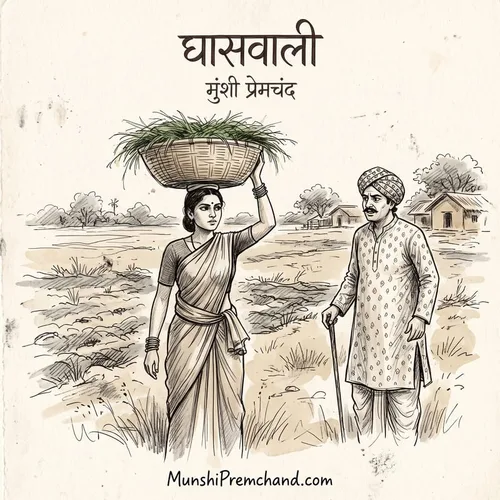
Complete English Translation: Ghaswali
1
When Muliya returned carrying a bundle of fresh green grass, her golden-wheat complexion was flushed with fiery crimson, and her large, intoxicating eyes were clouded with dark apprehension.
Seeing her flushed, agitated face, Mahavir asked, "What is the matter, Muliya? How are you feeling today?"
Muliya gave no answer; her eyes welled up with tears!
Stepping closer, Mahavir asked tenderly, "What has happened? Why don't you tell me? Did someone say something to you? Did Amma scold you? Why are you so sorrowful?"
Sobbing softly, Muliya whispered, "Nothing... what should happen? I am perfectly fine."
Looking at her from head to foot, Mahavir said, "Will you merely weep in silence and tell me nothing?"
Evading his gaze, Muliya said, "If there were something to tell, I would tell you. There is nothing."
Muliya was like a delicate rose blooming in a barren alkali wasteland. She possessed a golden-wheat complexion, deer-like liquid eyes, a delicately drawn chin, a soft blush upon her cheeks, long, sweeping eyelashes, and a strange, luminous moisture in her gaze that mirrored a vivid ache, a silent, unspoken grief. Heaven alone knew how an ethereal nymph had arrived in this humble quarter of Chamars! Was that soft, blossom-like frame meant to balance a heavy basket of grass upon her head and trudge to the bazaar to sell it? Even in that village, there were men who would gladly have laid their eyes beneath the soles of her feet, who yearned for a single fleeting glance from her, and who would have felt blessed beyond measure had she exchanged even a single word with them. Yet more than a year had elapsed since her arrival as a bride, and no one had ever seen her glance toward the village youths or engage in idle chatter.
Whenever she set out carrying her basket of grass, it seemed as though the radiant glow of dawn, bathed in a golden mantle, were scattering its dazzling splendor across the earth. Some young men would hum romantic Urdu couplets, others would place hands upon their hearts in dramatic sighs; yet Muliya, keeping her eyes cast down, walked straight ahead along her path. Struck with wonder, people would remark, "What colossal pride! What fabulous golden feathers are stuck in Mahavir's cap? He isn't even exceptionally handsome—who knows how this beauty deigns to live with him!"
Yet today, an incident had occurred which, for other young women of her caste, might have been treated as a secret romantic advance, but for Muliya was a piercing thorn driven straight into her heart.
It was early morning. The breeze blew intoxicated with the sweet fragrance of mango blossoms, and the sky seemed to rain molten gold upon the earth. Setting out with the large cane basket upon her head to scrape grass, Muliya's golden-wheat skin gleamed like pure, burnished gold in the morning rays. Suddenly, the young Thakur Chhainsingh appeared, striding toward her along the narrow path. Muliya attempted to step aside and slip past him; but Chhainsingh boldly caught hold of her hand and said:
"Muliya, do you feel not even the slightest pity for me?"
That blossom-like, radiant countenance flared up like a roaring furnace! She did not flinch in the least; she did not tremble; she did not hesitate for a fraction of a second. She flung the cane basket to the earth and cried:
"Release me this instant, or I shall scream for help!"
Today, Chhainsingh encountered an entirely unprecedented revelation in his life. In the worldview of men of his standing, what other purpose did beauty in the lower castes serve except to become a convenient plaything for upper-caste lords? He had won countless such conquests in his youth; but today, beholding the fiery flush upon Muliya's face, her ferocious anger, and her unbending dignity, his wits were completely scattered! Struck with burning shame, he released her hand.
Muliya dashed forward with furious speed. In the heat of a clash, the stinging agony of a wound is scarcely felt; it begins to throb only afterward. When Muliya had traveled some distance, the mingling waves of rage, terror, and the bitter realization of her own utter helplessness caused tears to brim over her eyelashes. She choked back her sobs for a few moments, and then broke down into bitter weeping. Had she not been so desperately poor, who would have possessed the audacity to insult her in broad daylight like this?
She wept continuously as she scraped the grass with her sickle. She knew Mahavir’s fiery temper only too well. If she breathed a single word of this to him, he would become thirsty for the Thakur’s blood! And then heaven alone knew what catastrophic bloodshed might follow! The mere thought made the hair on her flesh stand on end. That was why she had offered no answer to Mahavir's anxious inquiries.
2
The following morning, Muliya did not set out to cut grass. Her mother-in-law asked sharply, "Why are you not going? All the other women have already departed!"
Lowering her head, Muliya replied, "I shall not go alone."
Her mother-in-law flared up. "Will a royal tiger carry you off if you go alone?"
Lowering her head still further, Muliya murmured in a stifled voice, "Everyone harasses me."
The mother-in-law scolded her harshly: "You will not go with the others, nor will you go alone—then how on earth will you go? Why don't you speak plainly and admit you have no desire to work? Living like a pampered queen will not do in my household! No one loves delicate skin—people love useful labor! If you are so dazzlingly beautiful, am I supposed to lick your beauty on a plate? Lift that basket and go fetch grass!"
Outside the doorway, beneath the shade of the neem tree, Mahavir was standing grooming his horse. He watched Muliya setting out with a tearful, miserable face, but could utter not a word. Had it been in his power, he would have seated Muliya deep within his heart, sheltered her within his very eyelids; but feeding the horse was an inescapable necessity. To purchase grass from the market cost no less than twelve annas a day. And what income was there to be had? With great difficulty he earned a rupee and a half or two rupees, and even that was erratic and uncertain. Ever since those ruinous motorized lorries had begun plying the roads, the livelihood of ekka-drivers had been crushed completely. No one glanced at a horse-cart anymore. He had borrowed one hundred and fifty rupees from the moneylender to purchase the horse and cart; yet against those roaring motor buses, who would hire an ekka? He could not even manage to pay the moneylender’s compounding interest, leave alone the principal!
Speaking with gentle sympathy, Mahavir said, "If your heart is not in it today, let it be. We shall see."
Muliya's heart was deeply touched by this tenderness. She asked softly, "And what will the horse eat?"
Today she abandoned yesterday’s road, making her way along the winding earthen ridges between the fields. Every few paces, she glanced about with vigilant, darting eyes. On both sides stood tall, dense stands of sugarcane. At the faintest rustle of dry leaves, her heart froze with terror—what if someone lay lurking inside the sugarcane?
Yet nothing untoward occurred. The sugarcane fields fell behind; the mango grove was passed; irrigated plots began to appear. At a distant well, the leather bucket (pur) was operating rhythmically. Along the edges of the irrigated fields grew thick, lush green grass. Muliya's heart was tempted. In half an hour here, I can scrape more grass than I could find in the dry barren fields till noon! Who is watching anyway? If someone shouts, I shall leave immediately.
She sat down and began scraping the lush grass. Within an hour, her cane basket was more than half full. She was so completely absorbed in her task that she had no inkling of Chhainsingh's approach. Suddenly, hearing a footstep, she raised her head and saw Chhainsingh standing before her!
Muliya's heart hammered violently against her ribs. An urge seized her to bolt, to overturn the basket and flee with the empty cane frame; but Chhainsingh, halting several paces away, said in a pleading voice:
"Do not be frightened! Do not be afraid! God is my witness—I will not speak an untoward word to you! Scrape as much grass as you wish; this entire field belongs to me."
Muliya's hands went utterly numb; the sickle seemed frozen in her fingers; the grass vanished from her vision. She wished the earth would crack open and swallow her whole. The earth seemed to swim before her eyes.
Chhainsingh reassured her, "Why do you not scrape? I am saying nothing to you. Come here every day; I shall cut the grass for you myself."
Muliya remained seated, motionless as a statue carved in stone.
Chhainsingh took one step forward and spoke: "Why do you fear me so terribly? Do you imagine I have come to torment you today as well? God knows that even yesterday, I did not catch your hand to cause you grief. Seeing you, my hands reached out of their own accord; I lost all sense and control. After you walked away, I sat right there weeping for hours. I felt like chopping off my own hand! At moments I felt like swallowing poison! Ever since, I have been searching for you far and wide. Today you came by this path; I scoured the entire countryside before arriving here. Now, whatever punishment your heart desires, inflict it upon me! Even if you sever my head with that sickle, I shall not flinch my neck. I was a rascal, a rogue; but ever since I set eyes upon you, all the filth has been cleansed from my soul! Now the only desire left in my heart is that I were your dog, following behind your footsteps; that I were your horse, so that you would place grass before me with your own hands! That this mortal frame might somehow be of service to you—that is the supreme longing of my spirit! May my youth perish if I speak these words with any wicked intent! Mahavir is a fortunate man indeed to have been blessed with such a goddess!"
Muliya listened in absolute silence. Then, lowering her head, she asked with simple directness, "Then what is it that you ask me to do?"
Stepping a little closer, Chhainsingh said, "Only this—I seek your mercy."
Muliya raised her head and looked straight into his eyes. Her modesty seemed to vanish in an instant. In words that pierced like needle-points, she demanded:
"You are already married, are you not?"
Chhainsingh murmured in a muted voice, "I am married, yes; but what is that marriage? A mere formality, a childish game."
A scornful, mocking smile curled upon Muliya's lips. She said:
"Even so, if my husband were to speak to your wife in this very manner, how would you feel? Would you not be ready to slit his throat on the spot? Speak! Do you imagine that because Mahavir is a Chamar, his veins contain no blood, that he possesses no sense of shame, no regard for his honor?
"You are enamored of my beauty. Tell me, do far more beautiful women than I not stroll along the riverbanks and temple ghats? I cannot equal even the dust beneath the soles of their feet! Why do you not go and beg mercy from one of them? Do they possess no mercy? But you will never go there—because your chest quakes with terror to venture into their presence! You come begging mercy from me only because you know I am a Chamar woman, a woman of a despised caste, and that a low-caste woman will readily fall into your fist with a little threat, a little scolding, or a little greed!
"How wonderfully cheap a bargain! You are a Thakur lord—why should you ever let such a cheap bargain slip through your fingers?"
Chhainsingh, overwhelmed with humiliation, stammered, "Mula, it is not so! I swear to you, there is no question of high and low in this. All human beings are equal before God. I am ready to lay my forehead at your feet!"
Muliya replied fiercely: "Only because you know I have no power to strike you down! Go and lay your forehead at the feet of some high-born Khatri or Thakur woman, and you will learn what fruit comes from laying your forehead at a woman's feet! That head of yours will not remain upon your shoulders for another hour!"
Chhainsingh felt as though he were sinking into the earth with shame. His mouth was so parched, as though he had risen from months of wasting fever. Not a word could pass his lips. That Muliya possessed such devastating eloquence and razor-sharp intellect had never crossed his wildest imagination!
Muliya continued: "I too go to the town bazaar every day. I know the secrets of those grand aristocratic mansions! Name me a single grand house where some groom, some carriage-driver, some water-bearer, or some temple priest has not insinuated himself! That is the celebrated lifestyle of the wealthy. And those women who do such things do entirely right! For their husbands also spend their lives chasing after Chamar and Kahar women! The account is settled equally on both sides.
"Where is such luxury for poor, honest folk? For my husband, I am his entire universe. He does not lift his eyes to look upon any other woman in the world. It is mere chance that I am somewhat fair of face; but even if I were jet-black and ugly as a soot-pot, he would cherish and keep me in precisely the same way! Of that I am absolutely certain. Low-caste Chamar though I am, I am not so vile as to repay his sacred trust with treachery!
"Yes, if he were to follow his own whims and torment my chest, I would torment his chest in return! You are infatuated merely with my physical face, are you not? If smallpox were to strike me today and leave me one-eyed and scarred, you would not even look in my direction! Speak—do I speak a lie?"
Chhainsingh could not utter a denial.
In the same proud, unyielding voice, Muliya declared:
"Yet even if not one, but both my eyes were poked out, Mahavir would still cherish me in the exact same manner! He would lift me, seat me, and feed me with his own hands! And you desire that I should deceive such a man?
"Begone from here! And never dare harass me again, or the consequences will not be good for you!"
3
Youth is vigor, it is strength, it is compassion, it is courage, self-confidence, and nobility—it is everything that makes human life sacred, radiant, and complete.
The intoxication of youth, by contrast, is vanity, cruelty, selfishness, swagger, lust, bitterness—everything that drags human life toward bestiality, corruption, and disgrace.
Chhainsingh had been possessed by the intoxication of youth. Muliya's icy splashes of truth had washed that intoxication clean away! Exactly as a few splashes of cold water cast upon boiling sugar syrup dissolve the frothy scum, purge the impurities, and leave behind pure, crystal-clear nectar, so the intoxication of youth vanished, leaving only pure, noble youth behind. The words of a noble woman can destroy faith and virtue with effortless ease, yet with equal ease they can redeem them from the abyss.
From that day forth, Chhainsingh became an entirely transformed man.
Previously, fury had resided perpetually upon the tip of his nose; hurling abuses at laborers, scolding them, and thrashing them at the slightest pretext had been his habitual nature. His tenants had trembled before him like dry leaves. Laborers, catching sight of his approach, would hastily redouble their efforts, only to slacken and puff their clay pipes the moment his back was turned. Everyone secretly burned with hatred toward him, cursing him in their hearts.
Yet from that day, Chhainsingh grew so compassionate, so grave, and so patient that the villagers were struck with wonder.
Several days had passed. One evening, Chhainsingh went out to inspect his fields. The irrigation buckets were working. He noticed that at one point the earthen water-channel had breached, and the entire stream was pouring wastefully into the ditch. Not a drop of water was reaching the seedling beds; yet the elderly woman assigned to guide the water sat resting in silence, utterly indifferent to the loss.
In former days, beholding such negligence, Chhainsingh would have flown into a blind rage. He would have docked the woman's daily wage and showered the bucket-drivers with curses. But today, no fury touched his heart. Taking up a spade of moist earth, he repaired the breach himself, stepped into the field, and said gently to the old woman:
"You are sitting here resting, and all the water is running to waste."
The old woman scrambled to her feet in terror. "It must have breached just now, Raja! I shall go and close it this instant!"
Saying this, she began to tremble violently.
Comforting her, Chhainsingh said, "Do not run! Do not be frightened. I have already closed the breach myself. I have not seen the old uncle for several days—has he found any employment or not?"
Deeply moved, the old woman replied, "He is sitting idle at home these days, Bhaiya. He finds work nowhere."
Chhainsingh said with gentle warmth, "Then send him to our house. There is some hemp stored away; let him spin it into rope."
Saying this, he walked toward the well. Here, four irrigation buckets were operating; but at that moment, two drivers had slipped away to eat wild berries from a nearby jujube tree.
Catching sight of Chhainsingh, the remaining laborers were seized with dread. If the Thakur asked where the two missing men had gone, what answer could they give? All of them would be severely reprimanded! The poor men shrank with anxiety.
Chhainsingh asked, "Where have those two gone?"
Not a voice dared reply.
Suddenly, from the opposite thicket, the two missing laborers appeared, their dhoti corners piled high with wild berries, chatting cheerfully. Catching sight of Chhainsingh, the life-breath drained from their bodies! Their feet turned heavy as millstones. They could neither advance nor retreat. Both understood that today severe punishment awaited them; perhaps their entire day's wages would be confiscated! Their pace slowed to a crawl.
Just then, Chhainsingh called out pleasantly, "Come along, come along! What kind of berries are they? Bring some here and give them to me as well—they are from my tree, are they not?"
Both men were petrified with terror. Today the Thakur will not spare our lives! How sweetly he speaks—he will drench us in blistering blows all the more thoroughly! The poor wretches shrank into themselves.
Chhainsingh called again, "Come quickly, men! I shall take all the ripe ones. Let one man run quickly to my house and fetch a little salt! (Turning to the other two laborers) You two come along as well! The berries on that tree are exceptionally sweet. Let us eat the berries first; the work will certainly be done."
Now the two culprits took heart. All gathered around, pouring their berries before Chhainsingh, selecting the ripest fruit to hand to him. One man raced to fetch salt. For half an hour, all four irrigation buckets stood still.
When all the berries had been devoured and the Thakur prepared to depart, the two offenders folded their hands in supplication: "Bhaiyaji, grant us pardon today! We were ravenously hungry, otherwise we would never have left our posts."
Chhainsingh replied with humble warmth: "What harm was there in that? Did I not eat the berries alongside you? A half-hour's delay occurred—is that all? If you put your hearts into it, you will accomplish an hour's labor in half an hour. If you do not wish to work, even a whole day will not suffice for an hour's task."
When Chhainsingh departed, the four laborers began conversing among themselves:
The first said, "If a master behaves like this, one's heart rejoices in working! Not that he should sit perched upon one's chest every second."
The second: "I truly believed he would swallow us raw today!"
The third: "For several days now I have noticed his temper has turned sweet as honey."
The fourth: "Wait until this evening—if we receive our full wages, only then believe it!"
The first: "You are an utter simpleton! You cannot recognize the true spirit of a man."
The second: "Now we shall toil with all our hearts and souls!"
The third: "Indeed! When he has placed trust in us, it is our sacred duty to leave nothing lacking."
The fourth muttered, "As for me, brother, I still cannot bring myself to trust a Thakur!"
4
One day, Chhainsingh had to travel to the district courthouse on official business. The journey was five miles. Ordinarily, he rode his horse; but the sun was blazing with intense heat, and he decided to travel by horse-cart (ekka). He sent word to Mahavir to come and fetch him.
Around nine o'clock, Mahavir called out at his gate. Chhainsingh was ready, and climbed aboard the ekka without delay.
Yet the horse was so skeletal, the cart's cushion so filthy and tattered, and the entire outfit so dilapidated that Chhainsingh felt embarrassed sitting upon it.
He asked, "Why has your cart fallen into such ruin, Mahavir? Your horse was never so emaciated before. Are passengers scarce these days?"
Mahavir replied, "No, Malik, why should passengers be scarce? But against those roaring motor lorries, who hires an ekka? Where formerly I returned home earning two, two-and-a-half, or three rupees a day, today I cannot earn even twenty annas! What am I to feed the beast, and what am I to eat myself? I am caught in terrible calamity. I often think of selling off the cart and horse and working as a field laborer for you masters; but no buyer can be found. If nothing else, twelve annas are required for the horse’s grain alone, with grass over and above! When a man cannot fill his own belly, who can care for an animal?"
Looking at Mahavir's torn tunic, Chhainsingh asked, "Why don't you cultivate two or three bighas of land?"
Lowering his head, Mahavir said, "Agriculture requires great capital and strength, Malik! I have resolved that if a buyer turns up, I shall dispose of the cart for whatever pittance it fetches, and then scrape grass and sell it in the bazaar. Nowadays, both mother and daughter-in-law scrape grass together; only then do ten or twelve annas bless our hands."
Chhainsingh asked, "Then the old woman must be going to the market?"
Shamefaced, Mahavir replied, "No, Bhaiya, how could she walk so great a distance? My wife goes. She scrapes grass until noon, sets out for the market in the afternoon, and returns home late into the night. She is utterly exhausted, Bhaiya; but what can I do? Who can fight against fate?"
Chhainsingh reached the courthouse, and Mahavir drove his ekka toward the town bazaar in search of stray passengers. Chhainsingh instructed him to return at five o'clock.
Around four in the afternoon, Chhainsingh finished his legal business and stepped outside. Inside the court compound was a betel stall; a little beyond stood a massive, spreading banyan tree, beneath whose dense shade stood dozens of tongas, ekkas, and phaetons. The horses had been unharnessed. It was here that the conveyances of pleaders, legal agents, and imperial officials were parked.
Chhainsingh drank water, chewed a betel leaf, and was contemplating taking a motor bus into the city when his gaze fell upon a grass-cutter woman. Balancing a large cane basket of green grass upon her head, she was haggling with the syces and coachmen.
Chhainsingh’s heart leaped—It is Muliya!
Dressed with neat care in a pink sari, she was bargaining with the carriage-drivers. A knot of coachmen had gathered around her; one passed flirtatious jokes, another stared insolently, another chuckled.
A dark, rugged coachman remarked, "Mula, your grass is worth six annas at the very most!"
Looking at him with eyes that drove men to distraction, Muliya retorted, "If you wish to buy for six annas, other grass-cutters are sitting across the way—go there, and you will get it for two or three paise less! My grass will sell for no less than twelve annas!"
An elderly coachman called down from atop a phaeton, "It is your youthful season, girl—demand not twelve annas, but a whole rupee! The buyers will sigh and pay it. Let the lawyers emerge from court; it won't be long now!"
A tonga-driver wearing a pink turban chuckled, "Look, the old man’s mouth is watering! Why should Muliya bother looking at anyone else now?"
Chhainsingh burned with such furious indignation that he yearned to thrash those scoundrels with his shoes! How boldly every eye was fastened upon her, drinking her in with brazen glances! And how cheerful Muliya appeared here—neither bashful, nor hesitant, nor suppressed! How she smiled, bantered with sparkling, playful eyes, adjusting the veil from her hair, tossing her head with witty retorts!
This was the very Muliya who had flared up like an outraged tigress!
Just then, the clock struck four. A bustling crowd of court clerks, pleaders, and legal agents poured forth from the buildings. The clerks dashed for the motor buses; the lawyers strode toward the parked carriages. The coachmen harnessed their horses in haste. Several gentlemen cast appreciative, romantic glances at Muliya as they climbed into their vehicles.
Suddenly, Muliya dashed forward with her basket behind a carriage. Inside sat a young lawyer attired in fashionable English dress. He had the grass placed upon the carriage footboard and drew coins from his pocket to hand to Muliya. Muliya smiled; a few words were exchanged between them which Chhainsingh could not overhear.
A moment later, with a bright, contented face, Muliya set out on the long walk home.
Chhainsingh remained standing beside the betel stall in a daze of complete oblivion. The betel-seller packed up his wares, changed his clothes, locked the wooden cabinet, and stepped down, shattering Chhainsingh’s reverie.
Chhainsingh asked, "Have you closed your shop?"
The betel-seller remarked with genuine concern: "Seek medical treatment for this condition, Thakur Sahib! This sickness is not good."
Astonished, Chhainsingh asked, "What sickness?"
The vendor replied: "What sickness? You have been standing here for half an hour motionless as a corpse! The entire courthouse has emptied, all the shops are shuttered, even the sweepers have finished their sweeping and gone home—and you noticed nothing! This is a dangerous affliction; take medicine without delay!"
Grasping his walking staff, Chhainsingh walked toward the main gate, where Mahavir’s ekka came into view.
5
When the horse-cart had traveled some distance along the road, Chhainsingh asked, "How much money did you earn today, Mahavir?"
Mahavir laughed ruefully. "Today, Malik, I stood waiting the entire day in vain! No one even seized me for forced unpaid labor (begaar). Over and above, I smoked away four paise worth of bidis."
After a brief pause, Chhainsingh said: "I have a proposal for you. Take a fixed rupee every day from me. Whenever I call, bring your ekka—that is all. Then your wife will not have to trudge to the bazaar selling grass. Tell me, do you agree?"
Looking at him with eyes brimming with grateful tears, Mahavir said, "Malik, it is your bread I eat; I am your humble tenant. Whenever you wish, summon me! To take rupees from you..."
Cutting him off, Chhainsingh said firmly: "No, I have no desire to extract unpaid labor from you. Take one rupee from me every day. But do not send your wife to the market carrying grass! Your honor is my honor. And whenever you require money or loans, come to me without hesitation. But remember—never breathe a single word of this arrangement to Muliya! What use is there in speaking of it?"
Several days later, in the quiet of the evening, Muliya met Chhainsingh.
Chhainsingh was walking briskly toward home after collecting land rents from his tenants when, at the exact spot where he had once grabbed Muliya’s hand, her voice fell upon his ears.
He halted and looked back; Muliya came running toward him.
He asked, "What is it, Mula? Why are you running? I am standing right here."
Panting for breath, Muliya said, "I have been longing to meet you for several days. Seeing you passing today, I ran. I no longer go to the market to sell grass."
Chhainsingh replied, "That is very good."
"Did you ever see me selling grass in the market?"
"Yes, I saw you one day. Did Mahavir tell you everything? I had strictly forbidden him."
"He conceals nothing from me."
Both stood in silence for a long moment. Neither knew what words to utter.
Suddenly, a soft smile appeared upon Muliya's lips. She whispered:
"It was right here that you once caught hold of my arm."
Flushed with shame, Chhainsingh said, "Forget that, Mula! Heaven knows what demon had possessed me that day."
In a voice choked with profound emotion, Muliya said:
"Why should I ever forget it? You are honoring the sacred dignity of having grasped that arm! Poverty forces a person to endure whatever the world demands... You have saved me."
Silence enveloped them once again.
After a few moments, Muliya spoke softly: "You must have thought that day in the bazaar that I was rejoicing in flirting and laughing with those men?"
Chhainsingh answered with passionate conviction: "No, Muliya! Not for a single fraction of a second did I think so!"
Smiling gently, Muliya murmured, "That was what I hoped from you... and that is what I expect."
The evening breeze was departing to rest in the cool lap of the irrigated fields; the sun was sinking into the dark embrace of the night; and in that fading twilight, Chhainsingh stood watching the vanishing silhouette of Muliya as she melted into the horizon!
Summary of Ghaswali
'Ghaswali' (The Grass-Cutter Woman) is one of Munshi Premchand's most celebrated and socially transformative short stories. It explores the intersection of caste discrimination, economic deprivation, sexual harassment, and the unassailable dignity of working-class women in rural India.
The story centers on Muliya, an extraordinarily beautiful young Dalit woman married to Mahavir, an impoverished horse-cart (ekka) driver whose livelihood has been wiped out by modern motor transport. To keep their horse alive and help support the family, Muliya cuts grass from the fields and sells it in the town bazaar. Despite her captivating beauty, Muliya is intensely loyal to her husband and fiercely protective of her virtue.
One morning, Thakur Chhainsingh, a wealthy upper-caste landlord intoxicated by youth and feudal privilege, intercepts Muliya and grabs her arm, assuming his caste and economic status give him rights over a poor laborer's body. Muliya fiercely resists, dropping her grass basket and threatening to scream, shaming Chhainsingh into letting her go. The next day, Chhainsingh seeks her out again to apologize and declare his infatuation, asking for her "mercy." Muliya delivers a blistering critique of feudal entitlement: she asks if he would tolerate another man treating his own wife in this manner, and points out that he targets her only because her poverty and low caste make her an easy mark, whereas he would never dare touch an upper-caste woman whose family could retaliate. She proudly declares that while Chhainsingh is infatuated with fleeting beauty, her husband Mahavir loves her unconditionally.
Muliya's words pierce through Chhainsingh's arrogance, initiating a complete moral transformation. He renounces his cruelty, begins treating his farm laborers with humanity and kindness, and shares fruit with his workers. Realizing the harrowing economic pressure forcing Muliya into the vulgar town bazaar, Chhainsingh arranges to pay Mahavir a fixed daily wage of one rupee, ensuring Muliya no longer needs to sell grass. In a moving final encounter at the very spot where he had harassed her, Muliya thanks Chhainsingh for protecting her honor, acknowledging that by lifting her family from desperation, he has truly redeemed the shame of having grasped her arm.
Publication History
'Ghaswali' (घासवाली) was written by Munshi Premchand in 1929 and published in leading Hindi literary periodicals before being included in Mansarovar, Part 1 (मानसरोवर भाग 1).
The narrative represents one of Premchand's most progressive feminist statements, challenging feudal patriarchy and asserting Dalit female agency long before modern social justice literature gained prominence.
This unabridged English translation was published in 2026 by MunshiPremchand.com as part of the MunshiPremchand.com English Translation Series.
Themes & Critical Significance
- Subversion of Caste and Feudal Privilege: Premchand exposes the predatory sexual entitlement of upper-caste feudal landlords over lower-caste women. Chhainsingh assumes that Muliya's Dalit identity makes her readily available for exploitation. Muliya's fearless confrontation completely demolishes this feudal presumption, exposing his "love" as a cowardly bargain of convenience.
- Female Agency and Dignity of the Subaltern: Muliya is depicted neither as a passive victim nor as an idealized romantic figure, but as an articulate, morally unshakeable working woman who understands the economic and caste structures of oppression. Her sharp intellect and moral clarity reduce the powerful landlord to speechlessness.
- True Youth vs. the Intoxication of Youth: Premchand's philosophical exposition on youth (jawani) contrasts noble vitality, courage, and benevolence with the toxic arrogance of privilege (jawani ka nasha). Muliya's rebuke acts like cold water on boiling syrup, purging Chhainsingh's ego and awakening his latent humanity.
- Economic Vulnerability and the Changing Rural Economy: The story documents the impact of early technological transition on rural India. The advent of motorized buses ruins traditional ekka drivers like Mahavir, forcing his wife into precarious public labor. Premchand highlights how economic distress directly increases the vulnerability of women to harassment.
- Redemption Through Restorative Action: Chhainsingh's remorse does not remain an empty psychological sentiment; it translates into structural benevolence. He treats his farm laborers with genuine respect and discreetly secures Mahavir's livelihood to protect Muliya's dignity, illustrating Premchand's philosophy of hriday-parivartan (change of heart) leading to social harmony.