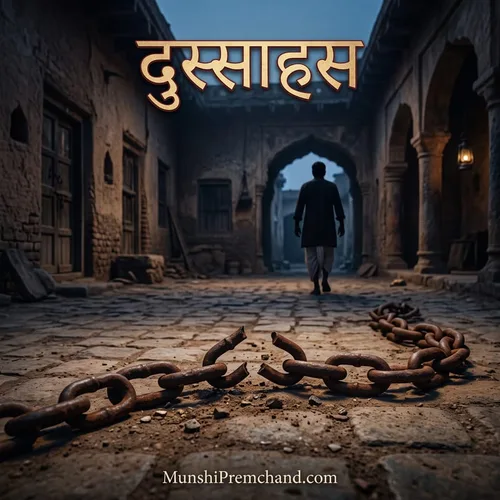
Complete English Translation: Audacity (Dussahas)
In the Naubasta neighborhood of Lucknow lived a legal pleader named Munshi Maikulal. He was an exceedingly generous, kind-hearted, and amiable gentleman. In his profession, he was so remarkably adept that rarely was there a lawsuit in which he was not retained by one side or the other. He also harbored a deep fondness for wandering sadhus and holy men. Through associating with them, he had acquired a smattering of metaphysical philosophy and a seasoned habit of smoking ganja and charas. As for alcohol, it was practically an ancestral family tradition. Under the influence of liquor, his pen flowed with extraordinary eloquence when drafting legal petitions; his intellect grew luminous and sharp. Ganja and charas, on the other hand, acted upon his spiritual consciousness: taking a deep pull from the clay pipe, he would plunge into blissful contemplation of worldly renunciation and cosmic detachment.
He commanded immense respect throughout the neighborhood. Yet this awe was not merely the fruit of his legal acumen, but rather the reward of his generous, unassuming character. The neighborhood's carriage drivers, milkmen, and palanquin-bearers were all his devoted servants, ready to abandon a hundred pressing chores just to do his bidding. His liquor-fueled generosity had captivated them all. Every day, the moment he returned from the courts, he would toss two silver rupees before Algu, his Kahar servant. There was no necessity to utter a single syllable of instruction; Algu understood the meaning instantly. By evening, a bottle of country liquor, along with fresh supplies of ganja and charas, would be laid out before Munshi-ji.
And then the evening gathering would assemble in all its glory! His cronies would arrive one after another. On one side sat a row of legal clients; on the other sat his neighborhood companions. Animated debates on philosophical renunciation and spiritual wisdom would commence. Now and then, amidst the lofty discourse, Munshi-ji would exchange a word or two with a client concerning court proceedings. At ten o'clock sharp, the assembly would disperse.
Munshi-ji never invited any headache into his life beyond his legal briefs and his philosophical debates. He had not the slightest connection with any political movement, public meeting, or social reform campaign in the country. In this regard, he was a man of absolute detachment. The Partition of Bengal took place; the Moderate and Extremist factions formed within the Congress; sweeping constitutional reforms were introduced by the government; the fervent aspiration for Swaraj was born; and cries of national self-reliance resonated across the land—yet not a ripple disturbed Munshi-ji's serene, unvarying tranquility. Beyond the law courts and his bottle of liquor, he regarded every single thing in this world as mere maya—transient illusion—and remained utterly indifferent to it all.
The evening lamps had already been lit. Munshi Maikulal’s salon had assembled, and the faithful devotees were gathered in their places; yet the Goddess of Wine had not made her appearance. Algu had not yet returned from the bazaar.
Everyone kept casting eager, impatient glances toward the street. One companion stood watching from the veranda; two or three gentlemen went out to the road to scout for him; yet Algu was nowhere to be seen. Today was the first occasion in Munshi-ji’s life that he had been subjected to such an agonizing trial of waiting. His restless anticipation had assumed the motionless stillness of deep yogic meditation: he uttered not a word, nor did he look anywhere. All his faculties were concentrated upon a single focal point of waiting.
Suddenly, word was brought that Algu was coming. Munshi-ji woke from his trance; his companions beamed with delight, shifting their positions upon the carpets to sit up straight, their eyes brightening with eager devotion. An anxious delay, after all, only intensifies the joy of fulfillment!
In an instant, Algu stepped into the room and stood before them. Munshi-ji did not scold him; this was a first offense, and there must surely be some compelling reason. With subdued yet anxious eyes, he looked down at Algu’s hands.
There was no bottle!
He was stunned; he could scarcely believe his eyes. He looked again with careful scrutiny—there was indeed no bottle! This was an unnatural, unheard-of occurrence. Yet he did not fly into a rage. In a gentle, trembling voice, he asked: "Where is the bottle?"
Algu replied: "None was to be had today."
Maikulal asked: "Why so?"
Algu said: "Volunteers of the Swaraj movement are standing at both ends of the lane, blocking the liquor shop! They won't let a soul pass that way!"
Now Munshi-ji flared with fury—not at Algu, but at the Swaraj volunteers! What right do they possess to shut off my liquor? In a haughty, indignant tone, he asked: "Did you not mention my name?"
Algu replied: "I pleaded a great deal, but who listens to anyone there? Everyone was being turned back, so I came away too."
Munshi: "Did you bring the charas?"
Algu: "The exact same state of affairs prevailed there as well."
Munshi: "Are you my servant, or the servant of those Swaraj wallahs?"
Algu: "I am your servant, master, but I am hardly your servant to have black soot smeared across my face!"
Munshi: "What! Are those rascals smearing soot on people's faces?"
Algu: "I didn't see it with my own eyes, but that was what everyone was saying."
Munshi: "Very well! I shall go myself! Let me see who possesses the audacity to stop me! I will show each and every one of them the inside of the red-brick jailhouse! This is the government's realm, not a state of lawless anarchy! Was there no policeman stationed there?"
Algu: "The Sub-Inspector of Police himself was standing right there, telling everyone that whoever wished to go and buy liquor or drink could do so; but people were turning back of their own accord. No one was listening to him."
Munshi: "The Sub-Inspector is a personal friend of mine! Come on, Eidu, will you come? Rambali, Bechan, Jhinaku—all of you, come along! Each of you will fetch a bottle! Let me see who dares bar our path! Tomorrow I shall teach them all a lesson they won't forget!"
Accompanied by his four comrades, Munshi-ji arrived at the entrance of the lane leading to the liquor shop. A dense crowd had gathered there. In the center stood two dignified, serene figures: one was Maulana Jamin, a celebrated religious jurist (mujtahid) of the city; the other was Swami Ghananand, the revered founder of the local Seva Samiti and an indefatigable champion of the public good. Directly facing them stood the Sub-Inspector of Police, flanked by several constables.
The moment the Sub-Inspector spotted Munshi-ji and his companions, he beamed with pleasure and stepped forward: "Welcome, Mukhtar Sahib! Did you have to take the trouble of coming in person today? Are these four gentlemen your companions?"
Munshi-ji replied: "Yes, indeed. I sent my man earlier, and he returned empty-handed. I heard that chaos reigns here today, and the Swaraj volunteers won't allow anyone to enter."
The Sub-Inspector said: "Not at all, sir! Who dares interfere with anyone's lawful business? Go right ahead, as you please! No one will dare utter a squeak. After all, what am I standing here for?"
Munshi-ji cast a haughty, triumphant glance at his companions and was just stepping into the narrow alleyway when Maulana Jamin addressed Eidu with profound gentleness:
"Brother, this is the hour of your evening prayers. What brings you to this place? Is it upon the strength of such piety that we shall resolve the sacred question of the Khilafat?"
It felt as though heavy iron fetters had clamped instantly around Eidu's feet. Mortified with shame, he stood rooted to the spot, staring at the ground, lacking the courage to take a single step forward.
Swami Ghananand then turned to Munshi-ji and his three remaining companions, holding out a vessel: "My children, take this sacred panchamrit before you go; it will bring you spiritual well-being."
Jhinaku, Rambali, and Bechan instinctively cupped their hands, took the consecrated nectar from Swami-ji, and drank it down.
Munshi-ji sneered: "Drink it yourself! I have no need for it."
Swami-ji folded his hands before him and spoke with playful, disarming humility: "Show mercy to this humble beggar today; do not enter that lane."
Munshi-ji, however, brushed the Swami’s outstretched hand aside and marched boldly into the lane. His three companions remained standing behind Swami-ji, their heads bowed low in embarrassment.
Munshi-ji turned back and barked: "Rambali, Jhinaku! Why aren't you coming? Who has the power to stop us?"
Jhinaku replied in his rustic dialect: "Why don't you turn back yourself, master? One must heed the words of holy men and saints."
Munshi: "So this was the mighty courage with which you stepped out of your houses?"
Rambali: "We stepped out thinking that if anyone used physical force to stop us, we would deal with them. We didn't come here to pick a fight with holy saints."
Munshi: "How truly it is said: rustics are nothing but sheep!"
Bechan: "You may become a lion, master; we are content to remain sheep."
Munshi-ji swaggered alone into the tavern. A heavy gloom hung over the shop. The liquor vendor was sitting upon his cushioned seat, dozing away in the empty room. Startled by Munshi-ji's footsteps, he looked up sharply with wide, astonished eyes, as though gazing upon some bizarre, mythical creature. He filled a glass bottle, handed it over, and promptly resumed his dozing.
When Munshi-ji emerged at the mouth of the alley, his companions were nowhere in sight. A large crowd surrounded him on all sides, pelting him with sharp, scornful jeers:
One bystander remarked: "If there be a hero, let him be like this!"
Another quoted mockingly in Persian: "Sharm che kuttist ki peshe mardan biawayad! (What dog is shame, that it should ever dare appear before real men!)"
A third sneered: "He must be some ancient, hardened drunkard—a hopeless addict!"
Just then, the Sub-Inspector pushed through and dispersed the crowd. Munshi-ji offered him his thanks and began walking homeward. A police constable accompanied him for his protection.
Munshi-ji's four companions had cast away all thought of liquor bottles and were walking back together, conversing among themselves.
Jhinaku said: "Once, when my carriage was seized by the authorities for unpaid forced labor, it was this very Swami-ji who spoke to the court peon and had it released for me."
Rambali added: "Last year, when fire broke out in my hut, wasn't it Swami-ji who arrived with the volunteers of the Seva Samiti? Had it not been for them, not a single thread would have been saved from the house!"
Bechan said: "Mukhtar Sahib counts no one as his equal. If a man commits an evil deed, he does so in secret; he doesn't gird up his loins to flaunt his shamelessness in broad daylight!"
Jhinaku said: "Brother, one shouldn't speak ill of a man behind his back. Whatever else he may be, he is undeniably a man of immense audacity! How boldly he pushed his way through that sea of people!"
Rambali scoffed: "That wasn't bravery! Had the Sub-Inspector not been standing there, he would have learned the true market price of flour and lentils!"
Bechan declared: "Even if someone had offered me fifty rupees, I could not have brought myself to set foot in that lane! My head was hanging so low with shame I couldn't lift my eyes!"
Eidu sighed: "I fell into a dreadful trap by tagging along with him today! Wherever Maulana sees me from now on, he will haul me over the coals. Why should a man commit deeds contrary to his faith and bring disgrace upon himself? Today I was ready to sink into the earth with mortification. I repent before God today! From this moment on, I will not cast even a glance in that direction!"
Rambali remarked: "A drunkard's vow of repentance is no stronger than a thread of raw cotton."
Eidu said fiercely: "If you ever catch me drinking again, smear black soot over my face!"
Bechan: "Very well, on that solemn oath, I abandon it from today as well! If I ever drink again, let it be the same as drinking cow's blood!"
Jhinaku: "Then am I the only sinner left among us? If you ever see me drinking again, sit me down and thrash me with fifty shoes!"
Rambali laughed: "Oh, go on! The moment Munshi-ji calls for you, you will go running like a dog!"
Jhinaku: "If you ever see me sitting in Munshi-ji's drinking circle again, strike me with a hundred shoes! A man whose word cannot be trusted is no true son of his father!"
Rambali: "Then, brothers, I too take an oath: from this day forth, I will never spend a single pice from my own pocket on liquor! Mind you, I don't refuse if it is offered free of cost."
Bechan retorted: "And when have you ever spent money from your own pocket?"
Just then, Munshi Maikulal was seen hurrying toward them. Although he had won the contest and brought away the prize, his face reflected mortified embarrassment rather than the triumph of victory. For some inexplicable reason, he could not savor the inward joy of this conquest. A secret shame, hiding in some dark corner of his conscience, kept pinching his heart. He was barely conscious of it himself, yet the sting of that reckless audacity weighed heavily upon his spirit.
Rambali said: "Welcome, Mukhtar Sahib! You took quite a while."
Munshi: "All of you turned out to be utter cowards—tricked and routed by a wandering sadhu!"
Rambali: "These fellows have taken a solemn vow never to touch liquor from today."
Munshi sneered: "I have never yet seen a man who, once caught in its clutches, managed to escape. Boasting with the mouth is an easy matter."
Eidu: "If life remains, you shall see for yourself."
Jhinaku: "No man can renounce bread and water, but other habits can be abandoned whenever the mind resolves upon it. All it takes is a sharp shock to the conscience. No one ever dies from quitting an intoxicant!"
Munshi: "I shall see this mighty heroism of yours."
Bechan: "What is there to see? Quitting is no great feat. At most, one’s body might feel sluggish for two or three days. In the Great War, English soldiers gave up alcohol, though they normally drink it like water; surely it is not an impossible task for us!"
Talking thus, they arrived at the Mukhtar Sahib’s residence.
The outer drawing room was wrapped in dead silence. The legal clients had all departed. Algu lay fast asleep in a corner.
Munshi-ji seated himself upon the large bolster cushion and began taking drinking glasses out of the wall cupboard. He still could not bring himself to believe in the solemn vows of his companions. He was thoroughly convinced that the moment the fragrant bouquet and ruby glow of the wine appeared before their eyes, their vows of repentance would shatter into pieces. The moment I offer a little encouragement, all of them will crowd around and the salon will blossom into life!
When Eidu offered his salaams and turned to leave, and Jhinaku picked up his bamboo lathi, Munshi-ji caught them both by the hands and pleaded in his gentlest, most affectionate voice: "Brothers, it is not right to desert a companion like this! Come, taste the flavor of it today—it is an exceptionally fine brew!"
Munshi: "Oh, come along! What is the use of brooding over such trifles?"
Eidu said firmly: "May it bring you joy, master; please grant me leave to go."
Jhinaku: "If God wills it, I shall not go near it again; who wants to be thrashed with shoes?"
Saying this, both men pulled their hands free and departed.
The Mukhtar Sahib then caught the hand of Bechan, who was just stepping down from the veranda: "Bechan, will you play false with me too?"
Bechan said: "I have taken a terrible oath. Once I have declared it to be as foul as cow's blood, I cannot even bear to look in its direction. However fallen I may be, shall I not uphold the honor of that sacred vow? Now you too should give it up, master; spend your days chanting the holy name of Rama! You have spent enough years drinking."
Saying this, he too offered his salaams and walked away.
Now Rambali alone remained behind. Munshi-ji said to him in an aggrieved, mournful tone: "Look at the treachery of those fellows, Rambali! I never imagined they would be so fickle-minded! Come, tonight let it be just the two of us! Two steadfast friends are better than a dozen fair-weather companions. Come, take a seat."
Rambali said: "I am entirely at your service, sir; but I too have sworn an oath never to spend a single pice from my own pocket on liquor."
Munshi: "My dear friend, as long as breath remains in my body, drink as much as your heart desires! What worry is there of money?"
Rambali: "But what happens when you are no longer here? Where shall I find another such generous benefactor?"
Munshi: "Oh, we shall cross that bridge when we come to it! I am hardly going to drop dead today!"
Rambali: "Life is utterly unpredictable, sir. You are certain to die before me, and who will feed me liquor every day then? At that time, I will not even be able to quit. It is far better that I make arrangements for myself from this very hour."
Munshi: "Friend, do not dampen my spirits with such morbid talk! Come, sit down—take just one single glass!"
Rambali: "Mukhtar Sahib, do not press me any further. When unlettered addicts like Eidu and Jhinaku—men who sold their wives' jewelry to buy drink—can take a vow, I am not so shameless as to remain its slave. Swami-ji saved my entire family from ruin during the fire. Under no circumstances can I disobey his command."
Saying this, Rambali too took his leave.
Munshi-ji raised the glass to his lips, but before he could pour a second cup, all desire for drink had completely evaporated.
This was the first occasion in his entire life that he was forced to sit in solitary isolation and swallow alcohol like bitter medicine.
At first, he fumed with rage against his companions: I must have spent hundreds of rupees wining and dining those ungrateful wretches! And yet today, over a trivial incident, every single one of them has deserted me! Now I sit here alone like a solitary ghost, without a single soul to laugh or converse with! Alcohol is a pleasure of companionship; when the joy of fellowship is gone, what pleasure is there in swallowing drink only to collapse upon a cot?
And what utter humiliation I endured today! When I entered that lane, hundreds of eyes were glaring at me with blazing fury. When I emerged clutching the bottle, had it been in the crowd's power, they would have torn the flesh from my bones! Had the Sub-Inspector not been present, reaching home alive would have been impossible. And for what was all this public ignominy and disgrace endured? Merely so that I might sit for an hour, make my mouth bitter, and burn my liver! With not even a soul beside me to share a joke!
Only today have I realized how deeply people despise this wretched poison! Otherwise, at a mere gesture from a holy ascetic, seasoned drunkards would never have defied me so openly. The truth is, in the depths of their conscience, everyone knows it to be vile and forbidden. When simple cowherds, carriage drivers, and water-bearers can renounce it, am I lower and more degraded than them? Having endured such public humiliation, having fallen so low in the estimation of the community, having earned infamy across the entire city, and having made myself a laughingstock—merely to generate a momentary haze in my head—what great triumph have I achieved? Is it noble to degrade one's immortal soul so abjectly for the sake of a base addiction? Those four men must be mocking me at this very moment, branding me a scoundrel, looking down upon me as a contemptible wretch! In the eyes of those humble laborers, I have become base and vile! I cannot bear this degradation! Tonight, I shall put an end to this vile craving once and for all—I shall put an end to this humiliation!
A moment later, a loud, shattering crash echoed through the house.
Algu woke with a start from his slumber. He rushed out to see Munshi-ji standing upon the veranda, while on the flagstones below lay the shattered remnants of the glass bottle, its dark contents spilling into the dust!
Summary of Dussahas
Dussahas ("Audacity") is a powerful story set against the backdrop of Mahatma Gandhi's Non-Cooperation and Temperance movements in colonial Lucknow, exploring the themes of moral awakening, the hypocrisy of the educated elite, and the triumph of conscience over addiction.
Munshi Maikulal, a prosperous and highly successful legal pleader (mukhtar) living in the Naubasta quarter of Lucknow, spends his evenings indulging in alcohol, ganja, and charas in the company of working-class companions: Eidu, Rambali, Bechan, and Jhinaku. Completely indifferent to the patriotic fervor sweeping India, Maikulal believes that politics is mere illusion (maya) compared to his professional practice and his nightly drink.
One evening, his servant Algu returns empty-handed, reporting that nationalist Swaraj volunteers have picketed and blockaded the entrances to the liquor shop. Enraged by this challenge to his personal liberty and relying on his friendship with the local police Sub-Inspector, Maikulal arrogantly rallies his four companions to march down and break the blockade.
Arriving at the shop under police protection, Maikulal encounters the picketers led by two revered figures: Maulana Jamin, a respected Islamic jurist, and Swami Ghananand, the selfless founder of the local Seva Samiti. When Maulana Jamin gently reminds Eidu of his evening namaz and the sacred honor of the Khilafat, Eidu freezes in deep shame. Swami Ghananand offers sacred panchamrit to the others and begs Maikulal with folded hands not to enter. While his companions are moved by memories of Swami-ji's selfless services (rescuing an impounded carriage, fighting a devastating house fire), Maikulal brushes the Swami aside and uses police escort to purchase his bottle of liquor from the shop.
As Maikulal emerges, the crowd pelts him with stinging jeers. On their walk home, Maikulal’s four companions, overwhelmed by shame, swear solemn oaths never to touch alcohol again. Back at his drawing room, Maikulal attempts to coax them into drinking, confident that the aroma of wine will break their vows. To his astonishment, each companion steadfastly refuses and departs.
Left entirely alone, Maikulal finds himself forced to swallow drink like bitter medicine. Reflecting on the intense public contempt he endured and realizing that illiterate coachmen and laborers possessed greater moral strength and self-respect than an educated lawyer, his conscience experiences a profound revolution. Refusing to remain degraded in his own eyes, Maikulal hurls the liquor bottle onto the veranda floor, smashing it to pieces and renouncing alcohol forever.
Publication History
Dussahas ("Audacity") was written by Munshi Premchand in 1921 during the peak of Mahatma Gandhi's Non-Cooperation Movement, in which the picketing of government-licensed liquor shops (madya-nishedh) was a central plank of constructive nationalist agitation. It was subsequently included in Volume 8 of Premchand's collected works, Mansarovar.
The story reflects Premchand's acute observation of the nationalist movement's profound moral impact on ordinary urban citizens, demonstrating how non-violent moral persuasion (satyagraha) succeeded in reforming social vices where colonial law and police batons had failed.
This unabridged English translation was published in 2026 by MunshiPremchand.com as part of the MunshiPremchand.com English Translation Series.
Themes & Critical Significance
- The Temperance Movement and Nationalist Awakening: Picketing liquor shops was not merely an economic boycott against colonial excise revenue, but a moral crusade aimed at national self-purification. Premchand portrays how the national movement touched the daily lives and ethical choices of ordinary citizens.
- Moral Superiority of the Working Class: In a characteristic Premchandian subversion, the uneducated laborers (carriage driver Jhinaku, milkman Rambali, and Muslim artisan Eidu) demonstrate far greater moral sensitivity, humility, and resolve than the wealthy, university-educated lawyer Maikulal.
- The Power of Selfless Social Service: Swami Ghananand and Maulana Jamin do not prevail through physical force or harsh condemnation, but through the moral authority earned by years of selfless service to the community. Their gentle appeals disarm hardened addicts precisely because their lives embody genuine sacrifice.
- Communal Harmony in National Reform: By featuring a Hindu Swami and a Muslim Maulana standing side-by-side at the picket line, Premchand highlights the composite, interfaith solidarity of the Non-Cooperation and Khilafat era.
- Psychological Anatomy of Audacity and Shame: The narrative charts Maikulal’s emotional trajectory from reckless arrogance (dussahas) and false bravado to public ignominy, solitary self-disgust, and finally transformative moral redemption.