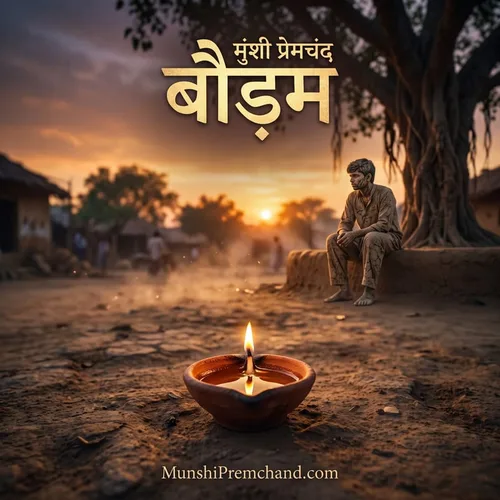
Complete English Translation: The Simpleton
1
Five days had passed since my arrival in the village of Devipur, but not a single day went by without some mention of the "Baudam"—the Simpleton.
From morning until dusk, villagers sat gathered around me. I had never before found such a glorious opportunity, nor such an intoxicating temptation, to display my extensive erudition. Lounging comfortably, I would hold forth on worldly affairs, spinning grand yarns: "The Viceroy said this to Mahatma Gandhi, and Mahatma Gandhi gave this crushing reply! What you see now is nothing; wait and see what miracles unfold! Fifty thousand brave youths are standing ready to march into British prisons! Gandhiji has issued a strict command that no trace of untouchability or caste discrimination must remain among Hindus; otherwise, our motherland will face darker days still."
The listeners hung upon my words with rapt devotion. Their faces blossomed like fresh flowers; the radiant glow of self-respect illuminated their eyes. In choked, emotional voices, they would exclaim, "Now Mahatmaji alone is our supreme hope! Ah, if only the Baudam were here—he would never have left your throat! You would have found it difficult even to eat or drink. If someone talks of such matters, he will sit listening the entire night!"
One day, I asked in curiosity, "Who on earth is this Baudam? Is he an insane madman?"
A gentleman in the circle replied, "Good sir, he is not a madman—he is simply a Baudam, a complete simpleton! His family possesses wealth in the lakhs. They own a large sugar mill in Siwan, two factories in Chhapra, and employ managers drawing salaries of three and four hundred rupees a month. Yet look at this boy—he wanders the roads in tattered rags!
"His family sent him to Siwan to oversee the mill. Within two months, he picked a quarrel with the European manager. The manager wrote to the proprietors: 'Kindly accept my resignation. Your son encourages the laborers to dance upon my head; they refuse to work with diligence.' In the end, the family was forced to recall him.
"The servants and retainers plunder the estate, and he does not care in the slightest; yet he stands guard over that mango orchard across the road day and night—woe to any village lad who dares cast a single stone at a tree!"
An elderly Muslim gentleman chimed in, "Babuji, dishes of every delicacy are cooked in his family mansion, yet in his destiny is written only coarse dry roti and watery dal—nothing else! His father purchases magnificent silks and fine clothes for him, but he will not even raise his eyes to look at them. He wanders about clad in a rough khaddar kurta and a coarse lungi tied around his waist. How far can one recount his peculiarities? He is, in short, a complete simpleton!"
2
Hearing these descriptions, my curiosity to meet this extraordinary individual grew intense.
Suddenly, someone pointed toward the road and exclaimed, "Look! There comes the Baudam!"
I turned with eager eyes. He was a sturdy, well-built youth of twenty or twenty-one years. Bareheaded, he wore a simple kurta of coarse, homespun cloth and loose cotton trousers, with ordinary shoes on his feet.
He walked directly toward me. I said, "Come, please be seated."
He cast a dismissive, indifferent glance over the assembled gathering and said, "Not right now; I shall come later."
With that, he turned and walked away.
When dusk fell and the assembly dispersed, he approached quietly from the direction of the mango orchard, took a seat beside me, and said with a faint smile, "Those people must have abused me thoroughly! I have been granted the glorious title of 'Baudam'."
I replied with some embarrassment, "Yes, they spoke of you every day. I was very eager to meet you. What is your name?"
He replied, "My name is Muhammad Khalil. But in ten or fifteen villages around here, people know me far better by my alias. My alias is 'Baudam'."
"Why do people call you a Baudam?"
Khalil shrugged, "It is their pleasure; what else can I say? I understand life rather differently. I am not even permitted to offer my five daily prayers in peace!
"There are my father and my uncle. Both gentlemen remain absorbed in business from the crack of dawn until late into the night. Day and night, their lips speak of nothing except ledgers, profits, losses, market slumps, and boom prices—as though they were not servants of God, but slaves of wealth!
"My uncle stands beside the barrels of molasses until late into the night, supervising their loading onto bullock carts. My father often weighs sacks of sugar with his own hands. They eat their midday meal at dusk, and their evening meal at midnight. Neither possesses the leisure to offer a single prayer to the Almighty!
"I say to them: 'Why do you torment your brains so endlessly? In large commercial enterprises, everything operates on mutual trust. A master must grant his subordinates some latitude. It is only petty shops that can be run entirely on one's personal brawn.'
"My philosophy pleases no one; hence, I am a Baudam!"
I smiled, "In my opinion, your philosophy is perfectly sound."
Khalil laughed, "Do not utter such a thing even by mistake, sir, otherwise there will be two Baudams sitting in the very same spot!
"People here have no concern for religion, nor for the world; neither for the country, nor for the community. I subscribe to national newspapers; I wish to dispatch funds to the Smyrna Relief Fund; I consider it my sacred duty to contribute to the Khilafat Fund. And the crowning outrage of all—I am a volunteer for the Khilafat movement!
"Tell me, sir, when enemies are assailing our people, our country, and our faith from all directions, is it not my duty to sacrifice personal wealth for the collective good? For this crime, I have been decorated with the title of 'Baudam' both at home and abroad."
I said earnestly, "You are doing precisely what our nation demands at this hour."
Khalil said, "I fear that by associating with me, you will depart from this upside-down town with a ruined reputation! When thousands of my brethren are languishing in British prisons, denied even a scrap of coarse cloth to cover their bodies, my conscience refuses to allow me to feast on rich delicacies and strut about in embroidered Lucknow chikan kurtas with ornate stitching upon the wrists and shoulders!"
"What you say is profoundly true," I replied. "It is tragic that others lack the capacity for such noble sacrifice."
Khalil shook his head, "I do not consider it a sacrifice, nor do I wear this coarse garb to show off to the world. My heart has simply turned away from luxury and vanity.
"A short while ago, my father sent me to oversee the sugar mill in Siwan. When I arrived, I discovered that the British engineer had enrolled his private cook, his bearer, his sweeper, his washerman, his gardener, and his personal watchman on the mill's payroll! They performed his private domestic chores, while their wages were paid from company funds!
"The sahib himself was utterly unprincipled, yet his tyranny over the laborers was so severe that if a poor worker arrived five minutes late, half a day's wages were deducted from his pay! I attempted to bring the sahib to his senses. I began extending concessions and fair treatment to the laborers.
"What happened? The sahib flew into a rage and threatened to resign. My family knew all about his scoundrelly character—he is a rogue of the first water! Yet the moment he threatened to resign, my family lost their wits in terror. I was summoned back by urgent telegram, and a furious scolding was heaped upon my head.
"Whatever minor deficiency remained in my reputation as a Baudam was perfected that day! God knows why people cower in such terror before these white masters!"
I said indignantly, "You did exactly what I would have done. In fact, I would first have filed a criminal suit against the sahib for embezzlement, had him thrashed by local ruffians, and only then engaged in conversation! Such knaves deserve nothing less."
Khalil laughed heartily, "Then we are truly birds of a feather! My only regret is that your stay here is so brief. I long to spend a few days in your company. After ages, I have encountered a gentleman to whom I can pour out my heart. With these ignorant rustics, I do not even care to speak.
"In his youth, my uncle had a liaison with a low-caste Chamar woman. Two children were born of that union—a boy and a girl. The mother died, leaving the baby girl in the cradle. Ever since, those two children were treated in our household as wretched pariahs. No one inquired after them; they were given neither decent food nor clothing. The poor orphans ate scraps with the domestic servants and slept outside in a thatched shed.
"Sir, I could not bear to witness such cruelty! I brought them inside, seated them at my own dining sheet, and fed them with my own hands—and I feed them there to this day!
"An uproar broke out in the mansion. Everyone scowled at me with fury, but I paid them no heed. After all, is not their blood our own family blood? For this crime, too, I am called a Baudam!"
I said with deep emotion, "Those who call you a Baudam are themselves the true fools!"
Khalil continued, "Sir, living among these people is an astonishing trial. The King of Kabul issued a royal decree forbidding cow slaughter. The venerable ulema of India issued religious fatwas against it. Yet right here in my own house, a cow was sacrificed on the festival!
"I protested with all my might, but who would listen to me? To atone for that sin, I performed penance: I sold my own riding horse and used the money to feed three hundred destitute fakirs! And ever since, whenever I see butchers driving cows down the road, I pay the price from my own pocket and purchase them. Up to this day, I have saved the lives of ten cows!
"All of them are now safely housed with Hindu families in the village. But the jest of it is that the very Hindus to whom I gifted those cows also call me a Baudam! I have grown so accustomed to this name that I have actually developed a fond affection for it."
I exclaimed, "Would that our country possessed many more such Baudams!"
Khalil smiled, "Now you too have begun flattering me!
"Look, you see that mango orchard? I guard it day and night. People say: 'Where thousands of rupees are being lost in business, he pays no attention; yet he displays such fierce vigilance over a tiny orchard!'
"Sir, the boys of this village are so destructive that they eat one mango and knock down twenty-five unripe ones with sticks and stones! So many branches are damaged that the trees are ruined for seasons. My wish is simply that the mangoes should ripen on the boughs; when they are sweet and golden, let anyone who pleases come and gather the fruit! What is the sense in destroying unripe fruit?
"This, too, is entered into the ledger of my simpleton nature!"
3
While we were conversing, a commotion arose on the road. Three or four men appeared, dragging an unfortunate village Bania merchant by the collar.
Upon inquiry, one of the captors—a man whose austere beard and demeanor proclaimed him a pious Muslim cleric—shouted, "This man is a consummate scoundrel! His measuring weights are fraudulent! Just now I purchased a seer of clarified butter (ghee) from his shop. When I weighed it at home, half a pau was missing! Now when I return to demand what was short, he claims he weighed it accurately! Ask him—if he weighed it accurately, did I swallow the ghee on the road? I am dragging him to the police station; there his hide will be properly tanned!"
The second gentleman, who was the village post office clerk (Munshi), added heatedly, "This is his habitual practice; he never gives full weight! Only today I sent my boy to purchase two annas worth of sugar. When the boy brought it home, it was scarcely worth an anna! When we returned to complain, he began rolling his eyes in defiance. His weights must be inspected by the police this very day!"
The third man was an Ahir herdsman. Dropping a heavy bundle of mustard-oil cake from his head, he cried, "Sir, this is eleven rupees worth of cattle feed! He sold it at the rate of six seers to the rupee. When I weighed it at home, it turned out to be barely two seers! I brought it back to return it, but he refuses to take it back! The matter can only be settled at the police station!"
Several onlookers in the gathering chimed in, "He is indeed a notorious rogue!"
The poor Bania pleaded with folded hands, "If my weights are found short by even the weight of a mustard seed, I will pay a fine of one thousand rupees!"
The Maulvi shouted, "Then, you rascal, you must be tilting the scales with your thumb!"
The Munshi chimed in, "He uses a trick of the hand; that is the secret!"
The Ahir shouted, "He keeps duplicate weights—one set for display, and another for selling! The police must search his shop!"
The Bania protested his innocence; the captors renewed their assault; and for half an hour the dispute raged back and forth. I could not determine what course to take—whether to intercede on the merchant's behalf or to remain silent. Everyone appeared bitterly enraged against him.
I looked around for Khalil, but he had vanished! God knows when he had slipped away.
The merchant refused to yield, declaring he had no fear of going to the police station.
The accusers were just about to drag him toward the station when the Baudam was seen walking back toward us. In one hand he carried a large wicker basket; in the other, a brass bowl; and behind him trailed a seven-year-old boy.
Approaching the Maulvi, Khalil held out the bowl and asked, "Does this brass bowl belong to your household, Qazi-ji?"
The Maulvi was startled: "Yes, it is mine. What of it? Why did you bring it from my house?"
Khalil said calmly, "Because inside this bowl is the very same half-pau of ghee regarding which you claim the merchant cheated you! The ghee is identical; the weight is identical! The dishonesty lies not with this poor merchant, but with Qazi Haji Maulvi Zahur Ahmad!"
The Maulvi blustered in fury, "Do not display your simpleton insolence here! I am not a man to be intimidated by anyone! You may be a millionaire in your own house, but what right did you have to enter my private residence?"
Khalil replied coolly, "The very same right by which you are dragging this poor merchant to the police station! Now this bowl of ghee shall accompany us to the station as well."
The Maulvi stammered in confusion, "Everyone keeps a little ghee stored in his home... By the Holy Quran, I shall go straight to your father! To this day, no man in the entire village has ever dared cast such an aspersion upon my name!"
The Bania shouted, "Where are you going, Maulvi Sahib? Come with us—let our dispute be settled at the police station! You pose as a holy cleric, a pious man of religion, as though you were an angel from heaven! Yet you conceal stolen goods in your own house and accuse an innocent man of fraud! Did you grow this long beard merely to deceive the world?"
The Maulvi, however, did not wait. Releasing the merchant, he hurried away toward Khalil's father's house—the easiest refuge to escape humiliating exposure.
Then Khalil turned to the Ahir: "Well, fellow, are you also marching to the police station? Come, I shall accompany you! I have brought this seer of cattle feed from your own cowshed."
Seeing the Maulvi's catastrophic exposure, the Ahir's face turned pale as ash. He stammered, "Bhaiya, by my youth I swear, the Maulvi Sahib coached me to make the false claim!"
Khalil scolded, "Because someone coached you, you are ready to set fire to an innocent man's home? You, who sell milk diluted with half water, have developed such brazen audacity that you seek to destroy an honest merchant? You stole the cattle feed, hid it in your shed, and then claimed the merchant gave short weight!"
The Bania cried, "Bhaiya, my commercial reputation worth lakhs has been dragged through the mud! I will not rest without filing a criminal complaint at the police station!"
The Ahir fell at his feet, "Sahu-ji, forgive me this once, or I shall be utterly ruined!"
Then Khalil turned to the post office Munshi: "Well, respected sir, shall I expose your dishonesty as well, or will you quietly take the road home?"
The Munshi blustered defensively, "What can you expose about me? Do you take me for an ignorant Ahir who will be frightened by your bluff?"
Khalil turned to the little boy: "Tell me, son, when you bought the sugar, did you walk straight home?"
The boy looked anxiously at the Munshi and whispered, "I will tell."
The Munshi interjected hastily, "Children will repeat whatever you teach them!"
Khalil said gently, "Son, repeat what you just told me a moment ago."
The boy whimpered, "Father will beat me!"
The Munshi snapped, "Did you swallow the sugar along the road, you wretch?"
The boy burst into tears.
Khalil said, "Yes, sir, the child confessed to me himself! But instead of questioning your own son, you leaped upon the throat of an innocent shopkeeper! Is this your gentlemanly honor?"
The Munshi stammered, "How was I to know the boy had committed such mischief on the way?"
Khalil retorted, "Then on what flimsy evidence were you marching to the police station? When you deliver money orders to poor, illiterate villagers, you pocket two annas as illegal commission from every rupee! You sell half-anna postcards for a full anna! I can prove it whenever you wish. Do you not consider that dishonesty?"
The Munshi deemed it prudent not to cross swords with the Baudam. Slapping the boy, he dragged him away toward home.
The Bania showered blessings upon Khalil from the depths of his soul. The spectators gradually melted away into the twilight.
I turned to Khalil and said with profound admiration, "You have saved this poor merchant's life today! Otherwise, the innocent fellow would have been ensnared in the clutches of the police."
Khalil smiled sardonically, "Do you know what reward I shall receive for this? The police sub-inspector will become my bitter enemy, complaining that I scare away his prospective victims! My father trembles in terror before the police; he will reprimand me severely: 'Why must you meddle in the affairs of others?'
"Here, this too is entered into the account of my simpleton nature! To defend an ordinary shopkeeper, it was hardly prudent of me to strip the disguise from respectable gentlemen. Such reckless folly is committed only by Baudams!"
My eyes filled with tears of deep reverence. I said in a voice trembling with emotion:
"From this day forth, I shall call you by this very name! Today I have learned that 'Baudam' is the sacred title bestowed upon angels!
"He who sacrifices his soul on the altar of selfishness is considered clever and wise by this world. But he who, before the majesty of his soul, before eternal principle, before absolute truth, cares not a straw for selfish gain or the slander of men—he alone is a Baudam, a divine simpleton!"
Summary of The Simpleton
'The Simpleton' (Baudam) is one of Munshi Premchand's most uplifting and idealistic narratives, exploring the tension between worldly cunning and genuine moral nobility.
While staying in the village of Devipur, the narrator repeatedly hears the villagers deride Muhammad Khalil, the son of a wealthy sugar mill owner, as a 'Baudam' (fool or simpleton). Intrigued by these reports, the narrator arranges a meeting with the young man, only to discover a profoundly principled, compassionate individual who has renounced luxury and devoted himself to the national independence movement.
Khalil recounts the reasons for his reputation: he was dismissed from managing his family's sugar mill in Siwan after confronting an abusive British engineer who exploited workers; he wears coarse khadi and donates to nationalist and Khilafat funds; he defied caste prejudice by adopting and feeding his uncle's ostracized, low-caste orphan children at his own dining sheet; he sold his riding horse to feed three hundred fakirs to atone for a family cow sacrifice, subsequently purchasing ten cows from butchers to place them in safe Hindu homes; and he tirelessly guards the village mango orchard so children do not ruin trees for unripe fruit.
The narrative reaches its dramatic climax when three influential village figures—a pious Muslim cleric (Maulvi Zahur Ahmad), the local post office clerk, and an Ahir herdsman—falsely accuse an innocent Bania shopkeeper of shorting their weights and attempt to drag him to the police station. While the crowd joins in condemning the merchant, Khalil quietly slips away, investigates the facts, and exposes the hypocrites: finding the missing ghee hidden in the Maulvi's own brass bowl, recovering the Ahir's stolen feed, and coaxing the Munshi's young son to admit he ate the sugar on the way home. Humbled and deeply moved by Khalil's fearless integrity, the narrator reverses the meaning of the word 'Baudam', declaring that those whom the selfish world calls fools are in truth the angels of humanity.
Publication History
'The Simpleton' (Baudam) was first published in Hindi in 1923 and subsequently included in Premchand's story collection Mansarovar (Vol. 8). Written during the height of the Non-Cooperation and Khilafat movements, the story reflects Premchand's passionate commitment to Hindu-Muslim unity, social reform, animal welfare, and the moral transformation of Indian youth.
This unabridged English translation was published in 2026 by MunshiPremchand.com as part of the MunshiPremchand.com English Translation Series.
Themes & Critical Significance
- The Inversion of Worldly Wisdom and Folly: Premchand brilliantly subverts conventional definitions of intelligence. Worldly society equates wisdom with selfish manipulation, greed, and hypocritical conformity, while branding selfless integrity, honesty, and compassion as foolishness ('Baudam').
- Communal Harmony and Practical Secularism: Through Khalil's voluntary penance for cow slaughter and his active protection of cows, Premchand presents a luminous model of interfaith empathy and shared cultural respect that transcends communal dogmatism.
- Dismantling Caste Prejudices: Khalil's insistence on treating his uncle's mixed-caste orphan children as full family members and feeding them at his table demonstrates Premchand's uncompromising rejection of caste hierarchies and social untouchability.
- Labor Rights and Anti-Imperialist Conscience: Khalil's confrontation with the British engineer at the Siwan sugar mill exposes colonial labor exploitation, asserting the dignity and fair compensation of ordinary Indian workers.
- Civic Courage against Institutional Hypocrisy: By exposing respected community leaders who conspire to frame an innocent shopkeeper, Khalil exemplifies the rare civic courage required to dismantle corrupt social power dynamics.