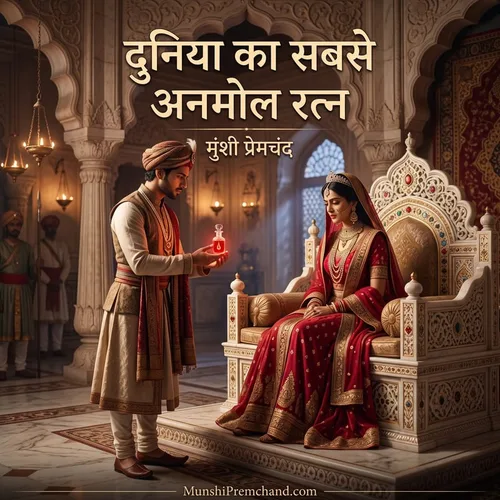
Complete English Translation: The Most Precious Jewel in the World (Duniya Ka Sabse Anmol Ratan)
Dilfigar sat beneath a thorny, desolate tree, his clothes torn in grief, shedding tears of blood. He was the true, life-sacrificing lover of the goddess of beauty herself—Queen Dilfareb. He was not one of those foppish suitors who, drenched in perfumes and oils and preening in splendid garments, merely play at being adored in the guise of lovers. Rather, he belonged to that breed of sincere, guileless, and utterly consumed devotees who dash their heads against jagged rocks and mountain precipices, wandering through wildernesses crying out their lamentations.
Dilfareb had laid down an unyielding decree before him: "If you are truly my sincere lover, go forth and bring to my royal court the single most precious thing in all the world. Only then shall I accept you into my service and grant you my hand. If you fail to find it, beware of ever turning your face back toward this realm, or I shall have you strung up upon the gallows!"
Dilfigar had not been afforded the slightest opportunity to express his surging emotions, to utter a word of grievance, or even to feast his eyes upon his beloved's dazzling countenance. No sooner had Dilfareb pronounced this sentence than her mace-bearers pushed poor Dilfigar out of the palace gates with rough shoves. And now, for three long days and nights, this wretched, stricken man had remained sitting beneath that very same thorny tree in that barren, desolate plain, racking his weary mind: What should I do? Can I ever hope to find the most precious thing in the world? Impossible! And what could it possibly be? The fabulous treasure of Karun? The elixir of eternal life, the Ab-e-Hayat? The legendary crown of Khusro? The miracle-working Cup of Jamshid? The fabled Peacock Throne? The boundless riches of Parvez? No, none of these things could possibly be it. Surely there exist things in this world far costlier, far more priceless than mere material treasures. But what can it be? Where can it be found? O God, how shall my agonizing trial be made easy?
Dilfigar’s mind reeled in these bewildering thoughts, and his intellect offered no answer. Munir Shami found a helper and protector like Hatim Tai. Ah, if only someone would rise to become my helper too! If only someone would at least tell me the name of that thing which is the most precious in all the world! Even if I failed to lay my hands upon it, at least I would know what kind of thing it was! I could willingly set out in search of a pearl as immense as an earthen water-pot. I could gird my loins to search for the song of the roaring ocean, the heart of a stone, the audible voice of Death itself, or things even more mysterious and untraceable than these. But the most precious thing in the entire world! This soars far above the loftiest flight of my imagination.
Stars began to glimmer across the vault of heaven. Dilfigar suddenly invoked the name of the Almighty, rose to his feet, and began walking into the unknown. Hungry, thirsty, barefoot, his body bare and broken with utter exhaustion, he wandered for years through desolate wildernesses and inhabited cities alike, sifting the dust of distant realms. The soles of his feet became lacerated with thorns; his flesh wasted away until his skeletal frame showed through his skin. Yet that thing which was the most priceless treasure in the world remained undiscovered, leaving not even the faintest whisper of a trace.
One day, wandering aimlessly, he arrived at an open plain where thousands of people stood assembled in dense circles. In the center, several bearded Qazis wearing elaborate turbans and voluminous robes sat with stern, magisterial authority, conferring together in solemn consultation. A short distance from this tribunal stood a tall wooden gallows. Dilfigar, partly from sheer physical weakness and partly curious to witness what was unfolding, came to a halt.
What did he see? Several soldiers, bearing naked swords, were marching forward with a prisoner whose hands and feet were bound in heavy iron chains. Upon reaching the foot of the gallows, the soldiers halted, and all the prisoner’s handcuffs and fetters were struck off. The garments of this unfortunate man were stained with the blood of hundreds of innocent victims; his hardened heart had never once felt the whisper of virtue nor known the call of mercy. He was notorious throughout the land by the name of Kala Chor—the Black Bandit.
The guards forced him onto the wooden platform of the scaffold and slipped the deadly noose around his neck. The executioners were just about to pull the lever of the trapdoor when the wretched criminal cried out with desperate urgency: "For the love of God, take me down from the noose for just one single moment, so that I may fulfill the last longing of my heart!"
Upon hearing this, a breathless hush fell over the entire assembly. The spectators stared in astonishment. The Qazis deemed it inappropriate to deny the final dying plea of a condemned man, and the unfortunate sinner, Kala Chor, was taken down from the gallows for a brief moment.
Amidst that massive crowd, a lovely, innocent little boy was riding a wooden stick, leaping about on his little feet, galloping his make-believe horse. He was so absorbed in his pure world of make-believe that he truly fancied himself an intrepid equestrian mounted on a magnificent Arabian steed. His glowing face bloomed like a fresh lotus with that authentic, untainted joy that is granted only for a few fleeting days in early childhood—a joy whose lingering memory remains unforgotten until a person's dying breath. His heart was as yet untouched by the dust and corruption of sin, and innocence cradled him tenderly in its lap.
The condemned bandit stepped down from the scaffold. Thousands of eyes were riveted upon him. He walked over to the little boy, lifted him gently into his arms, and showered him with tender affection. At that moment, memories of his own distant childhood surged through his mind—when he, too, had been just as innocent, just as joyful, and just as pure and untainted by the filth and wickedness of the world; when his mother had rocked him lovingly in her lap, his father had warded off evil spirits from his head, and his entire family had been ready to sacrifice their very lives for him.
Alas! The remembrance of those bygone days fell with such staggering force upon the hardened heart of Kala Chor that from his eyes—eyes that had stared unmoved at thrashing, dying corpses without ever blinking—a single tear fell.
Dilfigar darted forward and caught that priceless pearl in his open palm. His beating heart cried out from within: Undoubtedly, this is the most precious thing in all the world, before which the Peacock Throne, the Cup of Jamshid, the Water of Life, and the boundless gold of Parvez are mere trifles!
Exulting in this conviction and intoxicated with the bright hope of victory, Dilfigar set out on the journey back toward Minosabad, the royal city of his beloved Dilfareb. Yet, as he covered stage after stage of the long journey, his heart began to sink with dread: What if this thing, which I regard as the most precious treasure in the world, holds no worth in the discerning eyes of Dilfareb? I shall be hauled onto the gallows and depart this world in utter ruin and failure! But come what may, my fate is cast.
At last, having traversed rugged mountains and wide rivers, he arrived in the city of Minosabad. Approaching the palace threshold of Dilfareb, he sent word: "Exhausted and broken Dilfigar has, by the grace of God, returned after fulfilling your command, and begs leave to kiss your noble feet."
Dilfareb immediately summoned him into her royal presence and, speaking from behind a resplendent golden curtain, commanded: "Present that priceless treasure!"
In a state of mingled hope and terror, Dilfigar presented that teardrop and recounted its entire history in moving, evocative words. Dilfareb listened attentively to the whole story. Taking the gift into her hand, she reflected in silence for a few moments, and then spoke:
"Dilfigar, you have indeed brought forth an extremely precious thing from this world, and I applaud your courage and your deep insight! Yet this is not the single most precious thing in the world. Therefore, depart from here and strive once more. Perhaps this time fortune will grant you that true pearl, and it will be written in your destiny to enter my royal service. As I declared before, I have the full right to send you to the gallows; but I spare your life, because you possess those rare virtues that I desire to see in my lover. I have complete faith that you shall succeed one day."
Unsuccessful and crestfallen, Dilfigar drew a measure of courage from this tender concession of his beloved and spoke: "O Queen of my heart! After such an eternity of exile, it has been granted to me to prostrate myself at your threshold. God alone knows when such an auspicious day shall dawn again. Will you not take pity upon the miserable state of your life-sacrificing lover? Will you not grant him just one fleeting glimpse of your radiant beauty, to fortify this burning heart of Dilfigar with the strength to endure the harsh trials to come? Intoxicated by a single glance from your enchanting eyes, I could achieve feats that no mortal has ever accomplished!"
Dilfareb, hearing these impassioned entreaties of her lover, flared with indignation and commanded: "Cast this madman out of the royal court on the spot!" The mace-bearer immediately pushed poor Dilfigar out of his beloved’s threshold into the street.
For some time, Dilfigar wept bitterly over the cruel severity of his heartless beloved. Then he began to ponder: Where shall I go now? After measuring endless roads and wandering across wildernesses for years, I found that single teardrop. What thing on this earth could possibly possess a greater worth than such a luminous pearl? O Holy Khwaja Khizr! You guided Alexander the Great to the hidden well of the Water of Life; will you not grasp my helpless hand? Alexander was the master of the entire known world, while I am but a destitute, homeless wanderer. You have steered countless sinking ships safely to the shore; row the boat of this poor wretch to salvation as well! O exalted Angel Gabriel! Take pity upon this half-dead, sorrow-stricken lover! You are a favored courtier of the Divine Throne; will you not ease my excruciating trial?
In short, Dilfigar cried out in desperate supplication, but no one stepped forward to take his trembling hand. At last, sinking into total despair, he rose once more like a wanderer driven mad and set out on the road.
Dilfigar sifted the dust of countless forests and desolate wastes from east to west and north to south. Sometimes he slept on freezing snow-capped mountain peaks; sometimes he wandered through terrifying, shadow-draped gorges. But that elusive object of his relentless quest was nowhere to be found, until his flesh withered and his body was reduced to a mere cage of bones.
One evening, he lay collapsed in a state of utter exhaustion on the banks of a river. Coming to from a stupor of delirium, what did he behold? A sandalwood funeral pyre had been erected, upon which sat a young woman adorned in her bridal garments and embellished in all sixteen traditional ornaments. In her lap lay the head of her beloved deceased husband. Thousands of spectators stood gathered in solemn circles around the pyre, showering fresh blossoms upon her.
Suddenly, a flame burst spontaneously from within the pyre itself. The countenance of the faithful wife shone with a sublime, divine radiance. The sacred tongues of fire wrapped their embrace around her neck, and in an instant, that flower-like body was reduced to a heap of ashes. The devoted lover had sacrificed her very life for her beloved; the final earthly drama of two souls bound in pure, immortal love had vanished from sight.
When the assembled crowd dispersed and returned to their homes, Dilfigar rose softly in the shadows, gathered the heap of sacred ashes into the torn hem of his tunic, and holding this handful of ashes—convinced that it was the most precious treasure in the universe—he set off, intoxicated with the dream of triumph, back toward the street of his beloved.
This time, as he drew closer to his destination, his confidence swelled. An inner voice whispered within his breast: This time victory is yours! The radiant dreams that this conviction painted upon his heart need hardly be described.
At last, he entered the city of Minosabad and presented himself at Dilfareb's lofty threshold, announcing: "Dilfigar has returned victorious and triumphant, and begs leave to appear before Her Majesty."
Dilfareb immediately summoned the daring lover into her court and extended her royal hand to receive the thing deemed the most precious in the world. Dilfigar summoned his courage, kissed her silver-like wrist, placed the handful of ashes into her delicate palm, and related the entire moving tale in words capable of melting the hardest stone. He then waited with bated breath to hear the blessed verdict of his destiny from the lips of his beautiful beloved.
Dilfareb pressed that handful of ashes reverently to her eyes. After remaining submerged in deep contemplation for some time, she spoke:
"O life-sacrificing lover Dilfigar! Undoubtedly, these ashes you have brought—which possess the wondrous virtue of turning iron into pure gold—are a priceless treasure in this world, and I thank you from the depths of my heart for presenting such a magnificent offering. Yet there exists something in this world even more precious than this. Go forth, search for it, and only then return to me. I pray from the bottom of my heart that God grants you success."
Saying this, she stepped briefly from behind the golden curtain, revealed a fleeting, bewitching glimpse of her matchless beauty with coquettish grace, and vanished from sight once more.
Before Dilfigar could even regain his scattered senses, the mace-bearer gently took him by the hand and escorted him out of his beloved’s threshold. And once again, for the third time, the worshipper of love was plunged into the bottomless ocean of despair.
Dilfigar’s courage finally broke completely. He became utterly convinced that he had been created in this world only to perish in hopeless ruin and unfulfilled misery. There remained no alternative now but to climb to the summit of a lofty mountain and fling himself into the abyss below, so that not even a single bone might remain to lodge a complaint against the cruelties of his beloved.
He rose like a madman and, stumbling and falling, dragged himself to the peak of a sky-scraping mountain. At any other time, he would never have had the daring to scale such a dizzying precipice, but now, in the wild fervor of seeking death, that immense mountain appeared no higher than a common hillock.
He was on the very verge of leaping into the void when an elderly venerable sage, dressed in radiant green garments and wearing a green turban, carrying a prayer rosary in one hand and a walking staff in the other, appeared before him. In an encouraging, commanding voice, the sage spoke:
"Dilfigar! Foolish, ignorant Dilfigar! What cowardly conduct is this? You make boastful claims of true love, and yet do you not even know that an iron will is the very first milestone on the pathway of love? Act like a true man; do not lose heart! Far to the east lies a sacred land called Hindustan. Go there, and your heart's supreme desire shall be fulfilled!"
Having uttered these words, the venerable Khwaja Khizr vanished into thin air.
Dilfigar offered a prayer of profound thanksgiving. Sustained by renewed courage, fresh passion, and the wondrous assurance of supernatural guidance, he climbed down the mountain in joyful spirits and set his face resolutely toward Hindustan.
After enduring endless journeys through thorn-strewn forests, scorching deserts where the skies rained fire, perilous gorges, and barren, impassable mountains, Dilfigar finally set foot upon the sacred soil of Hind. Washing away the grime and agony of his travels in a cool, murmuring freshwater spring, he collapsed on the riverbank from sheer exhaustion.
By the time evening fell, he had reached a vast, desolate open plain littered with countless dead and dying corpses lying uncoffined and unburied under the open sky. Vultures, crows, and savage carnivores roamed everywhere, and the entire battlefield ran red with rivers of human blood.
At the sight of this gruesome, horrifying spectacle, Dilfigar’s heart quaked with terror. O God, what frightful nightmare is this? The groans of the dying, the ragged gasps for air, men in agony scraping their heels against the blood-soaked earth as life ebbed away, wild beasts tearing flesh from splintered bones and darting away with raw morsels—never in his life had Dilfigar witnessed such a ghastly scene. Suddenly it struck him: This is a battlefield, and these corpses belong to valiant warrior heroes.
Just then, he heard a faint groan nearby. Dilfigar turned toward the sound and saw a tall, powerfully built man whose manly, heroic countenance had turned ashen pale from the draining of life, lying with his head resting upon the bare ground. A fountain of blood poured steadily from his shattered chest, yet his clenched fist still held fast to the hilt of his gleaming sword.
Dilfigar tore off a strip of cloth and pressed it against the gaping mouth of the wound to staunch the flow of blood, asking gently: "O brave warrior, who are you?"
Hearing this, the warrior opened his eyes and spoke with heroic defiance: "Do you not know who I am? Did you not witness the terrible sharpness of this sword today? I am the son of my mother and a noble warrior son of Bharat!"
As he spoke these words, his brows knit in fierce pride. His pale face flushed crimson with righteous fury, and his tempered blade flashed once more as if eager to display its deadly prowess.
Dilfigar realized that the dying man took him for an enemy soldier. He said softly: "O valiant hero, I am not your enemy. I am merely a destitute traveler driven from his native land, who happened to wander into this place. For kindness' sake, tell me what has taken place here."
Hearing these words, the wounded warrior spoke in a voice of profound sweetness: "If you are indeed a traveler, come and sit beside my blood-soaked flank, for these two finger-widths of earth are the only land left to me now, and nothing except Death itself can tear them from my grasp! Alas, that you have arrived at a moment when I am powerless to offer you the hospitality due to a guest. The ancestral land of our forefathers has slipped from our hands today, and at this hour we are left homeless without a motherland. But—" (he shifted onto his side) "—we have taught the invading enemy a lesson they shall never forget! Those piles of corpses you see strewn across this field belong to those who were sent to the realm of death by the edge of this very sword!" (He smiled faintly.) "And though I am left without a country, it is a blessing that I am not drawing my last breath upon the soil of the enemy!"
Ripping the bandage away from his bleeding chest, the warrior cried: "Did you place this plaster here? Let the blood flow! What is the use of holding it back? Should I stay alive merely to live in shameful slavery in my own motherland? No! Better to die a thousand deaths than lead such a degraded life. A nobler, more glorious death than this is not possible!"
The brave warrior's voice grew faint and hoarse; his limbs relaxed their tension. So much blood had poured forth that the flow began to halt of its own accord, trickling only in stray, lingering drops. Finally, his entire body grew still, the beating of his valiant heart ceased, and his eyes closed forever. Dilfigar thought the warrior's spirit had departed, when suddenly the dying hero whispered softly with his last breath:
"Victory to Mother India! Bharat Mata ki Jai!"
And with those words, the very last drop of blood fell from his chest.
A true patriot and devoted son of the nation had paid the ultimate debt of love to his motherland.
This sublime scene made an overwhelming, indelible impression upon Dilfigar. The voice of his soul cried out: Without a doubt, there cannot exist anything in the entire universe more priceless than this single drop of blood!
Instantly, he caught that sacred drop of blood—before which the finest rubies of Yemen pale into insignificance—in his trembling hands. Marveling at the matchless valor and sacrifice of this brave Rajput hero, he set out on his journey back toward his homeland. Enduring countless hardships, he arrived after many long days at the palace threshold of Queen Dilfareb, the queen of beauty, and sent word: "Dilfigar has returned victorious, crowned with honor, and craves audience in the royal court."
Dilfareb immediately commanded that he be ushered into her presence. Seated as usual behind her shimmering golden curtain, she spoke: "Dilfigar, this time you have returned after a very long absence. Bring forth the most priceless treasure in the world—where is it?"
Dilfigar, kissing her henna-dyed palms with profound reverence, placed that sacred drop of blood upon her hand, and recounted the entire saga in a voice ringing with passionate fervor.
Before he had even finished speaking, the golden curtain was swept aside in an instant, and Dilfigar found himself gazing upon a magnificent court of dazzling splendor, where every maiden present surpassed even the legendary beauty of Zulaikha. Dilfareb was seated in royal grandeur upon an opulent golden throne.
Dilfigar stood spellbound, rooted like a painted portrait before this talisman of breathtaking splendor. Suddenly, Dilfareb rose from her throne, stepped several paces forward, and embraced him passionately. The royal songstresses burst into melodious hymns of joy; the courtiers showered Dilfigar with gifts and tributes; and the radiant pair, shining like the sun and the moon, were seated with highest honors side by side upon the royal throne.
When the captivating melody came to an end, Dilfareb rose, clasped her hands before Dilfigar, and spoke:
"O devoted, life-sacrificing lover Dilfigar! My prayers have been answered at last. God has heard my supplications and brought you home victorious, crowned with eternal honor. From this day forth, you are my lord and master, and I am your humble handmaiden!"
Having said this, she commanded a jewel-encrusted casket to be brought forward. From within it, she took out a golden plaque, upon which was inscribed in radiant golden letters:
'That final drop of blood which is shed in defense of the motherland is the most precious thing in all the world.'
Summary of Duniya Ka Sabse Anmol Ratan
Dilfigar, an ardent lover, is deeply devoted to Queen Dilfareb, who challenges him to prove the authenticity of his love by bringing her the single most precious treasure in the world. Banished from her court until he succeeds, Dilfigar embarks on an arduous quest across distant lands.
His first discovery is a tear shed by a notorious, condemned criminal named Kala Chor under the gallows, born of spontaneous remorse upon witnessing an innocent young boy playing joyfully. Believing this rare tear of repentance to be priceless, Dilfigar brings it to Dilfareb. While she acknowledges its immense moral beauty and spares his life, she declares it is not the world's most precious jewel and sends him away to try again.
On his second quest, after years of searching, Dilfigar witnesses a devoted woman voluntarily immolating herself upon the sandalwood funeral pyre of her deceased husband in an act of supreme marital fidelity. Gathering a handful of her sacred ashes, which symbolize transformative love, Dilfigar returns to Minosabad. Dilfareb reverently touches the ashes to her eyes and acknowledges their extraordinary worth—capable of turning iron into gold—yet explains that an even greater treasure exists.
Driven to despair and on the verge of hurling himself from a mountain peak, Dilfigar is stopped by the prophet Khwaja Khizr, who rebukes his cowardice and directs him east to Hindustan. There, Dilfigar encounters a gruesome battlefield where a mortally wounded Rajput warrior lies dying. The warrior refuses medical aid, proudly declaring that he will not live to see his homeland enslaved, and with his dying breath cries "Bharat Mata ki Jai!" as the final drop of blood trickles from his chest.
Dilfigar collects this sacred drop of blood and presents it to Queen Dilfareb. Recognizing that supreme self-sacrifice for the freedom and honor of one's motherland surpasses all worldly riches, moral tears, and romantic devotion, Dilfareb sweeps aside the curtain, welcomes Dilfigar into her embrace, and declares him her lord, unveiling a golden plaque that permanently enshrines the truth: the last drop of blood shed in defense of one's homeland is the most precious thing in the world.
Publication History
Duniya Ka Sabse Anmol Ratan ("The Most Precious Jewel in the World") holds a historic place in Indian literature as Munshi Premchand's very first published short story, appearing under his original pen name, Nawab Rai. Although early literary accounts by his son Amrit Rai dated its appearance to 1907 in the prominent Urdu journal Zamana (edited by Munshi Daya Narain Nigam in Kanpur), subsequent bibliographic research clarified that while it was composed around 1907, it was published in 1908 in Premchand's historic debut collection Soz-e-Watan ("The Dirge of the Nation").
Due to its fiery anti-colonial nationalist fervor and call for patriotic martyrdom, Soz-e-Watan was seized, banned, and publicly burned by the British colonial administration in 1909, compelling the author to adopt the pseudonym "Premchand" to avoid imprisonment. The Hindi text of the story was later published in Soz-e-Watan (1961) and in Gupt Dhan, Volume 1 (1962).
This unabridged English translation was published in 2026 by MunshiPremchand.com as part of the MunshiPremchand.com English Translation Series.
Themes & Critical Significance
- Patriotism as the Supreme Virtue: The central philosophical assertion of the story is that the highest possible human endeavor is the defense of one's motherland. By elevating the warrior's dying drop of blood above the criminal's tear of repentance and the faithful wife's ashes of romantic devotion, Premchand establishes national freedom and sovereignty as the supreme moral value.
- Evolution from Romantic Love to National Devotion: The narrative begins within the traditional conventions of Persianized romance (the lover enduring impossible trials to win the favor of a demanding beloved). However, Premchand subverts this courtly romantic trope, transforming a personal quest for romance into an allegorical awakening to anti-colonial patriotism.
- Hierarchy of Sacrifices: Premchand carefully constructs a three-tiered hierarchy of human values:
- Moral Contrition: The tear of a sinner recognizing innocence and repenting his misdeeds.
- Domestic & Romantic Fidelity: The ashes of conjugal devotion and marital self-immolation.
- Collective Liberation: The blood of a patriot dying willingly to resist enslavement and protect the collective motherland.
- Anti-Colonial Subtext in Colonial India: Written during the height of the Swadeshi movement and the initial revolutionary upsurge following the 1905 Partition of Bengal, the dying Rajput's declaration—refusing to live as a slave in his own land—served as an unmistakable call to Indian youth to resist British imperial subjugation.
- Allegorical and Mythic Structure: Using the framework of classical Eastern folk tales, dastan traditions, and figures such as Khwaja Khizr and Hatim Tai, Premchand blends fairy-tale romance with modern nationalist politics, making the message both enchanting and politically potent.