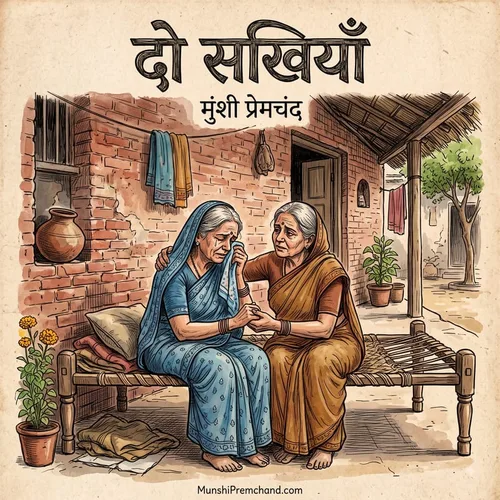
Complete English Translation: Do Sakhiyan (Two Friends)
Letter 1: Padma to Chanda
Lucknow
July 1, 1925
Dearest Sister,
Ever since I arrived here, thoughts of you have haunted me incessantly. If only you could come and stay with me for a few days—what splendid days they would be! I would introduce you to my Vinod. Is that truly impossible? Will your parents not grant you even this shred of liberty? My only astonishment is how you manage to live bound in such heavy shackles! For my part, I could not endure such confinement for even a single hour. I thank God that my father is not one of those who blindly tread the beaten path of ancient traditions. He is a devotee of those modern ideals that have transformed a woman's life into heaven. Had it not been for him, I would have been ruined.
Vinod has only recently returned from England after completing his D.Phil., and before embarking upon the formal voyage of life, he desires to travel around the entire world. He has already seen most of Europe, but he cannot rest until he has toured America, Australia, and Asia. He particularly intends to make a thorough study of Central Asia and China. His express aim is to shed illuminating light on precisely those matters which European travelers failed to comprehend. I speak the honest truth, Chanda—never in my life have I seen a man so brave, so fearless, and so idealistic. Listening to his conversation leaves me spellbound. There is scarcely a subject in which he is not thoroughly versed, or on which he cannot offer profound criticism; and his are no mere bookish observations, but brim with genuine originality and freshness. As for freedom, he is its absolute devotee. What woman on earth, becoming the wife of such a man, would not swell with pride over her good fortune?
Sister, how can I describe to you the state of my heart each morning when I watch him walking toward our bungalow? My soul yearns to surrender itself completely to him. He has taken up residence within the deepest recess of my spirit. Between the ideal man I once envisioned in my imagination and Vinod himself, there is not the width of a single hair's difference. Yet night and day, a ceaseless dread torments me—what if he discovers some shortcoming, some defect in me? I sit awake until midnight studying the very subjects in which he takes an interest. Never before have I laboured with such diligence! Never was I so attached to my comb and mirror; never did I commit wise maxims and literary witticisms to memory with such eager passion. If, after striving so hard, I fail to win his heart, then sister, my entire life will be laid waste, my heart will shatter, and this vast world will become a desolate wilderness for me.
Perhaps the sentiment of jealousy rises in the heart alongside love itself. Whenever I see him walking toward my bungalow and catch sight of my neighbour Kusum stepping out to stand on her veranda, my heart wishes that her eyes would lose their sight forever! Yesterday, an outright catastrophe occurred. The moment Vinod saw her, he tipped his hat and smiled. And that shameless hussy began grinning back at him from ear to ear! May God inflict every calamity upon a person, but spare them false vanity. Her face resembles a witch, yet she imagines herself an apsara, a celestial nymph! She writes verses, and several magazines have actually printed her poetry. Because of that, her feet scarcely touch the ground. Truly, for a brief while, my reverence for Vinod vanished entirely. A violent rage seized me; I wanted to rush out and scratch Kusum's face off! Fortunately, the two of them did not exchange words. But when Vinod entered and sat down, I could not bring myself to utter a single syllable to him for half an hour. It was as if his words had lost their magic, as though all sweetness had drained from his voice.
From that hour until now, the agitation in my breast has not subsided. I could not sleep all night; that same hateful scene replayed itself before my eyes again and again. I have hatched countless schemes to humiliate Kusum. If I did not dread that Vinod might deem me petty and shallow, I would have laid bare the raw agony of my heart to him plainly. I desire to become entirely his, and I wish to make him entirely mine. I am certain that even if the most handsome youth in the world stood before me, I would not raise my eyes to glance at him. Why does Vinod not harbour this identical sentiment toward me?
Chanda, darling sister—please come away for a single week! My heart grows restless to embrace you. At this moment, I desperately need your counsel and your sympathy. This is the most delicate, critical juncture of my existence. In these next ten or five days, I will either turn to gold through the philosopher's stone, or be reduced to worthless dust. Look, the clock has struck seven, and I have not even combed my hair yet! It is the hour of Vinod's arrival. I must bid you farewell. Pray that the wretched Kusum does not stand upon her veranda again today. My heart trembles already. Yesterday I consoled myself thinking he had merely smiled out of polite innocence; but if that spectacle repeats itself today, I shall not be able to pacify my heart so easily.
Yours,
Padma
Letter 2: Chanda to Padma
Gorakhpur
July 5, 1925
Dear Padma,
Well, after an entire epoch, you have finally deigned to remember me! I had assumed you had departed for the other world. This is merely the punishment for your cruelty that Kusum is meting out to you! College closed on the fifteenth of April, and you write your first letter on the first of July—after two and a half months, and even that solely by Kusum's grace! While you shower curses upon Kusum, I send her my heartfelt blessings. Had she not blocked your path like a severe affliction, why on earth would you have remembered me?
Be that as it may, the portrait you have painted of Vinod is remarkably attractive, and I pray to God that the blessed day arrives swiftly when I may greet him as my brother-in-law. But take heed: under no circumstances must you enter into a civil marriage! The wedding must be solemnized strictly according to traditional Hindu rites. Yes, you have every right to discard those hundreds of absurd, meaningless ceremonial clothes and frivolous conventions. But do summon a true, learned pandit—not so he may fleece coins from you at every turn, but so he may ensure that every ritual is conducted in accordance with the scriptures.
Now ask me why I remained silent for so long! In my own clan, during these two and a half months, no fewer than five weddings took place. There was an endless procession of wedding parties. Scarcely a day passed with fewer than a hundred guests in the house, and whenever a groom's party arrived, their numbers swelled to five hundred. All five of these brides are younger than I am. Had I my way, I would not have spoken of marriage for another three or four years; but who listens to me? And when I reflect upon it deeply, it seems to me that parents are not entirely unjustified in rushing to marry off their daughters. Life has no certainty. If parents die prematurely, who will arrange the daughter's marriage? Can one rely upon brothers? If the father has left behind abundant wealth, it may matter little; but as typically happens, if the father leaves behind a burden of debt, a sister becomes an unbearable load upon her brothers. Like so many other Hindu customs, this too is fundamentally an economic dilemma, and until our economic condition improves, this custom will not be eradicated.
Now the turn for my sacrifice has arrived. Fifteen days from today, this paternal home will become a foreign land to me. If I return for two or four months, it will be merely as a guest. My Vinod is a gentleman from Banaras; he is currently studying law. His father is an eminent advocate. I hear they possess several villages, multiple mansions, and immense social prestige. I have not yet set eyes upon the groom. Father sent word asking if I wished him to invite the prospective groom so I might see him. But I said there was no need. Who can predict what kind of daughter-in-law a girl will make in a household? Marriage is ultimately a bargain with destiny. Neither Father can peer into another person's inner heart, nor can I. Even if I had seen him once or twice, or conversed with him, could we have truly tested and evaluated each other? That is utterly impossible. At most, we could have inspected each other's outward complexion and physical features. On that score, I have full faith that Father is no less discerning than I am. My two elder brothers-in-law may not be statues of supreme beauty, but no woman could ever loathe them. My sisters lead joyful lives with them. Why, then, would Father commit an injustice against me alone?
I admit that in our society, the married lives of some people are far from blissful; but is there any society in the world devoid of miserable families? And furthermore, the fault does not invariably lie with men; very often, women themselves are the roots of bitterness and poison. For my part, I look upon marriage as a solemn vow of service and sacrifice, and it is in that sacred spirit that I welcome it.
Yes, I certainly do not wish to steal you away from Vinod, but if you could manage to come for just two days before the twentieth of July, you would grant me new life. As the day of this solemn vow draws near, an unknown dread grips my heart; but you are sick with love yourself—what medicine could you possibly offer me? Still, do come, dearest sister!
Yours,
Chanda
Letter 3: Padma to Chanda
Mussoorie
August 5, 1925
Dearest Chanda,
There are hundreds of things to write, and I do not know where to begin. First and foremost, I beg your forgiveness for being unable to attend your auspicious wedding. I had firmly resolved to come—how could I possibly miss the swayamvara of my darling Chanda? But exactly three days before the date, Vinod surrendered himself to me so completely, so enchantingly, that I lost all awareness of the world.
Ah! Those warm, impassioned, trembling words that sprang from the very depths of his loving heart still echo in my ears. I stood there, while Vinod knelt on the floor before me, the very picture of earnest inspiration, humility, and devotion. Such an occasion arrives in a person's life only once—only once!—yet its sweet remembrance permeates every fiber of one's existence like heavenly music. You will understand that ecstasy: I began to weep! I cannot tell you what turbulent emotions surged within my heart, but streams of tears flowed from my eyes. Surely that is the ultimate summit of bliss.
I had grown somewhat despondent in the preceding days. For three or four days, I had noticed Vinod conversing cordially with Kusum whenever he arrived or departed. Kusum was constantly adorned in new ornaments, and what can I say—one day Vinod even recited one of Kusum's poems to me, swaying his head in admiration over every single word! Being naturally proud and sensitive, I thought: If he is infatuated with that witch, what need do I have to ruin my peace of mind over him? The next morning, when he came to visit, I sent word through the servant that I was unwell. When he insisted on seeing me, I was compelled to enter the drawing room. I had come with a resolute mind, intending to tell him plainly: Please do not visit me any longer. I am not worthy of you; I am no poet, no scholar, no eloquent orator... A whole prepared speech was surging in my mind. But the moment I stepped into the room and saw Vinod's longing, ardent eyes and his lips trembling with intense emotion—sister, I cannot describe that overwhelming passion! Vinod did not even permit me to sit down. He dropped to his knees upon the carpet before me, and his eager, frenzied words caused my heart to swell like the rising tide.
A week flew by in joyous wedding preparations. Papa and Mama were beside themselves with delight.
And happiest of all was Kusum! The very Kusum whose countenance I had so detested! Now I realized that by doubting her, I had committed a grave injustice against her noble soul. Her heart is utterly guileless; within it lies neither jealousy nor selfish craving—service is the fundamental essence of her life. I cannot imagine how those seven days would have passed without her. I had become somewhat dazed and lost in a reverie. I entrusted my entire burden to Kusum. In selecting jewelry, arranging ornaments, and choosing the colours and tailoring of garments, her refined taste is extraordinary. On the eighth day, when she finished adorning me as a bride, I looked into the mirror and stood astonished at my own reflection! Never had I imagined myself to be such an ethereal beauty. A sweet intoxication of pride swept over my eyes.
That very evening, Vinod and I, like two distinct streams uniting at a sacred confluence, merged into one indivisible soul. Preparations for our holiday trip had been made in advance, and early the next morning we departed for Mussoorie. Kusum came to the railway station to see us off, and she wept copiously as we parted. I desperately wished to bring her along with us, but for some unknown reason she would not agree.
Mussoorie is breathtakingly beautiful, beyond all doubt. Dark wreaths of clouds rest gently upon the mountain peaks; the cool mountain breeze gladdens the spirit like waves of hope. Yet I truly believe that with Vinod by my side, I would live with equal joy in a barren, solitary wilderness. Having won him, I cherish no lingering desire for any worldly thing. Sister, you could perhaps never imagine such a joyous existence. Dawn breaks, breakfast arrives, and the two of us eat together; the dandi palanquin is ready, and by nine o'clock we set out for an excursion. We sit beside some cascading waterfall, listening to the sweet music of rushing waters, or recline upon a rocky cliff watching the aerial dance of clouds across the sky. By eleven we return. We take our lunch. Then I sit at the piano. Vinod is deeply fond of music; he sings exquisitely himself, and whenever I begin to sing, he sways in utter enchantment. In the afternoon, we rest for an hour and then go out to play tennis or watch a match. At night, after dinner, we attend the theatre, and upon returning, retire to bed. There are no scoldings from a mother-in-law, no conspiratorial whisperings from sisters-in-law, no sharp taunts from elder brothers' wives!
Yet amidst all this bliss, a subtle dread occasionally pierces my heart—is there a sharp thorn concealed within this fragrant blossom? Does darkness lurk behind this radiant light? I cannot fathom why such an apprehension visits me.
Ah, look! The clock has struck five. Vinod is dressed and ready; we are going to watch a tennis tournament today. Let me get ready in haste. I shall write the rest another time.
Yes, I was almost forgetting the most important matter! Do write to me with news of your wedding. How is your lord and husband? What is his appearance and complexion? Did you depart for your in-laws' home, or are you still at your parents' house? If you went to your marital home, you must describe your experiences there in detail. You must have been put on grand display! The women of the family, clan, and neighbourhood must have lifted your veil repeatedly to inspect your face, putting you through a rigorous examination! Write all of this at length. Let us see when we might meet again.
Yours,
Padma
Letter 4: Chanda to Padma
Gorakhpur
September 1, 1925
Dearest Padma,
Reading your letter brought immense peace and relief to my heart. When you failed to arrive, I had already deduced that Babu Vinod had abducted you; but I had no inkling that you had reached Mussoorie! Surrounded by such merrymaking and luxurious diversion, why on earth would you remember poor Chanda? Now I am beginning to comprehend the vast gulf that separates the modern ideal of marriage from the ancient one. You exercised your own free choice, and you are blissfully happy. I remained a submissive slave to social convention, and now I am left weeping over my fate.
Well, listen now to the tale of my misfortune. I had no concern with the squabbles of dowry and gifts. Father has been blessed with an exceptionally generous heart, and he must have given lavishly with an open hand. But the moment the groom's wedding party arrived at our gates, my trial by fire commenced. How intense was my yearning to catch a single glimpse of the groom! Yet how could I look? The sacred honour of the family lineage would have been tarnished. The wedding procession arrived at the gate; a vast crowd of spectators encircled the groom. I thought to myself: Let me look down from the terrace. I ascended to the roof, but could see nothing from there either. Yes, for committing that terrible crime, I had to endure Mother's furious scoldings. Whatever I do that displeases these people is immediately blamed on my modern education! Poor Father sympathizes with me deeply, but how many mouths can one man silence?
The welcoming ceremony at the door passed off in this fashion, and preparations began for the circumambulation of the sacred fire. From the groom's lodgings arrived the platters containing jewelry and wedding attire. Sister! The entire household—men and women alike—pounced upon those platters as though they had never laid eyes on ornaments before! One complained: "They haven't even brought a choker necklace!" Another wailed over the weight of the garland! Mother actually began to weep aloud, as if her daughter had been drowned in ruin! The groom's family was subjected to unstinting, venomous criticism. But I did not cast so much as a single glance toward the jewels. Whenever anyone mentioned anything regarding the groom, however, I listened with rapt, breathless attention. I learned that he is a slender man, of dark complexion, with large, expressive eyes and a cheerful, smiling countenance. These details only inflamed my yearning to behold him.
As the auspicious hour for the seven rounds drew near, my heart grew increasingly agitated. Even though I had not caught even the fleeting shadow of his face, I felt an unprecedented, boundless love welling up within me for him. At that moment, had I been told that any harm had befallen him, I would have lost my senses. I had not met him face to face; I had not heard the sound of his voice; yet the most handsome man in all creation could not have swayed my heart from him. He was now my all in all.
After midnight, the circumambulation ceremony took place. The sacrificial fire-pit burned before us; learned Brahmins sat on either side; oil lamps flickered; the consecrated images of the family deities were installed. Vedic mantras were being chanted. At that transcendent moment, it seemed to me as though the living gods were truly present. The sacred fire, the wind, the lamps, the distant stars—all appeared radiant with divine glory. For the very first time in my life, I experienced a true spiritual awakening. When I bowed my head before the sacrificial flame, it was no empty observance of ritual; I beheld the God of Fire manifest before me, resplendent with celestial light. At long last, the seven rounds were completed—yet I still did not catch a glimpse of my husband's face.
My final hope rested upon the morning breakfast ceremony, when the groom would be summoned inside the house to partake of sweets. At that time, the ceremonial crown would be removed from his head, and I would sit among my companions and feast my eyes upon him to my heart's content. But who knew what cruel game destiny was concocting?
When morning dawned, I looked outside and saw that the tents at the groom's encampment were being dismantled! The dispute had arisen over a trivial matter. The provisions sent for the wedding party's morning breakfast were deemed insufficient, and perhaps the clarified butter was of poor quality. You know my father well—he has never bowed his head before anyone; wherever he lived, he lived like a lion. He declared: "If they wish to leave, let them go! There is no need to plead or appease them. It is the duty of the bride's father to extend hospitable courtesy, but hospitality does not mean bowing to threats and haughty arrogance, as if our home were the camp of a royal magistrate! If he can marry off his son elsewhere, I too can find a husband for my daughter!"
The wedding procession departed, and I was left without ever beholding my husband! The entire city was thrown into an uproar. Our enemies found an occasion to mock us. Father had gathered immense provisions, all of which were spoiled. In our house, whoever you look upon is cursing my in-laws—calling them uncultured boors, greedy scoundrels, and rogues. I do not feel offended in the least by their words; but I refuse to hear a single word uttered against my husband!
One day Mother snapped: "The boy is utterly senseless too! He isn't a breast-fed infant; he studies law, he has grown a beard and mustache! He should have reasoned with his father and asked what they were doing. But he sat there like a meek, frightened cat!" Hearing this, I burned with inward agony. I said nothing, but Mother certainly realized that I did not agree with her.
I ask you, sister: in the delicate crisis that had erupted, what was his true duty? Had he defied his father and elder relatives, would he not have brought public humiliation upon his family? In that terrible moment, he did precisely what was righteous and proper. Yet I have absolute faith that once tempers cool down, he will come for me. I have already begun watching the road for his arrival. Whenever the postman brings letters, my heart begins to throb violently—perhaps there is a letter from him! Again and again, the urge strikes me: Why should I not write a letter to him myself? But hesitation and modesty hold me back. Perhaps I shall never find the courage to write. It is not stubborn pride, merely deep shyness.
Yet if his letter does not arrive in the next ten or five days, or if he does not come in person, this shyness may well transform into wounded pride. Could you not write a letter to him? That would resolve the entire difficulty! Will you not do this small favour for me? But for God's sake, do not let him suspect in the letter that Chanda prompted you to write! Forgive me for making such a clumsy request; by doubting your discretion, I commit an injustice against you—but when was I ever truly wise?
Yours,
Chanda
Letter 5: Padma to Chanda
Mussoorie
September 20, 1925
Dearest Chanda,
The very day after receiving your letter, I posted a letter to Kashi. I have received a reply as well. Perhaps the gentleman has written to you by now. He seems to be a man of rather orthodox, antiquated views. I could not have endured living with him for a single day! Yes, you will manage to pull through. Had my husband treated me in such a manner—taking offense without cause and abandoning me—I would not have looked upon his face for the rest of my days! If he ever dared to come, I would have driven him away like a stray dog! A wife holds the supreme, paramount claim over her husband. A man cannot humiliate and cast off his wife merely to keep his parents pleased. Your in-laws acted in a most despicable manner. Those devotees of old traditions possess astonishingly callous hearts to endure such insults. You see now the bitter fruit of that very custom which your tongue never tires of praising! That ancient wall has decayed to the core; plastering over the cracks will not suffice. That wall must be razed to the ground and rebuilt anew.
Now listen to my own tale of woe. I have begun to suspect that Vinod has played a deceitful game with me. His financial condition is not at all what I had imagined. Merely to entrap me, he put on a grand, deceptive facade! The motorcar was borrowed from a friend; the bungalow rent has not been paid to this day; the fine furniture was all rented. It is true that he never explicitly deceived me with his own lips. He never boasted of his wealth, but adopting a luxurious style of living designed to lead others into assuming that one is immensely wealthy is itself a form of fraud. This elaborate drama was enacted solely so that some wealthy catch might walk into the snare.
Now I see that Vinod constantly strives to conceal his true financial plight from me. He does not allow me to see his letters. Whenever a visitor calls, he is startled, and in an anxious, flustered voice asks the bearer: "Who is it?" You know well that I am no worshipper of gold. I desire only a sincere, unblemished heart. A man who possesses manly valour and genuine talent will inevitably attain wealth sooner or later. But I loathe this hypocritical masquerade! If Vinod would simply confide his difficulties to me, I would offer him my deepest sympathy; I would stand beside him to help overcome those hurdles. By hiding behind this veil of secrecy, he does not merely forfeit my sympathy and cooperation—he sows seeds of distrust, malice, and indignation within my breast.
This anxiety is eating away at my very life. Had he disclosed his true circumstances honestly, why would I have insisted on coming to Mussoorie? The summer heat in Lucknow is not so unbearable that a person loses her sanity! Why squander thousands of rupees like water? The most pressing problem is that of livelihood. He has submitted applications to several colleges and universities and is awaiting their replies. Perhaps by the end of this month he may secure a post somewhere. Initially he will receive three or four hundred rupees. I cannot comprehend how we shall manage. Papa used to give me a monthly allowance of a hundred and fifty rupees just for my college expenses! If he fails to secure a post for several months, what will he do? This dread consumes me.
The fundamental trouble is that Vinod maintains a veil between us. If only the two of us sat together and deliberated, all these tangled knots would be untied. But evidently he does not consider me worthy of such partnership! He seems to imagine that I am merely a silk doll, fit only to be adorned with assorted ornaments, perfumes, and luxurious dresses! Whenever a new play is staged at the theatre, he rushes to bring me the news. If there is a festive gathering, a sporting match, or an excursion, the glad tidings are conveyed to me without delay, and with immense delight—as though I desire nothing else day and night but to wallow in frivolous amusement, play, and sensual pleasure; as though there were no serious, reflective core within my being! This is an insult to me—a grave, unbearable insult that I can no longer tolerate. I can only be satisfied when I possess my full, equal rights.
That is all for now. Write to me in detail about your affairs. I worry no less for you than I do for myself. Let us see where our two boats eventually land! You sit in an indigenous, five-thousand-year-old, fragile, dilapidated rowboat; I ride aboard a brand-new, swift modern motorboat. Opportunity, science, and industry are on my side. Even if some divine catastrophe strikes, I would rather drown aboard this motorboat! Millions of people perish each year in railway collisions, yet no one chooses to travel by bullock cart. The network of railways continues to expand relentlessly. Enough.
Yours,
Padma
Letter 6: Chanda to Padma
Gorakhpur
September 25, 1925
Dearest Padma,
Yesterday I received your letter, and today I am writing my reply. Look at you—you make one wait for months! On this matter, you ought to take a lesson from me.
You are leveling unjust accusations against Babu Vinod. Why did you not investigate his financial circumstances beforehand? You simply saw a handsome, charming, polite, sweet-tongued youth, and your heart blossomed with vanity! Even now, the fault is entirely yours. Demonstrate through your daily conduct and lifestyle that you possess a serious, mature mind, and then let me see how Babu Vinod manages to keep secrets from you!
And sister, this is universal human nature: everyone wishes the world to regard them as prosperous. Men strive to maintain that illusion until the very end, and whoever succeeds in sustaining it is deemed successful in life. In an age where wealth reigns supreme, where honour, prestige, fame—and even learning itself—can be purchased with money, putting on such a facade becomes an absolute necessity. Rights look to competence! Understand that between the two, there exists the relation of blossom and fruit: when the blossom of competence blooms, the fruit of rights naturally follows.
Having delivered this sermon of wisdom, let me now offer you my heartfelt gratitude. The letter you wrote to my lord produced a wonderful effect! Exactly five days later, I received a gracious letter from my husband. Sister, you can scarcely imagine the boundless joy that letter brought me! It felt as though a blind person had been granted sight. One moment I was rushing up to the terrace, the next racing down to the courtyard; the entire household was thrown into a flurry. To you, that letter might have seemed terribly discouraging, but to me it was a life-giving nectar, a beacon of hope!
My beloved expressed profound regret over the insolence of the wedding party, but how could he have raised his voice against his elders? Moreover, the bride's family had also failed to extend the honour and hospitality that a wedding party rightfully deserves. In conclusion, he wrote:
"Beloved, I cannot express in words my burning yearning to behold you. Your imagined image rests before my eyes day and night. But upholding the honour and tradition of my lineage is my sacred duty. Until I discern the inclination of my parents, I cannot come to fetch you. Even if my life departs in separation from you, I cannot defy my father's will. Yet on one point I have taken an unshakeable vow: though the earth turn upside down, though I be branded an unfilial son, though I incur my father's wrath and be cast out of my ancestral home, I shall never marry another woman! But as far as I can see, matters will not drag out to such an extreme. These elders will soften in a few days, and then I shall come, seat the queen of my heart upon my eyes, and bring her home."
Enough, sister—now I am utterly content; I desire nothing more in this world! My lord bestows such grace upon me; what more could he possibly do? Beloved! Your Chanda will remain yours forever; your wish is her sole duty. As long as breath remains in this body, she will cling devotedly to your sacred feet. Do not forget her!
Sister, tears fill my eyes; I can write no further. Send your reply swiftly.
Yours,
Chanda
Letter 7: Padma to Chanda
Delhi
December 15, 1925
Dearest Sister,
I beg your forgiveness a thousand times; I fall at your feet! My failure to write was neither out of indolence nor a passion for frivolous amusements. Every single day I resolved to write, but some chore would arise, some unpleasant incident would occur, or some obstacle would present itself that threw my mind into turmoil, leaving me lying on my bed with my face buried in the sheets. If you were to see me now, you would perhaps fail to recognize me.
A month has passed since we moved from Mussoorie to Delhi. Here Vinod has secured a post at the university with a monthly salary of three hundred rupees. This entire month was spent wandering through the dust of bazaars setting up the house. Vinod has granted me complete, unbridled independence. I may do whatever I please; it is no concern of his. He behaves like a guest in his own household! Having cast the entire burden of domestic management onto my shoulders, he has become entirely carefree. Never have I witnessed such an indifferent man! He cares nothing for breakfast or dinner: if summoned, he comes to the table; if not, he remains seated in his chair. As for speaking to the servants, he seems to have sworn a solemn vow of silence! Whether I scold them, retain them, or dismiss them, it is entirely up to me—he has no involvement whatsoever.
I yearn for him to scrutinize my management, to point out flaws and deficiencies; I want him to inspect the goods I bring from the market and tell me whether I was swindled or struck a bargain; I want fierce debates between us when framing the monthly household budget! Yet not a single one of these desires is ever fulfilled. I cannot comprehend how any woman can succeed in household management under such conditions. Vinod's total abdication has left no room for my personal needs. It feels terribly awkward to purchase luxury items and trinkets for myself with my own hands—at least, I cannot bring myself to do it. I know full well that if I buy something for myself, he will not be angry; on the contrary, I am certain he would be pleased. Yet my heart longs for him to bring me gifts of adornment with his own hands! The joy of receiving them from his hands can never be matched by going out and buying them myself. Papa still sends me a hundred rupees each month, and I could easily spend that money on my personal desires; yet for some reason, I fear that Vinod might imagine I am squandering his earnings.
A man who cannot get angry over anything can never truly be happy over anything either! I simply cannot understand what pleases him and what displeases him. My condition resembles that of a person wandering aimlessly without knowing the road. You must remember how, after solving a mathematics problem at school, we would eagerly check the answer at the back of the book; and when our answer matched the book's, what immense, heartfelt satisfaction we felt! We gained confidence that our labour had borne fruit. When solving problems from books that lacked an answer key, we had no desire to work them out at all, thinking our effort might be wasted. Every day I solve the problems of this household, but I never know whether the answer is right or wrong! Imagine the state of my tormented mind.
A week ago, I bumped into Miss Rigg from Lucknow. She is a lady doctor and used to visit our home frequently. If anyone had a slight headache, Miss Rigg was immediately summoned. When Papa was a professor at the Medical College, he had taught Miss Rigg, and she remains grateful to him to this day. Seeing her here in Delhi, it would have been the height of incivility not to invite her to dinner. Miss Rigg accepted the invitation.
I cannot begin to describe the ordeal I suffered that day! I had never dined with English people at a formal table. I had absolutely no knowledge of their table etiquette and dining conventions. I had assumed that Vinod would explain everything to me, as he had lived in England among the English for years. I informed him of Miss Rigg's impending visit. Yet that good man acted as though he had not heard a word! I too stubbornly resolved: I shall not ask you anything; at worst, Miss Rigg will laugh at me—let her! I was constantly furious with myself for having invited her in the first place. Several families similar to ours live in neighbouring bungalows; I could have sought their advice, but hesitated, fearing they would consider me an uncivilized rustic. Over this helplessness, I wept for some time. Finally, in despair, I relied on my own wits.
The next day Miss Rigg arrived. The two of us sat at the table with her. The dinner began. I noticed that Vinod was repeatedly embarrassed, while Miss Rigg kept wrinkling her nose, making it obvious that the rules of etiquette were being violated at every step. I was dying of utter shame! Somehow or other, the ordeal passed. Then and there, I held my ears and swore never again to host an English person!
Since that day, I have noticed that Vinod maintains a cool distance from me. I too have remained silent. He probably thinks I made a fool of him, while I feel that he humiliated me. Truly, Chanda, amidst these endless domestic hassles, I find no leisure to laugh or converse with anyone. For months I have not read a single new book. Vinod's playful, humorous spirit has vanished into thin air. He no longer even mentions going to the cinema or theatre. Yes, if I propose going, he will get ready; but I want the initiative to come from him, and for me to approve it! Perhaps he is deliberately abandoning his old habits. I see the resolve of an ascetic etched upon his face. It seems that finding himself incapable of managing domestic affairs, he has dumped the entire burden upon me. In Mussoorie he was the manager; in two and a half months he spent fifteen hundred rupees. Where he obtained the money, I do not know to this day. He had little of his own; perhaps he borrowed it from a friend. On a monthly salary of three hundred rupees, how can one even dream of theatre and cinema? Fifty rupees go toward house rent alone!
I am thoroughly fed up with this entanglement. I feel like telling Vinod: I cannot drag this heavy cart any longer! You work for two or two and a half hours at the university and spend the rest of the day in leisurely comfort—playing tennis, reading novels, sleeping soundly—while from dawn to midnight I must wear myself to the bone dealing with household chores! Several times I intended to confront him; I approached him with firm resolve, but his physical presence steals away all my restraint, all my resentment, all my alienation! His glowing face, his affectionate eyes, his gentle, tender words cast an enchanting spell over me. In a single embrace, all my anguish dissolves into nothingness.
It would have been far better had he not been so exceedingly handsome, so sweet-tongued, so gentle. Then perhaps I could have quarreled with him and laid bare my grievances! In this state, he has turned me into a submissive sheep. Yet I am searching for an opportunity to shatter this illusion. In a sense, I have lost my self-respect. Why must I constantly live in dread of displeasing someone in every little matter? Why does the conviction not rise within me that whatever I do is right? Why do I depend so slavishly on his approval? I must conquer this mental weakness, come what may!
I take your leave for now. Write with your news; my heart longs for it.
Yours,
Padma
Letter 8: Chanda to Padma
Kashi
December 25, 1925
Dearest Padma,
Reading your letter caused me a mixture of sorrow, amusement, and anger! You do not even know what you truly desire. You have found an ideal husband; do not disturb your peace of mind with baseless anxieties. You desired freedom, and you have received it. Three hundred rupees is no small sum for two people, and on top of that, your father still sends you a hundred rupees. What more could you possibly want? I fear your mind has become unsettled. I do not have a single word of sympathy for you!
I arrived in Kashi on the fifteenth. My husband came in person to escort me. When leaving my parental home, I wept bitterly. Previously, I used to think that girls wept merely for show. For me, separation from my parents was nothing new: after summer vacations, Dussehra, and Christmas holidays, I had experienced that separation for six years at school. Never had tears welled up in my eyes; there was only the joy of reuniting with school friends. But this time, it felt as though someone were tearing my very heart from my chest! Clinging to Mother's neck, I wept so violently that I fainted. My yearning to roll at Father's feet and weep remained unfulfilled. Ah, the sublime ecstasy of that weeping! At that moment, I would have surrendered my very life just to fall at Father's feet and shed tears. The thought broke my heart that I had done nothing for them. What hardships had they not endured in raising me! I was sickly from birth, constantly falling ill. Mother would sit holding me in her lap throughout entire nights. I still remember climbing onto Father's shoulders and jumping with joy. He never once looked at me with a stern eye. If my head ached slightly, he would become utterly frantic with worry. Ten years passed like that, followed by six years in Dehradun. And now, just when I had become capable of serving them, I flapped my wings and flew away! In all, I was able to serve at their feet for barely eight months, and those eight months are the true treasure of my life. My sole prayer to God is that in my next birth, I may be born into the very same lap, to relish once more the incomparable bliss of that paternal love.
In the evening, the train steamed out of the station. I was seated in the ladies' compartment, while the others were in another carriage. At that moment, an overwhelming desire seized me to see my husband. My heart yearned desperately for solace, sympathy, and shelter. I felt like a condemned prisoner being transported to the penal colonies of the Andaman Islands!
An hour later, the train halted at a station. I leaned out of the window toward the rear to look. At that very moment, the door opened and someone stepped into the compartment. There was not another woman in the carriage. Startled, I looked back and saw a man! I instantly veiled my face and said: "Who are you? This is a ladies' compartment. Please go to the men's carriage."
The man stood there and said: "I shall sit in this very carriage. The men's compartment is overcrowded."
I said angrily: "No, you cannot sit here!"
"I certainly will sit here."
"You will have to leave! Go away this instant, or I shall pull the emergency chain!"
"Arre, madam! I am a human being too, not an animal! There is plenty of room here. What harm does it do you?"
The engine blew its whistle. Panicking further, I cried: "Are you leaving, or shall I pull the chain?"
The man smiled and said: "You seem to be terribly short-tempered! Do you not have a shred of pity for a poor man?"
The train began to move. Out of rage and humiliation, a cold sweat broke out over my body. I immediately flung open the carriage door and said: "Very well! You sit here—I am leaving!"
Sister, I swear to you, at that moment I did not feel the slightest fear! I knew that the moment I fell onto the tracks, I would die; but dying was far better than sitting alone in a carriage with a stranger. I had just lowered one foot outside when the man seized my arm, pulled me back inside, and said: "Until now you were making arrangements to send me to the penal colonies! There is no one else here, so why are you panicking so much? Sit down, laugh and converse a little. I shall get off at the next station; do not deprive me of your gracious glance for this brief while. Seeing you, my heart has slipped beyond my control! Why take the blood of a poor man upon your head?..."
I wrenched my hand free from his grasp. My whole body began to tremble violently; tears filled my eyes. At that moment, had I possessed a knife or dagger, I would surely have drawn it, ready to kill or be killed! But in this helpless state, what could I do except bite my lip in fury? Finally, realizing that throwing a tantrum was futile, I composed myself and demanded: "Who are you?"
He replied with the same insolence: "One who desires your love."
"You are joking! Tell me the truth!"
"I am telling you the truth—I am your devoted lover!"
"If you are my lover, then grant me at least this much: get off at the next station! You will gain nothing by ruining my reputation. Have this much mercy upon me!"
I spoke with folded hands, my throat choking with emotion. The man moved toward the door and said: "If that is your command, then look—I am leaving! Remember this!"
He opened the carriage door and stepped one foot forward into the rushing wind. It seemed to me that he was about to leap down from the speeding train! Sister, I cannot describe the terrifying state of my heart at that moment! Like lightning, I lunged forward, seized his hand, and pulled him violently back inside!
In a voice laden with sorrowful reproach, he said: "Why did you pull me back? I was leaving!"
"Wait until the next station arrives!"
"When you are driving me away, the sooner I depart, the better."
"When did I ever tell you to leap from a moving train?"
"If you have this much mercy on me, then grant me a glimpse of your face!"
"If another man were speaking to your wife like this, how would you feel?"
The man knitted his brows fiercely and said: "I would drink his blood!"
Without hesitation, I said: "Then you must understand well how my husband will treat you!"
"You are fully capable of protecting yourself! Beloved! You have no need of a husband's protection. Come now, embrace me! I am your fortunate lord and servant!"
My heart leaped with shock! A cry escaped my lips: "Oh! It is you!!"
I stepped back instantly, pulled a veil a cubit long over my face, and stood frozen. Not a single word would come from my mouth.
My lord said: "Why this shame and veil now?"
I said: "You are a terrible trickster! What pleasure did you derive from making me weep for so long?"
My husband replied: "In this brief time, I have come to understand your character more deeply than I might have in years inside the house! Forgive this transgression. Would you have truly leaped from the train?"
"Most certainly!"
"A narrow escape, indeed! But this jest will be remembered for many days."
My husband is of average height, dark-complexioned, slightly pockmarked, and slender. I have seen men far more handsome than him; yet how my heart surged with boundless joy! I cannot express the deep, blissful contentment I experienced.
I asked: "When will the train arrive?"
"We shall reach by evening."
I noticed that my husband's face had grown somewhat melancholy. For ten minutes he sat in silence, staring out the window. I had asked that unnecessary question merely to draw him into conversation. When he still did not speak, I did not tease him further. I opened the betel box and began preparing pan. Suddenly, he said: "Chanda, may I say something?"
I said: "Yes, of course, speak freely!"
He bowed his head, blushing with embarrassment, and said: "Had I known you were so exquisitely beautiful, I would never have married you. Now, beholding you, I feel that I have done you a grave injustice. I was in no way worthy of you."
Handing him the folded betel leaf, I said: "Do not speak such words! Whatever you are, you are my all in all. In becoming your maidservant, I consider my destiny blessed."
The next station arrived. The train halted, and my husband returned to his compartment. Whenever the train stopped, he would come to exchange a few words. By evening we reached Banaras. The house is situated in a narrow alley and is much smaller than my parents' home. During these few days, it has also become apparent that Mother-in-law is rather stern and dry by nature. But I cannot say anything definitive about anyone just yet; it is possible I am mistaken. I shall write again.
I do not care what the house is like, what the financial condition is, or what my in-laws are like. My only wish is that everyone here should be pleased with me. My husband loves me—that is more than enough for me! I care for nothing else. Mother-in-law does not like your brother-in-law coming to my room repeatedly; she fears it will spoil me and make me insolent. Why she bears this displeasure toward me, I cannot say; but I know that if she is displeased, it is for our own good. Why would she do anything that does not serve our welfare? No mother can wish harm upon her own offspring. She must have seen some fault in me. In a few days, the truth will reveal itself!
Write with your news. I do not expect a reply within a month, though the choice is yours.
Yours,
Chanda
Letter 9: Padma to Chanda
Delhi
February 1, 1926
Dearest Sister,
Reading the suspenseful, thrilling account of your first meeting brought immense joy to my heart. I feel thoroughly envious of you! I had imagined you would be envious of me, but the situation has turned completely upside down: you behold lush greenery everywhere, while wherever I cast my eyes, I see nothing but barren sand and naked dunes!
Well, listen now to my story—
"Now steady your heart and sit firm, for my turn has come!"
Vinod's unshakeable philosophical detachment has become utterly unbearable. He is a peculiar creature: whether the house catches fire or stones rain down, it is all the same to him! He feels not a shred of pity for me. I may fret and wear myself out from morning till night with household worries; it matters not to him. Never have I seen a man so devoid of active sympathy. He ought to have retired to some forest to perform ascetic penance! At present, there are only two of us, but if children ever arrive, I shall die an untimely death! God forbid that such a dreadful calamity ever befall me.
Chanda, my heart is now set on somehow shattering this trance of his! Yet no scheme succeeds, no trick hits the mark. One day I deliberately smashed the electric bulb of the lamp in his study. The room was plunged in darkness. When he returned from his evening stroll, he saw the dark room. He asked me what happened, and I told him the bulb was broken. That was all: he ate his dinner, came into my room, and lay down on the bed! He did not cast a single glance toward his periodicals and novels; heaven knows where his intellectual eagerness had vanished. An entire day passed, yet he showed no concern for replacing the bulb. In the end, I had to go to the bazaar and purchase one myself!
Another day, out of sheer exasperation, I dismissed the cook. I thought: When the master goes to bed hungry tonight, his eyes will open! But that blessed man did not even ask a question! He received no morning tea—he did not mind in the least. At precisely ten o'clock, he put on his clothes, walked toward the kitchen, saw it deserted and silent, and simply departed for the university! A normal man would ask: Where has the cook gone? Why was he dismissed? What arrangements will be made now? Who will prepare the meals? At the very least, he could have told me: If you cannot cook, order something from the bazaar.
The moment he left, a wave of deep remorse washed over me. I ordered a meal from the Royal Hotel and dispatched it to the university with the bearer; but I remained hungry myself. All day long, hunger tormented me; my head began to throb with agony. When he returned from the university and found me lying in bed, he became as agitated as though I were suffering from a fatal fever! He immediately summoned a doctor. The doctor arrived, examined my eyes, inspected my tongue, checked my temperature, prescribed one medicine for external application and another for drinking; a servant was sent to fetch the medicines, and when he returned, he brought a bill for twelve rupees! All of this enraged me so violently that I wanted to flee the house! On top of that, Vinod pulled an armchair beside my bed, sat down, and every passing moment asked: "How do you feel? Has the pain lessened?" Here my intestines were twisting with ravenous hunger, yet I had not touched the medicines with my hand! Finally, yielding to defeat, I had the bearer fetch food for me again.
Once more, my scheme backfired! I dreaded that in the morning this gentleman might summon the doctor again, so the moment dawn broke, I admitted defeat and busied myself with household chores. That very hour, I summoned another cook. As a penalty for wrongfully dismissing our old cook, I was forced to hire an absolute blockhead who cannot even bake ordinary chapatis! Since that day, a brand-new affliction has gripped my neck: two hours every morning and evening are consumed in teaching this cook. He is so proud of his culinary skill that no matter how much I scold him, he does precisely as he pleases. And in between, he smiles insolently, as if to say: What do you know of these matters? Sit quietly and watch! I set out to burn Vinod, and succeeded only in scorching myself! Money was squandered, and on top of that, I became trapped in another mess. I know perfectly well that Vinod's summoning the doctor and sitting beside me was mere outward display; upon his countenance there was not a trace of genuine panic, nor was his mind truly disturbed.
Chanda, forgive me. I do not know what would have become of you had you fallen into the clutches of such a man, but for me, remaining in this state is intolerable. What I am about to narrate next will make you wrinkle your nose, curse me, and brand me a disgraced, fallen woman; but say whatever you wish—I care not!
Four days ago, I staged a brand-new performance of female cunning. The two of us had gone to the cinema. A Bengali gentleman was seated beside me. Vinod sits in the cinema as though he were in deep meditation: neither speaking nor moving! The film was so exquisite, the acting so vivid, that words of admiration repeatedly escaped my lips. The Bengali gentleman was also thoroughly enjoying the performance. The two of us began discussing the film. He analyzed the emotional nuances of the story with such captivating eloquence that my heart was utterly enchanted; I found far greater pleasure in his conversation than in the film itself! Sister, I speak the truth: in physical appearance, he could not match the soles of Vinod's feet; yet solely to provoke Vinod, I began smiling and conversing with him flirtatiously. He assumed that a fine prey had walked into his net!
When the intermission arrived and he stood up to go outside, I stood up as well; but Vinod remained glued to his seat.
I said: "Are you coming outside? My back aches from sitting so long."
Vinod said: "Yes, yes, go along, stroll about."
I remarked indifferently: "If you do not care to come, do not; I am not forcing you."
Vinod sat back down in his seat and said: "Very well."
When I stepped outside, the Bengali gentleman asked: "Do you reside here in Delhi?"
"My husband is a professor at the university here."
"Ah! That gentleman was your husband? A peculiar man!"
"I believe I have seen you here before?"
"Yes, my home is in Bengal. I am the private secretary to the Maharaja of Kanchanpur. The Maharaja has come to Delhi to meet the Viceroy."
"So you will remain here for a few days?"
"Yes, I hope so. If I stay, I might remain for a whole year; if I leave, I might depart on the next train! There is no certainty with our Maharaja. Otherwise he is a very cultured, sociable gentleman. He will be delighted to meet you."
Conversing in this fashion, we reached the restaurant. The gentleman ordered tea and toast; I took only tea.
"Shall I introduce you to the Maharaja right now? You will be astonished that even crowned heads can possess such humility and grace. You will be enchanted by his conversation."
Looking at my reflection in the mirror, I said: "No, leave it for another day. We shall surely meet often. Did your wife not accompany you?"
The young man smiled and said: "I am still a bachelor, and perhaps shall remain a bachelor forever."
Inquiring curiously, I said: "Ah! So you too belong to that tribe of creatures who flee from women? We have spoken so much, yet I have not even asked your name."
The gentleman introduced himself as Bhuvan Mohan Das Gupta. I gave him my introduction.
"No, madam, I belong to that wretched band of men who, having suffered heartbreak once, never dare test their luck again. There is no dearth of beauty in this world, but the union of beauty and noble character is exceedingly rare. The woman I once loved is today the wife of an eminent advocate. I was poor. The punishment I received for that poverty is one I shall never forget throughout my lifetime. The woman whose worship I performed for an entire year—when she sacrificed me on the altar of wealth, what hope remains for me?"
I said with a laugh: "You lost courage far too quickly!"
Bhuvan stared toward the entrance and said: "To this day, I have never seen a brave man who was not defeated by women! They strike directly at the heart, and the heart can endure only one deep wound. The woman who trampled my love beneath her feet as worthless dust—I wish to show her how utterly contemptible money is in my eyes! That is the sole objective of my life. My life will be deemed successful on that day when my magnificent mansion stands directly opposite Vimla's house, and her husband considers it his good fortune to seek an audience with me!"
I said gravely: "That is hardly a very noble objective. Why do you assume that Vimla abandoned you solely for money? It is entirely possible there were other reasons: her parents might have coerced her, or she might have perceived some defect in herself that would have made your life miserable. Why do you assume that while you suffered intensely from the loss of love, she found happiness in losing it? It is quite possible that had you encountered a wealthy woman, you too might have slipped!"
Bhuvan insisted vehemently: "That is impossible, utterly impossible! For her sake, I would have renounced the sovereignty of all three worlds!"
I laughed and said: "Yes, you can easily claim that at this moment; but what your state would have been had you faced that trial, you cannot state with certainty! The proof of a soldier's valour is his sword, not his tongue. Consider it your good fortune that you did not face that test. Love that seeks refuge in vengeance is no love at all. The beginning of love is compassion, and its end is compassion. It is possible you may yet discover some truth that softens your heart toward Vimla."
Bhuvan sank into deep contemplation. A minute later, he raised his head and said: "Mrs. Vinod, today you have illuminated a thought that had never crossed my mind! Such an idea never rose within me. Why did I become so narrow-minded? I cannot comprehend it. Today I realize that only women are capable of upholding the highest ideals of love! A man can never truly surrender himself for love—he cannot separate love from selfishness and lust. Now my life will become joyful. I thank you for the profound lesson you have taught me today."
Saying this, Bhuvan suddenly started and exclaimed: "Oh! What a colossal fool I have been! The entire mystery is revealed to me now; nothing remains hidden. Oh, what a monstrous injustice I committed against Vimla! A monumental injustice! I had become completely blind. Vimla, forgive me!"
Bhuvan continued lamenting in this manner for a long time, repeatedly thanking me and repenting his folly. We lost all track of time—when the bell rang, when the film resumed.
Suddenly, Vinod entered the restaurant. I was startled. I looked at his face; there was not a trace of emotion upon it. He said calmly: "You are still here, Padma? The film resumed long ago! I have been searching for you everywhere."
I stood up flustered and said: "The show has started? I did not hear the sound of the bell at all!"
Bhuvan stood up as well. We returned to the hall and resumed watching the picture.
Had Vinod uttered a few sharp, stinging words to me at that moment; had a flicker of righteous anger appeared in his eyes, my turbulent heart would have steadied itself; my mind would have found solace! But his unruffled composure agitated me all the more. Sister, I want him to exercise authority over me! I long to behold his sternness, his fiery temper, his masculine strength! I have seen enough of his mildness, his amusement, his endless tolerance; they do not satisfy my soul! What would you say of a father who feeds his son well, clothes him well, but cares nothing for his education; who lets him wander down whatever path he chooses, permits him to do whatever he pleases, and never casts a strict eye upon him? Such a boy will inevitably turn into a vagabond! The very same is becoming of me.
This indifference is unbearable to me. That blessed man did not even inquire who Bhuvan was! Bhuvan must surely have assumed that this woman's husband cares nothing for her. Vinod wishes to remain free himself, and desires to leave me equally free. He does not wish to interfere in any of my actions; similarly, he expects that I should not interfere in any of his. I regard such absolute freedom as deadly poison for both of us! Whatever value independence may possess in the wider world, within the home, sweet dependence alone flourishes! Just as I consider a piece of my jewelry exclusively my own, so I wish to consider Vinod exclusively my own! If Vinod were to give away my ornament to someone without asking me, I would fight him tooth and nail. I want his sharp eye to watch over where I go, what I read, how I spend my life! When he cares nothing for me, why should I care for him? In this tug-of-war, we are drifting further and further apart. And what can I say—I have no idea to which friends he writes letters every day; nor has he ever asked me a thing.
Well, what was I writing, and where have I drifted? Vinod asked me nothing. I resumed discussing the film with Bhuvan.
When the show ended and we came outside to hire a tonga, Bhuvan said: "I shall drop you home in my car."
We raised no objection. Inquiring our address, Bhuvan drove the car. On the way, I said to Bhuvan: "Come dine with us for lunch tomorrow." Bhuvan accepted the invitation.
Bhuvan dropped us off and departed, but my mind remained preoccupied with him for a long time. In those two or three hours, I understood more of Bhuvan's nature than I have understood of Vinod to this day. And I revealed more of my inner heart to him than I have ever revealed to Vinod. Bhuvan is the kind of man who, if he saw another man casting a lustful eye upon me, would strike him dead! Similarly, if he saw me laughing with another man, he would drink my blood; and if the need arose, he would leap into fire for my sake! Such masculine character alone can conquer my heart. Not mine alone—the entire race of women, in my belief, surrenders its soul to such a man! A woman is fragile, and therefore seeks the shelter of the strong.
Sister, you must be thoroughly bored; the letter has grown exceedingly long, but I cannot rest without concluding this episode.
From early morning, I began preparations for Bhuvan's feast. The new cook is a wooden blockhead, so I prepared every dish with my own hands. Never before had I experienced such joy in cooking!
Bhuvan Babu's car arrived precisely on time. Bhuvan stepped out and came directly to my sitting room. A few words were exchanged, and we sat at the dining table. Vinod also came to join us. I introduced the two men. It seemed to me that Vinod displayed a certain aloofness toward Bhuvan. He detests aristocrats and princes; he is a socialist. When a man despises princes, why would he not despise their lackeys? He believes that the courts of these princes are packed with flatterers, parasites, unprincipled rogues, and men of hollow character whose sole function is to indulge every legitimate and illegitimate whim of their master, slitting the throats of the populace to fill their own pockets.
During the meal, the conversation drifted toward the momentous subjects of marriage and love.
Vinod declared: "No, I do not approve of the current institution of marriage. This institution was invented when mankind was in the primitive dawn of civilization. Since then, the world has progressed immensely; yet the institution of marriage has not altered by a single grain! This institution is entirely unsuited to the modern age."
Bhuvan asked: "After all, what defects do you perceive in it?"
Vinod reflected and said: "Its greatest flaw is that it imparts a religious sanctity to what is fundamentally a social question."
"And the second?"
"The second is that it acts as an obstacle to individual liberty. By staging the hypocritical farce of lifelong chastity and fidelity, it constricts our soul. The impediment this institution has placed in the path of intellectual development exceeds that caused by any physical or divine revolution! It has set false ideals before us, and to this day we continue to tread those ancient, rotten, shameful, animalistic tracks. A vow is merely another name for a meaningless chain! By bestowing such a grandiose name, we have sanctified that prison with religious authority. Why does a man demand that a woman regard him as her god, her all in all? Merely because he provides her food and sustenance! Is a woman's sole duty to produce heirs for a man's property?—that very property over which, according to Hindu jurisprudence, she possesses no legal claim after her husband's demise? This entire social structure, this entire organization, was founded upon the preservation of private property! It has made property paramount and the individual subordinate. That the offspring born of our own seed should inherit and enjoy our accumulated wealth—how much blind selfishness, how much servitude lies concealed beneath that sentiment, no one can fathom! If the children of a society shackled in this prison are shedding rivers of blood in the home, in the nation, across the world for their cruel, selfish ends, what wonder is there? I regard this institution of marriage as the fountainhead of all evils!"
Bhuvan was astounded. I myself was utterly stunned! Vinod had never spoken to me on this subject with such stark clarity. I knew he was a socialist—I had debated the matter with him once or twice—but that he was so radically opposed to the very institution of marriage was something I had never dreamed.
Bhuvan's face showed that he had never caught the faintest scent of such philosophical notions. After a brief pause, he said: "Professor Sahib, you have thrown me into a great quandary! Do you wish to replace this institution with some other arrangement, or do you consider marriage entirely unnecessary? Should we mate just as birds and beasts do?"
Vinod answered instantly: "Very much so! Among beasts and birds, mental development is not uniform. Some exercise no discrimination in selecting a mate; some part ways immediately after producing offspring; and some remain together throughout their entire lives. There are so many distinct categories! As a human being, I consider that category the noblest which remains together for life—but voluntarily! Among them there is no prison, no penalty. Both forage for their own food; together they build their dwelling; together they rear their young. No third male or female can intrude between them; so much so that when one dies, the other remains solitary until its own death. It is only in the human race that if a woman speaks with another man with a smile, a snake coils around her husband's chest and plots of bloody murder are hatched! If a man glances at another woman with an appreciative eye, his wife knits her brows, ready to take her husband's life! What is all this? With what face can such a human society claim to be civilized?"
Bhuvan scratched his head and said: "But among human beings too, there are diverse categories! Some would seek out a new partner every month!"
Vinod laughed and said: "But that will not be such an easy matter! Either he will seek a woman capable of rearing the children herself, or he will have to pay the entire maintenance cost in a single lump sum!"
Bhuvan laughed as well: "In which category would you place yourself?"
Vinod was unprepared for this question; it was indeed an awkward, blunt query. Blushing slightly, he said: "Whichever category circumstances lead me into! I am an advocate of complete liberty for both man and woman. There is no reason why, if my heart is drawn toward some young woman and she desires me as well, I should not look upon her out of fear of society and conventional morality. I do not consider it a sin!"
Before Bhuvan could offer a reply, Vinod stood up. He was running late for his university lecture. He dressed quickly and departed.
The two of us moved to the drawing room and sat down to converse.
Lighting a cigar, Bhuvan remarked: "Did you hear that? Do you see where the tune ended?"
I hung my head in utter shame. What answer could I give? Vinod's concluding words had dealt a cruel, crushing blow to my heart. It seemed to me that Vinod had formulated this radical critique of marriage solely to deliver a message to me! He wished to rid himself of me. He was on the lookout for some other woman; he was sick and tired of me! The thought pierced me with agony. Tears streamed from my eyes. In private I might not have wept, but before Bhuvan I could not maintain my composure.
Bhuvan offered me lavish consolation: "You grieve so bitterly in vain! Mr. Vinod may fail to appreciate your worth, but in this world there is at least one person who would sacrifice his very life at your slightest nod! Having obtained a gem of a woman like you, what man on earth would not deem his destiny blessed? Do not worry in the least over this!"
Bhuvan's words struck me as utterly offensive. My face burned red with fury. This cunning knave wished to exploit my vulnerability to bring about my total ruin! Tears of despair over my misfortune flowed unchecked. Barely a year had passed since our wedding, and my condition had degenerated to this—that an outsider dared to seduce me and cast his spells upon me! When I had first beheld Vinod, how my heart had soared! With what deep devotion had I dedicated my soul at his feet! How could I have known that I would fall from his grace so swiftly, and that, perceiving me as an abandoned woman, scoundrels would dare cast their nets over me?
Wiping my tears, I said: "I beg your pardon. Please permit me to rest."
"Yes, yes, do rest; I shall sit here and keep watch."
"No! Please be so kind as to leave now. I cannot rest while you remain."
"Very well, rest yourself. I shall come by this evening to see how you are."
"No! There is no need for you to take that trouble."
"Well then, I shall come tomorrow. Perhaps the Maharaja Sahib will come as well."
"No! You must wait until I invite you. Do not come without an invitation!"
Saying this, I rose and walked toward my bedchamber. Bhuvan stared at me for a moment, then quietly departed.
Sister, two days have passed since that incident, but I have not stepped out of my room. Bhuvan called two or three times, but I flatly refused to see him. Now he will probably not have the audacity to come again. God granted me wisdom at a most delicate juncture; otherwise, I would have brought about my utter destruction by now!
Vinod sits near me most of the time, but I have no desire to speak to him. A man who can defend adultery with philosophical theories; in whose eyes a sacred bond like marriage holds no sanctity; who can neither belong entirely to me nor make me entirely his own—how can a proud, sensitive woman like me endure living with him for long?
I bid you farewell now. Sister, forgive me: I have taken up so much of your precious time. But understand this—I do not seek your pity; I seek your sympathy.
Yours,
Padma
Letter 10: Chanda to Padma
Kashi
January 5, 1926 (Chronologically February 1926)
Sister,
Reading your letter, I felt as though I had just finished reading a sensational novel! If you were to write novels, I am certain they would create a tremendous sensation. You could easily cast yourself as the heroine! Where on earth did you learn such extraordinary notions? That is my sole wonder. How you managed to sit alone conversing with that Bengali stranger is beyond my comprehension; I could never have done such a thing. You set out to torment Vinod, to shatter his peace of mind! What a monstrous injustice you are committing against that poor man!
Why do you assume that Vinod is ignoring you? He is simply so absorbed in his intellectual pursuits that he has lost interest in mundane trivialities. It is entirely possible that he is researching some philosophical principle, writing a thesis, or composing a book. Who can tell? If a man remains preoccupied despite possessing an exquisitely beautiful wife like you, understand that some heavy burden weighs upon his heart! He stands in desperate need of your sympathy; you could lighten his load. Instead, you turn around and blame him! I cannot comprehend why you do not have a heart-to-heart conversation with Vinod one day. Doubts must be eradicated from the heart as swiftly as possible. Suspicion is a wound that, if not treated immediately, turns into a festering ulcer that never heals. Why do you not come here to Kashi for a few days? You might retort: Why don't you come to Delhi? But I am not free; I cannot take a single step without consulting my mother-in-law and father-in-law. You are bound by no such restrictions.
Sister, these days my life has become a strange mixture of joy and sorrow. When alone, I weep; when Anand arrives, I laugh. My heart longs for him to sit before me constantly, yet I catch no glimpse of him before midnight! One day he came to my room at noon, and Mother-in-law scolded him so harshly, as one would scold a truant child. I dread that Mother-in-law harbours a deep resentment against me.
Sister, I strive to the utmost of my power to keep her pleased. Tasks I had never performed in my life, I perform for her: I heat the water for her bath; I spread the wooden seat for her daily worship; when she finishes bathing, I wring out and dry her dhoti; when she lies down, I massage her feet; when she falls asleep, I fan her. She is my mother; from her womb was born that priceless jewel who is the very breath of my life! That I am able to render some service to her—what greater good fortune could I desire? I wish only that she would speak to me with a smile; yet for some unknown reason, she heaps curses upon me at every pretext. I know the fault must be mine, though I cannot discern what it is. If my crime is that I am more beautiful than both my sisters-in-law, that I am educated, that Anand loves me so deeply—sister, that is beyond my control!
Mother-in-law probably labours under the delusion that I am bewitching Anand. Perhaps she regrets ever accepting me as her daughter-in-law! She dreads that I might steal her son away from her. Once or twice she has actually called me a "sorceress"! Both my sisters-in-law burn with unprovoked jealousy toward me. The elder sister-in-law is still unwed; her resentment is incomprehensible to me. Had I been in her place, I would have tried to learn something from my sister-in-law, studied with her, washed her feet with reverence; but this girl derives malicious pleasure solely from humiliating me. I know that in a few days both sisters-in-law will feel ashamed; for now, they recoil from me. On my part, I give them no occasion for displeasure.
Yet what can I do about my physical beauty? Did I ever imagine that one day I would be condemned as a culprit on account of this very beauty? I speak the honest truth, sister: since coming here, I have virtually abandoned all cosmetics and adornment. I sit about looking plain and untidy. Out of dread that someone will sneer at my reading and writing, I do not touch my books. I had brought a bundle of books from my father's house, some of which are exceptionally fine; my heart yearns repeatedly to read them, but I hold back, terrified that someone will fling a taunt. Both sisters-in-law watch me incessantly—what I do, how I sit, how I speak—as though two spies had been set upon my trail! Why these two women find such delight in slandering me, I cannot say; perhaps these days they have no other occupation. My temper flares so fiercely that I want to snap at them once and for all, but I reason with my heart and restrain myself. This state will not last forever. A certain hesitation toward a newcomer is natural, especially when that newcomer differs in education, thought, and manners. If I were compelled to live with a French lady, perhaps I too would view her every action through a lens of criticism and curiosity!
These residents of Kashi perform extensive religious worship. Mother-in-law goes daily for a holy dip in the Ganges; the elder sister-in-law accompanies her. I had never performed ritual worship. You remember how you and I used to mock those who performed puja! Had I found the character of worshippers to be morally elevated, perhaps I too would have taken to worship by now. But I never observed any such thing: women who perform puja slander others just as much, and quarrel just as fiercely, as those who never worship. Nevertheless, a genuine reverence for worship is gradually awakening within me. My husband's grandfather had constructed a small temple directly opposite our house. I frequently accompany Mother-in-law there, and I have no hesitation in confessing that beholding those majestic consecrated deities awakens a divine radiance within my innermost soul. Much of the skepticism with which I used to criticize the lives of Rama and Krishna has dissolved away.
Yet the penalty for being beautiful does not end there! If my sisters-in-law burn with envy beholding my beauty, that is understandable. The true heartbreak is that this penalty is being inflicted upon me from that very quarter where no such possibility should exist—my own Anand Babu is punishing me for it! Yes, his system of punishment is of a singular kind: he brings me some present or trinket every single day. Yet as long as he remains in my presence, a gnawing doubt torments his mind that I dislike his company. He imagines that the love I show him is mere outward show, a diplomatic pretence! He remains so timid, so constrained, so self-conscious before me that I die of sheer embarrassment. He feels such hesitation in speaking to me, as though he were committing an audacious trespass. Just as a man clad in soiled, ragged clothes strives to keep his distance from those dressed in spotless white, so is his condition before me. He probably believes that a beautiful woman could never genuinely love a man who lacks physical beauty. Perhaps in his heart he regrets marrying me; perhaps he feels a sense of self-loathing. If he ever catches me weeping, he assumes I am lamenting my ill fortune; if he sees me writing a letter, he assumes I am weeping over his lack of looks!
What can I say, sister? This beauty has become the enemy of my life! To banish suspicion from Anand's heart and reassure him of my devotion, I am forced to utter words and adopt behaviours that I find thoroughly distasteful. Had I anticipated this plight, I would have prayed to the Creator to make me plain and ugly! I am caught in a terrible dilemma: if I do not serve Mother-in-law and humour my elder sister-in-law, I fall in their estimation; if I disappoint Anand Babu, he may become alienated from me entirely.
I reveal the innermost truth of my heart to you, sister—why should I hide anything from you? I cherish that boundless love for Anand Babu which any woman can feel for a man; if Indra, the king of gods, were to appear before me in his place, I would not raise my eyes to glance at him! Yet how am I to convince him? I see him entering the house repeatedly on one pretext or another, casting timid, longing glances toward the door of my room; my heart urges me to rush out, seize his hand, and pull him inside! But firstly, there is the terror that if anyone catches sight of us, she will beat her breast in scandal; and even greater is the dread that Anand himself might mistake my gesture for mere artifice! At present his income is very modest, yet he squanders two or four rupees daily on presents for me. If he gave me a worthless half-penny trinket as a token of true love, I would press it to my eyes; but he gives it as a tribute, as though God had sentenced him to pay a fine! What can I do? Now I too must put on a show of love. I detest theatrical displays of affection. You remember I once told you that love must reside either entirely within or entirely without; it cannot exist equally in both places. Theatrical display is for courtesans; a woman of noble lineage preserves her love enshrined within the sanctuary of her heart!
Sister, the letter has grown exceedingly long; you must be exhausted from reading it, and I too am weary from writing. I shall write the rest tomorrow. This letter will reach you the day after.
Sister, forgive me: yesterday I found no opportunity to write. Last night an incident occurred that threw my mind into utter turmoil. It is with great difficulty that I have stolen this brief moment.
Until now, I had never breathed a single complaint to Anand against anyone in the household. If Mother-in-law uttered a harsh word or Sister-in-law flung a taunt, why carry it to his ears? What could come of it except domestic discord? It is by failing to digest these petty trifles that households are ruined and malice grows between kin. Yet by pure misfortune, yesterday a remark slipped inadvertently from my lips for which I am still cursing myself, praying to God that matters escalate no further.
What happened was this: last night Anand Babu came to my room very late. I had been sitting up waiting for him, reading a book. Suddenly, Mother-in-law stepped up and demanded: "Is the electric light going to burn all night? If he doesn't return the whole night, will you keep the light burning until dawn?"
I instantly switched off the light. A short while later, Anand Babu entered to find the room pitch dark. Heaven knows what foolishness seized my intellect at that moment! Had I switched on the light the moment I heard his footsteps, nothing would have happened; but I remained lying in the dark.
He asked: "Have you gone to sleep? Why is it so dark?"
Alas! Even then, had I simply said that I had just switched off the light, matters would have been smoothed over. But from my mouth slipped the words: "Mother-in-law ordered the light switched off, so I switched it off. If you do not return the whole night, is the light to keep burning all night?"
"Well, switch it on now! I am coming from the bright light outside; I cannot see a thing!"
"I have sworn a vow never to touch the switch with my hand again! Whenever need arises, I shall light a wax candle. Who wants to endure scoldings for nothing?"
Anand pressed the electric switch and declared: "And I have sworn a vow that the light will burn the entire night, whether anyone likes it or dislikes it! I see everything; I am not blind! I would like to see any other daughter-in-law render so much devoted service! You were cursed with ill fortune to fall among such callous creatures. Had you served any other mother-in-law with such devotion, she would have turned you over like a betel leaf, carrying you upon the palms of her hands; but here, even if you lay down your life, a civil word will never cross their lips!"
I recognized my terrible blunder at once. Intending to pacify his wrath, I said: "The fault was entirely mine for sitting with the light burning uselessly until midnight. When Amma-ji told me to switch it off, did she say anything wrong? To instruct me and offer wise counsel is her duty; my duty is to serve her to the best of my ability and treasure her teachings."
Anand stared toward the door for a moment, then said: "I see clearly that I can no longer survive in this house. You say nothing, but I hear everything; I understand everything. You are being forced to atone for my sins! Tomorrow I shall tell Amma-ji plainly: 'If this is to be your conduct, you may keep your house; I shall find another path for myself!'"
Folding my hands, I pleaded desperately: "No, no! Do not commit such a disaster! May fire consume my mouth—why on earth did I bring up the matter of the light? Touching your feet, I swear to you that I harbour no grievance against Mother-in-law or Sister-in-law; both are elder to me, both are equal to my mother. Even if they utter a harsh word, I must bear it with patience! Say nothing to them, or it will cause me immense sorrow."
In a choked voice, Anand said: "Even after obtaining a daughter-in-law like you, Amma-ji's heart does not melt—did she expect a goddess from heaven to enter this house? Do not fear, I shall not pick a fight unnecessarily; but yes, I shall certainly tell her to keep her temper in check! Today, if I brought home two or four hundred rupees a month, no one would dare utter a squeak. I earn nothing, and this is the penalty for it! To tell the truth, I had no right to marry at all. What right did a dullard like me, incapable of earning a single copper, have to drag a noble woman down into ruin with him? Heaven knows what has possessed my sister that she hounds you incessantly. She destroyed her own in-laws' home, and now she is bent on setting fire to this one as well! It is only out of respect for Father that I hold back; otherwise I would set her straight in a single day!"
Sister, for the moment I somehow managed to calm him, but I cannot predict when his fury may boil over again. For my sake, he is ready to take on the entire world in battle! You can imagine the precarious circumstances in which I live. No matter how many blows fall upon me, I must not weep; I must not move my tongue! The moment I weep, this house will be shattered. Anand will listen to nothing, see nothing. Perhaps through this protective anger, he seeks to plant the seed of his love in my heart. Today I discovered how terribly hot-tempered he can be. Had I offered the slightest encouragement, he would have charged straight at Mother-in-law's head last night! How many young women, intoxicated by the pride of such marital influence, lose their senses! As for me, sister—God willing—I shall never forget myself. I do not fear that if Anand establishes a separate home, we shall starve; I can endure anything by his side. But the family home will be ruined!
Enough, darling Padma, that is all for today. Send your reply swiftly.
Yours,
Chanda
Letter 11: Padma to Chanda
Delhi
February 5, 1926
Dearest Chanda,
What can I write? A mountain of calamity has crashed upon my head! Alas, he has departed! For three days, there has been no trace of my Vinod—that heartless man has gone, abandoning me without a word, without a sound! I have not wept yet. To the people who come inquiring, I make up the excuse that he has gone to Kashi on urgent business and will return in a few days. But when I finally weep, this body will drown in those tears; my life will dissolve in them.
That trickster said nothing to me. He arose as usual, took his meal, went to the university, returned at the appointed hour, and came to me with his customary smile. We had tea together, after which he began reading the daily paper while I went out to play tennis. Of late, he had lost his taste for tennis, so I had been going alone. When I returned, I saw him strolling on the veranda, smoking a cigar, just as on any other day. The moment he saw me, he brought my overcoat as usual and draped it over my shoulders. Stepping down from the veranda, we began strolling across the open lawn. But he spoke very little, remaining immersed in some deep reverie. When the night dew began falling heavily, we both stepped inside.
Just then, the Bengali lady arrived from whom I have begun learning the vina. Vinod sat beside me throughout the lesson. I have already written to you how passionately he loves music. Nothing out of the ordinary occurred. After the lady departed, we dined together; then I came to my room to retire. He went to his study to write and read, as was his routine. I soon fell asleep; but no matter how deeply I sleep, the moment I catch the sound of his footsteps, my eyes open of their own accord. I saw him standing there, wrapped in his green shawl. I extended my hand toward him and murmured: "Come, why are you standing there?"—and fell asleep once more.
That, darling sister, was my final glimpse of Vinod! I cannot say whether he lay down upon the bed or not. Heaven knows what deep slumber had overcome these eyes.
When I awoke in the morning, Vinod was not there. I usually awake before him, while he remains asleep; but today he was not in bed. The green shawl was missing as well. I assumed he had gone to his study. I went to the bathroom. Half an hour later I emerged, but he was still nowhere to be seen. I went to his study; he was not there either. I wondered where he could have gone so early in the morning. Suddenly my eyes fell upon the peg—his clothes were missing! Had he gone to meet someone? Or had he decided to go for an early morning walk before his bath? At the very least, he could have informed me; my heart would not have been plunged into doubt. Anger flared within me: Does he consider me a mere maidservant?
The breakfast hour arrived. The bearer placed tea upon the table. Waiting for Vinod, the tea grew cold. I was constantly fuming, pacing in and out, firmly resolving that the moment the gentleman returned, I would give him such a scolding that he would remember it for life! I would tell him: You may keep your house—congratulations on your household! I am leaving for my father's home. Bread can be had there just as well! In the winter, the clock swiftly struck nine, yet there was still no sign of Vinod.
Fuming with rage, I entered the room intending to write a furious letter and leave it upon his desk—to write plainly: If this is how you intend to live, you may live alone; I cannot remain. The more forbearance I show, the more you torment me! Sister, in that fury, a torrent of burning emotions surged in my mind. Had I sat down to write, I would have filled pages upon pages!
Alas! I was merely threatening to flee; he had fled already!
The moment I sat at the desk, I found a letter from him tucked into the writing pad. I pulled it out instantly and scanned it with a fleeting glance—my hands began to tremble, my legs shook violently, the room seemed to spin! Drawing a cold, long, heart-rending sigh, I collapsed upon the couch.
The letter read as follows:
*"Beloved!
Nine months ago, I was blessed with the good fortune of beholding you for the first time. At that moment, I deemed myself blessed. Today, I face the misfortune of parting from you, yet even now I consider myself blessed. I do not feel the slightest sorrow at leaving, for I know that you will be happy. When you cannot be happy with me, why should I impose myself upon you by force? It is far better that you and I part ways. I shall remain as I am; you too will remain as you are. Where, then, lies the possibility of a happy life together?I regard marriage as a complete instrument of self-development. If there is any meaning in the union of man and woman, it is this alone; otherwise, I see no necessity for marriage whatsoever. Human offspring will survive without marriage, and perhaps in a far healthier form. Passion too can be fulfilled without marriage; nor is marriage required merely for household management. Livelihood is a very secondary consideration: whoever has been granted two hands by God can never starve. The sole purpose of marriage—the only purpose—is that man and woman should assist each other in the elevation of their souls. Where there is genuine love, there is marriage; and love alone is the supreme instrument of self-realization. When love ceases to exist, marriage ceases to exist as well. Without love, marriage is utterly devoid of meaning.
When I first saw you, you appeared to me as the living embodiment of love. You possessed beauty, education, affection, vitality, and enthusiasm. I was enchanted. At that time, my blind eyes failed to perceive that alongside so many virtues, there was also a deep fickleness—a restlessness that casts a veil over all those noble qualities. You are fickle—astonishingly fickle—which I failed to discern then. You are precisely like your other sisters: neither less nor more.
I wished to grant you complete freedom, for in my understanding, freedom is the supreme prerequisite for attaining one's full spiritual stature. Why is there such an uproar against men across the entire world? Solely because we have stripped women of their liberty and turned them into slaves of our desires. I made you free. I claimed no authority over you. You were your own mistress; I had no anxiety. Now I realize that you lived with me not out of free will, but out of constraint, hesitation, or the shackle of convention. This truth was revealed to me barely two or four days ago.
Therefore, I no longer wish to stand as an obstacle in the path of your happiness. I am not running away anywhere; I am merely stepping aside from your path—stepping so far aside that you will never again be troubled by my presence. In the bank, I have left three months' household expenses for you. When that is exhausted, you may write to your father; or if you wish to accept a position, I can arrange an honourable post for you.
Enough, I shall write no more. I feel an urge to offer you a word of warning, but I shall refrain, for you are capable of discerning your own good and ill. You have stripped me of the right to advise you. Yet I cannot help saying this much: in this world, there is no dearth of scoundrels who stage the hypocritical farce of love—beware of them! My sole prayer to God is that wherever you dwell, you may live in joy. If you ever find need of me, call upon me.
I am stealing one photograph of yours as I depart. Forgive me—do I not possess even this small right? Ah! My heart longs to see you once more, but I shall not come.*
Yours discarded,
Vinod"
Sister, you can imagine the terrible state of my heart upon reading this letter! I did not weep, but my heart seemed to sink into an abyss. Again and again, the urge seized me to swallow poison and sleep forever.
It was almost ten o'clock. I rushed immediately to the university and, reading Vinod's letter to the Head of the Philosophy Department, asked: "Do you know where he has gone and when he will return?" The Head replied: "This letter merely requests one month's leave of absence." I invented the excuse that he had gone to Kashi on urgent business, and returned home in despair.
My conscience, assuming a thousand tongues, was heaping curses upon me! Kneeling before his photograph in my room, the words of repentance and forgiveness I uttered—could they have somehow reached his ears, he would have realized what a monstrous delusion he harboured regarding me! From that hour until now, I have not touched food, nor slept for a single minute. Vinod took my hunger and sleep with him, and if no news of him arrives in the next five or ten days, my life will depart as well. Today I even went to the bank, but lacked the courage to ask whether any letter had arrived from Vinod. What would they have thought—that his own wife had come to inquire from strangers?
Sister, if Vinod does not return, what will become of me? I used to think he was indifferent toward me, that he did not care for me, that he hid his heart's thoughts from me, that perhaps I had become a burden to him. Now I realize what a terrifying delusion I was trapped in! Had I known his heart was so exceedingly tender, would I have ever given audience to Bhuvan that day? I would not have looked upon that wretch's face! If I were to catch sight of him at this moment, I would probably shoot him dead!
Read Vinod's letter once more, sister! The gentleman set out to make me free. If he truly made me free, why did my conversing briefly with Bhuvan rankle so deeply within him? I used to be infuriated by his unruffled calm; in truth, this trivial incident ignited a turmoil in his heart far greater than it could have in mine! Had I witnessed his interest in another woman, I might have sulked, flung taunts, wept myself and made him weep; but I would never have fled so swiftly! I have never heard of men abandoning their homes out of jealousy; it is women who run away to their maternal homes, drown themselves, or commit suicide, while men sit untroubled, twirling their mustaches! But here the Ganges is flowing in reverse—the man himself has fled!
Who can fathom the depth of this turmoil? Who can comprehend the profundity of this love? If I were to die at this moment lying at Vinod's feet, I would consider that I had attained heaven! Beyond this, I cherish no desire. This boundless love has filled my soul. Vinod fled from me, yet he could not flee: he was never so close to my heart, to my very consciousness, as he is now! Even now, I see him sitting before me. Did you think you could play the philosopher before me? Where has your philosophical gravity vanished now? Is this how you deceive yourself? Is this how you crush your own soul? This time you fled, but let me see you try to flee again! I did not realize what a clever actor you were. Now I understand—and perhaps your philosophical intellect has realized as well—that the truer, the more deeply felt love is, the more fragile and delicate it becomes: it can weather the wildest storms on a tempestuous ocean, but cannot endure a single slight of neglect!
Sister, it sounds strange, but it is the absolute truth: the surge of ecstasy and joy I feel in the depths of my soul at this moment, I cannot recall ever experiencing even when locked in Vinod's physical embrace! Then there was a veil between us; now that veil has been torn away. I had sought to test him on the vulgar touchstone of conventional romance. It has become the fashion that when a husband returns home, he must bring a present for his wife; that he must spend day and night getting ornaments made, dresses tailored, lace and ribbons purchased for her—then the wife has no complaint! He is an "ideal husband," and who could doubt his love? Yet three months after that beloved wife's death, he marries another woman! He consigns his love to the funeral pyre along with her body, and stages the very same drama with the new bride; the identical farce begins anew!
I had seen only this shallow love, and was weighing Vinod on that vulgar scale! What a fool I was! I mistook cheap flirtation for genuine love. How many women realize that most men who obsess over ornaments, fine clothes, and flattering banter are simply rakes? To conceal their lust, they stage this ongoing masquerade. To keep a dog quiet, they toss a bone before it! The poor, innocent woman surrenders her all, receives petty toys in return, and rejoices in them! I was weighing Vinod on that butcher's scale—placing a diamond on the scales used for weighing greens!
I know—my faith is unshakeable and eternal—that Vinod's eye could never fall upon another woman. For him, there is only me—me alone! Good or bad, whatever I am, I am his. Sister, my chest swells with pride and joy! Such a vast empire—so unshakeable, so self-guarded—has any queen of hearts ever received such a realm? I doubt it! And yet I was dissatisfied! I did not know that bubbles float upon the surface, while pearls are gathered from the ocean floor.
Alas! Because of my folly, what mental agony my darling Vinod is enduring! My life's treasure, my all in all—heaven knows where he is wandering, in what wretched condition he finds himself, what dark doubts regarding me are tormenting his mind! Beloved! You committed no small injustice against me. If I deemed you callous, you judged me far worse! Is your appetite for doubt not sated yet? Did you consider me so low, so fallen, that over that wretched Bhuvan... I would sacrifice a hundred thousand Bhuvans at your sacred feet! I see no creature in this entire world upon whom my eyes could ever rest. No, you cannot consider me so vile, so disgraced—had that terrible moment arrived, neither you nor I would remain alive in this world!
Sister, I have devised a scheme to summon Vinod, to draw him back, to compel his return! What can I say—why did this idea not occur to me on the very first day? Vinod cannot live without reading the daily newspaper, and I know exactly which paper he reads. In tomorrow's paper, this announcement will appear: "Padma is dying"—and the day after tomorrow, Vinod will be here! He will be unable to hold back! Then there will be glorious quarrels, grand battles!
Now a word regarding yourself. Does your old mother-in-law truly burn with jealousy simply because you are beautiful and educated? Splendid! And your Anand seems a peculiar creature as well. I have heard that no matter how plain a man is, his gaze invariably falls upon celestial nymphs! Why, then, does Anand Babu recoil from you? Look closely: is there some Kubja lurking between Radha and Krishna? If Mother-in-law continues to torment you like this, my advice would be to build your own separate cottage! But I know you will not heed my counsel—you will never agree. I congratulate you on this heroic forbearance.
Write swiftly. Yet perhaps before your letter arrives, my next letter will reach you!
Yours,
Padma
Letter 12: Chanda to Padma
Kashi
February 10, 1926
Dear Padma,
After waiting several days for your letter, I am writing today. I still hope that Babu Vinod has returned home; but if he has not returned and you are weeping your eyes blind, I shall not feel the slightest sorrow! That is the fitting punishment for the injustice you committed against him. I have not a shred of sympathy for you! Being a wedded wife, you set out to play that vile, manipulative game which befits only courtesans who trade in love. I would have been truly pleased had Vinod throttled your throat and silenced Bhuvan's corrupt inclinations forever! You may take offense if you wish, but I will say this plainly: you are not worthy of Vinod!
Perhaps you read in English novels that women swoon only over dashing, romantic rakes, and reading that has turned your head! You demand a daily sensation; otherwise your life feels dry and barren. You are not a devoted, faithful Indian wife; you are a pleasure-seeking European maiden! I pity you. Until now, you have considered physical beauty the sole foundation of attraction. Beauty holds attraction, I admit; but that attraction is called infatuation—it is not permanent, merely a deceptive illusion. The sole fundamental mantra of love is service. Do not imagine that a man who hovers around you like a honeybee truly loves you; his physical infatuation will not endure for long. The sprout of love originates in beauty, but nurturing it into blossoms and fruit is the work of selfless service alone!
I cannot believe that seeing Vinod return home exhausted and drenched in sweat, you ever picked up a hand fan to cool him. Probably the thought of switching on the table fan never crossed your mind either! Tell me honestly: is my guess correct or not? Tell me: did you ever massage his tired feet? Did you ever oil his hair? You will say: That is a servant's work; modern ladies do not nurse such vulgar habits! You have never experienced the sublime ecstasy of that service! You wish to hold Vinod under your dominion, but refuse to employ the means. A woman of pleasure can provide entertainment, but she can never become a lifelong companion! Even while wrapped around a man's neck, she remains leagues away from his soul.
I acknowledge that physical infatuation is human nature, but beauty alone cannot quench the thirst of the heart; it cannot satisfy the soul. If the husband of a plain woman blessed with the spirit of service ever falls into the snare of a beautiful woman, he escapes very quickly; a heart that has tasted the nectar of selfless service is never seduced by empty coquetry and superficial charms! But here I am, delivering a sermon to you, even though you are a few months older than I am! Forgive me, sister; this is no haughty sermon. These truths you and I both know; we merely forget them from time to time. I have only reminded you. A sermon possesses no heart, but my words spring from the deep agony awakened in my breast by your latest calamity.
Now listen to my own dramatic tale. During this past month, momentous events have unfolded here. I had already written to you that tension was brewing between Anand Babu and Mother-in-law. That fire continued to smolder beneath the ashes. Once or twice a day, sharp exchanges would occur between mother and son. One day, my younger sister-in-law carried away a book from my room. She has a passion for reading. When I did not see the book, I asked her about it. Over this trivial matter, that good lady took fierce offense and cried: "You are accusing me of theft!" Mother-in-law took her side and gave me a severe tongue-lashing. As misfortune would have it, just as Mother-in-law was heaping curses upon me, Anand Babu entered the house. Seeing him, Mother-in-law began shouting even louder: "Look at the arrogance of this daughter-in-law! You have spoiled her and placed her upon your head! Was that book her father's property? If the girl took it to read, what crime did she commit? She could not show a shred of patience, but rushed at her head and began snatching the book from her hands!"
Sister, I admit that I should not have shown such haste over a book. When Sister-in-law had finished reading, she would have returned it herself; and even if she had not, what would I have lost by not reading that single book? But my doom was upon me, and I had indeed tried to take the book from her hands. Had Anand Babu scolded me for it, I would not have felt the slightest pain; but instead, he took my side, knitted his brows, and said: "Why should anyone take another's property without asking? That is elementary courtesy!"
The moment she heard this, a fury seized Mother-in-law as though a demon had possessed her! Anand Babu kept firing back sharp retorts, while I sat in my room weeping, cursing the moment I had ever asked for the book. Neither Mother-in-law ate dinner, nor did Anand Babu; and as for me, I wanted nothing more than to swallow poison.
At night, when Mother-in-law lay down, I went to hold her feet according to my daily custom. I was seated at the foot of the bed. When Mother-in-law kicked out with her foot to shove me away, I tumbled down beside the bed. Several metal bowls were lying on the floor. Falling onto those bowls, I suffered severe bruises on my back and waist. I did not wish to cry out, but somehow a sharp shriek escaped my lips. Anand Babu had just entered his room; hearing my scream, he came running, stood at Mother-in-law's door, and shouted: "Are you trying to kill her, Amma? I am the culprit—why are you taking her life?"
Saying this, he strode into the room, seized my hand, and dragged me away by force! I struggled desperately to free my hand, but Anand would not release his grip. Truly, at that moment, his leaping into our quarrel was most unwelcome to me. Had he not intervened, I would have wept, pleaded, and pacified Mother-in-law; my falling had already softened her anger somewhat. Anand's arrival proved catastrophic! Mother-in-law stepped out into the courtyard and mocked: "Yes, go! Apply balms and bandages, see if any bones are broken!"
Anand halted in the courtyard and said: "Do you expect that you can murder someone and I will hold my tongue?"
"Yes! I am a witch—killing people is my profession! The wonder is why I didn't kill you!"
"Why regret it now? A half-penny worth of arsenic will do the job!"
"If you wish to place your wife upon your head like this, take her elsewhere and keep her! She cannot live in this house any longer!"
"I am planning that very thing myself; there is no need for you to tell me!"
"I too shall consider that I never gave birth to a son!"
"And I shall consider that my mother is dead!"
I was pulling Anand's hand with all my might to drag him away, but he repeatedly shook me off. Finally, when Mother-in-law retreated into her room, he came into our room and sat down, holding his head in his hands.
I said: "What madness seized you?"
Staring at the floor, Anand said: "Amma served notice today."
"You picked the quarrel yourself; that poor woman said nothing!"
"I picked the quarrel?!"
"What else? I did not lodge a complaint with you!"
"Had I not pulled you away, Amma would have beaten you half to death! You do not know her temper."
"That is your delusion. She did not strike me; she was merely pulling her feet free. I was perched on the edge of the frame, lost my balance, and fell. Amma was just about to help me up when you barged in!"
"Do not lecture me about my own mother—I know Amma intimately! I shall rent another house tomorrow; that is my final resolve. I will find employment somewhere. These people think I am living off their charity; that is why they behave with such arrogance!"
The more I reasoned with him, the more violently he raged. Finally, in exasperation, I said: "Then you go and live alone in another house! I will not go. Let me remain right here."
Anand glared at me with stern eyes and said: "Do you enjoy being kicked and beaten?"
"Yes, I enjoy it!"
"Then you endure it; I refuse to witness it. Is it a small benefit that I will not have to watch your humiliation with my own eyes, nor suffer the agony?"
"If you live separately, what will the world say?"
"I care nothing for the world; the world is blind!"
"People will say that the wife engineered this destruction!"
"I care nothing for that either; I will not risk my life out of such fear!"
Weeping, I cried: "You will abandon me? You have not a shred of love for me!"
Sister, at any other time, those words filled with loving entreaty would have moved mountains: upon such pleas kingdoms have crumbled and sacred bonds have severed—a woman possesses no mightier weapon! I had wrapped my arms around Anand's neck and was weeping upon his shoulder. But at that moment, Anand Babu had turned so rigid that even this tearful plea produced no effect upon him. Such fury against the mother who gave him birth! We cannot endure a single harsh word from our mother—is there any limit to this masculine pride? Were these the hopes for which a mother sacrificed all the joys and comforts of her life, making day's peace and night's sleep forbidden to herself? Does a mother possess not even this much claim over her son?
With unyielding hardness, Anand said: "If love means watching you being degraded in this house, then I have no such love!"
In the morning, as he rose to go outside, he said to me: "I am going to arrange a house. I shall bring a tonga as well; be ready."
Blocking the doorway, I said: "Has your anger not subsided yet?"
"It is not a matter of anger, merely removing our burden from other people's shoulders."
"You are not doing a righteous deed. Consider the deep sorrow it will cause Mother. Did you consult Father?"
"There is no need to consult him. The master and ruler of everything is Amma; Father is merely a lump of clay!"
"Yet he is the master of the house?"
"Tell me plainly: are you coming or not?"
"I certainly will not go right now."
"Very well, then endure their kicks!"
I said nothing. After a moment, Anand added: "If you have some money, give it to me."
I had money, but I flatly refused. I thought that perhaps trapped in that financial dilemma, he would stay. But he had resolved the matter in his mind. Bitterly, he said: "Very well! My purpose will be served even without your money. May this grand mansion, these luxuries, these servants, this pomp and splendor bring you joy! Why should you starve with me? Where would you find such comfort there? What value does my love hold, after all?"
Saying this, he strode away.
Sister, what can I say? How deeply I suffered over my helplessness at that moment! I wished only that the Lord of Death would arrive and take me away. It was because of a wretch like me that this enmity had erupted between mother and son! I rushed to Mother-in-law, fell at her feet, and through flowing tears told her that Anand Babu had left. But Mother's heart did not melt in the least. Today I realized that a mother too can possess a heart of stone! Why, then, should Anand Babu's heart not be hard? He is his mother's son, after all!
Mother-in-law said callously: "Why didn't you go with him? When he told you to leave, you should have left. Who knows—one day I might feed you poison here!"
I pleaded desperately: "Amma-ji, send for him, I fall at your feet! Otherwise he will wander away somewhere."
With the same callousness, Mother said: "Let him go or stay—what is he to me? Now you are everything to him; who counts me? Today, over a petty trifle, he flies into such a rage! My mother-in-law must have beaten me hundreds of times; I was no child, I was your age, yet I never dared speak before your father-in-law! She would have devoured me raw! After being beaten, I would weep all night, but no one ever abandoned the house like this! These modern boys do not know how to love; we loved too, but not in a way that discarded parents and elders as nothing!"
Saying this, Mother-in-law went off to perform her worship. I retreated to my room and wept over my fate. The dread tormented me that Anand might wander far away. Again and again, my heart reproached me: Why did I not give him the money? Poor man, he must be wandering aimlessly, without washing his face or having breakfast. If he doesn't eat on time, he catches a cold, and whenever he catches a cold, a fever follows!
I asked the maidservant: "Go and see if the young master is in the outer room?" She returned and said: "There is no one in the room; his clothes are missing from the peg."
I asked: "Has he ever sulked with Amma-ji like this before?"
The maid replied: "Never, Bahu-ji! I have never seen such an obedient boy. He never raised his head before the mistress. Heaven knows why he left today!"
I hoped that he would return at noon for lunch. But noon passed, evening arrived, and there was no sign of him. I stayed awake all night, my ears strained toward the outer door. Yet the night passed in the same desolate silence.
Sister, in this manner, three entire days slipped by! Had you seen me then, you would not have recognized me. My eyes were swollen red from weeping. During those three days, I did not sleep for a single moment; and as for hunger, I did not touch a single drop of water! I felt no thirst; it seemed as though life had departed from this body. A funeral gloom hung over the entire house. Mother-in-law went to the kitchen at both mealtimes, but returned after barely touching a morsel to her lips. The laughter and banter of both sisters-in-law vanished completely; the younger sister-in-law actually came to beg my forgiveness for her fault!
On the fourth morning, the family cook came running to me and said: "Bahu-ji, the young master just met me at Dashashwamedh Ghat! The moment I saw him, I rushed to him and said: 'Bhaiya, why don't you come home? Everyone is frantic with worry! Bahu-ji has not touched a drop of water for three days; her condition is terrible!' Hearing this, he fell into deep thought, then said: 'Why has Bahu-ji given up food and water? Go tell her: the comfort for which she refused to leave that house—has she grown tired of it so soon?'"
Just then, Mother-in-law stepped into the courtyard. The cook's words caught her ear, and she demanded: "What is it, Algu? Did you meet Anand?"
The cook replied: "Yes, elder mistress, I just met him at Dashashwamedh Ghat. When I asked why he wouldn't come home, he said: 'Who of mine is sitting in that house?'"
Mother: "Didn't you tell him: 'If no one else is yours, your wife is yours—why are you taking her life?'"
Cook: "I reasoned with him at great length, elder mistress, but he wouldn't budge an inch!"
Mother: "What is he doing there?"
Cook: "I didn't ask that, but his face looked terribly haggard."
Mother: "The older you grow, the more foolish you become! You should have asked where he is staying, where he eats and drinks! You should have seized his hand and dragged him home! But you ungrateful wretches care only for your own bellyful of food, whether anyone lives or dies! Both times a day you gorge yourselves and twirl your mustaches; what do you care if anyone else in the house eats or starves? I wouldn't care whether he comes or not—my duty was to raise him, and I raised him; now let him live wherever he pleases! But what am I to do with this daughter-in-law, who is giving up her life weeping? God has given you eyes; you see her condition! Could your mouth not utter even this much—that the daughter-in-law lies there having renounced food and water?"
Cook: "Bahu-ji, God knows I reasoned with him in every way, but he ran off as though fleeing! What could I do?"
Mother: "Reasoned with him—my foot! Had you reasoned with him, would he have simply walked away? Are all your fine, clever words reserved only for me? What can I say of this daughter-in-law? Had my husband shown such callousness toward me, I would not have looked upon his face! But on her, he has cast some strange spell! Such detached men deserve a shrew who would make them dance to her tunes!"
About half an hour later, the water-carrier came running and announced: "The young master has arrived and is sitting in the outer room!"
My heart began throbbing violently! I wanted to rush out and bring him in, but Mother-in-law's heart is truly forged of iron. She said: "Go tell him: who of his is sitting here that he has come to sit in the parlour?"
Folding my hands, I pleaded: "Amma-ji, please call him inside, lest he leave again!"
Mother: "Who of his is sitting here that he should enter? I will not permit him to set foot inside!"
While Mother-in-law was fuming, the younger sister-in-law ran out and brought Anand Babu inside. Truly, his face was so haggard, he looked like a patient who had suffered for months! Sister-in-law was dragging him along by the hand just as a reluctant bride is led to her in-laws' carriage!
Mother-in-law smiled sarcastically and asked: "Why did you bring him here? Who of his is sitting in this house?"
Anand stood with bowed head like a convicted criminal; his tongue would not move.
Mother-in-law asked again: "Where were you for four days?"
"Nowhere; I was right here."
"You must have lived in great comfort!"
"Yes, there was no hardship."
"That is evident from your face!"
Sister-in-law brought sweets for breakfast. Anand ate the sweets looking so embarrassed, as though he were visiting his in-laws! Then Mother-in-law took him into her room. For half an hour, mother and son conversed behind closed doors. I strained my ears, but could hear nothing clearly. Yes, it sounded as though at times Mother wept, and at times Anand. When Mother emerged to perform her worship, her eyes were red.
When Anand left her room, he came straight to mine. Seeing him approach, I quickly covered my face and lay upon the bed as though fast asleep. He entered the room, saw me lying upon the bed, drew near, called my name softly once, and turned to leave. He lacked the courage to awaken me! Believing himself to be the sole cause of my suffering, he was grieving bitterly within his soul. I had envisioned that he would raise me up, that I would feign wounded pride, and that he would plead and appease me; but all my grand schemes turned to dust!
Seeing him walk away, I could contain myself no longer. I sat up flustered and began stepping down from the bed; but for some reason my legs wobbled, and I felt as though I were falling. Suddenly Anand turned, caught me in his arms, and said: "Lie down, lie down! I shall sit on the chair. What a terrible state you have reduced yourself to?"
Composing myself, I said: "I am perfectly well. Why did you take the trouble to come?"
"First eat something, then I shall speak."
"Why do you worry about my food? You are busy enjoying your excursions!"
"What kind of excursions I enjoyed, my heart alone knows! But we shall talk later; wash your face and eat something right now. You haven't put a drop of water in your mouth for four days—Ram! Ram!"
"Who told you that I haven't put a drop of water in my mouth? When you cared nothing for me, why would I give up food and water?"
"Your face proclaims it plainly! Like a blossom... withered away!"
"Go look at your own face in the mirror!"
"Was I ever exceptionally handsome before? Whether a dry stump receives water or not, what difference does it make? I had no idea you would take this vow of fasting; otherwise, God knows, even if Amma had beaten me with sticks to drive me away, I would not have left! Now such a blunder will never happen again—I hold my ears! Amma-ji was weeping as she sang your praises."
Joyfully, I said: "Then my penance has borne fruit!"
"Drink a little milk, then we shall talk. There is so much to say!"
"I shall drink it; what is the hurry?"
"Until you eat something, I shall believe that you have not forgiven my transgression."
"I shall eat only when you swear a solemn vow that you will never sulk and leave like this again!"
"I swear that vow with all my heart!"
Sister, there was three days of intense suffering, but I do not feel the slightest regret for it! The purification of hearts that those three days of fasting achieved could never have been accomplished through any other means. Now I have absolute faith that our life will pass in tranquil peace.
Write with your news swiftly—very swiftly!
Yours,
Chanda
Letter 13: Padma to Chanda
Delhi
February 20, 1926
Dearest Sister,
Reading your letter filled my heart with deep pity for you. No matter how harshly you condemn me, I could never have endured such humiliation—never! I would either have surrendered my life, or refused to look upon that mother-in-law's face again! Congratulations on your simplicity, your forbearance, and your devotion to your mother-in-law! I would have walked out instantly with Anand, and even if we had been forced to beg for alms, I would never have set foot in that house again!
I feel not only pity for you, but anger as well, because you possess no self-respect! It is women like you who have inflated the arrogance of mothers-in-law and husbands to the skies! "To hell with such a home where one's dignity is trampled!" I would not purchase a husband's love at such a humiliating price. You ought to have been born in the nineteenth century; in that bygone age your virtues would have been celebrated. In this new era of freedom and women's rights, you are merely ancient history! This is not the age of Sita and Damayanti. Men ruled for long centuries; now the reign of womankind shall begin! But I shall scold you no further.
Now listen to my own story.
I had planned to publish the news of my critical illness in the daily newspapers. But then the thought struck me: the moment that news is printed, a endless procession of acquaintances and visitors will descend upon the bungalow! Someone will come to inquire after my health; someone will come to visit. Furthermore, I am no queen whose daily medical bulletin should be published in the press! Who knows what scandalous thoughts people might harbour in their minds? Thinking this over, I abandoned the plan of publishing it in the newspaper.
What a state of torment my mind endured throughout that day, I cannot describe! At times I wished to swallow poison; at times I wished to fly away into the void. All manner of dark doubts regarding Vinod began to torment me. Now I began recalling countless instances when I had displayed cold indifference toward him. I had demanded everything from him, yet given nothing in return! I wanted him to hover around me like a honeybee twenty-four hours a day, circling me like a moth around a flame! Seeing him absorbed in books and periodicals, I would flare with irritation. Most of my time was consumed in my own grooming and vanity; I never gave a thought to his comfort. Now I realize that the value of selfless service far exceeds that of mere physical beauty! Beauty can enchant the senses, but that which imparts true bliss to the soul is something entirely different.
In this manner, a week slipped away. One morning, I was making preparations to return to my parents' home—this empty house was devouring me alive—when suddenly the postman delivered a letter into my hands. My heart began throbbing violently! With trembling hands I took the envelope, but on the address there was not Vinod's familiar handwriting; the script was undeniably a woman's hand, yet entirely unfamiliar to me. I tore open the letter instantly, looked at the signature at the bottom, and started with shock—it was a letter from Kusum!
I read the entire letter in a single breathless gasp. She wrote:
*"Sister,
Babu Vinod stayed here with me for three days and has now departed for Bombay. It seems he intends to sail for Europe. He will remain in Bombay for three or four days. I tried desperately to persuade him to return to Delhi, but he would not agree under any circumstances. Send him a telegram immediately at the address written below. I extracted this address from him; he strictly enjoined me to keep it secret, but what secrets can I keep from you? Send a telegram at once; perhaps he may halt his journey.What on earth happened? Despite repeated questioning, Vinod would not disclose the truth, but he was in profound agony. That you could not win the heart of such an extraordinary man fills me with astonishment; yet I harboured this apprehension all along. Between beauty and pride, there exists the relation of lamp and light: pride is the radiant light of beauty!"*
I laid the letter down and that very instant dispatched an urgent telegram to Vinod's Bombay address: "Critically ill, come immediately." I hoped that Vinod would reply by telegram, but the entire day passed and no answer arrived. Whenever a bicycle passed before the bungalow, I would instantly gaze toward it, hoping it was the telegraph messenger. Throughout the night, I waited for the telegram. Then I pacified my mind with the thought that Vinod was already traveling on the train, and therefore saw no need to send a wire.
Now fresh doubts began to torment my mind. Why had Vinod gone to Kusum? Could he be in love with Kusum? Was it because of that love that he had grown alienated from me? Was Kusum playing some treacherous game? What right did she have to lodge Vinod in her house? At this thought, my mind became violently agitated. Rage flared against Kusum: surely the two of them had been corresponding for a long time! I read Kusum's letter again, and now every single word seemed loaded with sinister meaning! I resolved to write a letter to Kusum heaping curses upon her; I even wrote half the letter, but then tore it to shreds. That very moment, I wrote a letter to Vinod—if we ever meet, I shall show you that letter: whatever venom rose to my mouth, I poured onto the paper! But this letter met the identical fate of the letter to Kusum: after writing it, I realized it was merely the raving madness of a deranged mind. The conviction took root in my heart that he was with Kusum, that the enchantress was weaving her spells around him!
That day passed as well. The postman came several times, but I did not even raise my eyes to look at him. Chanda, I cannot describe how my heart burned with agony! Had Kusum crossed my path at that moment, heaven knows what violence I would have committed!
Lying in bed that night, the terror seized me: What if he has already sailed for Europe? My mind became utterly frantic; my head began to spin as though I were drowning in deep water. If he departed for Europe, all hope would be extinguished forever! I arose instantly and glanced at the clock: it was two o'clock in the morning! I awakened the servant and rushed to the telegraph office. The telegraph clerk was asleep in his armchair; with great difficulty he was awakened. I dispatched an urgent, reply-paid telegram. When the clerk finished sending the wire, I asked: "When will the reply arrive?"
The clerk said: "Ask this question of an astrologer! Who knows when the gentleman will choose to reply? The telegraph messenger cannot force an answer from him at gunpoint. If there are no complications, a reply should arrive by eight or nine in the morning."
In states of panic, human intellect takes flight. Having asked such an absurd question, I felt thoroughly ashamed of myself. What a colossal fool the clerk must have thought me! Well, I sat down upon a wooden bench there, and you will scarcely believe it—I remained sitting there until nine o'clock! Consider how many hours that was: seven continuous hours! Hundreds of people came and went, but I remained rooted to that bench. Whenever the telegraph sounder clicked, my heart began pounding violently. But out of dread that the clerk might lose his temper, I lacked the courage to inquire.
When the office clock struck nine, I timidly asked the clerk: "Has the reply arrived yet?"
The clerk snapped: "You have been sitting right here—if a reply had arrived, would I have swallowed it?"
Shamelessly, I asked again: "Then will it not come now?"
Turning his face away, the clerk said: "Go sit there for another two or four hours!"
Sister, that verbal arrow struck my heart like a poisoned dart! Tears welled up in my eyes. Yet I did not budge from that spot; hope still whispered that perhaps a reply was arriving. When another two hours slipped away, I sank into absolute despair. Alas! Vinod had abandoned me to total ruin!
I began walking home, streams of tears blinding my eyes so that I could scarcely see the road before me.
Suddenly, a motorcar horn sounded behind me. I stepped off the road. At that moment, the thought flashed through my mind: Let me throw myself beneath the wheels of this car and end my wretched life! Wiping my eyes, I looked toward the car—Bhuvan was behind the wheel, and seated beside him was Kusum!
It felt as though a tongue of fire had entered through the soles of my feet and shot out through the crown of my head! I wanted to escape their gaze, but the car screeched to a halt, and Kusum leaped out and wrapped her arms around my neck! Bhuvan remained seated silently in the car, acting as though he did not know me at all. Cruel, deceitful wretch!
Kusum asked: "I was just coming to your house, sister! Did any news arrive from him?"
To deflect the question, I asked: "When did you arrive?" I had no desire to narrate my tale of misery before Bhuvan.
Kusum said: "Come, sit in the car."
"No, I shall walk. If you find leisure, come visit me once."
Kusum did not insist. She sat in the car and drove off. I stood staring after them! Was this the very same Kusum, or someone else? What an astonishing transformation!
Walking home, I wondered: How did she become acquainted with Bhuvan? Could Vinod have sent her to spy upon me? Has she come to interrogate Bhuvan regarding my conduct?
I had barely reached home and sat down when Kusum arrived. This time she was not alone in the car—Vinod was seated beside her!
Beholding him, I froze in my tracks! What I ought to have done was rush forward, seize his hands, and help him down from the car; but I did not move from my place! I sat motionless like a stone statue. My proud, haughty nature was clamouring to stage its imperious drama!
In an instant, Kusum helped Vinod down and led him inside, supporting him by the arm. At that moment, I saw that Vinod's face had turned completely ashen, and he had become so feeble that he could not even stand without support! Terrified, I cried: "What has happened to you? What a condition you are in!"
Kusum said: "Ask of his condition later—spread his bed quickly and fetch a little warm milk!"
I spread the bed instantly and helped Vinod lie upon it; milk was already at hand. At that moment, Kusum had become my supreme mistress, and I was dancing to her every command! Chanda, at that hour I realized that the faith Vinod reposes in Kusum, he does not repose in me. I am simply not worthy of it! My heart was burning to ask a hundred questions, but Kusum would not leave Vinod's side for a single second. I am such a fool that had I found the opportunity, I would have bombarded Vinod with a barrage of questions even in that critical state!
When Vinod finally fell asleep, I turned to Kusum with tear-filled eyes and asked: "Sister, what affliction struck him? I sent a telegram; no reply came. At two in the morning I sent an urgent reply-paid wire, and sat at the telegraph office until ten waiting for an answer. I was walking back from there when you met me on the road. Where did you find him?"
Kusum took my hand, led me into the adjoining room, and said: "First tell me: what was this affair with Bhuvan? Look, speak the absolute truth!"
Protesting, I said: "Kusum, you commit an injustice against me by asking such a question! You should have understood yourself that there was no substance to that affair! Vinod merely fell into a delusion."
"Without any cause whatsoever?"
"Yes, in my understanding there was no cause!"
"I do not believe that! Why do you not confess that you staged that performance solely to provoke, tease, and awaken Vinod?"
Astonished by Kusum's penetrating insight, I said: "That was merely playful jest!"
"To you it was playful jest; to Vinod it was a thunderbolt! Having lived with him for so many months, you still failed to understand him! Amidst your endless grooming and vanity, where did you have the leisure to understand his soul? You probably imagined that this enchanting beauty of yours is everything! I tell you: its value lasts for two or four months; the enduring treasure is something entirely different!"
Acknowledging my fault, I said: "Vinod ought to have asked me something, at least?"
Kusum laughed and said: "That is precisely what he could never do! To ask you such a question was utterly impossible for him. He belongs to that rare breed of men who cannot endure living after falling in the estimation of the woman they love. He does not wish to impose any religious or moral shackles upon either man or woman. He is an uncompromising champion of absolute freedom for every individual. Beyond the heart and free will, he recognizes no bond whatsoever! I have had long discussions with him on this subject.
"Well—he knew my address, and came straight to me from Delhi. I realized at once that things had gone wrong between you two. My suspicion fell upon you."
I asked: "Why? Why did you suspect me?"
"Because I had observed your nature beforehand."
"You no longer suspect me now, do you?"
"No; but the cause is not your moral restraint, but ancestral tradition! I am speaking bluntly at this moment, so forgive me. You love yourself far more than you love Vinod! At least, that was the truth ten days ago; otherwise, why would matters have reached this catastrophe?
"Vinod came straight to me from here, stayed for two or three days, and then departed for Bombay. I questioned him persistently, but he disclosed nothing. There in Bombay, one day he swallowed poison!"
The blood drained from my face!
"The moment he reached Bombay, he wrote a letter to me detailing everything that had occurred here, concluding with the words: 'I have grown weary of this life; now there is no path left for me except death!'
"Receiving this letter, I panicked and departed for Bombay that very hour. When I arrived, I found Vinod on the verge of death; there was scarcely any hope of life! A relative of mine practices medicine there; I brought him immediately. The moment he examined Vinod, he declared: 'He has ingested poison!' Antidotes were administered at once. For three days and nights, the doctor knew neither day nor night, and as for me, I did not leave Vinod's bedside for a single second! Finally, on the third day, his eyes opened.
"Your first telegram was delivered to me, but who had the leisure to reply? We were forced to remain in Bombay for three more days. Vinod had become so weak that undertaking such a long journey was impossible for him. On the fourth day, when I proposed returning here, he said: 'I shall not go there now!' Only after immense persuasion did he agree, on the condition that I should first go to Delhi and assess the situation myself."
A cry escaped my lips: "Alas, God! What a wretched woman I am!"
"You are not wretched, sister; you simply failed to understand Vinod. He wanted me to travel alone, but I did not think it proper to leave him in that condition. The day before yesterday, we both set out. Arriving in Delhi, Vinod remained in the railway waiting room while I inquired my way to Bhuvan's residence. I scolded Bhuvan so severely that he broke down in tears! He confessed to me that you had driven him away with harsh contempt. His eyes are corrupt, but his heart is not evil. Once I was satisfied on that score, and meeting you on the road dispelled whatever lingering doubt remained, I brought Vinod to you.
"Now I restore your treasure to your hands! I trust this disaster has awakened you sufficiently that such an occasion will never arise again. Learn to surrender yourself! Forget that you are an ethereal beauty—that is the fundamental secret of a joyful life. I do not boast, but if I wished, I could snatch Vinod from you this very day! Yet in physical beauty, I am not equal to the dust of your feet. If you can unite the spirit of selfless service with your beauty, you will become invincible!"
I collapsed at Kusum's feet, weeping bitterly: "Sister, the debt of grace you have placed upon me will remain with me until my dying breath! Had you not intervened, heaven knows what ruin would have overtaken us today."
Sister, Kusum departs tomorrow. To my eyes, she appears now as a living goddess. My heart longs to wash her sacred feet and drink the water! Through her hands, I have not merely regained my Vinod—I have received the true ideal of selfless service and the true comprehension of a woman's sacred duty.
From this day onward begins a brand-new era of my life—an era governed not by luxury and self-indulgence, but by genuine empathy, intimacy, and selfless devotion.
Yours,
Padma
Summary of Do Sakhiyan
Do Sakhiyan ("Two Friends") is one of Munshi Premchand's most psychologically profound and intricately crafted epistolary novellas. Composed as a vibrant, multi-layered exchange of thirteen letters between two close school friends—Padma and Chanda—the narrative explores the contrasting philosophies of modern love versus traditional marriage, laying bare the unspoken anxieties, gender dynamics, and emotional realities of conjugal life in early twentieth-century India.
The Two Paths: Romantic Freedom vs. Sacred Duty
The novella begins with an ideological contrast between the two protagonists:
- Padma: Educated, self-conscious, and modern, Padma believes in individual liberty and intellectual equality. She falls passionately in love with Vinod, a brilliant scholar recently returned from England with a D.Phil. Vinod champions personal autonomy, equality between the sexes, and radical socialism. Padma idolizes him as the embodiment of her romantic dreams, yet her love is immediately infected by possessive jealousy when Vinod casually smiles at their talented neighbor, Kusum, a published poetess.
- Chanda: Traditional, practical, and deeply rooted in Indian family ethics, Chanda defends arranged marriage. She agrees to marry Anand, a law student from Banaras whom she has never seen. Chanda views marriage not as a contract of romantic passion, but as a sacred vow (vrata) of service, patience, and mutual self-abnegation.
The Honeymoon and the Ruptured Wedding
Following their marriages, both women face unexpected trials:
- Padma's Disillusionment in Mussoorie & Delhi: Padma marries Vinod in an idyllic ceremony (styled by Kusum) and departs for a romantic honeymoon in Mussoorie. On the surface, their life is filled with waterfalls, piano music, and theatre. However, Padma soon discovers that Vinod's opulent lifestyle was largely borrowed—the motorcar was loaned, the bungalow rent unpaid, the furniture rented. While she does not resent poverty, she is deeply wounded by Vinod's secretive concealment, feeling treated as a frivolous "silk doll" rather than an equal partner. When they move to Delhi on Vinod's university salary of 300 rupees, Vinod grants Padma absolute freedom, abdicating all household management. To Padma's growing distress, his complete lack of interference, authority, or jealousy feels like cold, detached indifference.
- Chanda's Ordeal in Gorakhpur & Banaras: Chanda's wedding in Gorakhpur collapses into chaos when a trivial dispute over breakfast hospitality erupts between the two families. Anand's father angrily withdraws the wedding procession before Chanda can even glimpse her husband's face. Despite public humiliation, Chanda refuses to blame Anand, trusting in his familial duty. After a secret letter of fidelity from Anand, he eventually comes to escort her to Banaras. There, Chanda endures the harsh, suspicious hostility of her mother-in-law and the petty jealousy of her sisters-in-law. Yet she bears their mistreatment with quiet dignity, refusing to sow discord between mother and son.
The Crises: The Dangerous Jest and the Broken Home
Both households reach a climactic breaking point:
- Padma and Bhuvan Mohan: Desperate to shatter Vinod's philosophical apathy and provoke his jealousy, Padma begins an intentional flirtation with Bhuvan Mohan Das Gupta, a cynical Bengali secretary, at a cinema hall. She invites Bhuvan to lunch, where Vinod delivers a radical philosophical critique of marriage as an outdated property-protection mechanism. Hearing Vinod advocate absolute sexual and emotional freedom, Padma feels discarded and weeps. When Bhuvan attempts to seduce her in her distress, Padma recoils in disgust and banishes him. But the damage is done: struck to the soul by her apparent infidelity, Vinod quietly packs his bags and vanishes, leaving behind a letter granting her freedom and financial support.
- Chanda and the Domestic Storm: In Banaras, a trivial quarrel over an electric light left burning late at night leads to a violent confrontation between Anand and his mother. When the mother accidentally injures Chanda, Anand vows to sever ties with his parents and establish a separate household. Chanda steadfastly refuses to leave, prioritizing the preservation of family unity over her own comfort. Bitter and misunderstood, Anand walks out of the house with empty pockets. For three agonizing days, Anand disappears, during which Chanda undertakes a strict, waterless fast (nirjala upavas), hovering between life and death. Her heroic self-sacrifice breaks the mother-in-law's stubborn pride and brings Anand rushing back in tearful repentance, permanently cementing their marital bond.
Resolution and Spiritual Awakening
In Delhi, Padma's frantic search for Vinod ends when she receives an urgent letter from Kusum. Vinod had fled to Bombay and ingested poison in a suicide attempt. Kusum had rushed to his bedside with a doctor, nursed him through three days of critical illness, reprimanded Bhuvan into confessing Padma's innocence, and escorted a weakened Vinod back to Delhi.
Beholding Kusum's supreme, selfless generosity, Padma's lingering jealousy dissolves into overwhelming reverence. Kusum gently admonishes Padma, revealing that physical beauty and intellectual wit are ephemeral; the true enduring foundation of marital bliss is selfless service, genuine empathy, and the surrender of vanity. Padma embraces this revelation, inaugurating a new chapter of life grounded in mutual intimacy, deep respect, and loving partnership.
Publication History
Do Sakhiyan (दो सखियाँ) was written by Munshi Premchand during his highly productive literary phase in 1926. It was first published in contemporary literary periodicals and subsequently collected in the fourth volume of his definitive short story anthology, Mansarovar (मानसरोवर भाग 4, Story No. 18).
The story stands out in Premchand's oeuvre as one of his rare, extended epistolary works, reflecting the social debates of the 1920s surrounding women's higher education, arranged marriage versus love marriage, the legal status of women, and the impact of Western philosophical concepts (such as socialist critiques of marriage and individual autonomy) on the traditional Indian domestic sphere.
This unabridged English translation was published in 2026 by MunshiPremchand.com as part of the MunshiPremchand.com English Translation Series.
Themes & Critical Significance
1. Modern Romance vs. Traditional Duty
Through the alternating correspondence of Padma and Chanda, Premchand examines the merits and hazards of both modern love-marriage and traditional arranged marriage. While Padma's self-chosen intellectual union initially appears enlightened, it falters due to a lack of shared domestic responsibility and emotional vulnerability. Conversely, Chanda's arranged marriage, though fraught with in-law friction and traditional restrictions, achieves profound stability through mutual sacrifice and unconditional loyalty. Premchand avoids simplistic moralizing, demonstrating that neither tradition nor modernity guarantees happiness without mutual understanding.
2. The Illusion of Absolute Freedom in Marriage
One of the novella's sharpest psychological insights is Vinod's radical insistence on personal autonomy. Vinod views marriage as a voluntary association and refuses to exercise authority, jealousy, or control over Padma. Paradoxically, this complete detachment feels to Padma like neglect and emotional abandonment. Premchand astutely reveals that within an intimate conjugal relationship, individuals crave emotional dependence, healthy possessiveness, and active concern; total detachment masquerading as freedom can alienate the human heart.
3. Beauty, Vanity, and the Ideal of Service (Seva)
The contrast between outward beauty and internal virtue forms a central motif. Both Padma and Chanda are exceptionally beautiful, but beauty proves to be an ambivalent blessing: it fuels Padma's pride and provokes the jealousy of Chanda's in-laws while making Anand feel unworthy. Kusum, though plainer in appearance, emerges as the moral hero of the novella. Her selfless devotion, lack of envy, and heroic rescue of Vinod teach Padma that while beauty can enchant for a season, only genuine seva (selfless service and empathy) sustains lifelong love.
4. Epistolary Realism and Female Interiority
By employing the epistolary format, Premchand grants direct, unmediated voice to female experience. The intimate letters capture the authentic cadences of female friendship, private confessions of sexual and emotional desire, vulnerabilities, and domestic negotiations that rarely found expression in early twentieth-century Indian fiction.