Complete English Translation: Actress
1
The stage curtain fell. Tara Devi, playing the role of Shakuntala, had utterly spellbound the audience. At the moment when, standing as Shakuntala before King Dushyanta, she gave voice to emotions ignited by revulsion, anguish, and disdain in fiery words, the spectators, casting aside all norms of decorum, rushed toward the stage like madmen and began singing Tara Devi’s praises. Several men climbed onto the stage and threw themselves at Tara Devi’s feet. The entire stage was carpeted with flowers, and a rain of jewelry poured down. Had Menaka’s celestial chariot not descended at that very instant to whisk her away, ten or a dozen lives might well have been lost in that frantic crush. The manager rushed out immediately, thanked the spectators for their appreciation of true artistry, and promised that the very same performance would be staged again the following night. Only then was the intoxication of the crowd pacified.
Yet one young man remained standing upon the stage even then. He was tall of stature, with a radiant countenance, a form golden and divine as pure bullion, a well-knit athletic frame, and a brilliance emanating from his face. He appeared to be some prince.
When all the spectators had filed out, he asked the manager, "May I meet Tara Devi for a moment?"
The manager replied with an air of indifference, "We have no such rule here."
The young man asked again, "Could you deliver a letter from me to her?"
The manager said with the same indifferent tone, "No, sir. Please pardon me. That is contrary to our regulations."
The young man said nothing further. Disappointed, he stepped down from the stage and was just about to walk outside when the manager called out, "Wait a moment, please—your calling card?"
The young man drew a scrap of paper from his pocket, wrote something upon it, and handed it over. The manager cast a fleeting glance over the slip: Kunwar Nirmalkant Chaudhary, O.B.E.
The manager’s stern demeanor softened instantly. Kunwar Nirmalkant—the city’s greatest nobleman and grandest landlord, a shining jewel of literature, a master virtuoso of music, a scholar of the highest order, enjoying an annual income of eight to ten lakhs of rupees, through whose munificent charities scores of national institutions flourished—stood before him at this moment in the guise of a humble petitioner! The manager felt deeply ashamed of his earlier indifference. In courteous, apologetic words, he said, "Pardon me, sir, I have committed a grievous offense. I shall carry Your Honor's card to Tara Devi this very instant."
Signaling him to pause, Kunwar Sahib said, "No, let it be for now. I shall come tomorrow at five o'clock. Tara Devi would be inconvenienced at this hour. This is her time for rest."
The manager said, "I am certain that for Your Honor's sake, she would gladly endure that much inconvenience. I shall return in just one minute."
However, having disclosed his identity, Kunwar Sahib was obliged to cast a veil of restraint over his eagerness. He thanked the manager for his courtesy, promised to return the next day, and departed.
2
Tara sat lost in deep contemplation before a dressing table in a clean, elegantly decorated room. That nocturnal scene danced continuously before her eyes. Do such days come repeatedly in a lifetime? How many men were desperately yearning for a mere glimpse of her! They were practically falling over one another. How many had she spurned with her foot—yes, spurned! Yet amidst that surging thrall, only one divine figure had stood motionless. What profound passion shone in his eyes, what resolute determination! It seemed as though both those eyes were penetrating straight into her heart. Who could tell whether she would behold that man again today or not? But if she was granted a sight of him today, Tara would never let him depart without conversing with him at least once.
Reflecting upon this, she looked into the mirror. She blossomed like a lotus flower. Who could possibly claim that this freshly bloomed blossom had already witnessed the splendour of thirty-three springs? That radiance, that tenderness, that vivacity, that enchanting sweetness could put any maiden in the bloom of youth to shame.
Once again, Tara had lit the lamp of love within her heart. Twenty years ago, she had experienced the bitter torment of love. Since then, she had led a sort of ascetic, widowed existence. How many lovers had sought to lay their hearts at her feet; but she had not deigned to lift her eyes toward any of them. In their professions of love, she detected only the stench of deceit. But alas! Today her self-restraint had slipped from her grasp. Once again today, she felt in her heart that very sweet ache which she had known twenty years ago. A man’s gentle, noble image had lodged in her eyes, had etched itself indelibly upon the canvas of her heart. She could not forget him by any means. Had she seen the same man driving by in a motorcar, perhaps she would not have paid him any heed. But seeing him standing before her holding the offering of love in his hands, she could no longer remain unmoved.
Suddenly her maidservant entered and said, "Bai-ji, all the things from last night have been gathered; should I bring them here if you wish?"
Tara said, "No, there is no need to bring things to me; but wait, what manner of things are there?"
"There is an entire mountain of them, Bai-ji, how far can I count—there are gold sovereigns, brooches, hairpins, buttons, lockets, rings, everything is there. And in a small velvet box there is a wondrous necklace. I have never seen such a necklace in all my days! I have put everything into the chest."
"Very well, bring that chest to me."
The maid brought the chest and placed it upon the table. Just then, a servant-boy brought a letter and handed it to Tara. Tara gazed at the letter with eager eyes: Kunwar Nirmalkant, O.B.E.
She asked the boy, "Who gave you this letter? Was it the gentleman who wore the silk turban?"
The boy merely said, "The manager sahib gave it," and darted out immediately.
The very first object visible in the chest was that small box. When Tara opened it, there lay an exquisite necklace of genuine pearls. On one side inside the box lay a card. Tara snatched it eagerly and read: Kunwar Nirmalkant...
The card slipped from her hand and fell to the floor. She sprang up from her chair and, traversing several rooms and verandas with great haste, came and stood before the manager.
The manager stood up to welcome her and said, "I congratulate you on last night’s magnificent success."
Standing where she was, Tara asked, "Is Kunwar Nirmalkant outside? The boy gave me the note and ran away; I could not ask him anything."
"Kunwar Sahib’s note was received last night, right after you had left."
"Then why did you not send it to me at that very moment?"
The manager said in a subdued voice, "I thought you must be resting, and deemed it improper to disturb you. And brother, the plain truth is, I was afraid that by introducing you to Kunwar Sahib, I might lose you altogether! Had I been a woman, I would have followed behind him that very instant. I have never in my life seen such a godlike man. The very one who stood before you wearing a silk turban. You saw him too, after all."
Tara said, as though in a state of half-sleep, "Yes, I saw him... Will he come again?"
"Yes, today at five in the evening. He is a deeply learned man, and the greatest aristocrat in this city."
"I shall not come to the rehearsal today."
3
Kunwar Sahib must be arriving shortly. Tara sat before the mirror while her maid attended to her toilette. Adornment, in this modern age, is a refined science. In earlier times, adornment followed fixed traditions. Poets, painters, and connoisseurs had prescribed the boundaries of beauty: kohl was compulsory for the eyes, henna for the hands, crimson lacquer for the feet. Each bodily limb had its designated ornament. Today that rigid convention no longer exists. Today, every woman adorns herself according to her own refined taste, intellect, and sense of harmony. The ideal is simply this: by what means can her beauty attain the utmost pinnacle of allure?
Tara was an accomplished master in this art. She had been with this theatrical company for fifteen years, and had spent all those years playing with the hearts of men. By what glance, by what smile, by what languid stretch of the limbs, by what artful scattering of tresses could hearts be completely massacred—who could possibly surpass her in this craft? Today she picked and drew seasoned arrows from her quiver, and when she emerged into the drawing room, armed with all her charms, it seemed as if all the sweetness of the universe were bestowing blessings upon her.
Standing beside the table, she looked at Kunwar Sahib’s calling card, her ears strained toward the sound of a motorcar. She wished that Kunwar Sahib would arrive at this very instant and behold her standing in this precise posture. In this posture, he would be able to appreciate the complete, flawless grace of her form. Through her cosmetic artistry, she had vanquished Time itself. Who could say that this vivacious youth had reached that stage of life when the heart yearns for serenity, longs for a permanent sanctuary, and its proud vanity bows before humility?
Tara Devi did not have to wait long. Kunwar Sahib was perhaps even more eager to meet her than she was. Barely ten minutes later, the hum of his motorcar was heard. Tara composed herself. Within a moment, Kunwar Sahib entered the room. Tara even forgot the courtesy of offering a handshake; even in maturity, a lover’s agitation and lack of composure are no less acute. Like a bashful young maiden, she stood with her head bowed.
As he entered, Kunwar Sahib’s eyes fell straight upon her neck. That pearl necklace, which he had presented the previous night, was shimmering there. Kunwar Sahib had never felt such ecstasy. For a moment, it seemed to him as though all the longings of his entire life had been fulfilled.
He said, "Pardon me for disturbing you so early today. This must be your hour for rest?"
Tara adjusted the sari that was slipping from her head and said, "What greater rest could there possibly be than beholding you? How can I ever thank you enough for this divine gift! I trust we shall meet occasionally from now on?"
Nirmalkant smiled and said, "Not occasionally, but every single day! Even if you should not care to see me, I shall still bow my head at this threshold once each day."
Tara smiled in return and answered, "Only until some new object of amusement catches your eye! Is that not so?"
"For me, this is no matter of amusement; it is a question of life and death. Yes, you may consider it mere diversion, yet it matters not. Even if my life should depart for your amusement, I shall consider my life fulfilled."
Vows were exchanged on both sides to remain steadfast in this affection. Then both partook of refreshments, and after extending an invitation for a banquet the next evening, Kunwar Sahib took his leave.
4
A month went by. Kunwar Sahib visited several times a day. Even a moment’s separation had become intolerable to him. Sometimes they went cruising down the river on a grand pleasure-barge; sometimes they sat talking on the lush green lawns of the parks; sometimes there was music and singing; every day brought a fresh itinerary. Throughout the entire city, it was rumored that Tara Bai had trapped Kunwar Sahib in her net and was plundering his vast fortune with both hands.
Yet for Tara, Kunwar Sahib’s love was the sole wealth beside which all the riches of the world were utterly contemptible. Seeing him before her eyes, she harbored no desire for any material object.
Nevertheless, even after wandering in this marketplace of love for a whole month, Tara had not obtained that one thing for which her soul thirsted. Daily she heard Kunwar Sahib speak of love—boundless and peerless love, sincere and guileless love—yet the word 'marriage' never found its way to his lips! It was as though a parched traveler in a market found everything except water. With what else could such a thirsty soul find satisfaction except water? Once the thirst is quenched, it is possible one's inclination might turn toward other things; but for the thirsty, water alone is the most precious substance in existence.
She knew well that Kunwar Sahib would lay down his life at her slightest beckoning, yet why did the word 'marriage' never escape his lips? Was it possible to write a letter on this subject and state her longing? Did he intend merely to keep her as an object of casual amusement? Such humiliation she could never endure. At Kunwar’s slightest signal, she could leap into fire; but this dishonor was intolerable to her. With some fashionable, pleasure-seeking nobleman, she might perhaps have stayed for a month or two in earlier days, stripped him of his wealth, and gone her own way. But love demands love in return; with Kunwar Sahib, she could never lead such a shameless, debased existence.
On the other hand, Kunwar Sahib’s kinsmen and relatives were not idle either. By some hook or crook, they wanted to liberate him from Tara Bai’s clutches. Arranging Kunwar Sahib’s marriage somewhere was the only measure that offered any hope of success, and that was precisely what they set about doing. They did not fear that Kunwar Sahib would actually marry this actress; what they truly dreaded was that he might deed some portion of his vast estate in her name, or make her future children masters of the realm. Pressures began mounting on Kunwar Sahib from every quarter. Even European officials advised him to contract a marriage.
That evening, Kunwar Sahib went to Tara Bai and said, "Tara, listen, I want to say something to you; do not refuse."
Tara’s heart began to leap. She said, "Speak, what is it? What object is there in this world which, by offering to you, I would not deem myself blessed?"
The words had barely left his lips. Tara accepted instantly, and in an ecstasy of wild joy, weeping, she fell at Kunwar Sahib’s feet.
5
After a moment, Tara said, "I had almost begun to despair. You took such a terribly long trial."
Kunwar Sahib pressed his tongue between his teeth, as though he had heard something improper.
"It was not that, Tara! Had I possessed the confidence that you would accept my petition, I might perhaps have stretched out my hands for alms on the very first day. But I did not consider myself worthy of you. You are a mine of virtues, and I... what I am, you know well enough. I had resolved that I would spend my whole life worshipping you. Perhaps someday, being pleased, you might grant me the boon unasked. That was my only yearning! If there is any virtue in me, it is solely this: that I love you. Whenever you begin expressing your thoughts on literature, or music, or religion, I am left stunned, and I feel ashamed of my own insignificance. To me, you are not worldly; you are heavenly. My only wonder is why I do not go mad with joy at this moment."
Kunwar Sahib continued speaking the sentiments of his heart for a long time. His speech had never been so eloquent!
Tara listened with bowed head, but in place of delight, a sort of distress—mingled with shame—was etched upon her countenance. Was this man so innocent of heart, so completely guileless? So humble, so generous!
Suddenly Kunwar Sahib asked, "So on which auspicious day will my fortune rise, Tara? Pray do not postpone it for very long."
Defeated by Kunwar Sahib’s innocence, Tara said in an anxious voice, "What will you do about the law?"
Kunwar Sahib replied with eager readiness, "Be completely at ease on that score, Tara; I have consulted the lawyers. There exists a law under which you and I can be united in the sacred bond of love. It is called Civil Marriage. Why, this very day shall bring that auspicious moment! What say you?"
Tara kept her head bowed. She could not utter a word.
"I shall arrive in the morning. Be prepared."
Tara kept her head bowed. Not a single word escaped her lips.
Kunwar Sahib departed, but Tara remained seated there like a lifeless statue. Why had this clever woman, who had played with the hearts of men all her life, become so utterly bewildered and dumbfounded?
6
Only one day remained before the wedding. Tara was receiving congratulations from all quarters. All the men and women of the theater had presented her with fine gifts according to their means. Kunwar Sahib had sent an ornate dressing case laden with exquisite jewels; several of his intimate friends had sent various costly offerings. Yet upon Tara’s beautiful countenance, not a single line of joy was visible. She was distraught and despondent.
For four days, this solitary question had been rising incessantly within her mind: Should I commit treachery against Kunwar? Should I practice deceit against that god of love who, for my sake, renounced the honor of his noble lineage, severed ties with his kinsmen, whose heart is as spotless as a snowflake and vast as a mountain?
No, she could never commit such baseness! In her life, she had acted the part of love with many young men; she had dangled false hopes before scores of infatuated suitors; yet never had such hesitation entered her heart, never had her conscience reproached her. Was there any reason for this other than the fact that such pure, unblemished devotion she had never encountered anywhere else?
Could she make Kunwar Sahib’s life truly happy? Yes, certainly. On that score, she did not harbor the slightest doubt. What is impossible for true devotion? But could she deceive Nature itself? Can the declining sun possess the scorching radiance of midday? Impossible. That freshness, that vivacity, that playful mirth, that innocent beauty, that total absorption, that sacrifice, that self-confidence—where could she bring that combination which is called Youth? No; however much she might strive, she could never make Kunwar Sahib’s life happy. An old bull can never walk alongside young calves!
Alas! Why did she ever permit matters to reach this pass? Why did she deceive Kunwar through artificial means and cosmetic adornments? Now, after everything had transpired, with what face could she confess: I am merely a painted doll; youth bade me farewell long ago, and now only its faint footprints remain!
Midnight had struck. Tara sat before the table immersed in these agonizing reflections. Piles of gifts lay upon the table, but she did not deign to lift her eyes toward any of them. Only four days ago, she would have staked her life upon such trinkets; she had constantly searched for preparations that could erase the marks of Time; but now, an intense revulsion for those very things filled her heart. Love is Truth—and Truth and Falsehood cannot dwell together!
Tara thought: Why not flee from here? Go away to some distant place where no one knows me. After some time, when Kunwar has married, I might return, meet him, and recount this entire tale. At this moment, it will fall upon Kunwar like a thunderbolt—alas, God alone knows what his condition will be! But for me, there is no other path than this. Now his days will pass in weeping; yet however much agony she must bear, she cannot practice deceit against her beloved. For her, the sacred memory of this heavenly love, its very anguish, is more than enough. Beyond that, she has no right.
The maid entered and said, "Bai-ji, come, have a little food; midnight has already struck."
Tara said, "No, I have no appetite whatsoever. You go and eat."
The maid said, "Remember, do not forget me! I shall accompany you as well."
Tara said, "Have you had fine clothes made for yourself?"
"Oh Bai-ji, what would I do with fine clothes? You can just give me one of your discarded ones."
The maid departed. Tara looked at the clock. Indeed, midnight had struck. Only six hours remained. In the morning, Kunwar Sahib would arrive to escort her to the marriage temple. Alas, O God! That treasure of which You deprived her for so many years—why did You place it before her today? This too is Your cruel sport!
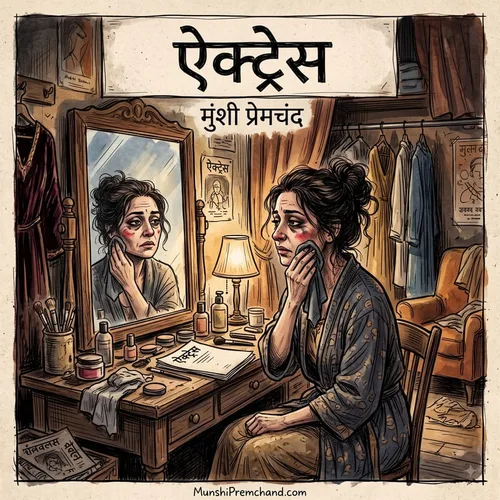
Tara put on a plain white sari. She removed every single ornament and set them aside. Warm water was ready. She washed her face thoroughly with soap and water, and went and stood before the mirror—where was that radiant beauty, that luminous brilliance which captivated the eyes? The form was the same, but where was the glow of youth? Could she still play the masquerade of youth?
It became unbearable for Tara to remain there even for another moment. The jewelry and luxurious articles strewn across the table seemed to bite at her. This artificial life became unendurable; the cool mansion, adorned with fragrant vetiver screens and electric fans, began to scorch her like a blazing furnace.
She thought: Where should I flee? If I flee by railway train, I will never escape. In the morning, Kunwar Sahib’s men will be dispatched and a search will begin in all directions. I must travel by a route where no one’s imagination would ever reach.
Tara’s heart at this moment was brimming with quiet pride. She was not sorrowful; she was not despairing. She would meet Kunwar Sahib again, but that would be a selfless union. She was walking upon the path of duty carved out by true love; why then should there be grief, and why despair?
Suddenly the thought struck her: What if Kunwar Sahib, not finding me here, should commit some dreadful calamity in his grief-stricken state? At this imagining, her hair stood on end. For a moment, her heart grew anguished. Then she sat down at the table and began writing this letter:
Beloved,
Forgive me. I do not find myself worthy of becoming your handmaiden. You have revealed to me that sacred countenance of love of which I could never have dared to hope in this life. For me, that alone is more than enough. As long as I live, I shall remain immersed in your love. It seems to me that in the memory of love, there is far greater sweetness and bliss than in the physical enjoyment of love.
I shall come again; I shall behold you once more; but only on that day when you have taken a wedded wife. That is the sole condition of my return. O life of my life, do not be angry with me. These ornaments which you sent for me, I leave behind on my part for your young bride. Only that necklace of pearls, which was the first offering of your love, I take away with me. With folded hands, I implore you—do not search for me. I am yours, and shall forever remain yours...
Yours,
Tara
Writing this letter, Tara placed it upon the table, put the pearl necklace around her neck, and stepped outside.
From the theater hall, the strains of music were drifting into the night air. For a single moment, her feet were rooted to the spot. A fifteen-year-old relationship was being severed today. Suddenly she saw the manager approaching. Her heart skipped a beat. Leaping swiftly, she concealed herself behind the shadow of a wall. The moment the manager passed, she slipped outside the compound, and after walking for some distance through the narrow lanes, took the road leading to the sacred Ganges.
A profound silence reigned over the banks of the Ganges. A few ascetics and mendicants lay resting before their smoldering sacred fires. A handful of travelers were sleeping, wrapped in blankets spread upon the ground. The Ganges crawled silently in the darkness like an enormous serpent. A small boat was moored at the river’s edge. The boatman sat inside.
Tara called out to the boatman, "O boatman, will you take the boat to the other shore?"
The boatman replied, "The boat cannot go at this late hour of the night."
Hearing the promise of double wages, however, he lifted his oar, and untying the boat, asked, "Where will Your Honor go on the other side?"
"I have to go to a village across the river."
"But at this late hour, no carriage or transport will be found."
"It does not matter; you just deliver me to the other bank."
The boatman untied the boat. Tara took her seat on the other side, and the boat began to glide forward at a gentle pace, as though a soul were drifting through the realm of dreams.
At that very moment, the moon of the eleventh day (Ekadashi), rising beyond the earth, steered its luminous silver boat into the heavens and began sailing across the vast ocean of the sky.
Summary of Actress
'Actress' (एक्ट्रेस) by Munshi Premchand is a deeply moving and morally profound story that explores the chasm between the glittering illusions of the stage and the uncompromising integrity demanded by true love. The protagonist, Tara Devi, is a celebrated thirty-three-year-old stage actress whose spellbinding portrayal of Shakuntala captivates city audiences. Following an impassioned performance, Kunwar Nirmalkant Chaudhary, O.B.E.—the city's wealthiest, most cultured, and philanthropic landlord—is so enchanted by her artistic brilliance and grace that he sends her an exquisite necklace of genuine pearls and seeks an audience with her.
Twenty years earlier, Tara had suffered a bitter heartbreak that left her distrustful of men's flattery, causing her to lead a life of strict emotional celibacy while dominating the theater world. However, Nirmalkant's gentle, godlike humility and guileless devotion pierce her defenses, rekindling the pure flame of love within her heart. For a month, the two spend blissful days together cruising down the river, discussing literature and philosophy, and sharing mutual affection. While the city gossips that Tara has ensnared a wealthy nobleman to plunder his estate, Tara cherishes Nirmalkant's affection above all worldly riches. Yet she inwardly grieves that the word 'marriage' never crosses his lips, refusing to accept the role of a kept mistress.
Confronted by intense pressure from his aristocratic family and British administrators to cut ties with an actress, Nirmalkant demonstrates his moral integrity by proposing a civil marriage under the law. Overwhelmed with joy, Tara accepts. Soon, however, a profound moral crisis overtakes her. Looking into her mirror after removing her elaborate theatrical cosmetics, she confronts the stark truth of her fading youth: she is thirty-three years old, her beauty sustained only by powders, dyes, and stage illusions, while Nirmalkant is a pure-hearted, noble young man at the peak of his youth. Realizing that an aging performer cannot provide lasting happiness to such a spotless soul and that true love cannot be built on cosmetic deception, Tara resolves upon a supreme sacrifice.
On the eve of the wedding, amidst mounds of costly gifts and jewels, Tara dresses in a simple white sari like an ascetic. She writes a poignant farewell letter to Nirmalkant, leaving all the wedding jewelry behind for his future bride and keeping only the pearl necklace—his very first token of affection. Promising to meet him only after he has married a suitable companion, Tara slips out into the midnight streets, leaves the theater behind forever, and boards a small boat to cross the Ganges into the quiet unknown, guided only by the serene light of the Ekadashi moon.
Publication History
'Actress' was written by Munshi Premchand during his prolific literary years in the late 1920s and was later collected in Mansarovar, Part 5 (मानसरोवर भाग 5). The story reflects Premchand's keen interest in the emerging Indian entertainment and theater culture of urban centers like Calcutta and Bombay, while examining the rigid social prejudices and double standards faced by performing women of that era.
This unabridged English translation was published in 2026 by MunshiPremchand.com as part of the MunshiPremchand.com English Translation Series.
Themes & Critical Significance
- True Love as Truth and Self-Sacrifice: Premchand emphasizes that authentic love cannot survive on falsehood or cosmetic deception. Tara chooses voluntary renunciation and social exile rather than building a marriage on artificial youth and concealed reality.
- The Contrast between Stage Illusion and Inner Reality: The story presents a poignant dichotomy between the glamorous, public adoration received by an actress and her private, aging reality. While Tara can effortlessly deceive thousands from the stage, her conscience refuses to deceive the one man who loves her with a pure heart.
- Female Dignity and Autonomy: Countering colonial and feudal stereotypes that regarded stage performers as mercenary courtesans seeking to plunder wealthy patrons, Premchand imbues Tara with supreme moral integrity, selfless devotion, and spiritual nobility.
- The Burden of Aristocratic Lineage versus Individual Freedom: Through Nirmalkant's courage in offering civil marriage despite societal condemnation, the narrative critiques feudal orthodoxy and family pride, showing that noble character transcends aristocratic birth.