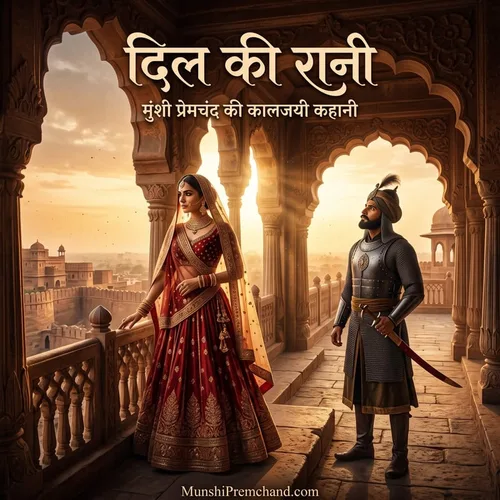
Complete English Translation: Dil Ki Rani (Queen of the Heart)
The fierce Turkish soldiers whose valor had once made all of Europe tremble were today lying wounded, scattered, and groaning in the dust of Constantinople. The proud banner of Sultan Bayezid had fallen into the dirt, and the victorious army of the Tatar conqueror, Amir Tamerlane, roamed through the streets, carrying out plunder and massacre. The earth seemed to quake beneath the thunderous hoofbeats of their horses, and the sky echoed with the triumphant battle cries of the Tatars.
In the vast square outside the imperial fortress, Amir Tamerlane sat upon a golden throne. Before him stood General Yazdani, commander of the defeated Turkish army, along with one hundred thousand captive soldiers bound in heavy iron chains. Behind them lay heaps of severed heads, and streams of blood ran through the gutters.
Tamerlane looked at Yazdani with eyes blazing like burning embers and roared: "What do you choose—life or death?"
General Yazdani raised his proud head and replied with calm dignity: "A life of honor, otherwise death."
Tamerlane sneered contemptuously: "The vanquished have no right to honor! A prisoner is a slave, and a slave’s only honor lies in obedience to his master!"
Yazdani answered unhesitatingly: "Honor is a divine gift from Almighty God. No earthly monarch has the power to snatch it away. A life without honor is a burden that a true soldier cannot bear."
Tamerlane’s wrath boiled over. "Insolent wretch! You dare speak to Tamerlane of honor while standing in chains? Executioner! Sever his head at once!"
A giant Tatar executioner stepped forward, his heavy, naked scimitar gleaming in the midday sun. Raising the blade high above Yazdani’s bare neck, he awaited the final nod.
At that precise moment, a slender, remarkably handsome young warrior of barely twenty years, standing directly behind Yazdani, broke through the line of prisoners. Fearlessly stepping between the raised sword and the general, the youth pushed aside the executioner's arm and fixed his brilliant, fiery eyes upon Tamerlane!
A collective gasp swept through the gathered ranks. Thousands of Tatar soldiers froze in astonishment. No living soul had ever dared look into Tamerlane’s eyes with such fearless defiance, let alone interpose his own body between the conqueror’s wrath and his victim!
General Yazdani turned pale with dread and cried out in agony: "Back! Stand back! Your Majesty, forgive this rash youth! He is my son, tender in years and thoughtless in speech. Let your punishment fall upon my head alone!"
The youth did not flinch. His countenance shone with heavenly majesty. Pointing a steady finger at the emperor, he spoke in a clear, resonant voice that rang across the silent square:
"O King who boasts of being the champion of Islam! Is this the Islam you claim to propagate across the world? Does the religion of Muhammad teach the slaughter of defenseless prisoners who fought bravely in defense of their motherland? Look upon these one hundred thousand men! Who among them is an infidel? Every single one of them recites the Kalima, prostrates before the One God five times a day, and reveres the Holy Prophet! If God granted you military might and the strength of the sword, was it so that you could bathe the earth in the blood of innocent believers?"
Tamerlane sat transfixed, his hand gripping the hilt of his dagger, but he uttered not a word.
The youth continued with mounting passion: "You tore through Anatolia, blew up seventy thousand soldiers in trenches, laid waste to smiling cities, and orphaned hundreds of thousands of helpless children! And do you believe you have performed a holy deed? Do you fancy that the Almighty will reward you for this butchery with Paradise? No, Emperor, no! You have not served Islam—you have dug out its very foundations! You have made the faith of peace and mercy an object of terror and abhorrence among mankind! Ask your own conscience: did you wage this war for the glory of God, or to satisfy your own insatiable lust for conquest and blood? A true Muslim is he who protects the weak, shows mercy to the fallen, and establishes justice upon the earth. You are not a soldier of God; you are a butcher drunk on blood!"
The Tatar generals gripped their swords, expecting Tamerlane to order the instant dismemberment of the audacious youth. But Tamerlane did not move.
For the first time in his life, the conqueror of Asia was hearing the pure, unadulterated truth. Throughout his career of conquest, sycophants, astrologers, and greedy courtiers had fed his vanity, assuring him that every massacre he ordered was a sacred decree of Heaven. Now, standing before an unarmed youth whose clear eyes mirrored absolute truth and whose soul radiated moral majesty, Tamerlane felt all his military triumphs wither into dust. The iron ruler of nations felt utterly small, barren, and naked before this spiritual power.
Slowly, Tamerlane rose from his throne. Walking down the marble steps, he approached the captive general. To the utter bewilderment of his army, the ruthless conqueror embraced General Yazdani!
Tears welled in Tamerlane's eyes. In a voice choked with emotion, he said: "Blessed are you, Yazdani, who has fathered such a son! This youth is not a mere mortal; he is an angel sent by God to shake my slumbering soul! He has torn the veil of darkness from my eyes!"
Turning to the youth, Tamerlane took both his hands into his own and asked: "Noble youth, what is your name?"
"My name is Habib," the youth answered softly.
Tamerlane smiled through his tears. "Habib—the Beloved of God! Truly, you are worthy of that name. From this day forth, you shall not be my captive; you shall be my master, my guide, and the keeper of my conscience!"
Turning toward his assembled commanders, Tamerlane issued a thunderous proclamation: "Break the chains of every Turkish prisoner! Return their swords and horses to them! Not a single hair on their heads shall be harmed! General Yazdani, you and your brave son shall accompany me to my royal pavilion as honored guests of the empire!"
Inside the imperial pavilion, Tamerlane seated Yazdani and Habib beside him. He ordered the most exquisite refreshments to be served, and for hours he poured out his heart to Habib, confessing his past cruelties with bitter remorse.
"Habib," the emperor pleaded, "I have conquered kingdoms from Persia to the borders of India, yet my soul has never known a single moment of peace. My hands are stained with the blood of millions. I have built minarets of human skulls, yet today I realize I am the poorest beggar upon the face of the earth. I beg of you—come with me to Samarkand. Become my Grand Vizier, the prime minister of my realm! Guide my hand, instruct my mind, and teach me how to govern with mercy and righteousness!"
Habib bowed respectfully and replied: "Your Majesty’s generosity is boundless. But allow me to consult my father and mother before I give my answer."
Tamerlane readily agreed. He provided Yazdani and Habib with a magnificent escort and sent them to their private residence.
In the privacy of their chamber, General Yazdani and his wife sat in deep deliberation, their faces etched with acute anxiety. For beneath the warrior’s armor and the masculine attire, Habib was not a young man at all!
Habib was, in truth, Umm-tul-Habib—the twenty-four-year-old daughter of General Yazdani.
Having had no sons, Yazdani had cherished his only daughter with extraordinary pride. From her earliest childhood, he had resolved never to let her remain confined within the narrow, helpless domesticity to which women of that era were condemned. He had trained her himself in swordsmanship, archery, lance combat, horsemanship, and military tactics. At the same time, the finest scholars had instructed her in the Quran, Islamic jurisprudence, philosophy, history, and poetry. Blessed with astonishing intelligence, physical grace, and an iron will, Umm-tul-Habib had surpassed every young nobleman in Anatolia. When war erupted, she had donned male armor and taken command of a cavalry division in the Ottoman army, fighting with such consummate skill that none of her comrades ever suspected her true sex.
Yazdani’s wife held her daughter's hands and pleaded tearfully: "My child, what madness is this? How can you contemplate going to Samarkand as Tamerlane’s minister? The man is a bloodthirsty barbarian! If your secret is discovered, he will tear us all to pieces and bring eternal dishonor upon our house! What will the world say? A maiden disguised as a vizier in the court of a Tatar tyrant!"
Yazdani, too, held his head in his hands, sighing deeply: "Your mother speaks the truth, Habib. Tamerlane is fickle and violent. Today he is moved by your words; tomorrow his savage instincts may return. Decline the offer politely. We shall return to our estates and live in quiet obscurity."
Habib looked at her parents with gentle reverence, her brow furrowing with resolve:
"Dear Mother, respected Father! Never in my life have I disobeyed your commands, nor shall I turn away from your wishes today by a grain’s breadth. You have absolute authority over my life. Yet I ask you to consider: will an opportunity like this to serve humanity and God’s creation ever present itself again? If I let this moment slip from my grasp, I will regret it for the rest of my days.
"I am convinced that through integrity, utter selflessness, and fearless truth, I can transform Amir Tamerlane into a true human being. If I can restrain his hand, hundreds of thousands of innocent lives will be spared from the sword! He is ferocious, but he is not without greatness. A truly brave man is never fundamentally cruel; whatever atrocities he committed were born of blind religious fanaticism and the corrupt flattery of his courtiers. Today, God has placed the reins in my hands so that I may show him that true faith consists in love and service, not in murder and loot!
"As for myself, I harbor no fear whatsoever. I am fully capable of defending my honor and my life with this very sword. And even if I fail, even if I am put to death—is not laying down one’s life for truth and justice the most glorious victory a mortal can attain? As for marriage, you know my convictions. I could never surrender my independence to become the plaything of an ordinary man whose spirit does not match my own. If ever I meet a man whose soul my soul can accept, in whose greatness I can merge my being to lift myself higher, I will willingly lay down my life at his feet. But until then, let me fulfill this sacred duty!"
Yazdani’s eyes shone with tears of admiration. He embraced his daughter with profound pride. Her mother, though still anxious, could not bear to separate from her; she insisted that if Habib went to Samarkand, she would accompany her.
Several months passed. In the imperial capital of Samarkand, the young Habib was officially installed as Grand Vizier. In truth, however, Habib was the real sovereign of the realm.
Tamerlane saw through Habib’s eyes, heard through Habib’s ears, and governed through Habib’s intellect. The emperor could scarcely bear to spend an hour away from his minister's presence; in Habib's company alone did his restless, blood-haunted soul find celestial peace. Throughout Samarkand, there was not a single soul who envied the young vizier. Habib’s absolute impartiality, humility, and gentle grace won the devotion of the high and the low alike. Even those who were penalized under the sharp wheel of Habib’s justice bore no bitterness, for Habib tempered justice with profound mercy, ensuring that the law never became unnecessarily harsh or vindictive.
Evening had fallen over the capital. The administrative scribes and courtiers had departed. In Habib’s private diwan, wax candles flickered in ornate sconces, filling the spacious chamber with the sweet fragrance of burning aloeswood. Habib was preparing to retire when the royal chamberlain entered, bowing low: "His Imperial Majesty arrives!"
Habib felt no elation at this announcement. Unlike other ministers who hungered for royal favor and court intimacies, Habib consistently avoided Tamerlane’s private gatherings. Habib never feasted at the royal banquet table, nor participated in palace festivities. Habib found true peace only in seclusion, spending the quiet evenings with her mother, recounting the events of the day and receiving her loving counsel.
Habib walked to the doorway to receive the emperor.
Tamerlane entered, discarded his heavy ceremonial robe, and sank down upon a silk cushion. Gazing intently at Habib, he said: "Habib, it baffles my understanding how you, in the prime of your youth, can live the life of a cloistered ascetic! God has bestowed upon you such peerless beauty that the loveliest maiden in Asia would count herself blessed to be your beloved. Do you know that when you ride through Samarkand upon your black steed, thousands of veiled eyes wait behind latticed windows just to catch a single glimpse of your face? Yet you never raise your eyes toward any woman!
"By God, I long to walk in your footsteps, yet this cursed world will not loosen its grip on my throat! I wish I could live detached from the world while dwelling in its midst, exactly as you do. But I possess neither your heart nor your divine intellect. I am constantly gnashing my teeth in fury at myself and at all mankind. A dreadful thirst for human blood burns inside me like an unquenchable fire, which you constantly labor to extinguish! Even while knowing that everything you do is infinitely wiser than anything I could conceive, I find myself helpless before my own rage.
"Wherever you walk, Habib, you radiate love and light. Those who ought to be your bitterest rivals become your devoted friends. But wherever I tread, I leave behind a trail of terror, hatred, and suspicion! Even those who should be my friends secretly harbor hatred against me. In the entire universe, there is only one sanctuary where my tormented soul finds peace—and that is beside you. If you tell me that this imperial crown and throne are stumbling blocks on my path to salvation, I swear by Almighty God that I will kick them away this very night! Show me the path to true joy, Habib. Come, leave this modest dwelling and reside permanently inside my palace, so that I may learn the art of living from you!"
Habib’s heart skipped a beat. A sudden dread seized her: had Tamerlane pierced her disguise? Had he discovered her womanhood?
Looking upon the conqueror, Habib saw that the terrifying warlord before whose name kingdoms trembled was now kneeling before her like a helpless, weeping child, begging for spiritual light. Beneath Tamerlane’s weathered, stern, and blood-hardened countenance, Habib perceived a soft, tender ember of genuine conscience struggling to emerge. Her heart melted with pity.
Speaking in a gentle, deferential voice, Habib said: "Your Majesty showers this humble servant with honors far beyond my deserts. Yet it is not fitting that I should dwell within the imperial palace."
Tamerlane asked eagerly: "Why?"
"Because wherever excessive wealth accumulates, robbers strike; and wherever royal favor is displayed excessively, enemies multiply."
"Could anyone possibly be your enemy?"
"I would become my own enemy, Your Majesty. For man’s deadliest enemy is his own pride (ghuroor)."
Tamerlane was struck as though he had discovered an invaluable jewel. He murmured the words repeatedly under his breath: "Man’s deadliest enemy is his own pride..."
Rising slowly, Tamerlane gazed at Habib with deep veneration: "You will never be caged, Habib. You are a bird created only to soar in the boundless heavens. Even if one were to place you in a cage of solid gold, you would beat your wings against the bars until you broke free. May God protect you, my friend."
The emperor walked swiftly toward his palace, as if eager to deposit that precious pearl of wisdom safely within the treasury of his soul. He had heard moral maxims before, but never had any sentence pierced his conscience with such divine illumination.
A few months later, alarming tidings arrived from the mountainous province of Istakhr. The region was in open rebellion.
Habib was deeply troubled. If Tamerlane marched to Istakhr in anger, the city would undoubtedly be put to the sword and transformed into another mountain of severed heads. Habib resolved to quell the rebellion through peaceful, compassionate means, demonstrating to Tamerlane the superior power of goodwill over brutal force.
When Habib requested permission to lead the expedition, Tamerlane adamantly refused. The thought of exposing his beloved minister to danger filled him with terror. But Habib persisted, arguing: "Your Majesty, it would be an everlasting disgrace to your loyal servant if you were to expose your royal person to peril while I sat safely in the capital."
Tamerlane smiled sorrowfully: "Habib, my life possesses not the slightest value when weighed against yours! What legacy have I left behind in this world other than slaughter, ashes, and tears? Believe me, when Tamerlane dies, no one in the world will shed a single tear for him! Marauders and conquerors like me will be born in every generation. But if, God forbid, anything were to happen to you, this entire empire would turn to dust, and I would have no choice left but to plunge a dagger into my own heart!
"I cannot express in words how much you have given me. Would that I had found you ten years earlier—Tamerlane’s name would not be written in history with black ink! If necessity demanded, I would gladly sacrifice a hundred Tamerlanes for a single breath of yours! Know this, Habib: when you depart, you take my very soul with you. I tell you frankly today—I have fallen deeply in love with you! I have only now understood the true nature of my feelings. What harm is there if I ride beside you to Istakhr?"
Habib’s heart pounded violently against her ribs. Lowering her eyes, she replied: "If the situation requires Your Majesty’s presence, I shall send an immediate dispatch."
Tamerlane stroked his beard and sighed: "As you wish. But send a mounted courier to me every single day without fail, or my anxiety will drive me mad, and I will gallop after you!"
Tamerlane oversaw the preparations for Habib’s departure with extraordinary affection and personal care. He packed luxury tents, delicate furs, rare medicines, and choice delicacies, worrying constantly about the harsh climate of the mountains. He behaved not like an emperor outfitting an army, but like an affectionate mother preparing her beloved daughter for her bridal journey.
When Habib rode out at the head of the imperial detachment, the entire populace of Samarkand lined the streets to shower blessings upon the young vizier. Meanwhile, atop his palace balcony, Tamerlane sat with his head bowed and a silk handkerchief pressed against his weeping eyes, looking like a magnificent eagle whose wings had been broken.
Istakhr was inhabited primarily by Armenian Christians. Following their military conquest, Muslim governors had imposed severe, humiliating restrictions upon them to constantly remind them of their subjugation.
The first was the burdensome Jizya tax, levied upon every Christian while Muslims were exempt. The second restriction prohibited the ringing of church bells in Christian cathedrals. The third restriction banned the production and consumption of wine, which Christians used in their holy sacraments but which orthodox Muslims deemed unlawful.
The Christians of Istakhr had long endured these indignities in silence. But when a tyrannical governor attempted to enforce the edicts with brutal violence, the Armenians rose in armed revolt. They captured the Muslim governor, imprisoned his garrison, and hoisted the standard of the Holy Cross above the fortress walls!
Habib had now spent two days in Istakhr, studying the situation. Habib’s generous, enlightened heart told her that these discriminatory laws were a travesty of justice. Every religion deserved equal dignity, and forcing people to pay a penalty for their faith was contrary to divine law. Yet Habib knew that orthodox Muslim clerics and military commanders would vehemently oppose the abolition of these privileges. And even if they were silenced, would Tamerlane ever consent to dismantling the religious superiority of the ruling faith? Though Tamerlane’s temperament had softened, he was still bound to Islamic orthodoxy.
"Yet, should I punish these people simply because they fight for their religious freedom?" Habib reflected in the quiet of the night. "How can I slaughter men whose cause is just? No! I must stand for truth, regardless of the consequences! Even if the Emperor believes I have exceeded my authority, I will not compromise with tyranny."
The following morning, at dawn, Habib ordered the imperial trumpets to sound and issued a historic proclamation throughout the province:
"By decree of the Grand Vizier: The discriminatory Jizya tax is abolished forever! Christian churches are granted full liberty to ring their bells! All restrictions upon wine are hereby lifted!"
The proclamation fell like a thunderbolt upon the Muslim garrison and the imperial troops!
An uproar erupted across the army camp. The orthodox commanders cried: "This is blasphemy (kufr)! This is heresy! The very Islam that Amir Tamerlane watered with his blood is being uprooted by his Turkish vizier, Habib Pasha!"
Mutiny broke out instantly. The imperial soldiers abandoned Habib and joined hands with the orthodox Muslim insurgents!
Finding herself surrounded by hostile troops, Habib was forced to seek refuge inside the fortress of Istakhr alongside the Armenian Christians. The mutinous soldiers surrounded the citadel, cutting off all supplies. Convinced that Habib had committed high treason against the crown, the mutineers dispatched a mounted courier to Samarkand to inform Amir Tamerlane and demand imperial vengeance.
Midnight had long passed in Samarkand.
Tamerlane had received no word from Istakhr for two whole days. He paced his bedchamber in agony, tormented by dreadful forebodings. He cursed himself for having allowed Habib to travel alone. It was true that Habib was an unparalleled statesman, but what could a handful of men do if a violent rebellion exploded? The mountain Christians were ferocious fighters. If they realized that Tamerlane had grown weary of the battlefield and preferred palace seclusion, their courage would double! And if Habib were trapped by ruthless enemies, what disaster might unfold?
Tamerlane struck his knee in fury, pacing the floor like a caged panther:
"Why have I grown so cowardly? Has my fiery valor abandoned me? The man whose very name once caused kings to soil their robes now sits hiding his face inside luxurious chambers! The world will say that Tamerlane is no longer the lion of the battlefield, but merely a lion embroidered upon a palace carpet!
"Habib is an angel of heaven, innocent of human wickedness! That pure soul, an incarnation of mercy, clean-heartedness, and selfless love—what does he know of the devil that lurks inside man? In days of peace, such noble virtues elevate a nation to the heights of glory. But in war, when the storm of demonic savagery rages, there is no place for gentleness! In battle, victory belongs only to him who plays with the color of human blood, who burns fields and granaries, and turns flourishing towns into desolate graveyards! The law of war is entirely different from the law of peace!"
Suddenly, the royal chamberlain announced the arrival of an exhausted courier from Istakhr.
The courier threw himself upon the carpet, kissing the marble floor, and stood trembling before the emperor. The sheer aura of Tamerlane’s ferocious presence struck him with such dread that the words froze in his throat.
Tamerlane glared at him with knitted brows and bellowed: "What news do you bring? You arrive after three days of silence, and that too in the dead of night!"
The courier kissed the floor again and stammered: "Majesty... your Grand Vizier has abolished the Jizya tax!"
Tamerlane’s eyes widened: "What did you say? Abolished the Jizya?"
"Yes, Your Majesty."
"By whose authority?"
"By his own decree, Sire."
"Humph!" Tamerlane grunted.
"And Sire... he has officially legalized wine!"
"Humph!"
"He has also commanded that bells be rung freely inside Christian churches!"
"Humph!"
"And worst of all, Sire—he has allied with the Christians and attacked the faithful Muslims!"
"So what do you expect me to do?" Tamerlane barked coldly.
The courier cried desperately: "Your Majesty is our lord and protector! If imperial reinforcements are not sent immediately, not a single Muslim in Istakhr will remain alive!"
"Where is Habib Pasha at this moment?"
"Inside the fortress of Istakhr, Sire."
"And what are the Muslim soldiers doing?"
"We have surrounded the fortress and laid siege to it!"
"With Habib trapped inside?"
"Yes, Sire! For he has raised the banner of rebellion against Your Majesty!"
Tamerlane’s fury detonated like an earthquake!
"And therefore, my 'faithful servants of Islam' have laid siege to my Vizier? And it is quite possible that before I arrive, you dogs may even murder him? Vile, treacherous cur! Begone from my sight before I have you skinned alive!
"You foolish zealots believe that Habib is my servant and that I am his master! That is a monstrous lie! The true master and sovereign of this empire is Habib, and Tamerlane is merely his humble slave! Tamerlane has no right to interfere in Habib’s decisions!
"Habib was absolutely right! The Jizya tax ought to be abolished! By what right do I extort a penalty from fellow human beings merely because they worship God in their own way? None! If the call to prayer rings from the minaret of a mosque, why shouldn't church bells ring in the cathedral? There is no sin in the chime of a bell!
"Do you know who a true infidel (kafir) is? An infidel is he who robs others of their rights, who oppresses the helpless, who breaks faith, and who is consumed by selfish greed! An infidel is not the person who sees the light of God in a piece of clay or stone, or who witnesses divine glory in rivers, mountains, trees, and meadows! Such a person is far more devoted to God than you hypocrites who believe Almighty God can be locked up inside the four walls of a mosque!
"Do you think I speak blasphemy? To brand another human being as an infidel is itself the greatest blasphemy! We are all children of the same God—all of us! Go at once! Ride day and night, and tell those mutinous soldiers that if the siege of Istakhr is not lifted this instant, Tamerlane will descend upon them like the Day of Judgment!"
Before the terrified courier could scramble to his feet, emergency bugles blared throughout the capital, and the imperial army began its thunderous mobilization for the march.
On the third day, when Tamerlane’s vanguard arrived at Istakhr, the siege had already been lifted. The cannons atop the ramparts boomed in salute.
Inside the citadel, Habib had prepared for the worst. Habib assumed that Tamerlane was arriving with fire and sword to punish the rebellious Christians. The Armenian leaders were petrified with terror, but Habib remained resolute, prepared to lay down her life in defense of the Christians’ rights. There could be no compromise on this principle: if Tamerlane chose the sword, Habib was ready to cross swords even with the conqueror of Asia!
Yet, as the dust cleared on the horizon, Habib beheld an astonishing spectacle: the imperial banner carried by Tamerlane’s advance guard was a pure white flag of peace!
Tamerlane had not come to wage war; he had come to make peace!
Habib rode out through the citadel gates accompanied by the Christian elders. Tamerlane was riding entirely alone, ahead of his legions. As soon as Habib dismounted to offer formal obeisance, Tamerlane leaped down from his horse, caught Habib in his arms, and kissed her forehead with tears of joy!
"I have heard everything, Habib," Tamerlane said tenderly. "You acted with supreme wisdom, doing that which no one on earth except you could have accomplished! I had no divine right to extort the Jizya or strip Christians of their sacred rights. Today, I shall convene a grand imperial durbar to ratify every single one of your decrees. And then, Habib, I shall reveal a proposal that has been burning in my heart for days—a proposal that you must accept. You shall have to accept it!"
The color drained from Habib’s cheeks. Had the secret of her identity been discovered? What could this mysterious proposal be? A storm of emotions raged within her breast.
Tamerlane smiled playfully: "Tell me the truth, Habib—were you prepared to fight me?"
Habib blushed, lowering her gaze: "Before the sanctity of Truth, Your Majesty, even Amir Tamerlane has no standing."
"Bravo! Bravo!" Tamerlane laughed with sheer delight. "You possess the heart of an angel and the courage of a hundred lions! My only regret is that you could ever imagine that Tamerlane would overturn your noble judgment! It was you, Habib, who taught me that an empire is not an emperor’s private property, but a living tree whose every branch and leaf deserves equal nourishment from the root."
The two leaders entered the fortress side by side. By the time the sun dipped below the rugged peaks, a magnificent imperial durbar was assembled inside the great hall.
Before the assembled Christian and Muslim dignitaries, Tamerlane solemnly ratified the complete abolition of the Jizya and confirmed absolute freedom of worship for all Christians.
A thunderous cheer rose from every corner of the hall: "May God grant our Emperor long life and eternal glory!"
Tamerlane raised his hand, silencing the crowd, and spoke with profound humility:
"My friends, I am not worthy of your blessings. By returning to you that which I stole by force of arms, I have performed no virtuous deed. It would be far more appropriate if you were to curse me for having deprived you of your God-given rights for so long."
The assembly responded with cries of wonder and reverence: "Marhaba! Marhaba! Praise be to God!"
Tamerlane continued: "Friends, along with your religious liberties, I hereby return your sovereignty and your kingdom to you! For in the eyes of the Almighty, all human beings are born equal. No race, nation, or monarch possesses the right to enslave another people! From this day forth, you are your own kings and masters. I trust only that you, in turn, will never deprive your Muslim brothers of their just rights. But if ever a day comes when any tyrant attempts to rob you of your freedom, remember that Tamerlane’s sword will always be ready to defend you!"
The celebrations inside the citadel continued late into the night. At last, the banquets concluded, and the nobles, commanders, and officials took their leave.
Inside the secluded Diwan-e-Khas, only Tamerlane and Habib remained.
For the first time since she had entered his service, Habib’s face was lit by a radiant, uninhibited smile that had previously remained hidden beneath a veil of official gravity. Tonight, her cheeks flushed with a delicate roseate glow, her dark eyes sparkled with playful intoxication, and her every movement possessed an enchanting, feminine grace. She teased Tamerlane with witty retorts and lighthearted laughter; her youthful spirit, forgetting titles and statecraft, fluttered like a bird liberated from its cage.
Suddenly, Tamerlane looked into her eyes and said: "Habib, until this day, I have obeyed every single command you ever gave me. Now, I lay before you that proposal of which I spoke. You must accept it."
Habib’s heart thumped against her ribs. Lowering her head in confusion, she whispered: "Speak, Your Majesty."
"First promise me that you will accept."
"I am merely your slave, Sire."
"No, Habib! You are my master, the light of my soul, and the keeper of my destiny! The debt of gratitude I owe you can never be measured. Until I met you, I believed that an empire was the most precious treasure on earth. To acquire it, I committed atrocities that should never have been committed—I stained these hands with the blood of friends and foes alike.
"My work is finished, Habib. I have laid the bloody foundation; to raise the magnificent palace of peace and justice upon it is your task. This is my deepest prayer: from this night forth, you shall become the supreme ruler and Emperor of this vast realm—both while I live, and after I am gone!"
Habib felt as though she were floating in the boundless sky. Shaking her head, she murmured: "Such a crushing burden... my shoulders are far too frail to bear the weight of an empire."
Tamerlane leaned forward, his voice trembling with humble supplication: "No, my dearest friend! You cannot reject this prayer. You must accept!"
Habib looked at him. Her eyes danced with affectionate mirth, while her lips trembled with maidenly modesty. In a voice as soft as a breeze, she whispered: "I accept."
Tamerlane’s face blossomed with radiant joy: "May God protect and preserve you forever!"
Habib paused, a mischievous smile playing on her lips. Looking sideways at the emperor, she asked:
"But what if... what if Your Majesty were to discover that your Grand Vizier is actually an inexperienced, tender-hearted, unmarried maiden?"
Tamerlane did not blink. Without a trace of hesitation, he replied tenderly:
"Then, she shall become not only the Empress of my realm—she shall reign forever as the Queen of my Heart (Dil ki Rani)!"
Habib looked at him in sheer astonishment: "Are you not surprised in the least?"
"I knew it all along," Tamerlane answered softly.
"Since when?" Habib gasped.
"From the very first moment on the battlefield of Constantinople, when you looked into my face with those tyrannical, beautiful eyes!"
Habib’s cheeks burned crimson. "Yet you concealed it so masterfully!"
"You taught me how to keep secrets, Habib," Tamerlane smiled. "No one in the entire world knows your secret except me."
"How could you possibly recognize me through a soldier’s heavy armor?"
Tamerlane looked at her with intoxicated, adoring eyes and replied with a quiet smile:
"Ah, Habib... that is a secret I shall never reveal!"
And in the chronicles of history, this very Habib is celebrated down the centuries as Tamerlane’s beloved consort—Begum Hamida.
Summary of Dil Ki Rani (Queen of the Heart)
Following his crushing victory over Sultan Bayezid at Constantinople, the fearsome Tatar conqueror Amir Tamerlane (Timur) sits in judgment over General Yazdani and one hundred thousand captive Ottoman soldiers. When Tamerlane offers Yazdani the choice between life and death, Yazdani demands a life of honor. Enraged, Tamerlane orders his execution. Suddenly, a radiant young warrior steps forward, blocks the executioner’s scimitar, and fearlessly denounces Tamerlane to his face. The youth rebukes Tamerlane for distorting Islam, arguing that slaughtering defenseless prisoners and massacring seventy thousand innocents is not jihad, but bloodthirsty ambition. Profoundly moved and spiritually transformed by this fearless truth, Tamerlane breaks the captives' chains, embraces Yazdani, and begs the youth—named Habib—to become his Grand Vizier.
In truth, Habib is Umm-tul-Habib, Yazdani’s brilliant twenty-four-year-old daughter. Having had no sons, Yazdani had trained her in swordsmanship, horsemanship, military strategy, Islamic jurisprudence, and philosophy. Reluctant to accept a traditional life of domestic subjugation, Habib convinces her parents that accepting Tamerlane’s offer is a sacred duty to civilize the conqueror and save countless lives.
In Samarkand, Habib governs with absolute justice, compassion, and humility, winning the adoration of all subjects. Tamerlane becomes completely dependent on Habib’s wisdom, confessing his internal struggle with bloodlust and pride. When a rebellion erupts in the Armenian Christian province of Istakhr over the discriminatory Jizya tax, church bell bans, and alcohol prohibitions, Habib travels there to resolve the crisis peacefully. Recognizing the Christians' grievances as just, Habib unilaterally abolishes the Jizya and restores religious freedom. The imperial soldiers mutiny against Habib, labeling the decree heresy, and besiege Habib inside the Istakhr fortress.
When a courier informs Tamerlane of Habib’s actions, Tamerlane’s wrath turns entirely against the religious fanatics. Tamerlane proclaims that Habib did what was right, declaring that true infidelity lies in oppressing others, not in ringing church bells. Tamerlane rides to Istakhr carrying a white flag of peace, embraces Habib, ratifies all reforms, and grants full political sovereignty back to the Armenians. That night in the private chamber, Tamerlane offers to abdicate the entire empire in Habib’s favor. When Habib playfully reveals her identity as a woman, Tamerlane confesses he had recognized her from the very first moment on the battlefield, declaring her the Empress of his realm and the "Queen of his Heart" (Dil ki Rani). Habib later enters history as Tamerlane’s legendary Empress, Begum Hamida.
Publication History
"Dil Ki Rani" (Queen of the Heart) is one of Munshi Premchand's most celebrated historical-romantic short stories. Written during the mid-1920s (first published in 1925), the story showcases Premchand's expansive historical imagination, drawing upon the dramatic confrontations between Amir Tamerlane and the Ottoman Turks, while subverting traditional martial narratives into a profound philosophical critique of imperial violence, religious intolerance, and gender hierarchy.
This unabridged English translation was published in 2026 by MunshiPremchand.com as part of the MunshiPremchand.com English Translation Series.
Themes & Critical Significance
- Feminine Agency, Valor, and Intellectual Leadership: Umm-tul-Habib represents Premchand's most progressive ideal of female empowerment. Raised as a warrior and scholar, she rejects the passive, dependent role assigned to women of her era, demonstrating superior military command, diplomatic acumen, and philosophical wisdom compared to the most formidable men of her time.
- The True Essence of Religion vs. Fanaticism: Through Habib’s confrontation with Tamerlane and the events in Istakhr, Premchand presents a radical critique of religious bigotry. True religion is defined not by rituals, conquest, or oppressive taxation (Jizya), but by universal compassion, service, and justice. Premchand boldly argues that coercing faith is the true spiritual heresy.
- Moral Authority Over Military Might: Tamerlane possesses irresistible physical power, yet he is morally conquered and spiritually humbled by an unarmed youth speaking unvarnished truth. The story illustrates Premchand’s core humanist belief that moral conviction and righteousness ultimately transcend the brute force of arms.
- Pluralism and Decolonization: By having Tamerlane restore self-rule to the Armenian Christians, Premchand expresses a powerful anti-imperialist ethos: no nation has the right to rule over another, and legitimate sovereignty must be rooted in mutual respect, equality, and the consent of the governed.