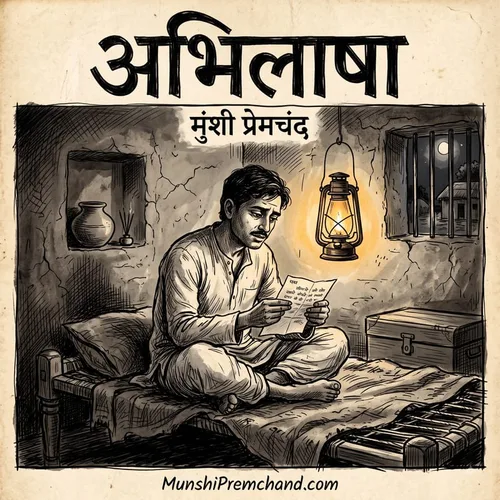
Complete English Translation: Abhilasha
Yesterday, a tremendous commotion broke out in the neighborhood. A paan-seller was thrashing his wife. The poor woman sat weeping, yet that heartless wretch did not feel the slightest trace of pity for her. At last, anger flared up in the woman too. Standing up, she said, "Enough! If you strike me now, it will not be good. From today onwards, I have no relationship with you. I will beg for bread, but I will never set foot in your house again." Saying this, she picked up an old sari of hers and walked out of the house. The man stood watching her like a wooden owl.
Walking a short distance, the woman turned around, opened the small cash-box of the shop, and took out a few coppers. Perhaps she still felt a lingering attachment; but that merciless man instantly seized her hand and snatched the money away. Alas, what utter heartlessness! Such tyranny by a man against a helpless woman! Once upon a time, he must have been ready to lay down his life for this very woman, must have watched her face with eager longing; but today he has turned so callous, as though they were never even acquaintances. The woman put the money back and walked away without uttering a word. Who knows where! From the window of my room, I kept watching for hours, thinking that perhaps she might return, or perhaps the paan-seller might go to appease her; but neither of the two happened. Today, for the first time, I came to realize the true condition of a woman.
That shop belonged to both of them. The man merely loafed around, while the woman sat there night and day, wearing herself down to the bone. Until ten or eleven at night, I would see her seated at the shop. When I woke in the morning, I would still find her sitting there. As much scraping, scrimping, and bargaining as the man did, the woman did slightly more. Yet the man is everything, and the woman is nothing! Whenever he pleases, he can throw her out onto the street!
My mind grew so restless over this question that sleep fled from my eyes. Midnight struck, and I remained seated. A spotless moonlight was scattered across the sky. The Lord of the Night sat swollen with pride upon his jewel-studded throne. Small patches of clouds moved slowly toward the moon and then broke apart in distorted shapes, as if fair-robed beauties, crushed and humiliated at his hands, were departing in tears. This imagining distressed me so much that I shut the window and came to sit upon the bed. My beloved was engrossed in deep sleep. His radiant countenance seemed to me at this moment somewhat akin to the moon itself. It was the very same smiling visage that once brought fullness to my eyes. It was that very same broad chest, resting my head upon which I used to feel a tender, sweet tremor in the depths of my being. Those were the very same strong arms which, when wrapped around my neck, caused waves of sheer bliss to surge within my heart. Yet, how many days have passed since I last saw the bright line of a smile upon that face, nor did my heart yearn to see it. How many days have passed since I rested my head upon that chest, nor have those arms encircled my neck. Why? Have I turned into someone else, or has my husband become another person?
Not very many days have elapsed either—merely five years. Only five years, when my husband welcomed me with blossoming eyes and eager lips. My neck was bowed down with bashfulness. What a powerful longing stirred within my heart to gaze upon his face; yet out of shyness I could not lift my head. At last, gathering courage, I raised my eyes, and although my glance returned halfway, could I ever forget the bliss I received from that half-glimpse? That picture is still etched upon the canvas of my heart. Whenever the memory of it returns, my heart thrills with delight. That joyful memory still holds the same tickling sweetness, the same tingling sensation! But now, night and day, I gaze upon that countenance. At dawn, in the morning, at midday, in the evening, in the deep of night—all twenty-four hours I behold it; yet no quiver stirs within my heart. He stands before me, speaking to me, and I keep looking down at my crochet work.
When he used to leave the house, I would come and stand at the doorway. And when he turned back and smiled, I felt as though I had gained the kingdom of heaven. In the late afternoon, I would climb onto the terrace and begin watching the road for his arrival. Seeing him come from afar, I would hurry downstairs as if intoxicated and greet him at the threshold. But now, I do not even know when he departs and when he returns. When the outer door closes, I gather that he has left; when the sound of the door opening comes, I understand that he has arrived. I cannot fathom whether I have become someone else, or my husband has become another man.
Back then, he did not spend much time inside the house. Whenever his voice fell upon my ears, a current like electricity would course through my body. Even his smallest words, his tiniest actions, I used to watch with loving, enchanted eyes. When he lifted little Lala into his lap and cuddled him; when he patted Tommy on the head and made him lie down; when he teased the old devout servant-woman and ran outside; when he drew bucket after bucket of water to irrigate the plants—these eyes remained fixed in that direction. But now, he stays at home the entire day; he laughs and speaks right before me, yet I am hardly aware of it. God knows why!
Back then, one day, he placed a small bouquet of flowers into my hands and smiled. Receiving that gift of love, my joy knew no bounds. They were merely a few flowers and leaves; but looking at them, my eyes could never be sated. For a while I held it in my hands, then placed it in the vase upon my table. While doing my chores, I would come repeatedly just to look at that bouquet. How many times did I press it to my eyes, how many times did I kiss it! Even if someone had offered a hundred thousand rupees, I would not have parted with it. Every single petal of it was a jewel to me. When it withered, I took it and kept it safely inside my box.
Since then, he has gifted me thousands of things. There are jewel-studded ornaments of every kind, invaluable clothes of every description, and bouquets he brings almost daily; yet upon receiving these things, that former ecstasy does not arise. Putting on those ornaments, I look at my reflection in the mirror and swell with pride. Showing them to my companions, I enhance my vanity and stoke their jealousy. That is all.
Only a few days ago, he gave me a chandrahar necklace. Whoever looks at it is spellbound. I too am captivated by its craftsmanship and adornment. I opened my box and brought out that dried bouquet. Ah! The moment I took it into my hands, electricity coursed through every single vein. All the strings of my heart vibrated. Those dried petals, which had now turned yellow, seemed to speak. From their withered, faded faces, faint, trembling words soaked in deep affection seemed to murmur softly like a gentle rustle; whereas that jewel-encrusted necklace, shimmering with radiance, was merely a collection of gold and stones, devoid of life, devoid of consciousness, devoid of a tender heart. I kissed the bouquet again, pressed it to my throat, watered it with moist eyes, and placed it back in the box. A chest filled with gold and jewels was utterly insignificant before that single keepsake of memory. What mystery was this?
Then I remembered an old letter of his. He had sent it to me from college. Could I ever forget the bliss that flooded my heart upon reading it, the tempest that arose, the river of tears that flowed from my eyes? I had placed that letter inside my bridal casket. At this moment, an intense desire arose to read that letter once more. I took the letter out of the casket. The moment I touched it, my hands began to tremble, and my heart began to pound. How long I stood holding it in my hands, I cannot say. It seemed to me that I had become once again the very woman I was on the day I received it.
Did that letter contain poetic outpourings of love? Did it contain literary discourses on romance? Was there a mournful cry of the agony of separation? It did not contain even a single word of sweet romance.
It read:
"Kamini, you have not written a letter for eight days. Why haven't you written? If you do not write to me, understand this clearly—I will not come home for the Holi holidays. After all, what do you do all day long? Have you unlocked the cupboard of my novels? Why did you open my cupboard? You must be thinking that if you don't write, the poor fellow will weep bitterly and fret. I don't care at all here. I go to sleep at nine at night and wake up at eight in the morning. If there is any worry, it is only that I might fail the exam. If I fail, you will answer for it."
How simple, coming from a pure, innocent heart, brimming with guileless, prideful reproach and playful bluster, as though the entire burden of responsibility lay solely upon me! Could he ever issue such a threat to me now? Never.
Such a threat can only be given by one who knows the anguish of not being able to meet, who truly feels it. My husband now knows that such a threat will have no effect upon me; I will merely laugh and sleep in comfort, for I know he will certainly come—where else could he possibly go? Where could he turn?
Since then, how many letters has he written to me! Even if he goes out for two days, he definitely sends a letter; and when he goes away for five or ten days, a letter arrives every single day. The letters are filled with carefully chosen words of love, polished phrases, exquisite forms of address. I read them, heave a cold sigh, and set them aside. Alas! Where has that beating heart gone? In these lifeless, emotionless, artificial words of love, where is that inseparable oneness, where is that nectar, where is that madness, where is that anger? Where is that petulant irritation? In them, my heart searches for something—some unknown, unexpressed, unseen thing—yet it cannot be found. They are laden with perfume, and the paper of the letters outshines fine art-paper; yet all this elaborate dressing up feels merely like the cosmetic makeup of an aging heroine whose youth has faded. Sometimes I do not even bother to open the letters. I know well what will be written inside them.
It was around those very days that I had observed the fast of Hartalika Teej. Bowing my head before the Goddess, I had prayed:
"O Goddess, I ask only one boon of you. May there never be separation between us two beings; I have no other longing, I desire nothing else in this entire world."
Four years have passed since then, and not for a single day has there been separation between us. I had asked for only one boon; the Goddess placed a veritable storehouse of boons into my hands. But today, if I were to behold the Goddess, I would say to her:
"Take back all your boons; I do not want even a single one of them. I want to see once again those days when my heart held the longing of love. By giving me everything, you have deprived me of that matchless bliss which resided in longing. This time, I shall pray to the Goddess to show me the day when I might wander through desolate riverbanks and dense forests in search of my beloved; when I might ask the waves of the river, 'Have you seen my beloved?'; when I might ask the trees, 'Where has my beloved gone?' Will that bliss never be mine again?"
At that very moment, a gentle, cool breeze began to stir. I stood with my head leaning outside the window. With the gusts of wind, the tresses of my hair began to scatter. I had the sensation as if my beloved were present in these very exhalations of the breeze. Then I looked toward the sky. The rays of the moon were playing hide-and-seek with my eyes like shimmering silver threads. When I closed my eyes, they appeared before me; but the moment I opened my eyes, they vanished. I felt at that moment that my beloved was descending from the heavens, seated upon those very shimmering rays.
Just then, someone sang in the distance:
O unique lover’s sacrifice,
O singular world of pain!
Where do you vanish away,
Squandering your golden love?
"Squandering your golden love—"
Where that verse went, piercing through my innermost soul like an arrow, I do not know. My hair stood on end. A torrent of tears broke from my eyes. It felt as though someone were tearing my beloved right out of my heart. I cried out aloud.
At that instant, my husband's sleep was broken. Coming beside me, he said, "Did you just cry out? Why, you are weeping! What is the matter? Did you see a nightmare?"
Sobbing, I replied, "If I don't weep, should I laugh?"
My master took my hand and said, "Why, is there a reason for weeping, or do you simply wish to cry for no reason?"
"Do you not know the reason for my weeping?"
"How can I know what is in your heart?"
"Did you ever make an attempt to know?"
"I never had the faintest inkling that you could have any cause to weep."
"You are so well-read, can you too say such a thing?"
Perplexed, my husband said, "Why do you speak in riddles?"
"Tell me, do you never weep?"
"Why on earth should I weep?"
"Do you have no longing left now?"
"My greatest longing has already been fulfilled. Now I desire nothing else."
Saying this, my husband smiled and moved forward to take me in his arms. His heartlessness at this moment felt exceedingly bitter to me. Pushing him away with my hands, I said, "I do not consider this masquerade to be love. One who can never weep can never love. Weeping and love both spring from the very same source."
At that very moment, the sound of the same song was heard once again:
O unique lover’s sacrifice,
O singular world of pain!
Where do you vanish away,
*Squandering your golden love!*¹
My husband's smile vanished. I saw him shudder. It seemed as though a thrill of deep emotion swept over him. Suddenly his right hand rose to his chest. He took a long, deep breath, and drops of tears slipped from his eyes and rolled down onto his cheeks.
Instantly, weeping, I rested my head upon his chest and experienced that supreme bliss for which my heart had been yearning for so many days. Today, once again, I heard my husband's heart beating; today, in his touch, I felt once again the surge of living warmth.
Even now, the words of that verse were echoing in my heart:
Where do you vanish away,
Squandering your golden love!
¹ A verse from a poem by Smt. Mahadevi Verma.
Summary of Abhilasha
'Abhilasha' (Yearning / Desire) is a delicate, psychologically profound story by Munshi Premchand that explores marital intimacy, the nature of emotional fulfillment, and the subtle dynamics of love and separation. The protagonist and narrator, Kamini, witnesses a domestic brawl in her neighborhood where a local paan-seller brutally beats his wife. When the abused woman resolves to leave and tries to take a few hard-earned coppers from the shop's cash-box, the husband forcibly snatches the money from her grasp. Watching from her window, Kamini is shaken by the stark reality of a woman's vulnerability and complete dependence, realizing how easily a husband can assert despotic control over shared labor and drive his wife out into the street.
This unsettling incident turns Kamini's gaze inward toward her own marriage of five years. Looking upon her peacefully sleeping husband, she reflects on how drastically their relationship has altered. In the early days of their youth, love was animated by intense longing, bashfulness, and the agonizing sweetness of separation. A simple, inexpensive bouquet of fresh flowers gifted by her husband had felt more precious than a royal fortune, prompting her to preserve the withered blossoms in her jewelry casket. An old, scolding letter sent from his college days—demanding that she write back or face his absence during the Holi holidays—carried a raw, unfiltered sincerity that proved how deeply he depended upon her affection.
Over five years of comfortable domesticity, however, material security has smothered romantic yearning. Her husband now showers her with expensive clothes, diamond necklaces (chandrahar), and daily bouquets, yet these gifts feel cold and lifeless compared to that one dried bouquet. His recent letters are crafted with polished literary expressions and perfumed stationery, yet they lack the spontaneous emotion, irritability, and genuine heartbeat of his youthful notes. Kamini recalls how, during a Hartalika Teej fast, she had prayed to the Goddess for an unbroken companionship free from separation. Having received that boon, she realizes that unbroken domestic proximity and complete certainty have stripped love of its vital spark—the abhilasha (the ache of yearning) that makes reunion sweet.
Late at night, as a cool breeze stirs her hair, a passerby outside sings an evocative verse by poet Mahadevi Verma about a lover's disappearance and sacrifice. The melancholy lyrics pierce Kamini's soul, bringing forth a flood of tears. Waking up, her husband is bewildered by her weeping and innocently declares that since his greatest desire has been attained in possessing her, he has no reason to ever grieve or yearn. Kamini rebukes this complacency, stating that one who cannot weep cannot truly love, as weeping and love originate from the exact same emotional reservoir. When the singer repeats the poignant verse, its haunting truth penetrates the husband's composure as well. His self-satisfied smile fades, a shiver runs through his body, and tears roll down his cheeks. Seeing his genuine emotional vulnerability, Kamini buries her head against his chest, feeling once more the living, vibrant pulse of true affection restored to their marriage.
Publication History
'Abhilasha' was composed by Munshi Premchand during his mature literary period in the late 1920s and was later collected in Mansarovar, Part 4 (मानसरोवर भाग 4), under the canonical series of his complete short stories. The story stands out in Premchand's oeuvre for its direct engagement with modern Hindi lyrical poetry (Chhayavad), explicitly citing a famous verse by Mahadevi Verma to illuminate the psychological complexities of marital affection.
This unabridged English translation was published in 2026 by MunshiPremchand.com as part of the MunshiPremchand.com English Translation Series.
Themes & Critical Significance
- Material Abundance versus Emotional Authenticity: Premchand sharply contrasts gold ornaments and costly jewels with dried flowers and unpolished letters. While expensive gifts provide social vanity and pride before peers, only genuine emotional vulnerability can satisfy the human soul.
- The Paradox of Longing and Proximity (Abhilasha and Viraha): Drawing from classical Indian aesthetics, the story illustrates that love cannot thrive solely on unbroken physical presence and domestic routine. The tension of longing, the uncertainty of pursuit, and the sweet pain of separation are essential elements that keep romantic passion vital and alive.
- Female Psychology and Interiority: Kamini’s monologue gives voice to a woman's refusal to settle for comfortable domestic subjugation or emotional stagnation. She does not demand more wealth or subservience; she demands a partner capable of shared vulnerability, empathy, and emotional resonance.
- Vulnerability as the Essence of Love: By demonstrating that both tears and affection spring from the same emotional depths, Premchand dismantles patriarchal stoicism. The story culminates not in estrangement, but in mutual emotional awakening when the husband sheds his complacent exterior and weeps alongside his wife.