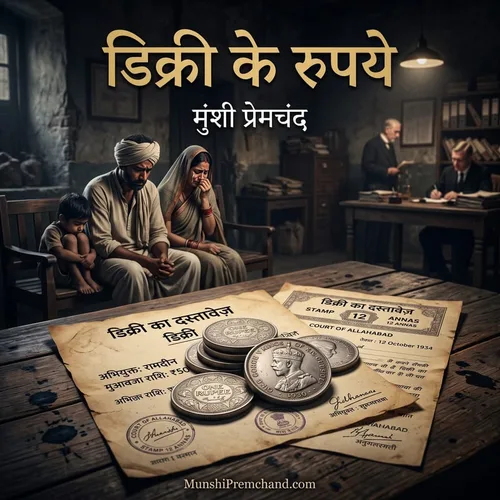
Complete English Translation: The Decree Money
Between Naeem and Kailas there existed as profound a physical, mental, moral, and social contrast as could possibly exist between two human beings.
Naeem was a towering, massive tree; Kailas was a delicate blossom in a garden. Naeem was addicted to cricket and football, excursions and hunting; Kailas to browsing through books. Naeem was a jovial, witty, carefree, laughter-loving, pleasure-seeking youth who never gave a thought to the morrow; for him, school was a playground, and occasionally a place to stand atop benches as punishment. In stark contrast, Kailas was a solitude-loving, physically sluggish student who shrank leagues from athletic exercise, stayed far from frivolities, and remained an anxious, introspective idealist whose spirit was perpetually tormented by worries of the future.
Naeem was the only son of an affluent, highly placed government official; Kailas was one of many sons born to a humble shopkeeper. Kailas never had enough money even to purchase textbooks, managing his studies by begging and borrowing from friends. For one, life was an uninterrupted dream of delight; for the other, an unremitting burden of distress.
Yet despite all these glaring dissimilarities, there existed between them an intimate friendship and a pure, unselfish love. Kailas would rather die than become a dependent beholden to Naeem's charity; and Naeem would rather perish than treat Kailas with the slightest discourtesy. For Naeem's sake, Kailas would occasionally venture out to taste the fresh morning air; for Kailas's sake, Naeem would sometimes pause to dream serious dreams of what lay ahead.
For Naeem, the doors to high state service stood wide open; his future was no boundless, terrifying ocean. Kailas, on the other hand, had to dig his own well with his bare hands before he could drink a drop of water; for him, the future was a fierce battlefield, the mere thought of which filled his breast with restless turmoil.
After graduating from college, Naeem secured a high executive post in the administration, despite having passed only in the third division. Kailas had passed in the first division with high honors; yet despite years of wearing down his heels, sifting dust, and peering fruitlessly into dry wells, he found not a single post. At last, driven by sheer necessity, he was forced to seek refuge in his pen: he founded an independent newspaper.
One had chosen the path of state power, whose sole objective was wealth; the other had embraced the path of selfless national service, whose harvest is fame, endless hardship, and not infrequently the dark cells of a colonial prison.
Beyond the walls of his official bureau, nobody in the wide world knew Naeem. Yet he resided in an expansive bungalow, took the air in a horse carriage, attended theatrical performances, and spent his summers vacationing in Nainital.
The entire nation knew the name of Kailas, yet his dwelling was a dilapidated mud-brick house, and his only conveyance was his own two feet. Even procuring milk for his children was a daily struggle; in purchasing simple greens and vegetables, his family had to pinch and scrape.
For Naeem, the greatest stroke of good fortune was that he had only a single child; for Kailas, his greatest worldly misfortune was an ever-increasing progeny, which never permitted him to rise above destitution.
The two friends maintained a continuous correspondence. Occasionally, they met face-to-face.
Naeem would say, "Brother, you are truly the fortunate one! At least you are rendering some service to the motherland and our people. As for me, I have proved utterly useless for anything beyond filling my own belly."
Yet this phrase—"filling my own belly"—was one that Naeem had mastered only after days of arduous reflection, and he perpetually watched for opportunities to employ it.
Kailas understood perfectly well that this was merely Naeem's gentle modesty. Deeply grieved by his friend's impoverished plight, Naeem sought to comfort him by this subtle device. Kailas, therefore, made vain attempts to conceal his true destitution from him.
A tremendous uproar had broken out in the princely estate of Vishnupur.
The general manager of the estate had been assassinated in broad daylight on the verandah of his bungalow, in full view of hundreds of onlookers! Although the assassin had fled, the British authorities harbored grave suspicions that this murder had been orchestrated at the instigation of the young Kunwar Sahib himself.
The Kunwar Sahib had not yet attained his majority; the administration of the estate was conducted under the Court of Wards. The murdered manager had also been charged with supervising the young nobleman. To the pleasure-loving Kunwar, the manager's incessant meddling was intensely galling. For years, bad blood had simmered between them, culminating on several occasions in bitter, face-to-face altercations.
It was entirely natural, therefore, that suspicion should fall squarely upon the Kunwar Sahib.
To conduct an impartial investigation into this grave affair, the District Magistrate appointed Mirza Naeem. Entrusting the inquiry to an ordinary police officer carried the danger of publicly humiliating the princely household.
For Naeem, this assignment was a golden opportunity to carve out his personal fortune. He was neither an ascetic renouncer nor a philosopher; everyone was familiar with the frailties of his character—if anyone remained ignorant, it was only the high British authorities. The Kunwar Sahib's party obtained their heart's desire.
When Naeem arrived in Vishnupur, he was greeted with extraordinary deference and hospitality. Offerings and tributes poured in; from the orderly to the peon, the court clerk, the syce, the cook, and the khidmatgar, every attendant's mouth was sweetened and every palm grew heavy with gold. The retainers and sycophants of the Kunwar Sahib hovered around Naeem night and day, as though a favored son-in-law had arrived at his bride's parental mansion!
One morning, the widowed mother of the Kunwar Sahib entered the chamber and stood before Naeem with folded hands.
Naeem had been reclining on his couch smoking a hookah; beholding this radiant embodiment of austerities, self-restraint, and noble widowhood, he sprang to his feet.
Gazing at him with eyes brimming with maternal tenderness, the Rani whispered: "Huzoor, my son's life rests entirely in your hands! You alone are the arbiter of his destiny. I adjure you by that very revered mother of whom you are the worthy son—save my child! I lay my body, my soul, and all my worldly wealth at your feet!"
Self-interest, joining hands with compassion, established complete dominion over Naeem's soul.
During those very days, Kailas came to pay a visit to Naeem. The two friends embraced each other with intense warmth. In the course of conversation, Naeem recounted the entire episode and sought to justify his proposed course of action before Kailas.
Kailas said, "In my view, sin is always sin, no matter what decorative veil it may be draped in."
Naeem countered, "And in my view, if committing an offense saves a human life, it is an act of supreme virtue! The Kunwar Sahib is still a mere youth—exceedingly promising, intelligent, generous, and kind-hearted. If you met him, you would be thoroughly charmed. His nature is remarkably humble. The manager, who was in reality a vile and malicious tyrant, went out of his way to torment the young master at every turn. Why, he refused even to sanction funds or make a recommendation for a motor car! I do not claim that the Kunwar Sahib's action is commendable; but the crux of the debate is whether we should prove him guilty and send him to rot across the black waters of the Andaman penal colony, or establish his innocence and preserve his life.
"And brother, between you and me there can be no secrets: there is a bag of a full twenty thousand rupees! All I need do is state in my report that this tragedy arose out of private enmity and that the young Raja had no connection with it whatsoever. Whatever incriminating depositions could be collected, I have quietly suppressed.
"The high authorities had a deliberate political design in appointing me to this inquiry. The Kunwar Sahib is a Hindu; therefore, instead of appointing a Hindu officer, the District Magistrate placed this burden upon my shoulders. This communal division is more than enough to prove my impartiality. On a few past occasions, partly at the instigation of my British superiors and partly out of my own inclination, I showed open favoritism toward Muslims, which created the public impression that I am a die-hard enemy of the Hindus. The Hindu community considers me an absolute personification of bias! That very illusion will now serve as my shield against all accusations. Tell me, am I not a favorite child of fortune?"
Kailas asked, "And what if the secret leaks out?"
Naeem smiled, "Then it will merely be considered an error of judgment on my part, a defect in my investigative method—a shining example of an immutable law of human fallibility! I am hardly omniscient. No taint will touch my integrity; no suspicion of bribery can possibly attach to me. Do not view this from a narrow practical angle; examine it solely from its ethical dimension. Is this deed in accord with higher policy or not? Do not drag in metaphysical dogmas; evaluate it strictly by the tenets of statecraft and moral consequence."
Kailas warned, "Its inevitable consequence will be that other wealthy nobles will receive encouragement to commit similar outrages. You can imagine for yourself how catastrophic will be the result if the belief spreads that wealth can cast a protective veil over the foulest sins!"
Naeem laughed, "No, sir, I cannot imagine any such catastrophe! Bribery already casts its veil over ninety percent of all criminal prosecutions; yet the fear of sin endures in every human heart."
The two friends argued over this question for a long time, but Kailas's sense of strict justice was completely powerless before Naeem's witty banter and satirical thrusts.
The assassination in Vishnupur soon became the subject of fierce debate across the press. With one voice, all nationalist newspapers condemned the conduct of the young nobleman and accused the colonial government of showing undue favoritism toward the princely dynasty. Yet they uniformly added a caveat: since the inquiry was still sub judice, conclusive commentary had to be reserved.
Mirza Naeem spent an entire month crafting his findings to endow them with the appearance of unimpeachable truth. When his report was officially published, a violent tempest erupted in the political world. The worst suspicions of the public were confirmed.
A profound and excruciating dilemma now confronted Kailas.
Until that moment, he had maintained absolute silence upon the affair. He could not make up his mind what to write. To endorse the government's whitewash was to trample upon his own conscience, to sacrifice his intellectual freedom. Yet to remain mute was even more dishonorable.
At last, when several contemporary journals began publishing veiled insinuations that the editor's silence was not without suspicion, neutrality became unendurable.
A fierce civil war broke out between his personal duty as a friend and his public duty to his people.
To tear out that friendship whose seeds had sprouted twenty-five years ago in his youthful breast, and which had now matured into a dense, sprawling banyan tree, was to rip open his own living heart!
That friend who grieved in his sorrows and rejoiced in his triumphs, whose heart was ever eager to come to his assistance, in whose house he forgot all worldly anxieties, the mere sight of whom brought him reassurance, fortitude, and inner strength—was he now to strike a fatal blow at the roots of that very friend?
"Cursed was that hour when I stepped into the journalistic arena!" he lamented to himself. "Otherwise, why should I be trapped in such an agonizing moral predicament today? What a monstrous betrayal it will be! Trust is the very foundation of friendship. Naeem made me his confidant; he never concealed a secret from me. To drag those private confidences into the public light would be an unspeakable crime against him! No, I shall never disgrace sacred friendship; I will not cast a foul blot upon his untarnished reputation; I will not strike a thunderbolt against love! May God never bring that dawn when harm comes to Naeem through my hands! I am utterly convinced that were any calamity to befall me, Naeem would gladly lay down his very life for my sake. Am I now to humiliate that very friend before the eyes of the entire world, and bring down an axe upon his neck? O God, never show me such an evil day!"
Yet the claim of public duty was not without its mighty armor.
According to every enduring code of honor, the editor of a public journal is a dedicated servant of the nation. Whatever he beholds, he must behold through the panoramic vision of the collective good. Whatever he contemplates must bear the stamp of national interest. Moving daily across the vast landscape of public welfare, the importance of the individual shrinks into absolute insignificance; the individual appears puny, trivial, and negligible.
To sacrifice the individual upon the altar of the collective is the primary tenet of his creed. Frequently, he must sacrifice even his own personal survival for the sake of his people. The beacon of his life is to follow in the footsteps of those sublime souls who forged nations, whose glory has become immortal as deliverers of the oppressed. He cannot knowingly perform any deed that threatens to cast a dark shadow across the radiant legacy of his ancestors.
Kailas had attained immense renown and moral authority in the political sphere. His opinions were received with profound respect; his fearless convictions and impartial critiques had elevated him to the undisputed leadership of the press corps.
Therefore, on this fateful occasion, preserving private friendship was not merely contrary to his principles and ideals; it was contrary to his most intimate moral instincts. It was a dishonor, an inner collapse, a shameful act of cowardice. It meant turning his back upon the path of duty and accepting permanent expulsion from the political arena.
What standing does a single individual possess before the majesty of a nation, no matter how intimately beloved he may be? Whether Naeem prospers or falls will not alter the destiny of the motherland; but to cast a veil of silence over the tyranny, lawlessness, and corruption of the administration could prove fatal to the nation!
He cared little whether his critique produced an immediate practical effect. In the vision of an editor, his published word appears like the roar of a lion—that his pen will shake the foundations of empire and move the world! Perhaps the entire globe would tremble at the scratching of his nib, and his published thoughts would usher in a brand-new epoch!
"Naeem is my dearest friend," he resolved, "but the nation is my supreme deity! To preserve the position of a friend, shall I deal a murderous blow against my beloved deity?"
For several days, this agonizing conflict raged between Kailas's duties as an individual and his duties as an editor.
In the end, the nation triumphed over the individual.
He resolved that he would unmask the true character of this sordid conspiracy; he would expose the utter unaccountability of the ruling power before the public; he would exhibit a glaring specimen of the venality and greed of imperial functionaries; he would show the world through whose biased eyes the government sees and through whose corrupt ears it listens! What more damning proof could ever be found to demonstrate its incompetence, its moral bankruptcy, and its utter decadence?
"If Naeem is my friend, so let him be! Before the nation, he is nothing! Why should I shrink from my patriotic duty out of fear of his ruin? Why should I defile my soul, why should I stain my independence? Ah, Naeem, dearer to me than life itself! Forgive me—today I sacrifice a jewel of a friend upon the altar of duty! Yet had my own son stood in your place, I would have offered him as a sacrifice upon this very same altar!"
The following morning, Kailas began his forensic dissection of the Vishnupur affair.
Whatever he had heard from Naeem's own lips, he began publishing in the form of a serial exposé. A traitor within the house brings down Lanka!
Where other editors were compelled to formulate opinions based on conjecture, circumstantial reasoning, and rumor—frequently wandering into absurd or libelous assertions—Kailas's commentaries were fortified with eyewitness facts and absolute proof. He struck at the very heart of the matter, with a fearless precision that denoted firsthand revelation. His articles were concise in phrasing, but devastating in substance.
He spared Naeem not in the slightest, drawing a searing portrait of his self-serving opportunism. He even named the exact sum of money—twenty thousand rupees—paid to cast a protective veil over this heinous crime!
The most sensational revelation was his account of a nationalist undercover operative who had personally witnessed Naeem accepting the fortune. Finally, he issued a direct challenge to the government to summon the courage to refute his evidence.
Not content with this, he published verbatim the private conversation that had transpired between himself and Naeem! The Rani's arrival at Naeem's feet, her desperate pleas, the Kunwar Sahib's lavish gifts—all these episodes infused his articles with the thrilling suspense of an undercover detective novel.
These exposés ignited an immense conflagration in political circles. Journalistic editors rarely stumble upon such magnificent opportunities to strike at the imperial administration!
Public meetings were organized throughout the province to denounce the shameless conduct of the government. Several legislators announced their intention to table formal interpellations in the Legislative Council. The imperial authorities had never suffered such a humiliating blow.
At last, seeing no other avenue to salvage their prestige, the high officials forced Mirza Naeem to institute a criminal defamation suit against Kailas.
The complaint for defamation was filed.
The crown apparatus took up Naeem's prosecution with all its legal might. Kailas represented himself in person: for reasons unknown, the prominent champions of justice—the elite barristers and senior advocates—refused to undertake his defense. The presiding judge was ultimately compelled to grant Kailas permission to conduct his own defense, despite his lack of formal legal credentials.
The trial dragged on for months, creating an unprecedented sensation among the public. Every day, thousands of spectators packed the courtroom. In the bazaars, newspapers carrying reports of the proceedings were snatched up like hot cakes. Shrewd readers who had finished their papers were able to resell them at double the price by evening, for the vendors' stalls were picked completely clean within hours.
Matters previously known only to a handful of subscribers were now the subject of passionate debate across every street corner.
Never had Naeem's reputation suffered such absolute degradation; in every lane, in every household, his conduct was fiercely condemned. The righteous indignation of the public converged entirely upon his head.
That memorable day arrived when the two devoted friends, who had once been ready to lay down their lives for one another, stood face-to-face in a crowded court of law, and Kailas commenced his cross-examination of Mirza Naeem.
Kailas was enduring such intense agony as though he were drawing a double-edged sword across Naeem's throat. And for Naeem, it was an ordeal by fire. Both countenances were clouded with misery—one with self-reproach, the other with apprehension. Naeem made desperate attempts to appear cheerful, occasionally forcing a dry smile; but as for Kailas—alas, who could fathom the agony tearing at that poor man's heart!
Kailas asked softly, "Do you admit that you and I studied together in college?"
Naeem replied, "I certainly admit it."
Kailas asked, "Do you admit that such profound intimacy existed between us that we concealed no secrets from each other?"
Naeem replied, "I certainly admit it."
Kailas asked, "Did you not tell me at that time that this murder had been committed at the instigation of the Kunwar Sahib?"
Naeem answered firmly, "Never."
Kailas asked, "Did these words not issue from your lips: that there was a bag of twenty thousand rupees?"
Naeem did not hesitate for an instant; he did not shrink by a hair's breadth. Not the slightest stammer touched his tongue, not a tremor shook his voice. Upon his countenance appeared no trace of disquiet, instability, or hesitation. He stood unshakeable as a rock.
Kailas had put this question with immense trepidation, dreading that Naeem would be struck dumb and perhaps break into tears.
Yet Naeem declared with cool nonchalance: "It is quite possible you heard these things in a dream."
For a moment, Kailas stood completely thunderstruck. Then, fixing an astonished gaze upon Naeem, he asked: "Did you not state that on several occasions you had shown favoritism toward Muslims, and that therefore, considering you an anti-Hindu officer, this investigation was entrusted to you?"
Naeem did not falter in the least. With a calm, steady, and unruffled demeanor, he replied: "Your imaginative power is truly astonishing! Despite having lived with you for years, I never realized you possessed such miraculous talent for inventing events out of thin air."
Kailas asked not another question.
He felt no sorrow over his own legal defeat; his sorrow was for the utter degradation of Naeem's immortal soul! He could never have conceived that any human being could deny with such brazen audacity words that had issued from his own lips—and that too directly in the face of the very man to whom they had been spoken! This was the ultimate extremity of human depravity.
Was this that very Naeem whose inner and outer nature were one, in whose thoughts and deeds there was no divide, whose speech was the mirror of his soul—that simple, self-respecting, truth-loving Naeem? Could he have turned into such an artful, treacherous hypocrite?
Does man forfeit his very humanity when cast into the mold of servitude? Is colonial bureaucracy a machine designed to extinguish divine virtues in the human breast?
The court awarded Mirza Naeem a decree of twenty thousand rupees against Kailas.
A thunderbolt had struck Kailas's head.
This verdict unleashed fresh outrage across the political landscape. The pro-government journals branded Kailas a malicious slanderer; the nationalist papers denounced Naeem as an unmitigated demon.
Naeem's brazen perjury might have established his formal innocence in the eyes of imperial law, but in the court of public opinion it degraded him even lower into the dust. Letters and telegrams of heartfelt sympathy poured into Kailas's office. Contemporary journals sang praises of his fearlessness and unswerving integrity. Protest rallies were held across the province, registering bitter dissatisfaction with the judicial decree.
Yet dry clouds cannot slake the thirst of a parched earth!
Where was the money to come from—and that too an astronomical twenty thousand rupees all at once? This was the price of upholding an ideal; national service is a costly bargain!
Twenty thousand! Kailas had perhaps never laid eyes on such a sum even in his wildest dreams—and now it had to be paid! Whence could he pay it? The interest on such a sum alone would have liberated him forever from the anxiety of earning daily bread.
He abhorred the thought of weeping over his personal misfortunes in his newspaper to raise a public subscription.
"I did not take on this lion after seeking permission from my subscribers," he reasoned. "Nobody held a knife to my throat forcing me to champion the murdered manager. I challenged the imperial rulers solely out of my own conviction of duty. Why should I cast the burden of an action for which I alone am responsible upon the shoulders of my readers? That would be unjust. It is possible that launching a public campaign might net two or three thousand rupees; but that is repugnant to the editorial ideal! It would tarnish my honor. Why give others the opportunity to sneer: 'Feasting on sweets at other people's expense is hardly winning a great war! We would acknowledge your greatness only if you roared upon your own strength!' The crown of fearless criticism was placed upon my head; why should I extract its cost from others? Let my paper be shuttered, let me be dragged into prison, let my ancestral home be attached, let my pots and pans be auctioned off—I accept all this with an open heart! Whatever falls upon my head I shall endure, but I will never stretch out my begging bowl before anyone!"
It was the hour of sunrise.
In the eastern sky, streams of crimson light came rushing forth like torrents of tears from weeping eyes. The chill morning breeze struck the heart like the sound of someone's mournful wailing. The open meadow facing the house seemed pierced by arrows of light, like an afflicted soul.
Inside the house reigned that deathly stillness that betokens the secret weeping of a master. There was neither the noisy clamor of children nor the soothing admonitions of a mother. When the lamp itself is expiring, whence can light illuminate the home? This was not the silence of hope, but the gloom of bereavement—for on this very morning, the court bailiff was arriving to auction off Kailas's entire worldly estate.
Tortured by inner anguish, Kailas lamented:
"Alas! Today will witness the final end of my public life. That edifice in whose construction I invested twenty-five years of my existence will be shattered to dust today! The knife will be drawn across the neck of my paper; shackles of ridicule and humiliation will bind my feet; foul blackness will be smeared across my face; this peaceful cottage will be desolated; and this grieving family will be scattered like the withered petals of a dead flower! There is no refuge left for them in this world. The memory of the public is fleeting; within a brief span, all my services will sink into the darkness of oblivion. Nobody will remember my name; no one will shed a tear over my misfortune."
Suddenly, he remembered that he had yet to write the leading editorial for the day's edition.
"Today I must inform my beloved readers that this is the final day of this journal's life; it will never again enjoy the privilege of entering your homes. We must have committed many errors; today we beg your forgiveness. For the sympathy and generosity you have lavished upon us, we shall remain eternally grateful. We harbor no grievance against anyone. We feel no sorrow over this untimely demise, for that supreme fortune belongs only to those who remain steadfast upon the path of duty. Our only grief is that we were not granted the strength to make a greater sacrifice for our people."
Having composed this farewell in his mind from beginning to end, he had barely risen from his desk when he heard the sound of approaching footsteps.
He raised his eyes: there stood Mirza Naeem!
The identical jovial countenance, the same gentle smile, the same playful, sparkling eyes!
The moment he arrived, he flung his arms around Kailas's neck!
Kailas wrenched himself away and snapped, "Have you come to sprinkle salt upon my wounds, to kick my dying corpse?"
Naeem tightened his embrace around his friend's neck even harder and laughed: "Of course! What else are the pleasures of love for?"
Kailas fumed, "Do not jest with me! I am boiling with rage; I will strike you!"
Tears welled in Naeem's eyes. He whispered: "Ah, cruel friend! It was solely to hear these harsh reproaches from your lips that my heart was yearning! Curse me as much as you please, shower me with abuses—to my ears, it sounds sweet as divine music!"
Kailas asked bitterly, "And in a few moments, when the court bailiff arrives to auction off my house and belongings, what will happen then? Speak! You saved your own skin and walked away!"
Naeem replied, "We shall both stand together and clap our hands merrily, and make him dance like a monkey!"
Kailas said, "You will take a beating from my hands now, you monster! Had you no pity even for my innocent children?"
Naeem chuckled, "You fancied you could match strength with me! There was a time when the game was always in your hands. Now it is my turn! You paid no heed to time and place, and pounced straight upon me."
Kailas said, "To turn a blind eye to the unvarnished truth was contrary to my principles."
Naeem quipped, "And to strangle the truth was entirely in accord with mine!"
Kailas warned, "If I saddle you with my entire family right now, you will weep at your fate! In stature I am not even half your size, but in siring children I outweigh three men like you! A full seven of them—neither more nor less!"
Naeem laughed, "Very well, are you going to offer me something to eat and drink, or will you keep singing this dirge of misfortune? I swear upon your life, I am ravenously hungry! I rushed out from home without eating a morsel."
Kailas sighed, "Here today is a complete, unremitting fast of the eleventh day! Everyone is sitting plunged in grief waiting for that executioner of the court. What talk of food and drink? If there is anything in your bag, bring it out; let us sit and eat together today, for after this there is only a lifetime of weeping."
Naeem asked with a smirk, "Then you will never commit such mischief again?"
Kailas declared, "Aha! That mischief permeates every fiber of my being! As long as the government rules over us by brute force, we shall resist it! My only regret is that I shall no longer have the opportunity to do so. But out of those twenty thousand rupees, you will not receive even twenty! There is nothing here except heaps of waste paper."
Naeem retorted, "Arre, in place of twenty thousand, I shall recover five times that sum from you! What are you imagining?"
Kailas snapped, "Go wash your face!"
Naeem said, "I am in dire need of money. Come, let us strike a compromise."
Kailas retorted, "You swallowed the Kunwar Sahib's twenty thousand rupees whole, and yet your appetite is not satisfied?"
Naeem said, "Litigating through government officers involves heavy personal expenses."
Kailas threw up his hands: "Then what compromise can I make? Is there anything here besides worthless sheets of paper?"
Naeem said, "It is more than enough to discharge my debt! Come now, let us agree on this: whatever single thing I choose to take, I may take. Promise that you will not weep afterward."
Kailas said, "Arre, take away the entire office on your head, take away the house, seize my person and feed me sweet crumbs of charity! Take an oath if I utter a single peep of protest."
Naeem smiled, "No, I desire only one thing—just one single thing!"
Kailas's curiosity knew no bounds. He wondered: what priceless treasure do I possess? Could he be asking me to convert to Islam? Faith is the only possession whose value can be set anywhere from one to infinity.
"Let me see what the gentleman says," Kailas thought, and asked aloud: "What thing?"
Naeem said, "Permission to converse in private with Mrs. Kailas for one minute."
Kailas gave Naeem a playful cuff on the head and exclaimed, "Still up to your old roguish pranks! You have seen her hundreds of times; what celestial nymph of Indra's court is she?"
Naeem insisted, "Whatever she may be, if you want a settlement, make it; but remember the condition: complete privacy."
Kailas said, "Agreed! But if the decree money is ever demanded again, I shall tear you to pieces!"
Naeem said, "Yes, agreed."
Kailas whispered softly, "Look here, brother, she is a sensitive woman; do not indulge in any crude vulgarity."
Naeem replied, "Sir, I do not stand in need of your sermons in these matters. Just escort me to her chamber!"
Kailas said, "Keep your head bowed."
Naeem laughed, "Why, tie a blindfold across my eyes if you wish!"
In Kailas's household, there was no custom of the veil.
Uma was sitting immersed in deep despondency. Beholding Naeem and Kailas suddenly enter together, she started in astonishment: "Welcome, Mirza ji! It has been a very long time since you remembered us."
Kailas left Naeem there and stepped outside the room; but slipping behind the curtain, he peered in to see what conversation would pass between them. He harbored no ill thought—it was sheer, irresistible curiosity.
Naeem said, "Where do we government servants find leisure? I had to recover the decree money, and that is why I have rushed here."
Uma had been smiling faintly, but at the mention of the money, the color drained from her face.
She said in a solemn voice: "We ourselves are plunged in that very agony. There is no hope of obtaining money from anywhere; and he feels ashamed to make an appeal to the public."
Naeem exclaimed, "Arre, what are you saying? I have already recovered every single penny of the money!"
Uma asked in utter bewilderment: "Truly? Where did he find the money?"
Naeem chuckled, "That has always been his habit! He must have told you, 'I haven't a single cowrie.' But I extracted it from him in the twinkling of an eye! Rise now, and make arrangements for breakfast."
Uma said doubtfully, "How could he possibly have paid the money? I cannot believe it."
Naeem said, "You are simple-hearted, and he is a consummate rogue! I know him thoroughly. He must be deceiving you by chanting endless tales of his destitution."
Kailas entered the room with a broad smile and said: "All right, now step outside! Even here you couldn't desist from your roguery?"
Naeem asked, "Shall I write out a formal receipt for the money?"
Uma looked at her husband: "Did you pay the money? Where did you get it?"
Kailas stammered, "I will tell you another time. Rise, Janab!"
Uma pressed, "Why don't you tell me? Where did you find it? What secret is there from Mirza ji?"
Kailas said, "Naeem, do you wish to humiliate me before Uma?"
Naeem countered, "Did you not humiliate me before the entire world?"
Kailas retorted, "If I humiliated you, you didn't have to pay twenty thousand rupees for it!"
Naeem laughed warmly: "I too shall pay with coin from that very same mint! Uma, I have received all my money. Let this poor fellow's veil of dignity remain intact!"
Summary of The Decree Money
Decree Ke Rupaye ("The Decree Money") is one of Munshi Premchand's most emotionally nuanced masterpieces, exploring the agonizing tension between personal friendship, bureaucratic corruption, journalistic ethics, and the endurance of human affection under colonial rule.
The story centers upon two lifelong friends: Mirza Naeem and Kailas. Despite their profound temperamental differences, they share an unbreakable bond forged in their student days. Naeem, affluent and carefree, secures a high-ranking administrative post in the British government; Kailas, a brilliant but destitute idealist, founds an independent newspaper and lives in poverty, dedicated to national service.
The narrative crisis begins in the princely state of Vishnupur, where the despotic British-appointed estate manager is murdered in broad daylight. Suspicion falls upon the young heir, Kunwar Sahib. Appointed to conduct the official inquiry, Naeem is swayed by the desperate pleas of the widowed Rani and an enormous bribe of twenty thousand rupees. He falsifies his report to exonerate the nobleman and confides the entire scheme to Kailas, rationalizing that saving a young man's life through bribery is an act of virtue. Kailas rejects this moral sophistry.
When the government endorses Naeem's whitewash, Kailas faces an excruciating dilemma: remaining silent makes him complicit in state corruption and betrays his calling as a journalist; exposing the truth means destroying his closest friend. Concluding that the nation's welfare must supersede individual loyalty, Kailas publishes a sensational serial exposé detailing the conspiracy and Naeem's twenty-thousand-rupee bribe.
Under government orders, Naeem sues Kailas for criminal defamation. In court, Kailas cross-examines his dearest friend, only to watch in horror as Naeem calmly perjures himself, denying that the confession ever occurred. The court awards Naeem a decree of twenty thousand rupees against Kailas. Refusing to seek public donations to satisfy a personal legal penalty, Kailas stoically prepares for the auction of his home, printing press, and meager household goods.
On the morning of the auction, Naeem arrives at Kailas's cottage. Rather than acting as a triumphant oppressor, he embraces Kailas with overflowing affection, laughing off his friend's fury. In exchange for cancelling the ruinous debt, Naeem asks only for a private word with Kailas's anxious wife, Uma. He tells Uma that he has recovered the entire sum from Kailas, playfully mocking his friend's supposed miserliness while privately writing off the decree. The story concludes on a deeply moving reconciliation: Naeem's moral failings as a bureaucrat do not extinguish his profound love as a friend, while Kailas's home and dignity are preserved without compromising his journalistic principles.
Publication History
Decree Ke Rupaye (डिक्री के रुपये) was written by Munshi Premchand in 1925 during the zenith of the Indian nationalist movement. It was later anthologized in Volume 3 of his masterwork collection Mansarovar (Mansarovar Part 3).
The story captures the political climate of the 1920s, highlighting the rise of fearless nationalist journalism, the corruption inherent in colonial administrative investigations, and the tragic personal sacrifices demanded of patriotic intellectuals.
This unabridged English translation was published in 2026 by MunshiPremchand.com as part of the MunshiPremchand.com English Translation Series.
Themes & Critical Significance
- Journalistic Ethics vs. Personal Friendship: The core philosophical dilemma pivots on Kailas's agonizing choice between loyalty to his dearest friend and his moral responsibility as a public editor. Premchand illustrates that true journalism demands absolute allegiance to the truth, even when it requires sacrificing the most cherished personal relationships.
- Colonial Administrative Corruption and the Facade of Impartiality: Through Naeem's investigation in Vishnupur, Premchand exposes how colonial administrative machinery operates. Royal influence, communal calculations, and direct financial bribery routinely subvert the course of justice, while the British state weaponizes defamation laws to silence independent investigative reporting.
- The High Cost of Moral Idealism: While corrupt officials like Naeem enjoy luxury and state protection, honest truth-tellers like Kailas face poverty, legal persecution, and the imminent destruction of their families. Premchand demonstrates that standing by one's principles in an unjust society is an extraordinarily costly sacrifice.
- Complexity of Human Affection and Redemption: Premchand avoids simplistic moral dichotomies. Naeem is corrupt, perjurious, and self-serving within the colonial system, yet his personal affection for Kailas remains genuine and uncorrupted. His playful, generous intervention at the climax proves that human empathy and friendship can survive even the deepest ideological wounds.
- Broader Social Significance: Decree Ke Rupaye remains a timeless exploration of the ethics of whistleblowing, the integrity of the fourth estate, and the enduring power of compassion across ideological divides.