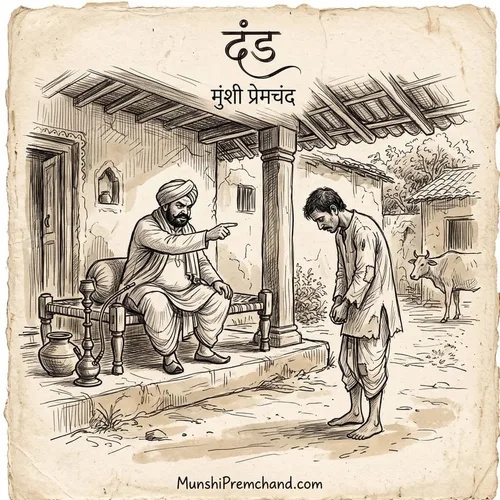
Complete English Translation: The Punishment
1
It was evening. The court had adjourned for the day. Clerks and peons were walking home with their pockets jingling. The scavenger was sifting through trash heaps in the hope of stumbling upon a stray coin. On the verandahs of the courthouse, stray bulls had taken the places of the lawyers. Beneath the shade of the trees, stray dogs could be seen sitting where the petition writers once sat.
Just at that moment, an old man dressed in tattered rags, leaning heavily upon a bamboo staff, arrived at the bungalow of the Joint Magistrate and stood waiting under the portico. The Joint Magistrate's name was Mr. G. Sinha.
The orderly bellowed at him from a distance: "Who is that standing under the portico? What do you want?"
The old man replied, "I am a poor Brahmin, brother. Could I have an audience with the Sahib?"
The orderly sneered, "The Sahib does not grant audiences to the likes of you."
Leaning firmly on his staff, the old man straightened himself with defiance: "Why, brother, am I a highwayman or a thief that some foul mark is stamped upon my face?"
"You must have come to fight a lawsuit on begging money!" the orderly taunted.
"And is that a sin?" retort the old man. "If I do not sell off my ancestral home to fight lawsuits, am I committing a crime? I have spent my entire life fighting lawsuits, yet I haven't spent a single penny from my own pocket. I make a fool pay for his own flogging! I beg from ten respectable gentlemen and hand it over to one. That settles the affair! The whole village trembles at the mere mention of my name. Let someone grumble or twitch an eyebrow at me, and I instantly file a claim in court!"
The orderly said, "You haven't crossed paths with an influential man yet, it seems."
"Arre! I have packed off many an influential man straight into the big house—what world are you living in?" boasted the old man. "I march straight up to the High Court! Who dares cross swords with me, poor creature! Not a farthing leaves my pocket, so why should I fear? Whatever thing catches my eye, I make it mine before I leave off. If they don't surrender it peaceably, I drag them into court and thrash them through litigation until they're beaten black and blue. What do I stand to lose? Now, will you inform the Sahib, or shall I raise my voice myself?"
The orderly realized that this fellow would not be dismissed easily. He went inside and informed the magistrate.
The Sahib inquired about his appearance, and then said with a pleased smile, "Show him in immediately."
The orderly warned, "Huzoor, he is in absolute rags."
The Sahib remarked, "Riches and rubies often lie concealed beneath rags. Go and send him in."
Mr. Sinha was a middle-aged gentleman, remarkably calm and deeply thoughtful. He spoke very little. That harshness and uncouth arrogance commonly considered an inseparable part of governance had never so much as touched him. He appeared the very god of justice and compassion. He was endowed with such piercing discernment that he could read a person the moment he laid eyes on his countenance. In stature he resembled a celestial titan, while his complexion was black as ebony. Reclining on an easy chair, he was smoking from an ornate hubble-bubble pipe.
The old man entered and offered a deep bow.
Sinha said, "Ah, so you are Jagat Pandey! Come, sit down. Your lawsuit is exceedingly weak, my good man. Couldn't you even manage a halfway decent forgery?"
Jagat pleaded, "Do not say so, Huzoor! I am a poor man, I will be ruined!"
Sinha asked, "Didn't you take counsel from any lawyer or mukhtar?"
Jagat answered, "Now I have placed myself entirely at Sarkar's mercy."
Sinha replied, "Can the government alter the court record, or forge a brand-new law? You have blundered, my man. I never step beyond the bounds of the law. You do know, don't you, that not a single judgment of mine has ever been overturned on appeal?"
Jagat took out a bundle: "May Sarkar earn supreme spiritual merit!" Placing a bundle of gold coins at Sinha's feet, he lamented, "I am in deep distress, Sarkar!"
Sinha smiled: "Even here you cannot desist from your tricks? Bring out some more; thirst cannot be quenched with droplets of dew. At the very least, you ought to round out the tens."
Jagat groaned, "I am hard-pressed, O Protector of the Poor!"
Sinha urged, "Reach into your waistband, reach in! Come now, at least uphold the honor of my name."
Jagat whined, "I shall be plundered, Sarkar!"
Sinha countered, "Let your enemies be plundered—the ones who sell off their estates to fight lawsuits! May God bless your patrons and patrons' households; what do you lack?"
In such matters, Mr. Sinha showed not the slightest leniency. Jagat saw that his cunning would bear no fruit here, so he quietly produced five more gold coins. But as he laid them at Mr. Sinha's feet, tears of blood seemed to well in his eyes. This was the fruit of years of bitter toil. It was by starving his stomach for years, scorching his flesh, denying his heart every indulgence, and swearing false depositions that he had managed to amass this hoard. Letting it slip from his fingers was no less agonising than surrendering his very soul.
After Jagat Pandey had departed, at around nine o'clock that night, a carriage pulled up before the Joint Magistrate's bungalow. From it alighted Pandit Satyadev, the legal agent of the Raja of Shivpur.
Mr. Sinha smiled and remarked, "You seem determined not to allow the poor to survive in your estate. Such oppression!"
Satyadev said, "Protector of the Poor, say rather that because of the poor, our own survival in the estate has become impossible! As you well know, Huzoor, ghee cannot be drawn out with a straight finger. A landlord is compelled to exercise some degree of strictness. But matters have come to such a pass that if we so much as squeak, those very poor folk scowl at us. Everyone wants to till land free of cost. Ask them for rent, and they are ready to file criminal complaints! Just look at this Jagat Pandey. By the holy Ganga, Huzoor, his claim is an unmitigated falsehood! Nothing can remain hidden from your keen sight. If Jagat Pandey wins this case, we shall be forced to bundle up our bedrolls and flee. Now, if Huzoor chooses to settle us, only then can we remain. The Raja Sahib sends his respectful salutations to Huzoor and humbly petitions that in this matter, Jagat Pandey be taught such a lesson that he remembers it for life."
Mr. Sinha knitted his brows and asked, "Are laws manufactured in my private residence?"
Satyadev replied, "Huzoor, everything rests in your hands."
With these words, he produced a packet of gold sovereigns and placed it upon the table.
Mr. Sinha counted the packet with his eyes and said, "Kindly present these to the Raja Sahib with my compliments. After all, you will surely engage a barrister or advocate. What will you pay him?"
Satyadev replied, "That rests entirely in Huzoor's hands. The more hearings there are, the more the expenses will mount."
Sinha observed, "If I so wish, I can drag this out for months on end."
Satyadev admitted, "Yes, who could possibly deny that?"
Sinha said, "Even if there are five hearings, at least a thousand rupees of yours will vanish into thin air. If you make up half that amount right here, the entire matter can be settled once and for all in a single hearing. Half your money will be saved."
Satyadev drew out ten more gold coins, set them upon the table, and said with pride, "If you grant permission, I may assure the Raja Sahib that he can rest easy, for the Sahib has bestowed his gracious favor upon us."
Mr. Sinha said sharply, "No, sir! There is absolutely no need to say that. I am not accepting this sum on any condition whatsoever. I shall do only that which the law intends. I cannot deviate from the law by even a barley-corn. That is my steadfast principle. If you gentlemen show me regard, that is your courtesy. But I shall consider anyone who seeks to buy my conscience as my bitterest enemy! Whatever I take, I take solely as a reward for upholding truth."
2
Jagat Pandey was entirely convinced that victory would be his. But when he heard the judgment, his senses were shattered! The claim was dismissed! And on top of that, court costs were slapped upon him!
"To play such a trick on me!" he raged. "If I don't teach this Lala Sahib a bitter lesson, I am no Brahmin! What does he imagine? I will strip away all his haughty arrogance! This was hard-earned money! Who can digest it? It will shatter his bones and burst out! I will smash my head upon his threshold and die right at his door!"
That very evening, Jagat Pandey took his seat directly in front of Mr. Sinha's bungalow. There stood a sprawling, dense banyan tree. Litigants were accustomed to eating their parched gram and coarse sattu there, whiling away the blazing afternoons under its canopy. Jagat Pandey began to denounce Mr. Sinha to them without restraint. He neither ate nor drank; he simply recounted his lamentable tale to all who passed by.
Whoever heard it cursed the Joint Magistrate roundly: "He is not a man, he is a demon! May he meet his end where not a drop of water can be found! He swallowed the bribe whole, and on top of that passed a decree with costs! If this was what he intended to do, why did he gulp down the money? This is the conduct of our own brethren! They call themselves our own! The English were far better than these people!"
Such condemnations continued all day long. A crowd surrounded Jagat Pandey at all hours of the day and night.
Four days passed in this manner, and word reached Mr. Sinha's ears as well. Like other corrupt officials, he was a brazen, domineering man. He carried himself with such complete nonchalance as though the vice of bribery had never even brushed against him. When he never wavered from the law by a hair's breadth, how could anyone harbor suspicion of bribery against him—and even if someone did, who would believe it? How could any formal disciplinary proceedings be initiated against such an astute player? Mr. Sinha never stooped to flatter his superior officers either. Consequently, the high authorities held him in great esteem.
Yet Jagat Pandey had struck him with a weapon for which he possessed no defense. Never before had he encountered such a stubborn, intractable creature. He would ask his servants, "What is the old man doing?"
To demonstrate their personal devotion, the servants piled on exaggerations: "Huzoor, he swore that he will become a ghost and torment you! He says, 'Let my sacrificial altar be raised! On the day I die, a hundred Jagat Pandeys shall rise in my place!'"
Mr. Sinha was a confirmed atheist, yet hearing these words, an unsettled foreboding crept into his mind. As for his wife, she trembled with terror. Time and again she urged the servants, "Go and ask him what he wants. Let him take whatever money he demands; whatever he asks of us, we will give him, if only he leaves this place."
Mr. Sinha, however, secretly signaled the servants not to go. He still hoped that, exhausted by hunger and thirst, the old man would slink away. An even greater fear was that if he showed the slightest sign of yielding, his servants would think he had been made a fool of.
On the sixth day, news came that Jagat Pandey had lost the power of speech. He could not even stir; he lay motionless, staring up at the empty sky. In all likelihood, his breath would leave him that very night.
Mr. Sinha drew a long breath and sank into profound anxiety.
With tears in her eyes, his wife pleaded urgently, "I swear upon my life, go somehow and ward off this calamity! If the old man dies, we will have no place left to hide our heads in this world. Do not look at the money now. Even if you must pay two or three thousand, pay him and appease him. If you feel ashamed to go, I shall go myself."
Sinha said, "I have been intending to go for several days. But whenever I look out, a crowd is gathered there, and my courage fails me. I cannot bring myself to go before all those people, no matter how immense the disaster that threatens. You speak of two or three thousand; I am prepared to give ten or five thousand! But I cannot go there. I know not under what ill-omened star I accepted his money! Had I known he would stir up such a storm, I wouldn't have let him step inside my gate. In appearance he seemed as simple and harmless as a gentle cow. For the first time in my life, I was deceived in judging a man."
His wife said, "Then shall I go? I will come around from the city side, disperse all the people, and speak to him in private. No one will ever know who I am. Surely there is no harm in that?"
Mr. Sinha said doubtfully, "Those who watch will see through it, no matter how much you try to conceal it."
His wife cried, "Let them see through it! Whom should I fear now, and to what end? Is there any shortage of disgrace being heaped upon us already, that more could make it worse? The whole world knows that you took money from him. A man does not lay down his life for someone without cause! Why maintain this futile vanity now?"
Mr. Sinha could no longer suppress his inner agony. He said: "My dear, this is not futile vanity. A thief whipped with canes in the court does not feel the humiliation, a woman branded with scandal does not suffer the disgrace, that an official feels when the veil is stripped from his corruption. He would rather swallow poison and die than reveal his true face to the world. He can bear to watch his complete ruin, but he cannot endure such public humiliation. Short of having his skin flayed alive while he lives or being crushed in an oil press, there is no circumstance that could ever force him to confess his guilt! As for me, I harbor not the slightest fear that a Brahmin will turn into a ghost and haunt us, or that we shall have to build an altar and worship him. I know full well that the punishment for sin rarely visits a man in this world. But being born a Hindu, the lingering doubts of ancestral conditioning remain within me. My soul shudders at the thought of bearing the blood-guilt of brahmahatya upon my head. That is the only matter. Tonight, watching for an opportune moment, I will go and do whatever can be done to avert this catastrophe. Set your mind at rest."
3
Midnight had passed. Mr. Sinha stepped out of his house and walked alone to placate Jagat Pandey.
Beneath the banyan tree, absolute silence reigned. The darkness was so deep it seemed the goddess of night herself lay asleep there. Jagat Pandey's breath came in harsh, labored gasps, as though death were dragging him away by force. Mr. Sinha's hair stood on end. Was the old man on the verge of dying?
He took out a pocket lantern, approached Jagat, and said softly, "Pandey ji, tell me, how are you?"
Jagat Pandey opened his eyes, made an unsuccessful effort to sit up, and wheezed: "You ask how I am? Can't you see, I am dying?"
Sinha asked, "Then why are you throwing away your life in this manner?"
Jagat answered, "If that is your wish, what else can I do?"
Sinha said, "That is certainly not my wish. On the contrary, it is you who are bent upon bringing about my total ruin. After all, I took only a hundred and fifty rupees from you. For such a trifling sum, you have undertaken such a terrible penance!"
Jagat retorted, "It is not a matter of a hundred and fifty rupees! You have ground me into the dust! Had the decree been in my favor, I would have gained ten bighas of prime land, and my name would have resounded across the entire region! You did not take merely a hundred and fifty from me; you destroyed five thousand rupees of mine! A full five thousand! But this arrogance of yours will not endure—mark my words! I tell you, you will be utterly destroyed! In this court your writ runs, but in God's court it is the Brahmins who hold sway! No one who consumes the wealth of a Brahmin can ever know happiness!"
Mr. Sinha expressed profound regret and shame, using every plea and entreaty, and finally asked, "Tell me truly, Pandey, how much money would it take for you to abandon this fast?"
Jagat Pandey summoned all his strength, sat up, and said with ravenous intensity: "I shall not take a single cowrie less than five thousand!"
Sinha gasped, "Five thousand is an enormous sum! Do not be so cruel!"
Jagat declared, "No! I will not take a cowrie less!"
Saying this, Jagat Pandey lay down once more. He had uttered these words with such absolute finality that Mr. Sinha had not the courage to say another word.
He turned toward home to fetch the money; but as he walked back, his resolve wavered. His heart ached at the thought of parting with five thousand rupees in place of a mere hundred and fifty. He said to himself: "If he dies, let him die! What is this talk of brahmahatya and what is this nonsense about sin? It is all superstition and hypocrisy. Won't there be scandal? Government servants are slandered as a matter of course anyway; there is nothing novel in that. How the scoundrel sat up! He must have thought, 'The pigeon is trapped!' If one can get five thousand rupees merely by fasting for six days, I would gladly undertake this ritual at least five times a month! Not five thousand—let someone give me just one thousand! Here I rub my nose in the dust for a whole month before I lay eyes on a measly six hundred rupees. Even with all the squeezing and plundering, one rarely extracts more than that in any month. He must be sitting there waiting for me. He will pocket the money and sweeten his mouth!"
He was about to lie down on his cot when his wife appeared before him. Her hair hung dishevelled, her eyes were terrified, and she trembled from head to foot. She could scarcely utter a word. With great effort she stammered, "It must be past midnight? Go to Jagat Pandey at once! Just now I had such a terrible nightmare that my heart is still pounding wildly; my very life feels in danger. Go somehow and ward him off!"
Mr. Sinha replied, "I am returning from there this very instant. I am far more anxious than you are. I had only just stepped inside when you arrived."
His wife asked, "Ah! So you did go! What was said? Did he agree?"
Sinha said, "He demands five thousand rupees!"
"Five thousand!" his wife gasped.
"He refuses to reduce it by a single cowrie," Sinha said, "and at this moment I have scarcely more than a thousand on hand."
His wife paused for a moment and said, "Give him whatever he asks, if only we can be rid of this nightmare! If you do not have the money, I shall provide it. I have already begun seeing ominous dreams. If he dies, how will our souls survive? He is still breathing and speaking, isn't he?"
If Mr. Sinha was ebony, his wife was sandalwood. Sinha was utterly devoted to her, moving at her slightest gesture. She, too, was adept in ruling her husband. Beauty and ignorance rarely keep company; a beautiful woman is never naive. She knows precisely how to establish her dominion over a man's most vulnerable core.
Sinha said, "Then bring the money, I shall go and deliver it. But the fellow is an utter knave—what if, after taking the money, he goes about parading it before everyone?"
His wife declared, "He must be made to flee from here this very instant!"
Sinha sighed, "Then bring it out, let me pay him. I will remember this lesson for the rest of my days."
His wife said mistrustfully, "Come, I shall accompany you. Who is watching at this hour?"
No one understands a man's nature better than his wife. Mrs. Sinha knew her husband's inclinations only too well. Who could tell whether he might stash the money along the way and claim he had delivered it? Or return and say, 'Even after taking the money he refuses to budge, so what can I do?'
She went to her chest, brought out bundles of currency notes, concealed them beneath her shawl, and walked out beside Mr. Sinha.
Sinha's face was as dark as a burnt cinder. Carrying the lantern, he walked along in bitter repentance. Five thousand rupees were slipping from his grasp! When would he ever see such a sum again? Who could say? It would have been far better if the wretched old villain had simply perished! To hell with scandal—at least no one would have snatched five thousand rupees directly out of his pocket! "May God grant that he has already died!" he muttered inward.
They had only reached the main gate when they saw Jagat Pandey shuffling toward them, leaning on his staff. His appearance was so horrifying that he looked like a corpse that had escaped from the cremation ground.
The moment he saw them, Jagat Pandey sank to the ground, panting: "You took so long! Have you brought it?"
Mrs. Sinha said, "Maharaj, we were coming to you; why did you trouble yourself? You will take the money and go straight home, won't you?"
Jagat gasped, "Yes, yes, I will go straight home. Where is the money? Let me see it!"
Mrs. Sinha produced the bundle of currency notes and held the lantern close: "Count them. It is a full five thousand rupees!"
Pandey took the bundle, sat on his haunches, and began turning the notes over and over. His eyes gleamed with a strange, ecstatic brilliance. Weighing the thick pack of notes in his trembling hands, he asked, "Are they a full five thousand?"
The wife said, "Count them for yourself!"
Jagat marvelled: "Five thousand would fill two whole baskets!" Gesturing with his hands, he muttered, "So much... all this is five thousand!"
Sinha asked, "Do you still not believe it?"
Jagat babbled: "Yes, yes, they are complete, a full five thousand! So now may I go? May I run away?"
With these words, holding the bundle, he took several staggering steps like a drunken man, and then fell heavily to the earth with a thud.
Mr. Sinha rushed forward to lift him up, only to find that the old man's eyes had turned to stone and his face had turned deathly pale. Sinha called out in panic, "Pandey! Pandey! Are you hurt anywhere?"
Pandey opened his mouth once, just as a dying bird lets its head droop and parts its beak. The last thread of life snapped. His lips remained parted, and the bundle of notes lay resting upon his chest.
Just then Mrs. Sinha hurried up. Seeing the corpse, she recoiled in horror: "What has happened to him?"
Sinha replied, "He is dead. What else could have happened?"
Striking her forehead in despair, the wife shrieked, "Dead! O God! Where can I go now?"
With that, she fled swiftly back toward the bungalow. Mr. Sinha picked up the bundle of notes from the chest of the corpse and followed her.
His wife asked trembling, "What will become of this money now?"
Sinha said, "I shall donate it to some pious charity."
His wife cried, "Do not keep it in the house, beware! O God, have mercy!"
4
The next morning, the news spread throughout the entire city: Jagat Pandey had given up his life outside the Joint Magistrate's residence. When his funeral procession was taken out, thousands of citizens marched with it. Curses and abuse were hurled openly at Mr. Sinha.
That evening, Mr. Sinha returned from the courthouse and was sitting in dejected silence when his servants approached him: "Sarkar, grant us our leave! Settle our accounts. The people of our caste biradari are threatening that if we continue in the Joint Sahib's service, our hukka-pani will be cut off and we shall be outcasted."
Sinha barked angrily, "Who is threatening you?"
The kahar said, "Whose name should we give, Sarkar? Everyone is saying it!"
The cook said, "Huzoor, people are threatening me that I will not be allowed to set foot inside the temple!"
Sinha said, "You cannot leave without giving a full month's notice."
The syce replied, "Huzoor, by quarreling with our biradari, where can we possibly go? Consider this our resignation from today. Settle our accounts whenever you please."
Mr. Sinha threatened them fiercely, then tried to coax them with soothing promises, but the servants refused to heed a single word. Within half an hour, every one of them had packed his belongings and walked out.
Mr. Sinha ground his teeth in helpless fury. But when did an official's household ever grind to a halt? He sent word immediately to the police kotwal, who seized several laborers by forced begar. The work of the household was kept moving.
From that very day, a protracted tug-of-war commenced between Mr. Sinha and Hindu society. The washerman refused to wash his clothes. The milkman showed reluctance to supply milk. The barber refused to shave him.
To compound these afflictions, his wife's endless weeping and wailing made life unendurable. She was visited by terrifying nightmares every single night. Walking from one room to another after dark chilled her to the marrow. If anyone suffered even a slight headache, she feared death had arrived.
The greatest sorrow of all was that their own relatives ceased visiting them. One day his brother-in-law came, but left without drinking a drop of water. In like manner, another sister's husband paid a brief visit, but refused even to touch betel leaf in their house.
Mr. Sinha endured all this humiliation with stubborn patience. Thus far, he had suffered no financial loss. Desperate suitors and litigants in need still came running, and gifts and bribes continued to flow into his hands. There seemed, therefore, no urgent reason for panic.
Yet to harbor enmity with the biradari while living among them is like picking a fight with a crocodile while dwelling in the water. Sooner or later, an occasion inevitably arises when one is forced to bow one's head before the community. Within the year, just such an occasion confronted Mr. Sinha.
It was the marriage of his daughter.
This is the very ordeal that crushes the pride of the haughtiest and most arrogant men. You may disregard who visits your house and who stays away; you may scoff at social boycott, communal feasts, and customary pleasantries; but the marriage of a daughter is an unavoidable calamity. Where can one flee to escape it?
Mr. Sinha had always harbored a nagging apprehension that obstacles would arise in Triveni's marriage; but he had maintained faith that the boundless power of wealth would dissolve any difficulty. For some time, he deliberately postponed the search, hoping the fury of the storm might subside. But when Triveni crossed her sixteenth year, all room for delay vanished.
He began sending out marriage proposals; but wherever the matchmaker went, the identical reply returned: "It is not acceptable to us."
In households where, barely a year ago, receiving a proposal from him would have been celebrated as a stroke of immense good fortune, the dry, stony answer was delivered: "It is not acceptable to us."
Mr. Sinha offered tempting sums of money; he offered gifts of prime land; he proposed sending the prospective bridegroom to England for higher education at his own expense; yet to all his lavish overtures, only one answer came: "It is not acceptable to us."
Seeing the attitude of the high-born families, Mr. Sinha began sending proposals to households with whom, in former days, he would have hesitated even to sit and dine. But from those quarters too came the same rebuff: "It is not acceptable to us."
Matters reached such an extremity that he personally went running from door to door. He pleaded and entreated people, but was met everywhere with the same cold words: "Sahib, it is not acceptable to us."
Perhaps in outcasted or disgraced families his proposal might have found acceptance; but Mr. Sinha had no wish to swallow a poisoned fly knowingly. He did not wish to ally himself with people who held no standing in the biradari.
In this manner, a whole year drifted away.
Mrs. Sinha lay groaning upon her cot; Triveni was preparing food in the kitchen; and Mr. Sinha sat beside his wife, plunged in deep anxiety. In his hand he held a letter, glancing at it repeatedly and sinking into brooding thoughts.
After a long time, the sick woman opened her eyes and whispered, "I will not survive now. Pandey will take my life before he is done. What paper is that in your hand?"
Sinha replied, "A letter has arrived from Yashodanandan. The scoundrel felt no shame in writing this letter! I arranged his employment, I arranged his marriage, and today he has grown so haughty that he does not deign to marry his younger brother to my daughter! The wretched fool's fortune would have opened up!"
His wife moaned, "O God, take me away now! I cannot bear to witness this ruin. I crave to eat grapes—did you have them brought or not?"
Sinha said, "I went and brought them myself."
Saying this, he filled a saucer with grapes and placed it beside his wife. She began picking them up and eating them slowly. When the saucer was empty, she asked, "To whose house will you send a proposal now?"
Sinha answered bitterly: "Whose house can I mention? To my mind, there is no one left. It is a thousand times better to remain outside such a biradari than to live within it! I took a bribe from a Brahmin—I do not deny it. But who does not take bribes? When self-interest is served, no one lets an opportunity slip. Leave alone a Brahmin—were God Himself to appear, those who take bribes would suck Him dry as well! If a bribe-giver loses hope and surrenders his life, what is my crime in that? If someone becomes displeased with my judgment and swallows poison, what can I do about it? Even so, I am willing to perform penance. I am ready to accept whatever punishment the biradari decrees. I have told everyone, 'Inflict whatever penance you wish upon me,' but no one listens!
"Punishment ought to be proportionate to the offense; otherwise it is sheer tyranny. If the biradari demands that I be sent across the black waters to the penal colonies merely for eating food touched by a Muslim, I shall never submit to it! And furthermore, if an offense exists, it is mine alone! What crime has my daughter committed? To punish the daughter for her father's crime is completely contrary to justice!"
His wife asked feebly, "But what will you do? Why don't you convene a panchayat?"
Sinha said, "In the panchayat too, there will be the very same chieftains of the biradari; I have no hope of justice from them. In reality, the root cause of this contempt is jealousy. Everyone burns with envy at my success, and they merely want to use this pretext to humiliate me. I understand these people thoroughly."
His wife wept, "The longing of my heart remained trapped within my heart. I shall have to depart from this world carrying this unfulfilled sorrow. As God wills! Your talk terrifies me—what will become of my poor child? But this is my last dying prayer to you: do not step outside the biradari, or even in the next world my soul shall know no peace! This grief is consuming my life. Alas, what misfortune is about to descend upon my child!"
Saying this, tears flowed freely from Mrs. Sinha's eyes.
Mr. Sinha comforted her, saying: "Do not torment yourself over this, my dear. My intention was only to express the thoughts that cross my mind. I tell you truly, my heart is torn to shreds by the injustice of this biradari."
His wife murmured, "Do not speak ill of the biradari. If people had no fear of the biradari, who knows what outrages and chaos man would unleash? Do not curse the biradari... (placing a hand upon her chest) There is severe pain here. Yashodanandan too gave a blunt refusal. I find no rest on any side. What shall I do, O God?"
Sinha asked anxiously, "Shall I call the doctor?"
His wife whispered, "Call him if you wish, but I will not survive. Please call Tibbo here for a moment, so I may hold and kiss her. My heart is sinking... My child! Oh, my poor child!!"
Summary of The Punishment
Dand ("The Punishment") is one of Munshi Premchand's most biting social satires, dissecting judicial corruption, moral hypocrisy, and the cruel, disproportionate machinery of caste excommunication (biradari bahishkar).
The protagonist, Mr. G. Sinha, is a respected district Joint Magistrate who maintains a public facade of unwavering legal purity and impartiality. Beneath this dignified veneer, however, he routinely accepts bribes while maintaining a bizarre internal rationalization: he will accept money only as a "reward for truth" and never deviate from the strict letter of the written law. An elderly, seasoned litigant named Jagat Pandey—who has spent his life exploiting others through legal chicanery and false testimony—bribes Sinha with gold sovereigns to secure a favorable verdict in a land dispute. Later that night, the opposing landlord's agent also attempts to bribe Sinha; Sinha sanctimoniously refuses the second bribe under the pretense of unassailable integrity, but nevertheless dismisses Jagat's claim on legal merits.
Having parted with his life savings under the expectation of a guaranteed victory, Jagat Pandey is devastated and furious. He camps under the expansive banyan tree directly outside Sinha's official residence and launches an indefinite fast unto death. Day and night, he denounces Sinha's corruption to the crowds of litigants and townspeople gathered there. Terrified of public exposure and paralyzed by orthodox Hindu superstitions regarding the fatal spiritual curse of killing a Brahmin (brahmahatya), Sinha's wife desperately urges her husband to pay off the old man. On the sixth night, when Sinha and his wife bring five thousand rupees to Jagat Pandey, the sight of the fortune overwhelms the starving litigant; he clutches the bundle to his chest and instantly drops dead.
Following Jagat's demise, the town's Hindu community unleashes a comprehensive social boycott against Sinha. His household servants resign en masse, local tradesmen (washermen, milkmen, and barbers) refuse to serve him, and even close relatives decline to accept water under his roof. While Sinha's official salary and continuing covert bribes shield him from financial devastation, the real crisis strikes when his daughter Triveni reaches marriageable age. Every respectable household coldly rejects his matrimonial proposals, indifferent to his offers of substantial dowries, land grants, or promises to fund the groom's foreign education.
In a climactic confrontation with his dying wife, Sinha decries the fundamental injustice of collective caste punishment: if he committed a crime, he alone should be penalized through legitimate penance; punishing his innocent daughter for his personal misdeed is an intolerable moral atrocity. Yet his wife, paralyzed by the dread of communal excommunication, begs him with her dying breath never to leave the biradari, leaving the family trapped in an inescapable social tragedy.
Publication History
Dand (दण्ड) was written by Munshi Premchand during his highly productive creative period in the mid-1920s and was published in 1925. It was later included in his renowned eight-volume anthology Mansarovar, appearing in Volume 3 (Mansarovar Part 3).
The story reflects Premchand's sharp observation of colonial administrative machinery—specifically the district judiciary—and his deep skepticism of traditional caste councils (panchayats and biradaris) that exercised tyrannical social power under the guise of communal morality.
This unabridged English translation was published in 2026 by MunshiPremchand.com as part of the MunshiPremchand.com English Translation Series.
Themes & Critical Significance
- Judicial Corruption and the Mask of Legality: Through Mr. Sinha, Premchand exposes the sophisticated hypocrisy of educated colonial officials who weaponize the formal technicalities of the law to conceal personal venality. Sinha's insistence that he "never deviates from the law" even while stuffing his pockets with gold coins reveals how legal formalism can easily co-exist with systemic moral rot.
- The Cruelty and Hypocrisy of Caste Sanctions (Biradari): The story offers a scathing indictment of caste excommunication. Premchand demonstrates that the biradari does not act out of genuine ethical righteousness; rather, its collective boycott is fueled by petty jealousy, envy of Sinha's prosperity, and malicious joy at his downfall.
- Inherited Guilt vs. Individual Responsibility: The central philosophical conflict of the story pivots on the question of punishment (dand). Sinha articulates a progressive, rationalist moral principle: punishment must be strictly proportionate to the offense and must fall exclusively upon the offender. Punishing Triveni—an innocent sixteen-year-old girl who committed no crime—exposes the archaic, barbaric nature of collective caste guilt.
- Superstition, Guilt, and Psychological Torment: Premchand masterfully traces how even Western-educated, ostensibly rational individuals remain vulnerable to deeply ingrained cultural fears. Sinha's outward atheism crumbles before the ancestral terror of brahmahatya (the sin of Brahmin-slaughter), while his wife is driven to physical collapse and death by apocalyptic nightmares and the dread of ghostly retribution.
- The Tragic Irony of Retribution (The Nature of Punishment): Jagat Pandey's weaponization of self-destruction and the community's asphyxiating social boycott are both manifestations of dand (punishment). Yet neither brings about moral rehabilitation or genuine justice; instead, retribution produces an escalatory spiral of suffering that destroys the guilty and innocent alike.
- Broader Social Significance: Dand delivers a piercing critique of colonial judicial institutions, middle-class moral hypocrisy, and the unchecked tyranny of caste hierarchies. It remains a timeless and modern meditation on the boundaries of collective versus individual moral accountability.