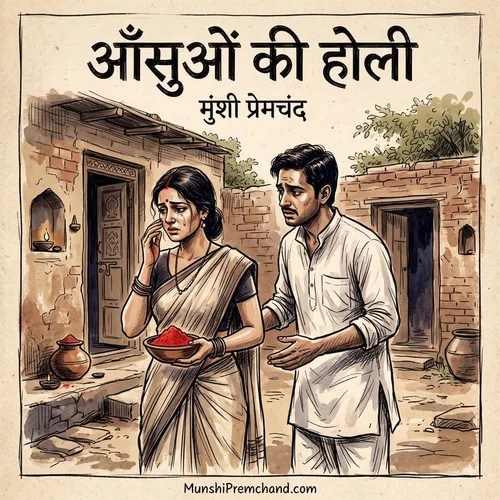
Complete English Translation: Aansuon Ki Holi
The strange custom of distorting people's names—who knows when it first began and where it originated? If someone were to trace the history of this universal malady, they would undoubtedly carve a permanent name for themselves in the annals of historical scholarship.
Our Pandit’s real name was Shrivilas, but his friends universally called him "Silbil." Names invariably cast some influence upon character, and poor Silbil was truly silbil—eccentric, absent-minded, and whimsical to a fault. He might be hurrying off to the office, yet the drawstring of his pajama would be dangling loosely behind him. Perched atop his head would be an English flat-cap, but a long, traditional tuft of hair (chutiya) would poke brazenly out from beneath its rim. His long coat (achkan), on the other hand, was always impeccably tailored.
For some inexplicable reason, he harbored a deep-seated grievance against festivals. Diwali would come and go, but the good man would never touch a single gambling cowrie. And the day of Holi was nothing short of a terrifying trial of endurance for him. For three consecutive days, he would refuse to cross the threshold of his house. Even indoors, he would sit curled up dressed from head to toe in somber black clothes. His merry friends were forever on the prowl, waiting for the poor fellow to get caught; but one cannot very well commit criminal trespass by breaking into a man's home. Once or twice he had been cornered in public, but by groveling, pleading, and whimpering, he had managed to slip away unstained.
This year, however, the predicament had grown exceedingly formidable. In strict accordance with the ancient scriptures, he had observed celibacy (brahmacharya) until the age of twenty-five before entering into matrimony. Whatever slight deficiency remained in ripening his ascetic discipline had been thoroughly completed by the three-year waiting period of the gauna.
Although he harbored no distrust toward his young bride, he was firmly opposed to pampering women or giving them their head. In domestic matters, he preferred the venerable, old-fashioned orthodox approach: once a husband administers a stern rebuke, where does a wife find the audacity to touch colored powders?
The catastrophe was that his in-laws were arriving to celebrate Holi at his house. As the old proverb goes: "When the sister is inside, the brother is Alexander the Great!" And who on earth could restrain these Alexanders?
His wife opened her eyes wide in disbelief and said: "Good heavens! Are you truly not going to bring any color into the house? What kind of Holi is this, Baba?"
Silbil knitted his brows in stern displeasure: "Enough! I have stated my position once, and I despise repeating myself. Color shall not enter this house, nor shall anyone dare touch it! The mere sight of red splashes upon garments induces nausea in my stomach. This is the custom of Holi in our household."
The wife lowered her head meekly: "Then do not bring your colors; what do I care for them? When you yourself will not bring color, how could I possibly touch it?"
Silbil beamed with deep satisfaction: "Undoubtedly, this alone is the sacred duty of a virtuous, devoted wife (sadhvi stri ka dharma)."
"But my brothers are on their way here," she cautioned. "Why would they ever agree to such a rule?"
"I have devised a clever stratagem for them as well," Silbil declared. "Bringing it to fruition is entirely your responsibility. I shall feign illness. I will wrap myself in a sheet and lie flat upon my cot. You must inform them that I have been struck down by a violent fever. That settles it; we shall be rid of the nuisance!"
The wife rolled her eyes and exclaimed: "May heaven forbid! What dreadful words you utter from your mouth! Let fever visit the houses of our enemies; if the wretched thing dares step here, I will scorch its miserable face!"
"Then what other remedy is left to us?"
"You must go and conceal yourself in the small attic room upstairs," she proposed. "I will tell them that you have taken a strong dose of purgative medicine (julaab). If you dare venture outside into the courtyard, the chill air will aggravate your bowels."
Panditji’s face lit up in pure triumph: "Splendid! Marvelous! That is the finest scheme of all!"
The day of Holi arrived. Outside in the streets, an uproarious clamor held sway.
In ancient times, people played only with scented dry powders like abir and gulal. Nowadays, blue, green, purple, and pitch-black dyes have all been stirred together into a chemical coalition; and escaping this toxic alliance is impossible for ordinary mortals—perhaps only the gods might evade it.
Silbil’s two young brothers-in-law had become the prime targets of the entire neighborhood—men, women, children, and old folks alike. The floors, the plastered walls, and even the framed portraits in the outer reception room were drenched in vibrant hues. Inside the domestic quarters, pandemonium reigned no less. The neighborhood sisters-in-law were hardly the sort to show mercy; even the rooftop drain was spewing out streams of vivid magenta water.
The elder brother-in-law asked: "Tell me, Champa, is he truly unwell? He hasn't even come down to take his meal?"
Champa lowered her eyes and said: "Yes, Bhaiya, his stomach began to ache terribly during the night. The doctor has strictly forbidden him from stepping out into the open air."
A short while later, the younger brother-in-law inquired: "Why, Jiji, won't Brother-in-law come downstairs at all? What kind of dreadful malady is this? If you permit, should I run upstairs and inspect him?"
Champa caught hold of his wrist and protested: "No, no! Do not go upstairs! He will not play with colors under any circumstances. The doctor has expressly forbidden any exposure to the breeze."
Both brothers rubbed their hands together in deep frustration.
Suddenly, a brilliant notion struck the younger lad: "Why shouldn't we play Holi with Brother-in-law’s clothes? The garments are certainly not sick!"
The proposal struck a chord of instant delight in the elder brother’s heart. What could the poor sister do? The Alexanders promptly seized the key ring from her hands, unlocked the wooden wardrobe, hauled out every single article of Silbil’s clothing, and rubbed bright dyes over each one—sparing not even a pocket handkerchief!
When Champa hung the drenched garments along the washing line in the central courtyard to dry, the courtyard looked for all the world as though a professional dyer had just finished tinting bridal trousseaus.
Silbil sat upstairs in his attic room, watching the entire spectacle through the window-slats; but he dared not utter a single sound. A venomous serpent crawled across his chest. All his respectable clothes were ruined! Not a single stitch remained fit for wearing to the office on Monday. What personal vendetta did these young scoundrels harbor against his wardrobe?
Meanwhile, a rich assortment of savory festival delicacies was being fried downstairs. Champa was laboring diligently over the stove alongside an elderly Brahmin woman from the neighborhood. When the two brothers, along with several guests, sat down cross-legged in the courtyard to enjoy their feast, the elder brother-in-law turned to Champa and asked: "Have you prepared some khichdi for him upstairs? The poor fellow won't be able to digest rich fried puris today."
Champa replied: "I haven't cooked it yet; I shall prepare it shortly."
"What marvelous wits you possess!" her brother scolded affectionately. "Up till now you haven't even spared a thought for what the poor invalid will eat! You were never this negligent before. Go, fetch some rice and yellow moong dal at once!"
Lo and behold, the khichdi was put on the fire to boil! Downstairs, the merry companions set about devouring their feast. Upstairs, Silbil sat alone, weeping over his cursed fate.
To his mind, this entire mountain of calamities could be traced back to one solitary root cause: Marriage! Had Champa not entered his life, why would these brothers-in-law have descended upon his house? Why would his respectable garments have been ruined? And why would he be condemned to eat watery moong khichdi on the festive day of Holi? But what was the use of crying over spilled milk now?
In the time it took the guests to polish off their feast, the pot of khichdi was ready. The elder brother-in-law personally dispatched Champa upstairs, carrying a steaming brass platter of khichdi to the invalid.
Silbil glared at the platter with venomous eyes and snapped: "Take this repulsive stuff away from before my face!"
Champa asked: "Are you determined to keep a total fast today?"
"If that is your heartfelt desire, so be it!"
"What wrong have I done?" she protested. "I have been slaving over the hot stove since dawn. Bhaiya himself insisted that the khichdi be cooked, and sent me up with it."
"Oh yes, I can see clearly enough that I am no longer the master of this house! The Alexanders have conquered and occupied it! But I will never accept that had you genuinely wished it, a platter of delicacies wouldn't have reached me long before anyone else touched food. I find myself thoroughly disgusted with this brand of wifely devotion!"
"You could see with your own eyes that both of them were hovering over my head every second!"
"What an exquisite joke!" Silbil hissed. "The whole world gorges on crisp samosas and savory khastas, while I am served sick-man's moong khichdi! Bravo, what glorious fortune is mine!"
"Eat just two or three mouthfuls," she pleaded softly. "The moment I find an opportunity, I will fetch another platter for you."
"They have dyed every single garment of mine red! How am I to go to the office? I find no humor in such antics; I call it downright hooliganism! Why did you surrender the wardrobe key to them? May I ask at least that much?"
"They snatched it from my hands by sheer force! Did you not hear the commotion? What could I do?"
"Whatever is done is done," Silbil said darkly. "Take this platter away. If you possess any sense of wifely duty, bring me a proper meal; otherwise, consider this day a sacred fast!"
Suddenly, hearing footsteps upon the wooden stairs, Silbil looked toward the doorway and saw his two brothers-in-law ascending. The moment his eyes fell upon them, the poor wretch contorted his face into an expression of agonizing pain, pulled the cotton sheet over his body, and began groaning piteously.
The elder brother-in-law stepped in and said: "Well, how does your health feel now? Eat a little khichdi."
Silbil twisted his mouth and muttered: "I have no desire to eat anything right now."
"No, no! Starving will do great harm to your stomach. You must eat the khichdi."
In his heart, poor Silbil cursed both devils with all his might, forcing the bland khichdi down his parched throat as though it were liquid hemlock. On the joyous day of Holi, bland khichdi alone had been inscribed into his destiny!
Until the very last grain had disappeared from the platter, both brothers remained firmly planted beside his cot, looking for all the world like prison wardens force-feeding a recalcitrant convict on hunger strike! The poor man was compelled to stuff himself to bursting with khichdi, leaving not an inch of space for any future delicacies.
It was ten o'clock at night when Champa finally crept into her husband’s room, carrying a large silver platter piled high with mouth-watering festive delicacies.
The gentleman had been stewing in silent resentment all evening: Who cares for a husband when her precious brothers are around? Where on earth did these two fiends drop from? They starved me all day, and even now there is no sign of food!
Catching the fragrant aroma of the rich dishes, however, the flames of his wrath were instantly doused. He remarked with dry sarcasm: "It is still exceedingly early in the day; why didn't you wait an hour or two longer?"
Champa set the tray before him and smiled: "You refuse to acknowledge defeat whether you lose or win! After all, two guests had arrived; if I did not attend to their hospitality, how would it look? You yourself would have felt humiliated before the world. Do they come visiting every single day?"
"God forbid that they should visit every day! A single day has broken my back!"
As his eyes took in the fragrant, ghee-drenched sweetmeats and savory pastries, a warm smile swept across Panditji’s countenance. He relished each mouthful, showering Champa with genuine praise: "Truth be told, Champa, I have never tasted such heavenly food in my entire life! What can a commercial sweetmaker know of such cooking? My heart yearns to bestow a handsome reward upon you."
Champa laughed: "You are merely flattering me. What could I do? I prepared whatever little I knew."
"No, indeed, I speak the absolute truth! My very soul has found contentment tonight. Today I have discovered that food has far less to do with the physical belly than it has with the soul. Tell me, what reward do you desire?"
"Will you truly give whatever I ask?"
"I swear by my sacred thread, I shall grant it!"
"If you go back on your word, my honor will be lost."
"I give you my solemn promise, woman! Shall I draw up a legal agreement on stamped paper?"
"Very well, then I make my demand: You must allow me to play Holi with you!"
The color instantly drained from Panditji’s face. He stared at her with bulging eyes: "Allow you to play Holi? But I do not play Holi! I have never played it in my life! Had I wished to play with colors, why would I have spent the day hiding in this stifling attic like a rat?"
"Do not play with outsiders, but with me you must play!"
"Good heavens, it violates my sacred principles! What I consider improper outside my threshold, by what logic of justice can I deem it proper within my home? Reflect upon it!"
Champa lowered her eyes and remarked with sly wisdom: "How many things do men deem proper inside their homes that are not merely improper outside, but outright sinful?"
Panditji, thoroughly flustered and embarrassed, stammered: "Ah, you win and I surrender! Now I beg of you this humble charity..."
"First bestow my promised reward; only then may you plead for charity!"
Saying this, Champa snatched up a brass pot filled with crimson dye and emptied it over Panditji, drenching him from head to foot! Before he could scramble to his feet and flee, she seized a generous fistful of bright red gulal and smeared it across his cheeks, forehead, and beard!
Panditji assumed a mournful, tearful countenance and whimpered: "If any further humiliation remains, finish that off as well! I never imagined that you would prove to be a venomous serpent nestled in my bosom. Is there any more dye left in your pot?"
Champa looked into her husband’s face, and her laughter died instantly in her throat. Across his features lay a shadow of profound, unbearable agony.
Overcome with sudden remorse, she asked anxiously: "Did you truly take offense? I thought you were merely teasing me."
Shrivilas spoke in a trembling, fragile voice: "No, Champa, I did not take offense at your prank. But you have awakened the memory of a sacred duty which I had long cast aside out of sheer cowardice.
"You see that framed portrait hanging upon the wall? It is the likeness of my dearest friend, Manharnath, who is no longer among the living. How can I ever describe to you what a tender, sensitive, and fearless soul he was!
"Whenever he looked upon the downtrodden state of our country, his blood boiled in fury. Nineteen or twenty is barely an age, yet at that tender age he had already chosen the unwavering course of his life. Whenever an opportunity to serve the suffering presented itself, he seized upon it as though he had stumbled upon a king's treasure. He was a born ascetic; worldly desire had never touched his spirit. While our other college companions squandered their hours in frivolous revelry and amusement, his path stood entirely apart. He was ready to lay down his life for truth. Wherever he witnessed injustice, his brow furrowed; wherever he read of tyranny in the newspapers, his face flushed with righteous wrath.
"I have never seen another human being like him. God summoned him away prematurely; otherwise, he would have shone as an incomparable jewel among mankind. To rescue anyone trapped in misery, he carried his very life upon the palm of his hand. And what deep reverence he held for womankind! To him, a woman was an object of veneration and worship.
"Five years ago, on this very festive day of Holi, I was sitting at home, intoxicated with bhang, drenched in colors from head to foot, preparing to set out to enjoy a musical performance with my friends. I dropped by his quarters to invite him along. I found him fully dressed, on the verge of rushing outside. I asked: 'Where are you hurrying off to?'
"He grasped my hand firmly and said: 'You have arrived at the most providential moment; otherwise, I would have had to hunt for someone! An orphaned old woman has passed away in the alley, and there is not a single soul willing to shoulder her bier! One friend has gone visiting acquaintances; another lies sprawled in a drunken stupor; another is hosting a festival feast, while another is entertained by dancing girls. There is no one to carry the corpse to the cremation ground. How could respectable Brahmins and Kshatriyas dare touch the corpse of a Chamarin? Their pristine caste purity would be defiled! Not a single man is willing. With great difficulty, I have rounded up two Kahar palanquin-bearers. I am the third. We lacked a fourth bearer to shoulder the bier, and God in His mercy has sent you. Come, let us make haste!'
"Alas! Had I only known that this was to be beloved Manhar's parting command to me, my soul would not be burning in such bitter remorse today!
"Several fashionable guests had gathered at my house, and musicians were tuning their instruments. At that festive moment, the prospect of hauling a dead corpse to the riverbank filled me with revulsion. I made an excuse: 'I cannot come right now, brother. Guests are seated in my drawing room. I came merely to invite you to the music.'
"Manhar looked at me with eyes overflowing with boundless contempt. He said: 'Very well, go your way; I shall find another companion. But I never expected such callousness from you. You too have repeated the exact words that others uttered before you; there is nothing new in your reply. If we our own selves had not forgotten our sacred duty, would our motherland be reduced to this wretched plight today?
"'Fie upon such a Holi! A festival is not the name for watching vulgar spectacles, gorging on rich delicacies, and parading in fine attire! A festival is a sacred vow (vrat), an austere penance (tap)! Love, compassion, and active sympathy for our suffering brethren is the true soul of every festival! And before you redden your garments with dye, redden your blood with courage and love! Upon cold, pale blood, this crimson dye is nothing but an unsightly mockery!'
"With those parting words, he turned and walked away. At that moment, his rebuke stung my vanity bitterly. If I lacked his burning zeal for service, what right had he to reprimand me so harshly? I returned home to my party, but his words continued to reverberate endlessly in my ears. The entire joy of Holi was poisoned for me.
"For an entire month, we did not cross paths. College had closed early for examination preparations, so there was no opportunity to meet in the lecture halls. I had no inkling when or how he fell ill, or when he returned to his ancestral home.
"Suddenly, one afternoon, a letter arrived in the mail. Alas! Even today, reading those words tears my chest apart!"
Shrivilas’s throat tightened; he was choked by sobs and could not utter a word for several moments. Wiping his eyes, he continued:
"I shall show the letter to you someday, Champa. He wrote: 'Come and meet me one last time, brother; perhaps we shall not meet again in this mortal life.'
"The letter slipped from my trembling fingers. His home was in Meerut district. There was barely half an hour before the next passenger train departed, and I rushed to the station without a second thought. But when I arrived... he was already gone!
"Champa! Ever since that tragic day, I have never played Holi. Not merely Holi—I abandoned every celebration. God perhaps did not endow me with the boldness of heroic action. In my heart, I yearn desperately that someone should enlist me in noble service; I lack the courage to step forward on my own. But tonight, by drenching me in this red dye, you have awakened the burning sting of that forgotten rebuke.
"May the Almighty grant me the moral strength that I may become like Manharnath—not merely in idle sentiment, but in fearless deed!"
Saying this, Shrivilas took a fistful of red gulal from the brass dish, stepped forward, and sprinkled it reverently over the portrait of his departed friend, bowing his head in silent, tearful homage.
Summary of Aansuon Ki Holi
Aansuon Ki Holi (Holi of Tears) is Munshi Premchand’s poignant yet subtly humorous story that questions the moral core of religious and cultural celebrations.
The story revolves around Pandit Shrivilas, an eccentric, absent-minded clerk known affectionately to his circle as "Silbil." Shrivilas harbors an intense aversion to festivals, especially Holi. Every year, he locks his doors, dons black clothing, and refuses to step outside for three days. Following his marriage to Champa, however, his routine is threatened when his boisterous brothers-in-law visit to celebrate Holi. To protect her husband from being drenched in colors, Champa schemes to hide him in the upstairs attic, telling her brothers that Shrivilas is suffering from severe abdominal distress after taking a dose of purgative medicine.
Thwarted in their attempt to color him directly, the mischievous brothers-in-law find Silbil's wardrobe keys, haul out all his office coats, shirts, and handkerchiefs, and dye every single garment red. To make matters worse, while the rest of the household indulges in festive puris and samosas, the brothers insist that the "invalid" be fed only bland moong dal khichdi, force-feeding him until he is bloated.
Late that night, after the guests depart, Champa brings Shrivilas a platter of rich delicacies. Delighted by the food, Silbil promises on his sacred thread to grant her any reward she desires. Champa asks for the right to play Holi with him. Despite his protests that it violates his sacred principles, Champa pours a pot of red dye over his head and rubs red gulal across his face.
Instead of laughter, Champa is horrified to see deep anguish and tears in her husband's eyes. Shrivilas then reveals the tragic origin of his hatred for Holi. Five years earlier, while a college student revelling in bhang and festival music, his saintly friend Manharnath—an ardent young patriot and social reformer—had pleaded with him to help carry the bier of an impoverished untouchable (Chamarin) widow whose corpse high-caste neighbors refused to touch. Reluctant to leave his comfortable party and guests, Shrivilas had refused. Manharnath had scornfully reprimanded him: "A festival is an austere penance, not an excuse for gluttony and fine clothes. Before reddening your clothes, redden your blood with empathy for humanity! Upon pale blood, this red dye is an unsightly mockery!"
Shortly thereafter, Manharnath fell gravely ill and passed away before Shrivilas could reach him. Haunted by remorse, Shrivilas had renounced all festive celebrations. Confronted with his wife's playful dye, Shrivilas's dormant conscience is rekindled. Taking the red gulal from his face, he sprinkles it over Manharnath's portrait, praying for the courage to honor his friend's memory through active humanitarian service.
Publication History
Aansuon Ki Holi was composed in 1926 during the height of the Indian nationalist movement and social reform debates surrounding caste untouchability and human equality. It was subsequently included in Volume 5 of Premchand’s comprehensive Hindi short story collection, Mansarovar (मानसरोवर भाग 5). The story reflects Premchand's signature technique of using domestic humor and light satire to deliver a stinging moral critique of social hypocrisy and ritualistic complacency.
This unabridged English translation was published in 2026 by MunshiPremchand.com as part of the MunshiPremchand.com English Translation Series.
Themes & Critical Significance
- True Celebration vs. Hedonistic Indulgence: Premchand challenges the superficial reduction of religious festivals to gluttony, intoxication, and fine clothes. Through Manharnath’s impassioned dialogue, he asserts that a true festival is an austere vow (vrat) of solidarity and selfless service to the suffering.
- Caste Bigotry and Untouchability: The story exposes the callous hypocrisy of high-caste society, which merrily celebrates festivals while refusing to touch the corpse of a destitute Dalit woman. Manharnath’s willingness to break caste taboos highlights Premchand's lifelong crusade against untouchability.
- "Reddening the Blood" as a Metaphor for Conscience: The contrast between dyeing one's external clothes red and reddening one's internal blood with courage, compassion, and social consciousness serves as the philosophical center of the narrative.
- Remorse, Memory, and Moral Awakening: Shrivilas’s comedic eccentricity is revealed to be a psychological defense mechanism against unhealed guilt. Champa’s prank unintentionally shatters this avoidance, transforming passive mourning into an active pledge of humanitarian commitment.
- Satire and Emotional Depth: The story seamlessly transitions from light-hearted domestic comedy (feigned illness, ruined office clothes, force-fed khichdi) to tragic social drama, showcasing Premchand’s unmatched narrative versatility.