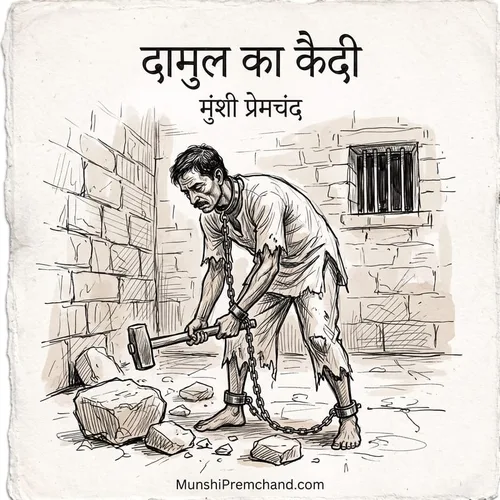
Complete English Translation: Damul Ka Kaidi (The Prisoner of Life)
1
Ten o'clock at night. Inside a palatial mansion, in a lavishly decorated hall warmed by an electric radiator, electric lamps cast a brilliant glow.
Christmas was fast approaching. Seth Khubchand was personally supervising the preparation of lavish gift baskets to be dispatched to senior British officials. Mountains of choice fruits, rich confections, dried nuts, and imported toys stood arranged before him.
The head clerk was reading aloud the names and designations of the various dignitaries, and Sethji, with his own hands, was assembling the hampers according to the rank and status of each recipient.
Khubchand was the proprietor of a vast textile mill and one of Bombay's foremost government contractors. He had once served as Mayor of the city. Even now, he was Secretary of several commercial associations and President of the Chamber of Commerce.
How large a share these annual gift baskets had played in the acquisition of all this wealth, renown, and influence, who could tell? Yet on this single occasion, Sethji routinely squandered five to ten thousand rupees without a second thought. If some people labeled him a sycophant, a flatterer, or a loyalist toady, let them! How did that diminish Sethji's stature? He was not one of those foolish idealists who cast their bread upon the waters without demanding interest in return.
Presently, the temple priest entered the chamber and announced, "Sarkar, the hour is exceedingly late. The ceremonial offering (bhog) for Lord Thakurji is prepared."
Like many other wealthy magnates, Sethji had constructed a private temple and engaged a salaried Brahmin priest to perform the daily rituals.
Glaring at the priest with irritation, Khubchand snapped, "Can you not see what I am engaged in? This too is important work, not child's play! Your Thakurji will not supply everything by Himself. One thinks of prayers only when the belly is full. Thakurji will not starve to death if He waits half an hour or an hour!"
The priest departed crestfallen, and Sethji immersed himself once more in packing the hampers.
The primary business of Sethji's life was the accumulation of wealth, and safeguarding the instruments of that accumulation was his paramount duty. All his conduct was governed by this single doctrine. He cultivated friendships with men only because they might prove useful in acquiring fortune; he indulged in recreation solely from a commercial vantage; he gave lavishly to public charities, yet behind every donation lay the very same calculated design.
His morning and evening prayers were merely an ancient convention—an empty routine that he continued to perform like forced, unpaid labor (begaar) simply because it served his worldly interests. When he found leisure from his worldly affairs, he would step into the temple for a moment, swallow a spoonful of holy water, and hurry out.
An hour later, the priest reappeared at his elbow. The moment he laid eyes on the Brahmin, Khubchand flared up in fury. When a man is engaged in a pursuit that yields immediate cash profits, why should he not resent repeated interruptions?
"I have already told you that I have no leisure right now!" he barked. "Must you dance upon my head? I am no slave to ritual worship! When money flows into the house, only then is Thakurji worshipped! If there is no money in the coffers, even Thakurji will not bother to inquire after our welfare!"
The priest retreated in despair, and Sethji returned to his task.
Just then, his intimate companion Keshavram arrived. Khubchand rose eagerly, embraced him, and said, "Where have you been, my friend? I was on the verge of sending a carriage for you."
Keshavram smiled wryly. "Are you still arranging gift baskets at this unearthly hour? Wrap them up now! You have the entire day tomorrow. How you manage to labor so incessantly is a perpetual wonder to me. Do you remember our program for tonight?"
Sethji raised his head, trying to recall. "Was there a special program? It slips my mind... (suddenly his memory awakens) Ah! That matter! Yes, now I remember! It is not too late, is it? In this wretched scramble, it completely escaped my thoughts."
"Then let us make haste. I imagined you would have arrived long before me."
"Laila was not offended by my delay, was she?"
"That we shall discover only when we reach her salon."
"You must plead my apologies on my behalf."
"What necessity falls on me to apologize for you? She was sitting there with severe, knit brows, declaring that if Sethji does not care for her, neither does she care for him! She refused to let me depart. I managed to pacify her, but you will have to invent a solid excuse."
Khubchand winked playfully. "I shall say that His Excellency the Governor summoned me on urgent state business."
"No, my friend, that excuse will not hold water there. She will retort, 'Why did you not obtain my permission before rushing to the Governor?' What does she care for governors? Beauty and youthful splendor are formidable powers, brother; you understand little of such matters!"
"Then you advise me—what excuse should I proffer?"
"There are twenty excuses ready at hand! Tell her you were seized with a violent fever of a hundred and six degrees since noon, and have only just managed to rise from bed!"
Both companions laughed heartily, and departed together to enjoy the dancing and singing of Laila's mujra.
2
Seth Khubchand's Swadeshi Mill was among the largest textile enterprises in the country.
Ever since the nationalist Swadeshi movement had gathered momentum, the demand for the mill's textiles had doubled. Sethji had promptly inflated the price of his cloth by two annas on the rupee, yet sales showed not the slightest abatement.
Recently, however, the wholesale prices of food grains had declined somewhat, and on that pretext, Sethji had issued a formal notice announcing a steep reduction in the workers' daily wages.
For several days, deputations of worker representatives had argued with Sethji, but he refused to yield a fraction of an inch. When he could easily recruit fresh hands at half the prevailing wages, why should he retain the old labor force? In truth, this wage cut was a calculated maneuver designed precisely to expel the senior workers.
Finding all appeals futile, the laborers resolved to launch a general strike.
It was early morning. The extensive compound of the mill was thronged with a vast multitude of workers. Some sat perched along the boundary walls; some squatted on the bare ground; others paced back and forth in anxious groups. Armed police constables guarded the main gates. The strike inside the mill was absolute.
Seeing a young man approaching from the roadway, hundreds of laborers ran forward and clustered around him. Every voice demanded:
"What did Sethji say, brother?"
This tall, lean, dark-complexioned youth was the chosen representative of the workforce. In his countenance was an air of such unyielding resolve, such transparent integrity, and such solemn gravity that all the laborers instinctively looked upon him as their natural leader. His voice, however, trembled with grief, indignation, and the sorrow of wounded dignity:
"Nothing was accomplished. Sethji refuses to listen to a single word."
Shouts erupted from all sides: "Then we too shall refuse to flatter him!"
The youth continued passionately: "He is resolved to enforce the wage reduction, whether anyone chooses to work or not. This mill earned a net profit of ten lakh rupees this past year! That colossal wealth is the direct fruit of our sweat and toil—yet our bread is being snatched from our mouths!
"The belly of the wealthy is never satisfied. We are weak, we are helpless—who will listen to our cries? The Chamber of Commerce is on his side; the colonial government is on his side; the shareholders of the mill stand behind him. Who stands behind us? God alone will deliver us from this tyranny!"
A laborer interjected, "Yet Sethji is known as a devout worshipper of God!"
The youth smiled bitterly. "Yes, an extraordinary devotee! Nowhere in this city is there a temple as lavishly decorated as his; nowhere is the ceremonial food offered with such elaborate ritual; nowhere are such grand religious festivals celebrated. It is the power of that ostentatious devotion that commands such high honors in the city today. The goods of other mills lie rotting in warehouses, while his bales never linger in the stockrooms.
"And yet that very king of devotees is slashing our meager wages! If the mill had suffered losses, we would gladly work for half our pay; but when profits of lakhs are being pocketed, by what moral law are our wages cut? We shall not endure this injustice!
"Swear an oath that you will not permit any blackleg to step across those gates, even if the management summons an army to escort them! We care nothing if batons rain upon our heads or if bullets tear through our chests..."
A terrified cry rose from the edge of the crowd: "Sethji!"
Everyone spun around. Color drained from hundreds of faces. Many, seized by sudden panic, began begging the constables to allow them inside the mill gates; others scurried behind massive stacks of raw cotton bales to hide. Only a small band of men, though pale with dread, remained standing beside the youth, having placed their lives upon the palms of their hands.
Stepping down from his motorcar, Sethji summoned the police constables and commanded:
"Thrash these rascals and drive them out of the compound this instant!"
Wooden batons began descending mercilessly upon the laborers' backs. A dozen fell groaning to the ground; the rest fled for their lives.
Yet that young man, accompanied by two steadfast companions, remained standing motionless.
Arrogant authority cannot tolerate defiance. That Sethji should arrive in person, and these wretches should dare look him in the eye without retreating—this was nothing short of open rebellion! Who could endure such insolence?
Look at this pauper of a boy! He doesn't even possess a whole shirt on his back, yet he stands planted like an iron pillar, as though I were nothing! He must imagine I am powerless against him.
Drawing a loaded revolver from his coat pocket, Sethji strode toward the trio and commanded them to disperse.
The small group stood unmoving.
Khubchand was beside himself with fury. Such insolence!
Summoning the Head Constable, he barked, "Arrest these three men immediately!"
The constables bound the trio securely with thick ropes and began marching them toward the main gate.
No sooner were they arrested, however, than a massive surge of a thousand workers came roaring out from the mill quarters and charged toward the prisoners. Seeing that even opening fire would not save their lives against such an overwhelming tide, the constables cast aside the ropes and took to their heels.
Khubchand was gripped by such murderous rage that he wished he could blast the entire mob with cannons. In his blind fury, all thought of self-preservation vanished.
Having rescued their companions, the sea of humanity surged directly toward Sethji. Khubchand assumed they were rushing forward to tear him limb from limb.
Aha! That young wretch Gopi marches at their very head! He plays the great leader here as well! Before me in the office, he sat like a drenched cat; but here he advances ahead of them all!
Even now, Sethji could have offered a compromise; but to bow before rebels and sue for mercy was utterly intolerable to his pride.
Suddenly, that advancing horde halted in its tracks.
The youth conferred briefly with his companions, and then, completely alone, began walking steadily toward Sethji.
Khubchand said to himself: He comes to dictate terms for sparing my life. They have agreed upon this among themselves. Look at how fearlessly he strides forward, like a victorious general! Those coward constables fled with their tails between their legs; but I shall not spare you, my lad! Whatever comes, let it come. So long as I hold this revolver, what can you do to me? I shall never bend my knee before you!
The young man drew near. He opened his lips to speak—when Khubchand leveled his revolver and fired point-blank!
Gopi collapsed upon the earth, writhing in agony as blood gushed from his wound.
The instant he fell, a roar of uncontrollable fury tore through the crowd. Until that moment, the laborers had harbored no violent intent; they had merely wished to demonstrate that wages could not be slashed with impunity. But violence ignited violence.
Khubchand realized that his life was in mortal peril. In the open compound, a handgun could not defend him for long, and there was nowhere to flee.
In desperate haste, he scrambled up onto a towering mountain of compressed cotton bales, and leveling his revolver downward, held the raging crowd at bay.
Below, a circle of five to six hundred furious men surrounded the stack. Above, Sethji stood alone with his smoking weapon. No help arrived from any quarter; with every passing heartbeat, the hope of survival diminished. The fled constables had evidently failed to alert higher authorities, or reinforcements would surely have arrived by now. How long could five remaining bullets preserve his life? In a single charge, his ammunition would be exhausted.
What a fatal error! I should have arrived armed with a repeating rifle and crates of cartridges. Then I would have tested their valor! I would have mown them down like weeds! But how could I anticipate such a horrifying calamity?
A voice shouted from the crowd below: "Set fire to the cotton bales! Bring a matchbox! He amassed his fortune from cotton—let him burn upon a pyre of cotton!"
Instantly, a laborer pulled a box of matches from his pocket and struck a flame.
At that very moment, the wounded youth dragged himself through the crowd and stood before the bales. A crude rag was bound around his thigh, through which crimson blood was flowing freely. His face was deathly pale, and the taut lines of his jaw revealed that he was enduring excruciating torment.
The moment the workers laid eyes on him, they swarmed around him. Even in the frenzy of their murderous wrath, the sight of their living leader filled them with boundless ecstasy. The sky reverberated with a thunderous roar:
"Gopinath ki Jai!"
Raising his trembling hand, the wounded Gopinath signaled for silence and spoke in a strained, choking voice:
"Brothers! I have crawled here to say one final word to you. I know not whether I shall live or die; it is quite possible that this is my last petition upon earth.
"What dreadful deed are you about to commit? The Lord Narayana resides in the hearts of the poor—will you turn that sacred truth into a lie? The wealthy man may be intoxicated with the arrogance of his gold; what pride do you possess? Where in your humble, thatched huts is there room for wrath and vengeance?
"I fold my hands before you and beg: disperse from this place! If you harbor any love for me, if I have ever rendered you any service, return peacefully to your homes, and let Sethji depart unmolested to his house!"
A chorus of angry protests arose from the crowd, yet not a single soul possessed the temerity to defy Gopinath's command.
Slowly, sullenly, the workers began to melt away.
When the compound was entirely cleared, Gopinath looked up at Sethji and said with profound humility:
"Sarkar, you may descend now and depart in safety. I know full well that you shot me through a tragic misunderstanding. I was approaching you solely to plead the very words I have just spoken to my brothers. It was my misfortune that you misjudged my intent. It was God's will."
A sudden wave of deep reverence swept through Khubchand's heart. He hesitated to descend, but lingering atop the cotton offered no safety either.
Glancing around with fearful eyes, he climbed down. The dispersing laborers stood clustered ten yards away, their eyes burning with fury and rebellion, muttering bitter reproaches under their breath; yet so formidable was the moral command of that dying youth that not a man dared step forward to block the master's path.
Khubchand leaped into his motorcar. Just as the wheels began to turn, Gopinath collapsed lifelessly onto the dust.
3
As rapidly as Khubchand's motorcar sped along the asphalt road, with equal speed the haunting image of the fallen, bleeding Gopinath raced before his eyes.
A tempest of conflicting thoughts raged in his mind; overwhelming waves of guilt tormented his soul. If Gopinath had been his mortal enemy, why had he preserved his life at the very threshold of death? To this question, Khubchand could find no answer.
The innocent Gopinath seemed to stand before him with folded hands, whispering mournfully: Why did you strike down a guiltless man?
Sensual indulgence and the lust for wealth blind a man's moral vision; yet Khubchand's conscience had not yet grown so utterly hardened that the slaughter of an innocent failed to induce remorse. He constructed a hundred ingenious justifications to pacify his intellect, but his inner sense of justice rejected every one of them. That accusation seemed seated upon the threshold of his conscience like a determined satyagrahi, resolved not to depart without exacting penance.
When he reached his mansion, he was so broken and dejected that he felt as though heavy iron manacles were clasped about his wrists.
His wife Pramila hurried forward, her voice trembling with apprehension:
"What happened with the strike? Is it still continuing, or was it settled? Did the laborers turn violent? I was terrified out of my wits!"
Sinking into an armchair, Khubchand drew a long, ragged breath and said, "Ask me nothing! My life was saved by a miracle—let that suffice. The police fled, the mob encircled me; I barely escaped with my breath. Surrounded on all sides, what else could I do? I fired my revolver."
Pramila gasped in horror. "Was someone wounded?"
"That very Gopinath who used to lead their deputations to my office. The moment he fell, a thousand men surrounded me. I scrambled atop the cotton bales; all hope of life was extinguished. The workers were about to apply a torch to the cotton."
Pramila shivered from head to foot.
"Suddenly," Khubchand whispered, his voice trembling, "that very wounded man dragged himself before the mob, reasoned with them, and saved my life! Had he not intervened, I would never have returned alive."
"God has shown boundless mercy!" Pramila exclaimed, joining her hands in prayer. "That was why I pleaded with you not to venture there alone. Have they taken that man to the hospital?"
Khubchand spoke in a tone of heavy sorrow: "I dread that he must have perished. As my motorcar pulled away, I saw him collapse to the earth, and a crowd rushed to surround his body. Heaven knows what became of him."
Pramila was one of those saintly women in whose veins faith flowed instead of blood. Daily worship, ritual ablutions, fasting, and prayer formed the bedrock of her existence. In joy or in sorrow, in comfort or in tribulation, divine adoration was her impregnable shield.
Now, too, facing this dark crisis, where else could she turn for salvation except to God? Standing before the doorway, her devout heart prostrated itself at the feet of the Almighty, begging for forgiveness and mercy.
Khubchand remarked, "That laborer must have been a sublime soul in some previous birth! Why else would he perform such monumental sacrifice to preserve the life of the very man who shot him down?"
Pramila replied with deep conviction, "It was divine inspiration—what else? It is only when the Lord's grace descends upon us that noble thoughts illuminate the mind."
Khubchand asked, "Then do evil thoughts also emerge from divine inspiration?"
Pramila responded without hesitation, "God is the very embodiment of bliss and purity. Darkness can never emanate from a lamp."
Before Khubchand could frame a reply, a tumultuous roar from the avenue outside startled them both.
Rushing to the balcony, they flung open the shutters. A sea of thousands of men carrying black flags was marching down the broad thoroughfare. Behind the banners moved a flower-decked bier, carried aloft above a dense forest of heads.
It was Gopinath's funeral procession.
The moment Khubchand had driven away from the mill, the workers had wired news of the murder to every industrial establishment in the city. In the blink of an eye, the news had coursed through Bombay like an electric current. Work ceased in dozens of textile mills; a general strike paralyzed the metropolis. The entire city was seized with terror; shops shuttered their doors in dread of bloody riots.
Having wound its way through the principal avenues of the city, this colossal procession had now arrived at the gates of Seth Khubchand's mansion, grimly resolved to exact blood for the blood of Gopinath.
The colonial authorities, on their part, were equally determined to defend Sethji's life and property at any cost, even if rivers of blood had to flow. Two hundred armed constables and soldiers were advancing in double time to disperse the demonstrators.
Before Khubchand could resolve his course of action, the vanguard of the demonstrators broke through the iron gates, swarmed into the ground-floor offices, and began smashing open the iron safes and casting the account ledgers onto a bonfire. The clerks, cashiers, and armed watchmen fled in panic to save their skins.
At that very moment, a company of armed police arrived at the gallop. The Police Commissioner raised his megaphone and gave the crowd five minutes to disperse, or troops would open fire.
The crowd answered with a thunderous roar from a thousand throats:
"Gopinath ki Jai!"
An hour earlier, had such a confrontation arisen, Seth Khubchand would have sat serenely behind his reinforced windows and permitted police rifles to mow down the mob.
But Gopinath's godlike nobility and supreme self-sacrifice had utterly cleansed the moral poison from his spirit. A simple, profound medicine now worked a miraculous cure upon his soul.
Turning to Pramila, he announced with calm resolve:
"I am going downstairs to confess my crime openly before the people. If I remain hidden, countless innocent families will be destroyed on my account."
Pramila caught his arm, her voice shaking with terror: "Why not address them from this window? Promise to increase their wages to whatever amount they demand!"
"At this moment, they thirst for my blood," Khubchand replied gently. "An offer of higher wages will have no effect upon their hearts."
Tears streamed down Pramila's cheeks. "Then they will prosecute you for murder!"
Khubchand spoke with serene fortitude: "If that is God's will, what power do we have to resist? The life of one man is not so infinitely precious that countless lives should be slaughtered to preserve it."
Pramila felt as though the Supreme Lord Himself stood before her in mortal form. Throwing her arms around his neck, she sobbed, "What parting words do you leave for me?"
Embracing her tightly, Khubchand whispered, "God will be your protector."
No other words crossed his lips. Leaving Pramila weeping in the hall, he descended the marble staircase.
All that immense empire of gold and influence for which he had committed every virtue and every vice, for which he had flattered officials, deceived rivals, and perpetrated injustices—that fortune which he had regarded as the blessed fruit of his life's toil—was slipping from his grasp forever this day. Yet within his breast lingered not the faintest trace of attachment, not the slightest pang of regret.
He knew that the sentence of penal transportation across the black waters (damul) awaited him; he knew that his vast commercial enterprise would collapse into dust, his fortune be scattered to the winds, and whether he would ever behold Pramila again in this life was known to Providence alone. It was as though he were voluntarily summoning the messengers of death.
Pramila followed him down to the outer portico, wishing to remain by his side until the mob tore him away; but Khubchand gently pushed her back, stepped swiftly through the portal, and surrendered himself to the crowd.
4
The instant its intended sacrifice was received, the demon of rebellion was appeased.
Khubchand spent a week in police custody before his formal trial commenced. Bombay's most eminent barristers were engaged by the labor unions to conduct the prosecution. The workers had raised an enormous defense fund through half-anna collections, and were so determined that they openly vowed that if the court acquitted Sethji, they would execute him with their own hands on the courtroom steps.
Every day, several thousand laborers packed the sessions court.
The evidence was incontrovertible; moreover, the accused freely confessed his guilt. His counsel merely submitted arguments in mitigation of sentence.
The verdict was pronounced: fourteen years of transportation to the penal settlement of the Andaman Islands.
With Khubchand's departure, Goddess Lakshmi turned her face away from the household. It was as though the living soul had been extracted from that colossal framework of splendor. Within a single year, only the bare skeleton of that vast fortune remained. The textile mill had shuttered immediately; after settling debts and commercial liabilities, nothing was left. Even the palatial residence was auctioned away.
Pramila possessed jewels worth lakhs of rupees. Had she wished, she could easily have secreted them away for her future security; but in her passion for renunciation, she cast them all into the liquidation of her husband's debts.
In her seventh month of pregnancy, she moved into a tiny, dilapidated rented room.
When a son was born to her, the joy of holding that precious jewel made her forget all her worldly tribulations. Her only sorrow was the poignant thought: Had my lord been present today, what boundless bliss would have filled his heart!
The tale of the hardships Pramila endured to raise her child is long and arduous. She bore every privation, but never once stretched out her hand in charity before another human being. Witnessing the scrupulous honesty with which she had surrendered her fortune to clear her husband's liabilities, many citizens revered her as a saint; several wealthy gentlemen offered to provide her with monthly allowances, but Pramila firmly declined every favor.
She was well acquainted with ladies of respectable households; by carrying and selling Swadeshi goods—khadi fabrics, handmade soaps, and swadeshi wares—from house to house, she earned just enough to maintain a modest subsistence.
As long as the child was nursing, she faced immense difficulties; but once he was weaned, she would entrust him to a neighbor and set out on her daily rounds.
Returning home at dusk after a day of exhausting labor, when she lifted the child into her lap, her spirit would take wing across thousands of leagues of dark ocean, seeking that desolate island where her husband toiled in chains.
She harbored not the slightest sorrow over the loss of her former millions. Her solitary longing was that her lord might return home in safety to cool his eyes upon the countenance of his boy. Then, even amidst this grinding poverty, she would consider herself the happiest of women.
Daily she bowed her head in prayer, petitioning the Almighty for her husband's protection. She believed with unshakeable faith that whatever God ordained was designed solely for their ultimate spiritual welfare. In prayer, she found miraculous fortitude, endurance, and life.
Under the sheltering shadow of that pious hope, fifteen years of tribulation passed away.
5
It was evening. The adolescent Krishna Chandra sat beside his mother, looking gloomy and disconsolate. He bore not the slightest physical resemblance to either parent.
Pramila asked gently, "Why, son, have your school examinations concluded?"
The boy replied with downcast eyes, "Yes, Mother, they are over; but my papers went poorly. My heart is not in my studies."
Tears brimmed in his eyes.
Pramila stroked his hair affectionately. "That is not right, child; you must apply your mind to your education."
Looking at his mother with glistening eyes, the boy whispered, "Mother, thoughts of Father haunt me incessantly. He must have grown exceedingly old by now. I constantly dream that when he returns, I shall serve him with my body and soul! Who has ever performed such a monumental sacrifice as he, Mother? And yet people call him ruthless and cruel!
"Mother, I have discovered Gopinath's family! He has left behind a widow, an aged mother, and a daughter who is two years older than I. Both the mother and daughter work as laborers in that very mill. The grandmother has grown blind with age."
Pramila stared at him in astonishment. "How did you discover them, son?"
Krishna Chandra's face brightened with enthusiasm: "Today I walked over to that mill. I wanted to see the exact spot where the laborers had surrounded Father, and the place where Gopinath fell under his bullet. But neither landmark remains; new buildings have been erected, and the mill is operating at full steam.
"The moment the laborers saw me, dozens clustered around me! Everyone exclaimed: 'Brother, you have arrived in the very likeness of Gopinath!'
"The workers have hung a portrait of Gopinath inside their union hall. When I looked upon that picture, Mother, I was struck dumb with wonder—it was as though it were a portrait of myself, differing only by a mustache!
"When I inquired after Gopinath's widow, a man ran and brought her to me. The moment she laid eyes on me, she burst into tears—and heaven knows why, tears flowed from my eyes as well! Those poor women live in utter wretchedness. My heart aches with such profound pity that I yearn to help them."
Anxious dread seized Pramila's heart lest the boy abandon his education to plunge into labor disputes.
She cautioned him: "What assistance can you offer them now, son? Had we wealth, I would say give them five or ten rupees each month; but you know our own circumstances. For now, concentrate on your studies. When your father returns, you may do whatever your heart desires."
Krishna Chandra made no reply; but from that day forward, it became his unbroken custom to visit Gopinath's tenement every afternoon after school. Whatever small pocket money Pramila gave him, he spent entirely upon those orphans—sometimes purchasing fresh fruits, sometimes a basket of vegetables.
One evening, when Krishna failed to return long after dark, Pramila grew deeply alarmed. Tracing his whereabouts to the working-class quarter, she reached a narrow, foul-smelling alley.
Inside a damp, suffocating hovel, Gopinath's widow lay prostrated upon a rickety charpai, and Krishna Chandra stood beside her, fanning her with a palm leaf!
Seeing his mother, the boy said, "I cannot come home just yet, Mother! Look how terribly ill Auntie is. Grandmother is blind, and Binni is busy cooking over the hearth. Who will sit beside her?"
Pramila said fretfully, "Night has fallen, child; how long can you remain here? The empty house frightens me. Come along now; you may return in the morning."
Hearing Pramila's voice, the invalid opened her sunken eyes and whispered weakly:
"Welcome, Mother, please sit. I was pleading with the boy to return home; but he refused to stir. Heaven knows why he showers such boundless compassion upon an unfortunate wretch like me! My own born son could not have served me with greater devotion."
A foul stench rose from the open drains outside; the humidity in that windowless dungeon was suffocating. Yet Krishna Chandra appeared as radiantly happy as a weary traveler who, after wandering across foreign lands, has finally stepped across his own threshold.
Pramila glanced around the dingy room. Her gaze fell upon a framed photograph hanging upon the cracked plaster wall.
She stepped closer to inspect it—and her heart leaped into her throat!
Turning to her son, she gasped: "When did you have this photograph taken, Krishna?"
Krishna smiled. "That is not my picture, Mother; that is the portrait of Gopinath."
Pramila stammered in disbelief: "Go on, you are deceiving me!"
The widow said in a voice heavy with emotion: "No, Mother, that is truly the portrait of my late husband. None can decipher the mysteries of the Almighty; but the boy's countenance resembles his so identically that I am perpetually lost in wonder! When we were wed, my husband was of this very age, and bore this exact countenance. The same radiant smile, the same gentle speech, the same noble temperament!
"What mystery lies behind this, I cannot comprehend. Mother, ever since this boy began visiting our home, I cannot tell you what joy has flooded my life! All of us in this lane are impoverished laborers; he moves among them like one of their own, and the sight of him fills their hearts with bliss."
Pramila offered no reply. An unnameable, terrifying dread settled upon her heart, as though she were trapped in a waking nightmare. A horrifying question arose repeatedly in her mind, the very imagination of which made her hair stand on end.
Suddenly, seizing Krishna Chandra's wrist, she dragged him forcefully toward the door, as though some unseen hand were about to tear him from her embrace forever.
The invalid called after her feebly: "Mother, please permit the boy to visit me occasionally, or I shall surely perish!"
6
After fifteen long years, the former Seth Khubchand stepped down onto the platform of Bombay railway station.
The once-lush, fruit-laden banyan tree had been reduced to a withered, leafless stump. Deep furrows lined his sunken cheeks; his hair was white as hemp; his beard grew wild and untrimmed; not a tooth remained in his mouth; and his spine was bent like a bow. Beholding that hollow stump, who could ever recognize that this was once the magnificent tree laden with blossoms and fruits, among whose branches birds had sung?
Emerging from the terminal, he stood bewildered. Where should he turn?
He felt ashamed even to utter his own name. Whom could he ask whether Pramila was alive or dead? And if she lived, where was she? Would she rejoice upon seeing him, or turn away in disgust?
Locating Pramila, however, proved surprisingly easy. Khubchand's former mansion was still known across the city as 'Khubchand's Mansion'—what does the world care for the dry legalities of changing titles?
Arriving outside the familiar gates, he approached a roadside betel-seller and asked, "Brother, is this not the mansion of Seth Khubchand?"
The shopkeeper looked at him with curiosity. "It was Khubchand's once upon a time; now it belongs to Lala Deshraj."
"Ah! It has been many years since I visited the city. I was once an employee of Sethji. I heard he was sentenced to penal transportation."
"Yes, poor gentleman! He was ruined by his own nobility! Had he wished, he could have escaped without a scratch. His entire estate was swallowed up."
"Is the Sethani still alive?"
"Of course she is alive! And she has a fine son as well!"
A sudden rush of youthful vigor seemed to illuminate the old man's face. That vital joy and enthusiasm which had lain dormant for fifteen years, like the giant Kumbhakarna, awoke with electrifying power, threatening to burst the bounds of his frail, withered frame.
Grasping the betel-seller's hand like an old friend, he stammered, "A son! She has a son? Tell me where she resides, brother, so I may go pay my respects! I ate their salt for many years."
The shopkeeper provided the address in a neighboring lane.
Khubchand walked forward as though floating on air. A short distance down the road, a temple of Lord Thakurji appeared.
Stepping inside, Khubchand bowed his forehead to the marble floor before the deity. Streams of devotional gratitude poured from every pore of his being. Throughout those fifteen years of excruciating penal servitude, if his tormented spirit had discovered any sanctuary, it had been exclusively at the lotus feet of the Refuge of the Destitute.
In contemplating those sacred feet, he had found peace. After spending long days yoked to an oil-press like a beast of burden or swinging pickaxes under the tropical sun, when he collapsed upon the bare earth at night, the ghosts of his past luxury would enact their agonizing drama before his eyes. That former life of sensual indulgence would weep before his memory, and from the depths of his soul a cry would wrench forth: Lord! Have mercy upon me!
In that desperate petition for grace, he had attained a transcendent tranquility, like a frightened child resting upon its mother's breast. When he possessed gold, power, luxury, and health, he had lacked the leisure for spiritual introspection; his intellect had raced only after worldly accumulation. Stripped of all possessions, in utter destitution, his soul had turned toward God.
As he stepped out of the temple, a woman crossed the threshold.
Khubchand's heart gave a violent leap! Bewildered, he shrank behind a stone pillar.
It was Pramila!
In all those fifteen years of exile, not a single day had passed without her image visiting his thoughts. That vision was etched behind his eyelids. Yet what a vast gulf separated that cherished memory from this living reality!
Time has no power over a mental image; joy and sorrow cannot alter its contours. In his memory, he had always envisioned a woman of youthful luxury—adorned with sparkling jewels, radiant smiles, and graceful modesty. In this living woman, he beheld the majestic, ascetic radiance of a saint! His heart trembled like a chord struck in divine ecstasy.
A wild impulse seized him to cast himself at her feet and cry: Goddess! Deliver this fallen sinner!
Yet instantly the dread arose: What if she turns away in horror? In his present degradation, he felt ashamed to appear before her.
Following her at a distance, he saw her turn into a narrow lane and enter a multi-story tenement. He reached the portal, but could not see which staircase she had climbed. He stood outside, wondering whom to ask.
Suddenly, an adolescent youth emerged from the hallway. Khubchand called out to him.
The youth turned, looked intently into the old man's eyes, and instantly threw himself at his feet!
Khubchand's breath stopped in his throat.
It was Gopinath!
The exact same stature, the identical facial features, the same noble brow—differing only in youthfulness! It seemed as though the martyr had taken birth anew. A strange, trembling awe shuddered through Khubchand's frame.
Rising swiftly, Krishna Chandra exclaimed, "We were waiting for you at home today, Father! I was just heading out to hire a carriage to meet your ship at the docks! You must have endured great hardship walking here. Come inside, Father! I recognized you the instant my eyes fell upon you; I would have known you anywhere in the wide world!"
Khubchand stepped inside, his spirit tangled in the thorns of the past. Could he ever banish Gopinath's countenance from his memory? He had beheld that face a thousand times in his dreams. That bloody tragedy had been the supreme turning point of his existence, and now, after the passage of an epoch, that very face stood before his path once more!
Halting at the foot of the stairs, Krishna said eagerly, "Let me run up and tell Mother! 'Father has arrived! New clothes have been stitched and kept ready for you!'"
Khubchand caught the youth by the shoulders, kissed his cheeks as though he were an infant, and lifted him bodily into his arms!
Carrying him up the stairs, he felt the surging power of an immense joy. Thirty years of unfulfilled paternal longing seemed to pour out upon this single treasure. Life enchanted him once more with new hopes. For this priceless jewel, he would gladly have endured a hundred exiles!
All the hard-won wisdom of his lifetime he now yearned to impart to Krishna Chandra. He held no ambition that his son should become wealthy, clever, or famous; his only prayer was that he become compassionate, humble, self-sacrificing, and devout. In the boundless mercy of the Almighty, his faith was now absolute; otherwise, was a wretched sinner like himself worthy of such divine grace?
And Pramila was virtue incarnate!
Krishna Chandra, too, was overjoyed to have his father back. Through his devoted service, he seemed determined to erase every painful memory of the past—as though his very birth had been ordained solely to serve this father, as though he had entered the world to repay some ancient debt from a previous life.
7
It was the seventh day following Khubchand's return.
Evening had descended. Khubchand was preparing for his evening prayers, when Gopinath's daughter Binni arrived and said to Pramila:
"Mother, my mother is severely unwell; she is asking for brother Krishna."
Pramila frowned. "He cannot go today. His father has returned after fifteen years, and they are conversing."
Krishna Chandra overheard the exchange from the adjacent room and came out at once. "No, Mother, I shall take Father's permission and return in a few moments."
Pramila chided him: "Whenever you go there, you forget all sense of home! Heaven knows what magic potion those women have fed you!"
"I shall return very quickly, Mother, I touch your feet!"
"What an obstinate boy you are! Your poor father sits here alone, and your mind is consumed with running there!"
Khubchand stepped forward and intervened: "What harm is there, Pramila? If the boy promises to return quickly, let him go."
Krishna departed happily with Binni.
A moment later, Pramila said, her voice heavy with unease, "Ever since I saw Gopinath's portrait, an incessant dread haunts my mind. I cannot escape the premonition that God is orchestrating some terrifying destiny."
Khubchand said solemnly, "When I first laid eyes on the boy, I was struck dumb with wonder. It seemed as though Gopinath himself stood before me."
"Gopinath's widow insists that Krishna's temperament is identically that of Gopinath."
Khubchand smiled a deep, mysterious smile. "It is the mysterious play of Providence that the very soul I murdered has returned as my own son. I am convinced that Gopinath has taken reincarnation in him."
Pramila pressed her hand to her forehead. "It is precisely that thought which fills my nights with terrifying visions!"
Khubchand looked at her with gentle faith: "Whatever the Lord ordains, He ordains solely for the welfare of His creatures. We imagine that Providence has dealt unjustly with us; that is our foolish ignorance. Providence is no petulant child who derives delight from smashing the toys he has created; nor is He our enemy, taking pleasure in our destruction. He is all-merciful, all-beneficent.
"It was this solitary faith that preserved me from complete annihilation during my long exile across the black waters. Without that anchor, I know not where my fragile bark would have drifted, or in what ruin it would have perished."
Meanwhile, after walking some distance down the lane, Binni turned to Krishna and confessed:
"I lied to your mother when I said my mother was ill. Mother is completely well. Because you had not visited us for several days, she instructed me to summon you on that pretext. She wishes to take your counsel on an urgent matter."
Krishna looked at her with curiosity. "Take my counsel? What advice can I offer? I could not come because my father had returned."
"Your father returned!" Binni exclaimed. "Did he ask who I was?"
"No, he asked nothing."
"In his heart, he must have thought: What a shameless hussy!"
"Father is not that kind of man," Krishna said warmly. "Had he known who you were, he would have spoken to you with the tenderest affection. I used to fear that convicts returning from the black waters must possess hearts of stone, but my father is a deity of compassion."
They walked on in silence for a few moments, and then Krishna asked, "What counsel does your mother desire from me?"
Binni's playful demeanor vanished. Her voice grew hard:
"Tomorrow, our mill is going on strike again. Our manager is so heartless that if a worker is five minutes late, he cuts half a day's wages; if ten minutes late, an entire day's earnings are confiscated! The workers have pleaded with him repeatedly, but he refuses to listen.
"You are young, but heaven knows why Mother places such absolute faith in you, and all the laborers trust you implicitly. Everyone's advice is that you should confront the manager and speak plainly to him. A clear yes or no! If he remains adamant, we shall shut down the mill!"
Krishna remained immersed in thought.
Binni continued with fierce pride: "This cruelty persists only because the manager knows we are helpless, with nowhere else to turn! We must show them that we would rather starve than endure injustice!"
Krishna cautioned, "If a riot erupts, bullets will fly."
"Let them fire!" Binni cried recklessly. "Our father died under their bullets, yet did we not survive?"
When they reached the tenement, a large assembly of mill workers was gathered outside the doorway, passionately debating the strike.
The moment they saw Krishna Chandra, a collective cry arose: "Look, our brother has arrived!"
8
It was the very same textile mill where Seth Khubchand had once opened fire upon the workers.
Today, his own son stood before the mill gates as the undisputed leader of the striking laborers, facing the threat of gunfire!
Krishna Chandra had confronted the manager. The manager had flatly refused to relax the punitive attendance fines. The strike was formally proclaimed.
Today was the day of action. Thousands of laborers were massed inside the mill compound. To protect the premises, the manager had summoned a company of armed military guards.
The workers had harbored no intention of rioting; the strike was intended purely as a peaceful demonstration of their grievances. But the sight of armed troops inflamed their passions. Both sides stood prepared for battle—on one side rifles and bayonets, on the other stones and brickbats.
The young Krishna Chandra raised his hand and addressed the multitude:
"Are you all prepared? We must march inside the mill gates, even if every one of us is slaughtered!"
A roar arose from hundreds of throats: "We are all prepared!"
"Those who have dependent wives and young children—let them return home!"
Binni's clear voice rang out from behind the front ranks: "God Himself protects children and families!"
Several hesitant laborers who had contemplated retreating were arrested by her words. A deafening cheer arose, and the phalanx of a thousand workers surged forward toward the mill gates.
The military guard raised their rifles and fired!
Krishna Chandra was the first to fall, followed by several other laborers.
The ranks began to waver in terror—when suddenly Khubchand, bareheaded and barefoot, burst into the compound!
He had learned of the crisis at home. Seeing Krishna Chandra collapse upon the earth, he rushed forward like a madman, shouting at the top of his voice:
"Krishna Chandra ki Jai!"
Dropping to his knees, he scooped up the bleeding youth and pressed him against his chest!
A wave of supernatural courage swept through the workers.
"Khubchand!" That legendary name worked like divine magic!
Throughout those fifteen years, Khubchand had attained the exalted status of a martyr in their collective memory. And now his own flesh and blood lay fallen as their champion! Blessed be the inscrutable play of the Almighty!
Laying his son's corpse gently upon the earth, Sethji rose and addressed the assembly with unshakable composure:
"Brothers! This boy was my son!
"When I returned after fifteen years of penal servitude across the black waters, by God's infinite grace I was permitted to behold his face. Today is the eighth day. Today, God has taken him back into His eternal sanctuary. That was His divine grace; this too is His grace!
"I was an ignorant, foolish creature then, and I remain ignorant now. Yet of this one truth I am supremely proud—that God blessed me with such a heroic child!
"Now, my brothers, offer me your congratulations! Who among mortals is blessed with such glorious martyrdom? He who bares his chest before injustice without fear is the only true hero!
"Therefore, roar together: Krishna Chandra ki Jai!"
From a thousand throats, a deafening roar shook the heavens, and with that cry, the entire multitude stormed into the mill offices.
The soldiers of the guard did not fire another shot; this astonishing, supernatural spectacle had paralyzed their arms.
Inside the executive chamber, the manager had drawn his pistol and stood waiting. Looking up, he found himself face to face with Seth Khubchand!
Lowering his weapon in profound shame, the manager stammered, "I am deeply grieved that this tragic accident occurred today through the cruelty of fate; but you can appreciate my position—what else could I do?"
Khubchand replied in a calm, majestic voice:
"Whatever the Lord ordains, He ordains for the ultimate welfare of His creatures. If this supreme sacrifice brings justice to these laborers, I shall harbor not the faintest sorrow."
The manager said deferentially, "Yet such philosophical convictions cannot soothe a grieving heart. Even the wisest men lose their composure."
Wishing to conclude the matter, Khubchand asked firmly, "What have you resolved now?"
The manager hesitated. "I am not an independent authority. I was merely executing the orders of the board of directors."
Khubchand's voice turned stern as steel:
"If you know in your heart that injustice is being perpetrated against these laborers, your sacred duty is to stand beside them! Cooperating with injustice is identical to committing injustice yourself!"
While outside the workers were preparing the funeral bier for Krishna Chandra, inside the executive office the mill directors and manager sat in conference with Seth Khubchand, hammering out an agreement to end the exploitation of the workforce.
At ten o'clock, Khubchand stepped out onto the portico and addressed the waiting multitude:
"Friends! Offer your gratitude to the Almighty, for He has accepted your petition. New, humane attendance rules will be instituted immediately, and the oppressive system of fines is abolished forever!"
The laborers heard the announcement, but the joy that would have intoxicated their hearts an hour earlier was absent. Having paid the price of Krishna Chandra's life, even the acquisition of an empire appeared worthless in their eyes.
Before the funeral bier could be lifted, Pramila, with wild, red eyes, came running like a demented creature and threw herself upon that body which she had carried in her womb and nurtured with her life's blood.
A collective wail of lamentation rent the air. There was not a laborer or a mill official present whose eyes did not overflow with tears.
Khubchand knelt beside her, placed a hand upon her shuddering shoulder, and said:
"What are you doing, Pramila? Upon a death at which one should rejoice and offer thanks to God, you shed tears?"
Pramila remained clutching the cold corpse against her breast.
That treasure upon receiving which she had regarded poverty as wealth, that lamp from which she had drawn hope, patience, and sustenance throughout fifteen years of lonely exile, had been extinguished forever. That blessing through which faith in God had permeated every pore of her being had been violently snatched away.
Suddenly looking up at her husband with wild, burning eyes, she cried out:
"You may believe that whatever God does, He does for our welfare! I do not believe it! I cannot believe it! How can I ever believe it?
"Alas, my child! My darling! My king! My sun! My moon! The solitary anchor of my life! My all! Having lost you, how can I ever pacify my heart?
"Beholding you in my lap, I considered my destiny blessed—how can I bear to see you stretched cold upon the dust today? My heart refuses to accept it! Alas, it refuses to accept!!"
Beating her chest in uncontrollable agony, she collapsed upon the body.
That very night, the grief-stricken mother departed this mortal world. The mother bird escaped her cage to seek her fledgling in the heavens.
9
Three years passed away.
In the working-class settlement of the textile mills, the sacred festival of Krishna Janmashtami was being celebrated.
Through their own modest contributions, the laborers had erected a temple of their own. In architectural dimensions, the structure was neither grand nor imposing; yet the pure, unadulterated devotion with which heads bowed before its altar was something that the grandest marble temples could never command. Here, men came not to parade their wealth, but to offer the humble tribute of their faith.
Working women were singing devotional hymns; children ran to and fro performing small tasks; men were absorbed in decorating the divine tableau of the child-deity.
Presently, Seth Khubchand entered the courtyard.
The moment the women and children caught sight of him, they ran forward from all sides to surround him with affectionate reverence. This temple was the fruit of his continuous, selfless labor.
Serving these laboring families was now the sole governing purpose of his existence. His tiny domestic family had expanded into this vast, collective fraternity. Their joy he regarded as his own joy; their sorrow, his own sorrow. The former curses of drunkenness, gambling, and moral decay had vanished from among them. Khubchand's companionship, guidance, and saintly conduct were transforming beasts into noble men.
Approaching the altar, Khubchand bowed his white head before the infant form of Lord Krishna, and his soul blossomed with transcendent bliss.
In that illuminated tableau, he caught a sudden, radiant vision of Krishna Chandra! And within that very heartbeat, the vision transformed into the luminous countenance of Gopinath!
Every hair on Khubchand's body stood on end with holy ecstasy.
The omnipresence of the Divine, the living reality of Supreme Mercy, was revealed to him this day for the first time in his life! Hitherto, he had acknowledged God's grace merely as an abstract philosophical doctrine; today, he beheld its living, radiant manifestation before his eyes!
For the salvation of a single corrupt, fallen soul, what monumental divine architecture! What relentless, unbroken providential design!
The entire panorama of his past life unrolled before his inner vision like a moving cinema reel. It became transparently clear to him that for twenty years, the grace of God had cast its sheltering mantle over his head.
What had Gopinath's sacrifice been?
When the rebellious mob had besieged his mansion, what was his own surrender but the prompting of divine mercy? Throughout fifteen years of penal exile across the black waters, and then in the miraculous form of Krishna Chandra—who had been preserving his soul from destruction?
From the depths of Khubchand's spirit, dissolved in the ecstatic tears of devotion, a mighty cry wrenched forth:
"Krishna Bhagwan ki Jai!"
And it seemed as though the entire universe was illuminated with the radiant light of divine compassion.
Summary of Damul Ka Kaidi (The Prisoner of Life)
'Damul Ka Kaidi' is an epic and profoundly moving short story exploring the dynamics of industrial class struggle, capitalist arrogance, spiritual repentance, and moral redemption. Seth Khubchand is a prominent Bombay textile mill owner and government contractor who uses religion merely as an instrument for commercial success. Despite amassing enormous profits during the nationalist Swadeshi movement, he arbitrarily slashes the wages of his workforce. When the workers launch a strike under the noble, principled leadership of Gopinath, Khubchand resorts to police brutality. When Gopinath approaches him peacefully to negotiate, Khubchand panics in arrogant terror and shoots him point-blank with a revolver.
Mortally wounded, Gopinath demonstrates superhuman nobility: dragging himself before the enraged laborers, he forbids them from lynching Khubchand or torching the cotton bales, pleading with them to let the master depart unharmed. Shaken to his soul by this selfless mercy, Khubchand experiences a profound moral awakening. When the workers surround his mansion demanding justice following Gopinath's death, Khubchand refuses to hide behind armed police; he steps out, confesses his crime, and is sentenced to fourteen years of penal transportation to the Andaman Islands (damul). His fortune is completely wiped out, but his saintly wife Pramila embraces honest poverty, surrenders her jewelry to clear his debts, and raises their newborn son, Krishna Chandra, while promoting Swadeshi goods.
Fifteen years later, Khubchand returns as a humble, toothless, impoverished old penitent. To his astonishment, he discovers that his son Krishna Chandra has grown up into the spitting image of Gopinath, inheriting the martyr's exact facial features, voice, and passionate dedication to the working class. When the mill management imposes draconian attendance fines and summons military guards against a fresh strike, Krishna Chandra leads the workers and is martyred in a hail of gunfire. Arriving on the scene, Khubchand embraces his son's corpse, reframing the tragedy as a glorious victory against injustice, and compels the mill management to abolish the oppressive rules. Pramila dies of grief that very night, while Khubchand dedicates the remainder of his life to living among and serving the laboring community. In a final vision before Lord Krishna's altar, he recognizes the unified spirit of Gopinath and Krishna Chandra, realizing that his entire life was a divine design to liberate him from the inner prison of ego and greed.
Publication History
'Damul Ka Kaidi' was written in 1932 during Premchand's mature phase of intense socio-political engagement and was published in Mansarovar (Volume 2), standing as one of his greatest masterpieces on labor rights and moral transformation.
This unabridged English translation was published in 2026 by MunshiPremchand.com as part of the MunshiPremchand.com English Translation Series.
Themes & Critical Significance
- Capitalist Exploitation vs. Working-Class Dignity: Premchand presents a scathing critique of industrial capitalism, exposing how mill owners exploit patriotic movements like Swadeshi for private profit while ruthlessly slashing the subsistence wages of the very workers whose labor produces their wealth.
- The Power of Non-Violent Moral Resistance: Gopinath's dying act—forbidding the workers from lynching Khubchand—mirrors the Gandhian ethos of non-violence and moral conquest. It is not violence that defeats Khubchand, but Gopinath's sublime forgiveness, which pierces the mill owner's conscience and initiates his conversion.
- The Multi-Generational Cycle of Karma and Reincarnation: The spiritual motif of Krishna Chandra being born as the living incarnation of Gopinath serves as a powerful metaphor for poetic justice and moral continuity. The son of the oppressor becomes the champion of the oppressed, completing the father's penance through sacrifice.
- True Freedom from the 'Prison of Life': The title operates on multiple symbolic levels. Khubchand was initially imprisoned by his greed, arrogance, and material lust. His fourteen years in the Andaman penal colony (damul) was a physical imprisonment that catalyzed his moral liberation. By ultimately serving the poor and abandoning his ego, he attains true spiritual emancipation.