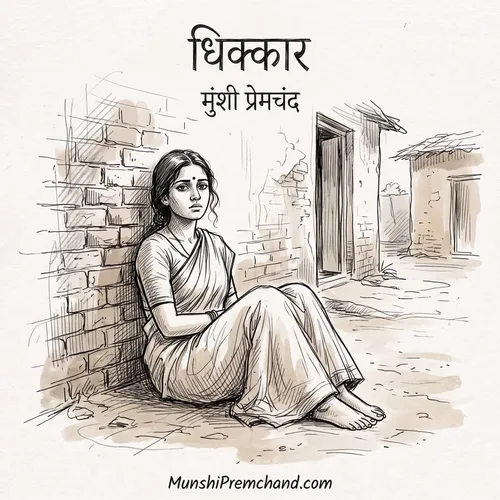
Complete English Translation: Dhikkar (Condemnation)
I
A ferocious, catastrophic war was raging between Persia and Greece. The Persian armies advanced relentlessly day by day, and Greece stood confronted with the darkest hour of its existence. All normal trade and commerce throughout the land had ground to a halt. Peasants who had known only the wooden handles of their plows were compelled to grip the hilts of bronze swords; merchants who had balanced scales in peaceful markets now hefted heavy spears. The entire nation had mobilized in a desperate struggle for self-preservation.
Yet despite their courage, the enemy's armies pressed ever forward. That very Persia which Greece had crushed beneath its heel time and again was now bearing down upon their heads like a fury of unquenchable wrath. The men were laying down their lives on blood-soaked battlefields, while at home, the women withered in anguish as report after disheartening report reached the cities. How was their honor to be preserved? It was not the fear of death that paralyzed their hearts, nor was it the loss of property; it was the terror of dishonor! The conquerors, intoxicated with arrogance, would stare insolently upon Greek maidens, lay brutal hands upon their delicate limbs, and drag them into humiliating captivity! The mere imagination of that catastrophe caused the hair on every neck to stand on end.
At last, when the crisis grew unendurable, a large assembly of men and women gathered together, ascended to the Temple of Delphi, and laid their anguish before the shrine:
"O Goddess! Why have the immortal gods turned their faces away from us? What terrible sin have we committed? Have we failed to observe the sacred ordinances? Have we neglected the sacrificial offerings? Have we broken our fasts and vows? Why, then, have the gods withdrawn their protective shield from our heads?"
The High Priestess of the temple stepped forward and spoke:
"Even the boundless mercy of the gods cannot shield a nation from the ruin wrought by a traitor! In this land, there is assuredly a traitor among us. Until his blood is shed and he is destroyed, this calamity shall never pass from Greece."
The people cried out in agony: "O holy mother! Who is this traitor? How shall we know him?"
The Priestess replied:
"The house from which the sound of singing floats into the night; the house from which gusts of sweet fragrance drift during the broad day; the man in whose eyes the red fire of intoxication gleams—he alone is the traitor of the motherland!"
The citizens pressed her with many more eager questions to identify the villain, but the oracle gave no further answer.
II
The Greeks began a desperate search to uncover the traitor.
From whose house could the sound of singing possibly emerge at night? As soon as dusk descended, a pall of funerary gloom settled over the entire city. If any sounds were heard floating through the dark streets, they were the muffled sobs of weeping; nowhere could the faintest sound of laughter or song be detected.
From whose house could gusts of fragrant perfume drift during the day? Wherever people walked, only foul odors greeted their nostrils. Heaps of uncollected refuse lay rotting in the alleys. Who had the leisure or spirit to sweep courtyards or burn aromatic incenses? The washermen had vanished, for most had marched to the battlefront; even garments went unwashed. Who would think of rubbing fragrant oils or applying perfumes?
And in whose eyes could the red flush of intoxication gleam? Red eyes were indeed to be seen on every street, but theirs was not the flush of wine—it was the burning redness of endless weeping! Thick dust blew across the deserted counters of the wine taverns. In this life-and-death struggle for existence, who could spare a thought for wine or revelry? The citizens searched every quarter of the city from end to end, but not a single eye could be found that was reddened by drunkenness.
Several days slipped by. With every passing hour, terrifying news poured in from the front, and the breath seemed to leave the people's bodies.
It was midnight. The city lay wrapped in pitch darkness, looking as desolate as a vast cremation ground. Not a human soul was to be seen upon the roads. In the grand amphitheatres where once not a sesame seed could find room to drop, jackals prowled and howled. In the lively public squares where spirited youths once paraded in polished armor, screech owls hooted in the ruins. In the temples, there was neither hymn nor lyre. Over the marble palaces hung impenetrable gloom.
An aged Greek father, whose only son was fighting at the distant battlefront, emerged from his dark house. Borne along on an overwhelming wave of despair, he began walking toward the Temple of Delphi. There was not a glimmer of light along the path; he stumbled against stones at every step, yet he pressed stubbornly forward. He had made a solemn vow in his heart: either he would wrest the blessing of victory from the Goddess tonight, or he would offer up his own life at her altar!
III
Suddenly, the old man started with shock.
He had arrived at the outer enclosure of the temple. And from a residence situated just behind the sacred shrine, the sweet, lively melody of music was drifting into the night air!
The old man was struck with utter amazement. In this deserted, grieving sanctuary, who could possibly be indulging in merriment at such an hour? Wings seemed to sprout upon his aged feet. He rushed around to the rear of the temple.
The music was coming from the very dwelling where the High Priestess of the temple resided!
The old man stood before the window in absolute bewilderment. Darkness beneath the very lamp! In the backyard of the holy temple, such unimaginable scandalous revelry?
He peered through the open lattice of the doorway. Inside, in a richly decorated room, wax candles burned brightly in bronze chandeliers. A clean, luxurious carpet covered the stone floor, and at a banquet table sat a young man, merrily singing a festive song! Bottles of imported wine and ornate goblets were laid before him. Two enslaved attendants stood attentively before the table holding silver platters of roast meat and delicacies, from which irresistible, savory aromas drifted into the air.
The old Greek cried out with all the fury of his lungs:
"Here is the traitor! Here is the traitor!"
The stone walls of the temple echoed: “He is the traitor!”
From the dark groves of the garden, the wind carried back: “He is the traitor!”
The High Priestess of the temple thrust her head out of her prayer cell and cried in horror:
"Yes! He is the traitor!"
The traitor was none other than the Priestess's own son, Pasanius!
Whatever defensive strategies were devised in the war councils, whatever secret decisions were taken to crush the invaders, Pasanius had been secretly conveying them to the Persians. Every single movement of the Greek legions was delivered to the enemy beforehand, enabling the Persians to anticipate and foil every assault. That was the sole reason why, despite pouring out their lives with superhuman valor, victory continually eluded the Greek forces.
And with the blood-money earned through this monstrous treachery, Pasanius lived a life of lavish hedonism. At a time when his country was drowning in blood and tears, he had auctioned his motherland to satisfy his low, sensual appetites! Except for his own fleeting pleasure, he cared nothing for the universe; whether his countrymen lived or died, whether his nation stood or fell, it mattered nothing to him. To satisfy his petty, selfish lusts, he was fully prepared to fasten the chains of perpetual slavery around the neck of his motherland!
Until this fateful hour, the Priestess had been entirely ignorant of her son's depravity. She rarely emerged from her secluded, dark cell, spending her days and nights in prayer, fasting, and contemplation of the divine. Absorbed in thoughts of the next world, she had remained blind to the mundane happenings around her; her spiritual meditations had dulled her awareness of the external world. Even at that moment, she had been kneeling behind bolted doors, praying to the Goddess for the salvation of her country, when suddenly that piercing shout tore through her ears: “Here is the traitor! Here is the traitor!”
Throwing open her door, she had looked out. Bright beams of candlelight streamed from Pasanius's quarters, and upon those golden beams, the rhythmic strains of a reveler's music were dancing! The ground seemed to vanish from beneath her feet; her heart froze with unspeakable horror. Almighty God! Is my own son the traitor to our motherland?
Overwhelmed by an irresistible inner voice of divine truth, she had cried out to the world:
"Yes! Here lives the traitor!"
IV
Within minutes, hordes of Greek men and women came surging through the darkness, gathering before Pasanius's threshold like a roaring sea, shouting with one voice:
"Here is the traitor! Drag him out!"
The lights inside Pasanius's chamber were extinguished in an instant; the music abruptly died away. But outside, the angry crowd grew larger with every passing second, and from thousands of throats rose the deafening cry: "Here is the traitor!"
Torches were lit. Men brandishing clubs, swords, and axes battered down the doors and stormed into the mansion. Some shouted: "Behead the swine!" Others roared: "Sacrifice his black heart at the feet of the Goddess!" Still others demanded that he be hurled from the high parapet of the terrace.
Pasanius realized that the hour of his doom had struck. Leaping down a secret staircase, he bolted out into the dark courtyard. Seeing no other avenue of escape, he darted inside the inner sanctuary of the Temple of Delphi!
Now, what was to be done?
By ancient, inviolable tradition, anyone who sought sanctuary within the sacred precinct of the temple received divine immunity. To shed human blood inside the house of the gods was a mortal, unforgivable sacrilege.
Yet how could the citizens allow the destroyer of their nation to escape so cheaply? Conflicting shouts and wild proposals rang through the gathering:
"Drag the swine out by his hair!"
"The Goddess will forgive us for slaughtering such a demon!"
"O Goddess, why do you not open your jaws and swallow him whole?"
"Stone him! Stone him through the gates—he will run out of his own accord!"
"Why do you not come out, you coward? Why sit there with your face blackened?"
Throughout the night, the furious clamor raged outside, but Pasanius remained crouching inside the sanctuary. At last, a terrible resolution was adopted: the citizens would demolish the roof of the temple, leaving Pasanius exposed to the scorching heat of the noonday sun and the merciless, biting frost of the winter nights!
No sooner was it spoken than it was done. In the twinkling of an eye, the crowd climbed the pillars and tore away the stone roof and golden spire of the shrine.
The wretched Pasanius stood stranded under the open sky throughout the following day beneath a blazing sun. A tormenting thirst consumed his throat—but where was water to be found? Gnawing hunger tore at his belly—but where was bread? The stone floor beneath his bare feet grew as hot as an iron skillet—but where was shade? In all his pampered life, he had never known a fraction of such physical agony.
He writhed like a fish cast out upon burning sand, screaming and imploring the crowd outside for mercy. But there was no one to heed his cries. Over and over he swore solemn oaths that he would never commit such an offense again; but not a soul stepped near him. Despair urged him repeatedly to dash his skull against the stone walls and end his life; but the stubborn instinct of self-preservation held him back with the faint, lingering hope that the crowd might yet take pity upon him. He began crying out like a madman:
"Kill me! Strike me dead with your swords! Take my life in an instant, but do not burn me alive by inches! O murderers, have you not a drop of human mercy in your hearts?"
The blistering day passed, and night arrived—a terrifying, freezing winter night. High above, the cold stars twinkled coldly, as though mocking his misery. As the night deepened, the stone idol of the Goddess seemed to assume a fearsome, menacing visage. At times she seemed to lunge forward with open jaws to swallow him; at other times she seemed to glare at him with burning, fiery eyes.
Outside, the freezing temperature plunged lower and lower. Pasanius's fingers and toes began to stiffen and freeze; his heart shuddered violently. Pulling his knees up to his chin, he sat huddled in a corner, weeping bitter tears over his destiny. He pulled the hem of his tunic over his knees, then over his trembling arms, until in this frantic tugging, the delicate silk tore to shreds. Toward midnight, heavy snow began to fall from the sky. At noon, he had believed that intense heat was the most unbearable torment on earth; before this agonizing frost, the memory of the scorching sun seemed like a paradise!
At last, in a desperate bid to kindle warmth in his freezing blood, an idea struck him. He began running wildly from one corner of the temple to the other. But he was a soft, pampered creature accustomed to luxury; within a few moments, he collapsed gasping upon the icy stones.
V
At daybreak, when the citizens unlatched the heavy wooden gates, they found Pasanius lying motionless upon the stone floor. His limbs appeared frozen stiff. Only after much shouting and shaking did he slowly flutter open his eyes; but he could not move a single limb from the ground.
What a wretched, pathetic spectacle he presented! Yet in the heart of the crowd, there was no pity. In Greece, treason against the motherland was the supreme crime, and for a traitor, there was neither forgiveness nor mercy.
Voices muttered in the crowd:
"Is he not dead yet?"
"Traitors do not die so easily!"
"Let him lie there—he will perish by noon."
"He is feigning death, the cunning fox!"
A solitary voice spoke up: "He has suffered enough punishment for his misdeeds. We ought to release him now."
Suddenly, Pasanius raised himself upon one elbow and spoke in a defiant, brazen voice:
"Who dares say that I should be released? No! Do not release me, or you will live to regret it! I am selfish! I am an incorrigible slave to sensual pleasures! Do not make the fatal mistake of trusting me!
Ah, when I reflect upon the horrific miseries you have endured on my account, my heart burns with the desire to reduce my own treacherous senses to ashes! Even if I took a hundred rebirths to perform penance for this monstrous sin, my soul could never be redeemed! Do not trust me—not even for a heartbeat! I do not trust myself! The lovers of base pleasure cannot walk the path of truth!
Yet even now, I possess the power to render an immense service to you. I hold deep, vital military secrets of the Persians, which, if placed in your hands, will enable you to utterly annihilate their legions! But I tell you plainly: I do not trust my own nature, and I plead with you: do not trust me!
Last night, in the agony of the frost, I prayed to the Goddess from the depths of a broken heart, and she revealed to me the exact plans and engines by which we can conquer the enemy, by which the advancing hordes of Persia can be blown into dust in an instant! But I have no faith in my own constancy. The moment I step outside this temple, I shall forget these holy resolutions! It is very likely that I shall succumb once more and secretly assist the Persians! Therefore, I beg of you: do not trust me!"
A Greek citizen exclaimed: "Listen! Listen to what he says!"
Another muttered: "He speaks like a truly honest man!"
A third said: "Look, he confesses his sins openly with his own lips!"
A fourth urged: "We must forgive him at once and learn all these secrets from him!"
A fifth argued: "Notice that he does not beg for his freedom! Over and over he warns us not to trust him!"
A sixth said: "The agony of the night has cooled his arrogance; his eyes have been opened at last!"
Pasanius raised his voice again: "Are you debating whether to set me free? I tell you once more: I am entirely unworthy of your trust! I am a traitor! I know the most intimate secrets of the Persian commanders. Were I to reach their camp, I could pose as their friend and destroy them utterly! But I dare not trust my own weak will!"
A citizen cried: "A scoundrel could never speak with such astonishing honesty!"
Another agreed: "He was blinded by selfish pleasure before, but now the truth has dawned upon him!"
A third declared: "There is no harm in extracting these vital secrets from him. If he fulfills his pledge, we should grant him his freedom."
A fourth said: "This miraculous transformation has been wrought by the Goddess herself!"
A fifth added: "The light of the soul resides even within the darkest sinner, and under the fire of suffering, it awakens! To believe that a man who has sinned once can never perform a noble deed is to deny the fundamental truth of human nature!"
A sixth shouted: "Let us carry him forth from here with music and rejoicing!"
How pathetically easy it is to bamboozle a crowd! This is the most fragile, dangerous flaw of popular democracy. The masses possess no steady discernment between genuine virtue and polished deceit; upon them, the spell of cunning rogues and dyed jackals operates with effortless magic. Only yesterday, this very crowd was screaming to sever Pasanius's head; today, preparations were being made to carry him out in a triumphal procession, simply because that master of deceit knew precisely which emotional strings to pluck!
A woman called out: "Summon the musicians! Pasanius is a noble gentleman!"
Another cried: "Yes! First let us fall at his feet and beg his forgiveness—we treated him with far too much cruelty!"
Pasanius smiled inwardly, saying: "Had you only asked me yesterday, I would have revealed everything then; you would have known whether it was just to kill me or let me live!"
Several men and women wept: "Alas, what a terrible blunder we committed! Forgive us, noble, honest Pasanius!"
Suddenly, an elderly woman came running frantically through the crowd. Ascending to the highest marble step of the temple entrance, she turned and faced the citizens, her voice ringing like a clarion of thunder:
"What madness has seized your senses? Have the sons of Greece become so utterly blind that they can no longer distinguish truth from treacherous falsehood?
You dare place your faith in Pasanius? That very Pasanius who has orphaned hundreds of our women and helpless children? Who has extinguished the hearth-fires of countless Greek homes? Who has dragged the honor of our gods and our warriors into the dust? And you are intoxicated by a handful of smooth, sugary words?
Mark my words! If Pasanius steps outside this temple today, your doom is sealed! Persia will rule over Greece, and the daughters of Greece will become the helpless playthings of foreign invaders!
It is the supreme command of the Goddess: Pasanius must never be permitted to emerge alive! If you love your country, if you revere the glorious name of your ancestors, if you cherish the sacred honor of your mothers and sisters, then wall up the gates of this temple with stone! Let this portal be sealed forever, so that this traitor never has another opportunity to walk the earth and poison your minds!
Look! With my own hands, I place the very first stone!"
The citizens stared in breathless awe.
Standing before them was the High Priestess of Delphi—Pasanius's own mother!
Within minutes, hundreds of hands leaped to the task. Mountains of heavy granite blocks were hoisted, and the temple entrance was bricked up solid from ground to lintel.
Inside the dark, tomb-like sanctuary, Pasanius was left grinding his teeth in impotent rage, forever trapped within the stone walls of his own deceit.
Hail to thee, heroic mother! Blessed be thy name! It is through mothers such as thou that the countenance of a nation shines with immortal glory—mothers who, before the sacred altar of the motherland, count maternal affection as lighter than the dust!
Their sons belong to the country; the country does not belong to their sons!
Summary of Dhikkar (Condemnation)
Set during a catastrophic war between Greece and the invading armies of Persia, Dhikkar opens with Greece on the brink of total collapse. Despite the legendary valor of Greek soldiers, the enemy advances relentlessly. Desperate for divine guidance, a delegation of citizens appeals to the High Priestess at the Temple of Delphi to discover why the gods have abandoned their land. The Priestess delivers an oracle: the gods cannot protect a nation harboring an internal traitor. She provides three unmistakable signs: the traitor's home echoes with music at night, emits fragrant scents by day, and harbors a man whose eyes burn red with the intoxication of luxury.
The citizens search the sorrow-stricken city in vain, finding only weeping, unwashed poverty, and grief. Midnight comes, and an aged father whose only son is at the front walks toward the temple to offer his life in prayer. Behind the temple, coming from the residence of the High Priestess herself, he hears music and laughter. Peering through the window, he discovers a luxurious banquet with fine wine and savory feasts enjoyed by a young reveler. The old man denounces him as the traitor, and the Priestess emerges to confirm the horror: the traitor is her own son, Pasanius. For gold and luxury, Pasanius had been selling Greek military secrets to the Persians.
A mob storms the house, and Pasanius flees into the inner sanctum of the Delphi temple to claim ancient religious sanctuary. Unable to shed blood within the shrine, the citizens tear down the temple roof, exposing the traitor to the scorching daytime sun and the freezing snow of the night. After enduring agonizing frost and physical collapse, Pasanius cleverly resorts to psychological manipulation. Rather than pleading for mercy, he loudly proclaims his unworthiness, warning the citizens not to trust him while promising that he holds secret knowledge that could defeat Persia. Charmed by this display of apparent self-awareness and honesty, the fickle crowd reverses its verdict, preparing to carry him out in a celebratory procession.
At that critical juncture, Pasanius's mother, the High Priestess, arrives. Denouncing the crowd's foolish gullibility, she warns that releasing him will guarantee the enslavement of Greece. Demonstrating supreme civic virtue, she places the first heavy stone at the entrance of the temple, commanding the citizens to wall her traitorous son inside forever. The story concludes with Premchand's immortal paean to patriotic motherhood: a mother's son belongs to the nation; the nation does not belong to the son.
Publication History
Dhikkar (धिक्कार) was written by Munshi Premchand in 1925 and published in his acclaimed anthology Mansarovar, Volume 3 (मानसरोवर, भाग 3).
Drawing upon classical Greek history—specifically the historical account of the Spartan regent Pausanias who betrayed his city to the Persians and was starved in the Temple of Athena of the Brazen House after his mother placed the first stone at the door—Premchand refashioned the legend into an urgent political allegory for colonial India, emphasizing the absolute primacy of national duty over familial sentiment.
This unabridged English translation was published in 2026 by MunshiPremchand.com as part of the MunshiPremchand.com English Translation Series.
Themes & Critical Significance
1. National Duty vs. Maternal Attachment
The moral core of the narrative is the absolute subordination of private familial love to the collective survival of the nation. The Priestess does not act out of cruelty or lack of maternal feeling; she recognizes that shielding a traitorous son condemns thousands of other mothers' sons to slaughter and enslavement. Her action elevates motherhood from personal biological possession to civic stewardship.
2. The Psychology of the Crowd and Democratic Vulnerability
Premchand presents a profound critique of crowd psychology. The Greek public shifts instantly from bloodthirsty vengeance to sentimental adoration when Pasanius deploys reverse psychology ("Do not trust me!"). Premchand warns that an uncritical, easily swayed populace is an existential danger to any free society, as demagogues and traitors readily exploit collective emotionalism.
3. The Parasitism of Treason
Pasanius represents the ultimate moral decay: a citizen who trades the blood and freedom of his countrymen for personal wine, perfume, and luxury. His treason is not driven by ideological conviction or allegiance to Persia, but by shallow, hedonistic narcissism that feeds upon the misery of others.