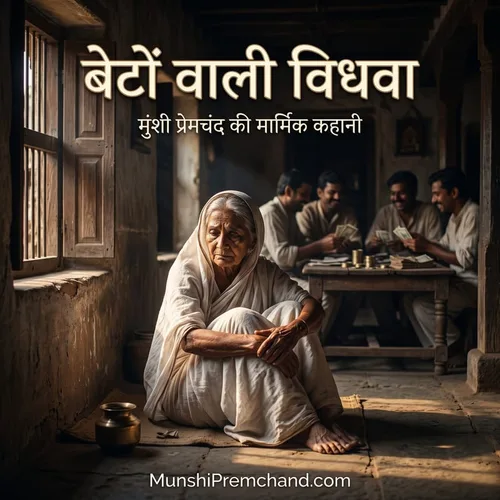
Complete English Translation: Beton Wali Vidhwa (A Widow with Sons)
When Pandit Ayodhyanath passed away, everyone said: "May God grant every man a death as blessed as his!" He left behind four young, grown sons and an unmarried daughter. All four sons were already married; only the daughter remained unwed. He had also left behind substantial wealth: a solid brick-and-mortar mansion, two orchards, several thousand rupees worth of gold jewelry, and twenty thousand rupees in ready cash.
The widow Phoolmati was plunged into grief and lay shattered for several days; yet looking upon her four robust, grown sons standing before her, she found courage and solace. The four young men were each more well-mannered and capable than the last, and the four daughters-in-law were each more obedient and deferential than the next. When Phoolmati lay down at night, the daughters-in-law took turns massaging her feet; when she rose from her bath, they wrung out and folded her sari. The entire household ran by the gesture of her finger.
The eldest son, Kamtanath, was employed as a clerk in an office on a salary of fifty rupees a month; the second son, Umanath, had passed his medical examinations and was making arrangements to open his own clinic; the third, Dayanath, had failed his B.A. examinations and was earning a modest living by writing essays and articles for periodicals; while the fourth, Sitanath, was the sharpest and most promising of them all, having passed his B.A. with first-class honors this very year and was currently preparing for his Master's degree. None of the sons suffered from any vices, spendthrift vanity, or profligacy that could torment parents or tarnish family honor.
Phoolmati was the absolute mistress of the house. Although the keys were kept by the eldest daughter-in-law—for the old woman possessed none of that petty lust for authority that makes elders bitter and quarrelsome—not a single child could send for even a penny's worth of sweets without her prior consent.
Dusk was falling. Today was the twelfth day since Panditji's death. Tomorrow would be the thirteenth-day death feast (terahi). The Brahmins would be fed, and the entire community of the clan invited. The preparations were in full swing. Sitting in her small chamber, Phoolmati watched the porters bringing in sacks of flour on their backs and piling them up. Tins of pure ghee were arriving. Baskets of green vegetables, sacks of sugar, and large earthen pots of curd kept pouring in. The articles destined for ritual donation to the chief funeral priest (Mahapatra) had been brought—brass vessels, sets of clothes, a cot, bedding, umbrellas, shoes, walking sticks, lanterns, and other furnishings; yet, not a single article had been shown to Phoolmati.
By established custom, every single provision ought to have passed before her eyes. She should have inspected each item, approved its quality, decided whether its quantity needed to be increased or decreased, and only then should the items have been stored away in the pantry. Why had no one felt the need to present them to her or seek her advice? And why, indeed, had only three sacks of flour arrived? She had expressly ordered five sacks! Of ghee, too, there were merely five canisters, whereas she had ordered ten! In the same manner, deductions must surely have been made in the vegetables, sugar, and curd. Who had dared to tamper with her orders? Once she had settled a matter, who possessed the right to increase or diminish it?
For forty long years, Phoolmati's word had been the supreme, unquestioned law in every domestic affair. If she said spend a hundred, a hundred was spent; if she said spend one, one was spent. No one had ever dared to raise an objection or find fault. Even Pandit Ayodhyanath himself had never acted against her wishes. Yet today, before her very eyes, in plain and direct defiance, her command was being brushed aside! How could she possibly tolerate this?
For a time she sat containing her simmering anger, but at last she could hold back no longer. Self-governance had become second nature to her. Brimming with fury, she strode out and addressed Kamtanath: "Did you bring only three sacks of flour? I told you to bring five! And only five canisters of ghee were ordered! Do you not remember that I specified ten canisters? I do not consider frugality a bad thing; but that the very soul of the man who dug this well should thirst for water—how utterly shameful that is!"
Kamtanath offered no apology, nor did he acknowledge any error, nor did he display the slightest embarrassment. For a minute he stood in an attitude of open rebellion, and then replied: "We all took counsel together and decided upon three sacks, and five tins of ghee were quite sufficient for three sacks of flour. Other items have also been reduced according to the same calculation."
Phoolmati flared up furiously: "By whose counsel was the flour reduced?"
"By our counsel."
"Then my opinion counts for nothing?"
"Why shouldn't it count? But after all, we understand our own loss and gain, don't we?"
Phoolmati stared at him, dumbstruck and bewildered. The meaning of this utterance eluded her grasp. Their loss and gain! In her own home, she alone was responsible for profit and loss! What right did others—even if they were the sons born of her own womb—have to interfere in her arrangements? This boy was answering her with such insolence, as though the house belonged to him, as though he had toiled unto death to build this household, while she was a stranger! Just look at his arrogance!
Her face flushed crimson as she said: "You are not the one responsible for my profit and loss. It is my prerogative to do whatever I deem fit. Go this instant, bring two more sacks of flour and five more tins of ghee, and let anyone beware of cutting across my words in future!"
In her mind, she felt she had administered an ample rebuke. Perhaps such sternness had been unnecessary. She felt a twinge of regret for her sharpness. After all, they were only boys; they must have thought some economy was desirable. They probably refrained from asking her because Mother herself practiced frugality in everything. If they had known that she would not brook penny-pinching in this sacred duty, they would never have had the audacity to ignore her.
Although Kamtanath was still standing in the exact same spot, and his demeanor suggested that he was by no means eager to carry out the order, Phoolmati returned to her room with an easy mind. The thought that anyone could possess the nerve to disobey her after such a reprimand did not even cross her mind.
Yet as time slipped by, the reality began to dawn upon her that she no longer held the status in this house that had been hers only ten or twelve days ago. Festive offerings and contributions of sugar, sweetmeats, curd, and pickles were arriving from relatives. The eldest daughter-in-law was receiving and storing these gifts with the sovereign air of an undisputed mistress. No one came to ask Phoolmati anything. Whatever queries the kinsmen had, they addressed to Kamtanath or to the eldest daughter-in-law.
And what a great manager Kamtanath was! He spent his days and nights steeped in bhang; he dragged himself weeping and moaning to his office, and even there he notched up at least fifteen days of absence every month! It was only because the English sahib held high regard for the late Panditji that he had not been sacked long ago. And what could an untidy, clumsy creature like the eldest daughter-in-law understand of such grand affairs? She could not even look after her own clothes properly, and here she was, setting out to run the whole household! Disgrace was inevitable, nothing less. Together they would drag the family's honor through the mud. When the time came, one item or another would run short. Such enterprises demanded vast experience! One dish would be prepared in such absurd excess that it would be thrown about in heaps, while another would be cooked in such miserable scarcity that it would reach some leaf-plates and leave others bare. What on earth had come over them all?
And look—why was the daughter-in-law opening the iron safe? Who was she to open the safe without her permission? True, she held the keys; but until Phoolmati directed the money to be taken out, the safe was never opened. Today she was opening it as casually as if Phoolmati were a nonentity! "This I will not endure!"
She rose abruptly, marched over to the daughter-in-law, and said in a cutting voice: "Why are you opening the safe, Bahu? I did not tell you to open it."
The eldest daughter-in-law replied without the slightest hesitation: "Goods have arrived from the market; shouldn't their prices be paid?"
"What item has arrived at what rate, and in what quantity, I know nothing of it! Until the accounts are properly settled, how can money be handed out?"
"The accounts have all been settled."
"Who settled them?"
"How should I know who settled them? Go and ask the men! I was ordered to bring the money, so I am taking the money!"
Phoolmati swallowed her fury like a draught of bitter poison. This was no time to create a scene. The house was packed with male and female guests. If she scolded her sons at this moment, people would wag their tongues and say that no sooner had the Pandit died than discord had torn the family apart. Placing a heavy stone upon her aching heart, she retreated back to her chamber. Once the guests had departed, she would deal with each one of them! Then she would see who dared stand before her and what they had to say. She would knock the insolence out of them all!
Yet even in the solitude of her room, she could not sit in peace. She watched the proceedings with the keen, piercing gaze of a hawk, noticing where each rule of hospitality was breached, where propriety was disregarded.
The feast commenced. The entire community was seated together in a single sitting (pangat). The courtyard could barely accommodate two hundred men; how could five hundred people possibly fit into so narrow a space? Were men to be seated on top of men? What harm would there have been if the guests had been served in two separate batches? At most, the feast would have concluded at two in the morning instead of midnight; but here, everyone was in a frantic hurry to sleep! They wanted to cast this burden off their heads by any means possible and sleep in peace!
The guests were packed so tightly against one another that no one had room even to stir. Leaf-plates were piled haphazardly upon leaf-plates. The puris grew stone-cold. Guests were clamoring for hot puris. Puris made of refined white flour turn leathery and tough when they cool down—who could eat such stuff? And for some inexplicable reason, the confectioner had been pulled away from the frying cauldron! These were precisely the blunders that brought utter dishonor upon a house.
Suddenly a loud clamor arose—there was no salt in the cooked vegetables! The eldest daughter-in-law began grinding salt in frantic haste. Phoolmati bit her lips in boiling rage, but on this public occasion she could not utter a word. The salt was ground and sprinkled over the leaf-plates.
Just then, another uproar erupted: "The water is lukewarm! Bring cold water!" There had been no arrangement for cooling the water; ice had not even been ordered. A servant was dispatched racing to the bazaar, but at such a late hour of the night, where could ice be found in the market? The man returned empty-handed. The distinguished guests were forced to drink the lukewarm water drawn straight from the municipal tap.
Had it been in Phoolmati's power, she would have scratched her sons' faces! Never in the history of her household had such humiliation taken place. And on top of it, everyone was dying to be the master! Not a single person had remembered to fetch so essential an item as ice! And how could they remember—when would they ever find the leisure from their endless gossip and chatter? What would the guests think in their hearts? "They set out to feast the entire community, and there wasn't even ice in the house!"
Wait—why was there another sudden commotion? Good heavens, the guests were abandoning their plates and rising from the sitting! What had happened?
Phoolmati could remain detached no longer. Emerging from her room onto the veranda, she asked Kamtanath: "What has happened, Lalla? Why are the people getting up?"
Kamtanath gave no answer and slipped away from the spot. Phoolmati was left fuming in agitation. Just then, she encountered the maidservant (kaharin). Phoolmati put the same question to her. She learned that a dead mouse had been fished out of someone's bowl of vegetable curry!
Phoolmati stood frozen to the spot like a painted statue. A tempest surged within her so violently that she felt like smashing her head against the wall! These wretched fools had undertaken to manage the feast! Was there no limit to such revolting carelessness? The religious purity of how many men had been utterly ruined! Why, indeed, would the assembly not abandon the feast? Seeing such an abomination with their own eyes, who would sacrifice their sacred caste rules? Alas! Everything they had done had turned to dust! Hundreds of rupees had been washed down the drain, and on top of it, an indelible disgrace had been stamped upon their name!
The guests had departed. The food lay untouched upon the scattered leaf-plates. The four sons stood in the courtyard, hanging their heads in deep shame, each blaming the other. The eldest daughter-in-law was venting her rage upon her younger sisters-in-law. The sisters-in-law were heaping all the blame upon the young daughter Kumud. Kumud stood in a corner, weeping bitterly.
At that very moment, Phoolmati arrived, ablaze with fury, and cried: "Has your face been blackened enough, or is there still something lacking? Go and drown yourselves, all of you, in a handful of water! You are no longer fit to show your faces anywhere in this city!"
Not a single son ventured an answer.
Phoolmati grew even more fierce: "What is it to you lot? None of you has any shame or decency! It is his soul that weeps—the man who ruined his life building the honor and dignity of this house! Is this how you have dragged his holy spirit through the mire? The entire town is spitting in contempt upon us! From this day forth, no respectable person will come to your door even to relieve himself!"
Kamtanath stood listening in silence for a time. Finally, losing his temper, he snapped: "All right, be quiet now, Mother! A mistake was made; we all admit it was a terrible blunder. But will you butcher the living souls of this house for it? Everyone makes mistakes. A man repents and lets it be. Nobody's life is taken for a mistake!"
The eldest daughter-in-law offered her own defense: "How were we to know that Bibiji (Kumud) could not even perform so tiny a task? She ought to have inspected the vegetables before tossing them into the cauldron. She picked up the entire basket and dumped it in! How is it our fault?"
Kamtanath scolded his wife: "It is neither Kumud's fault, nor yours, nor mine. It was a stroke of misfortune. Disgrace was written in our destiny, and so it happened. In a banquet of such magnitude, vegetables are not dropped into the cauldron by single handfuls! Basketfuls are tipped in all at once. Such accidents happen at times. But what is the need for all this public ridicule and wailing? You are merely rubbing salt into the wound without reason!"
Grinding her teeth, Phoolmati retorted: "You feel no shame at all; instead, you speak with even greater shamelessness!"
Kamtanath said unabashedly: "Why should I feel ashamed? Have I stolen from anyone? Ants in sugar and weevils in flour are overlooked. Our eyes failed to catch it beforehand, that was the only misfortune. Otherwise, we would have quietly picked the mouse out and thrown it away, and nobody would have been the wiser!"
Phoolmati gasped in horror: "What are you saying? You would feed people a dead mouse and corrupt everybody's religion?"
Kamtanath laughed and replied: "What antiquated notions you harp on, Mother! Religion isn't destroyed by such trifles! These holy, pious gentlemen who rose from their leaf-plates—is there a single one among them who doesn't feast on mutton and goat? They don't spare even the tortoises and snails of the ponds! What was so terrible about a tiny little mouse?"
Phoolmati felt that the end of the world could not be far off. When educated young men harbored such irreligious sentiments, then God alone could protect faith and righteousness! Discomfited and sick at heart, she turned away and retreated to her room.
Two months had elapsed. It was nighttime. Having finished their daily routines, the four brothers were sitting in a room chatting. The eldest daughter-in-law was also a party to their secret deliberations. The question of Kumud's marriage had been raised.
Leaning against a bolster, Kamtanath said: "Father's arrangements died with Father. Pandit Murarilal may well be a learned man, and he may belong to an illustrious lineage; but a man who sells his learning and high birth for cash is a base creature! We would not marry Kumud to such a vile man's son even if he asked for nothing, let alone pay him five thousand rupees! Let us show him the door and search for another bridegroom. We have a total of only twenty thousand rupees. That comes to five thousand rupees for each brother's share. If we give away five thousand in dowry, and squander another five thousand on ceremonial gifts, processions, and music, our backs will be broken completely!"
Umanath said: "I need at least five thousand rupees to open my dispensary. I cannot spare a single pie from my share. Besides, income will not start rolling in the very day it opens; I will have to live off the family funds for at least a year."
Dayanath was perusing a newspaper. Taking off his spectacles, he remarked: "I am also intending to launch a journal. To establish a printing press and a paper requires a capital of at least ten thousand. If I retain my five thousand, I can easily find a partner. I cannot make a livelihood merely by contributing articles to other magazines."
Kamtanath shook his head and said: "Good heavens! People are unwilling to publish articles even for free, so who is going to pay good money?"
Dayanath protested: "No, that is not so. I never write anywhere without receiving an advance remuneration."
Kamtanath qualified his words: "I am not speaking of you, brother. You manage to earn a bit here and there, but everyone doesn't get paid."
The eldest daughter-in-law chimed in with pious conviction: "If a girl is fortunate, she can live in happiness even in a pauper's hut. If she is ill-fated, she will weep even in a king's palace. Everything is a play of destiny."
Kamtanath looked at his wife with admiration: "Furthermore, we must also arrange Sitanath's marriage this very year."
Sitanath was the youngest. He had been sitting with his head lowered, listening to his brothers' selfish talk with mounting restlessness, eager to speak. Hearing his name mentioned, he spoke up: "Do not worry about my marriage. Until I secure some gainful employment, I will not even utter the word 'marriage'; and truth be told, I do not wish to marry at all. At this time, our country does not need more infants; it needs workers. Spend my share of the money on Kumud's wedding. After everything has been settled, it is not honorable to break off our alliance with Pandit Murarilal."
Umanath snapped sharply: "Where will ten thousand rupees come from?"
Sitanath replied tentatively: "I am offering my entire share of the money."
"And the rest?"
"Murarilal should be persuaded to reduce his dowry demands. He is not so blind to self-interest that he will refuse to make some concession under these circumstances. If he agrees to three thousand, the entire wedding can be accomplished within five thousand."
Umanath turned to Kamtanath: "Do you hear him, elder brother? Listen to his grand ideas!"
Dayanath spoke up: "And what loss is it to you two? I am glad that at least one among us is capable of making a sacrifice. He does not need money immediately. He already receives a government scholarship. Once he completes his studies, he will secure a post somewhere. Our situation is not like his."
Kamtanath displayed his worldly foresight: "What a foolish thing to say about 'no loss'! If one of us suffers hardship, are the rest of us to sit and watch? He is still a mere boy; what does he know? When the time comes, a single rupee does the work of a hundred thousand. Who knows, tomorrow he may be awarded a government scholarship to study in England, or he may enter the Civil Service! At that time, four to five thousand rupees will be required merely for his travel preparations. Before whom will he go begging then? I do not wish his entire future to be ruined for the sake of a dowry."
This argument undermined Sitanath's resolve. Blushing, he conceded: "Yes, if that were to happen, I would certainly require money."
"Is such an outcome impossible?"
"I do not consider it impossible; but it is certainly difficult. Scholarships go to those who have high recommendations; who cares about me?"
"Sometimes recommendations are left lying on the shelf, while those without influence carry the day."
"Then do as you think best. I am even willing to give up going to England, provided Kumud is married into a respectable family."
Kamtanath declared with sanctimonious solemnity: "A good household is not obtained merely by paying a dowry, brother! As your sister-in-law rightly observed, it is all a game of fate. My opinion is that we should decline Murarilal's proposal and look for an alliance that will settle for very little. I cannot spend more than one thousand rupees on this wedding. How about Pandit Deendayal?"
Umanath was delighted: "He is excellent! He may not possess an M.A. or a B.A., but he earns a handsome income from his priestly patrons."
Dayanath raised an objection: "Still, Mother ought to be consulted."
Kamtanath saw no need for this. He said: "Her intellect has become completely warped. She clings to the notions of a bygone age! She is hell-bent on Murarilal. She fails to understand that times have changed. Her only obsession is that Kumud must go to Murarilal's house, even if the rest of us are ruined!"
Umanath raised another suspicion: "Mother will hand over all her jewelry to Kumud, just wait and see!"
Kamtanath's selfishness could not quite stomach a breach of traditional ethics. He said: "She has absolute rights over her ornaments. That is her stridhan (woman's property). She may bestow it upon whomever she pleases."
Umanath argued: "Even if it is stridhan, does that give her the right to squander it away? After all, it was earned by Father's sweat!"
"Whosoever earned it, she has full legal authority over her stridhan!"
"These are legal quibbles! Here we are, four partners dividing twenty thousand rupees, while ten thousand rupees worth of jewelry remains in Mother's grasp. Mark my words, relying on the strength of those jewels, she will marry Kumud into Murarilal's family!"
Umanath was not a man to let so vast a fortune slip through his fingers so easily. He was a master of deceit and cunning. He would devise some clever plot to extract all the ornaments from their mother. Until then, it was unwise to provoke Phoolmati by bringing up Kumud's wedding.
Kamtanath shook his head: "Brother, I do not care for such trickery."
Umanath said with annoyance: "The jewels are worth no less than ten thousand."
Kamtanath said in an unyielding tone: "Whatever they are worth, I will not put my hand to dishonest schemes."
"Then you stay out of it. Just be sure not to spoil our game."
"I will remain aloof."
"And you, Sita?"
"I will remain aloof as well."
However, when the same proposition was put to Dayanath, he readily agreed to collaborate with Umanath. Out of ten thousand, two and a half thousand would belong to him. For so magnificent a sum, even if a little cunning had to be employed, it was excusable.
Phoolmati had just finished her evening meal and lay down to rest when Umanath and Dayanath came and sat beside her. Both had assumed expressions as though some terrible calamity had descended upon their heads.
Phoolmati asked with alarm: "You both look so agitated; what is the matter?"
Umanath scratched his head and said: "Writing articles for newspapers is a perilous business, Mother! No matter how carefully one writes, the authorities catch hold of something or other. Dayanath wrote an article recently. A security deposit of five thousand rupees has been demanded for it. If it is not deposited by tomorrow, he will be arrested and slapped with a ten-year prison sentence!"
Phoolmati beat her brow in anguish: "Why do you write such things, my son? Don't you know that these are evil days for us? Can the bail not be averted in any way?"
Dayanath replied with the posture of a penitent criminal: "Mother, I wrote nothing objectionable; but what can I do against my cruel fate? The District Magistrate is so severe that he shows not the slightest mercy. I ran about everywhere I could, but nothing availed."
"Did you not ask Kamtanath to arrange the money?"
Umanath pulled a face: "You know his nature, Mother! Money is dearer to him than his own life. Even if Dayanath were sentenced to the penal colonies across the black water, Kamta would not part with a single pie!"
Dayanath supported him: "I did not even mention it to him."
Phoolmati sat up from the bed and said: "Come with me, I will tell him! How dare he refuse? Is money meant for a day like this, or is it meant to be buried in the earth?"
Umanath restrained his mother: "No, Mother, do not say a word to him. He will not give a single rupee; instead, he will create a dreadful hullabaloo. He cares only for the safety of his government job; he will not even allow Dayanath to remain under this roof! It wouldn't surprise me if he went straight to the officers and reported on him!"
Phoolmati said in helplessness: "Then how will you arrange the bail? I have nothing with me. Yes, I have my jewelry—take it, pawn it somewhere, and furnish the security. And from this day forward, swear by your ears that you will never write a single word in any newspaper!"
Dayanath placed his hands over his ears and protested: "No, Mother, that can never be! That I should save my skin by taking your jewelry—never! At most, it will be a five or ten-year imprisonment; I shall endure it. What great deed am I performing sitting idly here anyway?"
Beating her chest, Phoolmati cried: "What terrible words are you uttering, my child! As long as I am alive, who dares arrest you? I would scorch his face! Is jewelry meant for an occasion like this, or for some other time? When you yourself are gone, what will I do with these jewels—throw them into the fire?"
She brought out the wooden casket and set it before him.
Dayanath looked toward Umanath with imploring eyes and said: "What is your counsel, elder brother? This was why I said we should not tell Mother. It would only have been a matter of jail, what else?"
Umanath said as though pleading a case: "How could it be that so grave a disaster should strike and Mother be kept in the dark? It was impossible for me to hear it and swallow it down. Yet what should be done now, I cannot decide for myself. Neither do I wish you to go to prison, nor does it please me that Mother's ornaments should be pledged away."
Phoolmati asked with an aching heart: "Do you imagine that my jewelry is dearer to me than you? I would sacrifice my very life for you; what significance do mere ornaments have?"
Dayanath insisted with seeming firmness: "Mother, I will not take your jewelry, come what may! When I have been unable to render you the slightest service to this day, with what face can I carry away your jewels? A worthless wretch like me should never have been born of your womb. I have brought you nothing but sorrow."
Phoolmati spoke with equal determination: "If you will not take them willingly, I will go myself, pawn them with my own hands, and personally deposit the bail with the District Magistrate! If you wish, you may test my resolve. What will happen after my eyes close forever, God alone knows; but as long as I draw breath, no one shall look askance at you!"
Umanath acted as though conferring a favor upon their mother: "There is no other way left for you now, Dayanath. What is the harm? Take them. But remember, the moment money comes into our hands, the jewelry must be redeemed. Truly they say that motherhood is a long, ceaseless penance. Who else besides a mother could bestow such boundless affection? How wretched we are that we do not possess even a hundredth part of the devotion we ought to have for our mother!"
The two brothers picked up the jewel casket as though bowing under the weight of an agonizing moral dilemma, and made off with it.
The mother watched them with eyes brimming with tender maternal adoration. Her entire soul seemed desperate to gather them into her embrace. Today, after months of estrangement, her bruised maternal heart felt a surge of supreme, divine bliss by surrendering her all. Her proud, sovereign spirit had been searching for an avenue for just such sacrifice, just such total self-abandonment. There was not the faintest trace of possessiveness, greed, or attachment left in her heart. Sacrifice was her sole joy, and sacrifice was her supreme right. Having regained her lost authority today by offering her very life upon the altar of the idol she had created, she felt utterly fulfilled and blessed.
Three more months passed by. Having made away with their mother's jewelry, the four brothers began treating her with flattering deference. They also instructed their wives not to cause her any grief. If a little superficial politeness brought peace to the old woman's soul, what harm was there in it? The four of them continued to do exactly as they pleased, but they would go through the motions of seeking their mother's counsel, or they would cast such a clever web of words that the simple woman was easily swayed and gave her assent to everything.
She had vehemently opposed selling the orchard; but the four of them spun such a web of deceit that she eventually agreed to the sale. However, on the question of Kumud's marriage, no consensus could be reached. The mother stood firm on Pandit Murarilal, while the sons insisted stubborn upon Deendayal. One day, an open quarrel broke out.
Phoolmati said: "A daughter has a legitimate share in the wealth earned by her parents. You received an orchard worth sixteen thousand rupees, and a house worth twenty-five thousand. In twenty thousand rupees of cash, does Kumud not have a right even to five thousand?"
Kamtanath replied with feigned humility: "Mother, if Kumud is your daughter, she is our sister too. You will depart from this world in two or four years; but our relationship with her will endure for many long years. We shall do nothing within our power that could bring harm to her. But if you speak of shares, Kumud has no legal share whatsoever. When Father was alive, it was a different matter. He could have spent whatever he wished on her wedding; no one could have stayed his hand. But now, we have to pinch every single copper coin. Where a task can be accomplished for a thousand rupees, what wisdom is there in squandering five thousand?"
Umanath corrected him: "Why say five thousand? Say ten thousand!"
Kamtanath knit his brows: "No, I shall speak only of five thousand. We do not have the means to spend five thousand rupees on a single wedding."
Phoolmati dug in her heels: "The wedding will take place only with Murarilal's son, whether it costs five thousand or ten thousand! It is the wealth earned by my husband. I toiled unto death to amass it. I shall spend it as I please! You are not the only ones born of my womb; Kumud came from that very same womb! In my eyes, you are all equal. I am not begging anything from anyone. You may sit back and watch the show; I shall manage everything myself. Out of twenty thousand, five thousand belongs to Kumud!"
Kamtanath had no choice now but to resort to the brutal, naked truth. He said: "Mother, you are dragging out this argument without cause. The money you consider your own is not yours. You cannot spend a single copper coin from it without our permission."
It was as if a serpent had stung Phoolmati. "What did you say? Say that again! I cannot spend my own accumulated money according to my will?"
"That money no longer belongs to you; it has become ours."
"It may become yours, but only after I die!"
"No! The moment Father died, it became ours!"
Umanath added with shameless brazenness: "Mother knows nothing of law and rules, and jumps up and down for nothing!"
Trembling with rage, Phoolmati wept and shouted: "To hell with your law! I acknowledge no such law! Your father was no great merchant prince when I married him. It was I who built this household by cutting from my own stomach and my own body, or else you would not have had even a patch of shade to sit under today! As long as I live, you cannot touch my money! I spent ten thousand rupees on the weddings of each of the three brothers; I shall spend the exact same amount on Kumud's marriage!"
Kamtanath too lost his temper: "You possess no right to spend anything whatsoever!"
Umanath snapped at his elder brother: "Why do you waste your breath arguing with Mother, brother? Write a letter to Murarilal stating that Kumud will not be married into his house. That settles the matter once and for all! She knows nothing of statutes and legal codes, and engages in senseless disputes."
Phoolmati asked in a controlled, chilling voice: "Very well, tell me: what is this law? Let me hear it too."
Umanath said with cold indifference: "The law is simply this: upon the father's death, the entire property passes to the sons. The mother's right is limited solely to food and clothing."
Phoolmati cried out in anguish: "Who framed this law?"
Umanath answered in a calm, steady voice: "Our ancient sages, the great lawgiver Manu—who else?"
Phoolmati stood speechless for a moment, and then asked in a voice choked with wound and disbelief: "So in this house, I am living merely on your crumbs?"
With the cold detachment of an unfeeling judge, Umanath replied: "You may understand it as you please."
Phoolmati's entire soul shrieked aloud as though struck by a bolt of lightning. Words burst from her lips like burning sparks: "I built this house, I gathered this fortune, I gave birth to you, I reared you, and today I am an outsider in this house? This is Manu's law? And you wish to live by that law? Very well! Take your house and your door! I refuse to live as your dependent. It is a thousand times better to die than that! Oh, what monstrous injustice! I planted the tree, and I am forbidden even to stand in its shade! If this is what law is, let fire consume it!"
The mother's torrential wrath and anguish produced not the slightest ripple upon the four young men. The steel armor of the law shielded them. What effect could these feeble thorns have upon them?
After a little while, Phoolmati rose and walked away. Today, for the first time in her life, her tender motherhood turned into a curse that recoiled upon her, mocking her. The motherhood she had regarded as the crowning glory of life, at whose feet she had blissfully laid down all her yearnings and desires, that very motherhood appeared to her today like a flaming pit of fire, in which her whole life was being burned to ashes.
Dusk had fallen. Outside the door, the neem tree stood motionless, with bowed head, as though dismayed by the cruel ways of the world. In the western horizon, the deity of light and life was sinking into his own funeral pyre, burning away just like Phoolmati's motherhood.
When Phoolmati lay down in her room, she felt as though her spine had been shattered. She could never have imagined in her wildest nightmares that the sons of her own womb would turn into her bitter enemies the moment her husband died. The sons whom she had nourished with the very blood of her heart were today striking such deadly blows against that very heart!
The house now felt like a bed of thorns. To eat bread like a helpless orphan where she held no respect, no significance—this was utterly intolerable to her proud spirit. Yet what was the remedy? Even if she parted ways with her sons and lived separately, whose reputation would be ruined? Whether the world spat upon her or upon her sons, the dishonor would still fall upon her own head! The world would only say that despite having four grown, earning sons, the old woman was living apart, slaving away as a manual laborer to fill her belly! The very people she had always looked down upon would laugh at her misfortune. No, that public disgrace would be far more agonizing than this private indignity. It was wiser to keep her own honor and the veil of the household intact.
Yes, she would have to adapt herself to these new realities. Times had changed. Hitherto she had lived as the mistress; henceforth she would have to live as a servant maid. Such was God's will. The harsh words and kicks of one's own sons were still preferable to the words and kicks of strangers.
For a long time she lay with her face buried, weeping over her plight. The entire night passed in this silent soul-agony. The dawn of autumn crept timidly from the lap of the twilight sky, like an escaped prisoner fleeing stealthily from a jail.
Contrary to her lifelong habit, Phoolmati rose before dawn today; a profound mental transformation had taken place overnight. While the entire house was still fast asleep, she was sweeping the courtyard. The brick pavement, soaked with night dew, pierced her bare feet like sharp needles. Panditji had never permitted her to rise so early in the morning; the damp cold was deeply harmful to her health. But those days were gone forever. Nature itself was compelling her to change with the times.
Having finished sweeping, she lit the fire and began picking grit and stones from the rice and lentils. After some time, the sons awoke; the daughters-in-law got up. All of them saw the old woman shivering with cold, toiling away; but not a single soul said: "Mother, why are you exhausting yourself?" Perhaps every one of them was secretly pleased at this crushing of the old woman's pride.
From that day on, it became Phoolmati's unbroken routine to toil ceaselessly at household chores and keep completely detached from domestic governance. The radiant self-esteem that had once shone upon her countenance was replaced by a pall of deep, enduring sorrow. Where an electric lamp had once blazed, a tiny oil lamp now flickered dimly, which a single gentle gust of wind could extinguish forever.
The decision to write a letter of refusal to Murarilal had already been finalized. The next day, the letter was dispatched. Kumud's marriage was arranged with Deendayal. Deendayal was over forty years of age, and somewhat inferior in lineage and status; but he was content with modest bread and lentils. He agreed to marry without laying down any dowry stipulations.
The auspicious date was fixed, the wedding procession arrived, the nuptial ceremonies were performed, and Kumud was given a send-off. What agony passed through Phoolmati's heart, who could tell? But the four brothers were jubilant, as though a painful thorn had been plucked from their chests.
The daughter of a noble house—how could she open her lips to complain? If happiness was written in her fate, she would enjoy happiness; if misery was her lot, she would suffer misery. Divine will is the ultimate refuge of the helpless. The man to whom her family had wedded her—even if he possessed a thousand defects—was now her lord and master, her object of worship. Rebellion was beyond her imagination.
Phoolmati took part in nothing. What was gifted to Kumud, how the guests were entertained, what wedding presents arrived from relatives—none of it concerned her in the least. Whenever anyone sought her opinion, she merely said: "My sons, whatever you do is good. Why do you ask me?"
When the palanquin arrived at the doorstep for Kumud and the girl clung to her mother's neck, weeping bitterly, Phoolmati led her daughter into her small chamber. Taking out the remaining fifty or a hundred rupees and the two or three ordinary trinkets that still remained with her, she placed them in the fold of her daughter's veil (aanchal) and said: "My daughter, my heart's deepest wishes remained unfulfilled within my breast; otherwise, would your wedding have taken place like this today, and would you have been sent away in this miserable manner?"
Until that day, Phoolmati had never spoken a word to anyone about her missing jewelry. Even if she had not fully understood the cunning plot her sons had played upon her, she knew well enough that the jewels would never be recovered and that speaking of them would only breed bitterness. But on this parting occasion, she felt the need to clear herself. She could not bear the thought that Kumud should leave with the impression that Mother had hoarded her jewelry for the daughters-in-law; that was why she had drawn her into the chamber.
However, Kumud had already caught wind of her brothers' deceit. She took the jewelry and the money from her veil, laid them at her mother's feet, and said: "Mother, your blessings are worth hundreds of thousands of rupees to me. Keep these things with yourself. Who knows what hardships you may yet have to face."
Phoolmati was about to say something when Umanath entered and said: "What are you doing, Kumud? Come along, hurry up! The auspicious hour is slipping away! The wedding party is clamoring outside. She will return in two or three months anyway; whatever you wish to give and take can be done then."
It was as though mounds of salt were rubbed into Phoolmati's bleeding wound. She said: "What do I have left now, brother, that I could give her? Go, my child; may God preserve your married bliss for all eternity!"
Kumud departed. Phoolmati collapsed to the floor in a swoon. All desire for living was extinguished.
A year passed by.
Phoolmati's original bedchamber had been the largest and most airy room in the house. Several months ago, she had vacated it for the eldest daughter-in-law, and had moved herself into a tiny, dingy hovel, living like a pauper. She felt not the slightest affection now for her sons or daughters-in-law; she was merely a household drudge. She had nothing to do with any person, any object, or any event in that house. She lived only because death refused to claim her. She had ceased to perceive any distinction between pleasure and pain.
Umanath opened his dispensary; a grand feast was thrown for friends, with music and revelry. Dayanath established his printing press; another celebration took place. Sitanath won a scholarship and departed for England; yet another banquet was held. Kamtanath's eldest son underwent the sacred thread ceremony (yajnopavita); there was great pomp and splendor; yet not a shadow of joy appeared on Phoolmati's face!
Then misfortune struck: Kamtanath lay bedridden with typhoid for a month and barely survived after staring death in the face. Dayanath, in an attempt to boost the circulation of his newspaper, actually penned an inflammatory article and was sentenced to six months' imprisonment. Umanath accepted a bribe in a criminal case, submitted a false medical report, and was stripped of his medical license; yet not a shadow of sorrow passed across Phoolmati's features.
There was no longer any hope, any interest, any anxiety left in her life. To work like a beast of burden and to eat—these were the only two functions of her existence. An animal works only when beaten, yet eats with relish; Phoolmati worked without being told, but ate her food as though swallowing morsels of poison. Months would pass without oil touching her hair, months without her clothes being washed—she cared for nothing. She had become utterly numb to the world.
It was the month of Shravan, and rain poured down in ceaseless torrents. Malaria was spreading everywhere. Muddy clouds hung low in the sky; muddy water covered the earth. The damp, chilled wind drifted about, distributing chills, fevers, and asthma.
The household maidservant fell ill. Phoolmati scrubbed all the brass pots of the house, doing all the domestic chores while drenched in the rain. Then she kindled the hearth and set the cooking pots upon the fire. Her sons must have their meals on time. Suddenly she remembered: Kamtanath never drank municipal tap water. In that very downpour, she picked up a brass pitcher and set out to fetch holy water from the Ganga.
Lying on his cot, Kamtanath said: "Let it be, Mother, I shall fetch the water. The maid has taken a fine day to stay away!"
Looking toward the gloomy sky, Phoolmati said: "You will get drenched, my son, and catch a chill."
Kamtanath said: "You too are getting drenched. You might fall ill."
Phoolmati replied in a cold, detached voice: "I shall not fall ill. God has made me immortal."
Umanath was also sitting nearby. His dispensary was earning nothing, and he was deeply anxious, continually seeking the favor of his elder brother and sister-in-law. He remarked: "Let her go, brother! She ruled over the daughters-in-law for long enough; let her do some penance for it now."
The Ganga was in full spate, roaring like an ocean. The distant horizon merged seamlessly with the opposite shore. Only the uppermost tips of the trees along the banks protruded above the surging waters. The bathing ghats were submerged deep beneath the flood.
Phoolmati descended the steps carrying her brass pitcher. She filled the vessel and was climbing back up when her foot slipped. She could not recover her balance. She plunged into the swirling water. For a fleeting moment she flailed her arms and legs, and then the powerful waves dragged her down into the depths.
On the shore, a few priests cried out: "Run, help! The old woman is drowning!"
A few men rushed forward, but Phoolmati had already been swallowed up by the turbulent waves—those churning, violent waters that made the heart tremble merely to behold.
One bystander asked: "Who was this old woman?"
"Oh, she was the widow of Pandit Ayodhyanath."
"Ayodhyanath was a very wealthy and prominent man, was he not?"
"Yes, indeed he was; but it was written in her destiny to suffer blows and misfortune."
"Doesn't she have several grown sons, all earning well?"
"Yes, they are all there, brother; but after all, destiny is a real thing too!"
Summary of Beton Wali Vidhwa (A Widow with Sons)
When Pandit Ayodhyanath passes away, everyone in the community considers his widow Phoolmati exceptionally fortunate. Panditji leaves behind a grand brick house, two blooming orchards, thousands of rupees in gold ornaments, and twenty thousand rupees in ready cash, along with four capable, educated sons—Kamtanath, Umanath, Dayanath, and Sitanath—and a young daughter, Kumud. For forty years, Phoolmati had been the undisputed matriarch of the home.
However, the reality of her position unravels during the preparations for her husband's thirteenth-day funeral feast (terahi). Her eldest son, Kamtanath, cuts the flour and ghee allocations without her knowledge, and the eldest daughter-in-law begins opening the family safe without her consent. During the banquet, severe mismanagement and the lack of ice cause chaos, culminating in a catastrophe when a dead mouse is found in a dish of vegetable curry, forcing the entire community of guests to abandon their plates in disgust and bringing public disgrace upon the family.
Soon after, when Phoolmati insists on arranging Kumud's marriage to the son of Pandit Murarilal for a dowry of five thousand rupees, the elder brothers refuse to spend money. Sitanath offers his entire share of the inheritance for his sister's wedding, but Kamtanath dissuades him. To prevent Phoolmati from giving her ten thousand rupees worth of gold jewelry to Kumud as dowry, Umanath and Dayanath hatch a despicable plot: they falsely claim that Dayanath faces a ten-year prison sentence unless a five-thousand-rupee bail security is furnished for a seditious article. Moved by maternal love, Phoolmati surrenders her entire casket of jewelry to save her son.
When Phoolmati later demands that five thousand rupees from her late husband's savings be allocated for Kumud's wedding, her sons coldly confront her with the patriarchal legal reality: under traditional Hindu law codified by Manu, sons inherit all ancestral property upon the father's death, leaving the widowed mother with nothing more than a right to basic sustenance (food and clothing). Devastated by the realization that she is considered an outsider and a dependent in the very house she built, Phoolmati resigns herself to living as a silent, uncomplaining domestic servant to preserve family dignity.
Kumud is married off to Deendayal, a middle-aged widower of modest means. At the time of departure, Kumud reveals that she knows how her brothers swindled her mother's jewelry, and refuses to take Phoolmati's few remaining coins. Over the following year, Phoolmati becomes totally indifferent to life, working tirelessly like a beast of burden while remaining unmoved by the subsequent misfortunes that strike her ungrateful sons (Kamtanath's life-threatening typhoid, Dayanath's imprisonment, and Umanath's loss of his medical license). Finally, on a stormy monsoon day in Shravan, while fetching holy Ganga water for Kamtanath, Phoolmati slips on the flooded ghat and is swept away to her death in the roaring river.
Publication History
Beton Wali Vidhwa (बेटों वाली विधवा) was written by Munshi Premchand during the early 1920s and was later collected in his famous short story anthology Mansarovar, Volume 1 (मानसरोवर भाग 1). It stands as one of Premchand's most piercing social critiques of Hindu joint family dynamics and the legal disinheritance of Hindu widows.
This unabridged English translation was published in 2026 by MunshiPremchand.com as part of the MunshiPremchand.com English Translation Series.
Themes & Critical Significance
- Disinheritance and the Legal Vulnerability of Widows: The core thematic conflict revolves around the legal status of Hindu widows under classical Hindu jurisprudence (Manusmriti). The moment the patriarch dies, the sons claim complete ownership of the property, reducing the mother who sacrificed her life to build the household to a penniless dependent entitled only to "food and clothing" (roti-kapda).
- The Cruelty of Patriarchal Exploitation: Premchand exposes the hypocrisy of sons who outwardly display filial devotion but strip their mother of her dignity, authority, and financial autonomy. The cynical manipulation of Phoolmati's maternal instincts by Umanath and Dayanath to swindle her stridhan (personal gold jewelry) highlights the moral degradation fueled by greed.
- The Paradox of Motherhood (Matritva): Premchand portrays motherhood not merely as biological affection, but as a sovereign identity rooted in sacrifice. When Phoolmati discovers that her sacrifice has been repaid with servitude, her motherhood turns from a blessing into a burning pyre that consumes her will to live.
- Daughters and the Dowry Economy: Kumud's marriage illustrates how daughters are viewed as financial liabilities in patriarchal families. Rather than honoring their father's wishes and securing a respectable match, the brothers marry Kumud off to an elderly widower simply to avoid spending five thousand rupees.
- The Tragedy of Silent Self-Erasure: Phoolmati's transformation from the proud, authoritative matriarch into a numb domestic drudge who willingly embraces the icy waters of the flooded Ganga reflects the quiet tragedy of countless Indian widows who chose death over the humiliation of enduring dependency.