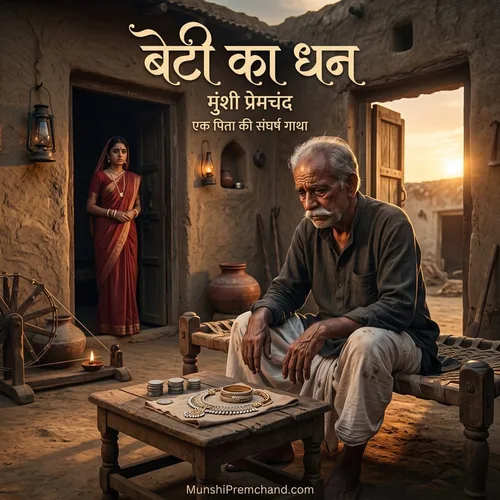
Complete English Translation: The Daughter's Wealth
1
On a high bluff overlooking the Betwa river lies a modest village celebrated for its ancient, crumbling ruins. Lovers of historic lore and departed glory frequently visited this venerable spot with deep affection and reverence.
The village elder, an aged Kevat boatman named Sukkhu Chaudhary, would conduct them on a tour of the site, pointing out the faded traces of the Queen’s palace, the King’s royal court, and the Prince’s assembly hall. Drawing a long sigh, he would say in a voice choked with nostalgia:
"Noble sirs! There was a time when boatmen received gold mohurs as rewards for presenting fine fish! Palace sweepers gathered gold coins as they swept the corridors! Daily the Betwa river rose in spate to touch the feet of his majesty! Such was our former majesty and splendor! But today, look upon our wretched ruin!"
It was beyond Chaudhary’s power to convince everyone of these extravagant legends, yet every listener departed deeply impressed by his warmth, sincerity, and passion for the past.
Sukkhu Chaudhary was a generous man, but his appetite was larger than his bread. He had three sons, three daughters-in-law, and several grandchildren. He had only one daughter, Gangajali, whose final nuptial departure (gauna) had not yet taken place. She was Chaudhary’s youngest child. Following his wife’s death, he had reared the motherless infant on goat’s milk.
There were many mouths to feed in the household, but their cultivation was limited to a single plow. Life was sustained with immense hardship. Nevertheless, Sukkhu’s venerable age and knowledge of the ruins had earned him a degree of social honor in the village that caused Jhagru Sahu, the wealthy moneylender, to burn with inward jealousy.
Whenever Sukkhu stood before the villagers, gesturing animatedly as he conversed with visiting British officers and guided them through the ruins, Jhagru Sahu—who dared not approach for fear of being shoved aside by the peons—would writhe in helpless irritation. Consequently, Sahu was always watching for a favorable opportunity to establish his financial dominion over Sukkhu.
The zamindar of the village was Thakur Jitan Singh, whose relentless demands for forced, unpaid labor (begar) had made life a misery for the villagers. That winter, when the British District Magistrate toured the region to inspect the ancient ruins, Sukkhu Chaudhary seized the opportunity to narrate the suffering of his fellow villagers in guarded, deferential words. He felt not the slightest fear when conversing with high officials.
To be sure, Sukkhu knew perfectly well that antagonizing Jitan Singh was like putting one's head into a lion's jaws. But when the villagers flattered him, saying, "Chaudhary, you enjoy such intimate friendship with high officials, while we weep day and night; of what use is your influence if not to rescue us? The wealth of the virtuous exists for the service of others!"—Sukkhu’s pride soared to the skies. For a fleeting hour, he forgot Jitan Singh.
The Magistrate demanded an explanation from Jitan Singh. Meanwhile, Jhagru Sahu lost no time in reporting Chaudhary’s daring defiance to the landlord.
The Thakur flew into a towering rage. He summoned his agent and called for the arrears ledger. By ill chance, a balance of rent was outstanding against Chaudhary for that year. Farm yields had been meager; then Gangajali’s wedding had to be performed; and the youngest daughter-in-law had persistently clamored for a gold nose-ring, which had to be made. These expenses had completely emptied Sukkhu's hands.
Yet he was not overly worried about the arrears. He was deluded by the vanity that the tongue which possessed the power to charm English magistrates could surely placate Thakur Jitan Singh.
While the old boatman rested in complacent pride, a legal suit for rent arrears was struck against him. The summons was served, and the court hearing was fixed for the very next day. Chaudhary was granted no opportunity to work his verbal magic.
Those very villagers whose flattering encouragement had spurred Sukkhu to provoke the landlord became invisible. The Thakur’s bailiffs and retainers began circling the village like vultures. In terror of them, no neighbor dared cross Chaudhary’s shadow.
The civil court was three miles away. It was the peak of the monsoon; the tracks were flooded, streams were overflowing, the dirt roads were impassable for bullock carts, and the old man’s legs lacked strength. In default of appearance, an ex-parte attachment decree was passed against him.
2
When the notice of attachment (kurki) arrived, Chaudhary’s hands and feet went cold. All his cleverness evaporated.
Lying quietly upon his string cot, he stared blankly toward the Betwa river, whispering to himself: Will my ancestral home be reduced to dust in my lifetime? Alas, will another man’s yoke be placed upon the necks of my beautiful pair of oxen?
At this thought, tears filled his eyes. He threw his arms around the bullocks' necks and wept bitterly. Why were tears flowing from the animals' eyes as well? Why did they refuse to touch their fodder in the trough? Had the pain of their master’s agony reached their mute hearts?
Then, gazing with anguished eyes upon his thatched cottage, he thought: Must we be driven from this roof? Will this heirloom of my ancestors be snatched away while breath remains in my body?
Some men stand firm in trials; others cannot endure even a mild flame of adversity. Chaudhary lay despondently upon his cot, spending hours chanting prayers to his patron deities, Mahavir and Mahadev, singing their praises. His tormented soul had no other refuge.
There was no doubt that Chaudhary’s three daughters-in-law possessed gold ornaments; but a woman’s jewelry is like the juice of sugarcane—it emerges only when crushed in a press! Chaudhary was of a humble caste, but of elevated spirit. He felt ashamed to propose such a humiliating measure to his daughters-in-law. Indeed, so low a thought had perhaps never entered his breast.
Had his three sons possessed an ounce of filial intelligence, the old father would not have been driven to seek refuge with the gods. But here, matters were of an entirely different order! The eldest son had no leisure from his ferry boat; while the two younger sons devised bizarre schemes to resolve the crisis.
The second son, Jhingur, made a fierce grimace and exclaimed, "Pah! What is left in this village? Wherever I labor, there I shall eat! But mark my words—I shall pluck out Jitan Singh's mustache hair by hair!"
The youngest son, Fakkad, puffed out his chest: "You may pluck his mustache! I shall chop off his nose! He will wander the world noseless!"
At this empty bravado, both brothers burst into hearty laughter and departed to catch fish in the river.
An elderly Brahmin priest resided in the village. He performed worship at the temple and daily crossed the river to visit his patrons, never paying a copper coin for the ferry. On the third day, slipping past the zamindar's spies, he approached Sukkhu and said in a voice of sympathy:
"Chaudhary! The deadline expires tomorrow, and you lie here sleeping! Why do you not search out your household valuables and send them away to safety? Send them to your in-laws' house! Whatever is saved is pure gain. No bailiff can dig up the mud walls and carry them off!"
Chaudhary sat up, gazed toward the sky, and replied, "Whatever is His divine will shall come to pass. I cannot engage in such fraudulent deceit."
Through days of continuous prayer and devotion, Chaudhary’s mind had become purified and serene; he harbored utter disgust for trickery. The priest, an expert in such dodges, hung his head in shame and departed.
The other members of Chaudhary’s household, however, placed no such trust in divine will. Stealthily, brass pots and copper vessels were smuggled out of the house. Not a single grain of wheat was allowed to remain in the granary. Night after night, a loaded boat departed across the river and returned empty.
For three consecutive days, no fire was lit in Chaudhary's hearth. Not a morsel of grain, nor a single drop of water passed the old man’s lips. The women parched chickpeas at the public oven to chew, and the young men roasted fish by the riverbank.
Yet if anyone shared in the old man's strict, waterless fast, it was his daughter Gangajali. The poor girl wept bitterly seeing her aged father writhing in thirst upon his cot.
Sons rarely possess that depth of affection for parents which daughters cherish. Gangajali remained absorbed in thoughts of how to rescue her father: If all of us brothers and sisters went to Thakur Jitan Singh and begged for mercy, he would surely relent; but Dada would never consent to such humiliation! If only he would visit the British Magistrate, everything would be resolved in an instant! But his wits seem utterly paralyzed.
In this torment of thought, a sudden inspiration struck her. Her pale, withered face bloomed with hope.
3
The priest had departed, and Chaudhary was crying aloud in prayer, calling upon his slumbering gods: "Where are You, O Krishna Murari? Relieve my distress!"
Gangajali came and stood quietly beside his cot. Seeing her, Chaudhary asked in surprise, "What is it, my daughter? Why have you come out so late into the night?"
Gangajali replied softly, "To live under the open sky is written in our destiny; how can I remain inside the house?"
Sukkhu cried out once more, "Where have You gone, O Lord of the Fallen? Make haste to help me!"
Gangajali sat down beside him and said in a gentle voice, "You have been singing hymns for three days now, Dada. Have you devised any plan to save the homestead, or will you allow it to turn to dust? Will you leave us to sleep beneath the trees?"
Chaudhary replied with an aching heart, "Daughter, no path presents itself to my eyes. Whatever God wills, that shall be! Hasten, O Girdhar Gopal, why do You delay?"
Gangajali said, "I have thought of a remedy. If you permit, I shall tell you."
Chaudhary sat up, "What remedy is it, daughter?"
Gangajali said firmly, "Pawn my jewelry with Jhagru Sahu. I have calculated the value: it will yield more than enough to satisfy the decree."
Chaudhary drew a deep, shuddering breath and said, "Daughter! Do you feel no shame in uttering such words to me? According to the sacred scriptures, it is forbidden for a father even to drink water from the well of his daughter’s village! Even to set foot upon your marital threshold is a sin! Do you wish to push me into the fires of hell?"
Gangajali was prepared for this objection. She replied, "I am not gifting my ornaments to you forever, Dada. Take them now to overcome this crisis; redeem them in the spring harvest when the crops are reaped!"
Chaudhary snapped fiercely, "This I will never do!"
Gangajali said with rising passion, "If you will not do it, I shall go to Jhagru Sahu myself! I cannot bear to watch the ruin of this house!"
Chaudhary retorted in irritation, "What face shall I show to our community?"
Gangajali answered impatiently, "Who is going to beat a drum before the community?"
Chaudhary pronounced his final verdict, "I will not destroy my sacred duty (dharma) merely to avoid public mockery!"
Gangajali cried in anguish, "If you refuse to listen to me, my blood will be upon your head! I shall drown myself in the Betwa river this very night! You may endure watching this house burn to ashes, but I cannot bear to see it!"
Chaudhary sighed deeply and pleaded in a piteous voice, "Daughter, do not destroy my soul's salvation. If matters have reached this extremity, go and ask for the ornaments of one of your sisters-in-law."
Gangajali replied with grave scorn, "Who will go to have her face scratched by sisters-in-law? Had they felt any concern for you, was curd frozen in their mouths that they could not speak? Would they not have offered them on their own?"
Chaudhary was left without an answer.
Gangajali went inside the hut, brought out her wooden jewelry box, and one by one, tied every single ornament into Chaudhary’s shoulder scarf.
Tears brimmed in Chaudhary’s eyes as he moaned, "O Lord Rama, what fate is written for this wretched body!"
He rose from the cot, unable to conceal the tears streaming down his withered cheeks.
4
It was late at night. Leaving the main thoroughfare, Sukkhu Chaudhary walked stealthily along the banks of the Betwa river, clutching the bundle of jewelry under his arm as though carrying a bundle of heinous sins.
When he reached Jhagru Sahu’s house, he paused outside the door and wiped his eyes carefully, lest anyone should suspect that he had been weeping.
Inside, Jhagru Sahu sat smoking his hookah, wearing thick spectacles tied with string, with his account ledgers spread before him. In the dim, flickering light of a clay lamp, he was straining to decipher figures written with an economy of ink. Repeatedly he polished his spectacles and rubbed his eyes, yet he considered it inappropriate to trim the wick or light a second lamp, lest oil be squandered.
At that moment, Sukkhu Chaudhary stepped into the doorway and said, "Jai Ram-ji, Sahu-ji."
Jhagru Sahu looked up, recognized his visitor, and said, "Jai Ram, Chaudhary! Tell me, what happened in the lawsuit? This moneylending is a vexatious trade; one does not find leisure even to raise one’s head all day long."
Chaudhary carefully concealed the bundle under his shawl and said with feigned indifference, "Nothing has happened as yet. Tomorrow the execution of the decree is scheduled. Thakur Jitan Singh has settled some ancient grudge against me. Had I been granted even two or three days' grace, the decree would never have been executed. The Magistrate and the Joint Magistrate both know me intimately; only this winter I conversed with them for hours beside the river! But first it was the monsoon rains, and second, not a single day's time was given. What could I do? At this moment, my only anxiety is for money."
Jhagru Sahu asked in astonishment, "Anxiety for money—to you? When your house is filled with wealth, of what use is it if not for such a day?"
This was no sarcastic dart; Sahu and the entire village genuinely believed that the goddess Lakshmi reigned supreme within Chaudhary’s household.
Chaudhary’s countenance changed. He said in a broken voice, "Sahu-ji! Had I money, what anxiety would there be? Why hide the truth from you? For three days no fire has been lit in my hearth; weeping and mourning reign in my home. Now I can survive only if you give me life. Thakur Jitan Singh has left no stone unturned to uproot me."
Jhagru Sahu certainly wished to keep Thakur Jitan Singh pleased, but he had no desire to alienate Chaudhary either. If principal and interest could be recovered comfortably without compound litigation, he had no objection to placing Chaudhary under an unearned obligation. Moreover, if Chaudhary’s intimacy with British officials could exempt Sahu from the commercial tax—which, despite numerous bribes to clerkly palms, continued to expand daily like his own paunch—what could be better?
He said, "What can I say, Chaudhary-ji? I too am ruined by expenses nowadays. Outstanding debts cannot be recovered; the income tax had to be paid; my hands are completely empty. How much money do you require?"
Chaudhary said, "The decree is for one hundred rupees. Including court costs, consider it nearly two hundred."
Jhagru began maneuvering: "Did your sons offer no assistance? They too earn something or other."
The arrow struck home. All the bitter thoughts stored in Chaudhary’s heart regarding his sons' callousness sprang to life: "Brother, had the sons been worth anything, why would I have been driven to see this day? They care only for their own pleasure. The burden of the household rests on my aged shoulders alone. Whether I sink or swim is no concern of theirs. Even at the point of death, my throat is not released! When I die, they will stuff my skin with straw and preserve it! Domestic life is a web of endless tribulations!"
Jhagru shot his third arrow: "Could the daughters-in-law do nothing either?"
Chaudhary replied, "Sons and daughters-in-law are all revelling in their own pleasures! For three days I lay at the door without food or water, and not one came to ask after me. Where was the question of counsel or conversation? The daughters-in-law may possess no cash, but they have jewelry, and that too made with my own earnings! In this dark hour, had they removed two pieces each, would I not have redeemed them in the spring? Will these dark days last forever?"
Jhagru perceived that Chaudhary was offering only verbal promises, and verbal promises he never accepted on any account. He said, "Your family members are truly extraordinary! Do they not understand where an old man can fetch money from? Times have changed, Chaudhary. Either execute a mortgage upon your land or pledge gold ornaments—only then can money be advanced. Even in land there are a hundred legal complications; the true convenience lies in pledged jewelry. But when your own family feels no concern, why should you sacrifice your life in vain? At most, people will laugh at you. How long can you maintain this hollow pride?"
Chaudhary said with profound humility, "Sahu-ji, it is this very pride that is killing me! What is hidden from you? There was a day when our forefathers rode beside the royal carriages; today the walls of our cottage are being sold at auction! I have no desire even to show my face to the world. Here—take this bundle of jewelry! Had it not been for this terror of public disgrace, I would never have brought it to your threshold. But to preserve this honor, I have been compelled to commit this mortal sin."
Jhagru Sahu asked in surprise, "Whose ornaments are these?"
Chaudhary bowed his head and murmured with immense difficulty, "They belong to my daughter Gangajali."
Jhagru Sahu was struck dumb with horror: "Ram! Ram!"
Chaudhary cried in agony, "I feel like drowning myself in the river!"
Jhagru said with deep religious gravity, "According to the Shastras, it is forbidden even to look upon the trees of a daughter’s village!"
Chaudhary drew a long, shuddering sigh: "God knows when Death will take pity on me! I married off three of my brother's daughters, and never once did I look upon the doorways of their villages! Until now, the Almighty preserved my honor; but today, God knows what terrible degradation awaits this clay."
Jhagru Sahu lived strictly by the merchant’s creed: Exact every single grain in accounts, but bestow hundreds in charity. To surrender a single pie of legitimate interest was anathema to him; if a debt ran one day into a new month, he charged interest for the entire month.
Yet during Navratri, he sponsored daily recitations of the Durga Saptashati; during the ancestral fortnight, he distributed flour and ghee to Brahmins every dawn. Banias possess deep, unshakeable reverence for traditional religion. If an indigent Brahmin stretched out his hands for aid to marry his daughter, he never returned empty-handed from Jhagru’s shop; begging ascetics, however robust and idle, never heard a harsh rebuke at his door.
In his religious worldview, it was far better to die of parching thirst than to drink water from the well of a married daughter’s village! He was a staunch devotee of this sacred principle, and anyone who upheld it was to him a venerable soul.
His hard heart melted. He thought: This man has never in his life harbored an unholy thought. Driven by the cruel buffet of time, he has descended onto the path of sin. To protect his sacred duty is my supreme religious obligation!
The moment this thought entered his mind, Jhagru Sahu leaned forward from his bolster, rose from his mattress, and said in a firm, resonant voice:
"That very Almighty God who has preserved your honor until this day shall preserve it still! Return the daughter's ornaments to the daughter. As the girl is your daughter, so is she mine! Take these rupees. Overcome your crisis today. Whenever money comes into your hands, you may repay it."
The unexpected mercy struck Chaudhary like a wave of light. He broke down and wept aloud with uncontrollable emotion.
In the ecstasy of his gratitude, he seemed to see the enchanting form of Lord Krishna standing before his eyes. That very Jhagru who was notorious throughout the village for heartless usury, against whom Sukkhu himself had lodged complaints before magistrates, appeared today as an incarnate deity!
In a voice choked with tears, Chaudhary cried:
"Jhagru, in this hour you have preserved my word, my honor, my sacred faith—nay, my everything! You have steered my sinking boat safely across the river! Lord Krishna Murari will reward you for this boundless mercy, and as long as breath remains in this body, I shall sing your praises to the heavens!"
Summary of The Daughter's Wealth
'The Daughter's Wealth' (Beti Ka Dhan) is one of Premchand's most moving portrayals of filial love, traditional Hindu ethics regarding daughters, and the unexpected redemption of a hardened rural usurer.
Sukkhu Chaudhary, an elderly Kevat boatman in village Bela, lives near ancient historical ruins on the Betwa river, serving as an affectionate guide to visiting colonial officers. When he courageously complains to the British District Magistrate about the unlawful forced labor (begar) extracted by the village zamindar Thakur Jitan Singh, the vengeful landlord files a retaliatory suit for rent arrears. Due to monsoon floods and old age, Sukkhu fails to appear in court, and an ex-parte attachment decree is issued against his cottage and beloved plow bullocks.
Confronted with ruin, Sukkhu fasts and prays for three days. His three sons and daughters-in-law display shameful selfishness: the sons brag idly of violence while smuggling household goods across the river, and the daughters-in-law hide their ornaments. Only his unmarried youngest daughter Gangajali shares his grief. Desperate to save her father, she brings her wedding jewelry and begs him to pawn it with the village moneylender Jhagru Sahu. Sukkhu is horrified, as orthodox Hindu tradition strictly forbids a father from utilizing a daughter's property (beti ka dhan) or even drinking water from her marital village. However, Gangajali threatens to drown herself in the Betwa if he refuses, compelling him to take the bundle.
Creeping through the night to Jhagru Sahu's shop, Sukkhu reveals the origin of the ornaments in deep shame. Jhagru Sahu, notoriously ruthless in extracting interest yet deeply orthodox in religious practice, is struck with horror at the thought of violating the sanctity of a daughter's property. Touched by Sukkhu's lifelong piety and plight, Jhagru experiences a profound awakening: he refuses the jewelry, proclaims Gangajali to be his own daughter as well, and lends Sukkhu the required money without interest or security. Overcome with tears of gratitude, Sukkhu sees the divine grace of Lord Krishna in the redeemed moneylender.
Publication History
'The Daughter's Wealth' (Beti Ka Dhan) was first published in Hindi in 1915 and later anthologized in Premchand's renowned collection Mansarovar (Vol. 2). Written during the early phase of Premchand's literary career, the story highlights the moral integrity of Indian rural society, the sacred status accorded to daughters, and the redemptive potential of conscience even within exploitative feudal structures.
This unabridged English translation was published in 2026 by MunshiPremchand.com as part of the MunshiPremchand.com English Translation Series.
Themes & Critical Significance
- The Moral Sanctity of a Daughter's Property: In traditional Indian culture, a daughter's wealth (beti ka dhan) is sacrosanct; exploiting it is viewed as an unpardonable sin. Premchand illustrates how this ancient ethical taboo remains a powerful moral force capable of checking desperation and greed.
- Filial Devotion versus Fraternal Greed: The contrast between the callous sons who abandon their father while hiding assets and Gangajali who readily sacrifices her wedding jewelry underscores the profound depth of daughters' selfless affection in the Indian family.
- Feudal Tyranny and Administrative Complicity: The narrative critiques the oppressive zamindari system, where speaking out against forced labor (begar) invites vindictive lawsuits and legal dispossession enabled by rigid colonial court procedures.
- The Moral Awakening of a Usurer: Jhagru Sahu represents the dual nature of rural moneylenders—relentlessly grasping in commerce, yet bound by traditional religious principles. His refusal to take the daughter's jewelry and his unconditional assistance demonstrate Premchand's belief in the latent goodness of human nature.
- The Tragedy of Aging Parents: Sukkhu's isolation in old age, despite having three sons, poignantly highlights the vulnerability of aging rural parents when economic pressures erode filial duty.