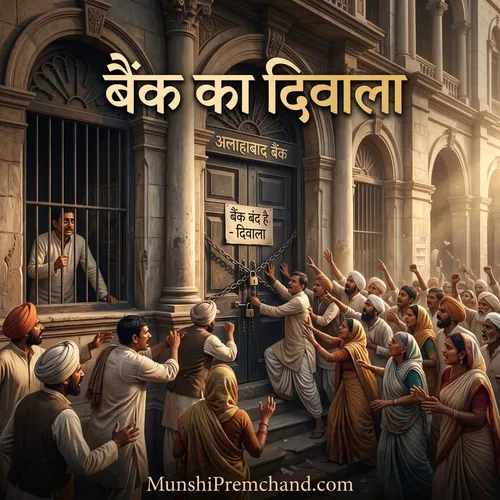
Complete English Translation: The Bank's Bankruptcy
1
In the office of the Lucknow National Bank, Lala Saindas reclined in an easy chair, scanning the latest share prices and wondering how dividends would be distributed to the shareholders this term. He toyed with the idea of purchasing shares in tea, coal, or jute; he considered speculating in silver, gold, or cotton. But fear of financial loss paralyzed his decision-making. In the grain trade, the bank had suffered a catastrophic loss that season; to reassure the anxious shareholders, a fictitious balance sheet showing profit and loss had been manufactured, and dividends had been disbursed out of the bank's own capital reserve. After that ordeal, his heart trembled at the mere thought of touching grain speculation again.
Yet it was impossible to let the money lie idle in the vault. Within a day or two, it was essential to find some profitable investment, for the quarterly directors' meeting was scheduled for the coming week. If no decision was reached then, nothing could be done for the next three months, and when the semi-annual dividend distribution arrived, the bank would be forced to resort once more to fraudulent bookkeeping—a dangerous gamble the institution could hardly survive repeatedly.
After fretting in this dilemma for a long time, Saindas rang the bell on his desk. A Bengali clerk poked his head out from the adjoining room and peered in.
Saindas said, "Draft a letter to the Tata Steel Company asking them to send their latest balance sheet."
The Bengali Babu replied, "Those people have no need of money, sir. They do not even reply to letters."
"Very well; write to the Swadeshi Mill in Nagpur."
"Their business is in terrible shape. Their laborers were recently on strike; the mill was shut down for two whole months."
"Confound it, write somewhere! In your eyes, the entire world is populated by swindlers!"
"Good sir, as far as writing goes, I can write to every corner of the world. But what is the use of merely writing letters if nothing comes of it?"
Lala Saindas had been appointed managing director of the bank purely on account of his high ancestral pedigree and family prestige, but he was completely ignorant of practical banking matters. This Bengali clerk was his chief adviser, and the Babu trusted neither factory nor trading corporation. It was owing to his chronic suspicion that the bank's idle capital had remained locked in the iron safe all of last year, and now the very same pattern threatened to repeat itself.
Saindas could see no way out of the impasse. Nor did he possess the courage to venture into business on his own judgment. In a state of nervous agitation, he rose and began pacing the room, when the liveried gatekeeper rushed in to announce: "Sir, the royal carriage of the Maharani of Barhal has arrived!"
2
Lala Saindas jumped up in astonishment.
The Maharani of Barhal had arrived in Lucknow only three or four days earlier, and her name was on every tongue in the city. Some were entranced by her regal attire, some by her striking beauty, and others by her fiercely independent spirit. Even her maidservants and guards had become objects of public curiosity and gossip. A perpetual crowd of onlookers gathered outside the gates of the Royal Hotel where she resided. Wealthy dandies, idle pleasure-seekers, perfume merchants, drapers, and tobacconists disguised themselves in various garbs merely to catch a fleeting glimpse of her majesty.
Whenever her carriage passed through the streets, crowds packed the thoroughfares. What magnificence! What royal splendor! Such a pair of thoroughbred Iraqi horses was hardly to be seen outside the stables of the Lieutenant-Governor himself, and the carriage fittings were dazzling beyond description. People whispered, "By heaven, one does not see such fair, radiant complexions even among foreigners! Our local aristocrats consume pearls, gold ashes, and moon-drops, yet not a trace of luster appears on their skin. God knows what food these Barhal royals eat, or from what mountain spring they drink—every one of them looks as fresh as a crisp apple! It must be the invigorating mountain climate."
Barhal was an estate situated in the north near the Nepal border, under British suzerainty. Although the public imagined it to be fabulously wealthy, in truth the estate's annual revenue did not exceed two hundred thousand rupees. To be sure, its territory was vast, but much of the land was barren scrub and wild jungle. Even the inhabited tracts were rocky and mountainous, and agricultural tenancies were leased for negligible rents.
Lala Saindas immediately pulled down his finest silk suit from the peg, smoothed his jacket, and took his seat behind the mahogany desk with great pomp, as though the visits of kings and queens were an everyday occurrence in his office. The clerks straightened their backs; a hush of bustling excitement swept through the bank. The doorkeeper adjusted his turban, the watchman drew his sword and stood rigidly at attention, the punkah-puller woke abruptly from his sweet slumber, and the Bengali Babu hurried outside to welcome her majesty.
Saindas maintained an impressive exterior, but his heart fluttered with a mixture of nervous dread and intoxicating hope. This was his first encounter with royalty; he was terrified that he might commit a social blunder. Aristocrats have their tempers in the clouds; who knew what minor slip of etiquette might cause offense?
At this moment, he felt acutely conscious of his shortcomings. He knew nothing of courtly protocol—how to greet royalty, what forms of address to employ, or how much humility was appropriate to safeguard his dignity. He felt like a native of tropical Lanka suddenly transported to the icy heights of Tibet, completely ignorant of the local customs and dialect. He desperately wished this examination would end quickly.
Suddenly, his eyes fell upon the wall clock. It was already four in the afternoon, but the clock still slumbered at twelve; its calendar hand, meanwhile, had raced days ahead of time. He sprang up hastily to set the clock right, but at that very moment, the Maharani swept into the room. Saindas abandoned the clock and stood frozen beside her, unable to decide whether he should bow low in a courtly salaam or offer his hand for an English handshake. The Maharani graciously extended her gloved hand, rescuing him from his awkward paralysis.
Once they were seated, the Maharani's private secretary opened business negotiations. After reciting the ancient lore and martial glory of the House of Barhal, he described the modern improvements initiated through her highness's visionary efforts. At present, ten lakh rupees were required to construct a major network of irrigation canals; however, her highness preferred to patronize a purely Indian banking institution rather than foreign capitalists. The choice now rested with the Lucknow National Bank whether it wished to seize this golden opportunity.
The Bengali Babu interjected cautiously, "We can provide the funds, sir, but we can do nothing without inspecting the property deeds and mortgage papers."
The secretary asked, "Do you require security?"
Saindas chimed in with grand generosity, "Noble sir, your word alone is sufficient security!"
The Bengali Babu pressed on, "Do you possess an audited account of the estate's revenue and expenditure?"
Lala Saindas was deeply irritated by his head clerk's petty, shopkeeper-like skepticism. He was thoroughly intoxicated by the romance of aristocratic benevolence. The Maharani's noble countenance was the finest security on earth! Demanding account books and balance sheets in her presence seemed like crude bania vulgarity, reeking of distrust.
Before women, men often become puppets of gallantry. Saindas shot a severe, reproving glare at the Bengali Babu and said firmly, "The examination of papers is not at all necessary; our mutual trust is all that matters."
The Bengali Babu protested, "The board of directors will never agree, sir."
Saindas replied haughtily, "I do not care about that. I am prepared to advance the money on my own personal responsibility!"
The Maharani looked at Saindas with a gaze of enchanting gratitude, and a faint, gracious smile played upon her lips.
3
Nevertheless, the bank directors deemed it indispensable to review the estate's accounts, revenues, and expenditures, and this task was entrusted to Lala Saindas himself, since no other director had the leisure to examine an entire archive of ledgers. Saindas observed the formalities: he spent three or four days perusing the ledgers, and then submitted a glowing report confirming his absolute satisfaction.
The agreement was concluded. The legal mortgage deed was executed, the ten lakh rupees were disbursed, and the interest was fixed at nine percent per annum.
For three consecutive years, the bank prospered magnificently. Every six months, without the slightest delay or reminder, a bag containing forty-five thousand rupees in hard cash arrived at the bank's office from Barhal. Depositors were paid five percent interest, and the shareholders enjoyed a handsome seven percent dividend.
Everyone was delighted with Saindas; all sang the praises of his financial genius and extraordinary foresight. Even the skeptical Bengali Babu was gradually won over.
Saindas would often say to him in philosophical triumph, "Babu-ji, trust has not vanished from this world, nor will it ever vanish! To believe in the truth of human nature is the supreme duty of man. A man from whose heart faith has departed must be regarded as spiritually dead. Such a man feels he is surrounded on all sides by enemies. Even the greatest saints appear to him as jackals in dyed skins; the purest patriots seem to him mere gluttons for public applause. To him, the entire world appears full of deceit and treachery, until at last faith in God Himself evaporates from his soul.
"A celebrated philosopher has observed that every man should be considered an honest gentleman until proven otherwise. The entire structure of modern civilized government rests upon this noble principle. As for hatred, we must despise no one; our souls are pure sparks of the divine, and to harbor contempt for man is to insult the Almighty.
"I do not claim there is no deceit in this world—there is, and in great abundance! But its cure is not chronic suspicion; it is the intuitive comprehension of human character, which is a gift bestowed by God. I do not boast, but I know that by looking into a man's countenance I can penetrate to his innermost motives. A man may disguise himself in a thousand costumes, but he cannot deceive my inner vision!
"Remember that trust begets trust, and suspicion breeds treachery; it is a law of nature. If you treat a man as a scoundrel from the outset, he will never deal honestly with you; he will seek only to outwit you. Conversely, if you place absolute trust even in a common thief, he will become your devoted servant. He may rob the whole world, but he will never betray your faith. No matter how wicked he may be, once you place the golden chain of trust around his neck, you can lead him wherever you please—you can even transform him into a saint!"
The Bengali Babu had no answer to these lofty philosophical sermons.
4
It was the first day of the fourth year. Lala Saindas sat in the bank's private office, eagerly awaiting the arrival of the postman. Today, the semi-annual interest of forty-five thousand rupees was due from Barhal.
This time, Saindas intended to purchase luxurious new furnishings for the office. Hitherto, the bank had possessed no telephone; an estimate for installation had already been procured. The glow of eager anticipation radiated from his face.
Laughing, he said to the Bengali Babu, "Whenever this date approaches, my palms begin to itch uncontrollably! Even today, my right palm is tingling."
Turning to the office clerk, he joked, "Come, Miyan Sharafat, interpret the omen for us—is it merely the interest arriving today, or will there be a handsome bonus and sweetmeats for the office staff as well?"
Hope lends its brightness to surrounding space; even the dreary bank office seemed luminous and cheerful that morning.
The postman arrived precisely on time. Saindas glanced at him with an air of casual nonchalance. The postman drew several registered envelopes from his leather satchel. Saindas rifled through them with eager eyes, but there was no envelope from Barhal—no insured parcel, no seal of the estate, no familiar handwriting.
A chill of disappointment ran through him. He was tempted to ask the postman if any registered packet remained in his bag, but restrained himself; such impatience was unbecoming before his subordinates.
Yet when the postman turned to leave, Saindas could contain himself no longer: "Brother, is there no insured letter left behind? It was scheduled to arrive today without fail."
The postman smiled politely, "Huzoor, could such a thing happen? Letters might go astray elsewhere in the world, but in your honor's business, could a mistake ever occur?"
Saindas's face fell, as though a freshly painted canvas had been drenched in muddy water. When the postman departed, he turned anxiously to the Bengali Babu, "Why this delay? Such a thing has never occurred before."
The Bengali Babu answered coldly, "There must have been some routine delay. There is no cause for panic."
Despair makes the impossible seem plausible. Saindas consoled himself with the thought that perhaps the money was being dispatched by parcel post—perhaps three thousand gold sovereigns had been packed in a wooden crate! Although he lacked the courage to voice this extravagant fantasy aloud, he clung to it desperately until the parcel postman made his rounds and departed empty-handed.
By evening, Saindas walked home in a state of agonizing restlessness. He paced his drawing room, waiting for a special messenger or a telegram. Twice he sat down in irritation to write a stern letter: To default on one's word in financial matters is an act of gross treachery. A single day's delay can prove fatal to a banking institution! But each time, fear of offending the royal house made him tear up the paper.
Night fell. Several gentlemen arrived at his house, and general conversation began. At that moment, the evening mail was delivered. Ordinarily, Saindas read the newspapers before opening correspondence, but today he tore open the letters first. There was nothing from Barhal.
With trembling hands, he picked up an English daily newspaper. The headline of the very first telegram froze the blood in his veins:
"YESTERDAY EVENING, THE MAHARANI OF BARHAL PASSED AWAY AFTER A BRIEF ILLNESS OF THREE DAYS."
Beneath the headline was an editorial note:
"The premature demise of the Maharani of Barhal is a catastrophic calamity not only for her principality, but for the entire province. Before the most eminent court physicians could even diagnose the mysterious malady, death had accomplished its grim task. Her highness was perpetually devoted to the progress of her people, and the public improvements executed during her brief reign will long be remembered with gratitude.
Although it was well known that the estate would pass into other hands after her death, this realization never hindered her highness in the discharge of her royal obligations. Under the strict provisions of Hindu personal law and estate tenure, she possessed no legal authority to encumber the estate with debt upon the security of royal lands. Yet, driven by the welfare of her subjects, she was compelled to bypass this restriction on numerous occasions.
We are convinced that had she lived a few years longer, she would have cleared all liabilities, for this concern weighed upon her mind day and night. But her untimely death has now transferred the final decision to other hands. It remains to be seen what will become of these substantial debts.
We learn from authoritative sources that the new Maharaja, Kunwar Jagdish Singh, who is currently residing in Lucknow, has, in accordance with the counsel of his eminent barristers, formally repudiated all debts and financial liabilities incurred by the late Maharani. We fear this fateful decision will trigger a violent upheaval in the banking community and will teach Lucknow's wealthy capitalists a bitter lesson regarding the perils of exorbitant greed."
Lala Saindas dropped the newspaper on the table and stared blankly at the ceiling—the final refuge of absolute despair.
His friends read the telegram, and an uproar broke out in the room. A furious barrage of criticism fell upon Saindas from every corner. The entire blame for the impending catastrophe was heaped upon his head; his years of financial prestige, his reputation for wisdom, and his boasted insight into human character vanished into dust.
The Lucknow National Bank was wholly incapable of absorbing a loss of ten lakh rupees. The sole question that remained was whether the institution could survive the night.
5
As the news spread through the city the following morning, panic gripped the populace. A frantic mob of depositors rushed to the bank doors to withdraw their savings. From morning until dusk, an endless queue of anxious creditors besieged the counters. Those who held current accounts withdrew every last copper anna without listening to any appeals for calm.
The newspaper article had shattered the bank's credit overnight. Had the public shown patience, the institution might have weathered the storm, but what vessel can remain afloat when caught in the vortex of a hurricane? By the third afternoon, the head cashier inverted his empty money-bags. The bank had bled so profusely from every artery that life had departed from its body; the iron shutters were slammed shut.
Three days had elapsed since the suspension of business. A desperate crowd of thousands was gathered outside the bank building. Armed police guards with fixed bayonets stood sentry at the locked doors.
Wild rumors flew through the air: some said Lala Saindas had swallowed poison; others reported he had been arrested in disguise; still others claimed the bank directors were already locked behind prison bars.
Suddenly, a luxurious motorcar drove down the boulevard and pulled up before the gates of the bank. Someone in the crowd shouted, "Look! It is the motorcar of the new Maharaja of Barhal!"
The moment the words were uttered, hundreds of frantic men rushed toward the vehicle and surrounded it on all sides.
Kunwar Jagdish Singh had arrived in Lucknow following the Maharani's death to consult eminent legal counsel regarding the succession and estate debts. He had also come to purchase luxury goods. Desires that had been suppressed for years under the weight of poverty and legal litigation now surged forth like torrents bursting through a breached dam. The magnificent motorcar had been purchased that very morning; negotiations were underway to acquire a palatial mansion in the city; and a bullock cart laden with expensive European luxuries had already departed for Barhal.
Seeing the vast gathering outside the building, Jagdish Singh assumed some novel theatrical spectacle was underway, and instructed his chauffeur to halt. Within moments, hundreds of agitated citizens encircled the car.
Kunwar Jagdish Singh leaned out and asked, "Why are all of you gathered here? Is there a performance taking place?"
A gentleman whose impoverished attire suggested a ruined aristocrat replied bitterly, "Yes, sir, a most entertaining drama is being performed!"
Jagdish Singh asked, "Whose drama?"
"The drama of Fate!"
The Kunwar was taken aback by this sardonic reply, but knowing that the citizens of Lucknow were fond of clever wordplay, he replied in the same vein: "One does not need to assemble in a dusty street to witness the play of Fate."
The gentleman retorted, "True, sir, but where else on earth will you find such entertainment? Between morning and dusk, Fate has transformed the wealthy into beggars and reduced proud merchants to destitution! Those who reclined in marble palaces at dawn have not the shade of a tree to shelter them this evening; those at whose gates free kitchens were open to all are now weeping for a crust of dry bread! A week ago, those who regarded poetical descriptions of tragedy as mere metaphors are now wailing with grief that would shame the most broken-hearted mourners. Where else in the world will you witness such a spectacle?"
Jagdish Singh said, "Sir, you have wrapped your riddle in still deeper shadows. I am a simple man from the countryside; speak plainly to me."
At that moment, a smartly dressed young man stepped forward from the crowd and said, "Sir, this is the Lucknow National Bank. It has gone into total bankruptcy! Aadab-arz—do you recognize me?"
Kunwar Jagdish Singh looked closely at the speaker, then leaped from the motorcar and grasped his hand in astonishment: "Mr. Naseem! You here? My dear friend, what a wonderful surprise!"
Mr. Naseem had been Jagdish Singh's classmate at the prestigious Dehradun College. The two young men had roamed the hills of Dehradun together as inseparable companions; but when family litigations forced Jagdish Singh to abandon his studies, the friends had lost touch. Soon after, Naseem had completed his education and returned to his family home in Lucknow.
Naseem smiled wanly, "Thank heaven you recognized me, Kunwar Sahib! I hear you have hit the jackpot of royal fortune. Do you still remember your old comrades?"
Jagdish Singh replied warmly, "I swear I have thought of you often! Tell me, are you well? I am staying at the Royal Hotel. Come and dine with me today so that we may talk at our leisure."
Naseem sighed, "My dear friend, all leisure and peace of mind vanished the moment the National Bank collapsed. Now the only question is how to keep body and soul together. Whatever small savings I possessed, I deposited here—and it has all been sacrificed to your royal house! This bankruptcy has made me a pauper. I shall have to stage a hunger strike at your doorstep."
Jagdish Singh was stunned: "My door is always open to you, Naseem; come with me right now! But tell me—I had no idea that my legal repudiation of the late Maharani's debt would produce such terrible consequences. Has the bank truly ruined so many lives?"
Naseem answered, "There is mourning in every home in this city. Aside from the clothes upon my back, I possess nothing in this world."
At that moment, an elderly, tilak-marked Brahmin schoolmaster stepped forward and pleaded, "Sir, this gentleman at least has clothes upon his back! For me, neither earth nor sky remains. I am the headmaster of the Raghuji Sanskrit Pathshala. All the school's endowment was deposited in this bank. Fifty destitute students studied Sanskrit and received their daily bread through that fund. Tomorrow, the school will shut its doors forever. The boys come from distant provinces; how they will ever reach their homes, God alone knows!"
A middle-aged man wearing a Punjabi turban, a coarse homespun coat, and rough country shoes pushed through the crowd and spoke with the voice of a community leader: "Sir, the failure of this bank has annihilated numerous charitable institutions! Lala Dinanath's Orphanage cannot survive another day; one hundred thousand rupees of its trust fund have been wiped out. Only a fortnight ago, I returned from a fund-raising tour and deposited fifteen thousand rupees into the orphanage account—and now not a single copper coin remains!"
An aged, trembling gentleman in the crowd sobbed, "Sir, my entire life's earnings have vanished into dust. I have not even enough left to purchase my own shroud!"
Gradually, other depositors pressed forward, each pouring out his tale of despair. Jagdish Singh stood beside Naseem for half an hour, listening to these heartbreaking testimonies.
When he finally returned to his motorcar and ordered the chauffeur to drive to the hotel, his eyes fell upon a solitary figure sitting on the dusty pavement with his head buried in his knees. It was a rustic Ahir milkman.
In their boyhood, this Ahir youth had been Jagdish Singh's favorite playmate. In those innocent days, no notions of caste or class had existed between them; they had played kabaddi together, climbed trees, and stolen fledglings from bird nests. When Jagdish Singh had been sent to Dehradun, the Ahir boy, Shivdas, had accompanied his father to Lucknow, where he had opened a modest milk and ghee shop.
Jagdish Singh recognized him instantly and called out in a loud, joyful voice, "Hey, Shivdas! Look here!"
Shivdas heard his name, but did not raise his head. He remained seated in the dust, staring toward Jagdish Singh with hollow eyes. Memories of childhood flooded his mind—the days when he and Jagdish had played gulla-danda, when they had mocked old Ghafoor Miyan and hidden in the haystacks, when he had signaled Jagdish from the schoolroom window so they could sneak away to watch the Ramlila pageant. He had assumed that the young master would have forgotten him long ago. What was he, a poor milkman, compared to the Maharaja of Barhal?
When Jagdish Singh called his name, instead of greeting him with delight, Shivdas lowered his head still further in embarrassment and attempted to slip away into the crowd.
Seeing him withdraw, Jagdish Singh stepped down from the car, caught Shivdas by the hand, and smiled affectionately: "Shivdas, have you forgotten me?"
Shivdas could no longer suppress the storm within his breast. His eyes welled with tears. He fell against Jagdish Singh's chest and sobbed, "No, master, I have not forgotten you. But I felt ashamed to appear before you in this wretched state."
Jagdish Singh said, "Do you keep a milk shop here? I had no idea! Had I known, why would I have drunk watered milk for weeks and caught this miserable cold? Come, sit in my motorcar! Come with me to the hotel; I want to talk of old times. I will take you back to Barhal with me, and we shall play gulla-danda once again!"
Shivdas wiped his eyes and said, "Do not do that, master; people will laugh at you for seating a milkman in your royal car. I will come to your hotel myself this evening. You are staying at the hotel in Hazratganj, are you not?"
"Yes, you must come without fail! Promise me!"
"When you summon me, how could I refuse?"
"Why are you sitting here outside the bank? Is your milk shop prospering?"
Shivdas looked away and whispered, "It was running until this morning, master. What will happen tomorrow, God alone knows."
"Did you have savings deposited in this bank as well?"
"I will tell you everything when I come to the hotel tonight."
Jagdish Singh returned to his car and instructed the driver, "Take me directly to the hotel."
The chauffeur asked, "Huzoor gave orders to drive to Whiteway & Laidlaw's department store."
"I will not go there now."
"Shall we proceed to Barrister Jacob's chambers, sir?"
Jagdish Singh snapped in irritation, "No! Go nowhere else. Take me straight to the hotel!"
The scenes of ruined lives and weeping citizens had ignited a profound, agonizing question in Jagdish Singh's soul: What is my true duty?
6
Seven years earlier, when the former Maharaja of Barhal had died in the prime of his youth after falling from his horse, the question of succession had arisen. As the late ruler had left no children, the legal right of inheritance devolved upon his first cousin, Thakur Ram Singh—Jagdish Singh's father. Ram Singh had filed a legal suit, but the British colonial courts confirmed the widowed Maharani as the rightful holder of the estate. Ram Singh appealed the decision through every higher court up to the Privy Council in London, but met with total failure.
In the course of this protracted litigation, Ram Singh had squandered vast sums of money, mortgaging his own ancestral estates; yet even in defeat, he refused to rest. He continuously harassed the widowed Maharani—inciting her tenant farmers to withhold rents, filing false lawsuits, and attempting to entrap her in legal snares.
The Maharani, however, was a woman of extraordinary courage and tenacity; she parried every blow struck by Ram Singh. But in this bitter war of attrition, she was forced to expend enormous sums of money. Because the tenants refused to pay their rents, she was repeatedly compelled to borrow capital. Under Hindu law, however, a widow holding a life interest had no legal authority to alienate or encumber the estate; consequently, she was forced either to conceal these transactions or to accept ruinous rates of interest from lenders.
Kunwar Jagdish Singh's childhood had been spent in pampered luxury; but when Thakur Ram Singh grew weary of litigation and feared that the Maharani's agents might attempt an attack on his son's life, he sent the young boy to Dehradun. Jagdish spent two happy years there; but just as he entered the first year of college, his father passed away. Jagdish was forced to abandon his education and return to Barhal, where the crushing burden of maintaining a large joint family and pursuing the feud with the Maharani fell squarely upon his young shoulders.
From that hour until the Maharani's death, Jagdish Singh had lived in acute poverty and humiliation. The family possessed no income other than borrowed funds and the sale of family jewelry. At the same time, the crushing anxiety of preserving aristocratic honor weighed upon him day and night. Those three years were a crucible of bitter trials. Daily he had to face the insolence of moneylenders whose ruthless taunts pierced his proud heart like barbed arrows. He had to endure the haughty insolence of British officials and local magistrates; but most agonizing of all was the venomous betrayal of his own relatives, who struck deceitful blows under the cloak of friendship.
These bitter experiences had turned Jagdish Singh into a sworn enemy of tyranny, privilege, and concentrated wealth. He was a man of deep sensibility. Literature had made him a philosopher of human nature; and while this knowledge alienated him from the superficialities of aristocratic society, it nurtured in his heart a passionate devotion to democracy and socialist ideals.
It had become clear to him that if genuine virtue and honest love survived anywhere on earth, it was only within the humble mud cottages of the poor. In those dark years of trial, whenever a ray of sincere sympathy had touched his life, it had emanated from the destitute. He came to regard vast wealth not as a divine blessing, but as a moral curse that suffocates compassion and love in the human breast—a dark cloud that blots out the radiant stars of conscience.
Yet the moment the Maharani died and royal wealth landed in his lap, the shield of philosophical idealism shattered to pieces. His capacity for self-examination evaporated. Those whom he had despised as flatterers became his constant companions; his true, humble friends were forgotten. A sweeping transformation overtook his socialist principles. His heart grew intolerant; renunciation surrendered to sensual pleasure; the golden fetters of feudal vanity bound his soul. The very officials whose arrogant faces he had once detested now became his intimate advisers. He closed his eyes to the destitution of the poor, for whom he had once felt burning sympathy.
To be sure, he still claimed to believe in socialist ideals, but he no longer possessed the courage to profess them openly. Conviction shrank in terror before self-interest. He had been granted the supreme opportunity to translate his lofty theories into practice, yet now the path seemed strewn with insurmountable obstacles. He had once been a sworn enemy of forced peasant labor (begar), yet now abolishing forced labor seemed dangerously impractical. He had championed rural sanitation and peasant health, yet now he feared the opposition of the villagers themselves. He had condemned the ruthless extraction of land revenue as a mortal sin, yet now it seemed impossible to govern the estate without stern coercion. In short, all the noble principles he had cherished in poverty appeared foolish and impractical the moment he possessed power.
Yet the heartbreaking scenes witnessed outside the bank that afternoon had awakened his sleeping conscience. He felt like a traveler lounging in a luxurious pleasure boat enjoying the serene beauty of the riverbank, who suddenly drifts past a burning cremation ghat—who sees the pyres consuming human corpses, hears the anguished lamentation of the bereaved, and instinctively leaps ashore to share in their sorrow!
It was ten at night. Kunwar Jagdish Singh lay awake upon his soft mattress at the Royal Hotel. The frantic mob outside the bank danced before his eyes; the mournful cries of the ruined depositors echoed in his ears.
A voice whispered within his conscience: Am I not the author of this calamity?
Immediately, his legal mind offered defense: I did only what I had a perfect legal right to do! It was the folly of the bank managers who advanced such a gigantic sum without adequate mortgage. Let the creditors seize the bank directors by their throats! I am no divine guardian sent to atone for the foolishness of others!
Then his thought reversed: Why did I take lodging in this extravagant hotel? Forty rupees a day—it will cost four hundred rupees for a mere ten days! And what was the need for all these luxury goods I purchased? Will velvet-cushioned chairs and crystal mirrors increase my true honor as a man? Could I not have rented an ordinary house for five rupees a month? I and all my retinue could have lived in comfort. At most, shallow aristocrats would have mocked me. What of that? The poor peasants from whose sweat this luxury is extracted are starving for a crust of bread! If I had spent those twelve thousand rupees digging irrigation wells, thousands of destitute farmers would have been blessed!
I will not allow myself to be duped again! This motorcar is a sheer absurdity. My time is not so precious that I must spend two hundred rupees a month merely to save half an hour. To speed in a motorcar before starving peasants who fast for days is like grinding lentils upon their chests! True, they may gaze in awe, and women and children will line the road to watch the car pass, but to squander thousands merely for empty vanity is utter madness! If other talukdars indulge in such folly, let them; why must I imitate their sins?
Until now, I managed to live on two thousand rupees a year. Now four thousand would be more than sufficient. What moral right do I possess to squander the fruits of other men's labor? I engage in no enterprise; I produce no wealth. If my ancestors seized this territory through brute force and cunning, what right do I have to feast upon the spoils of their plunder? Those who toil have a sacred right to the full fruit of their labor. The state merely protects them from the violence of predators, and for that service alone it is entitled to reasonable compensation. I am merely an agent appointed to collect that compensation—beyond that, I have no rightful share in the earnings of the poor!
They are poor, ignorant, and voiceless; today we may oppress them as we please because they know not their rights. But a day will surely come when their tongues will find speech, when they will understand their rights—and on that day, our reckoning will be terrible!
This luxury is alienating me from my fellow men. My salvation lies in living among them, sharing their simple bread, and easing their burdens. If this debt were a minor sum, I would pay it without hesitation; but it is ten lakh rupees principal, plus several lakhs of interest, and the moneylenders' personal claims amount to another three lakhs. The total revenue of Barhal is barely two hundred thousand rupees a year. On what strength can I dare undertake such an immense liability?
To plunge into this fire means burning away my entire youth, my ambitions, and all my dreams! Alas, how many agonies I endured awaiting these golden days! My father died of grief in this struggle. This royal inheritance was the distant beacon that sustained us through our long, pitch-black night. We survived upon its promise. In our darkest hours of hunger, our pride never wavered. Now that good fortune has arrived after years of patience, how can I turn my face away?
And it is not merely my own life—I had envisioned so many grand schemes for the improvement of the estate! Must I renounce all those dreams? That cursed Maharani trapped me in her net; while alive, she gave me no peace, and in death, she has cast this demon upon my shoulders!
Yet why do I dread poverty so intensely? Poverty is no sin! If my sacrifice can save thousands of innocent families from ruin and starvation, should I shrink from it? To live in selfish comfort is not the ultimate purpose of human life! True honor and immortal glory are not won through luxury. Who remembers the princes who wallowed in palaces? It is Maharana Pratap's self-sacrifice and austere vows that have made him the radiant sun of our race! If Sri Ramachandra had spent his days in courtly luxury, who would speak his name today? It was his supreme sacrifice that made him immortal!
Our dignity depends neither on wealth nor on motorcars. Whether I ride a motorcar or mount a village pony, whether I reside in a palace or sleep in a mud hut—what does it matter? At most, the talukdars will sneer at me. Let them! In my heart, I desire nothing more than to sever ties with their idle vanity. If by enduring their scorn hundreds of families are saved from ruin, I am no man if I cannot bear it with joy!
The destinies of thousands of families are in my hands tonight. My luxury is their poison; my self-restraint is their nectar of life! When I have the power to become nectar, why should I choose to become poison?
And why call it a sacrifice? It is a mere accident of birth that I am the master of this estate. I did not earn it; I shed no blood and spilt no sweat for it. Had this estate not fallen to me, I would have been toiling for my daily bread like millions of my brethren. Let me forget that I am the ruler of this land!
It is in moments such as these that a man's soul is weighed in the balance. For years I studied books; for years I professed the gospel of benevolence. If I abandon those principles tonight, if I allow selfishness to triumph over humanity and conscience, it will be the most contemptible cowardice! Did I study the Bhagavad Gita, John Stuart Mill, Emerson, and Aristotle merely to practice cold, calculating greed? That lesson I could have learned from any petty shopkeeper!
No! I will not murder my conscience! Where I have the power to perform righteousness, I will not commit sin! O Lord God, be my witness! You caused me to be born into a noble Rajput lineage—do not let my actions bring shame upon that great name! No, never! This neck will never bow before selfishness! I am the descendant of Rama, of Bhishma, of Pratap—I will not become the slave of bodily comfort!
At that moment, Kunwar Jagdish Singh felt as though he were standing upon the summit of a lofty tower. His heart swelled with noble pride; his eyes shone with radiant resolve.
Yet in the very next instant, a shudder ran through his body. He looked down from the dizzying height, and his spirit trembled like a man standing on the edge of a precipice, contemplating the leap into the abyss.
He thought: Will my family ever consent to this madness? Even if they yield out of regard for me, do I possess the moral right to sacrifice their happiness upon the altar of my conscience? My mother will never agree; my younger brothers will reject it outright. In proportion to the estate's revenue, they are entitled to at least ten thousand rupees each year, and I have no right to touch their share. I am master only of my own destiny! And Savitri—my beloved wife—she might willingly leap into the fire beside me, but she will never allow our darling son Lal Singh to be scorched by this flame!
Unable to bear the agony of these conflicting thoughts, Jagdish Singh sprang from the bed and paced the room in torment. He opened the window, breathed the cool night air, and slipped quietly out of the hotel.
The night was pitch-black. Before him flowed the vast, silent Gomti, dark and brooding like his own turbulent thoughts. He walked slowly along the deserted riverbank. A restless soul finds kinship in flowing water—perhaps because the waves, too, are eternally agitated.
He sought to calm his mind and calculate: If all these family pensions are disbursed from the estate's income, it will be impossible even to pay the interest on the debt, to say nothing of the principal! Can the revenue not be increased? There are twenty horses in the royal stables; for me, one is plenty. There are no fewer than one hundred servants; for me, two are more than enough. It is unjust to force our own brethren into degrading servitude. I will grant those servants fertile plots from my private lands—they will farm in peace and bless my name. The fruit orchards were hitherto distributed as presents to officials; I will sell the harvest in the open market. And the largest source of revenue is the transit duties—the Maheshganj market alone yields ten thousand rupees, all of which has been squandered by the temple priest. A thousand rupees a year is sufficient for him; I will auction the market lease for eight thousand rupees. Through these reforms, twenty-five thousand rupees can be saved each year.
For Savitri and little Lal, a thousand rupees a year is ample. I shall tell Savitri plainly: either accept a simple life of a thousand rupees with me, or take half the estate's revenue and let me depart! If she wishes to be a queen, she may be a queen in her own right—but I will never be a king!
Suddenly, words shattered the silence of the night:
"Ram Naam Satya Hai! The Name of God alone is Truth!"
Jagdish Singh turned around. A small group of mourners approached through the darkness, carrying a corpse upon a bamboo bier. They carried the body to the river's edge, erected a pyre of wood, and set it ablaze.
Two women threw themselves upon the sand, shrieking in wild, heart-rending lamentation.
At first, the sight made no impression upon Jagdish Singh's mind. He stood watching like a stone statue, feeling a strange shame: How stone-hearted I have become! A poor man's corpse is burning, women are wailing in agony, and my heart does not melt in the slightest!
Suddenly, one of the women cried out in a voice of piercing anguish:
"O my king, my jewel! How could bitter poison taste sweet to your lips?"
Those words pierced Jagdish Singh's heart like a dagger. His indifference shattered; tears sprang to his eyes.
Poison! He took his own life by drinking poison! How could bitter poison taste sweet to him? What unimaginable agony, what bottomless despair must have driven a man in the prime of life to drink bitter poison in exchange for the sweet breath of life? Only when life itself becomes a living hell can poison taste sweet!
The agonizing cry echoed repeatedly in his soul. He could bear it no longer. He walked swiftly toward the mourners and asked one of the men in a trembling voice, "Was he ill for a long time?"
The man looked at Jagdish Singh through tear-filled eyes and replied, "Illness, sir? What illness! Only this evening he was sitting in his shop, talking and laughing with us! God knows what he swallowed at dusk, but he began vomiting blood. Before we could summon the physician, his eyes rolled back and his pulse ceased. The doctor arrived, felt his wrist, and said, 'It is too late.' He was barely twenty-two or twenty-three years of age, sir—there was not a finer, stronger youth in all Lucknow!"
Jagdish Singh asked, his voice shaking, "Do you know why he took poison?"
The man looked around and replied in a lowered voice, "Sir, there was no other trouble in his home. But ever since this great bank collapsed, he was drowned in despair. He had deposited about a thousand rupees in that bank—the savings of his entire youth! He owned a thriving shop selling milk, curd, and clotted cream, and held an honorable name in our community. All his capital sank when the bank failed. We begged him not to keep all his money in the bank, but fate had ordained his ruin. This morning, he asked his wife for her gold jewelry so he could pawn it to pay the milk-suppliers. Words were exchanged, an argument broke out—and in despair, he swallowed poison."
Jagdish Singh's heart froze in terror. A terrible suspicion seized him: Could it be Shivdas?
He asked, his throat dry, "Was his name... Shivdas?"
The man stared in surprise, "Yes, sir! That was his name. Did your honor know him?"
Jagdish Singh choked back a sob, "Yes... he and I played together as children in Barhal. Only this afternoon, he met me outside the bank. Had he breathed a single word to me of his distress, I would have given him everything I possessed to save his life! O God, what a tragedy!"
The man looked closely at Jagdish Singh, recognized his royal attire, and hurried to the weeping women: "Hush, mother! The Maharaja of Barhal himself has come!"
Hearing those words, Shivdas's aged mother threw herself into the dust, crawled forward, and clasped Jagdish Singh's feet, sobbing with boundless grief:
"My child! He whom you called your brother in childhood... he is gone!"
Her voice choked; she could speak no more.
Tears streamed down Kunwar Jagdish Singh's face. In the flickering glow of the funeral pyre, he seemed to see the spectral image of his childhood playmate standing before him, pointing an accusing finger and whispering: You were my friend, yet you took my life!
7
Dawn broke over Lucknow, but sleep had not visited Jagdish Singh's eyes. Ever since he returned from the banks of the Gomti, a profound detachment from worldly vanity had taken possession of his soul. That tragic pyre had consumed all the selfish arguments of legal right and personal comfort.
He no longer feared Savitri's displeasure, his son's disappointment, or his mother's curses. Let Savitri be grieved; let Lal Singh plunge into the battlefield of labor; let my mother curse me to the skies! I will not murder thousands of innocent families merely to maintain my wife, my son, and my relatives in idle luxury! To save Shivdas, I would have surrendered ten such estates without a second thought! Let Savitri fast, let Lal Singh become a day-laborer, let me beg from door to door—but I will never strangle the poor!
There is no time for delay. Who knows what further suicides and ruin this bankruptcy will breed? Why do I hesitate? It is mere spiritual weakness! Men sacrifice their fortunes for charity every day. I know my sacred duty; why should I turn my face from it? Come what may, let the blow fall upon my own head!
Jagdish Singh rang the bell. An orderly entered, rubbing his sleepy eyes.
Jagdish Singh said, "Go immediately to Barrister Jacob's residence and give him my compliments. He must be awake by now. Tell him it is a matter of urgent importance. No, take this letter with you. And have the motorcar brought to the door at once!"
8
Mr. Jacob, the eminent English barrister, argued strenuously with Jagdish Singh, pleading with him not to step into this financial quicksand: "Once you enter this quagmire, Kunwar Sahib, you will never emerge alive! You have no idea how many debts the late Maharani accumulated."
But a resolve rooted in spiritual conviction is like hardened cement—the buffeting waves of adversity only make it more unyielding. Jagdish Singh remained immovable.
The very next morning, a public announcement appeared in all the leading newspapers:
"NOTICE TO THE PUBLIC
I, Kunwar Jagdish Singh, legal successor to the Estate of Barhal, hereby publicly acknowledge full personal liability for all debts, loans, and financial obligations incurred by the late Maharani of Barhal, and pledge to discharge them in full within the stipulated time."
The publication of this notice created a sensation throughout Lucknow. The sophisticated intelligentsia regarded it as an act of sheer madness, while those ignorant of the law assumed there must be some hidden legal trick behind it. Very few could comprehend the moral purity of Jagdish Singh's motive.
Yet if praise from the elite was lacking, blessings were boundless. Thousands of ruined depositors, widows, and orphans prayed for him from the depths of their grateful hearts.
For a whole week, Jagdish Singh found not a moment's rest. Mr. Jacob's dire prediction proved true: the liabilities mounted daily. Promissory notes surfaced of which he had never heard. Debts owed to jewellers, drapers, and money-lenders amounted to thirteen or fourteen lakh rupees; the grand total climbed toward twenty lakhs!
Jagdish Singh was shaken. A dark fear arose: What if I am forced to terminate even the modest allowances of my brothers, over which I have no moral authority?
On the seventh day, he took a firm stand against the ruthless usurers. He confronted the greedy moneylenders, denounced their extortionate practices, drastically reduced excessive interest rates, and rejected claims whose legal limitation had expired. He was disgusted by the cruelty of the financiers, believing that creditors should be content with recovering a reasonable portion of bad debts. Even after the strictest scrutiny, the total liability stood at nineteen lakh rupees.
Having completed these urgent arrangements, Jagdish Singh walked one afternoon toward the Lucknow National Bank.
The bank was open! The dead body had been restored to life! A dense crowd of depositors filled the hall, but there was no weeping or panic now—people were returning home with radiant smiles, clutching their saved earnings.
The moment the crowd caught sight of Kunwar Jagdish Singh, hundreds of people rushed toward him with overflowing love. Some wept tears of gratitude, some fell at his feet, and others expressed their heartfelt thanks in words of profound reverence.
Jagdish Singh entered the manager's office to meet the staff. The clerks exclaimed, "Your proclamation has brought this dead bank back to life!"
The Bengali Babu could not resist a sharp critique of his former chief: "That Lala Saindas believed every man in the world was an angel! He used to lecture me on philosophy. Now his eyes are opened! He sits alone in his house, ashamed to show his face to anyone. I hear he wanted to flee the city, but the head commissioner warned him that an arrest warrant would be issued if he attempted to escape."
The Bengali Babu had now been appointed manager in Saindas's place.
Soon after, Kunwar Jagdish Singh returned to Barhal.
When his younger brothers learned of his decision, they were furious and threatened to file partition suits in court. The shock fell so heavily upon his aged mother that she took to her bed that very day and passed away within a week.
Savitri, too, was deeply grieved by the loss of royal splendor; yet she possessed a noble heart. She not only reconciled herself to their modest fate, but openly praised her husband's sublime generosity and moral courage.
As for little Lal Singh, when the boy saw the spirited horses being led out of the stables, the royal elephants dispatched to the Makanpur cattle fair for auction, and the carriage-drivers dismissed with folded hands, he ran to his father in bewilderment: "Babuji, where are all these servants, horses, and elephants going?"
Jagdish Singh smiled gently, "To attend the grand wedding procession of a great king."
The boy asked eagerly, "Which king, Babuji?"
"His name is King Din Singh—the Lord of the Poor."
"Where does he live?"
"In Daridrapur—the City of Poverty."
"Then I want to go with you!"
Jagdish Singh drew his son close and said, "I will take you with me, my son; but in this procession, those who walk on foot receive far greater honor than those who ride in carriages."
The boy replied instantly, "Then I will walk on foot!"
"In that kingdom, only those who work with their hands are praised."
"Then I will work harder than anyone else!"
Kunwar Jagdish Singh's two brothers took five thousand rupees each as their independent share and separated from the joint family. Jagdish Singh was barely able to secure an income of one thousand rupees a year for himself and his immediate household. For a princely family, this sum was meager indeed. Guests and travelers arrived daily, and hospitality had to be maintained. Life was sustained with immense difficulty.
For the past year, the maintenance of Shivdas's destitute mother and family had also fallen upon Jagdish Singh's shoulders.
Yet Kunwar Jagdish Singh never once regretted his decision. No one ever saw a shadow of sorrow or anxiety upon his brow. His countenance was permanently illuminated by the calm radiance of patience and honest pride.
His love of literature had always been deep; now he had developed an equal passion for gardening and agriculture. From dawn till dusk, he tended the plants in his orchard with his own hands.
As for little Lal Singh, he was growing into a true, sturdy farmer. Though barely nine or ten years old, he ran to the fields before the break of dawn, forgetting even his meals in the joy of cultivating the soil. His riding pony still stood in the stable, but months passed without his ever mounting it.
Watching his son's tireless labor and sunburnt face, Jagdish Singh's heart overflowed with happiness. He would say to Savitri:
"I have no anxiety for the future of our house. Lal Singh will never forget this lesson! If we had retained vast wealth, what would he have learned except luxury, hunting, and vice? By selling our idle wealth, we purchased honest labor, self-respect, and contentment—and believe me, it was no bad bargain!"
Savitri was not entirely free from aristocratic attachment. Despite her husband's gentle reproaches, she occasionally accepted small customary offerings of fruit and milk from the village women, unwilling to break entirely with ancestral tradition. Yet in their modest home, illuminated by the light of sacrifice and honest labor, reigned a peace and joy that all the gold of kings could never buy.
Summary of The Bank's Bankruptcy
'The Bank's Bankruptcy' (Bank Ka Diwala) is one of Munshi Premchand's most powerful social narratives, contrasting the legal mechanisms of capitalist finance with the transcendent demands of moral conscience and human solidarity.
Lala Saindas, the status-driven managing director of Lucknow National Bank, disregards the warnings of his prudent Bengali adviser and advances a massive uncollateralized loan of ten lakh rupees to the glamorous Maharani of Barhal. When the Maharani dies unexpectedly in the fourth year, the new heir, Kunwar Jagdish Singh, refuses on legal advice to accept liability for her unauthorized debts. Deprived of its capital, the bank collapses, wiping out the life savings of thousands of middle-class citizens, school endowments, and charitable orphanages.
When Kunwar Jagdish Singh arrives in Lucknow, he is confronted by the catastrophic human misery caused by his legal refusal. Most devastatingly, he discovers that his childhood playmate Shivdas, an Ahir milkman whose savings were lost in the collapse, committed suicide by drinking poison. The sight of Shivdas's burning funeral pyre on the banks of the Gomti and the wailing of his bereaved mother trigger a profound moral crisis in Jagdish Singh's soul.
Rejecting the advice of his English barrister and braving the fury of his family—which leads to his mother's death from shock and his brothers' estrangement—Jagdish Singh publicly assumes full personal liability for nineteen lakh rupees of debt. He liquidates his royal assets, selling off elephants, horses, and carriages, and accepts a life of severe personal austerity. The bank is resurrected, the depositors are saved, and Jagdish Singh discovers genuine spiritual freedom and happiness in manual agricultural labor, raising his young son as an honest, self-reliant cultivator.
Publication History
'The Bank's Bankruptcy' (Bank Ka Diwala) was first published in Hindi in 1919 and subsequently collected in Premchand's famous anthology Mansarovar (Vol. 7). Written during the transformative post-World War I era of Indian nationalism, the story reflects Premchand's deep engagement with socialist ideals, Tolstoy's philosophy of manual labor, and Gandhi's doctrine of trusteeship.
This unabridged English translation was published in 2026 by MunshiPremchand.com as part of the MunshiPremchand.com English Translation Series.
Themes & Critical Significance
- Legal Privilege versus Moral Conscience: The narrative establishes that legal innocence does not equate to moral righteousness. While Jagdish Singh was legally exempt from his predecessor's liabilities, his conscience recognizes that profiting from feudal inheritance while abandoning ruined depositors is moral murder.
- Childhood Equality versus Adult Class Stratification: The bond between Jagdish Singh and the Ahir youth Shivdas highlights Premchand's recurring theme of innocent boyhood camaraderie uncorrupted by caste or class, contrasting sharply with the destructive social hierarchies of adult life.
- The Pitfalls of Speculative Banking: Through Lala Saindas's reckless lending and the Bengali clerk's futile cautions, Premchand offers a penetrating critique of early colonial-era Indian banking, where family prestige and social vanity often superseded financial prudence.
- Redemption Through Manual Labor and Austerity: Influenced by Gandhian and Tolstoyan thought, Jagdish Singh's voluntary transition from an idle feudal aristocrat to a dirt-under-the-fingernails cultivator celebrates manual labor as the ultimate source of human dignity and psychological peace.
- The Moral Education of the Next Generation: Jagdish Singh's conscious effort to raise his son Lal Singh as a hardworking peasant rather than a pampered princeling reflects Premchand's vision for a democratic, egalitarian India free from feudal decadence.