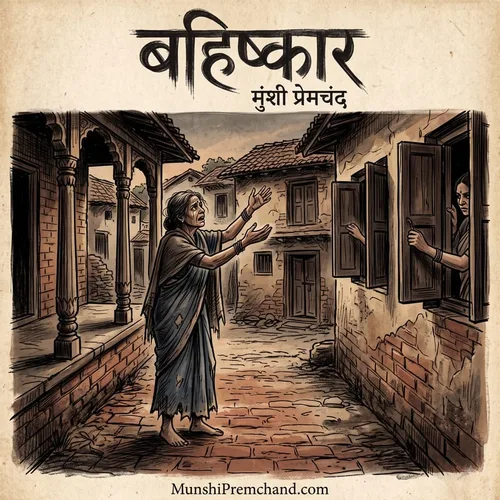
Complete English Translation: Bahishkar (The Boycott)
Pandit Gyan Chand gazed toward Govindi with earnest, longing eyes and said: "I have not the slightest sympathy for such heartless creatures. Is there no limit to such barbarity—to cast out onto the streets, over a trifling squabble, the woman with whom one enjoyed three whole years of life's domestic bliss?"
Govindi cast her eyes down and asked: "After all, what was the matter between them?"
Gyan Chand: "Nothing at all! Is there ever any real matter in such things? The complaint is that Kalindi has a sharp tongue. For three years her tongue was not sharp, and today it suddenly became sharp! Nothing of the sort—some other bird must have caught his wandering eye. For her sake, it was deemed necessary to empty the cage! That is how this complaint was manufactured. If I had my way, I would shoot such scoundrels down! On several occasions I had the opportunity to converse with Kalindi; I have rarely seen a woman so cheerful and good-natured."
Govindi: "Did you not reason with Somdatt?"
Gyan Chand: "Such people do not heed reasoning. He is a man who understands only the language of the stick; what does he care for words? My firm conviction is this: once a sacred bond has been forged with a woman, whether she turns out good or bad, one must stand by her through life! I say even if some flaw should emerge in a woman's ancestral family, one must act with forgiveness and magnanimity."
Govindi looked up with tender, troubled eyes and remarked: "Men such as you are exceedingly rare in this world."
Gyan Chand: "It is simply beyond my comprehension how a man can abandon to wander begging from door to door the woman with whom he laughed and spoke for so long, the memories of whose love permeate every single atom of his heart! The very least he ought to have done was to convey her to some safe sanctuary and make suitable arrangement for her maintenance. The brute cast her out of the house exactly as one casts out a stray mongrel! The poor creature sits weeping outside the outskirts of the village. Who can say where she will wander? Perhaps she has no one left even in her parental home. Out of dread of Somdatt, not a single villager dares venture near her. What trust can one place in such a ruffian? A man who could not prove loyal to his own wedded wife—what will he ever be to anyone else? Beholding her pitiful plight, tears sprang to my eyes. My heart urged me to say, 'Sister, come to my house'; but then Somdatt would have become thirsty for my very life."
Govindi: "Go once more and try to reason with him. If he refuses by every means, then bring Kalindi here."
Gyan Chand: "Shall I truly go?"
Govindi: "Yes, go by all means; but if Somdatt should utter harsh, bitter words, bear them patiently."
Gyan Chand embraced Govindi warmly and said: "There is immense compassion in your heart, Govindi! Look, I go; if Somdatt does not yield, I will bring Kalindi along. She cannot have traveled very far yet."
Three years went by. Govindi became the mother of a sweet child. Kalindi was still living in this very house. Her former husband had taken another wife. Between Govindi and Kalindi there existed the deep, pure affection of sisters. Govindi was forever solicitous of her comfort and happiness. Never once did it cross her mind that Kalindi was an outsider living upon their charity. But Somdatt could not stomach Kalindi's residence in Gyan Chand's house for a single instant. He lacked the courage to take any legal action—and indeed, what could he possibly do under the law? Nevertheless, he constantly sought an opportunity to humiliate Gyan Chand and bring his head low in the dust.
It was evening. The sweltering heat of the summer breeze had not yet completely subsided. Govindi had gone down to the banks of the Ganges to fetch water, and was savoring the cool, solitary tranquility of the riverbank. Suddenly, she saw Somdatt approaching. Govindi veiled her face with the hem of her sari and was on the verge of lifting her pitcher to depart when Somdatt stepped directly in front of her and said: "Wait a moment, Govindi, I have something to say to you. I only wish to ask whether I should speak it to you, or to Gyanu?"
Govindi answered in a soft, low voice: "Speak it to him."
Somdatt: "My own inclination is certainly that; but I feel pity for your helplessness. The day I speak this matter to Gyan Chand, you will be thrown out of that house! I have unearthed every single detail of your past. Who your father was; what fate befell your mother—I know the entire sordid history. Do you imagine that Gyan Chand, hearing this tale, will retain you in his home? However independent and liberal his philosophy may be, no man can swallow a living fly!"
Govindi trembled from head to foot and murmured: "When you know all matters, what can I say? Do whatever you deem proper; yet I have never done you any injury."
Somdatt: "You people have left me without a face to show in this village! And on top of that, you say you have done me no injury! By giving shelter to Kalindi for three whole years, the torment you have inflicted upon my soul is known to me alone! For three long years I have been consumed with the thought of how to avenge this humiliation. Now that I have found this weapon, I will not let it slip through my hands at any cost!"
Govindi: "If it is your wish that I should not remain here, I shall depart—I shall leave this very day; but pray say nothing to him! I fall at your feet!"
Somdatt: "Where will you go?"
Govindi: "If there is no other refuge left upon earth, Mother Ganga is always there."
Somdatt: "No, Govindi, I am not so heartless as that. I desire only this: that you drive Kalindi out of your house, and I desire nothing more. I grant you three days' time; think and reflect well upon it. If Kalindi is not turned out of your house on the third day, you shall bear the consequences!"
Somdatt turned on his heel and walked away. Govindi stood frozen beside her pitcher like a stone statue. Before her loomed an agonizing, insoluble dilemma—and that dilemma was Kalindi! Only one of them could remain in that house. For both, there was no longer room beneath that roof. For Kalindi's sake, should she renounce her own home, her own earthly heaven? Kalindi was alone; her husband had already abandoned her long ago; she could wander wherever she pleased. But where could Govindi go, abandoning her soul's anchor and her precious child? Yet what could she ever bring herself to say to Kalindi? The woman with whom she had lived like a loving sister for so long—could she ever drive her out of the door? Her child was so deeply attached to Kalindi; Kalindi adored him so boundless! Could she cast out that destitute, abandoned woman onto the ruthless roads? Yet what other remedy existed? Her very life now hung suspended upon the mercy of an arrogant, vindictive wretch. Could she truly place absolute faith in her husband's love? Gyan Chand was kind-hearted, generous, thoughtful, and firm of character; but could his love withstand the crushing onslaught of public humiliation, mockery, and communal ostracism?
From that very day, an estrangement began to appear between Govindi and Kalindi.
The two women rarely sat together now. Kalindi would call out: "Sister, come and eat your meal." Govindi would reply: "You eat; I shall eat later." Formerly, Kalindi would hold and play with the child the entire day, the boy going to his mother only to nurse. But now Govindi kept him constantly by her own side. An invisible wall had erected itself between them. Kalindi wondered over and over: Why is she displeased with me these days? Yet she could discern no cause. The dread seized her that perhaps Govindi no longer wished to keep her in the household. Immersed in these anxious thoughts, she floated in sorrow; yet Govindi was no less tormented. She wished to sever her affection for Kalindi; but beholding her sorrowful countenance, her own heart broke into pieces. She could utter nothing to her face. Words of rejection refused to cross her lips. If she saw her stepping out of the house, she knew she would burst into tears and forcibly pull her back inside.
In this agonizing vacillation, three days slipped away. Kalindi did not leave the house. On the third evening, Somdatt stood waiting on the riverbank for a long time. At last, dense darkness enveloped the landscape. Yet even as he walked away, he turned his head repeatedly to look back toward the water's edge.
It struck ten at night. Gyan Chand had not yet returned home. Govindi was frantic with terror. He had never been so late before. Where was he detained tonight? Her heart shuddered with dark forebodings. Suddenly, the sound of the outer door opening reached her ears! Govindi rushed into the sitting room; but the moment she beheld her husband's face, the strength drained from her limbs. A faint smile lingered upon his lips—but in that smile was reflected the mockery of cruel fate! Perverse destiny had chosen even this simple, upright soul for its ruthless sport. Was that secret worthy of weeping over? A cruel farce is not a matter for weeping, but for bitter laughter!
Gyan Chand did not look directly at Govindi. He removed his outer garments, placed them carefully upon the peg, took off his shoes, sat down upon the floor, and began turning the pages of a manuscript.
Trembling with anxiety, Govindi asked: "Why so late tonight? The food is growing cold."
Gyan Chand, staring down at the floor, replied: "You people go ahead and eat; I have already dined at a friend's house."
Govindi comprehended the unspoken meaning instantly. After a pause, she spoke again: "Come, eat just a small morsel."
Gyan Chand: "I have no appetite whatsoever."
Govindi: "Then I too shall simply go and sleep."
Gyan Chand now lifted his eyes, looked at Govindi, and said: "Why? Why will you not eat?"
She could utter not a word more. Her throat choked with sobs. Gyan Chand came close, placed his hand upon her, and said gently: "I speak the truth, Govindi; I have already eaten at a friend's house. Go and have your meal."
Govindi lay upon her cot, tossing in an ocean of anxiety, despair, and crushing desolation. Had she driven Kalindi out, she would not have had to confront this catastrophe today; yet such inhuman brutality had been impossible for her soul. Even in this state, she did not regret her compassion. Nor did she harbor resentment against Gyan Chand for this apparent rejection. The very Gyan Chand who spoke incessantly of righteousness and noble character now appeared to be casting her off with such cold severity; yet toward him she felt not the faintest spark of bitterness, wrath, or malice. Only one overwhelming thought agitated her mind: How can I continue to live in this house now? Until today, she had been the undisputed mistress of this home—only because she was the mistress of her husband's love! But now she was stripped of that love. What rightful claim did she possess over this house now? How could she ever show her face to her husband again? She knew Gyan Chand would never utter an unkind syllable against her; yet knowing such dark things concerning her origins, could he ever love her again? Never! For the moment, out of some strange forbearance, he had remained silent. Come morning, the tempest would break. However high-minded a man might be, who would willingly choose to be cast out from his own community? There is no scarcity of women in this world—thousands could be found to take her place! Who cared for her? To remain here now was shamelessness. After all, a person does not have to be beaten with a stick to be driven away; for a person of honor, a mere glance of the eye is more than enough. Though lips remain silent, the secrets of the heart cannot stay hidden. Yet looking down at her sweet infant sleeping peacefully in her arms, maternal tenderness made her frail heart weep with boundless sorrow. How could she ever abandon this anchor of her very life?
Lifting the baby to her bosom, she stood weeping in the dark. How blissfully those three years had passed! She had believed her whole life would drift away in this quiet joy; but in her destiny, no greater happiness had been inscribed. Words soaked in poignant agony tumbled from her lips: "O Lord! If You were destined to bring about my ruin in this manner, why did You not do so three years ago? Had You snuffed out my life back then, I would have offered You my heartfelt thanks! After granting me three years to savor the fragrance, gentle breeze, and sweetness of good fortune's lovely garden, You have laid waste to that very garden! Alas! The tender plants she had nurtured with the waters of her love were now being trampled under the ruthless feet of cruel misfortune!" Remembering Gyan Chand's gentle nobility and affection, she wept aloud. Sweet, tender memories came rushing back to squeeze her heart.
Suddenly, hearing Gyan Chand step into the room, she composed herself. She hardened her heart to endure the harshest, most cutting words; yet upon Gyan Chand's face there was not the faintest trace of anger! He asked in gentle astonishment: "Have you not slept yet? Do you know what hour it is? It is past midnight."
Govindi whispered timidly: "You too have not slept yet."
Gyan Chand: "If I do not sleep, must you stay awake as well? If I do not eat, must you starve? If I fall ill, must you fall ill too? Why so? I was merely drafting an astrological chart; it must be delivered tomorrow. Tell me, what were you doing all this while?"
What innocent affection echoed in those syllables! Could feelings of rejection ever be expressed in words so exquisitely tender? Could deceit ever be so pure? Perhaps Somdatt has not yet struck his thunderbolt. He may not have found the opportunity; but if that is so, why did he return home so late? Why did he refuse his food? Why did he not speak to me earlier, his eyes inflamed with blood? He did not even lift his eyes to look at me. Is it possible that his anger has subsided? That lies beyond the utmost bounds of possibility! Could Somdatt have felt pity upon me? Has grass sprouted upon stone? Govindi could determine nothing; and just as a homeless wanderer stretches his weary limbs in peaceful sleep beneath the shade of a wayside tree, finding tranquility in his very helplessness, so Govindi, amidst her intense agitation, found sudden calm. Smiling softly, she answered in a voice rich with love: "I was merely waiting for you."
Saying this, Govindi's throat filled with tears. Can a bird fluttering trapped within a hunter's snare sing sweet melodies? Gyan Chand sat upon the edge of the string-cot and said: "An untruth! Usually you are fast asleep by this hour."
A week went by; yet Gyan Chand asked not a single question of Govindi, nor did his conduct afford the slightest glimpse into the hidden thoughts of his mind. If there was any novelty in his behavior, it was that he became even more affectionate, cheerful, and light-hearted than before. Never had he treated Govindi with such deep respect and tender honor. Yet, despite his careful efforts, Govindi perceived the inner turmoil of his soul, and her mind remained perpetually restless and agitated with dread. She harbored not the slightest doubt that Somdatt had set the fire ablaze.
Whether a spark falling upon damp wood will sputter out, or whether the dry leaves of the forest will erupt into an all-consuming conflagration—who can predict? But the moment that week ended, the fury of the fire became manifest. Gyan Chand was employed as an accountant for a local moneylender. The moneylender summoned him and said: "I have no further need of your services here." His second source of livelihood was his priestly duties for patron families (yajmans). One by one, the patrons began severing their ties and turning him away. Soon, people stopped visiting his doorway altogether. Having devoured the dry foliage, the flames were now encircling the green tree itself. Yet from Gyan Chand's lips, not a single bitter, ungracious word issued toward Govindi. He would have cared nothing for this communal punishment had it not, by cruel misfortune, slammed shut every gateway to their daily bread. Govindi understood everything; but out of painful shame, she could say nothing. That her beloved husband was being reduced to this pitiful plight on her account was something for which she felt she ought to die of shame. Yet how could she cast off her life? How could she free herself from the attachment to existence? In this catastrophe, a river of blessing and prayer flowed toward her master from every pore of her being; but from her mouth, not a single word could escape.
The cruelest mockery of destiny occurred on the day when Kalindi, without uttering a word of explanation, packed her few belongings and went straight to Somdatt's house! The very woman for whose protection all these unbearable torments had been endured proved disloyal in the end! When Gyan Chand heard of it, he merely smiled a sad smile; but Govindi could not endure this treacherous blow with such calm forbearance. Harsh, resentful words against Kalindi tumbled from her lips. Gyan Chand said gently: "You curse her in vain, my love; it is not her fault. God is putting our souls to the test. In this hour, we must place no hope in anyone except patience."
The emotions that Govindi had suppressed within the depths of her heart for so many days suddenly burst forth with uncontrollable fury as the dam of her patience shattered:
Folding her hands before her husband like a condemned criminal, she cried: "My lord, it is solely on my account that you are compelled to endure all these crushing tribulations! I am the black stain upon your family lineage! Why do you not send me away to some distant place where no one may ever look upon my face again? I speak the solemn truth to you..."
Gyan Chand did not allow Govindi to utter another word. Drawing her close, he pressed her to his heart and said: "My beloved, do not wound me with such words! You are as pure in my eyes today as you were on that sacred day when, before the holy fire and the gods, I took the lifelong vow of fidelity to you as my wife! Back then, I barely knew you. Today, every single atom of my body and soul is illuminated by your imperishable love! To speak of public mockery and social condemnation is nothing—even the harshest blow of cruel misfortune cannot shatter my sacred vow! If we sink, we shall sink together; if we cross over, we shall cross over together! The foremost duty of my existence is toward you. The world comes afterward—far, far behind!"
To Govindi, it seemed as though a divine being stood before her. Never until this day had she felt such boundless reverence, such pure devotion toward her husband. Her head lifted with pride, and a celestial radiance shone upon her face. She never dared speak of leaving him again.
Prosperity looks upon insult and social boycott as trivial trifles; but in the absence of wealth, these obstacles become mortal blows. Gyan Chand spent whole days lying inside the house. He lacked the courage to step beyond his doorway. So long as Govindi possessed her gold ornaments, there was no anxiety regarding food. But when that final anchor was exhausted, their condition deteriorated drastically. Often, they were forced to go without food altogether. To whom could they pour out their agony? Who was a friend? Who was their own? Govindi had never been exceptionally robust, but now, ravaged by starvation and inner grief, her frame grew frail and wasted. Formerly, she bought milk for the infant; now they lacked the means for even a drop. Day by day, the child grew emaciated. It seemed as though he had contracted the wasting disease. All day long, the infant lay upon the rough string-cot, gazing at his mother with wide, despairing eyes. Perhaps even his innocent child's intellect understood their plight: he never threw a tantrum for anything. His natural childlike playfulness, restlessness, and laughter had transformed into a long, hopeless vigil. Beholding his pitiful state, the parents suffered silent, agonizing torment in their hearts.
It was evening. Govindi sat in the dark house beside the child's head, lost in brooding sorrow. The sky was overcast with dark clouds, and the icy gusts of wind pierced her half-clad body like sharp arrows. All day long, the baby had not received a single morsel of nourishment; there was nothing in the house. Tormented by the pangs of hunger, the child tossed restlessly; yet either he did not wish to weep, or he lacked the very strength to cry. Just then, Gyan Chand arrived carrying a tiny drop of oil from the oil-presser. The earthen lamp was lit. In the feeble, flickering glow of the lamp, the mother looked upon the child's face—and recoiled in horror! The boy's countenance had turned ghastly pale, and his pupils had rolled upward! Frantic with dread, she lifted the child into her lap. His little body was icy cold! She cried out in terror: "O God! What has happened to my child?"
Gyan Chand looked upon the infant's face, drew a long, shivering breath, and murmured: "O Lord, will You shower all Your mercy upon us alone?"
Govindi cried: "Alas! My precious darling has turned limp with starvation! Is there not a soul in this world who can give him two sips of milk?"
Saying this, she placed the child into her husband's arms, seized a small brass pot, and ran frantically toward Kalindi's house to beg for milk. How much shame, how much agonizing humiliation she endured in going to beg the charity of milk at the doorstep of the very Kalindi who for six months had not cast a single glance toward their home—God alone could know! This was the very child for whose sake Kalindi had once been ready to lay down her life; yet she had hardened her heart so completely that although several cows were milked in her household, she had not sent a single palmful of milk. To beg for her mercy tonight, through the pitch-black darkness and driving rain, Govindi was running desperately. O Mother! Blessed is your maternal devotion!
Kalindi, holding a lamp, was standing in the veranda supervising the milking of a cow. Formerly, she used to quarrel bitterly with her co-wife to be the mistress of the house, refusing the status of a maidservant; now, by accepting the role of a maidservant, she had become the true mistress! Seeing Govindi, she stepped forward immediately and asked in astonishment: "What is it, Sister? How have you come in this pouring rain?"
Govindi murmured with painful embarrassment: "The little one is starving, Kalindi! All day long he received nothing. I have come to beg for a little milk."
Kalindi went inside at once, emerged carrying a large earthen pot of milk, and said: "Take as much as you wish, Govindi! What scarcity of milk is there here? The little one must be walking by now! My heart longs immensely to come and see him. But there are strict orders forbidding me from visiting. If one must fill one's belly, one must obey orders! You never told me before; otherwise, is there any shortage of milk for the child? Simply because I departed, did you have to make me yearn even to see his face? Does he ever ask for me?" Saying this, Kalindi placed the pot of milk into Govindi's hands.
Tears streamed from Govindi's eyes. She had never expected such generosity from Kalindi. Now she realized that this was the very same kind-hearted, service-minded woman as before; not the slightest change had occurred in her inner soul. She said: "What shall I do with so much milk, Sister? Pour a little into this small pot."
Kalindi: "Milk is taken by everyone, young and old. Take it all! (Softly) Do not imagine that because I left your home, I have become a stranger. By God's grace, there is no anxiety about anything here now. You have only to ask. Yes, I cannot come myself—in that I am helpless. Tomorrow, at some hour, bring the child down to the riverbank. My heart longs desperately to behold him."
Holding the pot of milk, Govindi hurried back toward home, her feet fairly flying with proud, joyful relief. Stepping into the entryway, she called out: "Hold up the lamp a little, I can see nothing here! God forbid the milk should spill!"
Gyan Chand held up the flickering lamp. Govindi laid the child in her lap and attempted to feed him milk from a small bowl. But no more than a single sip passed down his throat. The infant gave a shuddering gasp—and brought his earthly play to an end!
A piercing, heart-rending wail echoed through the house. The entire village started at the sound; but the moment they realized the cries issued from Gyan Chand's house, not a single soul came to their doorway. All night long, the heartbroken couple wept in darkness.
At daybreak, Gyan Chand lifted the small corpse onto his shoulders and walked toward the cremation ground. Hundreds of villagers watched him pass; but not one approached to lend a shoulder. Communal honor (kul-maryada) is the supreme treasure in this world—for its sake, even human lives are freely sacrificed! The treasure of which Gyan Chand had been so proud had slipped from his grasp. That dignity, that spiritual strength, that radiant vigor that ancestral tradition had instilled in his blood—a portion of it had already been eroded; the remainder was wiped out by the death of his son. He became convinced that God had visited this punishment upon him for some unrighteous folly. Destitution, physical decay, and mental exhaustion all conspired to deepen this conviction. Yet he still held Govindi entirely innocent. Not a single harsh word escaped his lips toward her, nor did an unkind thought find lodging in his heart. That the cruel sport of perverse destiny was accomplishing their total annihilation—of this he harbored not the slightest doubt.
The house now seemed to devour them. The life had departed from its walls. For whom would the mother now cradle her arms and call down the Uncle Moon? For whom would she rub fragrant paste? For whom would she cook sweet halwa at dawn? Everything was now a vast void; it seemed as though their very hearts had been torn from their breasts. Amidst humiliation, suffering, and starvation, they had forgotten all misery in the sweet play of their child. In his affectionate upbringing, they had considered their lives fulfilled. Now, all around them was impenetrable darkness.
If there are men whom adversity spurs to courage and resolute action, there are also men who, in the hour of catastrophe, become entirely paralyzed, stripped of manhood, enterprise, and purpose. Gyan Chand was educated and capable. Had he gone to the city and exerted himself, he would surely have secured employment somewhere. Even if the salary were modest, they would not have been reduced to begging for bread. But deep self-doubt and mistrust prevented him from stepping out of the house. Where should he go? Who knew him in the city? Even if there were a few acquaintances, why should they care for him? And in this destitute state, how could he go? He possessed not even a decent set of clothes upon his body. Before departing, it was imperative to make some provision for Govindi; yet there was no means in sight. Brooding over these relentless anxieties, his days slipped away. It reached the point where he felt profound shame even in stepping out of his front door. The entire burden of earning bread fell upon Govindi. The poor woman stitched children's clothes by day, and ground flour on the handmill for others by night. Gyan Chand saw everything, and could only strike his forehead in silent despair.
One day, while eating his meager meal, Gyan Chand smiled with bitter self-reproach and remarked: "There cannot be another man in this world as utterly shameless as I, who feels no shame even in living off the earnings of his wife!"
Govindi knit her brows and said: "I fall at your feet—do not speak such words before me! After all, is not all this misfortune because of me?"
Gyan Chand: "You must have committed some immense sin in your previous birth, Govindi, that you fell to the lot of an idle good-for-nothing like me! While I live, you live the life of a widow! Cursed be such an existence!"
Govindi: "May you drink my blood if you ever utter such words from your mouth again! Having become your handmaiden, my life has been sanctified. I regard it as the sacred fruit of penance performed in my past lives. Upon whom does joy and sorrow not fall? May God preserve your well-being—that is my only desire!"
Gyan Chand: "May God fulfill your desire! Grind the mill to your heart's content!"
Govindi: "I grind the mill for your sake, not for strangers!"
Gyan Chand: "Yes, yes, keep grinding. Do I forbid you? If you do not grind the mill, who here will twirl his moustaches and feast in luxury? Ah, today there is even ghee floating in the lentils! Excellent! Now my fortune has turned; my ship has crossed the ocean! In this very village there are daughters of high and noble lineage. Before their clothes and jewelry, they care for nothing else in the world! Whether their husbands steal or commit highway robbery to fetch it, they care nothing at all. You do not possess that noble virtue! You are not a daughter of a high-born family! Ah, glorious world! Such pure, divine women are dishonored in your midst! They are branded as stains upon their lineage! Blessed indeed is your commerce! Did you hear what else happened? Somdatt has incited my tenant-farmers not to pay their rent, saying, 'Let us see what he can do!' Tell me, how shall I pay the revenue to the zamindar?"
Govindi: "Shall I go and demand an explanation from Somdatt? How can they refuse to pay—is it a joke?"
Gyan Chand: "No, Govindi, do not go near that scoundrel. I do not wish that even his shadow should fall upon you. Let him commit as much tyranny as he pleases. I too am watching to see how just God truly is!"
Govindi: "Why do you not go to the tenants yourself? They may refuse to visit our house, refuse to drink water touched by our hands—but will they rob our rightful money as well?"
Gyan Chand: "Ha! Nothing is simpler than that! They will say, 'We have already paid the money.' The entire village will stand witness for them! After all, am I not the sworn enemy of the whole village now? Today I have dined sumptuously! Now I too am a wealthy nobleman—I feast in luxury without moving hand or foot! Truly I tell you, I am now completely at ease concerning you. Even if I wander off to distant lands, you are capable of maintaining yourself."
Govindi: "There is no need to go anywhere."
Gyan Chand: "Then who is going anywhere? Has a rabid dog bitten me that I should abandon such devoted service to go labor and toil? You are truly a goddess, Govindi!"
Finishing his meal, Gyan Chand stepped outside. When Govindi completed her work and came into the room, Gyan Chand was nowhere to be seen. She assumed he had gone out for a walk. Today, hearing her husband's words, her heart felt somewhat lighter. Perhaps he was going somewhere in search of employment; that hope comforted her. Yet the underlying meaning of his bitter, sarcastic jesting had remained beyond her grasp. He had never spoken in such a vein before. What had crossed his mind today?
There were some clothes to be stitched. It was the winter season. Govindi sat out in the warm sunshine and began sewing. In a short while, dusk gathered. Gyan Chand had not yet returned. The hour for lighting the lamps arrived, and she began preparing the evening meal. Kalindi had sent a little milk. Govindi felt no hunger; nowadays she ate only once a day. But chapatis had to be baked for Gyan Chand. She thought: There is milk; he will eat bread with warm milk.
She had just finished cooking and stepped into the courtyard when Somdatt entered and asked abruptly: "Where is Gyanu?"
Govindi: "He has gone out somewhere."
Somdatt: "Was he wearing his clothes when he left?"
Govindi: "Yes; he wore his black quilted jacket."
Somdatt: "Was he wearing his shoes as well?"
Govindi's chest began pounding with violent terror. She said: "Yes, he was wearing his shoes. Why do you ask?"
Somdatt struck his hands together in agony and cried out: "Alas, Gyanu! Alas!"
Frantic with terror, Govindi screamed: "What has happened, Uncle? Alas! Why don't you speak? Alas!"
Somdatt: "I am returning straight from the police station! His body was found there! He threw himself beneath the railway train! Alas, Gyanu! Why did death not claim a murderer like me instead?"
From Govindi's lips, not another word ever escaped. With that final, agonizing cry of "Alas!", the bird of her life—which had fluttered in torment for so many long months—took wing and soared away into the eternal silence!
Within moments, scores of village women gathered in the courtyard. Everyone lamented: "She was a goddess! She was a true Sati!"
At daybreak, two funeral biers were carried out from the village. Over one lay a shroud of red silk; over the other, a shroud of fine wool. Among the high-born Brahmins of the village, Somdatt alone walked behind them. All the rest were men of the lower castes. Somdatt himself had arranged the entire cremation. Over and over, beating his chest with both hands, he wailed aloud: "Alas! Alas, Gyanu! What have I done!"
Summary of Bahishkar (The Boycott)
Bahishkar (The Boycott) by Munshi Premchand is an intensely moving and devastating tragedy that exposes the brutal cruelty of social ostracism, the hypocrisy of communal honor (kul-maryada), and the ultimate cost of marital fidelity and human compassion. Pandit Gyan Chand and his noble-hearted wife Govindi offer shelter to Kalindi, an abandoned woman whose heartless husband, Somdatt, has discarded her to marry another. For three years, Kalindi lives with them as an affectionate sister, helping raise their infant son.
Humiliated by Gyan Chand's righteous defiance, Somdatt discovers a secret regarding Govindi's maternal lineage and blackmails her: she must drive Kalindi out within three days or face public ruin. Trapped between loyalty to her marriage and compassion for a helpless sister, Govindi refuses to cast Kalindi into the streets. True to his threat, Somdatt incites the entire village to enforce a ruthless social and economic boycott (bahishkar) against Gyan Chand's family.
Gyan Chand is summarily dismissed from his job as an accountant, his priestly patrons abandon him, and tenant-farmers withhold rent. In the face of catastrophic destitution, Gyan Chand remains steadfastly devoted to Govindi, asserting that his sacred marital vow surpasses all social conventions. To sustain the household, Govindi stitches clothes by day and grinds grain on handmills by night. As severe starvation ravages the family, their infant son falls critically ill. Though Kalindi generously supplies milk in secret, the child dies in his mother's arms. Barred by the boycott, not a single villager attends the funeral or offers solace.
Crushed by the loss of his child and the unbearable humiliation of living off his exhausted wife's labor, Gyan Chand suffers complete emotional paralysis. One winter evening, after speaking in bitter irony about his own helplessness, he walks to the railway tracks and commits suicide beneath a train. When Somdatt brings the news, Govindi collapses and dies instantly of a broken heart. The story concludes with the tragic spectacle of two funeral biers leaving the village together, arranged by the remorse-stricken Somdatt, delivering Premchand's scathing indictment of a society that sacrifices human lives at the altar of false prestige.
Publication History
Bahishkar was written by Munshi Premchand and originally published in Hindi in 1926. It was subsequently anthologized in Mansarovar, Volume 5 (मानसरोवर भाग 5), standing as one of Premchand's most piercing social tragedies on the brutality of community boycotts, caste orthodoxy, and gender oppression in rural colonial India.
This unabridged English translation was published in 2026 by MunshiPremchand.com as part of the MunshiPremchand.com English Translation Series.
Themes & Critical Significance
- The Brutality of Social Boycott (Bahishkar): Premchand portrays communal ostracism not as a moral corrective, but as an inhumane, weaponized instrument of social terrorism. By severing economic ties and withholding human sympathy during grief, the community effectively commits cold-blooded murder.
- Hypocrisy of Caste and Communal Honor: The story savagely deconstructs the concept of Kul-Maryada. Society tolerates Somdatt's abandonment of his wife and his malicious vengeance, yet unites to destroy an upright man whose only "crime" was providing shelter to the destitute and standing by his wife.
- Sublime Marital Devotion: Gyan Chand's character embodies an extraordinary ideal of marital loyalty. Confronted with the revelation of his wife's origins and facing total ostracism, he refuses to compromise his vows, declaring that his sacred duty to his wife takes precedence over the entire world.
- Female Solidarity and Maternal Sacrifice: Govindi and Kalindi's bond transcends societal divisions. Govindi's willingness to endure extreme physical exhaustion—grinding grain at night and sewing by day—reflects the quiet, heroic endurance of Indian women under systemic oppression.
- The Tragic Climax and False Remorse: Gyan Chand's suicide and Govindi's instant death underscore the fatal weight of social isolation. Somdatt's dramatic chest-beating at the cremation exposes the hollow, useless nature of social remorse after human lives have already been destroyed.