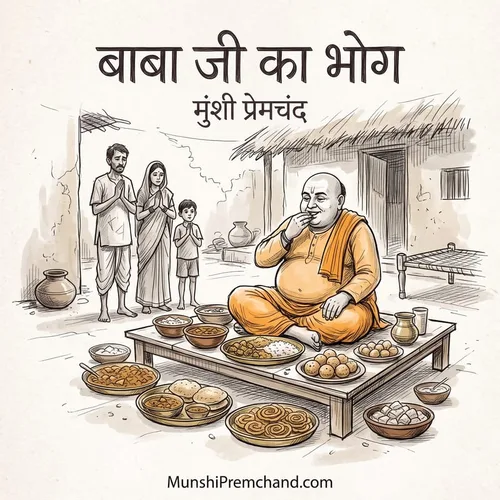
Complete English Translation: Babaji Ka Bhog
A sadhu arrived at the doorstep of Ramdhan Ahir and called out: "Child, may blessings be upon you! Show some pious reverence toward a holy man!"
Ramdhan went inside and said to his wife, "A sadhu has come to our door; give him something."
His wife was scouring the cooking pots, deeply immersed in the agonizing worry of what on earth could be prepared for food that day—there was not a single grain of cereal in the house. It was the harvest month of Chait, yet here, darkness had descended in broad daylight. The entire harvest had been swept straight from the threshing floor. Half of it had been seized by the moneylender; the other half had been confiscated by the landlord's bailiffs. When the fodder was sold, they barely managed to rid themselves of the debt owed to the cattle-dealer; only a meager pile of leftover stalks fell to their share. By beating and threshing that, they had managed to extract barely a single maund of grain. Somehow, the month of Chait had been endured. But what would happen ahead? What would the bullocks eat? What would the human souls in the house eat? God alone knew! Yet a holy ascetic had arrived at the doorway—how could he be turned away empty-handed? What would he think in his heart?
The wife said, "What am I to give? Nothing is left at all!"
Ramdhan: "Go, look inside the earthen jars; if you can find some flour or something, bring it out."
The wife said, "The jars were scraped clean only yesterday just to light the hearth! Is food going to miraculously sprout inside them?"
Ramdhan: "Well, I cannot bring myself to tell the holy father that there is nothing in the house. Go ask for a loan of some from a neighbor's house."
The wife: "We haven't yet reached a position to repay what we already borrowed from others; with what face can I go begging for more?"
Ramdhan: "You set aside a small sacred offering for the gods, didn't you? Bring that, let me give it to him!"
The wife: "Then how will the worship of the household gods be performed?"
Ramdhan: "The gods don't come begging at the door! If we have the means, we will perform the worship; if we don't have the means, we won't."
The wife: "Oh, and is that sacred offering a whole measure or two? At most it would be half a seer. And after this, will no other sadhu ever come? We will have to refuse the next one anyway!"
Ramdhan: "Let this immediate trouble pass for now; whatever comes next will be seen to."
Exasperated, the wife rose and brought out a tiny earthen pot containing barely half a seer of flour. That wheat flour had been preserved with immense care and devotion for the gods. Ramdhan stood hesitating for a moment, thinking; then, placing the flour into a bowl, he stepped outside and poured it into the sadhu's begging sack.
Receiving the flour, the holy man remarked, "Child, now this sadhu shall dwell right here today. Give a little pulse as well, so that the sadhu's sacred offering may be prepared."
Ramdhan went inside once again and told his wife. By good fortune, there was a little lentil pulse left in the house. Ramdhan supplied the lentils, salt, and cow-dung fuel cakes. Then he went to the village well and drew water. The sadhu, following elaborate ritual methods, fashioned thick roasted dough-balls (baatis), boiled the lentils, and, extracting potatoes from his own sack, prepared a savory mash. When all the provisions were ready, he called out to Ramdhan: "Child, a tiny measure of clarified butter (ghee) is required for the Lord's holy offering. If the cooking is not sanctified with ghee, how can it be offered as bhog to the Deity?"
Ramdhan: "Babaji, there is surely no ghee in our house."
The sadhu: "Child, the Lord has bestowed plenty upon you! Do not utter such untruths."
Ramdhan: "Maharaj, I possess neither cow nor buffalo; from where could ghee possibly come?"
The sadhu: "Child, in God's great storehouse, everything exists! Go and ask the mistress of the house, will you?"
Ramdhan went inside and told his wife, "Now he is demanding ghee! He comes begging for alms, yet without ghee not a single morsel will go down his throat!"
The wife replied: "Then take a little of this leftover lentil, run to the shopkeeper, and fetch some ghee with it. When we have done so much already, why displease him over this little thing?"
The ghee was brought. The revered sadhu took out his sacred stone emblem of the Lord (Thakurji's pindi), rang his ritual bell, and sat down to make the holy offering. He ate ravenously, stuffing his belly to the brim, and then, stroking his round stomach with immense satisfaction, stretched himself out at the doorway to sleep. Ramdhan gathered the brass plate, the cooking bowl, and the ladle, and carried them inside for his wife to scour and wash.
That night, no cooking fire was lit in Ramdhan's house. They merely boiled the remaining plain lentils and drank the watery broth.
As Ramdhan lay down upon his cot, he thought to himself: "He is far better off than me!"
Summary of Babaji Ka Bhog
Babaji Ka Bhog by Munshi Premchand is an acutely penetrating, satirical short story that exposes rural exploitation, crushing agrarian poverty, and the parasitic demands levied upon destitute peasants under the guise of religious devotion. Set during the post-harvest month of Chait, the story portrays the hopeless plight of Ramdhan Ahir. Despite toiling all season, his grain harvest has been entirely seized at the threshing floor by the extortionate moneylender and the landlord's ruthless bailiffs. He and his wife face immediate starvation.
At this desperate juncture, an itinerant Hindu ascetic (sadhu) appears at their door, demanding food in the name of holy merit. Terrified of bringing down divine curses and facing the social ignominy of turning away an ascetic, Ramdhan compels his wife to surrender the tiny reserve of wheat flour painstakingly kept aside as an offering to the gods. The sadhu, however, continuously escalates his demands: he asks for lentils, salt, fuel cakes, and fresh well-water to cook his meal on their premises. Finally, when the food is cooked, he insists that the offering cannot be consecrated to God without pure clarified butter (ghee). Ramdhan's wife is forced to barter part of their remaining pulse with the village bania to purchase the ghee.
The sadhu consecrates the food to his deity, gorges himself to full satiety, and sprawls luxuriously at their doorway to sleep. Meanwhile, inside the cottage, no cooking fire can be lit; Ramdhan and his wife survive by drinking watery boiled lentils. In the unforgettable, bitterly ironic climax, Ramdhan lies awake on his cot and reflects on the stark reversal of reality: "He is far better off than me!"
Publication History
Babaji Ka Bhog was written by Munshi Premchand and originally published in Hindi in 1926. It was later collected in Mansarovar, Volume 3 (मानसरोवर भाग 3), where it stands as one of Premchand's most celebrated and incisive satirical miniatures on the social and economic contradictions of rural colonial India.
This unabridged English translation was published in 2026 by MunshiPremchand.com as part of the MunshiPremchand.com English Translation Series.
Themes & Critical Significance
- Religious Parasitism and False Piety: The story delivers an unsparing critique of mendicants who manipulate spiritual authority to extort material luxuries from the vulnerable. The term Bhog (divine offering) is drenched in irony, as the primary beneficiary of the ritual is not God, but the gluttonous ascetic.
- The Grinding Agony of Agrarian Debt: Premchand situates the religious extortion against the broader structural violence of colonial Indian agriculture. The moneylender, the zamindar's bailiffs, and the cattle merchant have already stripped Ramdhan bare; the holy man merely extracts the very last crumb left in the house.
- Superstition and Social Coercion: Ramdhan's compliance does not stem from joyful charity, but from deeply ingrained fear—fear of spiritual demerit (paap) and dread of village judgment. Premchand demonstrates how religious guilt is weaponized against the powerless.
- Pragmatism versus Ritual Duty: The interaction between Ramdhan and his wife highlights gendered perspectives on survival. The wife realistically assesses the empty grain jars, yet even her practical wisdom is ultimately overridden by the overwhelming weight of religious custom.
- The Bittersweet Satirical Reversal: The final sentence—"He is far better off than me!"—crystallizes the story's poignant irony. The supposed beggar enjoys a feast of hot baatis, lentils, and pure ghee before resting carefree, while the hard-working peasant who fed him starves in silence.