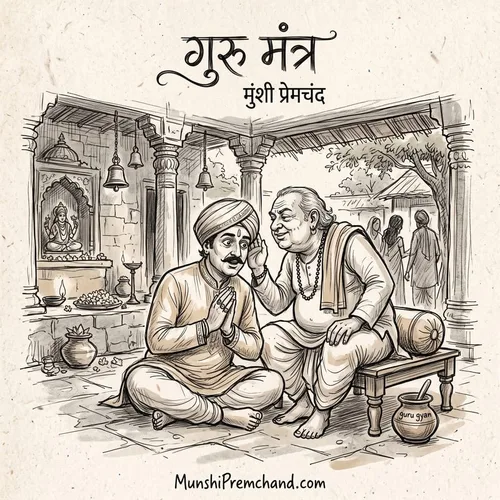
Complete English Translation: Guru Mantra (The Sacred Formula)
When, exhausted by domestic quarrels and depressed by a complete absence of feast invitations, a sudden wave of holy renunciation awakened in the heart of Pandit Chintamaniji and he resolved to take the vows of sannyasa, his bosom comrade Pandit Moteram Shastriji offered him this sage counsel:
"My friend, I have enjoyed close fellowship with the finest sadhus and holy mahatmas of the realm. When such great souls arrive at the threshold of a respectable householder, they do not cringe and stretch out their palms like common beggars, nor do they start showering bogus blessings like: 'May Lord Narayana preserve thy earthly cloak in joyous intoxication; mayest thou ever be happy!'
That is the wretched habit of street mendicants. True saints, the moment they reach the door, unleash a thunderous roar that startles the entire household out of their wits and sends them scurrying toward the entrance with trembling eagerness!
I happen to know three or four classic holy utterances—choose whichever takes your fancy!
Gudri Baba used to roar: 'If we die, let all five perish together!' The moment householders heard that terrifying war-cry, they would prostrate themselves before his holy feet.
Siddha Baba's cry was exceptionally magnificent: 'Eat, drink, revel in luxury, deck yourselves in gold; but ever tremble before Baba's heavy wooden cudgel!'
Nanga Baba used to demand: 'Give if thou wilt; if not, have others give! Feed me, drench me, put me to sleep!'
Bear this firmly in mind: the respect and royal hospitality you command will depend almost entirely upon the terror of your holy shout! What more can I say? Do not forget me. You and I have lived together for many long years; we have polished off hundreds of feasts side by side. Whenever an invitation arrived and the two of us showed up together, our competitive rivalry would ensure that we polished off at least two extra leaf-plates each! Without you, my colorful sparkle will be extinguished. May God ever place fragrant, ghee-drenched delicacies before your sight!"
Chintamani did not care for a single one of these traditional slogans. He said, "Devise a brand-new utterance tailored specially for me!"
Moteram pondered, "Well, how does this sound: 'If thou wilt not give, we shall perch upon thy neck!'"
Chintamani beamed, "Yes! I like that immensely. With your kind permission, may I trim and polish it slightly?"
Moteram said, "By all means, do so!"
Chintamani said, "Listen: let us phrase it thus—'If thou wilt not give, we shall perch upon thy head!'"
Moteram leaped into the air with delight: "Lord Narayana is my witness—this utterance is completely unique in its majestic flavor! Devotion has illuminated your intellect! Come, unleash it once at the top of your lungs, let us hear how you deliver it!"
Pandit Chintamani plugged both his ears tightly with his fingers, took a colossal breath, and screamed with all his might: "IF THOU WILT NOT GIVE, I SHALL PERCH UPON THY HEAD!"
This sonic blast was so earth-shattering that even Moteram jumped in terror! Bats flew screeching out of the surrounding trees in panic; stray dogs began barking furiously down the street!
Moteram cried, "My friend! Hearing that roar, my very liver began to tremble! Such a terrifying bellow was never heard before upon this earth; you roar like a man-eating lion!
The holy slogan is settled; now listen carefully while I explain a few other crucial secrets. The speech of holy sadhus is entirely different from our ordinary worldly dialect. In everyday life, we address one person with polite honorifics like Aap, and another as Tum. But sadhus address everyone—high and low, rich and poor, old and young—strictly as the informal Tu!
Moreover, keep up the regular practice of addressing people as Mai (Mother) and Baba (Father). And remember this above all: never speak plain, correct, standard Hindi! Otherwise, your secret will be blown wide open! Always speak crooked, ungrammatical Hindi. Saying politely: 'Mother, please give me something to eat' is completely inappropriate in the language of holy mendicants. A seasoned, authentic sadhu will phrase the exact same demand thus: 'Mai, thou feedest mine stomach with food, and great religious merit shall accrue unto thee!'"
Chintamani nodded enthusiastically, practicing the new grammar on the spot: "Friend, how far can I sing praises of thee? Thou hast performed a great service unto me!"
Having imparted this sacred initiation (Guru Mantra), Moteram took his leave.
Pandit Chintamaniji marched forward into the world. After walking a short distance, what did he behold? Outside a shop selling ganja and bhang, several dreadlocked, ash-smeared holy mahatmas were sitting in a circle, drawing deep puffs from their clay pipes of cannabis.
Catching sight of Chintamani, one mahatma chanted his sacred cry: "Move along, move along, bring it quick and fine, or I shall drive this restless soul out of its mind!"
A second sadhu thundered: "A-ra-ra-ra-dham! We have arrived at last, so what sorrow can last?"
While this crackling roar was still echoing through the sky, a third holy man bellowed his slogan: "The land of Bengal, never seen nor known; fill up the cup right away, before thy peace has flown!"
Chintamani could restrain himself no longer. Puffing out his chest, he roared his newly coined slogan with all his might: "IF THOU WILT NOT GIVE, I SHALL PERCH UPON THY HEAD!"
The moment they heard this majestic cry, the holy ascetics welcomed Chintamani with deep reverence. Immediately, a clay chillum was packed to the brim with potent ganja, and the high honor of lighting and smoking the first puff fell upon Panditji!
The poor Brahmin was thrown into a terrifying dilemma! He thought to himself: If I refuse the pipe, my disguise will be exposed this very second!
Resigned to his fate, he took hold of the glowing clay pipe. But a man who has never touched ganja in his entire life cannot take a proper puff, no matter how desperately he exerts himself.
Chintamani screwed his eyes shut, pressed the cloth-wrapped base of the pipe to his lips, and sucked with all the might of his lungs.
Disaster struck!
The glowing chillum slipped from his trembling hands and shattered on the ground. His eyeballs bulged out of their sockets, his face turned purple, saliva and froth spewed uncontrollably from his gaping mouth—yet neither did a cloud of smoke emerge, nor did the cannabis catch fire!
This catastrophic incompetence was more than enough to expel him from the fellowship of holy saints on the spot.
Two or three furious ascetics lunged forward, grabbed him roughly by the scruff of his neck, and hoisted him to his feet.
One mahatma snarled, "A curse upon thee!"
Another mahatma sneered, "Hast thou no shame? Thou hast dressed thyself as a sadhu, thou utter blockhead!"
Thoroughly humiliated and trembling, Panditji slunk away and took refuge sitting upon the curb outside a nearby sweetmeat vendor's shop.
Meanwhile, the holy assembly of ascetics picked up their tambourines (khanjari), rhythmically striking them as they burst into a pious devotional hymn:
"The world is mere illusion, O Dark Lord, the world is mere illusion!
Righteousness and sin are nothing but a lie—such is worldly wisdom;
O Dark Lord, the world is mere illusion!Those who dare prohibit ganja and bhang—a curse upon their heads!
O Dark Lord, the world is mere illusion!"
Summary of Guru Mantra (The Sacred Formula)
Guru Mantra ("The Sacred Formula") is one of Munshi Premchand's most hilarious and sharply focused satirical short stories, offering a biting critique of commercialized religion, performative asceticism, and the counterfeit holiness that flourishes on social credulity.
The story unfolds through three tightly constructed comic episodes:
- The Motivation for Renunciation: Pandit Chintamani resolves to renounce household life and become a wandering sadhu (sannyasi), not out of genuine spiritual awakening, but out of domestic frustration and a severe shortage of invitations to free Brahmin feasts.
- The "Guru Mantra" of Mendicancy: His gluttonous comrade, Pandit Moteram Shastri—a master of religious posturing—acts as his preceptor. Moteram explains that successful sadhus never beg meekly; they roar intimidating slogans designed to shock householders into surrender. Together, they invent a fearsome custom cry: "If thou wilt not give, we shall perch upon thy head!" Moteram further coaches him in "sadhu grammar"—eschewing polite Hindi to address everyone as tu, while adopting distorted, aggressive phrasing to establish spiritual authority.
- The Test of Fire (The Cannabis Chillum): Clad in ascetic robes, Chintamani encounters a band of dreadlocked sadhus smoking outside a cannabis shop. He roars his new slogan, earning their instant admiration. However, when handed the ceremonial clay pipe (chillum) of ganja, Chintamani's fraud is instantly unmasked. Having never smoked in his life, he chokes, drops the pipe, rolls his eyes, and spews foam. The ascetics violently eject him into the street as an incompetent impostor. The satire culminates as the rejected Chintamani sits humiliated outside a sweet shop, while the cannabis-smoking ascetics play their tambourines and sing a pious devotional song proclaiming that the world is an illusion and that anyone who forbids ganja is cursed.
Publication History
Guru Mantra ("The Sacred Formula") was written by Munshi Premchand in 1926 and was published in leading Hindi literary periodicals before being collected in Part 3 of his authoritative anthology Mansarovar (मानसरोवर, भाग 3).
At approximately 890 words in its original Hindi text, it stands among Premchand's most concise and potent satirical miniatures, frequently cited by literary scholars as a prime example of his sharp critique of priestly parasitism, religious hypocrisy, and the commercial exploitation of faith.
This unabridged English translation was published in 2026 by MunshiPremchand.com as part of the MunshiPremchand.com English Translation Series.
Themes & Critical Significance
1. Performative Religion vs. True Spirituality
The central target of Premchand's satire is the theatrical nature of institutionalized asceticism. Chintamani and Moteram demonstrate that becoming a "holy man" in society requires no moral virtue, philosophical contemplation, or self-restraint; it requires only a costume, a terrifying shout (haank), and a specialized dialect designed to bully superstitious householders into providing free food and money.
2. The Inversion of the "Guru Mantra"
In Indian spiritual tradition, a Guru Mantra is a sacred formula whispered by an enlightened master to liberate the disciple's soul. In Premchand's hands, the title is deployed with razor-sharp irony: Moteram's "mantra" is a coercive marketing technique for extracting bread without labor. True spirituality is replaced by professional scamming.
3. The Absurd Standards of Counterfeit Communities
The comedy of the story reaches its philosophical peak in the ascetics' rejection of Chintamani. He is not rejected because he lacks wisdom, purity, or spiritual discipline; he is thrown out solely because he cannot inhale ganja! The counterfeit sadhu community judges authenticity through shared vices rather than virtues.
4. The Irony of Sacred Language and Worldly Hypocrisy
The closing hymn encapsulates Premchand's critique of religious cynicism. The ascetics sing about the world being Maya (illusion) and declare righteousness and unrighteousness (dharma-adharma) to be meaningless, yet their entire existence revolves around securing intoxicants and extorting food from the very material world they dismiss. Religious philosophy is used not to transcend worldly desire, but to license unrestrained self-indulgence.