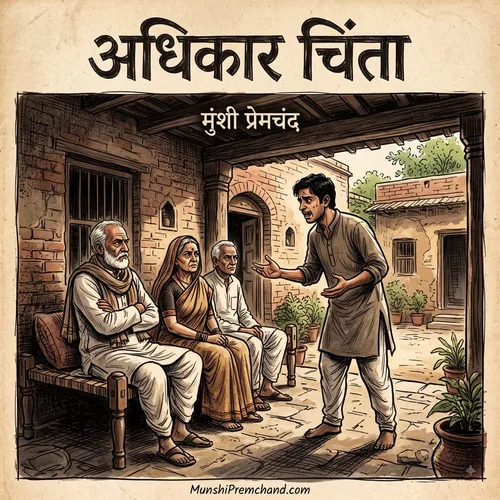
Complete English Translation: Adhikar-Chinta (The Burden of Authority)
1
Tommy had never known what sorrow was in his entire life. In his childhood, his mother's maternal affection had enveloped him in sweet slumber; as he grew into youth, the fortune of entering the bungalow of an English Sahib smiled upon him.
The Master was a solitary bachelor, without a family. He had concentrated his entire store of love upon Tommy. Day and night, Tommy remained pressed to his bosom; he sat beside him in the motorcar, slept in his bed, and shared his breakfast. He had never even tasted the bread of coarse grains. In the morning, milk and double-roti (toast); in the afternoon, chicken broth and roasted mutton; in the evening, cakes and tea; and at night, minced meat stew with biscuits. Where could such heavenly luxury be found even by mortal men!
A bearer remained in his service round the clock, giving him a bath with sweet-smelling soap each morning, brushing his silken coat, and tying a scarlet silken ribbon around his slender neck. Tommy would strut proudly, puffed up with vanity, while the neighborhood mongrels watched him from afar with envious, covetous eyes and lamented their wretched lot. Whenever Tommy accompanied his Master for an evening stroll, the street dogs would gaze upon his silken, pampered majesty and heave deep sighs: Ah, if only fate had granted us such fortune! He walks like a reigning prince! What exquisite grace, what regal majesty!
Tommy looked down upon every dog of his kind with boundless contempt. The poor wretches possessed neither grace nor beauty, neither civilized etiquette nor refined breeding. Starved of food, their ribs jutted out like cages; infested with sores and filth, their skins looked repulsive. Whenever Tommy barked at them in aristocratic disdain, they would tuck their tails between their legs and scatter in sheer terror. Tommy considered himself far above ordinary dogs—perhaps only a notch below human beings, or even on par with them.
Summer arrived. The Sahib departed for the cool heights of the hills. By some misfortune, he forgot to take Tommy along, leaving him in the care of the bearer.
Once the Master departed, the bearer threw off all restraint. The lavish feasts of butter, minced meat, and roast chicken were cut off; Tommy was now offered dry, stale remnants of daily food. The servant would pocket Tommy's food allowance and squander it on drinking liquor and gambling. Bathing and brushing ceased altogether.
Tommy, accustomed to pampered luxury, took this humiliation deeply to heart. He refused to touch the coarse crumbs thrown before him. For two or three days, he starved in aristocratic protest; but when the agony of hunger gnawed at his belly, he was forced to step out into the streets to scavenge.
Having set foot upon the streets, Tommy encountered the harsh realities of common life. He had never roamed the alleys before. Whenever he ventured near a doorstep or shop, the street dogs attacked him like a swarm of hornets. Tommy was soft, plump, and thoroughly unaccustomed to physical combat. He fled in terror, bruised and bleeding, saving his life by the skin of his teeth.
Disheartened and outcast in his own city, he wandered toward the riverbank.
It was the month of Jeth (midsummer). The river had shrunk into a narrow, gentle stream. Tommy waded across the shallow water and stepped onto the opposite bank.
There lay vast, open ravines, thorny shrubs, and quiet fields. It was an entirely different world, untamed and free. A local pack of wild village dogs inhabited this wilderness. When they spotted a pampered, urban dog trespassing upon their sovereign soil, they sprang forward with furious snarling, teeth bared, ready to tear the intruder to ribbons.
In the city, Tommy had fled because he knew safety lay back in his bungalow. But here, the wide river cut him off behind, while snarling fangs surrounded him in front. There was nowhere to run. A cornered animal finds courage born of sheer desperation. As the adage goes—when death stares you in the face, even a coward fights like a lion.
Tommy stood his ground, raised his hackles, and let out a bloodcurdling roar. He threw himself upon the pack leader with the fury of a demon. He sank his sharp teeth into the leader's neck and pinned him to the earth with crushing weight. Seeing their chieftain pinned and howling in agony, the rest of the pack recoiled in horror. The leader yielded, whimpering for mercy. Tommy released him, climbed atop a high mound of earth, and declared his supreme sovereignty over the entire territory!
The local dogs, utterly vanquished by his ferocity and commanding stature, bowed their heads in submission. Tommy became the undisputed master of the northern realm.
His physical needs were minimal, yet every morning and evening, the subject dogs brought him tributes of scavenged bones, discarded offal, and choice scraps. Sitting upon his earthen throne, Tommy accepted their feudal tithes with regal aloofness. He lived like an absolute monarch, feasting at his pleasure, surrounded by obsequious courtiers who barked choruses in his praise.
2
Yet, supreme power brings along a terrible curse—the burden of authority (adhikar-chinta).
So long as Tommy had been a humble pet, he slept without a care in the world. But now that he was the supreme lord of a sovereign kingdom, peace deserted him forever. He was tormented day and night by the obsessive anxiety of preserving his throne.
Every rustling leaf made him leap up in suspicion. Could a rival faction be plotting a revolt? Could the southern packs across the river launch a surprise invasion to overthrow him? Could his own subjects be conspiring against him behind his back?
When a ruler seizes power by force, he trusts no one. Tommy became a prisoner of his own crown.
He could no longer sleep for two consecutive hours. The slightest whisper in the tall grass roused him into a barking frenzy. If two dogs sat together in the shade of a bush, Tommy imagined they were whispering seditious plots. He would charge at them, snap viciously, and drive them apart. If a young, robust hound ran with high spirits, Tommy suspected him of training for a coup d'état.
He abolished gatherings, forbade long conversations among his subjects, and demanded absolute, abject submission at all hours. He ceased taking leisurely strolls; every step was now an armed inspection of borders. He neglected his food, abandoned all joy, and wore himself out with endless patrolling along the riverbanks.
His subjects, who had once respected his prowess, grew terrified of his tyrannical paranoia. Where once there had been genuine loyalty, now only sullen silence and simmering hatred remained. The dogs whispered among themselves: What kind of ruler have we brought upon our heads? He neither rests himself nor allows anyone else to live in peace!
Within six short months, Tommy's magnificent, silken physique was unrecognizable. His pampered flesh melted away; his glowing eyes became bloodshot and sunken with feverish vigilance; his ribs protruded sharply through his unbrushed skin; and his luxurious fur grew patchy and dust-caked. He was consumed, bone and marrow, by the unrelenting fire of authority.
One day, his old Master returned from the hills. Remembering his beloved dog, the Sahib sent the servant to scour the city. After much searching, the bearer heard rumors of a strange dog reigning as king in the wilderness across the river. He took a boat, crossed over, and recognized Tommy huddled upon a barren mound.
"Tommy! Tommy! Come here, boy!" the servant called out cheerfully.
Tommy opened his heavy, weary eyes. He recognized the familiar voice of his Master's house. For an instant, a spark of longing flickered in his breast—the memories of velvet cushions, warm milk, roast chicken, and the tender caresses of his Master. But then he looked down upon the vast riverbank and his subject pack standing at a distance.
If I leave this kingdom, who will rule here? he thought in a grip of mad vanity. All this sovereign earth belongs to me! If I return to the bungalow, I will be a mere pet, a pampered slave living on crumbs of pity. Here, I am King!
Tommy turned his face away, let out a harsh, rasping bark, and refused to move an inch. The servant, bewildered, returned empty-handed.
Winter passed, and summer returned once more. The fierce loo winds began to howl across the sandy plains. The burden of vigilance had shattered Tommy's mind and body completely. He could neither eat nor drink; he spent his days pacing restlessly, raving and snapping at shadows, his body burning with the fever of supreme paranoia.
One sweltering afternoon, exhausted by sleepless nights, Tommy collapsed beneath a thorn bush. His breath came in ragged, wheezing gasps. He tried to rise, to patrol the perimeter one last time, but his stiffened limbs refused to obey.
Seeing the tyrant helpless on the ground, the very subjects he had bullied and mistrusted gathered in a silent circle around him. There was no grief in their eyes, no tears for the fallen king—only cold detachment and relief that the reign of madness was drawing to a close.
Tommy fixed his glazed eyes upon them. To the very last breath, his dying heart was wracked not by physical pain, but by the agonizing terror of losing his realm: Who will guard the border? Who will sit upon my throne?
With that final shudder of anxiety, the great conqueror breathed his last. Authority had granted him a crown, but it had devoured his life.
Summary of Adhikar-Chinta
'Adhikar-Chinta' (The Burden of Authority) is a brilliant satirical fable by Munshi Premchand that uses an animal allegory to explore the psychological decay brought about by political power, territorial conquest, and autocratic governance.
The story traces the transformation of Tommy, an aristocratic, pampered dog belonging to a wealthy English official. Accustomed to silk ribbons, scented baths, roasted meat, and comfortable beds, Tommy views ordinary street dogs with extreme contempt. However, when his master leaves for the hills, the neglected Tommy faces starvation and is forced into the streets, where he is attacked by local packs. Crossing the river into wild territory, Tommy is cornered by native dogs. Spurred by desperation, he defeats their chieftain and establishes himself as the undisputed monarch of the northern territory.
Yet, sovereign power quickly turns into a living nightmare. Consumed by the paranoia of rebellion, foreign invasion, and assassination, Tommy loses all peace of mind. He stops sleeping, bans social gatherings among his subjects, patrols the riverbanks incessantly, and views every whisper as treason. When offered a chance to return to his luxurious life in the city, he refuses out of imperial vanity. The endless mental strain, sleeplessness, and chronic anxiety wreck his health, reducing the once-luxurious pet to a withered, feverish skeleton. Ultimately, Tommy dies an agonizing, lonely death under a bush, unmourned by his subjects, with his dying breath still trapped in the futile dread of losing his authority.
Publication History
'Adhikar-Chinta' was written by Munshi Premchand during the late 1920s—a period when India was witnessing intense debates over colonial authoritarianism, imperial arrogance, and the hollow vanity of absolute political control. The story was first published in contemporary literary journals before being collected in the classic anthology Mansarovar (Vol. 1).
This unabridged English translation was published in 2026 by MunshiPremchand.com as part of the MunshiPremchand.com English Translation Series.
Themes & Critical Significance
- The Paranoia and Tragedy of Absolute Power: The core theme of the story is how authority (adhikar) inevitably breeds suspicion, alienation, and terror. Tommy’s trajectory illustrates that despotic rulers do not own power; power owns them, transforming them into nervous wrecks who cannot trust a single companion.
- Satire on Imperialism and Colonial Governance: Through Tommy’s foreign invasion, forceful subjugation of native dogs, and subsequent policing of borders, Premchand offers a stinging satirical commentary on the British Raj and imperial powers who rule conquered lands through brute force and live in perpetual dread of native uprising.
- The Loss of Freedom in Luxury and Vanity: Tommy’s rejection of his comfortable bungalow life to retain an agonizing kingship exposes the human folly of ego. Man often sacrifices genuine happiness, health, and liberty for the hollow illusion of prestige and dominance.
- Psychological Realism in Allegorical Form: While framed as an animal fable reminiscent of the Panchatantra, the story operates with modern psychological acuity, dissecting the precise symptoms of authoritarian anxiety, sleeplessness, and emotional isolation.