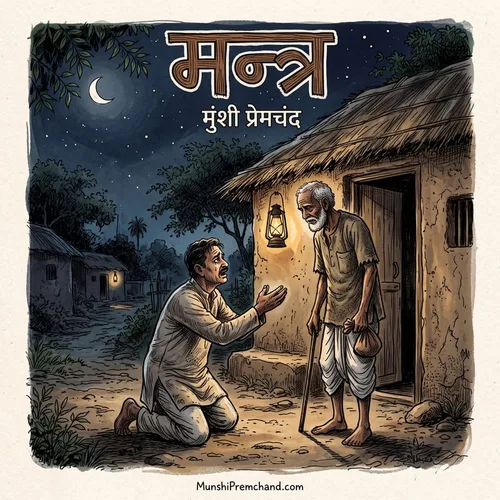
Complete English Translation: Mantra (The Sacred Incantation)
1
There was magic in Pandit Leeladhar Choube's tongue. The moment he mounted the speaker's dais and began raining down the nectar of his eloquence, the souls of his listeners were enraptured; a warm intoxication of devotion swept over the assembly. In Choube-ji's orations, philosophical substance was scant, and his choice of vocabulary was far from elegant; yet, despite frequent repetition, its hypnotic spell never waned—indeed, like successive sledgehammer blows, each delivery grew only more striking and persuasive. We ourselves find it hard to credit, but those who listened declared that he had memorized merely one single standard speech, which he recited word-for-word at every gathering with an artful air of novelty.
Singing the praises of racial and communal glory was the cardinal virtue of his lectures. Stepping onto the stage, he would strike the melodious chord of India's ancient splendor and the immortal renown of our ancestors, leaving the audience spellbound. For instance:
"Gentlemen! Whose eyes would not brim with a torrent of weeping upon hearing the tragic chronicle of our present degradation? Recalling our pristine glory, we begin to doubt whether we are truly the descendants of those titans or whether our very nature has changed! The man who wrestled bare-handed with lions yesterday now scurries about in search of a rat-hole at the sight of a mouse! Even decline must have its limits! Why look far afield? Take only the golden age of Emperor Chandragupta! The wise historians of ancient Greece record that in those days, locks were never hung upon doors; theft was unheard of in the land; of adultery there remained not a trace; legal deeds and mortgage contracts had not even been invented—transactions of millions were settled on scraps of paper; and officials seated upon the bench of justice idled away their hours swatting flies! Gentlemen! In those glorious days, no man ever died in the flower of his youth! (Applause) Yes, in those days, no young man ever perished! The demise of a son before his father's eyes was an unprecedented—an impossible—calamity! Today, how many parents are there whose hearts do not bear the searing brand of a deceased young son? That India exists no longer; India has been reduced to dust and ruin!"
Such was Choube-ji's signature oratorical style. By harping upon the miseries and degradation of the present while painting the prosperity and virtue of the ancient past, he awakened communal pride among the populace. Thanks to this singular accomplishment, he was counted among the prominent leaders of the day. In particular, he was hailed as the supreme pilot and guiding helm of the Hindu-Sabha. Among all the devotees of the Sabha, there was no other worker so enthusiastic, so dexterous, and so politically astute. One might well say that he had dedicated his entire life to the organization. Wealth he had none—or at least such was public opinion; but he possessed priceless gems in the form of courage, patience, and intellect, and all these were surrendered at the altar of the Sabha.
He was, in truth, the very breath and soul of the Shuddhi (reconversion) movement. In his conviction, the rise or fall, life or death of the Hindu nation rested entirely upon this single pivotal question. Apart from Shuddhi, there existed no other remedy for the resurrection of the Hindu race. The cure for all the moral, physical, mental, social, economic, and religious afflictions of the community was circumscribed within the triumph of this crusade; and to this end he laboured with all his body and soul.
In the art of extracting public donations, Choube-ji was a master wizard. Providence had bestowed upon him that miraculous knack whereby he could wring oil out of stone! As for miserly patrons, he shaved them with such a blunt razor that those venerable gentlemen received an unforgettable lesson for the rest of their days! In this noble pursuit, Pandit-ji deployed all four classical stratagems of statecraft—conciliation, bribery, punishment, and division—going so far as to regard even robbery and theft as entirely pardonable when committed for the national welfare!
2
It was the height of summer. Leeladhar-ji was making elaborate preparations to depart for some cool hill-station, reasoning that he would enjoy a pleasant vacation and, if opportunity served, collect handsome donations along the way. Whenever the wanderlust seized him, he would set out with a company of friends under the guise of an official delegation. If, after collecting a thousand rupees in donations, he squandered half that sum on lavish sightseeing and pleasures, who suffered any loss? After all, the Hindu-Sabha invariably received something! Had he not undertaken the exertion, even that much would never have entered the coffers!
This time, Pandit-ji had resolved to take his entire family along. Ever since the advent of the Shuddhi movement, his personal financial situation, which had previously been pitifully precarious, had stabilized considerably.
Yet where do the consecrated servants of the nation possess the good fortune to savor the tranquil delights of a quiet sanctuary? Their very birth is destined for endless, restless wanderings! News arrived that rival conversion missionaries (Tableegh) had unleashed a storm in the Madras province. Entire villages of Hindus were converting. The preachers had launched their campaign with fierce zeal; if the Hindu-Sabha did not organize an immediate counter-offensive to stem the tide, the entire province would be emptied of Hindus—not a single tufted head (shikhadhari) would remain visible in the land!
Consternation broke out in the Hindu-Sabha. A special emergency session was summoned at once, and the crisis was laid before the leadership. After prolonged deliberation, it was resolved that the immense burden of this mission should be laid upon Choube-ji's shoulders. He was earnestly petitioned to depart for Madras without a moment's delay and rescue their estranged brethren.
The plea had only to be voiced. Choube-ji had already dedicated himself to the service of the community; he shelved all thoughts of mountain excursions and braced himself for the southern expedition. The General Secretary of the Hindu-Sabha, eyes brimming with tears, implored him: "Maharaj, you alone can steer this ship across! Providence has endowed you alone with such supreme prowess. Outside of you, there breathes no man in all of Bharatvarsha capable of rising to this dreadful crisis. Have mercy on the pitiable plight of our community!"
Choube-ji could not reject such supplication. A disciplined contingent of volunteer workers was mobilized immediately and set out under Pandit-ji's leadership. The Hindu-Sabha hosted a grand, lavish farewell banquet in their honor. A generous nobleman presented Choube-ji with a heavy purse of cash, and thousands gathered at the railway terminus to bid them a triumphant farewell.
There is no need to detail the chronicle of the journey. At every major railway station, the volunteers received an ovation of honor. At several stops, purses of silver were presented. The princely state of Ratlam gifted an enormous ceremonial marquee (shamiana). Baroda donated an automobile so that the volunteers might be spared the hardship of traveling on foot; so that by the time they reached Madras, the mission had amassed, in addition to a handsome treasury, an abundance of every conceivable luxury.
Far from the bustling town, out in an expansive open field, the Hindu-Sabha established its encampment. The national banner fluttered proudly atop the great marquee. The volunteers don their crisp uniforms, local wealthy merchants dispatched wagonloads of rich foodstuffs, and luxurious tents were pitched. All around, such festive brilliance unfolded that the place resembled the royal encampment of an emperor!
3
It was eight o'clock at night. Close to an untouchable settlement, the encampment of the volunteer corps blazed with the bright illumination of gas lamps. A crowd of several thousand people had assembled, of whom the vast majority were the local outcasts. Rough jute mats had been spread out for them to sit upon; high-caste Hindus reclined upon rich, ornate carpets.
Pandit Leeladhar was delivering a fiery, thunderous oration:
"You are the flesh and blood of those very ancient sages who possessed the spiritual power to forge a new cosmos beneath the heavens! Sages before whose justice, intellect, and profound wisdom the entire civilized world bows its head in reverence today!"
Suddenly, an elderly untouchable rose from the rough matting and asked, "Are we too the descendants of those ancient sages?"
Leeladhar declared, "Without a shadow of doubt! The blood of those very sages courses through your veins! And though today's callous, rigid, unthinking, and narrow-minded Hindu society regards you with eyes of neglect, nevertheless you are inferior to no Hindu, no matter how elevated he may deem himself!"
The old man asked, "Then why does your society never care for our plight?"
Leeladhar replied, "The Hindu-Sabha was born only a short while ago, and for the achievements it has accomplished in this brief span, it may well take immense pride! The Hindu race has awakened from centuries of deep slumber, and the hour is close at hand when no Hindu throughout Bharatvarsha will look down upon another as low, when all shall embrace one another as brothers! Lord Ramachandra drew the low-born Nishada to His breast; He feasted on the tasted wild berries of Shabari..."
The old man interrupted, "If you are the offspring of those noble souls, then why do you maintain such rigid barriers between high and low?"
Leeladhar replied, "Because we have fallen into degeneracy—blinded by ignorance, we forgot the noble teachings of those masters."
The old man asked, "Now that your slumber is broken, will you sit and share a meal with us?"
Leeladhar hesitated: "I have no objection to that."
The old man asked, "Will you marry your daughter to my son?"
Leeladhar stammered, "Until your ancestral practices undergo refinement, until your diet and daily habits are transformed, we cannot enter into matrimonial alliances with you! Abandon eating meat, forsake drinking liquor, acquire education—only then can you merge with high-caste Hindus!"
The old man retorted with cutting clarity: "We know countless high-born Brahmins who remain drenched in liquor night and day, who refuse to touch a morsel of food without meat; and we know scores who cannot read a single letter of the alphabet! Yet I see you dining freely in their company! You would scarcely hesitate to marry your daughters to them! When you yourselves remain mired in ignorance, how can you presume to deliver us? Your heart is still brimming with arrogant conceit! Go, spend a few more days refining your own soul! Our salvation will never be achieved through your hands! Remaining inside Hindu society, the stigma of untouchability will never be wiped from our brows. No matter how learned, no matter how virtuous we become, you will persist in treating us as degraded outcasts. The soul of the Hindus has perished, and in its place sits naked arrogance! We are now taking shelter under masters whose followers stand ready to embrace us with open arms this very day! They do not demand that we change our habits before coming. Whether we are good or bad, they summon us into their fold exactly as we are! If you consider yourselves high, remain high upon your perches; we shall have no need to take flight to reach you!"
Leeladhar cried, "Hearing such cynical words from the lips of a sage's offspring fills me with utter astonishment! The division of castes (varna-bhed) was ordained by the sages themselves—how can you hope to erase it?"
The old man countered sharply: "Do not defame the sacred sages! All this hypocrisy has been engineered by you priests! You say to us: 'You drink liquor'; yet you lick the very boots of those who drink liquor! You recoil in disgust from us because we eat meat; yet you rub your noses in the dirt before those who feast on beef! Is it not simply because they are powerful and wield worldly authority? If tomorrow we too became kings and rulers, you would stand before us with folded hands! In your religion, whoever is mighty is exalted; whoever is weak is degraded and low! Is this your religion?"
Saying this, the old elder turned his back and strode away into the dark, and behind him the entire multitude of outcasts rose and walked out. Only Choube-ji and his troupe of volunteers remained on the empty stage—like the hollow echo of a song lingering in the air after the music has ceased!
4
Ever since the rival conversion missionaries had caught wind of Choube-ji's arrival, they had been plotting how to drive this entire contingent far from the district. Choube-ji's fame was known far and wide. They knew that if this charismatic orator established a firm foothold here, all their patient labor would come to naught. His feet must never be permitted to take root!
The preachers began debating countermeasures. After much dispute, deliberation, and fierce argument, it was resolved that this infidel must be assassinated! To harvest such spiritual merit, what scarcity of volunteers could there be? For the slayer, the gates of Paradise would swing wide open; heavenly houris would shower him with blessings, angels would apply the dust of his footsteps as kohl to their eyes, the Prophet would lay a hand of benediction upon his head, and the Almighty would draw him to His bosom, declaring: "You are My beloved friend!"
Two powerfully built, athletic youths instantly took up the deadly challenge.
It was ten o'clock at night. Desolate silence claimed the Hindu-Sabha encampment. Inside his private tent, Choube-ji sat alone penning an urgent dispatch to the General Secretary of the Hindu-Sabha:
"The paramount necessity here is money. Money, money, money! Send as much as you can possibly muster! Dispatch delegations to collect funds, probe the deep pockets of wealthy merchants, beg on the streets! Without money, the salvation of these unfortunate wretches is impossible! Until a school is opened, until a dispensary is established, until a public library is erected, how can they ever believe that the Hindu-Sabha seeks their welfare? If I can receive even half the funds that the rival missionaries are squandering here, the banner of Sanatan Dharma will flutter triumphantly across the land! Mere lectures will achieve nothing. No man can survive on empty blessings alone."
Suddenly, hearing a stealthy rustle, he started. Lifting his eyes, he saw two menacing men standing directly before him.
Alarmed, Pandit-ji asked, "Who are you? What have you come for?"
The grim reply came: "We are the angels of Death. We have come to seize your soul! The Angel of Death has summoned you."
Pandit-ji was, by physical build, a very powerful man; with a single shove, he could easily have knocked both assailants to the ground. Every morning he devoured three-quarters of a seer of rich sweetmeats (mohanbhog) washed down with two seers of milk. At midday he poured a quarter-seer of pure ghee into his lentils, and in the late afternoon he strained a frothy concoction of bhang blended with a seer of rich clotted cream and half a seer of ground almonds! At night he feasted heartily at supper, for he ate nothing further until morning.
To top it all off, he never walked a single pace on his own two feet! If a palanquin was available, nothing could be grander—it felt as though his domestic bedstead were flying through the clouds! If not, there was always a horse-carriage; although even in the city of Kashi, there were barely a couple of coachmen who, spotting his enormous bulk, did not instantly shout: "The carriage is engaged!" Such an immense human being could lie prone in a soft wrestling arena and exhaust the opponent grappling above him; but in an hour demanding agility, speed, and sharp reflexes, he was like a lumbering tortoise stranded upon dry sand!
Pandit-ji glanced sideways toward the tent flap. There was no avenue of escape. At that moment, desperation ignited courage. Despair pushed to its zenith is courage! Reaching his hand toward his heavy wooden cudgel, he roared, "Get out of here!"
Before the words had completely left his mouth, a rain of heavy lathis crashed down upon him.
Pandit-ji collapsed unconscious to the earth. The assailants stepped close and examined him; there was not a flicker of life left in his frame. Convinced that the deed was done, they turned to leave. They had held no intention of plundering; yet when no one was around to question, what harm was there in stretching out a hand? Scooping up whatever valuables and money they could lay their fingers upon, they vanished into the night.
5
When morning broke, the Dalit elder happened to pass by the ground, only to be confronted by eerie, desolate silence. Not a human soul, not a living creature was in sight! The rows of canvas tents had vanished into thin air!
He stood bewildered. What witchcraft is this? Like the enchanted palace of Aladdin, everything has disappeared overnight! Not a single one of those holy sages is visible—those very men who gorged on rich sweetmeats at dawn and ground bhang at dusk!
Curious, he stepped closer and peered into Pandit Leeladhar's private tent. His heart stopped in terror!
Pandit-ji lay stretched upon the dirt like a rotting corpse! Flies were buzzing over his open mouth. In his matted hair, thick pools of blood had congealed like paint upon an artist's brush. His entire clothing was soaked in blood. The elder assumed that the Pandit's own cowardly companions had murdered him and fled with the loot.
Suddenly, a faint, agonizing groan escaped Pandit-ji's lips. Life still lingered within the battered frame!
The elder turned and raced back to the village. Summoning several men, he had Pandit-ji lifted gently and carried to his own humble hut.
Poultices and bandages were applied at once. Day and night, the old elder sat vigil beside Pandit-ji's head. His family members devoted themselves entirely to nursing the wounded Brahmin. The other villagers contributed whatever assistance they could provide. Who else does this poor foreigner have in this strange land? If we do not care for him, who will? He came across the country for our salvation, after all; why else would he come here?
Several times in his past life, Pandit-ji had fallen ill in his own home, but never had his own kinsmen nursed him with such unstinting, tender devotion! The entire household—indeed, the entire village—became his humble servants. Hospitality toward a guest was an integral tenet of their sacred code. The polished selfishness of modern civilization had not yet strangled that pure human virtue within their breasts! The village healer who knows the sacred mantra against snakebites still sprints barefoot five or ten leagues across pitch-black, storm-tossed winter nights to exorcise the venom from a stranger, requiring neither a double fee nor a carriage!
The old elder personally scooped and cleared away the patient's urine and feces with his own hands; he endured Pandit-ji's irritable rebukes with infinite patience; he begged milk from every door in the settlement to nourish the invalid. Yet a shadow of displeasure never darkened his brow. If his family members showed the slightest negligence during his brief absences, he would return and reprimand them sternly.
After a month of devoted nursing, Pandit-ji was able to walk again. And now, the full magnitude of the boundless debt he owed these people dawned upon his awakened conscience! It was the miraculous devotion of these outcasts that had snatched him from the very jaws of death; otherwise, what had been lacking to seal his doom?
He realized with burning shame: The very people whom I deemed degraded and low, whose 'salvation' I had arrogantly come to champion, are infinitely more exalted than I! Had our roles been reversed, I would at best have dumped the patient into some public charity hospital, preening myself on having fulfilled my noble duty like King Harishchandra or Sage Dadhichi!
From every pore of his being, silent blessings and tears of reverence began to flow for these divine souls.
6
Three full months slipped away. Neither the Hindu-Sabha nor his family made the slightest inquiry after Pandit-ji. The official organ of the Sabha published mournful eulogies lamenting his tragic martyrdom, recounting his illustrious deeds, and opened a public subscription fund to erect a bronze memorial in his honor! His family, too, wept, beat their chests, and settled back into their routine.
Meanwhile, nourished on fresh country milk and pure butter, Pandit-ji grew robust and revitalized. A healthy, radiant flush returned to his cheeks; his body filled out with supple vigor. The pristine climate of the countryside accomplished what mountains of sweetmeats and urban luxuries had never achieved! He did not regain his former unwieldy obesity, but his agility and stamina were doubled! The sluggish indolence born of fat vanished without a trace. A vibrant new life coursed through his veins.
Winter had set in. Pandit-ji was packing his few belongings to return to his northern homeland. Just then, a devastating outbreak of the bubonic plague struck the countryside!
Three men in the village fell critically ill in a single day, and among them was the old elder Chaudhary himself!
Panic seized the villagers; the family members abandoned the sick and fled into the forests! It was the ancient custom of the land that diseases deemed the wrath of the local goddess were abandoned to fate: attempting to nurse them was seen as courting enmity with the gods, and who could survive the wrath of heaven? When a deity had chosen a mortal soul for sacrifice, who possessed the audacity to wrest the victim from divine hands?
The fleeing villagers pleaded with Pandit-ji to accompany them; but Pandit-ji flatly refused to abandon his post. He resolved to remain in the deserted village and protect the sick. How could I abandon in his agony the very man who snatched me from the claws of death? The debt of gratitude had awakened his immortal soul!
On the third day, when the old Chaudhary regained consciousness and saw Pandit-ji standing beside his cot, he murmured in delirium, "Maharaj, why have you remained here? The decree of the gods has arrived for me. I cannot be held back now by any power on earth! Why do you imperil your precious life? Have mercy on yourself—flee from here!"
Yet Pandit-ji remained unmoved. He went in turns to each of the three patients—now applying hot fomentations to their swollen plague buboes, now soothing their delirium with gentle recitations from the sacred Puranas. The houses stood abandoned with grain, cooking pots, and provisions untouched; Pandit-ji cooked nourishing broths and fed the sick with his own hands. At night, when the patients drifted into fitful sleep and the abandoned village hummed with eerie desolation, terrifying specters seemed to dance before his eyes. His heart pounded in dread; yet he never flinched from his duty. He had taken a solemn vow: Either I shall save these souls, or I shall lay down my life for them!
When three days of fomentations and nursing failed to arrest the disease, Pandit-ji was gripped by deep anxiety. The nearest city was twenty miles away. There was no railway line; the path was a treacherous wilderness of ravines, and no conveyance was to be had. Moreover, the dread gnawed at him: Left alone in my absence, what will become of these three helpless souls?
The poor Brahmin was caught in an agonizing dilemma. Finally, on the fourth day, several hours before dawn, he set out on foot toward the distant city, and by ten o'clock in the morning, he arrived at the urban hospital.
Procuring medicine from the government hospital proved to be a formidable ordeal. The hospital clerks were accustomed to extorting arbitrary bribes from illiterate peasants; why would they part with remedies for free to an unknown traveler?
The hospital doctor said curtly to the head clerk, "The medicine is not prepared."
Pandit-ji pleaded, "Sarkar, I have walked from afar. Three human lives are hanging by a thread! If I do not obtain the medicine, they will all perish!"
The clerk snapped irritably, "Why do you eat my head? I told you, the medicine is not ready, nor can it be prepared in such haste!"
Pandit-ji pleaded with utmost humility, "Sarkar, I am a Brahmin; may God grant long life to your children! Have pity, sir; may your glory shine forever!"
Where does mercy dwell in a corrupt subordinate? They are slaves to bribes alone! The more Pandit-ji flattered and pleaded, the more arrogant the clerk grew. Never in his entire life had Pandit-ji exhibited such abject servility. At this moment, he did not possess even a single copper coin. Had he known that securing medicine would involve such an ordeal, he would have begged a few annas from the neighboring villagers before leaving.
As he stood bewildered, wondering what to do, the Chief Medical Doctor stepped out of his bungalow. Pandit-ji rushed forward, fell at his feet, and cried in a voice choked with grief: "Protector of the poor! Three members of my household are dying of the plague! I am a destitute man, Sarkar; give me the remedy!"
The doctor saw impoverished peasants arrive every day; people falling at his feet and wailing before him were routine occurrences. Had he begun dispensing charity to every petitioner, he would have ended up a pauper; how could his grand aristocratic lifestyle be sustained? Yet, no matter how cold his heart, his speech was polished: "Where are the patients?"
"Sarkar, they are at home in the village. How could I transport them across such a distance?"
"The patients are at home, and you come to collect medicine? What a farce! How can I prescribe without examining the patients?"
Pandit-ji realized his error: Indeed, how can an illness be diagnosed without examining the patient? But hauling three plague-stricken men across twenty miles was an impossibility! Had the villagers helped, palanquins might have been arranged; but here he stood alone, and the superstitious villagers had turned hostile, dreading that this foolhardy stranger was provoking divine wrath upon them!
Swallowing his humiliation, Pandit-ji asked, "Sarkar, is there nothing that can be done?"
The doctor said, "The hospital cannot dispense medicine like this. I can supply a private prescription from my dispensary—for a fee."
"How much will it cost, Sarkar?"
The doctor quoted ten rupees! He added that this private remedy was infinitely superior to the stale stock of the hospital: "Old medicines sit in the hospital dispensary. The poor come and take it; those destined to live, survive; those destined to die, perish—it is no concern of ours! The medicine I give you privately will be genuine and effective."
Ten rupees! At that moment, ten rupees felt to Pandit-ji like ten lakh rupees! In the past, he had squandered that much on bhang and delicacies in a single afternoon; but today he was destitute of even a single copper. Where was the hope of obtaining a loan? Perhaps begging might yield something, but gathering ten rupees quickly seemed impossible.
For half an hour he stood paralyzed in indecision. Outside of begging, no avenue appeared; yet he had never begged in his life! He had gathered donations by the thousands, collecting fortunes in a single tour; but that was entirely different! Standing as the defender of faith, the servant of the race, and the champion of the oppressed carried majestic dignity—by accepting donations, he was conferring an honor upon the givers! But here he would have to stretch out his palm like a beggar, grovel, and endure insults!
People would jeer: "You look so strapping and fat, why don't you work? Aren't you ashamed to beg?" Others would scoff: "Go chop grass, I will pay you fair coolie wages!" No one would believe he was a venerable Brahmin. If only he had his fine silk achkan, his embroidered turban, or even his saffron scarf, he could have played a part! Posing as an astrologer, he could have netted some wealthy merchant—he was an absolute master of that craft! But all his finery had been plundered months ago.
Midday was slipping away; there was no leisure for brooding. If evening overtook him here, returning across the wilderness at night would be impossible, and the patients would perish! Swallowing his shame, he stepped into the market. He stood before a grain merchant's shop, but his tongue refused to utter a begging plea.
The merchant asked, "What do you want?"
Pandit-ji stammered, "What is the price of rice?"
Ashamed, he moved on to the next shop. A wealthy merchant (Seth) sat reclining on a white bolster upon his wooden gaddi. Pandit-ji stepped forward and recited a melodious Sanskrit shloka from the Bhagavad Gita.
Struck by the flawless pronunciation and resonant sweetness of his voice, the Seth looked up in wonder: "Where do you hail from, Maharaj?"
"I come from Kashi, the holy city of Benares."
Pandit-ji then expounded upon the ten cardinal virtues of Dharma, delivering such a brilliant, illuminating commentary upon the shloka that the merchant was completely captivated!
The Seth exclaimed, "Maharaj, honor my humble dwelling by taking your meal with me today!"
Any ordinary selfish man would have seized the offer with delight; but Pandit-ji's mind was consumed by the dying patients in the village. He replied, "No, Seth-ji, I have no leisure today."
"Maharaj, you must permit me the privilege of serving you!"
When Pandit-ji firmly refused to tarry, the merchant said sadly, "Then how may I serve you, Maharaj? Give me some command. My soul has not had its fill of your nectar. Whenever you pass this way again, you must grant me your darshan!"
"If you harbor such devotion, I will certainly return."
Pandit-ji turned to depart. Bashfulness had sealed his lips again: This respect is paid to me only because I have concealed my selfish need! The moment I express a monetary want, his eyes will turn cold. He stepped down onto the road, despairing: When I do not ask, why should anyone give? Who can read the agony of my heart?
Suddenly, the merchant called out from behind: "Pandit-ji, pray wait a moment!"
Pandit-ji halted. He must be coming to plead again that I visit his home. Instead of offering a rupee note, he wants to drag me to his house!
But when the Seth walked up, pulled out a gold guinea (ginni), and laid it reverently at Pandit-ji's feet, tears of overwhelming gratitude burst from the Brahmin's eyes! Merciful heavens! True, righteous souls still breathe upon this earth, otherwise how could the world endure? Had the Seth demanded a seer of his own blood at that moment, Pandit-ji would have surrendered it with joy!
In a trembling voice, Pandit-ji murmured, "There was no need for this, Seth-ji! I am no beggar; I am your humble servant."
The Seth bowed with folded hands: "Maharaj, pray accept this humble offering. This is not charity; it is an offering of reverence (bhent). I too have an eye for men! Countless ascetics, monks, and patriotic preachers pass through my doors, yet my soul is never drawn to them—I merely seek to rid myself of their nuisance! But observing your noble hesitation, I realized that begging is not your trade. You are a profound scholar, a righteous soul, caught in some sudden misfortune. Accept this trivial offering and bestow your blessing upon me!"
7
Purchasing the medicines with the gold coin, Pandit-ji set out on the return journey, his heart leaping with triumphant joy! Even Lord Hanuman, flying through the skies bearing the life-saving Sanjeevani herb, could hardly have experienced such divine ecstasy! Never in his entire life had he tasted such unadulterated bliss; never had such pristine, holy sentiments flooded his soul!
Daylight was rapidly waning. The sun was racing toward the western horizon. Did the sun god too have to deliver medicine to some dying patient? With incredible speed, the sun slipped behind the sheltering ridge of the mountains. Pandit-ji quickened his pace, as though determined to outrun the daylight itself!
Before his eyes, darkness descended. One or two stars began twinkling in the dusk. Ten long miles of wilderness still lay before him. Just as a housewife, seeing dark rain clouds gathering overhead, races frantically to gather her drying grain, Leeladhar broke into a sprint! He feared neither loneliness nor ghosts; his only terror was losing the faint track in the dark.
Suddenly, a dog appeared on the footpath ahead of him! Pandit-ji started; but in an instant, he recognized the animal. It was Moti—the old Dalit elder's faithful dog!
How had he wandered so far from the village into this lonely wilderness? Did he know that Pandit-ji was bringing the medicine and might lose his way in the pitch-black night? Who can say?
Pandit-ji called out, "Moti!"
The dog wagged its tail vigorously, but did not stop—he had no wish to waste precious moments in idle greetings!
A profound conviction washed over Pandit-ji: God is with me; He Himself is guiding my steps!
By ten o'clock at night, Pandit-ji strode into the village.
The illness had been deadly, but glory was written in Pandit-ji's destiny. Within a single week of meticulous nursing and regular doses, all three patients were cured and walking about!
Pandit-ji's renown spread far and wide across the district. He had fought a ferocious duel against the God of Death and snatched these souls from his grasp! He had triumphed over the wrath of the gods, turning the impossible into reality! In the eyes of the villagers, he was God incarnate. Crowds flocked from surrounding settlements to receive his darshan; yet Pandit-ji derived far less joy from his fame than from the sight of the old elder walking upright in health!
The old Chaudhary fell at his feet, saying, "Maharaj, you are a living god! Had you not remained, we would never have survived!"
Pandit-ji replied with deep humility, "I did nothing. All this is the boundless mercy of Providence."
The Chaudhary declared, "Now we will never permit you to leave! Go, bring your wife and children, and dwell among us forever!"
Pandit-ji smiled gently: "Yes, I too have been pondering the same. I cannot abandon you now."
Finding the field abandoned, the rival missionaries had previously made rapid inroads into the surrounding countryside. But this radiant new light eclipsed their influence entirely! Here, an avatar of divine love had manifested—a living saint who brought the dead back to life, who laid down his own life for the welfare of his flock! Where did the rival preachers possess such spiritual power, such selfless sacrifice, such miraculous love? Before this blazing spectacle of altruistic devotion, what weight could dry theological arguments carry?
Pandit-ji was no longer that arrogant Brahmin puffed up with caste pride. He had learned to revere the so-called untouchables and outcasts as his own brethren. Drawing them to his chest no longer aroused the slightest revulsion in his soul. It was only when their own house was dark that these neglected souls had turned toward an alien lamp; now that the sun itself blazed in their own courtyard, what need had they to knock on strangers' doors?
Sanatan Dharma had achieved its truest victory. In village after village, temples were erected, and mornings and evenings the resounding music of conch-shells and temple bells echoed through the air. The moral conduct of the people reformed naturally.
Pandit-ji never performed a single ritual of Shuddhi upon them. He now felt deep shame at the very mention of the word: How can I presume to 'purify' these noble souls? Let me first purify my own arrogant heart! I cannot insult such immaculate, sacred spirits with the empty hypocrisy of Shuddhi!
This was the sacred Mantra—the secret incantation of selfless love and divine service—which he had learned from those very outcasts; and through the power of that mantra alone was he able to safeguard his faith.
Pandit-ji lives to this day; but he resides with his entire family in that very province, dwelling in harmony among those very Dalit brethren.
Summary of Mantra (The Sacred Incantation)
In Mantra (The Sacred Incantation), Munshi Premchand presents a profound story of moral evolution, dismantling the arrogance of high-caste revivalism through the power of genuine human empathy and service. Pandit Leeladhar Choube is an eloquent, gluttonous Brahmin orator and the celebrated champion of the Hindu-Sabha's Shuddhi movement. When reports arrive that lower-caste Hindus in the Madras province are converting en masse, Choube is dispatched with an entourage to halt the tide. At a grand assembly, Choube delivers a fiery speech praising ancient Hindu sages and telling the local outcasts that they too are the progeny of those sages. However, an elderly Dalit elder publicly challenges him, asking if Choube would share a meal with them or marry his daughter to an untouchable. Choube evades the question by demanding that they first abandon meat and liquor. The elder boldly exposes this caste hypocrisy, pointing out that Brahmins flatter beef-eating rulers simply because they wield power, and leads the entire assembly in walking out.
That night, two rival assassins attack Choube's tent, beating him unconscious and leaving him for dead, while his cowardly entourage flees with the camp. The next morning, the same Dalit elder discovers the bleeding Pandit, carries him home, and nurses him with unstinting, tender devotion for an entire month, cleaning his bedsores and feeding him milk until he recovers. Deeply humbled by this selfless charity, Choube realizes that these despised outcasts possess a moral grandeur far surpassing his own.
When an outbreak of bubonic plague strikes the village, the terrified inhabitants flee into the wilderness, abandoning the sick—including the elderly Chaudhary. Refusing to flee, Choube stays behind to care for the dying elder. Realizing that medicine is essential, he embarks on a grueling forty-mile round-trip walk to the city. Rebuffed by corrupt hospital staff demanding bribes, Choube impresses a wealthy merchant by reciting and expounding upon the Bhagavad Gita, receiving a gold coin that enables him to purchase the medicine. Guided through the midnight wilderness by the elder's faithful dog Moti, Choube returns and nurses all three patients back to complete health. Humbled and transformed, Choube renounces the superficial hypocrisy of the Shuddhi movement, recognizing that these noble souls need no purification; rather, high-caste society must purify itself of prejudice. He moves his entire family to the southern province to spend the remainder of his days in humble service.
Publication History
Mantra (मंत्र) was written by Munshi Premchand and first published in Hindi in the prestigious monthly literary journal Madhuri in February 1926. It was subsequently included in Volume 5 of Premchand's celebrated anthology Mansarovar. An Urdu adaptation of the story was also published under the title Taalif (तालीफ़) in Premchand's Urdu short-story collection Khaak-e-Parwaana. The story represents Premchand's mature critique of early twentieth-century competitive communalism, offering a radical humanist alternative centered on labor, compassion, and cross-caste solidarity.
This unabridged English translation was published in 2026 by MunshiPremchand.com as part of the MunshiPremchand.com English Translation Series.
Themes & Critical Significance
- Hollow Oratory vs. Selfless Action (The True 'Mantra'): The central thematic conflict contrasts Choube's grandiloquent, theoretical speeches with the living 'mantra' of selfless service (seva). Premchand demonstrates that social reform cannot be accomplished through platform rhetoric, theatrical rituals, or communal competition, but only through genuine love, empathy, and sacrifice.
- Scathing Critique of Caste Hypocrisy: Through the sharp dialogue of the Dalit elder, Premchand mercilessly exposes the double standards of upper-caste society. High-caste orthodoxy readily dines with meat-eating and alcohol-drinking elites because of their political power, yet ostracizes impoverished Dalits under the guise of ritual impurity.
- The True Meaning of 'Shuddhi' (Purification): The narrative subverts the political Shuddhi movement of the 1920s. Choube comes to realize that the impoverished outcasts who nurse a dying stranger require no external purification; instead, it is upper-caste society that must cleanse its soul of arrogance, untouchability, and moral cowardice.
- Spiritual Rebirth and Moral Awakening: Choube's physical and spiritual transformation—from a pampered, gluttonous orator into an active, fearless caregiver willing to walk forty miles through the wilderness and brave plague infection—embodies Premchand's faith in the redeemability of human nature through moral education and direct human connection.