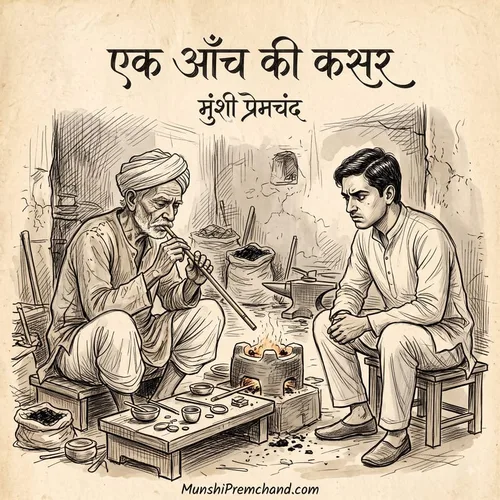
Complete English Translation: Falling Short by a Single Spark (Ek Aanch Ki Kasar)
Across the entire city, praises were being sung of Mahashay Yashodanand. Not only throughout the city, but across the entire province his renown was being celebrated. Leading newspapers were publishing glowing editorial commentaries, and congratulations poured in from friends in an unbroken stream.
This is what true social service looks like! This is how enlightened, progressive men conduct themselves! The worthy gentleman has brightened the face of the entire educated community! Who can now dare assert that our public leaders are wealthy only in grandiose words, but bankrupt in practical deeds?
Had Mahashay-ji so desired, he could easily have commanded at least twenty thousand rupees in dowry for his son—with obsequious flattery thrown into the bargain as pure profit! Yet the venerable gentleman cared not a brass farthing for worldly wealth when set against high moral principles, and accepted the marriage of his son without accepting a single copper pie in dowry.
Bravo! Bravo! If there be moral courage, let it be like this! If there be devotion to principle, let it be like this! If there be adherence to noble ideals, let it be like this! All hail, true warrior, true noble son of your motherland—you have achieved that which no man before you ever dared accomplish! We bow our heads before you in profoundest reverence!
Mahashay Yashodanand had two sons. The elder boy had completed his education and graduated with high honors. It was his wedding that was currently taking place—and, as we have seen, without taking a single pie in dowry.
Today was the ceremony of the bridegroom’s tilak. Mahashay Swami Dayal was arriving from Shahjahanpur bringing the formal offerings. Invitations had been dispatched to all the eminent, respectable citizens of the city, and they had gathered in large numbers. The assembly was arranged with great splendor. A master sitar player was displaying his virtuosic artistry, keeping the audience spellbound. The banquet preparations were in full swing. Friends and well-wishers crowded around Yashodanand, showering him with effusive congratulations.
One gentleman remarked: "My dear friend, you have accomplished a veritable miracle!"
A second added: "Miracle? Say rather that he has planted his flag at the very summit! Hitherto, whomever we saw merely spouted sermons from the public platform; but when the hour arrived for practical action, everyone tucked their tails between their legs and fled!"
A third observed: "And what clever excuses people invent! 'Oh, my dear sir, I personally detest the dowry system from the bottom of my heart—it is entirely against my principles! But what can I do? The boy’s mother simply will not hear of it!' One man lays the blame upon his father; another shifts it onto some obstinate old relative."
A fourth chimed in: "Good heavens, some are so utterly shameless that they say right to your face: 'We must recoup whatever money we spent upon the boy's education!' As though they had deposited those rupees in a fixed-deposit bank account!"
A fifth gentleman said: "I understand very well—you gentlemen are hurling barbed insinuations at me! Tell me, is the entire fault on the boy's side, or is the girl's family also somewhat to blame?"
The first replied: "What fault can possibly lie with the girl's family, except the unfortunate fact that he happens to be the father of a daughter?"
The second said: "Then the entire fault lies with Almighty God for creating daughters in the first place! Isn't that so?"
The fifth argued: "I do not say that. The fault does not belong entirely to the girl's side, nor entirely to the boy's side. Both are equally guilty. If the girl's father gives nothing, he has no moral right to complain: 'Why didn't you bring lavish gifts of clothing? Why didn't you bring magnificent gold ornaments? Why didn't you arrive with blaring brass bands and royal pomp?' Tell me that!"
The fourth said: "Yes, that is indeed a question worthy of serious contemplation. In my opinion, under such circumstances, the bride’s father ought not to lodge such complaints."
The fifth concluded: "Say rather, then, that along with the dowry system, the custom of demanding wedding trousseaus, gold ornaments, and lavish finery must be discarded as well. Trying merely to eradicate cash dowry while keeping all the rest is utterly futile."
Yashodanand smiled condescendingly: "That too is a lame excuse! I have refused to take a single pie of dowry, yet do you imagine I shall not take magnificent gifts and jewelry for the bride?"
The first gentleman exclaimed: "Ah, Mahashay-ji, you are in a league of your own! Why do you even count yourself among ordinary mortals like us? Your proper place is among the celestial gods!"
The second added: "Surrendering a colossal sum of twenty thousand rupees! What an extraordinary feat!"
Yashodanand puffed out his chest: "It is my unshakeable conviction that we must always remain steadfast upon our principles. Before principles, mere money has no value whatsoever! I myself have never delivered long public speeches against the evil custom of dowry; perhaps I have not even written an article on the subject. But at the social conference, I personally seconded the resolution condemning dowry, and therefore I consider myself bound hand and foot by that resolution. Even if I wished to violate it, my conscience would never permit it. I speak the solemn truth: were I to accept this money, it would cause me such unbearable mental anguish that I doubt I could ever survive the shock!"
The fifth remarked: "If the forthcoming provincial conference does not elect you as its President, it will be guilty of the grossest injustice!"
Yashodanand said with studied humility: "I have merely discharged my duty. Whether it receives recognition or not, I do not care in the least."
Just then, word arrived that Mahashay Swami Dayal had made his entrance. The guests prepared to welcome him, ushered him to the seat of honor upon the velvet bolster, and the formal tilak ceremony commenced. Swami Dayal placed a leaf-platter of sacred dhak leaves containing a coconut, betel nuts, auspicious uncooked rice, and betel leaves before the bridegroom. The family priests chanted Vedic mantras, the sacred sacrificial fire was kindled, and the auspicious crimson mark was applied to the bridegroom's forehead. Immediately, the women of the household burst into melodious celebratory wedding songs from within the inner courtyard.
Here in the assembly, Mahashay Yashodanand mounted a wooden platform and began delivering a lecture on the evils of the dowry system. The speech had been carefully drafted and rehearsed beforehand. He offered an elaborate historical analysis of the custom:
"In ancient times, the very name of dowry did not exist! Gentlemen! No one in ancient India even knew what manner of bird this thing called dowry or thehrouni was! Believe me on my word, no one knew whether thehrouni was an animal or a bird, whether it dwelled in the heavens or upon the earth, whether it was something to eat or something to drink!
"The foundation of this wicked custom was laid during the era of imperial monarchies. Our young men began enlisting in royal armies; they were valiant warriors, and joining the military was considered the highest badge of honor. Mothers decorated their beloved sons with weapons with their own hands and sent them marching into the battlefield. In this manner, the number of marriageable young men began to dwindle, and the commercial bargaining for grooms began!
"Today matters have reached such a pass that editorial columns in newspapers are commenting upon this petty, insignificant service of mine, as though I had performed some miraculous, superhuman feat! I declare to you: if you desire to survive in this modern world, put an immediate end to this accursed custom!"
One gentleman in the audience voiced a playful doubt: "If we don't put an end to it, shall we all drop dead?"
Yashodanand replied: "If that were so, what more could one ask? People would receive their just punishment—and in truth, that is precisely what ought to happen! It is a travesty of divine justice that such greedy, money-grubbing vultures—such slave-traders who auction off their own flesh and blood—remain alive and prosperous, and society does not spit upon them! But they are nothing less than human-traffickers..."
The lecture was lengthy, dramatic, and laced with theatrical humor. The audience cheered and applauded with repeated shouts of Wah! Wah!
Having concluded his own address, he summoned his younger son, Parmanand—a boy of barely seven years—and placed him upon the platform. He had written out a short speech for the child to deliver. He wanted to demonstrate to the assembly how extraordinarily sharp-witted and enlightened even the youngest children of this noble lineage were! After all, having children deliver speeches at social gatherings was a fashionable practice, so no one found it unusual.
The child was exceptionally handsome, bright, and cheerful. Smiling sweetly, he climbed onto the platform, pulled a folded sheet of paper from his pocket, and with great pride began to read aloud in a clear, ringing voice:
"Respected and Beloved Brother,
Salutations.
From your recent letter, it appears that you do not place complete trust in me. Taking God as my witness, I assure you that the stipulated sum of money will reach your service in so secret a manner that not a soul shall harbor the faintest shadow of suspicion. However, I venture to make just one humble inquiry: in view of the immense honor, renown, and prestige that will accrue to you by keeping this transaction secret, and the bitter public condemnation that will be heaped upon me among my relatives, what concession will be granted to me? It is my earnest, humble prayer that five thousand be deducted from the twenty-five thousand, and that justice be done to me..."
Mahashay Yashodanand had stepped inside the house to give instructions for serving the dinner platters to the guests. As he stepped back into the drawing room, these exact words fell upon his ears:
“...deducted from the twenty-five thousand, and that justice be done to me!”
His face turned ashen pale! He lunged forward like a hawk, snatched the paper furiously from the child’s hands, and roared: "You good-for-nothing scoundrel! What on earth are you reading? This is a client's private letter regarding a court case! Where did you pick this up from, you devil? Go this instant and bring the paper that was written out for you!"
One gentleman called out: "Oh, let him read on! The exquisite pleasure in this written document surpasses any speech ever delivered!"
Another laughed: "That is true magic which proclaims itself from the rooftop!"
A third remarked: "Well, dismiss the assembly now! I, for one, am taking my leave."
A fourth said: "I am slipping away as well."
Yashodanand pleaded frantically: "Please stay, gentlemen, please be seated! The dinner platters are being laid out right now!"
The first gentleman asked: "Come here, little Parmanand, my boy—where did you find that piece of paper?"
Parmanand replied tearfully: "Babuji himself wrote it and put it inside his desk! He told me, 'Read this.' And now he is getting furious at me for no reason at all!"
Yashodanand barked: "Was that the paper, you pig? I had placed your speech right on top of the desk! Why did you pull this paper out from inside the drawer?"
Parmanand whined: "I couldn't find anything on top of the desk!"
Yashodanand yelled: "Then why didn't you tell me? Why did you open the drawer? Just wait—I will teach you such a lesson today that you will remember it for the rest of your life!"
The first gentleman remarked: "This is a direct voice from the heavens!"
The second added: "This is what modern leadership truly means: feather your own nest with secret plunder, while parading as a righteous saint before the public!"
The third said: "You should be thoroughly ashamed of yourself! True renown is earned through genuine sacrifice, not through fraudulent deceit!"
The fourth chuckled: "He had almost attained it—there was only a flaw of a single flame (ek aanch ki kasar)!"
The fifth concluded: "This is how God punishes two-faced hypocrites!"
Saying this, the guests rose to their feet and began streaming out. Yashodanand realized that the pot was smashed and the secret was completely out; no amount of smooth talk could ever restore his ruined prestige. Over and over again, he glared at little Parmanand with murderous, wrathful eyes, twitching his hands as if aching to thrash him with a stick. That little devil had shattered a game that was already won, smeared black soot over his father’s face, and brought his head down into the dust! He had committed an offense worthy of being shot!
Meanwhile, out on the street, the departing friends were exchanging lively commentaries:
One said: "How thoroughly God has smeared his face with disgrace! If he possesses a shred of shame left, he will never show his face in public again!"
The second remarked: "What astounds me is how such wealthy, respected, and educated men can sink to such base depths! If you want to take dowry, take it openly in the daylight—who is there to stop your hand? But what manner of character is this: to pocket the loot in secret, while parading as an enlightened reformer in public?"
The third sneered: "Black be the face of the hypocrite!"
The fourth laughed: "I almost feel pity for poor Yashodanand! The wretched man orchestrated such an elaborate, cunning deception—and even then, his game was blown completely open! There was just one tiny flaw of a single flame!"
Summary of Ek Aanch Ki Kasar
Ek Aanch Ki Kasar ("Falling Short by a Single Spark") is a brilliant satirical critique of the double standards, moral bankruptcy, and rampant hypocrisy pervasive among the educated, reformist middle class in colonial India.
Mahashay Yashodanand has built a formidable reputation across the province as an enlightened social reformer, celebrated in leading newspapers for arranging the marriage of his highly educated elder son without accepting a single pie in dowry. At the formal tilak engagement ceremony held at his opulent residence, Yashodanand regales his distinguished guests with high-flown rhetoric, sprinkling his speech with modern English loanwords (principles, money, value, conference, duty) to project an air of sophisticated moral superiority. Mounting a platform, he delivers an impassioned, theatrical lecture denouncing dowry-seekers as sub-human slave-traders and vultures.
To cap off his performance and demonstrate that enlightened values run deep within his family, Yashodanand places his innocent seven-year-old son, Parmanand, on the platform to deliver a pre-written anti-dowry address. However, Parmanand—unable to find the speech on top of his father’s desk—pulls a folded sheet from inside the desk drawer instead. Standing proudly before the assembled elite, the child innocently reads aloud a secret, confidential letter written by Yashodanand to the bride's father: taking God as his witness, Yashodanand promises to receive the dowry in complete secrecy so that his public reputation remains untarnished, but humbly begs that five thousand rupees be deducted from the agreed twenty-five thousand rupees as a concession for keeping the transaction quiet.
Hearing the boy read out the incriminating letter, Yashodanand rushes back in horror, his face drained of color. He violently snatches the letter, curses the boy, and frantically invents excuses, but the deception is completely exposed. The guests mock his hollow pretenses, pointing out that true honour comes from genuine sacrifice rather than fraudulent posturing. Leaving the feast untouched, the guests depart, jesting that Yashodanand’s elaborate scheme had succeeded in every detail, falling short by just a single spark of heat (ek aanch ki kasar).
Publication History
Ek Aanch Ki Kasar ("Falling Short by a Single Spark") was published by Munshi Premchand in 1924 and was later included in Volume 3 of his comprehensive short-story anthology Mansarovar.
Written during an era when the Indian nationalist and social reform movements actively debated the eradication of oppressive customs such as dowry, child marriage, and conspicuous consumption, the story serves as a blistering indictment of bourgeois reformers who embraced the vocabulary of progressive politics merely as an ornament for personal prestige while secretly indulging in the very vices they denounced.
This unabridged English translation was published in 2026 by MunshiPremchand.com as part of the MunshiPremchand.com English Translation Series.
Themes & Critical Significance
- The Hypocrisy of Bourgeois Social Reform: Premchand exposes the dual morality of educated elites who use progressive rhetoric (principles, social service, duty) as a fashionable costume to amass social capital, while privately practicing regressive, avaricious customs.
- Dowry as Commercial Transaction: The narrative lays bare how dowry reduces marriage to a calculated financial contract (thehrouni), where young men are commodified and traded like livestock under the cover of family prestige.
- Childhood Innocence as the Mirror of Truth: The climactic exposure is executed not by a bitter enemy or investigative authority, but through the pure, unintentional innocence of seven-year-old Parmanand. A child’s uncomprehending honesty effortlessly shatters years of adult deceit.
- The Fragility of False Reputation: The title's idiom—ek aanch ki kasar—draws from the goldsmith's craft, where gold that lacks just one firing in the furnace fails to achieve purity and reveals its base alloy. Premchand illustrates how a single unforeseen slip can instantly disintegrate the most meticulously crafted facade of moral respectability.
- Satire on Anglicized Pretentiousness: By highlighting Yashodanand’s affected use of English vocabulary, Premchand satirizes the superficial westernization of the colonial middle class, who adopted the language of modern liberty without internalizing its ethical essence.