There are a thousand things in this world that puzzle my understanding.
For instance, why do men scrape their faces with razors every morning? Have men become so delicate that they cannot bear the weight of a mustache? Why have the eyes of every educated man grown so weak that they must wear spectacles? Why do people run madly after titles and honors?
However, I am not concerned with those questions today. A new question has arisen in my mind, and no one offers a satisfying answer: Who is truly civilized, and who is uncivilized? What are the true marks of civilization?
At first glance, it seems simple enough. Even a child could answer: wearing suits, ties, and felt hats, dining at polished tables, drinking tea thirteen times a day, and walking with a cigar between your lips!
Yet if external fashion defines civilization, then even drunken British soldiers stumbling along the road, hurling abuses at passersby, would have to be called civilized! That is impossible.
Thus, it is proven: Civilization has far less to do with the body than with the mind and character.
Among my few acquaintances is Rai Ratan Kishore.
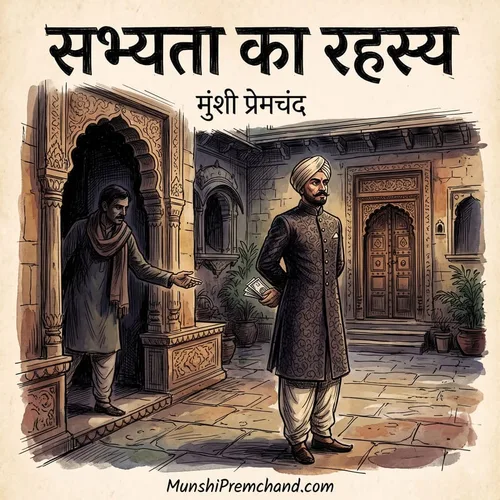
He is a highly educated, cultured, wealthy gentleman holding a prestigious government magistrate post. Despite his high salary, his expenses always outstrip his income—a quarter of his salary goes into maintaining his grand bungalow!
Rai Sahib enjoys a stellar public reputation for integrity. Yet, to boost his income, he spends half his time "on official tours" to claim heavy travel allowances. In reality, while his official tents are pitched fifty miles away in the countryside, Rai Sahib stays comfortably at home, chatting and drinking tea with friends! Yet who would dare question the integrity of such a polished gentleman? His status as a "civilized gentleman" is unquestioned.
One afternoon, I visited Rai Sahib and found him angrily scolding his poor grass-cutter, Damri.
Damri was a full-time domestic servant paid a meager monthly wage, but he ate his meals at home in a nearby village. The previous night, an unexpected guest arrived at Damri's hut, so Damri stayed home to host him.
Rai Sahib barked furiously: "When I hire you for day and night, why did you stay at your house? I will deduct your daily wages!"
Damri pleaded with folded hands: "Huzoor, an unexpected guest arrived at my doorstep... forgive me just this once!"
"Then go collect your wages from your guest! Two rupees fine!"
Damri walked away weeping. For a single night's absence, a poor laborer lost two rupees from his tiny wage; while Rai Sahib claimed hundreds of rupees in fraudulent government travel allowances every month without batting an eye!
Damri owned six small biswas of ancestral land to feed a family of six. Naturally, the land produced barely enough to survive.
Rai Sahib often sneered at him: "Why don't you sell those two skinny bullocks of yours? Your wages get eaten up buying fodder for them! Sell the bullocks and become a full-time laborer!"
Damri replied with quiet pride: "Huzoor, if I sell my bullocks and become a daily laborer, my family's honor in the village will be ruined! No one will marry my daughters! A farmer's bullocks are his pride—they protect his dignity at the village door."
Rai Sahib laughed mockingly, turning to me: "Look at this foolishness, Munshi-ji! He is starving in the cold, yet he insists on keeping bullocks for 'family honor'!"
He added boasting: "Look at me! My family hosted grand Janmashtami feasts for generations, spending thousands of rupees. After my father's death, I stopped it immediately! Why squander money? People called me an atheist and a miser, but I saved four thousand rupees a year! When someone in the village gets married, they used to take free timber from our estate—I stopped that too, saving five hundred a year! Let people weep—I look after my own profit!"
I pondered deeply: Who is truly civilized? Damri, who sacrifices his personal comfort to preserve family honor—or Rai Ratan Kishore, who sacrifices family tradition and honor to hoard money?
A few weeks later, a major criminal case landed in Rai Sahib's court.
A wealthy landlord from the city had been implicated in a murder. The landlord was desperate to secure bail, declaring he would spend his entire estate to come out clean. High-level recommendations and influence were tried, but Rai Sahib maintained a strict, untouchable facade of judicial purity.
Desperate, the landlord's wife approached Rai Sahib's wife in private, offering a secret bribe of twenty thousand rupees in cash!
Rai Sahib's wife rushed into his room, breathless with excitement: "Take it! Take it! Twenty thousand rupees!"
Rai Sahib put on a grand show of moral indignation: "How impetuous you are! Do you have no regard for my reputation as a Civilian Magistrate? You should have scolded her and thrown her out!"
His wife smiled: "I did scold her! But she fell at my feet weeping and left the cash box in our safe!"
Rai Sahib embraced his wife with delight, whispering softly: "Well... since the money is already in the safe, returning it might cause a scandal. We must trust in God and grant the bail!"
Thus, twenty thousand rupees in bribe money quietly entered the Magistrate's iron safe!
That very night, in Damri's small village hut, a heartbreaking scene was unfolding.
Damri's two bullocks stood tied in the courtyard, their troughs completely empty. It was midnight, and the two animals stood gazing at Damri with hollow, starving eyes, licking his palms in silent hunger.
Damri had no money left to buy fodder, and his wages were days away. Seeing his beloved animals starve tore at his heart. A farmer loves his bullocks like his own children; they are his companions in sweat and toil.
Unable to sleep, Damri picked up his sickle at one in the morning and walked out to the edge of the village.
Standing before a rich landlord's sorghum field, Damri's hands trembled. He was no thief. He cut only a tiny armful of green sorghum—just enough to keep his two bullocks alive until morning.
He thought to himself: If anyone catches me, I will pay them for this handful of fodder. I am not stealing to sell at the market; I am cutting a handful to save my starving animals.
Just as he lifted the small bundle onto his head, a police constable emerged from the shadows!
The constable grabbed Damri by the throat: "Hao! Stealing crops at midnight!"
Damri trembled in terror: "Huzoor, look! I cut only a tiny armful because my bullocks were starving!"
The constable dragged poor Damri to the police station. The next morning, Damri was produced in Rai Sahib's court for theft!
When Rai Sahib saw his own servant standing in the dock accused of stealing a handful of grass, he put on a dramatic show of judicial severity!
He thundered from the bench:
"This is an insult to my court! If you were not my servant, I might have shown leniency! But because you work in my bungalow, I must pass the strictest punishment to prove that Rai Ratan Kishore shows no favor to his own employees!"
Rai Sahib passed judgment: Six months of rigorous imprisonment in jail for cutting a handful of grass!
That very afternoon, on the exact same bench, Magistrate Rai Ratan Kishore signed the official bail order releasing the wealthy murder suspect—after pocketing twenty thousand rupees in illegal bribe money!
When I heard both judgments, the ultimate truth flashed before my mind like lightning!
"Civilization" in modern society is merely the art of committing crimes with sufficient skill to conceal them!
If you commit the grandest crimes, take massive bribes, and betray justice—but possess the education, status, and power to cover your tracks behind polished manners—society calls you a civilized gentleman!
But if you are a poor, helpless man who gets caught cutting a handful of grass for starving animals—society brands you an uncivilized, illiterate criminal!
That is the ultimate Secret of Civilization.
Significance & Themes
- Biting Satire on Colonial Bureaucracy: Premchand exposes the double standards of the colonial judicial system, where high-ranking Indian officials adopted Western etiquette to project a polished image while practicing corruption behind closed doors.
- Class Inequality Before the Law: The story presents a stark, heartbreaking contrast between the harsh legal punishment meted out to the poor for trivial survival acts versus the total immunity enjoyed by the rich through bribery.
- Redefining True Morality: Premchand dismantles the superficial definition of "civilization" (clothing, etiquette, status), affirming that genuine moral dignity lies in the unselfish heart of the poor farmer rather than the corrupt magistrate's court.