Complete English Translation: Mukti Marg (The Path to Deliverance)
1
The pride that a policeman feels in his red turban, that a beautiful woman feels in her glittering ornaments, or that a physician feels in the crowd of patients seated before his clinic—that very same intoxication fills a peasant's heart when he gazes upon his lush, waving fields!
Whenever Jhingur looked at his three bighas of sugarcane, a heady intoxication washed over him. Three bighas of sugarcane! Six hundred rupees would fall into his lap without the slightest effort. And if God looked down with favor and sugar prices soared at the market, what more could one ask! His two bullocks had grown old; this year, at the Bateshwar cattle fair, he would buy a brand-new pair. If he could lay his hands on two more bighas of land, he would have the lease deed drawn up immediately. Why worry about money? The village shopkeepers and moneylenders were already flattering him and soliciting his favor. There was scarcely a soul in the village with whom he had not picked a quarrel. He considered no one his equal!
One evening, while picking pea pods in his field with his little boy perched in his lap, Jhingur caught sight of a large flock of sheep heading straight toward him.
He muttered to himself: There is no thoroughfare for sheep through here. Couldn't the flock walk along the ridge of some other boundary? What is the need to drive them right through here? They will trample the field and graze on the tender sprouts. Who will pay for the damage? It looks like Buddhu the shepherd. The scoundrel has grown swollen with conceit; that is why he comes driving his flock right through the middle of cultivated fields. Look at his insolence! He sees me standing right here, yet he does not turn his sheep back. Did he ever show me the slightest courtesy that I should show him indulgence? If I ask him to sell me a single ram, he demands five rupees on the spot! Everywhere else in the world blankets sell for four rupees, but he refuses to utter a word under five!
By now, the sheep reached the edge of the field. Jhingur bellowed in a fierce, challenging voice: "Hey! Where are you driving those sheep?"
Buddhu replied in a meek and humble tone: "Mahato, they will just slip along the field ridge. If I go all the way around, it will mean a detour of a whole kos."
Jhingur snapped: "So to save you a detour, should I let my crop be trampled underfoot? If you must take a ridge, why didn't you take the ridges of other fields? Do you take me for some low-caste Chuhar or Chamar? Or has money made you arrogant? Turn them back!"
Buddhu pleaded: "Mahato, let me pass just this once. If I ever come this way again, give me whatever punishment you please."
Jhingur barked: "I told you to turn them back! If a single sheep sets foot on this ridge, remember, it will not be good for you!"
Buddhu replied: "Mahato, if even a single vine gets crushed under a sheep's foot, sit me down and shower a hundred curses upon me!"
Buddhu spoke with great outward humility, yet in turning back he sensed his own humiliation. He thought to himself: If I start turning my sheep back at every petty threat, my herding days are over. If I retreat today, tomorrow no one will let me pass anywhere. Everyone will start throwing their weight around!
Buddhu, too, was a man of substantial means. He owned twelve score of sheep—nearly two hundred and forty head. For penning them overnight in farmers' fields to fertilize the soil, he received eight annas per score each night; in addition, he sold milk and wove wool blankets. He thought to himself: He is getting so hot-headed, but what can he do to me? After all, I am not his subordinate!
The moment the sheep caught sight of the lush green sugarcane foliage, they grew uncontrollable. They swarmed straight into the field! Buddhu began striking them with his herding stick to drive them back toward the boundary, but the sheep darted from left and right, plunging deeper into the green crop.
Enraged to the boiling point, Jhingur shouted: "You've come to display your arrogance to me? I'll knock every ounce of swagger out of you!"
Buddhu shouted back: "They are startled seeing you! Move out of the way, and I will drive them all out!"
Jhingur set his boy down upon the ground, gripped his heavy wooden staff with both hands, and fell upon the helpless sheep! Even a washerman would not beat his donkey with such merciless savagery. Under his crushing blows, one sheep's leg snapped; another's spine was shattered. The entire flock erupted into a frantic chorus of agonized bleating.
Buddhu stood in stone-cold silence, watching the destruction of his army with his own eyes. He neither drove the sheep nor uttered a single word to Jhingur; he merely stood motionless, watching the spectacle. Within two minutes, Jhingur routed that entire army through his inhuman savagery. Having slaughtered and scattered the flock, he proclaimed in triumphant arrogance: "Now go straight! Don't ever take the name of coming this way again!"
Gazing upon his bleeding, crippled sheep, Buddhu said quietly: "Jhingur, you haven't done a good deed today. You will live to regret this."
2
Felling a banana plant is not nearly as easy as taking revenge upon a peasant! A peasant's entire life's earnings lie exposed in open fields or piled in threshing floors. Only after surviving countless divine and earthly calamities does a morsel of grain ever enter his home. And if, in addition to these natural disasters, human malice joins in league against him, the wretched peasant is utterly destroyed.
When Jhingur returned home and narrated the tale of this battlefield triumph to his neighbors, the villagers began to chide him: "Jhingur, you have committed a dreadful blunder! Why do you act blind when you know the truth? Don't you know Buddhu, what a vengeful, quarrelsome fellow he is? Even now, nothing is lost. Go to his house and pacify him. Otherwise, calamity will descend upon the entire village along with you!"
The truth of their words sank into Jhingur's heart. He began to repent bitterly: Why did I ever stop him? Even if the sheep had grazed a little, would I have been ruined? In truth, the welfare of us poor peasants lies only in remaining submissive. Even God does not like to see us walking with our heads held high.
His heart shrank from going to Buddhu's door, but compelled by the persistent urging of his neighbors, he set out. It was the month of Agahan. A heavy winter fog hung in the air, and pitch darkness enveloped the countryside. He had barely stepped beyond the outskirts of the village when suddenly, looking toward his sugarcane field, he froze in sheer terror.
A red column of flame was leaping into the sky!
His heart pounded against his ribs like a hammer. The field was on fire! He ran headlong, praying desperately that it might not be his field. But the closer he drew, the more that hopeful illusion melted away. The very disaster he had set out from his house to avert had already come to pass!
The murderer has set the fire, Jhingur thought in despair, and ruined the whole village behind me!
To his fevered eyes, the blazing field seemed unnaturally close, as though the intervening barren fallow lands had ceased to exist. When he finally reached the edge of the crop, the conflagration had assumed monstrous proportions. Jhingur began screaming and wailing: "Hai! Hai!"
Villagers came rushing from every quarter, tearing up arhar stalks from neighboring plots to beat out the flames. A horrific spectacle of battle between man and fire erupted. For three agonizing hours, pandemonium reigned. At times the roaring fire surged forward; at times the human fighters drove it back. The fiery warriors seemed to die only to resurrect with doubled fury, striking with blistering heat.
Among the human army, the warrior whose valor shone brightest was Buddhu!
With his dhoti hitched up to his waist and his life held in the palm of his hand, Buddhu hurled himself into the towering wall of fire, subduing the flames and escaping narrowly with his life time and again. At last, the human host secured victory—but it was a victory at which even defeat would laugh in mockery!
The sugarcane crop of the entire village had been reduced to smoldering ashes—and along with the sugarcane, every peasant's hopes and dreams had been burned to cinders!
3
Who had set the fire was an open secret; yet no one dared utter a word. There was not a shred of evidence. What was the value of suspicion without proof?
It became impossible for Jhingur to step out of his house. Wherever he went, stinging taunts rained down upon him. People said openly to his face: "You are the one who brought this fire upon us! You caused our total ruin! You were so bloated with arrogance that your feet wouldn't touch the ground! You ruined yourself, and you dragged the whole village down with you! If you hadn't provoked Buddhu, why would we ever have seen this black day?"
Jhingur felt far less anguish over his own financial ruin than over these venomous, lacerating words. He remained huddled inside his hut all day long.
The harsh month of Poos arrived. Where previously the crushing mills groaned day and night, the sweet, heady aroma of fresh jaggery wafted through the winter air, furnace fires blazed brightly, and peasants sat happily smoking their hookahs before the flames—now, a deathly, desolate silence reigned. Shivering from the piercing cold, villagers bolted their wooden doors at dusk and lay huddled under thin blankets, cursing Jhingur's name.
The month of Magh proved even more agonizing. Sugarcane is not merely a source of wealth; it is the very life-sustainer of peasant folk. Through it, poor farmers endure the brutal North Indian winter. They drink the warm, freshly boiled cane juice, warm their shivering limbs before fires of dried cane leaves, and feed the succulent green tops (agoras) to their draft animals. That winter, every village dog that used to sleep curled in the warm ash heaps of the jaggery furnaces perished from the bitter cold. Many cattle perished for lack of green fodder. A biting cold snap gripped the region, and the entire village was laid low with racking coughs and raging fevers.
And all this misery had been brought about by Jhingur—that wretched, murderous Jhingur!
Brooding day and night in his dark hut, Jhingur resolved: I will reduce Buddhu to the exact same misery as mine! He brought total ruin upon me, and now he plays his carefree flute! I will destroy him, root and branch!
From the day that fatal feud had sprouted, Buddhu had stopped visiting Jhingur's quarter. Jhingur now began cultivating close intimacy with him. He wanted to demonstrate to Buddhu that he harbored not the faintest suspicion against him. One day he went to Buddhu's house on the pretext of borrowing a blanket; a few days later, he went on the pretext of purchasing milk. Buddhu received him with lavish hospitality. A man offers a chillum even to a bitter foe, but Buddhu never let Jhingur depart without serving him warm milk and sweet sherbet.
In those days, Jhingur had taken up daily wage labor at a nearby hemp-twisting mill. His wages were often distributed only after intervals of several days; it was largely through Buddhu's generous advances and neighborly assistance that Jhingur's daily household expenses were kept afloat. Thus, Jhingur deepened their friendship.
One afternoon, Buddhu asked him: "Tell me the truth, Jhingur, if you ever laid hands on the man who set fire to your sugarcane, what would you do to him?"
Jhingur replied with solemn gravity: "I would say to him: Brother, whatever you did, you did well. You shattered my pride; you turned me back into a human being."
Buddhu exclaimed: "If I were in your place, I wouldn't rest until I had burned his house to the ground!"
Jhingur sighed: "In this fleeting life of four short days, what is the use of multiplying hatred and enmity? I am already ruined; what will I gain by ruining someone else?"
Buddhu nodded thoughtfully: "That alone is true human virtue. But brother, once a man falls under the sway of wrath, his intellect turns completely upside down."
4
The spring month of Phagun arrived. Peasants were busily preparing their fields for the new sugarcane planting. Buddhu's business was booming. There was a frantic scramble among the farmers to hire his sheep to pen in their fields for manure. Two or three peasants stood at his doorway every day, flattering him and begging for his favor.
Buddhu spoke to no one with a pleasant countenance. He had doubled the fee for penning his sheep. If anyone dared object, he retorted bluntly: "Brother, I am not forcing my sheep around your neck. If you don't like it, don't take them. But not a single cowrie less than what I named!" Yet such was their agricultural need that people crowded around him despite his haughty coldness, exactly like temple priests surrounding wealthy pilgrims.
The physical form of Lakshmi, the Goddess of Fortune, is not particularly vast, and it expands or shrinks according to circumstances. At times, she compresses her colossal form into a few written characters on a sheet of paper; at other times, she perches upon a man's tongue, and her visible form disappears altogether. Yet for her residence, she requires immense space!
The moment she arrives, the house begins to expand. She cannot abide living in a cramped cottage. Buddhu's house began expanding rapidly. A spacious verandah was erected at the front; six large rooms were constructed in place of two. The house was being rebuilt from its very foundations!
He asked one peasant for timber, another for cowdung cakes to fire the tile kiln, another for bamboo poles, and another for thatch reeds. For the masonry work on the walls, he paid not in silver cash, but in newborn lambs! Such is the divine majesty of Lakshmi: the entire reconstruction was accomplished through begar—customary free labor! A magnificent, sprawling house stood completed without costing him a single rupee. Elaborate preparations began for the grand housewarming ceremony (griha-pravesh).
Meanwhile, Jhingur toiled from dawn to dusk at the hemp mill, barely earning enough to fill half his belly with coarse grain. At Buddhu's house, a shower of gold was falling. If Jhingur burned with dark jealousy, was he to blame? Who could bear such glaring injustice?
One evening, Jhingur strolled toward the quarter of the leather-workers (Chamar-tola). He called out to Harihar.
Harihar emerged, greeted him with "Ram-Ram", and packed a clay chillum with tobacco. Both men sat down to smoke. This headman of the leather-workers was a notoriously wicked man; every peasant in the village trembled at his name.
Taking a deep puff from the chillum, Jhingur said: "Is there no festive Phagwa singing this season? One hears nothing."
Harihar replied: "What singing, brother? One gets no respite from the belly's drudgery. Tell me, how are things going with you these days?"
Jhingur lamented: "How could things go? Like a mutilated wretch dragging out a miserable existence! When I slave all day at the mill, the hearth fires up at night. The silver belongs to Buddhu these days! He has nowhere left to stack his wealth. A palace of a house built, more sheep purchased! Now there is grand uproar over his housewarming feast. Betel nuts of invitation are being sent to seven neighboring villages!"
Harihar remarked: "When Mother Lakshmi arrives, humility and modesty usually soften a man's eyes. But look at that rogue—his feet don't touch the ground! Whenever he speaks, he speaks with nothing but swagger."
Jhingur egged him on: "Why shouldn't he strut? Who is his equal in this village today? But friend, my eyes cannot bear to witness such injustice! If God grants wealth, one should walk with head bowed low, not look upon everyone else as dirt beneath his feet. When I listen to his bragging, fire blazes through my veins! A petty hawker of yesterday, a great merchant prince today! He dares to throw his weight around before us! Just yesterday he was running around in a tattered loincloth shooing crows from the fields, and today his lamp burns in the very heavens!"
Harihar leaned closer: "Say the word, brother—shall I devise some scheme?"
Jhingur asked: "What can you do? It is out of this very fear that he never keeps cows or buffaloes."
Harihar replied: "There are his sheep."
Jhingur scoffed: "What good is that? Killing a heron only yields a handful of feathers."
Harihar said: "Then you think of something."
Jhingur whispered: "Devise such a stratagem that he may never flourish again in this lifetime!"
Thereupon, their voices dropped to hushed whispers.
It is a curious mystery of human nature that as much jealousy and spite exist among the virtuous, an equal measure of camaraderie and affection flourishes among the wicked! A scholar burns with hatred upon seeing another scholar; an ascetic detests the sight of another ascetic; a poet despises a rival poet. They cannot bear to look upon one another's faces. But a gambler displays instant warmth toward a fellow gambler; a drunkard extends open arms to a drunkard; a thief shelters and aids another thief! If a learned pandit stumbles in the dark and falls, a brother pandit, instead of helping him up, will plant two more kicks upon his ribs to ensure he never rises again. But if calamity befalls a thief, another thief will risk his neck to rescue him. Everyone despises evil; hence, evil men feel mutual solidarity. The whole world sings the praises of goodness; hence, the good are consumed by mutual rivalry. What does a thief gain by betraying a thief? Only contempt. What does a scholar gain by humiliating a rival scholar? Fame and renown!
Jhingur and Harihar finalized their scheme. The blueprint of the conspiracy was mapped out—its form, its timing, and its precise execution. When Jhingur walked away, he strutted with a jaunty air. He had struck the enemy down! Where could the wretch escape now?
The next morning, as Jhingur set out for work, he stopped first at Buddhu's house. Buddhu asked: "Why, aren't you going to work today?"
Jhingur said: "I am on my way. I only stopped by to make a humble request: why don't you graze my little heifer along with your sheep? Tied to her peg day and night, the poor beast is starving to death. There is neither grass nor fodder in my house; what am I to feed her?"
Buddhu replied: "Brother, I never keep cattle. You know the leather-workers—they are born butchers! This very Harihar poisoned and killed two of my finest cows. God knows what deadly stuff he slipped them. Since that day, I pulled my own ears and vowed never to keep cows or buffaloes again. But you have only one solitary heifer; what harm could anyone wish upon her? Bring her over whenever you please."
With that, Buddhu proudly showed Jhingur the lavish provisions assembled for his housewarming festival. Tins of pure ghee, sacks of refined sugar, fine white flour, heaps of vegetables—everything had been procured in abundance. Only the priest's arrival for the recitation of the Satyanarayan sacred legend was awaited. Jhingur's eyes were dazzled. Never in his entire life had he made such opulent preparations, nor had he ever seen anyone else make them.
Returning from his day's labor at dusk, the very first thing Jhingur did was lead his heifer to Buddhu's house and tether her among the sheep.
That night, the sacred recitation of the Satyanarayan Katha was performed at Buddhu's house. A sumptuous feast was served to the Brahmins. The entire night passed in welcoming, serving, and flattering the priests. Buddhu found not a single moment of leisure to visit his flock of sheep.
At dawn, having just eaten his morning meal (since the grand feast had concluded only at daybreak), Buddhu was sitting in his verandah when a man came running up in breathless horror: "Buddhu! You are sitting here at your ease, while out in the pen, the heifer lies stone-dead among the sheep! Good heavens, man, you didn't even untie her neck tether!"
Hearing this, Buddhu felt as though struck by a bolt of lightning!
Jhingur, who had also feasted and was sitting right there, cried out in anguish: "Hai! Hai! My poor heifer! Come, let me see! But I never tied any tether around her neck! I simply dropped her among the flock and went straight home. When did you tie this tether?"
Buddhu swore desperately: "God in heaven is my witness if I even laid eyes on her tether! I haven't gone near the sheep pen since yesterday afternoon!"
Jhingur retorted: "If you didn't go, who else could have tied the tether? You must have gone and forgotten all about it in the bustle."
A village Brahmin chimed in solemnly: "She died in your pen, didn't she? The world will say she choked to death through Buddhu's negligence, no matter whose tether it was!"
Just then, Harihar stepped out from the crowd and declared: "I saw him myself yesterday evening, tying the heifer among the sheep!"
Buddhu gasped: "You saw me?"
Harihar insisted: "Weren't you resting a staff across your shoulder, tying the tether with your own hands?"
Buddhu shouted: "What a paragon of truth you are! You dare swear you saw me tying that heifer?"
Harihar shrugged: "Why get angry at me, brother? If you say you didn't tie her, so be it!"
The Brahmin pronounced with grave authority: "This matter must be formally settled! The terrible sin of cow-slaughter (go-hatya) has been incurred! A penance must be performed. Is cow-killing a matter of jest?"
Jhingur feigned tearful sympathy: "Maharaj, he did not do it intentionally!"
The Brahmin snapped: "What difference does intention make? Sin attaches itself in precisely this manner; nobody sets out with an axe to slaughter a sacred cow!"
Jhingur nodded: "True, tying and untying sacred cows is a perilous business."
The Brahmin recited: "The holy Shastras declare it a heinous mortal sin! Killing a sacred cow is no less grievous than murdering a Brahmin!"
Jhingur sighed: "Yes, after all, she is the divine Mother Cow. That is why she is revered above all. A cow is our mother. But Maharaj, an accidental blunder has occurred. Please prescribe some light penance so the poor man may be spared total ruin."
Buddhu stood frozen, listening as the monstrous guilt of cow-murder was effortlessly clamped onto his head. He saw through Jhingur's diabolical cunning; yet what could he do? If he swore a million times that he had never touched the tether, who would believe him? Everyone would simply say he was lying to escape religious penance.
Moreover, the Brahmin priest stood to reap immense personal profit from administering the penance. How could he possibly let such a golden prize slip through his fingers? The village Brahmins had long harbored deep resentment against the haughty shepherd; here was the perfect opportunity to extract their pound of flesh!
The religious decree was proclaimed: Buddhu was condemned to wander for three months as an outcaste beggar, begging from door to door; undertake a pilgrimage to seven holy shrines; feed five hundred Brahmins at a grand banquet; and donate five sacred cows to the temple!
When Buddhu heard the sentence, his heart collapsed. He fell to the ground, weeping and touching the priest's feet. Moved by his desperate wailing, the Brahmin reduced the begging sentence from three months to two. Beyond that, not an inch of mercy was granted. There was no court of appeal, no magistrate, no petition! The wretched shepherd was forced to accept his doom.
Buddhu entrusted his sheep to God's care. His sons were small children; what could his solitary wife manage on her own?
The miserable man was forced to wander from village to village, standing at strange doorways with his face wrapped in a cloth, chanting the humiliating formula: "The heifer of the sacred cow has decreed my exile..."
Alms he received, but with every handful of grain came two or four stinging, insulting words: "What a fine, shameless way you have discovered to earn your daily bread!"
Whatever scraps he gathered during the day, he cooked under the shade of a tree at night, and there he lay down on the bare earth. Physical hardship never troubled him—he had spent his whole life walking behind sheep all day, sleeping under trees, and eating coarse food barely better than this. But the searing shame of begging broke his spirit. Whenever an abrasive housewife taunted him with the accusation of being a lazy parasite, a dagger pierced his soul. Yet what choice did he have?
After two agonizing months, he returned home. His hair and beard were wild and matted; he had grown so emaciated that he looked like an old man of sixty!
Now money had to be arranged for the mandatory pilgrimage. But who would lend money to an impoverished shepherd? What guarantee was there in sheep? A single epidemic could wipe out an entire flock in a single night. Furthermore, it was the scorching month of Jeth, when sheep yielded neither wool nor milk. One oilman (teli) finally agreed to advance a loan—but at the extortionate interest rate of two rupees per month on every hundred! In eight months, the interest alone would equal the principal. Buddhu lacked the courage to step into such a fatal trap.
Meanwhile, during his two months of exile, disaster had struck his flock. When his young boys drove the sheep out to graze, men from neighboring villages would secretly snatch a sheep or two, hide them in a hut or sugarcane field, and slaughter and eat them. The poor boys could never catch the thieves; and even if they caught sight of them, how could children fight an entire village? Within another month, not half the flock would remain.
The crisis was insurmountable. Driven to total despair, Buddhu summoned a butcher and sold his entire remaining flock of sheep for five hundred rupees.
Taking two hundred rupees, he departed on his long pilgrimage to the holy shrines; the remaining three hundred rupees he left behind for his family to feed the five hundred Brahmins upon his return. While he was away on pilgrimage, burglars attempted to break into his house twice; by sheer fortune, the neighbors stirred in time, and the hidden money was saved.
5
The monsoon month of Sawan arrived. Lush greenery blanketed the earth.
Jhingur no longer owned bullocks. His fields had been handed over to others on sharecropping. Buddhu was finally liberated from his religious penance—and with it, completely liberated from the snare of worldly illusion (māyā)! Neither Jhingur possessed anything, nor did Buddhu. Who was there to envy whom, and for what?
The hemp-twisting mill had closed down; Jhingur now worked as a common earth-digger and mortar-carrier (beldār). In the nearby city, a colossal charitable inn (dharamshala) was under construction. Thousands of laborers toiled there from morning till dusk. Jhingur was among them. Every seventh day, he collected his meager wages, returned home to his village for the night, and set out again at dawn.
Buddhu, too, arrived at this massive construction site in search of bread. The supervisor took one look at his emaciated frame, realized that the man was far too weak for heavy digging, and assigned him the task of carrying iron pans of mortar to the bricklayers.
Buddhu placed an iron pan upon his head and walked up to the mortar pit to collect a load. There, standing knee-deep in mud, shovel in hand, was Jhingur!
Their eyes met.
"Ram-Ram," they murmured quietly.
Jhingur shoveled mortar into the pan until it was full; Buddhu hoisted it onto his head and carried it away. All day long, both men worked side by side in complete silence, performing their appointed tasks.
When dusk fell and the work bell rang, Jhingur asked: "Aren't you going to cook something?"
Buddhu replied: "If I don't cook, what will I eat?"
Jhingur said: "I usually just chew a handful of roasted parched grains at noon, and get by on roasted barley flour (sattu) at night. Who wants to take on the hassle of cooking?"
Buddhu said gently: "There are dry sticks and firewood lying scattered all around; go gather some. I brought wheat flour from home; I had it ground in the village. Flour is terribly expensive here in the city. I will knead the dough right here on this flat stone slab. You won't eat food cooked by my hands, so you bake the rotis, and I will shape them."
Jhingur hesitated: "We don't even have an iron griddle (tavā)."
Buddhu smiled faintly: "There are plenty of griddles! I will take this iron mortar pan and scour it sparkling clean."
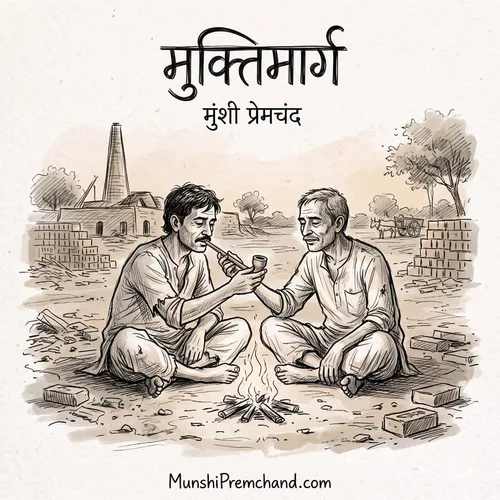
A small fire was kindled; the dough was kneaded upon the flat rock. Jhingur baked thick, uneven rotis over the iron mortar pan. Buddhu fetched cool water in an earthen pot. Sitting together in the dusk, the two ruined men ate the warm rotis with coarse rock salt and crushed red chilies.
When the meal was done, a single clay chillum was packed with tobacco. Both men stretched their tired limbs out upon the flat stone slabs beneath the open sky, passing the chillum back and forth between them.
Buddhu looked up into the darkness and said quietly: "It was I who set fire to your sugarcane."
Jhingur took a slow puff and replied with a faint, gentle smile: "I know."
A long silence descended, broken only by the crackle of the tobacco.
After some time, Jhingur looked over at Buddhu and said softly: "It was I who tied the heifer's tether among your sheep... and Harihar fed her the poison."
Buddhu took the chillum from his fingers and replied in the exact same gentle tone: "I know."
Then, having laid down the crushing burden of their hatred and their guilt, both men closed their eyes and fell peacefully asleep.
Summary of Mukti Marg (The Path to Deliverance)
Mukti Marg (The Path to Deliverance) is Munshi Premchand's profound masterpiece on rural pride, jealousy, and the self-destructive futility of mutual revenge. Jhingur Mahato, an ordinary peasant whose three bighas of sugarcane promise a bumper profit of six hundred rupees, becomes arrogant and picks quarrels with his neighbors. One evening, when Buddhu Gadariya, an equally proud and prosperous shepherd owning over two hundred sheep, attempts to herd his flock along Jhingur's field boundary to avoid a long detour, Jhingur's rage explodes. Grabbing a heavy staff, Jhingur brutally beats and cripples Buddhu's sheep. Buddhu vows revenge; that very night, he sets fire to Jhingur's field, destroying not only Jhingur's crop but the entire sugarcane harvest of the village. The village's winter economy is devastated, cattle perish, and the villagers ostracize Jhingur, blaming his arrogance for bringing ruin upon them all.
Humiliated and isolated, Jhingur resolves to destroy Buddhu in return. Rather than confronting him openly, Jhingur feigns warm friendship while Buddhu prospers, building a large new house and charging double fees for his sheep. Jhingur allies with Harihar, a ruthless Chamar headman, and concocts a deadly plot: Jhingur leaves his heifer among Buddhu's sheep to graze, and Harihar poisons the animal. Framing Buddhu for cow-slaughter (go-hatya), the village Brahmins seize the opportunity to exploit Buddhu's prosperity, imposing an unbearable penance: two months of begging as an outcaste, a pilgrimage to seven holy shrines, feeding five hundred Brahmins, and donating five cows. The shame of begging shatters Buddhu's spirit; while he is away, his flock is stolen and decimated. Desperate to fund his penance and pilgrimage, Buddhu is forced to sell his remaining sheep to a butcher for five hundred rupees, reducing himself to utter poverty. Meanwhile, Jhingur's fields are leased out, his bullocks sold, and his livelihood gone.
Months later, during the monsoon season, both ruined men meet as daily wage laborers at a city construction site building a dharamshala. Jhingur is shoveling mud and Buddhu is carrying mortar pans. Stripped of property, wealth, and pride, their enmity dissolves into shared suffering. In the evening, they scour an iron mortar pan to use as a griddle, bake coarse rotis together, share salt and red chilies, and recline on stone slabs smoking a chillum. In quiet, calm tones, Buddhu confesses to burning the sugarcane, and Jhingur confesses to framing him for the heifer's poisoning. Neither reacts with anger; each simply replies, "I know." Having relinquished the crushing burden of pride, malice, and vengeance, both men fall asleep in profound peace, having finally attained the true path to deliverance.
Publication History
Mukti Marg (मुक्ति-मार्ग) was written by Munshi Premchand and first published in Hindi in 1924. It was later anthologized in Volume 3 of Premchand's celebrated eight-volume collection Mansarovar. One of Premchand's most critically acclaimed short stories, Mukti Marg stands alongside Kafan and Poos Ki Raat as an enduring portrait of rural peasant psychology, exposing how social hierarchies, economic vulnerability, and institutional religion interact to ruin ordinary human lives.
This unabridged English translation was published in 2026 by MunshiPremchand.com as part of the MunshiPremchand.com English Translation Series.
Themes & Critical Significance
- The Destructive Spiral of Ego and Revenge: The story presents an unsparing analysis of how a minor boundary dispute escalates into catastrophic ruin. Jhingur's initial brutality invites Buddhu's arson; Buddhu's arson provokes Jhingur's poisoned conspiracy. Each act of retaliation creates a justification for the next, illustrating that revenge inevitably consumes both perpetrator and victim.
- Interdependence of the Rural Economy: Premchand demonstrates that a peasant's fortune is fragile and deeply entwined with the communal ecosystem. The destruction of Jhingur's sugarcane does not hurt him alone; it eliminates winter fodder, warmth, employment at the crushing mills, and health for the entire village, revealing the communal cost of private feuds.
- Religious Hypocrisy and Institutional Exploitation: The Brahmin priesthood transforms an ambiguous animal death into a lucrative industry of atonement. The oppressive penance imposed upon Buddhu—begging, pilgrimages, and lavish feasts for priests—serves not to purify the soul, but to enrich the priestly caste while economically annihilating an innocent, hard-working shepherd.
- Material Wealth as the Source of Division: Premchand observes that social vanity, arrogance, and rivalry are fueled entirely by material possessions—cows, sugarcane, sheep, and brick houses. The moment wealth disappears, the false barriers of pride dissolve.
- True Spiritual Deliverance (Mukti): The title carries profound philosophical irony. Buddhu's formal religious penance brings only degradation and bankruptcy; true mukti (liberation) is achieved only when both men confess their sins, abandon resentment, and embrace each other in shared humanity and forgiveness.