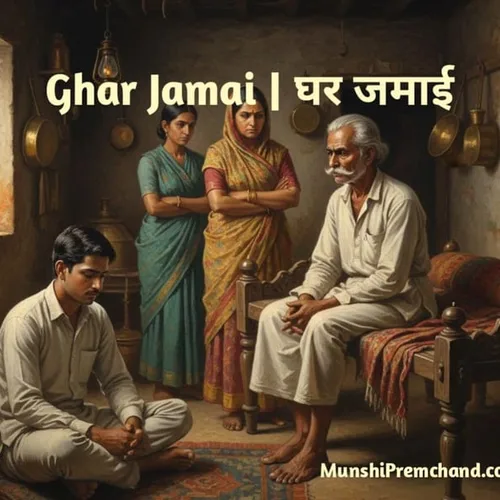
Complete English Translation: Ghar Jamai
1
Haridhan returned from watering the sugarcane fields under the blistering noon heat of late May (Jeth) and sat outside in the dusty forecourt. Smoke was visible rising from the kitchen chimney inside the house, and the sizzling crackle of frying drifted into the air.
His two brothers-in-law returned from the fields after him and walked straight into the house. The sons of both brothers-in-law also arrived and stepped inside in the same easy manner. Only Haridhan could not bring himself to enter.
For the past month, the treatment meted out to him in this house—and particularly the stinging rebuke he had been forced to endure only yesterday—seemed to have clamped heavy iron fetters upon his feet. Yesterday, his mother-in-law herself had snapped at him: "My heart is utterly fed up with you! Did I sign a lifelong contract to feed and keep you?" And most painful of all, his wife's cruel callousness had shattered his heart into fragments. She had sat there quietly, listening to that whole torrent of insults; yet not once did a word escape her lips: Mother, why are you humiliating him like this? She had sat there listening with smug satisfaction, perhaps secretly gloating over his degradation!
How could he step into that house now? To swallow the same abuses again? To suffer the same humiliating rebukes? And this was the state of affairs after ten long years of his life had been spent serving this household! Did he work any less than anyone else? While both his brothers-in-law slumbered in sweet, peaceful sleep, he was up at the crack of dawn, feeding and watering the oxen, chopping dry fodder. Out in the fields, while everyone else stopped every few moments to puff on the hookah, he kept his eyes lowered and toiled relentlessly. In the evening, when the men of the house went strolling off to sing songs and listen to music, he stayed behind milking the cows and buffaloes late into the night. And the reward he received for all this was that no one even bothered to ask him if he had eaten! Instead, insults and curses were heaped upon his head.
His wife emerged from the house carrying a brass bucket and called out, "Go draw some water from the well. There isn't a single drop left."
Haridhan took the bucket and drew water from the deep well. He was ravenously hungry, and assumed that now she would call him inside to eat. But having carried the bucket inside, the woman stayed there as though she belonged nowhere else. Exhausted, crushed, and tormented by hunger, Haridhan lay down on the ground and drifted into sleep.
Suddenly, his wife Gumani came out and shook him awake.
Lying on the ground, Haridhan muttered, "What is it? Will you not even let me lie here in peace, or do you need more water?"
Gumani retorted in a caustic voice, "Why are you growling at me? I came only to call you for your meal."
Haridhan looked past her and saw both his brothers-in-law, along with the two sons of the elder brother, strolling out of the house, having finished a hearty meal. His entire body caught fire!
So my condition has deteriorated to this! I am no longer permitted even to sit and eat alongside these people! They are the masters, and I am merely a beggar waiting to lick their soiled plates! I am their stray dog, thrown a crust of dry bread after they have eaten their fill!
This was the very house where, ten years ago, he had been greeted with such boundless reverence and honor! His brothers-in-law had waited on him like humble servants; his mother-in-law had watched his countenance for the slightest wish; his wife had worshipped him like a deity! In those days, he possessed wealth, coins, and ancestral property. Now he was a pauper; all his wealth had been squandered away into dust by these very people. And now he was forced to beg for a crust of bread! A blazing fury flared up within his soul—an urge to storm inside that very second and thoroughly drench his mother-in-law and brothers-in-law in blistering truths. But he choked down his rage.
Remaining on the ground, he muttered, "I have no hunger today. I shall not eat."
Gumani sneered, "If you don't eat, what is that to me? To the devil with it! If you eat, the food will go into your stomach, not mine!"
Haridhan's fury dissolved into bitter tears. This is my wife, for whose sake I reduced my all to dust! Having turned me into an utter fool, they now wish to kick me out into the street. Where am I to go now? What am I to do?
His mother-in-law came out and snapped, "Why don't you come inside and eat, man? Over whom are you throwing tantrums? Nobody here has the strength to pamper your delicate whims! If you don't want to work, don't work—what more can you do? We married our daughter to you; we didn't sign a contract to feed you for your entire life!"
Deeply wounded to the core of his being, Haridhan said, "Yes, Mother, it was my foolish mistake that I believed so. What do I possess now that you would take a contract for my life? When I had wealth, everything was at my feet. Now that I am a pauper, why should you care about my existence?"
Puffing her cheeks in annoyance, the old woman turned on her heel and strode back inside.
2
For children, a father is an extra luxury—an indulgence, like roasted grams for a horse or rich mohanbhog sweetmeat for wealthy gentlemen. A mother is staple dal-roti. If a person does not taste mohanbhog his whole life long, what loss does he suffer? But let dal-roti disappear for a single day, and look at the misery that follows!
A father's face is glimpsed occasionally in the morning or evening; he bounces the child in the air, fondles him, lifts him into his lap or takes him for a stroll holding his finger, and that is the end of his duty. If he departs for a foreign land, the child scarcely cares; but a mother is the child's entire universe. A child cannot bear separation from her for even a single minute. The father may be anyone, the child is indifferent—any man who plays and leaps about will do; but a mother must be his very own, sixteen annas in the rupee his own—the same face, the same touch, the same love, the same everything. If she is gone, the fountain of the child's life withers away; thereafter he is like Lord Shiva's stone bull, Nandi, upon whom offering flowers or water is entirely a matter of discretion, not an obligation.
Haridhan's mother had passed away ten years ago. At that time, he was already married, a strapping youth of sixteen. Yet the moment his mother died, he discovered how utterly helpless he was, as though he had no claim left upon anything in the world. His sisters were already married and gone; he had no brother. The poor lad feared even entering the house alone. He wept for his mother, yet was terrified of her phantom shadow. Toward the small chamber where she had breathed her last, he dared not even lift his eyes.
There was an aunt in the house who pampered Haridhan with great affection. Haridhan now received more milk to drink and had to perform less labor. The aunt would ask him tenderly time and again, "Son, will you eat something?" His father, too, showered him with greater love; he purchased an extra cow exclusively for his son, and occasionally slipped coins into his hand to spend as he pleased. Yet these salves could not heal the deep wound that had lacerated his soul. This pampering and indulgence merely served to remind him of his mother all the more.
Did this coddling possess the exquisite joy of a mother's scoldings? Did this charity hold the supreme delight of begging from one's mother, quarreling with her, whining, throwing tantrums, and wringing sweet treats from her hands? Previously, he had been healthy, demanding food with a fight, eating heartily after a quarrel; now he was an invalid, offered the finest delicacies on a platter, yet devoid of appetite.
For an entire year he lingered in this despondent state. Then the world altered. A new woman—whom people called his mother—entered the house, and within days, like a dense dark cloud, she overshadowed his small universe. Over all the greenery, over all the light, a heavy veil of darkness descended. Haridhan never spoke a word to this artificial mother; he never once went near her.
One day, he walked out of his home and went away to his in-laws' village.
His father summoned him repeatedly, but so long as his father lived, Haridhan never set foot inside that house again. On the day he received the news of his father’s demise, he felt a peculiar, jealous joy rather than grief; not a single tear fell from his eyes.
Entering this new world at his in-laws', Haridhan once again tasted the joy of maternal affection. Like the blessing of an ancient sage, his mother-in-law filled his empty, barren life with warmth and abundance. In the arid desert, lush green sprouted anew. In the playful banter of his sisters-in-law, the tender love of his mother-in-law, the lively wit of his brothers-in-law, and the affection of his young wife, all the yearnings of his heart found fulfillment.
His mother-in-law would say, "Son, consider this house your own. You are the apple of my eye!" She would confide in him, complaining about the faults of her own sons and daughters-in-law. In his heart, he truly believed: Mother-in-law loves me far more than her own sons!
Upon his father's death, he went back to his native village, liquidated his entire ancestral inheritance into hard cash, and returned carrying a heavy sack of silver coins. Now, his prestige and honor doubled! Placing his entire worldly fortune at the feet of his mother-in-law, he felt his life had found its ultimate purpose.
Until then, memories of his ancestral home occasionally flickered in his mind; now, he never recalled it even by mistake, as though it were some horrific tragedy of his past that was best forgotten. He was the first to rise in the morning, the one who laboured the hardest; seeing his dedication and tireless toil, the villagers bit their fingers in astonishment, praising the good fortune of his father-in-law for having acquired such an exemplary son-in-law!
Yet as the years rolled by, his honor and respect steadily eroded. First he was a god; then an accepted member of the household; and finally, the unpaid slave of the house. Obstacles were placed even in the way of his daily bread. Insults began to rain down upon him. Had the members of the family been starving and he had been forced to starve alongside them, he would not have harbored the slightest grievance. But when he saw everyone else twirling their mustaches in contentment while he alone was treated like a fly in the milk, a long, cold sigh would escape from the depths of his soul.
He was barely twenty-five years old. How was a whole lifetime to be spent in this house? And worst of all, his own wife had averted her eyes from him. That was the cruelest cut in his calamity.
3
While Haridhan lay outside, hungry, parched, and burning in the fire of humiliation, inside the house his mother-in-law and both brothers-in-law were conversing, with Gumani chiming in with nodding agreement.
The elder brother-in-law sneered, "He tries to place himself on an equal footing with us! He doesn't understand that no one took a contract to keep him for life. Ten years have passed! In all these years, has he not devoured two or three thousand rupees?"
The younger brother remarked, "If he were a hired laborer, a man could scold him, reprimand him, push him around; but what can anyone say to a gentleman like him? Heaven knows whether we shall ever be rid of him or not! In his heart he must believe: Did I not give two thousand rupees? He doesn't realize that his two thousand vanished into thin air long ago. A seer and a quarter of flour is required for his single meal alone!"
The mother-in-law remarked gravely, "His appetite is truly monstrous!"
Gumani, who was picking lice from her mother's hair, spoke up with a smoldering heart: "What other work does an idle man have, except gorging on food?"
The elder brother said, "The food is of no consequence. Let a man eat according to his appetite; but he ought to earn something too! He doesn't realize that no one can spend his whole life playing the honored guest (pahunai)!"
The younger brother added, "One of these days I shall tell him plainly: 'Take yourself off down your own road; we are not indebted to you!'"
Listening to her family's endless jibes, Gumani had developed a deep hostility toward her husband. Had he gone out and earned money, bringing home wealth, how much respect he would have commanded in this house, and she would have lived like a queen! For some reason, the mere thought of going out to earn seemed to kill his spirit.
Gumani's mental outlook was still entirely childlike. She possessed no independent home of her own; the welfare and interests of her parents' household were paramount to her. She thought in the very terms and saw the problem through the very eyes of her natal family. In truth, could two thousand rupees purchase a man's lifelong lodging? What were two thousand rupees over ten years? Barely two hundred a year! Could two grown people survive on less than two hundred a year? Then there were clothes, fabrics, milk, ghee, everything! Ten years had passed, and not even a brass ring had been made for her. When he had to step beyond the village boundary, it was as though his life-breath departed from him. He assumed that because he had been worshipped like a god in the beginning, he would continue to be worshipped for a lifetime!
He failed to realize that what held true in the beginning does not hold true forever. When a young bride first enters her in-laws' home, how immense is her prestige! The moment she steps out of the palanquin, drums and trumpets sound, women of the neighborhood gather to behold her face, bestowing coins upon her. For months she receives the finest food and clothing in the house, and not a stroke of work is demanded from her; yet after six months, no one even looks at her, and she becomes the maidservant of the whole household. In his house, my fate would have been precisely the same! Then why all this weeping and wailing? And if you say, 'I work hard,' that is your foolish mistake—a hired laborer is entirely different. A master scolds a laborer, strikes him, keeps him when he pleases, dismisses him when he pleases, and extracts hard labor from his bones. It is not as though whenever he feels like it he works, and whenever he feels like it he lies down to sleep!
4
Haridhan was still lying outside, smoldering within, when both brothers-in-law walked out. The elder brother called out, "Brother, get up! The third quarter of the day is passing; how long will you lie sleeping? The entire field lies waiting to be tilled."
Haridhan sat up abruptly and snapped in a sharp voice, "Do you take me for an utter fool?"
Both brothers-in-law were struck dumb with astonishment. For a man who had never uttered a word of protest, who had always stood before them with folded hands like a submissive slave, to suddenly exhibit such fierce pride was enough to shock them out of their wits. No reply came to their lips.
Seeing that both had lost their footing, Haridhan could not restrain the powerful urge to deliver another blow. In the same biting tone, he cried: "I too possess eyes! I am neither blind nor deaf. I break my chest toiling for this house, and in return I am treated like a stray dog? If you search the world, where else will you find such donkeys?"
Now the elder brother-in-law lost his temper as well. "Has anyone tied you here against your will?"
This time it was Haridhan who was struck speechless; no answer came to his mind.
The elder brother continued in the same cutting tone: "If you desire to remain an honored guest for the rest of your life and expect the same worship to continue forever, that is beyond our power to grant!"
Haridhan glared at him with burning eyes. "Do I do any less work than you people?"
"Who says that you don't work?"
Haridhan demanded, "Then is it the code of your household that whoever toils the hardest must be starved to death?"
The elder brother retorted, "You didn't go inside to eat yourself! Was someone supposed to place the morsel into your mouth?"
Biting his lip, Haridhan said, "Are you not ashamed to claim that I didn't go in to eat myself?"
"Did my sister not come out to call you?"
The younger brother chimed in, "Mother came out as well! When you told her you had no hunger, what was she supposed to do?"
The mother-in-law was already hurrying out from the house. Hearing this exchange, she snapped, "I pleaded with him until I was exhausted! If a man refuses to get up, what can I do?"
In a voice brimming with venom, blood, and fire, Haridhan cried: "Am I meant to eat the leftovers of your sons? Am I a dog, that after you all have eaten your fill, you toss a scrap of dry roti before me?"
The old woman drew herself up haughtily and sneered: "Can you ever equal my sons?"
Haridhan was vanquished. With that single verbal thrust, the old woman had finished him off! His furrowed brows relaxed, the fire in his eyes died out, his quivering nostrils grew still. Like a mortally wounded soldier, he collapsed onto the earth.
'Can you ever equal my sons?' That sentence pierced deeper and deeper into his heart like a colossal spear—there was no end to his heart, nor an end to that spear!
5
The entire household ate dinner, but Haridhan did not get up. His mother-in-law coaxed him, his sisters-in-law coaxed him, his father-in-law coaxed him, and both brothers-in-law exhausted themselves with entreaties. Haridhan refused to rise. He lay at the doorway upon a tattered jute sack. Lifting the sack, he carried it away from everyone to the well, spread it across the raised masonry rim, and lay there alone.
The night deepened. In the infinite expanse of the heavens, brilliant stars were playing like children. Some were dancing, some leaping, some laughing; some winked their eyes shut only to flash open again; while some daring youth of a shooting star darted across that vast playground in a single breath, vanishing into the unknown.
Haridhan remembered his own childhood, when he too had romped and played in just this way. His childhood memories flared into brilliance like those shimmering stars. His modest little home, the mango orchard where he had gathered fallen green fruit, the dusty open fields where he had played kabaddi—all came flooding back into his mind.
Then, the gentle, radiant image of his beloved mother rose before his eyes. What infinite tenderness, what boundless compassion had shone in those eyes! It seemed to him as though his mother, her eyes brimmed with tears, was advancing toward him with outstretched arms to gather him to her bosom. He lost himself entirely in that sweet, intoxicating vision. It felt as though his mother had gathered him to her chest and was caressing his hair with her loving hands. He began to weep, weeping bitterly and uncontrollably.
In that state of self-induced trance, the words burst from his lips: "Mother, have you forgotten me so completely? Look at the miserable plight of your beloved child! No one even asks him for a cup of water! Is there no place for me where you dwell?"
Suddenly, Gumani’s voice shattered the stillness: "Have you fallen asleep? God forbid anyone should sleep such a demonic slumber! Why don't you come inside and eat? How long is someone supposed to sit waiting for you?"
Haridhan was violently wrenched from the realm of imagination back into cruel reality. There was the raised rim of the well, there was the tattered jute sack, and there stood Gumani, asking: How long is someone supposed to sit waiting for you?
Haridhan sat up abruptly, as though drawing a sword from its scabbard. "Ah! So you finally remembered me? I had already told you that I am not hungry."
Gumani asked, "Then how many days do you intend to fast?"
"I shall not drink even a drop of water in this house! Are you coming with me or not?"
Hearing these words spoken with unshakeable resolve, Gumani shrank in alarm. "Where are you going?"
In a voice charged with emotion, Haridhan demanded, "What concern is that of yours? Will you come with me or not? Do not say later that I did not ask you!"
Gumani protested, "Why don't you tell me where you are going?"
"Will you come with me or not?"
"I will not go until you tell me where!"
"Then it is clear—you do not wish to come. That was all I needed to know; otherwise, I would have been halfway down the road by now."
Saying this, he rose to his feet and began striding toward his ancestral home. Gumani kept calling after him, "Listen to me! Listen to me!"—but he did not turn his head even once to look back.
6
The distance of thirty miles was covered by Haridhan in five hours.
When he arrived before the mango groves of his native village, his maternal emotions were playing in the golden lap of the dawn. Beholding those ancient trees, his overwhelmed heart began to dance. Catching sight of the golden spire of the village temple, he ran toward it as though he could leap upon it in a single bound! He ran with such furious momentum as though his mother were calling him with outstretched arms.
Reaching the mango orchard—where, perched upon the sturdy branches, he had once enjoyed the thrill of riding an elephant, where the wild berries and unripe fruit had possessed a heavenly sweetness—he sat down, pressed his forehead against the earth, and wept bitterly, as though pouring out the entire tale of his woes to his departed mother. In the morning air, in the golden sunlight, his mother’s colossal spiritual presence seemed to permeate everything; every inch of that sacred soil was sanctified by her footprints, and her words of maternal tenderness still seemed to echo through the sky.
There was some miraculous, life-giving elixir in that air and sky that flooded his grieving, broken heart with childlike vigor! He climbed up into a tree and began plucking and devouring raw mangoes straight from the branches. His mother-in-law's cruel words, his wife's callous blow, the crushing mountain of insults—he forgot them all! His feet were swollen, the soles of his feet burned like fire, yet in this sublime ecstasy, he was oblivious to all pain.
Suddenly, the orchard watchman shouted from below: "Who is that perched up there? Climb down this instant, or I shall fling a stone that will knock you cold on the spot!"
The watchman hurled several choice abuses along with the threat. Yet in those scoldings and abuses, Haridhan found a strange, otherworldly delight. Hiding behind the thick foliage, he snapped off several mangoes, tossed them to the ground, and burst into a boisterous, ringing laugh. He had not laughed with such pure, carefree merriment in years!
The watchman found that laughter strangely familiar. Yet how could Haridhan be here? He is busy breaking bread at his in-laws' home! What a cheerful lad he used to be, how full of mischief! Heaven knows what has become of the poor fellow. He used to leap straight from the tree branch into the pond. Who in this village has such daring anymore?
Shouting sternly, the watchman warned, "If you sit there laughing, I shall come up and knock all the laughter out of you! Climb down quietly!"
He was about to hurl another curse when a mango stone struck him right on the head. Rubbing his head, he growled, "Who is this devil? You won't listen? Just wait, I am coming up to teach you a lesson!"
Setting his wooden staff against the trunk, he scrambled up the tree like a monkey. Reaching the branch, he found Haridhan sitting there smiling.
Astonished, he cried: "Arre, Haridhan! When did you arrive here? How long have you been sitting in this tree?"
The two childhood friends embraced warmly right there upon the branches.
"When did you come? Come along, let us go home, brother! Were you not even able to get mangoes at your in-laws'?"
Haridhan smiled and replied, "Mangru, the flavor that resides in these mangoes is not to be found in the mangoes of any other land! Tell me, how are affairs in the village?"
Mangru said, "All is peaceful, brother! But you severed all ties with us. Does anyone abandon their ancestral home like this? Ever since your father died, the entire household has fallen into ruin. There are two little boys; what can they manage by themselves?"
Haridhan replied, "Brother, what concern do I have with that household now? I have already taken and settled my share. Can I not find wage-labor here? I shall graze your cows for you; just give me enough to eat."
Mangru looked at him in disbelief. "Arre, brother, what nonsense are you speaking? My very life is at your service! Will you no longer live at your in-laws'? Have no fear. First of all, your own home is waiting for you. Take charge of it. There are little children to be raised. You feared your new stepmother for nothing; the poor woman is exceedingly gentle. Treat her as your own mother, and she will be overjoyed to have you back! By the way, will you be bringing your wife here as well?"
Haridhan declared firmly, "I shall never look upon her face again! For me, she is dead."
Mangru said, "Then we shall arrange another marriage for you! This time I shall find you such a wife that you will wash her feet and drink the water! But what if the first one comes back?"
Haridhan replied, "She will never come."
7
When Haridhan reached his ancestral house, both his little stepbrothers came running inside, crying, "Bhaiya has come! Bhaiya has come!"—to deliver the news to their mother.
The moment he stepped across the threshold, Haridhan experienced such a serene, majestic sanctity as though he were sitting once again in his own mother's lap. The hard knocks and bruises of so many years had softened his heart. Where formerly there had been pride, stubborn insistence, and arrogance, there was now humility, defeat, and supplication. The fever of his old rebellion had subsided; now even a simple remedy could take effect. The fortress walls had crumbled; to enter within was no longer unbearable. That very home from which he had once turned away in bitter alienation was now standing ready to embrace him with open arms. Finding this shelter, Haridhan's unmoored soul felt profoundly content.
In the evening, his stepmother said, "Son, you have returned home, and our great fortune has awakened! Now, raise these little children. Even if there is no bond of the mother between us, the bond of the father remains. Just give me a dry piece of bread, and I shall lie peacefully in a corner. Your mother was like an elder sister to me; by that tie as well, are you not my own son?"
Haridhan's mother-hungry eyes beheld the living spirit of his own mother reflected in his stepmother's face. In every corner of the house, memories of his mother were scattered like soft moonlight, and his stepmother's mature countenance was illuminated by that very radiance.
The following morning, Haridhan hoisted the wooden plow upon his shoulder and set out for the fields.
Upon his countenance shone boundless joy, and in his eyes gleamed proud dignity. He was no longer a dependent clinging to someone else's charity; he was the provider! He was no longer a beggar waiting outside another man's doorway; he was the master and protector of his own home!
Some time later, news reached the village that Gumani had remarried—she had "made another home."
Haridhan went to his stepmother and said, "Did you hear, Kaki? Gumani has taken another husband."
Kaki exclaimed in outrage, "Made another home? Is it a joke? Such lawlessness in our community? Even if there is no panchayat, are the courts closed?"
Haridhan laughed and said, "No, Kaki, it is wonderful that it happened! Come, give me a few annas to offer sweets at the shrine of Lord Mahavir! I was terrified in my heart that she might come and hang around my neck again. God has heard my prayer! I left that house with the firm vow never to look upon her face again."
Summary of Ghar Jamai
'Ghar Jamai' (The Resident Son-in-Law) is Munshi Premchand's poignant rural masterwork on the perils of economic dependence, the fragility of familial affection tied to material wealth, and the reclamation of male dignity through self-reliant agricultural labor.
The narrative centers on Haridhan, a young peasant who loses his beloved mother at the age of sixteen. Deeply traumatized and alienated by his father's remarriage, Haridhan leaves his ancestral village to live with his in-laws. Welcomed with open arms by his mother-in-law, sisters-in-law, brothers-in-law, and wife Gumani, Haridhan believes he has found a surrogate maternal home. Upon his father's death, he liquidates his entire ancestral inheritance into cash and places the money at his mother-in-law's feet.
However, over the next decade, as his money is exhausted, Haridhan's status plummets from an honored deity to a household member, and finally to an unpaid domestic slave. Though he toils harder than anyone else—hauling water, watering sugarcane under the scorching Jeth sun, and milking cattle late into the night—he is denied food until everyone else has eaten, forced to survive on cold leftovers, and subjected to constant verbal abuse from his mother-in-law and brothers-in-law. Even his wife Gumani sides with her family, regarding him as an idle burden.
When his mother-in-law cruelly asks, "Can you ever equal my sons?", Haridhan's illusions are shattered. Refusing to eat, he spends the night beside the village well under the stars, experiencing a profound mystical communion with the spirit of his dead mother. Realizing that true dignity cannot be found in another's house, he asks Gumani to accompany him. When she hesitates, he abandons the in-laws' home and walks thirty miles through the night back to his ancestral village.
At dawn, embraced by the familiar mango orchards and reunited with his childhood friend Mangru, Haridhan returns to his family home. His stepmother welcomes him warmly, asking him to take charge of his younger stepbrothers. Reclaiming his ancestral plow, Haridhan rediscovers his independence as a provider rather than a beggar. When news arrives that Gumani has remarried, Haridhan rejoices, offering sweets to Lord Hanuman in thanksgiving for his complete emotional liberation.
Publication History
'Ghar Jamai' (घर जमाई) was written by Munshi Premchand in 1922 and published in leading Hindi literary periodicals before being collected in Mansarovar, Part 1 (मानसरोवर भाग 1).
The story stands as one of Premchand's most celebrated sociological portraits of rural North Indian domestic dynamics, dissecting the institution of the resident son-in-law (ghar jamai) and examining the psychological impact of maternal loss and economic dependency.
This unabridged English translation was published in 2026 by MunshiPremchand.com as part of the MunshiPremchand.com English Translation Series.
Themes & Critical Significance
- The Illusion of Conditional Affection: Premchand exposes how family affection in a feudal agrarian society is frequently tethered to material wealth. Haridhan is worshipped so long as he possesses money; once his resources are exhausted, his tireless physical labor is taken for granted, and he is demoted to a despised dependent.
- The Psychology of the 'Ghar Jamai': In traditional Indian patriarchy, a woman enters her husband's household as a dependent; 'Ghar Jamai' inverts this dynamic by placing a man in a wife's natal home. Premchand illustrates how economic dependence emasculates and degrades an individual regardless of gender, rendering him vulnerable to domestic tyranny.
- The Primacy of Maternal Love: The narrative contains Premchand's famous philosophical reflection on parenthood: a father is a luxury (mohanbhog), but a mother is essential sustenance (dal-roti). Haridhan's tragic trajectory stems from his desperate attempt to find a substitute for his lost mother, a quest that ends only when he reconciles with his ancestral soil and his stepmother.
- Self-Reliance and the Dignity of Labor: Agricultural labor is agonizing when performed as unpaid servitude for ungrateful in-laws, yet becomes a source of boundless pride and joy when performed on one's own land. Hoisting his plow at dawn, Haridhan transforms from an unwanted beggar into an autonomous provider, demonstrating Premchand's core belief in peasant self-sufficiency.
- Unsentimental Liberation: The conclusion avoids conventional melodrama. When Gumani remarries, Haridhan seeks neither vengeance nor reconciliation; instead, he offers sweets at a temple, recognizing that severed ties can be the ultimate gateway to spiritual peace and personal freedom.