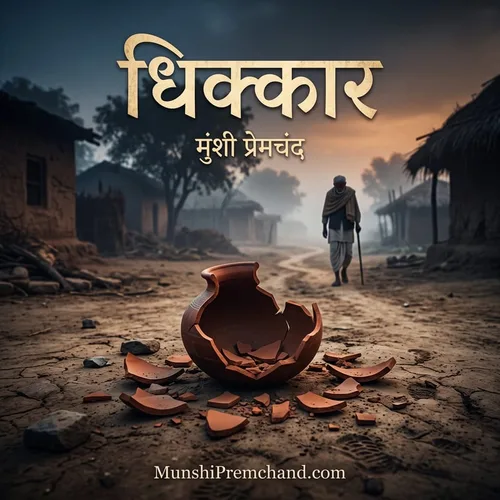
Complete English Translation: Dhikkar (Condemnation)
For the orphaned widow Mani, there remained no refuge or solace in life except her own bitter tears. She was barely five years old when her father departed this world. Her mother somehow struggled and brought her up through years of crushing hardship. When she turned sixteen, with the generous assistance of the neighborhood community, her wedding was solemnized. But within that very year, both her mother and her husband departed from the earth, leaving her completely destitute.
In this ocean of misfortune, she saw no soul who might offer her shelter save her paternal uncle, Vamshidhar. From the past conduct of Vamshidhar, there was little reason to hope that she would ever live in his household with peace or honor. Yet Mani was prepared to endure anything, to submit to everything. She would bear abuse, scolding, insults, and even physical beatings without a murmur—so long as no one cast suspicions on her chastity, so long as no slanderous stains were hurled at her character, and so long as she remained shielded from the predatory gazes of neighborhood scoundrels and rakes. On his part, Vamshidhar was burdened by some vague concern for family prestige and caste honor; he could not bring himself to refuse Mani's desperate plea.
Within two or three months, however, it became painfully evident to Mani that she could not survive in that house for very long. She performed all the domestic labor of the household, danced to every whim and whisper of the family, and exerted every ounce of her strength to keep everyone pleased; yet for reasons unknown, both her uncle and aunt burned with ceaseless malice toward her. The moment she set foot in the house, the maidservant was dismissed. A boy who had been employed for washing and cleaning was also sent away. But despite saving them so much household expenditure, uncle and aunt continually wore scowling faces. Sometimes the uncle roared with insults, sometimes the aunt showered her with venomous curses, and even her younger cousin Lalita hurled abuses at her over the pettiest trifles.
In the entire house, only her cousin Gokul felt any genuine sympathy for her. In his words alone could one detect a faint warmth of human affection. Gokul knew his mother's savage temper only too well. If he ever attempted to reason with her or openly took Mani's side, Mani's life in that house would have become unbearable for even a single hour. Consequently, his sympathy remained confined to offering Mani words of quiet solace in private. He would say: "Sister, only let me secure employment somewhere, and an end will come to your sufferings! Then I shall see who dares cast a crooked glance at you. Your bad days will last only as long as my studies continue." Hearing these tender, loving words, Mani's heart would swell with joy, and every pore of her being would pour forth blessings upon Gokul.
Today was Lalita's wedding day. From the crack of dawn, guests had begun pouring into the house. The entire house resonated with the merry clinking of gold and silver jewelry. Mani too felt a surge of joy as she watched the guests arriving. There was not a single ornament upon her body, nor had she been provided with fine clothes, yet her countenance beamed with innocent delight.
Midnight had passed. The auspicious moment for the wedding rituals was drawing near. From the wedding pavilion where the groom's party was lodged, the ceremonial gifts and bridal offerings arrived. All the women gathered around in eager excitement to examine the silks and ornaments. Lalita was being dressed in her glittering bridal jewels. A powerful yearning arose in Mani's heart to catch a glimpse of the bride. She could not restrain her desire to behold her little sister, who was just a carefree child yesterday, transformed into a resplendent bride today.
Smiling timidly, she stepped into the room.
Suddenly, her aunt turned around and barked at her with fierce contempt: "Who invited you in here? Get out of here at once!"
Mani had endured countless insults and bitter hardships in her life, but that vicious rebuke pierced her heart like a poisoned arrow today. Her own conscience seemed to rise up in mocking condemnation: This is the rightful reward for your shallow, shameless curiosity! What business had an inauspicious widow among auspicious married women?
Humiliated and crushed, she retreated from the room and hurried upstairs to weep in seclusion.
On the staircase, she collided with Indranath. Indranath was Gokul's classmate and dearest friend. He had come as an invited guest to the wedding and had just ascended the stairs in search of Gokul. He had seen Mani on a couple of occasions before and was well aware of the cruel treatment meted out to her in that household. The aunt's cutting words downstairs had reached his ears as well. Seeing Mani rush upstairs in tears, he understood the anguish of her heart and followed her to offer comfort. But the door of the upstairs room was locked from within. Peering through the crevice of the door panel, he saw Mani standing beside the table, weeping inconsolably.
He whispered softly: "Mani, please open the door."
Hearing his voice, Mani shrank into a corner and asked in a strained voice: "What do you want?"
Indranath pleaded with deep emotion: "I beg of you, Mani, please open the door!"
Such an entreaty, dripping with genuine tenderness and respect, was entirely unprecedented in Mani's life. That anyone in this merciless world could ever plead with her with such reverence was something she had never imagined even in her wildest dreams. With trembling hands, she unlocked the door.
Indranath rushed into the room. His eyes caught sight of a thick hemp rope hanging from the iron ring of the ceiling fan! His heart leaped into his throat with horror. Instantly pulling a pocketknife from his coat, he severed the noose and cried: "What were you about to do, Mani? Do you realize what punishment awaits such a desperate act?"
Mani lowered her head and answered in a choked whisper: "Can any punishment be more terrible than the punishment I endure every waking day? When people shrink in disgust from the mere sight of my face, if God inflicts severe punishment even for seeking death, then I can only say that in the court of God, there is no such thing as justice! You cannot fathom the agony of my existence."
Tears welled up in Indranath's eyes. What bitter, undeniable truth was packed into her words!
He said: "These dark days will not last forever, Mani. If you believe there is no one in the world who cares for you, you are deeply mistaken. There is at least one man in this world to whom your life is far dearer than his own breath!"
Just then, Gokul was seen coming up the stairs. Mani slipped out of the room at once. Indranath's words had stirred a tempest within her soul. What could his words possibly mean? She could not fathom it. Yet for the first time in many years, her existence felt meaningful. Into the dark abyss of her life, a ray of celestial light had dawned.
Seeing Indranath sitting there and Mani hurrying out of the room, Gokul felt a sudden twinge of suspicion. His brow darkened, and he demanded in a sharp tone: "When did you come up here?"
Indranath replied with undisturbed composure: "I came up searching for you. When I didn't find you, I was about to return downstairs. Had I walked away, you would have found this room bolted from inside and a corpse dangling from that iron ring."
Gokul suspected that his friend was concocting a convenient excuse to conceal an improper encounter. In a bitter voice, he said: "I never expected that you would commit such treachery in my house!"
Indranath's face flushed crimson with righteous indignation. He sprang to his feet and said: "Nor did I ever expect that you would fling such a foul accusation at me! I did not know that you considered me so vile and deceitful. Mani may be an object of contempt to your household, but to me she is an object of profound reverence, and so she shall always remain! I owe you no apologies or explanations, but Mani is far more pure and sacred in my eyes than you can ever conceive!
I had not intended to speak of these matters today; I was waiting for a more favorable opportunity. But since circumstances have forced my hand, I must speak plainly. I knew that Mani received no honor in your house, but that your family regarded her as so utterly vile and untouchable was something I learned only today, hearing your mother's venomous words downstairs! Merely because she stepped into the room to look at the bridal jewelry, your mother lashed out at her with words one would not throw even at a stray dog! You will ask, what could you do? What power had you?
I tell you, in a house where an orphaned, helpless woman is subjected to such savage cruelty, even to drink a drop of water is a sin! If you had firmly reasoned with your mother on the very first day, matters would never have come to this horrifying pass. You cannot escape your share of the blame! Today is a day of celebration in your home, and I cannot enter into discussions with your parents; but I have no hesitation in declaring to you that I would consider myself blessed to make Mani the companion of my life! I had intended to secure my own position first before making this proposal, but I fear that any further delay might cost Mani her life. Therefore, to relieve you and your family of this burden forever, I place this proposal before you today!"
Gokul had never felt such boundless reverence for Indranath as he felt at that moment. He was overwhelmed with shame for having doubted his friend. He realized with a heavy heart that out of fear of his mother, his passivity regarding Mani had been nothing less than sheer cowardice.
Feeling deeply humbled, he murmured: "If Mother rebuked Mani for that, it was sheer foolishness on her part. I will question her the moment an opportunity arises."
"The time for questioning and arguing is long past," Indranath said firmly. "I want you to consult Mani on this matter and let me know her decision. I do not want her to remain under this roof for even a single moment longer. Today I discovered that she possesses a fiercely sensitive and proud spirit; and to tell you the truth, I am utterly enchanted by her noble nature. Such a woman cannot endure perpetual degradation."
Gokul asked hesitantly: "But... you know that she is a widow?"
Whenever someone witnesses extraordinary generosity bestowed upon them, they instinctively lay bare all their perceived defects, wishing to show that they are unworthy of such grace.
Indranath smiled gently. "I know it; I have heard it all, and that was the sole reason I hesitated to approach your father directly. But even had I not known it, it would not have altered my resolve by a hair's breadth. Even if Mani were not merely a widow, but an untouchable, or something even lower if such a thing exists, to me she would still be a priceless gem among women! We search high and low for experienced, tested individuals for the pettiest tasks of life; yet when it comes to the lifelong journey of marriage, we consider experience to be a flaw! I am not one of those hypocrites who strangle justice. There is no university on earth that teaches wisdom like the school of adversity. A person who has earned a degree in that harsh school can be trusted with the reins of life without a moment's anxiety. In my eyes, for a woman to have suffered widowhood is not a blemish; it is a virtue!"
Gokul asked: "And what of your own family?"
Indranath replied with calm confidence: "I do not consider my family so foolish as to raise objections in this matter. But even if they do, I prefer to keep my destiny in my own hands. My elders possess countless claims upon me, and in most matters I revere their wishes as law; but in a matter that concerns the moral and spiritual fulfillment of my own soul, I will bow to no man. I wish to savor the proud joy of being the architect of my own life!"
Gokul asked with a lingering doubt: "And what if Mani does not consent?"
Indranath brushed the doubt aside. "You are speaking like a child, Gokul. It is natural that Mani will not agree easily. She will endure kicks, insults, and abuses in this house, yet cling to it; the deep-seated conditioning of centuries cannot be erased overnight. But we must persuade her. We must purge these accumulated superstitions from her mind. I am not an advocate of widow remarriage for the mere sake of it. I believe that the transcendent ideal of lifelong fidelity is a priceless treasure of the world, and we must ponder deeply before disturbing it. But in Mani's case, that question does not even arise! True love and devotion are offered to a living human being, not to an empty name or an abstract ritual! How could she love a man whose face she never even had the chance to behold? It was nothing more than an empty ceremony. We must pay no heed to such hollow pageantry. Listen, someone is calling you downstairs. I must leave now. I will see you in two or three days; but do not let hesitation delay your decision, lest time slip away."
Gokul threw his arm around his friend's shoulder and said: "I will come to your house myself the day after tomorrow."
The wedding party had departed, and all the guests had taken their leave. It was nine o'clock at night. The deep sleep that follows a grand wedding is legendary; exhausted by days of turmoil, everyone in the house had fallen asleep at dusk. Some lay on cots, some on wooden platforms, some on mattresses spread across the floor—wherever each found space, there they slumbered. Mani alone was still awake, tidying up the kitchen and watching over the household. Upstairs, Gokul was sitting in his room reading a newspaper.
Presently, Gokul called out: "Mani! Bring me a glass of cold water, please. I am thirsty."
Mani carried a glass of water upstairs, placed it upon the table, and turned to leave.
Gokul said: "Wait a moment, Mani. I have something important to say to you."
Mani said: "I have no leisure right now, brother. The whole house is fast asleep. If a thief slips inside, not even a brass pot will remain."
Gokul said: "Let them slip inside! If I were in your place, I would have colluded with the thieves and had the entire house looted! Listen, I must meet Indranath tonight; I gave him my word. Do not be shy, and give me a swift answer to what I ask. If I am late, he will be beside himself with anxiety. You know that Indranath loves you, do you not?"
Mani turned her face away, blushing deeply. "Did you call me upstairs to speak of such things? I know nothing of it."
Gokul said: "Well, let that remain between the two of you. He wants to marry you. The ceremony will be performed according to sacred Vedic rites. Do you accept?"
Mani's head sank with overwhelming shame. Not a word could escape her lips.
Gokul continued gently: "Father and Mother have not been informed of this, and you know the reason why. They would rather torment you and burn you with cruel scoldings until you die, but they would never consent to your marriage! To them, it would be an intolerable loss of prestige. Therefore, the decision rests entirely with you. As for me, I believe you ought to accept. Indranath loves you with all his heart; moreover, he is a man of spotless character and immense courage. Fear has never touched him. To see you happy and honored will bring me true, everlasting joy."
A powerful surge of emotions rushed through Mani's chest, but her voice failed her.
Gokul spoke with slight impatience: "Mani, this is no time for silence! What are you thinking?"
In a faint, trembling whisper, Mani uttered: "...Yes."
The heavy burden was lifted from Gokul's heart. A bright smile broke across his face. Overcome with modesty and confusion, Mani fled from the room.
The following evening, Gokul said to his mother: "Mother, there is a major religious ceremony at Indranath's house today. His mother was worrying alone about how all the work would be managed, and I promised that I would send Mani over to help. If you permit, I shall take her there now; she will return by tomorrow or the day after."
Mani happened to walk into the room at that exact moment. Gokul looked at her from the corner of his eye. Mani felt as though she would sink into the earth with embarrassment, finding no avenue of escape.
His mother replied indifferently: "Why ask me? If she wishes to go, take her. It will be one less mouth to feed for two days."
Gokul turned to Mani: "Put on your clothes and get ready. We must go to Indranath's house."
Mani protested feebly: "I do not feel well today. I will not go."
Gokul's mother snapped: "Why shouldn't you go? Are you going to dig mountains there? Go and do some useful work!"
Clad in a simple white sari, Mani climbed into the horse-drawn carriage. Her heart was pounding furiously, and tears brimmed repeatedly in her eyes. Her spirit felt crushed and heavy, as though she were being led to drown in a deep, dark river.
When the carriage had traveled some distance, she pleaded with Gokul: "Brother, my heart feels strange and terrifyingly heavy. Please, I fall at your feet, let us turn back home!"
Gokul said: "Have you lost your mind? Everyone is waiting eagerly for you there, and you talk of returning?"
Mani said: "My inner soul tells me that some terrible calamity is about to occur!"
Gokul laughed: "And my inner soul tells me that you are going to become a queen!"
Mani murmured: "Why can we not wait another ten or fifteen days? Tell them Mani has fallen ill."
Gokul retorted: "Stop talking like a madwoman!"
Mani whispered: "How people will mock and laugh at us!"
Gokul replied firmly: "In performing a noble deed, I care nothing for the mockery of the world."
Mani said: "Mother will never permit you to step foot inside the house again. For my sake, you too will suffer endless abuse."
Gokul dismissed it: "I care nothing for that. Scolding is her second nature."
The carriage arrived at Indranath's residence. Indranath's mother was a wise, noble, and enlightened lady. She came out to the carriage, warmly helped the young bride down, and led her into the inner chambers with boundless affection.
When Gokul returned home, the clock was striking eleven. In his heart, there was immense joy at having accomplished a noble task, but there was also anxiety: When Mani does not return tomorrow, what answer will I give to the family? He resolved to speak the truth openly. It was pointless to hide it; if not today, then tomorrow or the day after, everything would have to be revealed. Why not confront it tonight?
With this firm resolve, he entered the house.
Unbolting the door, his mother demanded: "What kept you out so late? Why didn't you bring her back with you? Who is going to clean the hearth and scrub the pots tomorrow morning?"
Gokul lowered his head and answered steadily: "She will probably never return here, Mother. Arrangements have been made for her permanent residence there."
His mother's eyes widened in disbelief. "What nonsense are you babbling? How can she remain there permanently?"
Gokul said: "She has been married to Indranath."
His mother stood as if struck by lightning from the heavens. All control abandoned her; she lost all sense of what she was uttering. Curses, abuses, and foul epithets poured from her lips—she branded him a traitor to the family, a pimp, an illegitimate wretch!
At last, Gokul's patience was completely exhausted. His face turned crimson, his eyebrows knit in fury, and he said: "Mother, enough! I will not listen to another word! Had I committed an improper or dishonorable deed, I would have bowed my head to your slippers without complaint; but I have done nothing improper! I have done only what was my sacred duty under these circumstances, and what every honorable man ought to do! You are blinded by ignorance; you do not understand the progress of the times. That is why I listened to your abuses with patience until now.
You—and I say with deep sorrow that Father too—made Mani's life a living hell upon earth! You inflicted tortures upon her that one would not inflict upon a sworn enemy! And why? Simply because she was an orphan dependent upon your charity? Simply because she was helpless? She will never come here to endure your venom again! On the very day when our house was celebrating a wedding, wounded by a single cruel remark from your tongue, she was on the verge of hanging herself! Had Indranath not rushed upstairs at that exact second, today you, I, and the entire family would be sitting behind bars in police custody!"
His mother twisted her face with mocking venom: "Oho! Look at the noble, dutiful son who has saved the whole house from catastrophe! Splendid! First it is your cousin; in a few days, carry me off as well and tie me around someone's neck! Then your fortune will be made! This is the most lucrative trade of all—why bother studying and earning an honest living?"
Gokul shuddered as though a red-hot iron had seared his soul. In a voice trembling with agony, he cried: "May God never permit any child to be born of the womb of such a mother! To behold your face is a mortal sin!"
Saying this, he bolted out of the house into the darkness, walking blindly like a madman. A ferocious, howling wind was blowing across the streets, but to his suffocating chest, it felt as though there was not enough air left in the world to draw a single breath.
A week passed, but of Gokul there was no trace.
Meanwhile, Indranath had secured a respectable post in Bombay and had already departed for that city. Once he made proper residential arrangements there, he was to send a telegram to his mother, whereupon both mother and bride would travel to join him.
At first, Vamshidhar suspected that Gokul was hiding in Indranath's house; but when an inquiry revealed that he was not there, Vamshidhar launched a frantic search across the entire city. He visited every friend, acquaintance, and relative, but from every quarter received the same negative reply. After wandering the streets all day in exhaustion, he would return home at dusk and unleash his fury upon his wife:
"Go on, curse the boy more! Drink water and curse him from dawn to dusk! God knows whether you will ever possess a grain of sense! The wretch had gone, you should have let her go! One heavy burden was lifted from our shoulders. We could have hired a maidservant to do the scrubbing. When she wasn't here, was our household starving? Widow remarriages are happening all around us today; it is no longer an unheard-of calamity! If it were in my power, I would banish every supporter of widow marriage from the country or burn them with curses; but it is not in our power! Couldn't you even wait until I returned from the office? Did you think I would never return alive, that my funeral would take place at the office desk? You fell upon the boy like a fury, and now look what you have done! Now weep—weep your heart out!"
Dusk had fallen. Having berated his wife, Vamshidhar was pacing up and down before his front door in great agitation. Wave after wave of burning fury against Mani surged in his breast: It is because of that demoness that my entire household has been ruined! In what cursed, unlucky hour did she cross my threshold? Had she not come, why would I have to witness these terrible days? Such a brilliant, promising boy... God knows where he has wandered!
Suddenly, an old woman approached him in the twilight and said: "Babu Sahib, I have brought this letter for you. Please take it."
Vamshidhar snatched the envelope from her hand, his heart pounding with desperate hope. Perhaps Gokul had written! In the darkness, he could decipher nothing. He asked eagerly: "Where have you brought this from?"
The old woman replied: "The young lady who lives in Husain Ganj, the daughter-in-law of the gentleman employed in Bombay—she has sent it."
Vamshidhar rushed inside, lit the oil lamp, and opened the letter. It was from Mani. The letter read:
"Revered Uncle,
Please accept the humble salutations of unfortunate Mani.I was devastated beyond words to hear that brother Gokul has left home and that there is still no trace of his whereabouts. I alone am the cause of this calamity. It was my destiny to bear this dark stain upon my forehead, and so it has come to pass. That you should suffer such overwhelming grief on my account causes me unspeakable agony. Yet I have complete faith that brother Gokul will surely return home. I am departing for Bombay tonight by the nine o'clock train. Please forgive whatever offenses and wrongs I have committed, and convey my humble pranams to dear Aunt. My only prayer to God is that brother Gokul returns home safely at the earliest moment. If God wills it, I shall behold your holy feet again at brother Gokul's wedding."
Vamshidhar tore the letter into tiny shreds in a fury. He glanced at the wall clock; it was eight o'clock. Dressing in haste, he ran out into the street, hailed a horse carriage, and ordered the driver to race toward the railway station.
The Bombay Mail was standing alongside the platform. A frantic commotion reigned among the passengers. The piercing cries of vendors and porters created such a deafening din that one could scarcely hear one's own voice. Only a few minutes remained before the train's departure. Mani and her mother-in-law were seated inside a ladies' compartment.
Mani was gazing out of the window with tearful eyes. However painful the past may have been, its memories always carry a bittersweet tenderness. Today, remembering those harsh days, Mani felt an ache of longing in her heart. Who knew when she would ever see Gokul again? If only her uncle had come to the station, she would have touched his feet one last time. What if he scolded her sometimes? It was only for her own good that he rebuked her. But he would never come. How could he come? The scandal in orthodox society would be too great. God willing, she thought, whenever I return here in the future, I will surely visit him and touch his feet.
Suddenly, her eyes fell upon Lala Vamshidhar rushing down the platform.
Mani stepped down from the compartment at once and hurried toward her uncle with folded hands, intending to fall at his feet.
Vamshidhar recoiled violently, his eyes bulging with rage. "Do not dare touch me! Stay back, you cursed wretch! Having blackened our family's face, you have the shameless audacity to write letters to me? Why doesn't death take you? You have brought total ruin upon my ancestral lineage! To this day, there is no news of Gokul! It is because of you that he was driven from our home, and you still have the gall to sit upon my chest like an incubus! Was there no water left in the holy Ganga for you to drown yourself?
Had I known you were such a shameless, wanton harlot, I would have strangled you with my own bare hands on the very day you arrived! Now you have come to flaunt your hypocritical devotion before me! It is better for sinners like you to die; the earth will be relieved of a disgusting burden!"
A crowd of hundreds of curious passengers had gathered around them on the platform. Vamshidhar continued to shower her with shameless, venomous abuses. The crowd could not fathom the exact nature of the dispute, but in their hearts, every spectator inwardly cursed the cruel, raving old man.
Mani stood rooted to the stone platform like a statue carved of marble. Every shred of her dignity, self-respect, and joy was shattered into dust. She felt as though the earth should split open and swallow her whole, or that a celestial thunderbolt should crash from the heavens and extinguish her wretched existence forever! Before hundreds of staring eyes, her pride had been stripped bare. Not a single tear fell from her dry eyes; in her heart, tears had ceased to exist. In their place burned a ferocious, consuming forest fire that surged toward her brain with terrifying velocity. What life on earth, she thought, could ever be more vile, more cursed than mine?
Her mother-in-law called out anxiously from the train: "Daughter, come inside! The train is about to move!"
The train chugged out of the station. Inside the compartment, the mother-in-law said indignantly: "I have never seen such a shameless, heartless brute! I felt so enraged that I wanted to scratch his eyes out! God knows when sense will ever dawn upon these fossilized relics; they already have one foot in the grave. If his son chose to run away, what fault was it of ours? If they weren't such wicked sinners, why would such a calamity have fallen upon their heads?"
Mani did not raise her head.
Her mother-in-law spoke again: "Do not pay attention to that wretched madman, child. God will punish him."
Mani still uttered not a syllable. Perhaps she had not heard a word. Perhaps she was no longer conscious of her own physical existence. She sat staring fixatedly out of the window into the pitch-black night. What visions she was perceiving in that swirling darkness, only God knew.
The train reached Kanpur. The mother-in-law asked affectionately: "Daughter, will you eat something? Have a few sweets; it is already past ten o'clock."
Mani murmured faintly: "I am not hungry just now, Mother. I will eat later."
Presently, the mother-in-law lay down to sleep. Mani too lay down upon the berth; but her uncle's twisted, furious countenance danced continuously before her eyes, and his vicious curses rang incessantly in her ears: Ah! Am I truly so vile, so fallen, so repulsive that my death would lighten the burden of the earth? What did he say? 'If you are truly your parents' daughter, never show your face again!' No... I shall never show it again! Upon a face marked with such indelible shame, I have no desire to ever let the world look again!
The train raced through the night, slicing through the darkness.
Mani rose quietly, opened her steel trunk, took off all her silver and gold ornaments, and placed them carefully inside. Then she took out Indranath's photograph and gazed at it for a long, long time. A fleeting gleam of proud, tender light flickered in her eyes. Replacing the photograph inside the trunk, she whispered to herself:
"No, my beloved... no! I cannot permit your noble life to be stained by my cursed existence. You are like a god; you took pity upon an abandoned wretch. I was only paying the penalty for the sins of my past lives. You lifted me from the dust and pressed me to your heart. But I will never bring disgrace upon your name! You love me with all your soul; for my sake, you would willingly endure the insults, mockery, and condemnation of the entire world; but I will never allow myself to become a heavy millstone around your neck!"
The train roared onward, piercing the pitch-black void. Mani stood by the window, gazing up into the dark sky so intently that the stars seemed to fade and vanish, and in that boundless black expanse, she saw the radiant form of her departed mother—so luminous, so vivid, and so real that Mani caught her breath and closed her eyes in awe.
How much of the night had elapsed, no one knew. The sudden metallic clatter of the carriage door unlatching jolted the mother-in-law awake. The train was racing at full speed through the dark wilderness; but of Mani, there was no sign!
Rubbing her eyes, the elderly lady sat up and called out: "Daughter! Mani! Where are you?"
There was no answer.
Her heart began to pound violently. She looked at the upper berth, searched the lavatory, peered beneath the wooden benches—the bride was nowhere to be seen! She rushed to the door and stood trembling. What had happened? Who had unlatched this door? Had an intruder crept into the compartment? A wave of dizzying panic engulfed her. She secured the latch and began to weep aloud in terror. Whom could she ask? The express train would not stop for hours. She had pleaded with me to sit in the women's compartment, the old lady wept, saying I would sleep more comfortably. Is this the comfort she has given me?
Suddenly, she remembered the emergency communication cord. With all her strength, she pulled the chain repeatedly.
After several agonized minutes, the brakes screeched, and the train ground to a halt in the middle of the desolate countryside. The guard rushed over with a lantern. Several passengers from adjoining carriages hurried to the scene. They searched the entire compartment thoroughly. They examined the floorboards under the lantern light; there was not a trace of blood. They inspected the baggage—bedrolls, trunks, jewel cases, brass utensils—everything was completely intact and locked. Nothing was missing. Had an intruder entered, where could he have vanished from a speeding train? It was impossible for an outsider to leap from a racing train carrying an adult woman.
From these signs, the passengers and railway officials concluded that Mani must have opened the door to gaze outside into the night air, lost her grip on the handrail, and fallen onto the tracks.
The guard was a decent, conscientious man. He descended to the tracks with his lantern and searched both sides of the railway line for over a mile, but in the pitch darkness, no trace of Mani could be discovered. What more could be done in the middle of the night? The passengers gently persuaded the distraught mother-in-law to move into a general compartment. It was decided that she would alight at the next station, Lalpur, where an extensive search along the tracks would be mounted at daybreak.
In overwhelming grief, human beings become utterly dependent upon the mercy of strangers. The old woman looked from one face to another, her tear-filled, pleading eyes seeming to cry out: Why doesn't someone find my child and bring her back to me? Alas, the bridal dye upon her hands had not even faded! With what tender dreams and longing was she traveling to her husband! Won't someone go to that vile, wicked Vamshidhar and say: 'Take it, your heart's desire has been fulfilled! What you demanded has come to pass! Is your burning chest cooled at last?'
The broken mother sat weeping bitterly as the train plunged once more into the dark void.
It was Sunday evening in Bombay. Indranath was sitting on the rooftop terrace of his rented house with two or three close friends. A lively banter of laughter and teasing was underway, and the impending arrival of Mani was the merry subject of their conversation.
One friend joked: "Well, Indranath, you have tasted the preliminary waters of matrimony. What counsel do you offer us? Should we build nests of our own, or continue perching freely upon branches? If one reads contemporary journals, it seems there is precious little difference between married life and hell!"
Indranath smiled with radiant warmth. "That is entirely a game of destiny, my friend—sixteen annas a matter of fate! If under one set of circumstances married life is akin to hell, under another it is nothing less than heaven upon earth!"
The other friend teased: "But will you ever enjoy your old freedom again?"
Indranath laughed: "My old freedom? Not a hundredth part of it! If you wish to watch cinema until midnight every evening, wake up at nine in the morning, and play cards the moment you return from the office, then marriage will bring you no joy. And as for the new suit you have tailored every single month—well, you might not manage a single one in a whole year!"
"So... the mistress of the house arrives tonight?"
"Yes, by the Bombay Mail. You will accompany me to the station to receive her, won't you?"
"Is that even a question? Who goes home now? But remember, you owe us a grand feast tomorrow!"
Just then, a telegraph peon climbed the stairs and placed an urgent envelope into Indranath's hands.
Indranath's face lit up with anticipation. Tearing open the envelope, he began to read. But as his eyes scanned the words, the color drained from his face; his breath seized in his throat; his head spun violently. The light of the world seemed extinguished in an instant, as though a pitch-black curtain had dropped over the entire universe.
He hurled the telegram onto the floor before his friends, buried his face in both hands, and broke into uncontrollable, heart-wrenching weeping!
Terrified, the two friends picked up the slip of paper. As they read the brief, horrifying words, they were struck dumb with shock, staring blankly at the wall. What joyful dreams had they been weaving just moments ago, and what monstrous tragedy had struck!
The telegram read:
Mani leaped from the moving train. Her body was discovered three miles from Lalpur. I am at Lalpur. Come immediately.
One friend whispered in disbelief: "Could some enemy have sent a malicious falsehood?"
The other murmured: "Yes... people sometimes play cruel pranks..."
Indranath turned his hollow, lifeless eyes toward them, but no sound came from his lips.
For several minutes, the three young men sat in frozen, paralyzed silence. Suddenly, Indranath rose to his feet and said in a flat, hollow voice: "I am taking the next train."
The return mail train departed Bombay at nine o'clock that night. The two friends hurriedly packed his bedding and trunk. One carried the bedroll, the other seized the suitcase. Indranath threw on his clothes and walked toward the station—despair marching ahead of him, and weeping hope trailing behind.
A week had passed. Lala Vamshidhar had just returned from his office and was seated on the veranda before his house when Indranath suddenly appeared and offered his salutations.
Vamshidhar started violently at the sight of him—not because of his unexpected arrival, but because of his terrifyingly altered appearance. Indranath looked like the living embodiment of dispassionate, inconsolable grief, as though an agonizing sigh torn from the depths of a broken heart had taken human form before him.
Vamshidhar asked in a cautious voice: "Had you not gone to Bombay?"
Indranath answered quietly: "Yes, sir. I have arrived only today."
Vamshidhar said with a sharp edge to his voice: "Well! You have completely swallowed up my Gokul!"
Indranath looked down at the ring on his finger and replied: "Gokul is at my house."
A sudden surge of joyful light broke across Vamshidhar's gloomy countenance. "He is at your house? Then why didn't he come here? Where did you meet him? Had he gone to Bombay?"
"No, sir. When I stepped off the train yesterday, I found him standing at the station."
"Then go and fetch him at once! Whatever you did, you did well."
Saying this, Vamshidhar ran into the house to share the glad tidings. Within a moment, Gokul's mother called Indranath inside.
As Indranath stepped into the inner courtyard, Gokul's mother examined him from head to foot with anxious surprise. "Were you ill, son? Why does your face look so pale and ravaged?"
Setting down a brass pot of fresh water, she continued: "Wash your face and hands, child. Is Gokul truly well? Where has he been hiding all these days? I have made hundreds of vows at the temples since he left! Why didn't he come with you?"
Washing his face, Indranath replied: "I urged him to come, Mother, but he is terrified of facing you."
"And where had he wandered all these days?"
"He said he was wandering aimlessly through the rural villages."
"And did you travel from Bombay alone?"
"No, Mother. My mother has returned with me as well."
Gokul's mother hesitated, then asked in a lowered, awkward tone: "And... is Mani well?"
A faint, terrible smile played across Indranath's lips. "Yes, Mother. She is very happy now. She has been liberated from all the cruel bondages of this world forever."
Gokul's mother scolded him half-heartedly: "Hush, you mischievous boy! Why do you curse the poor girl? But tell me, why did you return from Bombay so quickly?"
Indranath looked at her with tears brimming in his eyes. "What else could I do? A telegram from my mother reached me in Bombay stating that Mani had leaped from the speeding train and ended her life. Her broken body was lying at Lalpur. I rushed there at once. We performed her funeral rites beside the tracks. Today I brought my mother home. Now... please forgive my offenses."
He could utter no more. A convulsive sob choked his throat.
Reaching into his pocket, he pulled out a folded sheet of paper and placed it gently in the hands of Gokul's mother. "This letter was found inside her trunk."
Gokul's mother sat as though struck by a mortal blow, staring at the floor in stunned, paralyzed silence. Grief, and an overwhelming, crushing weight of guilt and remorse, pressed down upon her soul like a mountain.
With trembling hands, she unfolded the paper and began to read:
"My Lord,
When this letter reaches your hands, I shall have departed from this world forever. I am a woman of deep misfortune. There is no rightful place for me in this world. Because of me, you too would receive nothing from society but disgrace, insult, and perpetual condemnation. I reflected deeply on everything, and I resolved that it is far better for me to die.
For the divine mercy and love you showered upon an abandoned wretch like me, what return could I ever offer you? In all my life, I never craved any worldly possession; my only sorrow is that I could not die resting my head upon your holy feet. My final prayer to you is that you do not grieve for me. May God keep you happy and blessed forever."
Gokul's mother lowered the letter to her lap, and tears gushed uncontrollably from her eyes.
Outside on the veranda, Lala Vamshidhar stood frozen, speechless and motionless, feeling as though the ghost of Mani, with head bowed in modest sorrow, was standing silently before him in eternal, unanswerable condemnation.
Summary of Dhikkar (Condemnation)
Dhikkar tells the tragic story of Mani, an orphaned young woman whose father died when she was five, and whose mother and husband both passed away within a year of her marriage at sixteen. Left destitute, Mani seeks refuge with her paternal uncle, Vamshidhar. Despite Mani taking on all domestic drudgery without complaint, Vamshidhar, his wife, and their daughter Lalita subject her to relentless emotional abuse and cruel insults. Only her cousin Gokul shows her genuine affection.
During Lalita's wedding, Mani timidly enters the bridal room to see the bride adorned in jewelry. Her aunt brutally ejects her before all the guests, calling her an inauspicious widow. Devastated by the public humiliation, Mani prepares to hang herself from the ceiling fan. Gokul's progressive college friend, Indranath, who had witnessed her mistreatment, rushes in, cuts the rope, and saves her life. Indranath, an enlightened youth who values human virtue above orthodox taboos, professes his love for Mani and proposes marriage under Vedic rites. Supported by Gokul, Mani and Indranath are married, and Indranath's noble mother welcomes Mani into their home.
When Gokul reveals the marriage to his mother, she unleashes a storm of vile curses upon him, leading Gokul to renounce his family and disappear into the night. Blaming Mani for Gokul's disappearance, Vamshidhar's fury boils over. When Mani sends a respectful letter before boarding the Bombay Mail to join Indranath, Vamshidhar rushes to the railway station. In front of hundreds of onlookers on the platform, he unleashes a torrent of ruthless insults upon Mani, calling her a shameless harlot and demanding why she didn't drown herself in the Ganga.
Shattered by this public condemnation (dhikkar) and determined never to allow her cursed existence to bring dishonor upon her noble husband, Mani removes her jewelry in the train carriage, gazes into the dark night, and leaps from the speeding train to her death. Indranath receives the tragic news in Bombay and performs her funeral rites. Returning to Vamshidhar's house to deliver Gokul safely, Indranath hands Mani's farewell letter to his aunt and uncle. Confronted with the pure, self-sacrificing love of the woman they hounded to death, Vamshidhar and his wife are crushed beneath the unendurable weight of guilt and remorse.
Publication History
Dhikkar (धिक्कार) was written by Munshi Premchand in 1930 during the peak of his social realism period. It was published in leading literary periodicals of the era and was subsequently included in his celebrated short story anthology Mansarovar, Volume 1 (मानसरवर, भाग 1).
The story stands as one of Premchand's most devastating exposés of the cruel treatment of young widows in orthodox Hindu households, directly challenging the hypocritical notions of family prestige (kula-maryada) that sacrifice innocent human lives to social dogma.
This unabridged English translation was published in 2026 by MunshiPremchand.com as part of the MunshiPremchand.com English Translation Series.
Themes & Critical Significance
1. The Persecution of Hindu Widows and Domestic Tyranny
Premchand vividly exposes the horrific psychological and physical violence inflicted on young widows within their own extended families. Widows were treated not only as unpaid domestic drudges but as inauspicious omens whose mere presence at auspicious rituals was deemed polluting. Premchand illustrates how familial cruelty is often far more destructive than societal apathy.
2. Reformist Idealism vs. Entrenched Orthodoxy
Through the noble characters of Indranath and Gokul, Premchand champions progressive youth who reject orthodox superstitions in favor of moral justice and widow remarriage. Indranath's declaration that suffering is a virtue and that true marriage is a spiritual partnership of equals represents Premchand's radical reformist vision.
3. The Destructive Weapon of Public Condemnation (Dhikkar)
The title encapsulates the central tragedy of the story: the lethal power of social censure and public humiliation. Vamshidhar's verbal lynching of Mani at the railway platform strips her of her hard-won dignity. Mani leaps to her death not out of weakness, but out of a fierce, tragic desire to protect Indranath's honor from the venom of social gossip.
4. Guilt and the Moral Awakening of Tormentors
The conclusion delivers Premchand's signature psychological realism. Rather than staging a melodramatic confrontation, the author leaves Vamshidhar and his wife in stunned, paralyzed silence. Mani's farewell letter becomes an eternal mirror reflecting their own monstrous cruelty, turning their self-righteous pride into an unendurable torment of guilt.