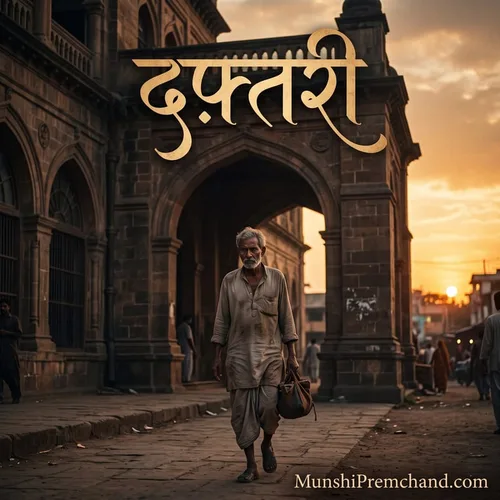
Complete English Translation: Daftari (The Record Keeper)
1
Rafaqat Husain was the record keeper—the daftari—in my office.
He drew a monthly salary of ten rupees. An additional two or three rupees came his way from odd freelance bookbinding jobs outside. That was his entire livelihood, yet he remained thoroughly contented with his lot.
What his internal spiritual state may have been remained unknown, but outward he was always dressed in spotlessly clean clothes and wore a cheerful, radiant countenance. Indebtedness is commonly considered the natural ornament of men belonging to his social class; upon Rafaqat, however, its dark magic had never worked.
His speech was completely devoid of artificial, courtly flattery. He spoke bluntly, plainly, and truthfully. Whatever vices or shortcomings he observed among the office staff, he voiced them openly without hesitation. It was precisely on account of this fearless candor that people respected him far above his humble station.
He harbored an extraordinary, passionate love for animals. He kept a mare, a cow, several goats, a cat, a dog, and a flock of chickens. He was devoted to these creatures with his very soul. He would wander about plucking fresh green leaves for the goats and cutting tender grass for the mare.
Although this passion often led him to pay visits to the town cattle pound, and people frequently made mockery of his animal fixation, he never paid heed to anyone's taunts; his was an entirely selfless, unconditional love.
No one had ever seen him sell chicken eggs for profit. The offspring of his goats had never once passed beneath the butcher's knife, and his mare had never felt the bite of an iron bit in her mouth. The cow's rich milk was drunk by the dog; the goat's milk fell to the share of the cat. Whatever little remained, he consumed himself.
By great good fortune, his wife was also a saintly, virtuous soul. Although their dwelling was exceedingly small, no one had ever heard her raise her voice at the threshold, nor had anyone ever seen her peeping out through the doorway. She never tormented her husband's sleep with demands for ornaments or fine clothes.
The record keeper worshipped her like a goddess. She would collect the cow dung, toss fresh hay to the horses, seat the cat beside herself during meals to feed it, and never shrank in disgust even from bathing the dog with her own hands.
2
It was the monsoon season; the rivers were swollen in spate.
The clerks of the office set out on an expedition to fish in the backwaters. Unlucky Rafaqat, driven by his ill-fated star, joined their company.
All through the day, the party fished along the banks. By evening, a torrential downpour lashed the countryside. The office clerks took shelter and passed the night in a nearby village, but the daftari set off for home.
In the pitch-black night, he lost his bearings and wandered aimlessly across the flooded fields until dawn. When he finally reached his home in the early morning, twilight still lingered, but both leafs of the front door were standing wide open.
His dog, with tail tucked between its legs, came crawling forward whimpering in a heart-wrenching whine, and rolled over at his feet.
Seeing the doors unbolted, the daftari's heart missed a beat. He stepped across the threshold; the entire house was wrapped in desolate silence. He called out to his wife two or three times, but no answer returned. The empty rooms seemed to roar with desolation.
He searched through both chambers. When she was not to be found there, he ventured into the animal shed. As he stepped inside, an unknown, creeping terror seized his chest—the very dread one feels when entering a dark, subterranean cavern.
There upon the damp earth lay his wife, stretched out on her back. Flies buzzed over her face, her lips had turned a bruised blue, and her eyes were petrified like stone. From all the visible signs, it was evident that a venomous serpent had bitten her.
When Rafaqat returned to the office the following day, it was difficult to recognize him. He appeared as though he had been bedridden with illness for years. Utterly lost and bewildered, he sat silent and brooding, as though he inhabited another realm entirely.
As soon as evening fell, he rose and went straight to sit beside his wife's fresh grave. Darkness descended. Three or four hours of the night slipped away, yet in the flickering lamplight he remained seated upon that earthen mound—the very embodiment of despair and grief—as though awaiting the arrival of death itself. No one knew at what late hour he finally trudged home.
This now became his unbroken daily routine.
Rising at dawn, he would proceed directly to the burial ground, sweep the tomb clean, lay garlands of fragrant flowers upon it, burn sweet-scented incense, and recite verses from the Holy Quran until nine o'clock. In the evening, the same solemn ritual was repeated.
This was now the sole governing duty of his existence. He had taken up his dwelling in an internal, ethereal realm; from the external world, he had turned his face away forever. Bereavement had transformed him into an ascetic.
3
This state of affairs continued for several months.
The office clerks felt profound sympathy for the record keeper. They would quietly handle his binding tasks for him so as not to cause him distress. People marveled at such extraordinary, unyielding marital devotion.
Yet man cannot reside perpetually in the ethereal realm of the spirits. Its climate is not suited to mortal flesh. Where in that spectral world can one find those warm, colorful, pulsating sentiments of living life? Where in severe detachment can one discover that anxious thrill of joy? Where is that hope-filled bliss?
After spending half the night immersed in silent meditation at the graveyard, the daftari had to return to a cold hearth, kindle the firewood with his own hands, and rise at dawn to tend to the animals. This solitary burden became unbearable for his spirit.
Physical reality gradually triumphed over emotional sorrow. Like a parched traveler in a scorching desert, the daftari turned his longing eyes once more toward the flowing spring of domestic happiness. He yearned to witness that comforting drama of family life once again. The memory of his departed wife began to dissolve into a general craving for spousal companionship, until within six months, hardly a trace of his former asceticism remained.
At the far end of the same neighborhood lived the Head Saheb's orderly (ardali). Through intermediaries, negotiations for a marriage began with his family, and Miyan Rafaqat was beside himself with joy.
The orderly's prestige in the locality was no less than that of an advocate. Endless conjectures were entertained regarding the magnitude of his illicit income; in common parlor, people said, "Whatever he receives is considered a drop in the ocean." He himself used to boast that during the government agricultural loan (taccavi) distribution seasons, he had to carry a sack instead of a pocket!
The daftari concluded that his star of fortune had risen. He leaped at the proposal just as an eager child pounces upon a glittering toy. Within a single week, all matrimonial arrangements were concluded, and the new bride stepped across his threshold.
To see a man who merely a week before had sat detached from the world and despairing of life, now riding a decorated horse with a marriage veil (sehra) adorning his face, blossoming like a fresh flower, was a remarkable commentary on the elasticity of human nature.
4
However, within a single week, the true qualities of the new bride began to unfold.
Providence had deprived her of physical beauty, but to compensate for that deficiency, it had endowed her with an exceptionally sharp organ of speech. Ample proof of this was provided by that razor-edged eloquence which now regularly entertained the neighbors while humiliating the daftari.
She spent eight days scrutinizing the daftari's character from a foundational perspective, and then announced one afternoon:
"You are truly a bizarre creature! A man keeps domestic animals for his own convenience and comfort, not to invite an endless nuisance upon his head. What madness is this that the cow's milk is drunk by dogs, and the goats' milk is lapped up by a cat? From this day forward, all the milk must be brought into the kitchen!"
The daftari was left speechless.
The very next day, the mare's daily ration of gram was abruptly discontinued. That grain was now roasted in the hearth, spiced with salt and chilies, and served as afternoon snacks.
Breakfast now consisted of rich, fresh milk; sweet milk puddings (tasmai) were prepared every other day. Being the daughter of a grand household, how could she survive without betel leaf? The expenditure on clarified butter and rich spices mounted rapidly.
Within the very first month, it became blindingly clear to the daftari that his modest income was utterly inadequate to sustain this lavish existence. His predicament resembled that of a man who, mistaking it for sugar, has gulped down a mouthful of bitter quinine.
The daftari was an inherently pious and god-fearing man. For two or three months, he endured this bitter torment in silence. Yet his physical countenance expressed his inner agony far more eloquently than words.
That same record keeper who once tasted the supreme bliss of contentment amidst poverty had now become the living picture of anxiety. His clothes grew filthy, his hair was disheveled, a heavy pall of gloom hung over his face, and day and night he sighed in despair.
His cow was reduced to a walking skeleton of bones; the mare could barely summon the strength to stir from her stall; the hungry cat leaped at the food-baskets of neighbors; and the starved dog roamed the garbage mounds gnawing at dry bones.
Yet even now, with immense fortitude, he refused to part with these old, faithful companions.
The greatest affliction of all was his wife's relentless torrent of speech, before which his patience, his devotion to duty, and his enthusiasm would completely take flight; he would retreat to a dark corner of his dingy room and weep bitterly.
Finding the pure bliss of contentment unattainable, Rafaqat's tormented heart drifted toward reckless abandon (faaqamasti). That quiet self-respect which is the blessed fruit of contentment evaporated from his soul.
He adopted the philosophy of the spendthrift pauper. He no longer possessed any vessel in which to store water; he wanted to draw water from the well and drink it down that very instant, lest it spill onto the earth.
The moment his salary was received, he would purchase an entire month's luxuries in a single day. Cold water and dry rotis no longer brought him peace; he bought packaged biscuits from the bazaar, carried home bowls of clotted cream, and reached eagerly for prized grafted mangoes.
What endurance could ten rupees possess? In a single week, all the money evaporated. Then he would seek cash advances on his bookbinding jobs; next came a day or two of enforced starvation; and finally, he resorted to begging for loans.
Gradually, matters reached such a pass that his monthly salary passed directly into the hands of his creditors, and on the very first day of the new month, he would start borrowing fresh funds.
Previously, he used to deliver lectures on thrift and frugality to others; now, when well-wishers tried to counsel him, he brushed them aside with careless bravado:
"Sahib, we eat what we receive today; tomorrow's master is God! If we get food tomorrow, we shall eat; if not, we shall lie down and sleep!"
His condition had become like that of a terminally ill patient who, despairing of recovery, abandons all dietary restrictions, so that until death knocks at the door, he may gorge his fill upon every forbidden delicacy.
Yet even then, he had not brought himself to sell the mare and the cow, until one afternoon both were seized and impounded in the municipal cattle pound.
The goats, too, fell into the claws of the tiger of debt. His wife's craving for rich meat pilaf and sweet saffron rice (zarda) had made him heavily indebted to the neighborhood cook (naanbai). When the baker realized that cash repayment was impossible, he arrived one morning and drove away all the goats in settlement of his bill.
The daftari could only stare after them in helpless silence.
The cat, too, turned her face away from fidelity. Following the departure of the cow and the goats, she could no longer harbor even the faint hope of licking the empty milk bowls—which had been the final thread binding her affections to the hearth.
Only the faithful old dog, remembering years of past kindness, continued to observe his devotion; yet all vivacity had deserted him. This was no longer the fierce watchdog before whom no stranger or stray cur dared pass the gate. He still barked occasionally, but did so while lying flat on his belly, usually burying his muzzle into his chest as though weeping over his present degradation. Either he lacked the physical strength to stand, or he considered this muted homage sufficient recompense for past blessings.
5
It was evening. I was seated outside my front door reading the evening newspaper, when suddenly I noticed the daftari approaching down the lane.
Perhaps a destitute farmer was never so terrified at the sight of a process-server delivering a court summons, nor children so frightened of the vaccinator's needle, as I was by his arrival.
Flustered, I scrambled to my feet, intending to slip inside and bolt the door; but before I could retreat, the daftari came hurrying forward and stood before me. How could I run now?
I sank back into my chair, my brows knit in annoyance.
Regarding the purpose of the daftari's visit, not a shred of doubt lingered in my mind. The inner yearnings of seekers of loans are inscribed upon their countenances and conduct in glaring colors—a peculiar humility, an embarrassed servitude which, once seen, can never be forgotten.
The moment he arrived, without any introductory prelude, the daftari blurted out the request which I had already anticipated.
I replied with cold curtness: "I have no money."
The daftari offered a silent salute (salaam) and turned upon his heels to leave.
His face was cloaked in such utter wretchedness, such profound helplessness, that a wave of pity swept through my heart.
How eloquent, how heavy with meaning was his silent departure without a single word of protest! It contained shame; it contained resignation; it contained bitter remorse. Not a syllable crossed his lips, yet his downcast face seemed to say:
I knew in my heart that this was the very answer you would give! I had not the slightest doubt of it. Yet knowing this full well, I still dragged myself to your door—heaven knows why! I cannot fathom it myself. Perhaps your past benevolence, your kindness drew me here. Now I depart; I no longer possess the face to recount my wretched tale.
I called out after him: "Listen, Rafaqat! What is the matter?"
A faint flicker of hope appeared in his eyes. He stopped and said, "What shall I submit to you, Huzoor? For two days now, we have been fasting without a morsel of food."
I remonstrated with him gently: "How long can your household survive on borrowed funds like this? You are a sensible man; you know that in these times, everyone is burdened with their own anxieties. No one possesses surplus wealth; and even if someone does, why should he purchase domestic squabbles by extending loans? Why don't you reform your domestic circumstances?"
The daftari spoke with the weary detachment of a broken man:
"Huzoor, it is all the cruel turn of fate! What more can I say? The provisions I purchase to last an entire month vanish in a single day. I am utterly powerless before my wife's gluttony!
"If milk is not supplied for a single day, she raises a tempest that shakes the roof! If I fail to bring sweets from the bazaar, staying inside the house becomes impossible! If meat is not cooked in the pot every single day, she would tear the flesh from my very bones!
"I belong to an honorable, respectable family (khandaan ka shareef hoon). I cannot bear the public disgrace of brawling and quarreling with a woman over food! Whatever she demands, I fulfill upon my head.
"Now my only prayer to the Almighty is that He lift me from this world! Aside from that, I see no other deliverance. I have tried everything, and I have lost every battle."
I opened my wooden cash chest, drew out a five-rupee note, placed it in his palm, and said:
"Take this. This is the reward of your manly fortitude (purusharth). I did not know that your heart was so magnanimous, so filled with heroic spirit."
The silent heroes who burn in the agony of domestic hearths are no less noble than the warriors who fall upon the battlefield.
Summary of Daftari (The Record Keeper)
'Daftari' is an intensely moving and realistic psychological short story depicting the quiet dignity, domestic torment, and moral fortitude of a humble government servant. Rafaqat Husain is an office record keeper (daftari) earning a meager salary of ten rupees a month, supplemented by minor freelance bookbinding work. Despite his poverty, Rafaqat lives with immaculate cleanliness, cheerful contentment, and spotless integrity, refusing to fall into debt or indulge in flattery. His greatest joy is his selfless devotion to domestic animals—he maintains a mare, a cow, goats, a dog, a cat, and chickens, feeding them generously without any commercial exploitation. His first wife is an equally pious and frugal partner who shares his quiet life and tends to the animals with devotion.
This idyllic domestic harmony is shattered during the monsoon floods. Returning home after being stranded overnight during a fishing trip, Rafaqat finds his front doors wide open and his beloved wife lying dead in the animal pen from a snakebite. Overcome with grief, he spends months in solitary mourning, reciting the Quran and burning incense beside her grave. Eventually, the crushing loneliness of maintaining the household forces him to remarry. His second wife, the daughter of a high-ranking official orderly, is sharp-tongued, demanding, and extravagant. She scoffs at his animal charity, diverts the milk and grain for personal indulgence, and demands daily meat, rich sweets, and fine spices far beyond his financial capacity.
Too dignified and honorable to engage in crude domestic brawling over food, Rafaqat exhausts his earnings, abandons his lifelong frugality, and falls into reckless debt to appease her demands. One by one, his beloved animals are lost—the mare and cow are impounded, the goats seized by the neighborhood cook in settlement of pilaf debts, and the cat departs. Finally, reduced to two days of complete starvation, Rafaqat approaches the narrator for a loan. When initially refused, he turns to leave with such silent, dignified pathos that the narrator calls him back, listens to his tragic story, and gives him five rupees. The narrator salutes Rafaqat as a true hero, reflecting that those who endure the burning furnace of domestic crisis with silent patience are no less courageous than warriors on the field of battle.
Publication History
'Daftari' was written in 1919 and published in contemporary literary journals before being collected in Premchand's prestigious compilation Mansarovar (Volume 8).
This unabridged English translation was published in 2026 by MunshiPremchand.com as part of the MunshiPremchand.com English Translation Series.
Themes & Critical Significance
- The Philosophy of Contentment vs. Extravagance: Through Rafaqat's contrast between his first and second marriages, Premchand demonstrates that happiness is governed not by the magnitude of income, but by mutual contentment and shared values. A ten-rupee salary provided paradise with a frugal partner, but bred financial ruin and despair with an extravagant one.
- Selfless Compassion for Animals: Rafaqat's relationship with his menagerie offers a rare, tender portrait of selfless ecological kinship. His refusal to sell eggs, slaughter goats, or exploit milk reveals a pure, non-transactional love for living creatures that stands in stark contrast to the commercial exploitation around him.
- The Tragedy of Respectable Poverty (Sharafat): Rafaqat's ruin stems not from inherent vice, but from his deep-rooted code of gentlemanly honor (khandaani sharafat). He considers brawling over kitchen expenses more humiliating than starvation and debt, illustrating how social pride can become an instrument of self-destruction for the impoverished middle class.
- Domestic Martyrdom as True Heroism: The closing aphorism encapsulates Premchand's profound humanism: endurance in the face of unglamorous, grinding domestic distress requires a fortitude no less heroic than martial valor on the battlefield.