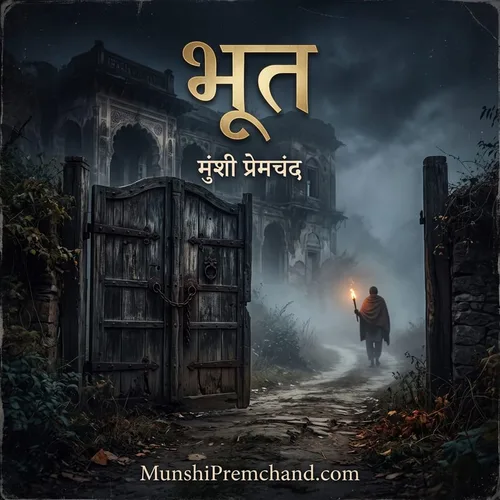
Complete English Translation: Bhoot (The Ghost)
For the past thirty years, Pandit Sitanath Chaube of Moradabad had been the undisputed leader of the bar in that city. His father had passed away during Sitanath's early childhood, leaving behind no property whatsoever. His mother had endured untold hardships and miseries to raise him and educate him. He began his professional career as a humble clerk in the district court on a salary of fifteen rupees a month. He then sat for the law examinations and passed. He was endowed with natural talent; within two or three years, his legal practice flourished brilliantly.
By the time his mother passed away to heaven, her son was counted among the foremost dignitaries of the entire district. His monthly income was not less than a thousand rupees. He had built a magnificent mansion, purchased zamindari estates, deposited tidy sums in the bank, and invested money in moneylending. In addition to this prosperity, the presence of four sons made his fortune appear truly ideal. All four sons were studying in different classes.
Yet to say that this entire magnificence was solely the fruit of Chaubeji's unceasing toil would be doing grave injustice to his wife, Mangala Devi. Mangala was an exceptionally simple-hearted, domestic woman, skilled in household management, capable of stretching a copper coin to do the work of four. Until they built their own home, she had never rented a house for more than three rupees a month; and as for hiring a cook for the kitchen, she had never employed one to this day.
If she harbored any weakness at all, it was a fondness for gold jewelry; and if Chaubeji had any indulgence, it was adorning his wife with ornaments. He was a truly devoted husband. Ordinarily, joking and bantering with dancing courtesans at social gatherings was not regarded as particularly objectionable; but in his entire lifetime, Panditji had never once attended an assembly of dancing and singing. From five o'clock in the morning until midnight, his only addiction, recreation, reading, writing, and study was the law. He had no affection for politics, nor any interest in community service. All such pursuits appeared to him thoroughly useless.
In his opinion, if there was any task worthy of being undertaken, it was simply to go to court, argue cases, accumulate money, eat his meal, and sleep. Just as the universe appears an illusion (maya) to a Vedantic philosopher except for the supreme Brahman, so to Chaubeji the entire cosmos seemed an illusion except for the law. Everything was maya; the law alone was real.
Upon the full moon of Chaubeji's countenance, only a single lunar crescent was missing: he had no daughter. After their firstborn daughter died in infancy, no other daughter was born to them, nor was there any hope of one now. Both husband and wife wept whenever they remembered that lost child. In childhood, little girls display far more endearing coquetry and affectionate pranks than boys. For those sweet childish pranks, both souls yearned incessantly.
The mother thought: "Had there been a daughter, I would have had delicate ornaments crafted for her and braided her hair. How delightful it would have been to see her tottering gracefully about the courtyard with tinkling anklets on her little feet!" Chaubeji thought: "Without performing the holy gift of a daughter in marriage (kanyadaan), how can one attain salvation (moksha)? Kanyadaan is the supreme charity. He who has not bestowed this gift has lived his human life in vain!"
At last, this longing grew so overwhelming that Mangala resolved to bring her youngest half-sister to their home and rear her as their own daughter. The girl's parents were impoverished; they gladly consented. This child was the daughter of Mangala's stepmother. She was remarkably beautiful and lively. Her name was Binny.
With her arrival, Chaubeji's home blossomed with joy. Within a couple of days, the little girl forgot her biological parents entirely. Her age was barely four years, yet she preferred doing little household chores to mere playing. Whenever Mangala went to the kitchen to cook, Binny would follow close behind, quarreling with her for the privilege of kneading the dough. Cutting vegetables gave her immense delight.
As long as the lawyer was at home, she sat beside him in the drawing room—now turning over the pages of a weighty legal tome, now playing with the inkwell and reed pen. Chaubeji would smile and say: "My daughter, do you want a beating?"
Binny would retort: "You will get a beating! I will cut off your ears, call the bogeyman, and hand you over to him!" At this, hearty roars of laughter would ring out across the drawing room. The lawyer had never been so tenderly fond of children before! Whenever he returned from outside, he invariably brought some sweet or toy for Binny, and the moment he stepped across the threshold, he would call out: "Binny, my daughter, come!" Binny would come running and seat herself in his lap.
One day, Mangala was sitting with Binny when Panditji entered. Binny dashed over and scrambled into his lap. Panditji asked: "Whose daughter are you?"
Binny: "I won't tell you!"
Mangala: "Tell him, my child: 'I am elder sister's daughter!'"
Panditji: "Are you my daughter, Binny, or hers?"
Binny: "I won't tell you!"
Panditji: "Very well, we shall both close our eyes; Binny will go and sit in the lap of whoever she belongs to!"
Binny got up and promptly sat right back in Chaubeji's lap.
Panditji cried: "She is my daughter, she is my daughter! Now don't you dare say she is yours!"
Mangala teased: "Very well, go away then, Binny! I will not give you any sweets now, nor will I buy you a doll!"
Binny replied: "Bhaiyaji will buy them for me; I won't give you any!"
Laughing with joy, the lawyer pressed Binny to his chest and carried her outside in his arms. He wanted his dear friends to relish the sweetness of this childish play. From that day onward, whenever anyone asked Binny, "Whose daughter are you?", Binny would instantly reply: "Bhaiya's!"
Once, Binny's father came and took her away with him to their native village. Binny wept incessantly, bringing the roof down with her wails. Meanwhile, Chaubeji found it impossible to pass his days without her. Before a month had passed, he journeyed to his in-laws' village and brought Binny back. Binny forgot her natural mother and father completely. She began regarding Chaubeji as her father and Mangala as her mother. Those who had given her birth had now become strangers.
Several years went by. The lawyer's sons grew up and were married. Two of them took their wives and children and set up independent legal practices in other districts; the remaining two were studying in college.
Binny blossomed from a tender bud into a magnificent flower. There was no maiden in the entire community who could match her in beauty, virtue, and modesty. Clever in reading and writing, deft in domestic chores, skilled in embroidery and needlework, expert in culinary arts, soft-spoken, exquisitely modest—she was a treasure of incomparable loveliness. In that dark house, the divine radiance of her beauty seemed to illuminate every corner.
Neither in the crimson flush of dawn, nor in the enchanting splendor of moonlight, nor in the glistening dewdrop sparkling beneath the morning rays upon a blooming rose was there that life-giving grace and charm; nor did the snow-crowned peak of the white mountain possess that serene coolness which radiated from the large, luminous eyes of Binny—now named Vindhyeshwari.
Chaubeji began searching for a suitable groom for Binny. In his sons' weddings, he had already fulfilled his worldly ambitions; now, in the marriage of this daughter, he wished to satisfy the deepest yearnings of his soul. He had already won worldly renown by spending fortunes; now he yearned to earn a glorious name through lavish dowry and ceremonial gifts. To marry off a son is an easy matter; but to maintain one's honor through a daughter's wedding is the true test of manhood. Everyone can journey safely on a boat; only he who swims across the surging river is worthy of supreme praise.
There was no shortage of money. A noble family and an accomplished groom were found. The horoscopes matched; the alliances were agreed upon. The auspicious ceremonies of Phaldan and Tilak were duly performed.
Yet alas, cruel fate! While the preparations for the wedding were underway, while the tailors, goldsmiths, and confectioners were all toiling at the doorstep, merciless destiny spun an entirely different web! Just one week before the wedding, Mangala fell suddenly ill. Within three days, carrying all her unfulfilled yearnings with her, she departed for the other world.
Dusk had fallen. Mangala was lying on her bed. Her sons, daughters-in-law, grandsons, and granddaughters were all standing gathered around the bed. Binny sat at the foot of the cot, gently massaging Mangala's feet. The terrifying silence of the impending hour of death hung over the room. No one spoke to anyone; in their hearts, all understood what was about to happen. Only Chaubeji was not present there.
Suddenly, Mangala looked around with longing eyes and whispered: "Please call him; where is he?"
Panditji was sitting alone in his private chamber, weeping. Receiving the summons, he wiped away his tears, entered the room, and presented himself before Mangala with immense composure. He was terrified that if even a single drop of tear fell from his eyes, a wail of despair would erupt across the entire household.
Mangala said: "I wish to ask you one thing; do not take it amiss. Who is Binny to you?"
Panditji replied: "Who is Binny? She is my daughter—who else?"
Mangala: "Yes! That was what I wanted to hear from your own lips. Always continue to regard her as your daughter. The preparations I made for her wedding—do not curtail or diminish them in any way."
Panditji: "Have no anxiety on that account. If God wills, her wedding shall be celebrated with even greater splendor!"
Mangala: "Keep summoning her often; never forget her on festivals and celebrations."
Panditji: "There is no need to remind me of these things."
Reflecting for a moment, Mangala said again: "Perform her marriage this very year."
Panditji: "How can it be done this year?"
Mangala: "This is the month of Phagun. The auspicious wedding season extends until Jeth."
Panditji: "If it is possible, I shall do it this year."
Mangala: "It is not a question of 'if possible'; you must certainly do it!"
Panditji: "I will do it."
After this, preparations for the ritual gift of a cow (godan) began.
The death of a wife in old age is like the collapse of a house in the torrential rains: there remains little hope of rebuilding it. With Mangala's demise, Panditji's life became irregular, desolate, and unhinged. Socializing with people came to an end. For days on end, he would not attend court; even when he went, it was only under great insistence. He lost all appetite for food.
Vindhyeshwari felt deep sorrow seeing his miserable condition, and made every effort within her power to comfort his grieving heart. She would read aloud stories from the sacred Puranas to him; she cooked an assortment of delicacies and coaxed him with affectionate entreaties to eat. Until he had dined, she would touch nothing herself. It was summer; late into the night, she would sit at the foot of his bed fanning him, and until he drifted off to sleep, she would not retire to her own bed. If he complained of even a slight headache, she immediately applied fragrant oil to his forehead. At night, whenever he felt thirsty, she would hurry over herself to offer him cold water.
Gradually, in Chaubeji's heart, Mangala remained merely a tender memory of past happiness.
One day, Chaubeji handed over all of Mangala's jewelry to Binny. This had been Mangala's dying command. Binny was ecstatic with joy. She dressed and adorned herself lavishly that day. When Panditji returned from the court in the evening, laden with ornaments, she came and stood before him, blushing and smiling shyly.
Panditji gazed upon her with thirsty, longing eyes. A new and forbidden emotion was sprouting within his heart toward Vindhyeshwari. As long as Mangala lived, she had constantly kept the sacred father-daughter bond awake and fortified within him. Now Mangala was gone. Consequently, that paternal sentiment grew weaker day by day. In Mangala's presence, Binny had been a child; in Mangala's absence, she was a stunning, blooming young woman.
Yet simple-hearted Binny had not the faintest inkling of the transformation taking place in her brother's heart. To her, he remained the exact same fatherly "Bhaiya." She was utterly innocent of the nature of men. In a woman's character, the instinct of motherhood grows firmer with age, until a time arrives when in a mature woman's eyes, all young men appear like sons; not a trace of carnal desire remains in her heart. But in men, this saintly state never arrives! Their physical faculties may grow feeble, but their lust often burns with even greater ferocity. Man is never truly liberated from lust; rather, as his age declines, just like the scorching heat at the end of the summer season, the fierce blaze of his desire becomes even more intense. To satisfy it, he stands ready even to stoop to the lowest, most ignoble means.
In youth, a man does not fall so low. His character retains a measure of pride that recoils from contemptible methods. He may use force to break into someone's house, but he will not crawl through the gutter.
Panditji looked upon Binny with thirsty, lustful eyes, and then, feeling ashamed of his own unbridled thoughts, lowered his gaze. Binny could not comprehend the meaning of this at all.
Panditji said: "Seeing you, I am reminded of Mangala at the time when she first arrived here as a bride. She had the exact same face—this very fair complexion, this smiling countenance, these soft cheeks, these shy eyes! That portrait is still etched upon the canvas of my heart; it can never be erased. In your form, God has given my Mangala back to me!"
Binny: "What refreshment should I bring for you?"
Panditji: "Bring it later. Sit down for a while; I am very sorrowful. You have made me forget my grief. Truly, you have kept me alive; otherwise, I had no hope of surviving after Mangala. You gave me the gift of life. I do not know what will become of me once you depart."
Binny: "Depart where? I am not going anywhere!"
Panditji: "Why, the date of your wedding is drawing near. You will leave, of course."
Binny (blushing shyly): "What is the hurry?"
Panditji: "Why shouldn't there be a hurry? The world will laugh."
Binny: "Let them laugh! I shall stay right here and continue to serve you."
Panditji: "No, Binny, why should you ruin your life for me? I am an unfortunate wretch; as long as life lasts, I shall live—whether weeping or smiling. Laughter has been wiped from my destiny. That you have cared for me all these days—is that a small debt of gratitude? I know that once you leave, there will be no one left to look after me; this house will be shattered into ruins, and I shall have to abandon the home and flee. But what can be done? I am helpless. Without you, I cannot remain here for a single moment. You filled the vacant place left by Mangala; now who will fill your place?"
Binny: "Can it not be postponed for this year? In this condition, I will not leave you and go away."
Panditji: "It is not entirely in our hands. If those people insist, we shall be forced to proceed."
Binny: "If they press too hard, tell them: 'We will not do it now!' Let them do whatever they please. Are we under their thumb?"
Panditji: "They are already pressing hard."
Binny: "Why don't you reprimand them and turn them away?"
Panditji: "After all, it must be performed someday; why should I delay? This sorrow and separation must happen one day. Why should I place the burden of my misery upon your head?"
Binny: "If I am of no use to you in sorrow and joy, then on what other day will I be of any use?"
A fierce moral struggle raged within Panditji's mind for several days. He could no longer view Binny with the eyes of a father. Binny was now Mangala's sister—his sister-in-law (saali). If the world laughed, let it laugh; life would pass in bliss! His emotions had never been so buoyant and intoxicating. He felt the vigorous surge of youth coursing through his limbs once more!
He rationalized to himself: "I used to consider Binny my daughter; but she is not my biological daughter after all! What does such imagining signify? Who knows, perhaps this was God's very will; otherwise, why would Binny have come here in the first place? On this very pretext, Providence must have destined this union! The Lord's ways are unfathomable!"
Panditji dispatched a notice to the bridegroom's father, informing him that owing to special circumstances, the marriage could not take place that year.
Vindhyeshwari still had no inkling of the web being spun around her. She was simply happy that she was serving Bhaiyaji and that Bhaiyaji was pleased with her. "He grieves so deeply for my sister. If I am not here, he will wander away somewhere; who knows, he might even turn into an ascetic sadhu! How could his heart find peace in an empty home?" She made ceaseless efforts to divert Panditji's mind, never allowing him to sit brooding.
Panditji's mind no longer engaged in his courtroom work. He would sit for an hour or two and return home. In the love of the young there is turbulence; in the love of the old there is desperate devotion. The elderly seek to compensate for their lost youth with flattering compliments, sweet words, and witty repartee.
Barely three months had passed since Mangala's death when Chaubeji arrived at his mother-in-law's house in the village. The mother-in-law felt as though her heart's fondest wish had been granted. She had two young sons and no capital or wealth in the house. She could see no means for their upbringing and education. Mangala was already dead. The moment Binny was married off, she would belong to another family, and all connection with the wealthy Chaubeji would be completely severed. She was brooding over this very anxiety when Chaubeji arrived—as though a deity had descended in person to bestow a boon!
When Chaubeji lay down to rest after his meal, the mother-in-law asked: "Bhaiya, have any talks been initiated anywhere?"
Panditji: "Mother, what talks of marriage can there be for me now?"
Mother-in-law: "Why, Bhaiya, what is your age after all?"
Panditji: "Even if I wished to, I cannot do so for fear of public disgrace. Besides, who would have me now?"
Mother-in-law: "There are thousands who would have you! Why look far afield? There is a girl sitting right in your own home! I hear you have gifted all of Mangala's ornaments to Binny. If she is married elsewhere, goods worth several thousands will slip straight out of your hands! Where could I ever find a better household than yours? If you accept her, I shall be delivered from all worldly torment!"
What does a blind man ask for, except two eyes! Chaubeji accepted his mother-in-law's proposal with feigned reluctance, as though bowing to unavoidable circumstance.
Binny sat beside her mother in their village mud house. This time, Chaubeji had sent a personal maidservant along to attend to her. Vindhyeshwari's two little brothers were gazing wide-eyed in astonishment at her glittering gold ornaments. Several village women had come to visit her, marveling at the bloom of her beauty and grace.
"Is this the very same Binny who used to play here wearing a coarse, tattered skirt? How her complexion and beauty have blossomed! Ah, it is the body of prosperity and comfort!"
When the crowd thinned and solitude was restored, the mother asked: "Your Bhaiyaji is keeping well, isn't he, my daughter? When he came here, he was so terribly sorrowful. Grief for Mangala is consuming him. There are indeed such men in the world who would lay down their lives for their wives! Otherwise, here a wife dies and instantly a second wedding is staged—as though men sit praying for the wife to die so they can bring a brand-new bride into the house!"
Vindhyeshwari: "He constantly weeps remembering her. I have come away; God knows how he is managing!"
Mother: "I am terrified that once your marriage takes place, he might lose his mind in despair and turn into an ascetic wandering sadhu!"
Vindhyeshwari: "I too harbor that very terror! That was why I told him: 'What is the hurry right now?'"
Mother: "The longer you serve him, the deeper his affection will grow; and your eventual departure will cause him all the more grief. Daughter, the truth is that he lives only by looking upon you! The moment your palanquin is lifted, his home will be utterly ruined. Were I in your place, I would marry him myself!"
Vindhyeshwari gasped in horror: "Oh, get away, Mother! Are you heaping insults on me? He has reared me as his own daughter! I too regard him as my father..."
Mother: "Hush, you silly girl! What does mere talk signify?"
Vindhyeshwari: "Mother, just think: what an absurd, monstrous proposition!"
Mother: "I see nothing absurd or monstrous in it."
Vindhyeshwari: "What are you saying, Mother? With him... I would die of sheer shame! I could never look him in the eye again! Nor would he ever agree. Is it even a thing to be agreed to?"
Mother: "I take his responsibility upon myself! I shall persuade him. You just give your consent. Remember, this is not a marriage for festive fun and romance; it is a matter of saving his very life—the life of the only man in this world upon whom we depend! Besides, he is not of any great age. He is barely two or four years above fifty. He even consulted an astrologer, who examined his horoscope and declared that he has at least twenty years of life ahead of him. In appearance and stature, he is one man in a hundred or two hundred!"
Clever in persuasion, the mother wove such a labyrinth of emotional words that the simple maiden could not escape. The mother knew well that the magic of worldly temptation would not work upon Binny. She did not even mention wealth, ornaments, family prestige, or a life of luxury. She focused exclusively upon Chaubeji's pathetic, desolate condition.
At last, Vindhyeshwari said: "Mother, I know that my absence will cause him immense sorrow; I also know that happiness is not written in my destiny. Very well: for his welfare, I shall sacrifice my life. If such is God's will, then so be it."
Wedding songs were resounding in Chaubeji's mansion. Vindhyeshwari had entered this house today as a bride. Several years ago, she had entered this very house as Chaubeji's little daughter! She had never imagined, even in her wildest dreams, that she would one day become the mistress of this household.
Chaubeji's attire and grooming today were a spectacle to behold! A colorful kurta of fine muslin, a trimmed and carefully groomed mustache, hair glistening with dark dye, a smiling face, and animated, kohled eyes—it was a complete masquerade of youth!
The night had worn on. Vindhyeshwari sat on the floor with her head bowed, weighed down by heavy gold jewelry and bridal silk. She felt neither eager longing nor sharp terror; she felt only an overwhelming, paralyzing shame: "How will I ever open my lips before him? I played in his lap; I sat upon his shoulders; I rode upon his back—how will I ever show him my face? But why should I dwell on past things now? May God grant him happiness! The purpose for which I consented to turn from a daughter into a wife—may that purpose be fulfilled! May his life pass in joy and peace."
Just then, Chaubeji entered the room. Vindhyeshwari stood up. Such a wave of shame washed over her that she wished she could flee somewhere, or jump out of the window into the courtyard below!
Chaubeji took her hand and said: "Binny, are you afraid of me?"
Binny spoke not a word, standing motionless like a stone statue. In a moment, Chaubeji gently guided her to sit down, and she sat. Her throat choked with rising sobs. This cruel mockery of destiny, this monstrous play of fate was becoming unbearable to her soul.
Panditji asked: "Binny, why don't you speak? Are you displeased with me?"
Vindhyeshwari covered her ears with her hands. This was the exact familiar voice she had heard for so many years! Today, it sounded sharper than sarcasm and more bitter than mocking laughter.
Suddenly, Panditji gave a violent start! His eyes widened in sheer horror, and his hands drew back convulsively like the legs of a terrified frog. He recoiled two paces backward.
From the open window, Mangala was peering inside!
Not a shadow—it was Mangala herself! Mangala in bodily form, vivid, living, flesh and blood!
Chaubeji cried out in a trembling, shattered voice: "Binny, look! What is that?"
Binny looked toward the window in panic. There was nothing there. She said: "What is it? I see nothing."
Chaubeji: "It has vanished now; but God is my witness, it was Mangala!"
Binny: "Sister?"
Chaubeji: "Yes, yes, she herself! She was peering inside through the window! My hair stood on end!"
Trembling all over, Vindhyeshwari said: "I will not stay here!"
Chaubeji: "No, no, Binny, there is no danger. My eyes must have deceived me. The truth is, she lived in this house; she slept right here; that is probably why my imagination conjured up her image before me. It is nothing. What an auspicious day this is—that my Binny has truly become mine..."
Even as he spoke these words, Chaubeji started violently again!
The very same figure was peering through the window once more! Not an illusion—it was Mangala herself, in physical form, living, vivid! This time, there was neither anger nor contempt in her eyes; they were filled with mocking laughter, as though she were laughing at this grotesque spectacle, as though a farcical drama were being staged before her eyes!
Chaubeji stammered in shaking terror: "Binny, the same thing has happened again! Look there—Mangala is standing there!"
With a piercing shriek, Vindhyeshwari clung to his neck!
Chanting the holy name of Mahavir Hanuman, Chaubeji said: "I will shut the window shutters!"
Weeping, Binny cried: "I will not stay in this room! (Sobbing) Bhaiyaji, you did not honor Sister's dying wish; that is why her soul is grieving! I dread that some terrible evil is about to befall us!"
Chaubeji rose and slammed the window shutters shut. He said: "From tomorrow, I shall have the sacred recital of Durga Saptashati performed. Never before in my life have I experienced such terror. What can I tell you... it felt as though... well, let it be. It is terribly hot here. It will be at least two months before the rains arrive. Why shouldn't we go away to Mussoorie?"
Vindhyeshwari: "I have no desire to go anywhere. Tomorrow, you must certainly have the Durga recitation performed. I will never be able to sleep in this room again."
Panditji: "In the sacred scriptures, it is written that after death only the subtle body (sukshma sharira) remains. I cannot fathom how this physical form is appearing. I tell you the truth, Binny: had you not taken pity on me, I would have been destroyed. Perhaps at this very moment I would have been dashing my head against the crags of Badrinath, or who knows, swallowed poison and ended my life!"
Vindhyeshwari: "In Mussoorie, will we have to stay in a hotel?"
Panditji: "No, bungalows are available for rent. I shall write to a friend of mine, and he will arrange a house for us there..."
The words had not yet finished leaving his lips when, as though an ethereal voice boomed from the heavens, a resounding proclamation echoed through the room:
"Binny is your daughter!"
Chaubeji covered both his ears with his hands. Shivering with uncontrollable terror, he gasped: "Binny, let us flee from here! God knows from where these voices are coming!"
"Binny is your daughter!"
The chilling sound began reverberating in Panditji's ears through a thousand echoes, as though every single wall, every brick, and every object in the chamber was crying out that very proclamation!
Weeping bitterly, Binny asked: "What kind of voice was it?"
Panditji: "What can I tell you? I feel ashamed even to utter it!"
Binny: "It is surely Sister's spirit! Sister, have mercy on me! I am entirely blameless!"
Panditji: "The voice is echoing again! Alas, O God! Where shall I go? Those very words are reverberating through every pore of my being! Binny, a terrible sin was committed! Mangala was a chaste, virtuous woman; by disregarding her dying command, I have sowed deadly poison for my own soul! Where shall I flee? What shall I do?"
Saying this, Panditji threw open the doors of the room and fled headlong in blind panic. Reaching his outer male drawing room, he collapsed to the floor, plunging into deep unconsciousness.
Vindhyeshwari too ran after him, but the moment she crossed the threshold, she collapsed senseless upon the floor!
Summary of Bhoot (The Ghost)
Pandit Sitanath Chaube, an eminent and wealthy lawyer of Moradabad, and his frugal, devoted wife Mangala have four grown sons but sorely miss having a daughter. To fill this emotional void and satisfy Chaubeji's spiritual yearning to perform the holy ritual of kanyadaan (giving a daughter in marriage), Mangala brings her impoverished four-year-old half-sister, Binny (Vindhyeshwari), to their home. Sitanath raises the lively girl with immense paternal tenderness, and Binny grows up regarding Sitanath as her father and Mangala as her mother.
As Binny blossoms into an accomplished and exquisitely beautiful young woman, Chaubeji arranges her marriage into a noble family with great fanfare. However, just a week before the wedding, Mangala falls mortally ill. On her deathbed, Mangala makes Sitanath swear a solemn oath: he must always treat Binny as his own daughter and complete her marriage that very year. Sitanath weeps and promises faithfully.
Following Mangala's death, fifty-year-old Sitanath is overwhelmed by desolation. Binny tends to his every need with filial devotion. Gradually, stripped of Mangala's moral presence, Sitanath's paternal affection decays into carnal lust. Seeing Binny adorned in Mangala's gold jewelry, he begins viewing her not as a daughter, but as a desirable woman. He postpones her marriage on flimsy pretexts.
Visiting his mother-in-law's village, Sitanath encounters a woman eager to retain his financial support for her two young sons. The mother-in-law proposes that Sitanath marry Binny himself, keeping the jewelry and wealth in the family. By playing on Binny's tender sympathy for Sitanath's lonely plight, the mother manipulates the innocent girl into agreeing to marry her elderly guardian as a self-sacrificing act of devotion.
On their wedding night, Chaubeji enters the nuptial chamber dressed in the ridiculous garb of youth. As he touches Binny's hand, he suddenly sees the vivid, physical form of his deceased wife Mangala peering into the room through the window with mocking laughter. Slamming the window shut in terror, Chaubeji attempts to dismiss the vision as an optical illusion and proposes fleeing to Mussoorie.
Suddenly, an ethereal voice echoes thunderously through the chamber: "Binny is your daughter!" The proclamation reverberates from every wall, driving Sitanath into a frenzy of guilt, terror, and moral revulsion over his incestuous betrayal of his wife's dying oath. Overcome by supernatural horror, Sitanath flees the room and collapses unconscious in the drawing room, while the traumatized Binny falls senseless across the threshold.
Publication History
Bhoot (भूत) was written by Munshi Premchand in 1929 and was published in the prestigious literary journal Madhuri (माधुरी). It was later compiled into Volume 4 of his celebrated short story anthology Mansarovar (मानसरोवर भाग 4).
This unabridged English translation was published in 2026 by MunshiPremchand.com as part of the MunshiPremchand.com English Translation Series.
Themes & Critical Significance
- Senile Lust and Moral Degeneration: The story is a devastating psychological study of the decay of patriarchal ethics. Premchand observes with unflinching realism that while age sublimates desire into maternal affection in women, in aging men, carnal lust often burns with desperate, unprincipled intensity. Sitanath's rationalizations illustrate how easily religious philosophy is perverted to justify base desires.
- The Betrayal of Sacred Paternal Trust: The emotional horror of the story lies in the violation of the father-daughter bond. Binny was brought into the home as a child, played on Sitanath's shoulders, and called him fatherly "Bhaiya." Sitanath's transformation into her husband represents a grotesque moral transgression that shocks the reader's conscience.
- The Psychology of Guilt and the Supernatural: Premchand masterfully blurs the boundary between external supernatural phenomenon and internal psychological guilt. Whether Mangala's spirit physically appears or is a terrifying hallucination conjured by Sitanath's guilty conscience, the moral retribution is absolute: his own mind transforms the nuptial chamber into a chamber of horrors.
- Female Self-Sacrifice and Societal Exploitation: Binny's tragedy illustrates the absolute vulnerability of Indian maidens. Coerced by an opportunistic mother who uses emotional blackmail, Binny surrenders her youth, romantic hopes, and identity in a sacrificial attempt to comfort a grieving man, highlighting how female martyrdom was weaponized by patriarchal society.
- The Sacred Sanctity of the Dying Oath: In Indian cultural tradition, a dying person's final request carries supreme spiritual sanctity. Sitanath's willful breach of Mangala's dying command ("Binny is your daughter") serves as the catalyst for his psychological collapse, proving that moral law cannot be violated without destroying the soul.