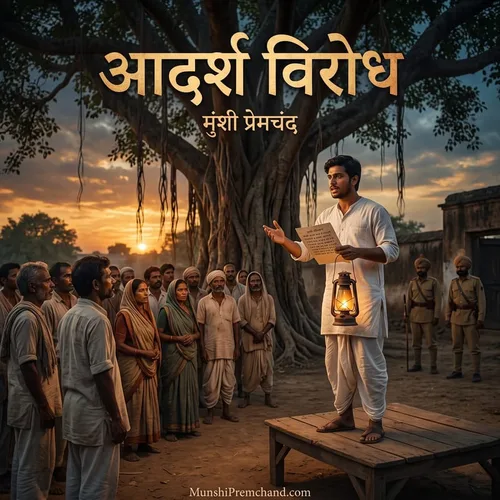
Complete English Translation: Adarsh Virodh
1
Mahashay Daya Krishna Mehta’s feet barely touched the earth. That supreme aspiration of his life, which had been its sweetest dream, was fulfilled at last. He had attained that sovereign state office which, for the inhabitants of India, is nothing short of earthly paradise. The Viceroy had appointed him a Member of his Executive Council.
Friends were showering him with congratulations. Joyous celebrations were taking place on every side; banquets were hosted in one quarter, addresses of felicitation presented in another. It was regarded not as his personal honor, but as a great national triumph. The British officialdom, too, carried him on the palms of their hands.
Mahashay Daya Krishna was a celebrated barrister of Lucknow. He was a man of generous heart, deeply skilled in political statecraft, and devoted to the public welfare. He was perpetually engrossed in public causes. In the entire country, there was no investigator of administrative principles so fearless, no critic so disinterested, nor did the populace possess a friend so discerning, trustworthy, and compassionate.
In the newspapers, this appointment was being vigorously debated. From one side, the voice was raised: "We cannot congratulate the Government on this choice." The people of the second camp said: "This is the finest proof of governmental benevolence and solicitude for the public good." There was a third faction as well, which whispered under its breath: "Another mighty pillar of the nation has fallen."
It was evening. A reception was given in honor of Mahashay Mehta by the Liberals at Kaiser Park. Distinguished men from across the entire province were assembled. After dinner, the chairman declared in his address:
"We possess complete faith that your accession to authority will prove beneficial to the people, and that through your sincere endeavors those statutory provisions which hinder the progress of our national life will be amended."
Mahashay Mehta replied:
"The laws of a nation are subject to existing circumstances. So long as circumstances do not change, it is an illusion to expect a well-ordered reformation in the law."
The gathering dissolved. One party exclaimed, "What a just and commendable political principle!" The second faction said, "He has fallen into the trap." The third faction shook their heads in despondency, yet uttered not a word.
2
Mr. Daya Krishna had now been in Delhi for a month. It was the month of Phagun. Evening was descending. He sat in a velvet armchair beside the marble fountain pool in his garden. Mrs. Rajeshwari Mehta sat facing him, learning to play the piano, while Miss Manorama was feeding breadcrumbs to the goldfish in the pool. Suddenly Manorama asked her father:
"Who was that gentleman who just came?"
Mehta replied, "He is the Military Member of the Council."
Manorama asked, "He must be second only to the Viceroy?"
Mehta said, "Everyone is subordinate to the Viceroy. The salary of all is equal as well, but no one matches his sheer competence. Why, Rajeshwari, did you observe how courteous and modest the English are?"
Rajeshwari said, "I call them the very embodiment of modesty! In this virtue, they far surpass us. His wife embraced me with such genuine warmth!"
Manorama added, "My heart was tempted to fall at her feet."
Mehta said, "I have never seen men so generous, refined, guileless, and appreciative of true merit. Our boasts of charity and righteousness are mere words. I deeply regret why I harbored suspicions against them until now. Generally speaking, whatever grievances we hold against them arise solely from the lack of mutual association. We are unfamiliar with each other's true temperament and character."
Rajeshwari said, "A Union Club is sorely needed where people of both races may enjoy the pleasure of social fellowship. That is the solitary means of erasing groundless prejudice and malice!"
Mehta said, "That is my view as well." Looking at his watch, he continued: "It is seven o'clock; the time for the gathering of the Industrial Association has arrived. The people of India are in a strange state of mind! They imagine that the moment an Indian member enters the Council, he becomes the sovereign lord of India and can act with absolute caprice. It is expected that he will overturn the established policy of administration, fashion a brand-new sky and a brand-new sun! No thought is given to the rigid boundaries within which members must function."
Rajeshwari said, "It is not their fault. It is the way of the world that people place every manner of hope upon their own kin. Now half the members of the Council are Indians. Can their voice exert no influence upon the Government's policy?"
Mehta replied:
"Certainly it can exert influence, and it is doing so. But the core policy itself cannot be transformed. Not merely half—even if all the members were Indians, they could not inaugurate an entirely new policy. How can they forget that their presence in the Council depends solely upon the favor and confidence of the Government? Furthermore, upon arriving there, they come to realize the internal realities of governance, and the vast majority of the public's suspicions begin to appear completely unreasonable. Along with high office, a heavy burden of responsibility falls upon one's shoulders. While fashioning any new policy, the worry naturally arises in the mind lest its outcome prove contrary to expectations.
"Here, in reality, their independence is destroyed. They hesitate even to meet those people who were formerly their close colleagues, but who, owing to their unrestrained views, now rankle in the eyes of the Government. In their speeches, they talk of justice and truth, yet even while understanding the Government's policy to be injurious, they support it. When they can do nothing against it, why should they invite personal humiliation by opposing it? In this predicament, the most prudent course is to protect oneself by resorting to grandiloquent rhetoric. And the greatest consideration of all is that to say or do anything against such courteous, generous, statesmanlike benefactors is nothing less than strangling common decency and good manners. Ah, see, the motorcar has arrived. Come, the people at the Industrial Association must have gathered."
When they arrived at the venue, loud applause broke out. The chairman read an address, the essence of which was that the Government ought to protect indigenous handicrafts and arts that were being obliterated under foreign competition; that new factories should be established for the industrial advancement of the nation, and upon their successful operation, handed over to commercial bodies; and that it was the sacred duty of the state to grant financial subsidies to emerging industries in their infancy, thereby inspiring public enterprise.
After thanking the chairman, Mr. Mehta enunciated the industrial policy of the Government, declaring:
"Your principles are irreproachable, but to translate them into practice is exceedingly difficult. The Government can offer you wise counsel, but to take the initiative in commercial enterprises is the duty of the public itself. You must remember that God helps those who help themselves. There is a profound lack of self-reliance and industrial enterprise among you. To stretch out begging hands before the Government at every step is merely an announcement of your own incompetence and indolence!"
The next day, commentaries began appearing in the newspapers regarding this address. One faction wrote:
"Mr. Mehta's speech has demarcated the policy of the Government with extraordinary clarity and skill."
The second faction wrote:
"We are stunned upon reading Mr. Mehta's speech. The Industrial Association merely pursued the very path of which Mr. Mehta himself was once the foremost champion! He has vindicated the ancient proverb that 'Whatever enters the salt mine turns into salt!'"
The third faction observed:
"We are in full agreement with Mr. Mehta’s doctrine that we should not stretch out our hands in humble supplication before the Government at every step. This speech will open the eyes of those who insist that we must dispatch our most capable men to the Council. We feel only pity for the members of the Industrial Association who traveled all the way from Kanpur to Delhi merely to receive a lecture on self-reliance!"
3
It was the month of Chaitra. Shimla was now fully populated. Mahashay Mehta sat reading in his library when Rajeshwari entered and asked, "What manner of papers are these?"
Mehta replied, "This is the draft of the Budget. It will be presented before the Council next week. There are several items in it regarding which I harbored grave doubts formerly, and do so even now. I cannot fathom how to give my assent to it. Look here: three crore rupees have been earmarked for increasing the salaries of senior British officials. The salaries of officials here are already bloated; there is no necessity whatsoever for this increment. But how can I bring myself to utter this? Those who will profit from this are all my daily social companions! Military expenditure has been increased by twenty crore rupees. When our armies are dispatched to foreign lands, it is self-evident that they exceed our domestic requirements. Yet if I oppose this item, the Council will point accusing fingers at me."
Rajeshwari said, "To remain silent out of this fear is hardly proper. What, then, was the purpose of your coming here?"
Mehta said, "To say so is easy, but to do so is difficult. All the prestige and honor here lies in saying 'Yes, Huzoor!' If the Viceroy casts a disapproving glance, no one would come near me. I would become an outcast. Ah, look, Raja Bhadra Bahadur Singh has arrived."
Rajeshwari asked, "Is Shivrajpur a prominent estate?"
Mehta said, "Yes, its annual revenue is not less than fifteen lakhs, and moreover, it is an autonomous state."
Rajeshwari said, "The Raja Sahib seems immensely drawn toward Manorama. Manorama, too, appears to have developed an affection for him."
Mehta smiled: "If this alliance is concluded, what more could one ask! It is my authority that is drawing the Raja Sahib in this direction. Where were such golden opportunities in Lucknow? Look, the Finance Secretary, Mr. Kak, has arrived."
Mr. Kak, shaking hands with Mehta, said, "Mrs. Mehta, I am completely enamored of your attire. It is a pity our English ladies do not wear the sari!"
Rajeshwari said, "Why, I am wishing to wear an English gown now!"
Mr. Kak said, "No, Mrs. Mehta, for heaven's sake, never commit such a catastrophe! Mr. Mehta, I have brought splendid news for you. Is your accomplished son arriving soon or not? The Maharaja of Bhind wishes to appoint him his Private Secretary. You must inform him this very day."
Mehta said, "I am exceedingly grateful to you."
Kak said, "It would be splendid if you sent a telegram. You must have read the intelligence reports from Kabul. His Majesty the Amir does not appear keen on concluding a treaty with us. He is leaning toward the Bolsheviks. The situation is alarming."
Mehta said, "I do not think so. In the past century, Kabul never possessed the audacity to invade India. India herself took the offensive. Yes, those people are adept at defending themselves."
Kak said, "Pardon me, but you forget that an alliance has been concluded between Persia, Afghanistan, and the Bolsheviks. Is the massing of so many adversaries upon our frontier not a cause for deep alarm? To remain vigilant against them is our paramount duty."
Just then, the hour for luncheon arrived. They sat down at the table. At that moment, conversation regarding horse racing and the theater alone seemed agreeable.
4
The views expressed by Mahashay Mehta on the Budget created a tremendous uproar across the entire country. One faction regarded his pronouncements as divine wisdom; the second faction, setting aside a few elements, concurred with the rest; but the third faction beat their heads in despair over every single word of the speech, weeping over the degeneration of India. They could scarcely believe that such words could have escaped Mehta’s lips!
In his address, Mehta had declared:
"I am astonished that non-official members have with one voice opposed that portion of the proposed expenditure upon which the defense, peace, well-being, and prosperity of the country depend! You consider educational reforms, sanitary provisions, and the expansion of irrigation canals to be of greater importance. You are more concerned with lower-salaried clerks. I had placed far greater faith in your political acumen!
"The primary duty of any government is to protect the realm from internal and external forces of disorder. Education and public health, commerce and industry, are strictly secondary duties. We can bear to see our entire populace submerged in the ocean of ignorance; we can permit the entire country to be gripped by plague and malaria; we can abandon our low-salaried clerks to gnawing anxiety and leave our peasantry to the mercy of capricious nature; but we can never endure seeing an enemy standing upon our frontiers! Even if our entire national revenue were dedicated solely to the defense of the country, you should raise no objection!
"You will say that at this moment there is no probability of invasion. I say that in this world, the realm of the impossible reigns supreme! Trains can run through the air; water can catch fire; trees can converse; inert matter can turn conscious! Do such mysteries not pass before our eyes daily? You will say that the duty of statesmen is not to chase probabilities, but to resolve present and imminent problems. What the duties of statesmen are, I do not wish to enter into that debate; but this much everyone concedes: that prevention is better than cure. It is not merely your duty to support the military expenditure of the Government; rather, this motion should have originated from your side!
"You will argue that the volunteer army should be expanded. The Government has already gained a very regrettable experience of this in the recent Great War. The educated classes are luxury-loving, devoid of daring, and self-seeking. The people of the countryside are peace-loving, narrow-minded—I will not call them cowardly—and clinging to their domestic hearths. Where is that self-sacrifice in them, where is that valor, where is that heroism of their ancestors? And perhaps I do not need to remind you that a peaceful populace cannot be transformed into seasoned warriors and battlefield experts in two or three short years!"
5
It was the month of Jyeshtha, yet in Shimla there was neither the scorching blast of the loo nor the blaze of heat. Mahashay Mehta was opening his foreign mail from England. Seeing a letter from Balakrishna, his heart leaped with paternal pride; but as he read it, a dark cloud of gloom enveloped his countenance. Holding the letter, he came to Rajeshwari.
She asked eagerly, "Has a letter from Bala arrived?"
Mehta said, "Yes, here it is."
"When is he coming home?"
Mehta replied bitterly:
"He has written nothing regarding his coming or going. The entire letter is merely a weeping lament over my treason against the nation and my moral degradation! In his eyes, I am an enemy of the people, an artful schemer blinded by selfishness, a wicked soul, everything vile! I cannot comprehend how such a transformation occurred in his thoughts. I regarded him as an extraordinarily serene, thoughtful, courteous, virtuous, and principled youth, and took immense pride in him.
"And writing this letter was not enough to satisfy him—he has had a detailed critique of my speech published in a prominent English journal! It was fortunate that he did not publish the article under his own name; otherwise, I would not have been fit to show my face anywhere. God knows whose evil company has borne this fruit! In his view, service under the Maharaja of Bhind is sheer slavery, and Manorama’s marriage to Raja Bhadra Bahadur Singh is loathsome and degrading! To have the audacity to call me a knave, an imposter, a seller of his conscience, a traitor to his lineage! Such an insult! I never wish to see his face again..."
Rajeshwari said, "Give it to me, let me see this letter! He was never so insolent."
Saying this, she took the letter from her husband’s hand, read it from beginning to end in a minute, and said:
"Where are all these bitter words? I do not find a single abusive term in it."
Mehta retorted, "Look at the spirit; do not look at the literal words!"
Rajeshwari said gently, "When there is an opposition of ideals between you and him, how could he possibly maintain veneration for you?"
Yet Mahashay Mehta was beside himself with fury. Rajeshwari’s tolerant words inflamed his temper even further. Going to his study, in that very tempest of rage, he began writing a letter to his son, every single word of which was sharper than a dagger and a sword.
6
Two weeks after the aforementioned incident, when Mr. Mehta opened the foreign mail from London, there was no letter from Balakrishna. He assumed: My stinging blows have done their work; he has returned to the straight path, and therefore did not possess the courage to reply.
He tore the wrapper of the London Times—a journal he was accustomed to reading with keen eagerness—and began scanning the telegraphic dispatches.
Suddenly a gasp of anguish escaped his lips. The newspaper slipped from his hands and fell to the floor. The very first headline read:
GATHERING OF INDIAN PATRIOTS IN LONDON: DISSATISFACTION OVER SPEECH OF HONORABLE MR. MEHTA — OPPOSITION BY MR. BALAKRISHNA MEHTA AND SUICIDE
Last Saturday, a grand assembly of Indian youths and leaders took place at Brixton Hall. The chairman, Mr. Talibja, declared:
"Even after searching diligently, we do not find words so heart-piercing and callous in the speech of any British member of the Council. Never until now have we heard notions so misleading and despotic from the lips of any statesman. This speech has proved beyond doubt that if there is any salvation for India, it is Swaraj—which signifies complete liberty of thought and speech. If our faith in gradual Evolution had not been shattered until now, it is shattered today!"Our disease has become incurable. It can no longer be healed by tonics and herbal powders; to rid ourselves of it, we require a total rejuvenation of our being! High offices under the state do not make us free; rather, they reinforce our spiritual bondage even further. We possess complete conviction that the Honorable Mr. Mehta inwardly regards the ideas he expounded as utterly false; but the craving for honor, the thirst for adulation, and the infatuation with rank have compelled him to strangle his own soul..."
Suddenly someone shouted in a ringing voice: "This is a false accusation!"
The audience looked around in astonishment to find Mr. Balakrishna standing in his place. His body was trembling with fury. He wished to speak, but the crowd surrounded him and began heaping condemnation and insults upon him. With great difficulty, the chairman restored order, but Mr. Balakrishna rose and departed from the hall.
The following day, when friends went to visit Balakrishna, his lifeless body was found lying upon the floor. Two revolver bullets had pierced his chest. His diary lay open upon the table, upon which these lines were inscribed:
"Today in the assembly my pride was crushed. I cannot endure this humiliation. I would have to witness scores of such condemnatory scenes directed against my revered father. It is best to put an end to this conflict of ideals. It is possible that my life may prove an obstacle in his chosen path. May God grant me strength!"
Summary of Adarsh Virodh
'Adarsh Virodh' (Conflict of Ideals / Ideal Opposition) by Munshi Premchand is a poignant political tragedy that portrays the corrupting influence of colonial power, the erosion of moral convictions, and the agonizing generational rift between a compromised father and his fiercely idealistic son. Mahashay Daya Krishna Mehta, a brilliant and fearless nationalist barrister from Lucknow, is appointed to the Viceroy's Executive Council—an appointment hailed across the nation as a supreme patriotic honor. However, upon moving to the colonial corridors of power in Delhi and Shimla, Mehta undergoes a gradual moral transformation. Seduced by the courtesy, lavish lifestyle, and aristocratic flatteries of British officials, Mehta rationalizes his compromises, insisting that Indian members cannot alter imperial policy and that survival requires complete subservience ("Yes, Huzoor!").
His wife Rajeshwari and daughter Manorama are likewise dazzled by high colonial society, planning Westernized lifestyles and seeking alliances with feudal princes such as Raja Bhadra Bahadur Singh of Shivrajpur. The ultimate test of Mehta's conscience arrives during the Shimla budget debate. Faced with a colonial proposal to lavish three crore rupees on British official salaries and twenty crore rupees on imperial military expansion while starving public education, sanitation, and rural irrigation, Mehta delivers a shocking speech defending the military budget. He justifies imperial priorities by declaring that national defense supersedes civilian welfare, while publicly insulting his countrymen as luxury-loving, weak, and submissive.
In London, Mehta's son Balakrishna is completing his studies. An ardent nationalist devoted to the cause of complete Swaraj, Balakrishna is sickened by his father's reactionary defense of colonial militarism. He publishes an anonymous article dissecting his father's speech and writes an anguished letter imploring his father to remember his lost integrity. Blinded by power and wounded vanity, Mehta writes back a venomous, cruel letter repudiating his son.
The tragedy reaches its climax at a massive rally of Indian patriots at Brixton Hall in London. When the chairman, Mr. Talibja, denounces the Honorable Mr. Mehta as a spineless careerist who strangled his own soul for office, Balakrishna leaps to his feet to defend his father against charges of treason. But the hostile crowd turns upon him, mocking and humiliating him as the son of an imperial apologist. Unable to bear this public disgrace, and torn between filial devotion to his father and uncompromising loyalty to India, Balakrishna shoots himself through the heart with two revolver bullets. He leaves behind an open diary stating that ending this conflict of ideals is the only honorable path, hoping his death will remove an obstacle from his father's chosen ambition. The story closes with Daya Krishna Mehta reading the horrific news in the London Times, his political triumph collapsing into catastrophic paternal grief.
Publication History
'Adarsh Virodh' was composed by Munshi Premchand in 1921, during the turbulent peak of Mahatma Gandhi's Non-Cooperation Movement, and was later anthologized in Mansarovar, Part 8 (मानसरोवर भाग 8). The story directly critiques the Montagu-Chelmsford Reforms (Government of India Act 1919), which introduced diarchy and expanded Indian representation in legislative and executive councils. Premchand brilliantly used fiction to expose how the British Raj co-opted moderate Indian intellectuals with high titles, grand salaries, and bureaucratic status to legitimize draconian colonial expenditures.
This unabridged English translation was published in 2026 by MunshiPremchand.com as part of the MunshiPremchand.com English Translation Series.
Themes & Critical Significance
- Colonial Co-optation and Moral Decay: Premchand illustrates the corrupting nature of state power under imperial rule. Daya Krishna Mehta’s transformation from an independent, public-spirited barrister into a sycophantic apologist for British military spending embodies the moral collapse of Indian moderates who traded national interests for imperial prestige.
- Compromise versus Absolute Idealism: The conflict between Daya Krishna Mehta and Balakrishna symbolizes the generational schism of 1920s India—between the older generation of constitutional moderates who accepted incremental compromises and the youthful nationalist vanguard demanding complete, uncompromising Swaraj.
- The Tragedy of Filial Devotion: Balakrishna’s suicide is among the most haunting moments in Premchand’s political literature. Despite rejecting his father’s reactionary politics, Balakrishna cannot endure seeing his father humiliated by his peers, choosing death to resolve the unbearable tension between familial love and patriotic conscience.
- Critique of Imperial Economic Priorities: The story highlights the stark disparity of the colonial budget, where defense and bureaucratic salaries devoured public revenues while essential civilian needs—healthcare, primary education, and famine relief—were dismissed as secondary luxuries.