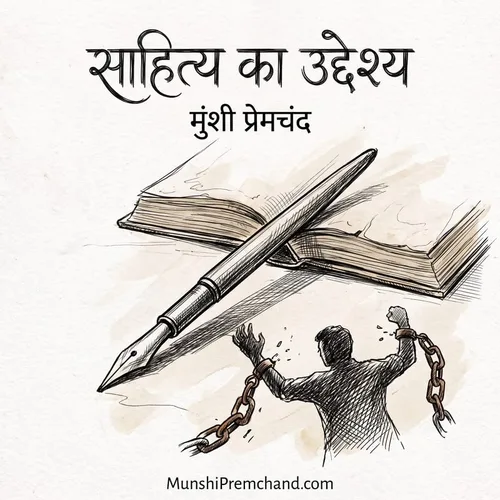
The Aim of Literature (Sahitya Ka Uddeshya)
Presidential Address delivered at the First Conference of the Progressive Writers' Association, Lucknow, April 1936
Gentlemen,
This conference is a memorable event in the history of our literature. In our conventions and societies hitherto, debate has generally centered on language and its propagation. The early literature available in Urdu and Hindi aimed not at influencing thoughts and emotions, but merely at constructing language. That too was a work of great significance; until a language acquires a stable form, how can it possess the power to express complex thoughts and feelings? If we were not grateful to the pioneers who cleared the path and built the Hindustani language, it would be sheer ingratitude on our part.
Language is a means, not an end. Now our language has attained a stage where we must look beyond form to substance, and consider how the purpose for which this foundation was laid may be fulfilled. The language in which the creation of works like Bagh-o-Bahar and Baital Pachisi was once considered the highest literary service is now capable of analyzing questions of philosophy and science. This conference is a clear acknowledgment of that truth.
Literature as the Criticism of Life
Language exists both for spoken conversation and for writing. Spoken language existed in the times of Mir Amman and Lallu Lal; but the language whose foundations they laid was written language, and that is literature. Through speech we express our thoughts to those close to us—drawing pictures of our joys and sorrows. The literary writer does the same through the pen, but the circle of his listeners is vastly wider, and if there is truth in his expression, his works continue to move human hearts for centuries and ages.
However, I do not mean that everything written down is literature. We designate as literature only that creation in which some truth is revealed, whose language is mature, refined, and beautiful, and which possesses the quality of moving the heart and the mind. Literature attains this quality in full measure only when it expresses the truths and lived experiences of life.
We may once have been entertained by tales of magic (tilism), ghost stories, and romantic legends of separation; but today they hold very little interest for us. No doubt a writer who understands human nature can portray the truths of life even within fairy tales and royal romances; but this only confirms the truth that for literature to exercise impact, it must be a mirror of the realities of life.
"Many definitions of literature have been proffered, but in my view, the best definition of literature is 'the criticism of life.' Whether in the form of essays, stories, or poetry, literature must critique and interpret our life."
The era we have just left behind had no connection with real life. Our writers created a world of fantasy, weaving arbitrary magic. Their sole aim was entertainment and the gratification of our appetite for the marvelous. The idea that literature had any relationship with real life was unimaginable. Story was story, and life was life—the two were considered mutually contradictory.
From Courtly Romanticism to Social Reality
Poets too were steeped in individualism. The ideal of love was the gratification of desires, and beauty was merely for the eyes. In expressing these sensual feelings, poets displayed their talent and imagination. A novel word arrangement or imaginative conceit in verse was enough to win applause—no matter how far removed it was from actual reality. The imagery of nests and cages, lightning and harvests, and various states of grief were presented with such skill that listeners held their hearts.
Undoubtedly, the object of poetry and literature is to intensify our sensibilities. But human life is not confined merely to male-female romantic love. Can a literature whose theme is limited to sensual emotions and romantic grief—which views running away from the world and its hardships as the fulfillment of life—satisfy our intellectual and emotional needs? Sensual passion is merely one aspect of human existence, and a literature whose major part deals only with this cannot be a matter of pride for a nation or an age.
Literature is the reflection of its age. The emotions and thoughts that vibrate in the hearts of the people cast their shadow upon literature as well. In an era of decline, people either indulge in sensual pleasure or lose themselves in quietism and renunciation. When literature is dyed in despair, lamenting the adversity of times and reflecting only courtly romance, understand that the nation has fallen into the grip of inertia and decay. It has lost the strength for struggle, closed its eyes to noble goals, and lost the power to understand the real world.
The New Standard of Literary Excellence
But our literary taste is changing rapidly. Literature is no longer merely a means of idle amusement; beyond entertainment, it has a higher purpose. It no longer tells only the story of lovers' union and separation; it ponders the problems of life and seeks to solve them.
The benchmark of literature today is its utility in awakening our consciousness, expanding our mental horizon, and inspiring us toward action and justice.
Ethics and aesthetics share the same ultimate goal—they differ only in their method of instruction. Ethics seeks to influence the mind through logic and sermons; literature chooses the domain of emotional states and aesthetic feelings. What we observe in life and the struggles we undergo—these experiences, when transformed by imagination, inspire literary creation.
"That literature which does not arouse in us a refined taste, which fails to grant spiritual and mental satisfaction, which does not generate strength and dynamism within us, and which does not awaken our love of beauty and firm resolve to overcome difficulties—is useless to us today. It does not deserve to be called literature."
In ancient times, society was guided by religion, which operated through fear and temptation. Today, literature has taken up this responsibility, and its instrument is the love of beauty.
The literary writer is by nature a champion of the oppressed, the suffering, and the marginalized. Society is his court of justice; before this court he presents his petition, and by awakening society's sense of justice and beauty, he considers his endeavor successful.
The True Meaning of Progressivism
The name 'Progressive Writers' Association' is, in my view, almost a tautology. A writer or artist is by his very nature progressive; if he were not, he would not be a writer at all! He feels a deficiency within himself and in the world outside, and his soul remains restless to overcome it. The state of happiness and freedom he visualizes for humanity is absent in current reality, and therefore his heart aches against existing social injustice.
By 'progress' we mean that state which generates within us firmness, dignity, and the power of action—which makes us conscious of our degraded state and impels us to remove the causes of our decay.
I have no hesitation in stating that I measure art, like all other things, on the scale of utility. The purpose of art is to nourish our aesthetic sense; but there is no spiritual or emotional joy that does not possess an aspect of utility. Art creates beauty to make human conditions conducive to growth and freedom.
Conclusion: The Call to Action
We must change the standards of beauty. Hitherto, beauty was sought in affluent ease, idle luxury, and courtly romance. But true beauty is found in honest labor, in struggle, in self-respect, and in selfless service to humanity.
A writer who hides in an ivory tower while millions starve and suffer under oppression is guilty of betraying his vocation. Literature must become the torch-bearer of revolution, marching ahead of social movements to light the path of freedom, equality, and human brotherhood.
"If you seek the secret of life, you will find it nowhere except in struggle; for a river to rest in the ocean is a matter of shame! Let us create a literature that carries the message of action, courage, and ultimate human redemption."
Significance & Themes
- Manifesto of Progressive Literature: Premchand's 1936 address laid down the foundational principles of modern Indian realism and progressive literature (Pragatisheel Sahitya).
- Literature as Life's Criticism: Premchand redefined literature from passive courtly entertainment into an active critique of social reality (Jeevan ki Aalochna).
- Redefining Beauty: True beauty resides not in aristocratic luxury, but in human labor, struggle, equality, and compassion for the oppressed.